Showing posts with label confidence. Show all posts

May 20, 2023

When You Can Swim

Written and illustrated by Jack Wong
Orchard Books (Scholastic)
978-1-338-83096-5
48 pp
Ages 4-8
May 2023 

When You Can Swim is a promise of possibilities. With four little words, a parent offers their child opportunities and experiences, all once they learn to swim.
From When You Can Swim by Jack Wong
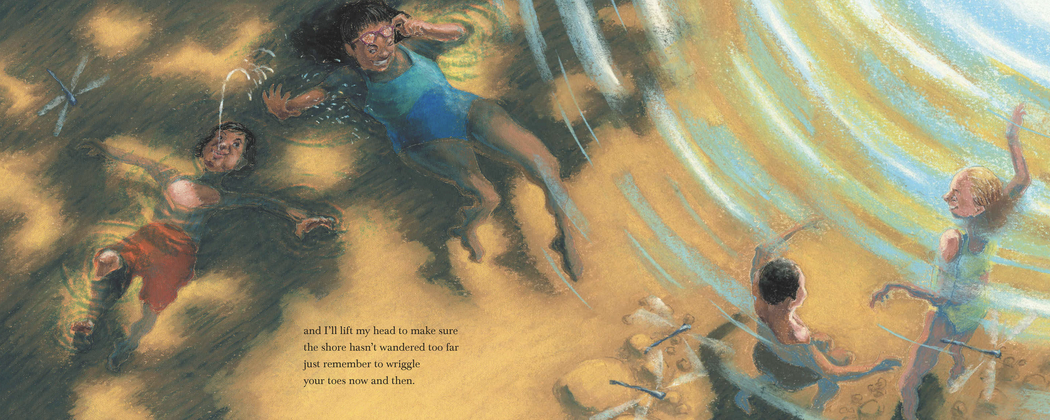
Though the story begins and ends with one mother encouraging her child to learn to swim, various parents describe what their children will experience once they do. They speak of all the places they will go and what they will do and see. There will be a trip to the ocean...
past the sandpipers tracing
the shape of a wave on the shore
past the edge of wet
splashing at your ankles
to receive the water's welcome.
From When You Can Swim by Jack Wong
They'll experience the joys of floating and exploring underwater worlds and playing in waterfalls. Oh, and the things they'll see and feel and hear! From the early morning mist on the lake to listening to "the clinking of waves passing in and out of a million pebbles telling of countless days and months of years" and the echoes of voices beneath a canal bridge from which they've dived. 

They'll push themselves to far-off islands to pick blueberries and swim into darker waters that may look scary but promise gold. The possibilities are enormous, and they will all come when the children learn to swim.
So swim, little one!
When You Can Swim may be Jack Wong's debut picture book but it's a triumph of the heart and the senses, like he's a seasoned author-illustrator.  Whether it's for a child who needs to be encouraged to venture into the water for the first time or for a parent remembering their own experiences with water and swimming, When You Can Swim is a beautiful expression of what promise learning to swim can offer. Most of us will be taught to swim to keep ourselves safe when in or near the water but Jack Wong makes us see that there is so much more than that. It's the offering of a sensory experience of sights and sounds and touch. It's seeing and hearing and feeling. And to get that feeling may require some risk-taking and confidence building, but it also requires and feeds curiosity. 
From When You Can Swim by Jack Wong
The breadth of the experiences that are open to the children who have learned to swim are as expansive and sweeping as Jack Wong's illustrations. His artwork, created with pastels and watercolours, gives an ethereal quality to the natural landscapes and the water settings, intensifying those feelings of wonder and newness that comes from exploration and novelty. There's movement, as befits a book about swimming, and there's amazement that is both internal and external to the swimmer. For the young novice swimmer and the reader, When You Can Swim opens the door for possibilities and offers a promise that good things will happen with the courage to try and learn.

February 07, 2020

Tickled Pink: How Friendship Washes the World with Color

Written by Andrée Poulin
Illustrated by Lucile Danis Drouot
Pajama Press
978-1-77278-104-5
32 pp.
Ages 4-7
February 2020 


I'm tickled pink by any book that supports diversity and acceptance of differences as the norm so I'm especially thrilled about a picture book that supports this message in as subtle and eloquent a way, as well as playful, as Tickled Pink: How Friendship Washes the World with Color.

When Zac the zebra and Poncho the panda are playing and Filippo the flamingo asks if he can join them, he is told that he is too pink, a colour which gives Poncho a headache. But when Filippa asks his parents, they tell him pink is the colour of kindness and happiness. So Filippo tries again.

From Tickled Pink: How Friendship Washes the World with Color by Andrée Poulin, illus. by Lucile Danis Drouot

From Tickled Pink: How Friendship Washes the World with Color by Andrée Poulin, illus. by Lucile Danis Drouot
Zac and Poncho are now rude to Filippo, telling him they don't want him to play and that "Pink doesn't mix with black and white." His grandmother shows him with her paints how wrong that idea is. So Filippo adds some black and white paint to his body and asks politely again. But, of course, Zac and Poncho continue to make excuses, about pink being the colour for babies who cry and princesses who are fussy.

From Tickled Pink: How Friendship Washes the World with Color by Andrée Poulin, illus. by Lucile Danis Drouot

Though Filippo gets support from his family, it's input from his shy peer, Ludo the lemur, that makes things right for Filippo.  Ludo recounts to Filippo all the wonderful things that come in pink: shrimp, salmon, bubble gum, cherry blossoms, begonias, peonies, petunias, and roses. And Ludo, who is black and white, says he would be pleased to play with Filippo. That play includes adding a little pink paint to the sleeping zebra and panda, who are not pleased, but also to other animals who are "tickled pink to go pink."

From Tickled Pink: How Friendship Washes the World with Color by Andrée Poulin, illus. by Lucile Danis Drouot
The story in Tickled Pink is far from black and white. It goes beyond a story of excluding those who are different. It demonstrates how much we all want to be included.  Filippo could have thrown up his wings and said, "Fine, I don't want to play with you, Zak and Poncho" but he didn't. He questioned his parents and his grandmother and his sister, all to help him grasp what being pink meant. But bullying and intolerance are incomprehensible, especially when "reasons" are given to explain the intolerance. I'm glad Andrée Poulin gave Filippo a quiet and insightful friend in Ludo who proves that it's not the black-and-white animals that lack understanding, but just one zebra and one panda. (Okay, there may be others out there, there always are, but it's clear that it's not all black-and-white animals.) For intolerance to be eliminated, everyone needed to see beyond the colours.

Artist Lucile Danis Drouot keeps her palette, until the very end, black, white, gray and pinks to emphasize the separation that Zak and Poncho highlight but she adds a playfulness in her animals' activities–vine-climbing, soccer, volleyball, and badminton–that embeds the message in gentleness and whimsy. A final spread resplendent in pinks brightens the world in happiness and friendship.

Like any racism or discrimination, the zebra and the panda could have arbitrarily chosen an attribute other than colour, such as non-feathered vs. feathered, or four-legged vs. two-legged.  But, like so many who discriminate, they chose colour. Fortunately, there are so many who don't see the colour, only the substance, and infuse our world with goodness and acceptance.

July 01, 2013

Willow Finds A Way

by Lana Button
Illustrated by Tania Howells
Kids Can Press
978-1-55453-842-3
32 pp.
Ages 3-7 
March 2013

I know that school has only been out for a few days but with a relevant and delightful story like Willow Finds a Way, it really doesn't matter whether it's read in school or out of school.  When a child finds the means to deal with a classmate who coerces loyalty with the carrot of a birthday party, this life lesson could be useful for any one of the millions of circumstances in which people behave badly. If an author provides a strategy for young people to deal successfully with such situations, I say we publicize it as much as we can, especially if it is as subtle and non-preachy as it is in Willow Finds a Way.

In Lana Button and Tania Howell's sequel to Willow's Whispers (Kids Can Press, 2010), Willow's classmate Kristabelle announces that she will be having a fantastic birthday party and she has made a list of those who are invited.  Willow and her classmates are relieved to see that on a pink sparkly paper Kristabelle has listed all their names.  But Kristabelle doesn't just make a list.  She holds it over everyone as a bribe to encourage them to do just as she asks:  play on the climber, sit at her table, allow her to be line leader, wear pink.  If anyone doesn't comply, Kristabelle crosses their name off her pink sparkly list.  Around her, children want to do different activities, sit other places, wear different colours and enjoy their own choices, but no one comes to the aid of those whose names are removed so publicly from the list.  As in Willow's Whispers, shy Willow must find her voice again and do what she believes is right and she does, all without hurting anyone's pride.

The austere text and simple drawings by Lana Button and Tania Howells respectively acknowledge the commonality of the circumstances of Willow Finds a Way.  No child wants to be the ostracized by his or her peers, experience friendlessness, or feel coerced instead of compromising. Likewise for adults for whom these same circumstances could be witnessed in any workplace.  Without shaming Kristabelle, Willow finds a way to send her the message that it is not OK to treat others as she does by threatening to take names off her list.  By allowing Kristabelle to examine the situation and amend it herself, every one can keep their frail egos intact.

It's a rare day when you'll read a review of a children's book in Canada's national newspaper, The Globe & Mail, nowadays.  At one time, a "Children's Books" column could be found every second Saturday in their Books section, sharing reviews of a number of children's books, Canadian and otherwise.  So imagine my surprise to see the cover of Willow Finds a Way on a Book page in the June 22, 2013 edition of The Globe and Mail!  A delightful contribution of reviews by author Andrew Kaufman (Born Weird, Random House Canada, 2012) and his children, Frida and Phoenix, starts with Willow Finds a Way.  To have this book win the attention of Andrew Kaufman and company in this rare promotion of children's books should tell readers how special this book is in challenging children to see beyond the obvious and stand up to injustice, even if it is only in regards to a birthday party.  But, as you may recall from your youngest days, birthday parties are a very, very big deal to the young.  By solving these kinds of problems, young readers may be more resilient, all courtesy of Willow, Lana and Tania, when more significant problems arise.