Showing posts with label opportunities. Show all posts

May 13, 2026

Worm on the Job

Book cover of Worm on the Job , written by Maureen Fergus, illustrated by Paul G. Hammond shows a worm with a cap
Written by Maureen Fergus
Illustrated by Paul G. Hammond
Kids Can Press
978-1-5253-1316-5
36 pp.
Ages 3–7
May 2026
 
If there's one lesson to learn from Worm, it's that anything is possible if you can see your strengths for what they are and apply them to each situation. Not surprising that Worm is the guy for every job because he believes in himself. 
A head librarian worm sorts library books
From Worm on the Job, written by Maureen Fergus, illustrated by Paul G. Hammond
After being the head librarian for many years, Worm decides it's time for a new job. And he's willing to try anything. Even when the job may be hazardous to Worm, like life-guarding in the hot sun or deep-sea fishing among sharks, Worm gives it a try. But when he sees a sign advertising for a "courageous night security guard to keep dastardly thief from stealing nifty inventions," (pg. 8) Worm thinks he's found just the job for him. And though the manager is reluctant to hire him, Worm easily proves his value with his unique strengths.  
A worm cleans windows while pigeons look on
From Worm on the Job, written by Maureen Fergus, illustrated by Paul G. Hammond
When that dastardly thief shows up just as Worm is checking out all the cool inventions, Worm puts his many strengths of flexibility and sliminess to work to catch the bad guy.

 "And when I believe I can do something . . ."
 "I usually can." (pg. 33-34)
A security worm scooches around a convention center filled with inventions
From Worm on the Job, written by Maureen Fergus, illustrated by Paul G. Hammond
It's not often that a worm can inspire risk-taking and self-confidence, but Maureen Fergus's Worm does just that. He believes he can, so he does. He may have to adjust his choices, but they are still his to make. And because he believes in himself, every choice is a step closer to finding another job that he will challenge himself to take on. He is tenacious, courageous, and positive, and he could be a role-model for any non-worm who may be anxious about trying something new. 
 
Because Maureen Fergus's story of Worm is couched in much humour which illustrator Paul G. Hammond strengthens with his whimsical digital art—do check out the clever details like Worm sorting library books on soil, composting, or crawling, or the striking inventions in the convention center—Worm on the Job is not a preachy tale. It's fun and inspiring and entertaining. And perhaps it will give all readers an opportunity to see their own attributes with fresh eyes.  

May 07, 2026

A Door Is to Open

Book cover of A Door Is to Open by Kyo Maclear and Julie Morstad shows a girl peeking out behind a door which is behind many doors
Written by Kyo Maclear
Illustrated by Julie Morstad
Tundra Books
978-1-77488-744-8 
48 pp. 
Ages 3–7 
April 2026 
 
Doors come in all sizes and shapes. They can be opened and closed. They can protect and invite. They offer so many possibilities. And Kyo Maclear and Julie Morstad show us the promises that come with those doors.
A child opens a blue door through which a black cat and four kittens enter.
From A Door Is to Open, written by Kyo Maclear, illustrated by Julie Morstad
Kyo Maclear begins her reflective exploration of doors and all they entail with the simplest of functions. As a child opens a blue door, a mother cat and a trail of kittens, each a little different, follow. But there are many doors still be put to work. There are doors that are knocked upon, doors to walk through (into a birthday party), and to close. There are house doors, classroom doors, frosty doors and tent doors. There are automatic doors, turning doors, clear doors, and colourful ones. And there are doors that are organic portals used by animals, both on land and in the water, opening to places of shelter and family.
Two children with a flashlight open a trap door in a dark room.
From A Door Is to Open, written by Kyo Maclear, illustrated by Julie Morstad
But doors can be as imaginary as they are real.
Some doors are made of words
and lead to places you’ve never imagined. (pg. 17)
And all these doors can make us feel different ways, whether nervous or calm, excited or creative. Each offers something.
A child opens a door onto a classroom.
From A Door Is to Open, written by Kyo Maclear, illustrated by Julie Morstad
I could not have predicted that a book about doors would make me feel so much. While many may see doors as barriers, Kyo Maclear gets on the other side of doors and revels in the potential that each presents. I've always appreciated the physical nature of doors, but never have I really looked at what doors offer. With this new perspective, all readers, young and old, are invited to think about what these physical and intangible portals bring to our lives. And Kyo Maclear presents this perspective with few but powerful words—I love writers who use few words to tell big stories (probably explains why I love novels in verse)—and helps us to see more than a barrier.
A child sits in a camping tent under a dark sky.
From A Door Is to Open, written by Kyo Maclear, illustrated by Julie Morstad
But, with few words, Julie Morstad's illustrations have to be equally powerful, imparting the story graphically. Her art uses pencils, coloured pencils, markers, and watercolours, and then assembled digitally. Because of the variety of media, Julie Morstad's art unlocks details and insight, showing us feeling, opportunity, and children as they live. 
Many children push on a massive, brown door.
From A Door Is to Open, written by Kyo Maclear, illustrated by Julie Morstad
A Door Is to Open is a triumph of perspective in storytelling. Not only are we invited to think more about doors and see the promise of their structure and function, both real and imaginary, Kyo Maclear and Julie Morstad have invited us to see more than doors. They've opened something else for us. They let us see possibility.

October 17, 2024

Milo the Knight

Written by Grégoire Laforce
Illustrated by Charlotte Parent
Milky Way Picture Books
978-1-990252-35-8
48 pp.
Ages 4-8
October 2024
 
Milo is a brave knight who comes from a long line of knights. His armor means everything to him, and he is proud to wear it. And he always wears it just in case a dragon attacks their colony. Those silly jesters could waste their time on frivolous activities, but Milo is determined to keep everyone safe from the bad out there.
From Milo the Knight, written by Grégoire Laforce, illustrated by Charlotte Parent
One day while outside the castle walls, Milo is caught in a horrific rainstorm. It goes on and on, raining and raining, and Milo keeps going. It's only when the rain stops, and Milo is still struggling to keep going that he realizes that his beautiful armor has rusted until it seizes completely.
From Milo the Knight, written by Grégoire Laforce, illustrated by Charlotte Parent
A wandering jester offers Milo help, but he initially refuses. After all, he is a knight and not a silly jester. But the jester suggests that the only way to help Milo is for Milo to remove his armor. Even though he is both shocked to consider this and fearful of not being able to protect the colony–something which he already could not do–Milo opens his visor, looks into the jester's eyes and is moved to tears.
From Milo the Knight, written by Grégoire Laforce, illustrated by Charlotte Parent
But the armor does not survive, falling into useless pieces, while Milo emerges for the first time to feel the warmth of the sun and the stirring of the wind. By shedding his armor, Milo also sheds his fears and his mistrust.
 
Gatineau's GrĂ©goire Laforce, former military, seems to have something to say about the roles we play in a community, from the protectors to the entertainers. No one is only one thing. And to restrict yourself by putting on a shield of armor that keeps you separate from others and from experiencing a life that is full and varied can be harmful. Milo only knew about being a knight, as did his ancestors. He didn't know otherwise. It was only the jester with his own perspective and suggestion that Milo remove his armor–an armor that was doing him harm at that point–that Milo becomes open to another life. Perhaps this was GrĂ©goire Laforce's experience too, going from the military life of service and security to having kitchen parties with his family at home, as his bio reveals. It probably wasn't as easy as just removing a uniform but, as with Milo and the jester, a little outlook can bring big change.
From Milo the Knight, written by Grégoire Laforce, illustrated by Charlotte Parent
Montreal artist Charlotte Parent, who illustrated Mireille Messier's The Magic Cap, uses coloured pencils to give Milo the Knight both a bright contemporary feel as well as a medieval tone appropriate for a story about a knight. Her use of colour that range from pinks and purples to oranges and greens keeps the story light and bright as do the patterns she uses to decorate borders with floral motifs and scenes of activity. Milo the Knight could've been a darker tale of perceived fears and wariness of others and even injury, but Charlotte Parent makes it a story of revelation through her radiant colours and emotive lines and shapes.

Milo the Knight thought his life had been determined and he would serve as he had been born to do so but a change in circumstance and an openness to see beyond the obvious gives him the opportunity for more in his life. His service was admirable, but it was time to live for himself and enjoy that which he'd never experienced before. Whether he becomes Milo the Jester or Milo the Vagabond or something else entirely, he's taken off his armor and left himself free and receptive to more possibilities.
 

May 20, 2023

When You Can Swim

Written and illustrated by Jack Wong
Orchard Books (Scholastic)
978-1-338-83096-5
48 pp
Ages 4-8
May 2023 

When You Can Swim is a promise of possibilities. With four little words, a parent offers their child opportunities and experiences, all once they learn to swim.
From When You Can Swim by Jack Wong
Though the story begins and ends with one mother encouraging her child to learn to swim, various parents describe what their children will experience once they do. They speak of all the places they will go and what they will do and see. There will be a trip to the ocean...
past the sandpipers tracing
the shape of a wave on the shore
past the edge of wet
splashing at your ankles
to receive the water's welcome.
From When You Can Swim by Jack Wong
They'll experience the joys of floating and exploring underwater worlds and playing in waterfalls. Oh, and the things they'll see and feel and hear! From the early morning mist on the lake to listening to "the clinking of waves passing in and out of a million pebbles telling of countless days and months of years" and the echoes of voices beneath a canal bridge from which they've dived. 

They'll push themselves to far-off islands to pick blueberries and swim into darker waters that may look scary but promise gold. The possibilities are enormous, and they will all come when the children learn to swim.
So swim, little one!
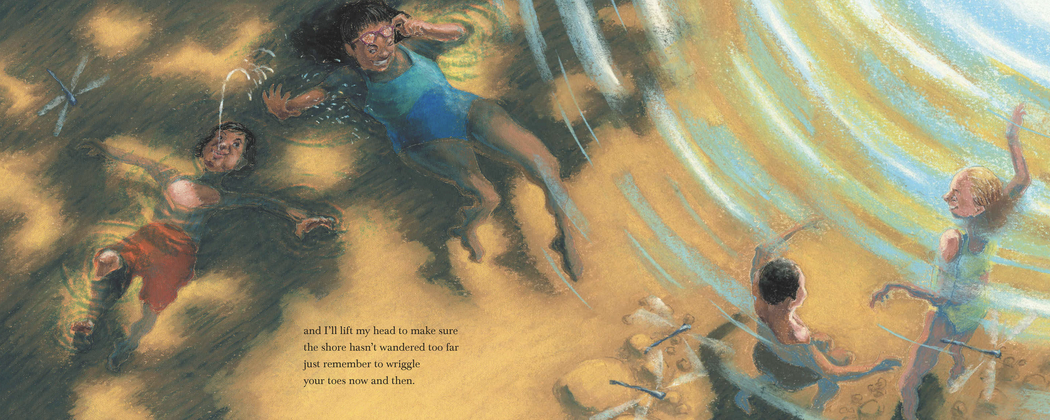
When You Can Swim may be Jack Wong's debut picture book but it's a triumph of the heart and the senses, like he's a seasoned author-illustrator.  Whether it's for a child who needs to be encouraged to venture into the water for the first time or for a parent remembering their own experiences with water and swimming, When You Can Swim is a beautiful expression of what promise learning to swim can offer. Most of us will be taught to swim to keep ourselves safe when in or near the water but Jack Wong makes us see that there is so much more than that. It's the offering of a sensory experience of sights and sounds and touch. It's seeing and hearing and feeling. And to get that feeling may require some risk-taking and confidence building, but it also requires and feeds curiosity. 
From When You Can Swim by Jack Wong
The breadth of the experiences that are open to the children who have learned to swim are as expansive and sweeping as Jack Wong's illustrations. His artwork, created with pastels and watercolours, gives an ethereal quality to the natural landscapes and the water settings, intensifying those feelings of wonder and newness that comes from exploration and novelty. There's movement, as befits a book about swimming, and there's amazement that is both internal and external to the swimmer. For the young novice swimmer and the reader, When You Can Swim opens the door for possibilities and offers a promise that good things will happen with the courage to try and learn.