Showing posts with label curiosity. Show all posts

November 23, 2025

The Inquisitive Raven

Written by Richard Wagamese
Illustrated by Bridget George
D & M Kids (Douglas & McIntyre)
978-1-771624497
32 pp.
All ages
September 2025 
 
Last year, the first book in the Richard Wagamese Storybook CollectionThe Animal People Choose a Leader, was published. This beautiful book, a retelling of a short story by the late Richard Wagamese with illustrations by Bridget George, introduced new readers to his writings. Now, with The Inquisitive Raven, the second book in this collection, a story of curiosity, determination, and self-acceptance, there will be new readers of all ages who will be drawn to the wisdom in Richard Wagamese's Ojibwe storytelling and the beauty of Bridget George's digital artwork.
From The Inquisitive Raven, written by Richard Wagamese, illustrated by Bridget George
Rueben is the titular inquisitive raven. Some might see him as nosy, but he just finds the world to be an amazing place. He is especially curious about the other animals and what they do.  Grampa Raven, ever supportive, tells Rueben, "Wonder is the glue that holds everything together. It keeps you searching, eager for more." (pg. 10) 
 
When Rueben sees a magnificent eagle with its impressive wingspan and ability to soar, his grandfather tells him of Migizi and that she is blessed with many gifts. Sadly, Rueben then sees himself as lacking and decides to learn to soar like Migizi. 
He craved the sensation of becoming more: bigger somehow, more beautiful, less a raven and more revered and respected like an eagle, through the singular act of soaring. (pg. 17) 
From The Inquisitive Raven, written by Richard Wagamese, illustrated by Bridget George
With great determination and much practice, Rueben learns to soar, but when he goes to demonstrate his newfound ability, fatigue and fear get the better of him and he plummets to the ground. He is devastated to think that others will not respect him as they do Migizi, but Grampa Raven has wise words to share about Rueben's own gifts and the blessing that is respect.
From The Inquisitive Raven, written by Richard Wagamese, illustrated by Bridget George
Taken from Richard Wagamese's One Drum: Stories and Ceremonies for a Planet (Douglas & McIntyre, 2013), The Inquisitive Raven has an important message about self-acceptance. Like many of us, Rueben aspires to be admired, though he doesn't recognize that he already is appreciated by the other animals for his curiosity and enthusiasm for learning. In fact, it is that curiosity and passion for knowledge that takes him to try something new and work hard at achieving it. He may not reach the heights of Migizi, but his skill at soaring and his consequent plummeting are recognized as amazing just the same. Through Rueben, Richard Wagamese helps us respect the best in ourselves.
 
Bridget George is an Anishinaabe illustrator who has also authored her award-winning picture book It's a Mitig! (D & M Kids, 2020). Her art is created digitally with a Woodland style to her animals, giving shape and movement with the internal lines. While Rueben and many animals are in earthy browns and blacks, Bridget George adds colour in her landscape features like the blues and pinks of her skies and water, and in her decorative, embroidery-like flowers.
From The Inquisitive Raven, written by Richard Wagamese, illustrated by Bridget George
The Inquisitive Raven will be a much-cherished gift that will be appreciated for many years and countless generations. Beautifully covered
 in textured buckram, and decorated with Bridget George's Woodland-style art, The Inquisitive Raven lets us connect once again with Richard Wagamese and share in his insight into the value of curiosity and recognizing the gifts we have.
 
• • • • • • •
 
For teachers, there is a Teacher's Guide available from Douglas & McIntyre here.
 
 • • • • • • •

July 22, 2024

Have You Ever Heard a Whale Exhale?

Written by Caroline Woodward
Illustrated by Claire Victoria Watson
Pownal Street Press
32 pp.
Ages 3-7
June 2024
 
With humour and rhyme, Caroline Woodward, who wrote the text for beautifully illustrated picture books  A West Coast Summer (2018) and Singing Away the Dark (2017), again takes us to her beloved West Coast to really take in all the sensory experiences that life there offers. We will hear, and see, and smell, and taste, and learn and wonder at the unique ecosystem that is the ocean and its coast from those who live and enjoy it.
Have you ever heard a whale exhale
and SLAP the water with its tail?
Breathing in after breathing out,
heaving WHOOSH with a mighty spout!
Our visit to the West Coast has us listening to a whale as it breaches, breathing and tail slapping and spouting. Its behaviours may be typical but to any observer they are captivating and revealing. Such are the actions of the seals who spy-hop to see what's going on–one with a monocle suggests they are paying close attention–or of the oystercatcher, a shore bird, who can pry open molluscs.
From Have You Ever Heard a Whale Exhale? by Caroline Woodward, illus. by Claire Victoria Watson
And what of the smelly sea lions and the squawking seagulls, eagles and dolphins? All have their place and ways of living that intrigue and reveal life on and near the ocean. But Caroline Woodward also includes humans who are invited to think about what it means to be these animals and the ocean and what living on it and near it is truly like.
From Have You Ever Heard a Whale Exhale? by Caroline Woodward, illus. by Claire Victoria Watson
By phrasing her text as a series of questions, Caroline Woodward invites the reader to think about the ocean, its animals and their behaviours, including those of humans on the water, at a campfire or something else. Questions like "Have you ever felt the freezing north wind blow...?" or "Have you ever wondered why eagles love to fly..?" encourage young readers to look and smell and feel a little deeper about the coast and its inhabitants and not take for granted that which makes the West Coast their home.
From Have You Ever Heard a Whale Exhale? by Caroline Woodward, illus. by Claire Victoria Watson
Like Caroline Woodward, illustrator Claire Victoria Watson is a creator in British Columbia. Her visual art blends a variety of media including pen and ink, watercolours, and acrylic, with some digital design. Though the media she uses are plentiful, there is still a simplicity to her art that helps the readers focus on the smells–wavy lines emanating from the sea lions make this clear–or the sounds or the visuals of the scenes depicted. And though she follows Caroline Woodward's text to bring life to Have You Ever Heard a Whale Exhale?, Claire Victoria Watson also adds her touches of humour. There are the cormorants with the clothespins on their noses, the gray whales fine dining on herring roe, and a cowboy-hatted octopus square dancing or at least trying to. The message about the ocean and the diversity of its animals is never lost but it is told playfully as well as naturally.
From Have You Ever Heard a Whale Exhale? by Caroline Woodward, illus. by Claire Victoria Watson
Have You Ever Heard a Whale Exhale? may not cover every animal that lives in the ocean or near it, but it does cover an important message of appreciating our natural world so that we might protect it and all its inhabitants.

 🐋🦭🌊
 
Picture Book Giveaway 📫📘
 
Because I was fortunate to receive two copies of this lovely picture book,  I would love to share one with a reader of CanLit for LittleCanadians. (Only Canadian addresses are eligible to apply. Sorry.)
 
Leave a comment about the ocean (whether you've visited one or not) for me on X (formerly known as Twitter) by tagging me @HelenKubiw or on Bluesky at @hkubiw.bsky.social and using the hashtag #HaveYouEverHeardAWhaleExhale. I'll log all comments until Friday, July 26th, 2024 at 12 noon (EST) and then do a random draw. If you are selected, I will DM you to let you know and get details about where to send the book.
 
Good luck everyone! 
 
 🐋🦭🌊

September 19, 2023

Garden of Lost Socks

Written by Esi Edugyan
Illustrated by Amélie Dubois
HarperCollins
978-1-443464734
32 pp.
Ages 4-7
September 2023 

Sometimes when you go looking for something that's lost, you find something else. And what's better than finding a friendship for one who looks for things with one who writes about things he finds.

Akosua calls herslef an exquirologist because she can find anything, though her family might think that what she often finds is trouble. When Akosua meets Max, he is struggling, having lost one of his favourite socks, a yellow, green, and red sock with black stars. Though Max loves finding stories from around his neighbourhood and recording them in his notebook, whether it's discovering a dog allergic to humans or a girl who would perform as a waterspout in a play, finding that missing sock has been a challenge. Fortunately, exquirologist Akosua offers to help.
From Garden of Lost Socks, written by Esi Edugyan, illus. by Amélie Dubois
The two children go in search of the AWOL sock, starting at Max's home and then venturing out to the laundromat, the barbershop, and even to the park. They find a variety of socks, some as decorations, as on a hot air balloon, and some in different versions, like as wrapping around trees. But nowhere do they find Max's missing sock.
From Garden of Lost Socks, written by Esi Edugyan, illus. by Amélie Dubois
They do find other amazing things which Max records enthusiastically. Ultimately, Akosua uses her keen observational skills to follow a clue and discover the location of the lost sock, only to realize that Max needs it less than someone else.

The convergence of Akosua and Max in Garden of Lost Socks demonstrates that sometimes things and people that appear very different are actually meant to be together. Akosua seems like a bit of a dynamo, an extrovert who puts herself out there. Max, on the other hand, seems more inside his thoughts and his words, sitting quietly on his stoop, considering his options and his stories. By questioning him, Akosua begins a conversation that brings the two together, as unlikely as that might have been originally. (And to think Akosua's brothers suggest she has difficulties finding friends.) Finding that lost sock may have been their original mission, but they find so much more in their search, from new stories to new friends.
From Garden of Lost Socks, written by Esi Edugyan, illus. by Amélie Dubois
Though many fans of CanLit will know Esi Edugyan as a two-time Giller winner, Garden of Lost Socks is her first children's picture book. But, if Esi Edugyan shows a comparable curiosity to that shown by her young characters–illustrated by Quebec's Amélie Dubois–then I foresee more heartfelt literary explorations for young readers. Esi Edugyan's story on its surface is a simple one with two children of different strengths coming together for one purpose and finding more than expected. But like the two children whose eyes see well but differently, whether with analytic or artistic sight, Garden of Lost Socks is more than a story of looking for a sock. It's a story of finding friends without looking and working with your own strengths. It's cheering for diversity in personality and in purpose.

Amélie Dubois, whose art was first seen by this reviewer in A World of Mindfulness (2020), has an incredibly light touch. Searching for a lost sock might not seem a big deal but, to a child, missing a favourite anything is a very big deal. Still Amélie Dubois does not emphasize the angst or the frantic nature of a search for a missing object but keeps it more exploratory than hunt. They walk, they look, they ask, and they delve, but they do not panic, and they are not intrusive. Instead Amélie Dubois takes us on our own journey of discovery, from a laundry where a tutu shares a line to dry with an astronaut suit and a safety suit of orange and yellow, to a doorstep where dozens of shoes rest, and to a park of flowers, knitted tree protectors, and animals. Her lines produced by the strokes of her coloured pencils emulate the movement of the kids in their own quest while giving the story an airy texture.
 
The world is a garden of lost socks, from a laundry to a drawer, to a park or a nest, but Esi Edugyan reminds us that finding one sock may just be the start of something far greater.

May 20, 2023

When You Can Swim

Written and illustrated by Jack Wong
Orchard Books (Scholastic)
978-1-338-83096-5
48 pp
Ages 4-8
May 2023 

When You Can Swim is a promise of possibilities. With four little words, a parent offers their child opportunities and experiences, all once they learn to swim.
From When You Can Swim by Jack Wong
Though the story begins and ends with one mother encouraging her child to learn to swim, various parents describe what their children will experience once they do. They speak of all the places they will go and what they will do and see. There will be a trip to the ocean...
past the sandpipers tracing
the shape of a wave on the shore
past the edge of wet
splashing at your ankles
to receive the water's welcome.
From When You Can Swim by Jack Wong
They'll experience the joys of floating and exploring underwater worlds and playing in waterfalls. Oh, and the things they'll see and feel and hear! From the early morning mist on the lake to listening to "the clinking of waves passing in and out of a million pebbles telling of countless days and months of years" and the echoes of voices beneath a canal bridge from which they've dived. 

They'll push themselves to far-off islands to pick blueberries and swim into darker waters that may look scary but promise gold. The possibilities are enormous, and they will all come when the children learn to swim.
So swim, little one!
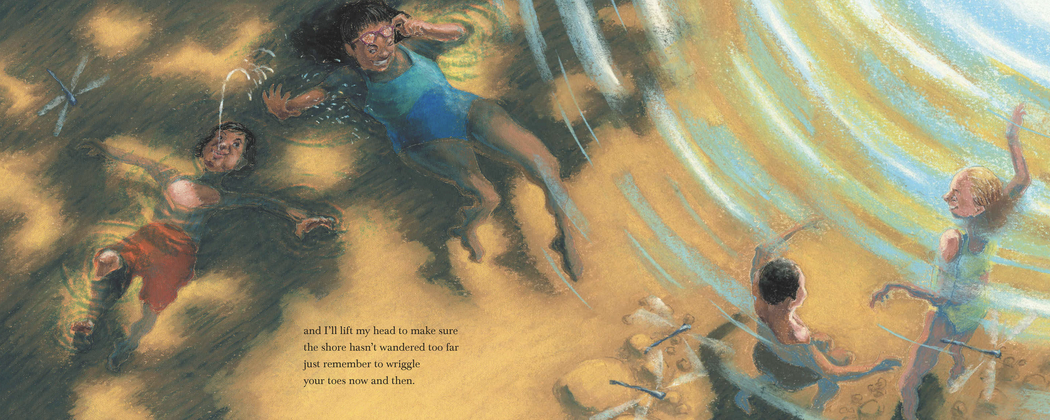
When You Can Swim may be Jack Wong's debut picture book but it's a triumph of the heart and the senses, like he's a seasoned author-illustrator.  Whether it's for a child who needs to be encouraged to venture into the water for the first time or for a parent remembering their own experiences with water and swimming, When You Can Swim is a beautiful expression of what promise learning to swim can offer. Most of us will be taught to swim to keep ourselves safe when in or near the water but Jack Wong makes us see that there is so much more than that. It's the offering of a sensory experience of sights and sounds and touch. It's seeing and hearing and feeling. And to get that feeling may require some risk-taking and confidence building, but it also requires and feeds curiosity. 
From When You Can Swim by Jack Wong
The breadth of the experiences that are open to the children who have learned to swim are as expansive and sweeping as Jack Wong's illustrations. His artwork, created with pastels and watercolours, gives an ethereal quality to the natural landscapes and the water settings, intensifying those feelings of wonder and newness that comes from exploration and novelty. There's movement, as befits a book about swimming, and there's amazement that is both internal and external to the swimmer. For the young novice swimmer and the reader, When You Can Swim opens the door for possibilities and offers a promise that good things will happen with the courage to try and learn.

August 16, 2021

The Deepest Dig

 
Written by Mark David Smith
Illustrated by Lily Snowden-Fine
Owlkids Books
978-1-77147-419-1
32 pp.
Ages 3-7
August 2021

What can come from a little curiosity and some brain power and brawn? A whole lot of treasure. Even if no one believes, at first.
From The Deepest Dig by Mark David Smith, illus. by Lily Snowden-Fine
Caden is a child with a curious mind. When he and his dog find something poking out of the backyard, he eliminates all the things it is not: not a root, not a post, not a stone. His neighbour Martha encourages him to dig deeper. His scientific brain asks questions and considers his options. While he does ask his parents as he proceeds to dig, they both dismiss his inquiries.
From The Deepest Dig by Mark David Smith, illus. by Lily Snowden-Fine
First shovelling and then with the use of Martha's truck winch, bits and pieces are excavated. Even when he tells his teacher what he'd found, Caden is dismissed (later compelling Mr. Clerkson to eat his words, or rather his hat). Because Martha recognizes that, "It's only a treasure if it's put together," Caden gets to work. 
 
From The Deepest Dig by Mark David Smith, illus. by Lily Snowden-Fine
This time when his parents see his efforts, they have a lot less to say–they are speechless–and it's Caden who puts together what the next steps should be to get the woolly mammoth skeleton witnessed by all.

It's been awhile since I've reviewed a story by Mark David Smith. I'd been quite impressed by his middle-grade novel Caravaggio: Signed in Blood (Tradewind, 2013) and still am but now also with a picture book that promotes curiosity and endeavour. Of course it's a child who discovered a skeleton. They're the ones who aren't focusing on their bills and their work and household chores. Mom or Dad probably had already rolled over it or around it with their lawn mower, oblivious to its importance. Caden, on the other, got down and looked at it. Really looked at it. This is scientific inquiry at its best. In order to see more, he makes a plan and digs it out. Then putting together what he learns in class and through his own efforts, he assembles a find worthy of a museum. (That's where it ends up according to the newspaper article that concludes the story.) Martha and his parents may have had to be there to get him further along in his inquiry but it was all driven by Caden, and his efforts should be applauded.
From The Deepest Dig by Mark David Smith, illus. by Lily Snowden-Fine
Lily Snowden-Fine, whose artwork I only recently reviewed for the first time (Kimmy & Mike, 2021), uses vibrant colours and scale to emphasize the daring and magnitude of Caden's endeavour. Readers are taken from the outdoors where the tree, red truck and bushes are large to when they are overshadowed by the skeleton Caden puts together. It's quite incredible but Lily Snowden-Fine makes us feel the enormity of what he has accomplished. Moreover, her diversity of characters will let all children imagine that they too could dig up a dinosaur.

The Deepest Dig encourages children to dig deep, whether it's into their curiosity, science, research or any passion. They may not always get the support they deserve at first but perseverance and determination can go a long way to unmasking a hidden treasure. Ask Caden. He did.

July 08, 2021

Hidden Treasure

Written and illustrated by Elly MacKay
Running Press Kids
978-0-7624-6301-5
32 pp.
Ages 4-8
June 2021
 
There's magic here. It's the magic of Elly MacKay's artwork but it's also in a child's wonder of discovery, finding treasure which most would overlook and appreciating a day of togetherness. It's in a lazy summer day on a beach and we're invited to watch.
 
From Hidden Treasure by Elly MacKay
A child and her Papa stroll down to the bay with their dog, past stores that claim to sell treasures, though she knows better.  She knows what true treasures are, and it's not the stuff sold in stores or the kind lauded by pirates in movies.

From Hidden Treasure by Elly MacKay
She finds treasure in the beach stones that are different with each visit. This day she picks up one that looks like a whale tooth, a perfect match for the whale she envisions in the clouds.

Dipping into the water, she discovers more treasure including shells, a speckled rock, a bubble wand, a rusty key and a marble, all which she lays out on the dock for her dog to see. Some she will return to the water to revisit another day and some treasures she will admire from afar, like the cocoon on the swamp milkweed.
 
From Hidden Treasure by Elly MacKay
Deciding what she will choose to add to her treasure box–“ones I can borrow, keep for a while”–is an important part of the process and one she shares with her Papa.
When I’m here, I feel like a queen.
So I think I know what treasure means.
And she knows that treasure goes beyond the things she picks up or sees on their outing.

From her debut picture book, If You Hold a Seed, Elly MacKay has been wowing young readers and their teachers, school and home, with her expressive illustrations. Because she blends drawings with ink and cut paper into scenes which she photographs–her Twitter handle is appropriately @theatercloudsElly MacKay melds layer upon layer of colour and texture and shape into an evocative landscapes of life and setting. The water produced from iridescent wrapping paper shimmers with movement and warmth and the beach radiates summer heat and softness with natural quiet. There's connection between people and with place but there is solitude as well. This is treasure in itself, as the child recognizes. 
 
I suspect that there will be, as there always have been, children collecting hidden treasures from walks in forests, along beaches and in urban settings on this very day. They will see the extraordinary in the ordinary. With Hidden Treasure and her ethereal artwork of theatre, Elly MacKay has reminded us all of the magic that comes from the ordinary and to see the treasure that is too often missed.

June 02, 2021

Outside, You Notice

Written by Erin Alladin
Illustrated by Andrea Blinick
Pajama Press
978-1-77278-193-9
32 pp.
Ages 4-7
April 2021

How often do we notice things, especially things in the outdoors, that are right under our noses? Erin Alladin wants us to open our eyes, ears, noses and touch the world to know the wonders that our world holds outside, no matter what your outside looks like.
 
From Outside, You Notice by Erin Alladin, illus. by Andrea Blinick
As children and others participate in the world outside, whether it be a backyard, a park, a playground, a sidewalk or something else, there are so many things to check out, and Erin Alladin makes sure we see it all. Each double-spread asks the reader to notice one attribute of nature like the rain, the soil, leaves or colours, and then info boxes provide brief content related to that focus. For example, when asked to notice "How after the rain everything smells greener," we learn about leaves capturing rain, how a tree's canopy provides cover, why the rain can smell like it does, and why plants get the rain they need.
 
From Outside, You Notice by Erin Alladin, illus. by Andrea Blinick
We discover how animals make the outdoors their homes, how they live, and the sounds they make. We learn about life cycles of plants, from seeds and germination, to flowers and fruits. Above ground and below, along water ways and at farmers' markets, there is so much to see and learn.
From Outside, You Notice by Erin Alladin, illus. by Andrea Blinick
With Outside, You Notice, Erin Alladin has invited the reader to explore and make observations and grow themselves into sentient beings beyond the confines of our indoors. She may provide information tidbits that instruct and direct inquiry, so perfect for science lessons with little ones, but she also asks us to be mindful of our worlds. Outside, You Notice gives us the prompts to stop and smell and look and touch in the moment, wherever that moment may be. The experiences will be as diverse as the children who are doing the noticing, and the learning as fulfilling and filling as can be. With that, a calmness will envelop the reader, taking away the bustle and the tech, as the focus is on the world we too often take for granted.
Outside, you notice
The breath in your body
Your feet on the ground
Your self in the world
Toronto artist Andrea Blinick uses gouache, coloured pencils, collage and chalk pastel to create the diversity of textures, colours and shape that convey the sensory nature of the text and take us into the outdoors. The eyes that see, the dog that sprints, the dandelions being picked, the sweetness of a strawberry about to be eaten–Andrea Blinick takes us there, to appreciate and acknowledge the outdoors and its moments.
 
Whether a child of the city or the country, of a place of rain or sunshine, trees or fields or concrete, there is a world of wonder that is the landscape of our lives. With Outside, You Notice inviting us to explore and appreciate the sensations and marvels of the outdoors, young readers can only flourish.

From Outside, You Notice by Erin Alladin, illus. by Andrea Blinick

February 21, 2020

The Silence of Bones

Written by June Hur
Feiwel and Friends
978-1-250229557
336 pp.
Ages 13+
April 2020

The eyes that stare out from the cover of The Silence of Bones are haunted. They are the eyes of sixteen-year-old Seol, a girl indentured to the Capital Police Bureau, who has lost her parents, wants to find her brother or his grave, and is far too curious about those she serves and the investigations in which she must assist. In 1800s Korea, time of the Joseon dynasty, Seol knows her place and, like all servants, knows to "Be cautious. Cross no one. Obey always." (pg. 14)

As a police damo, Seol goes where she is needed to help with female criminals and victims whom the male police are forbidden from touching, according to Confucian tradition. When Lady O, daughter of Cabinet Minister O of Southerner faction, is stabbed and her nose cut off, Seol finds herself talking to her maid, Soyi, and learning about a man and a letter that took the young woman to her death. When Inspector Han discovers Seol eavesdropping and trying to learn more about the murder, he informally mentors her about motives for murder, how to tell if someone is lying, etc. After she saves the inspector's life from a tiger and the two share stories of their families, Seol becomes devoted to Inspector Han. So when evidence is revealed that a man in the blue robe of the inspector was seen near the scene of the crime, Seol tries to help. But the mystery is complicated and Seol begins to wonder if the man she has grown to respect is guilty after all.

Sometimes my reviews cannot do justice to the complexity of the story and such is the case for the extraordinary historical mystery of The Silence of Bones. June Hur has woven countless characters, each with their own motivations revolving around class structure, religion, and family, into an intricate story in which the honourable may not be and the lowly may be of the highest integrity, and vice versa. Amidst the class hierarchy, largely based on birth, in which there are aristocrats, palchŏn (low class), and even baekjeongs (outcasts), June Hur's characters are real but flawed, looking for family and acknowledgement for their efforts, humble and otherwise. But among those characters is evil and...
"...evil comes from the unfulfilled need for significance." (pg. 192)
This is June Hur's debut novel and it is an accomplishment of plot and writing, taking readers into the Korean dynastic kingdom of Joseon at the turn of the 19th c., a time of Confucian traditions, prohibition of Western teachings, and the persecution of Catholics. From behind the covers of the book, you will cheer for those who looked beyond their station, ignoring censure–"This is what happens when a foolish girl thinks she can be someone of consequence. She creates chaos, utter chaos." (pg. 131)–and search for truths, to honour the dead and the living, while you suspect character after character of murder and misdeeds, never guessing where June Hur will take her story. The Silence of Bones has given us a new voice in YA CanLit for which I'll be listening from now on.

June 03, 2019

The Little Book of Big What-Ifs

Written and illustrated by Renata Liwska
Houghton Mifflin Harcourt
978-1-32876-701-1
32 pp.
Ages 4-7
May 2019

I like to think of Renata Liwska's new picture book as a consequential book of big ideas and hopeful opportunities. It's an opening to look at the world from different perspectives. In a world rife with dissension, isolation and fear-mongering, The Little Book of Big What-Ifs provides an opportunity for little ones to see the possibilities for turning that world inside out in a positive way.

Renata Liwska sees common worries that might plague children like What if you slept through your birthday? or What if you make a mistake? and turns them around into What if you're surprised? and What if we all work together? It would seem that, for every uncertainty, there is a possibility for goodness and hope and community.
From The Little Book of Big What-Ifs by Renata Liwska
Sometimes Renata Liwska presents the different perspectives in a double spread as in the example below in which What if you can't think of anything? could also be What if your imagination runs wild? Other times she addresses the two disparate perspectives separately, starting the book with more of the worries but ending it with the positives of What if everyone shared? and What if it spreads? before deviating from the questions and asserting What a difference it would make!
From The Little Book of Big What-Ifs by Renata Liwska
These big ideas, though, come through subtly and intimately, never preachy nor scarily. Renata Liwska's words pack meaning and consideration but at the right level for her audience. Similarly, her illustrations are profound in their quiet resolution of feeling. Perhaps it's because her pencil drawings, coloured via Photoshop, seem touchably soft, like pages of stuffies that include bears, lynx, elephant and mouse. Perhaps it's the emotion with which she infuses her characters, through expression and action. The reassurance the lynx feels from another after spilling milk, or the pleasure of the elephant sharing a radish sandwich with a mouse. Every illustration gives depth of feeling and sensitivity to children's unease about their world and daily events.  Fortunately, Renata Liwska's The Little Book of Big What-Ifs reassures, soothes and uplifts while still acknowledging those qualms as familiar and honest.
From The Little Book of Big What-Ifs by Renata Liwska

December 22, 2017

The Spirit Trackers

Written by Jan Bourdeau Waboose
Illustrated by François Thisdale
Fifth House Publishers
978-1-92708-311-6
32 pp.
Ages 4-8
November 2017

It's been far too long since the CanLit world has welcomed a book from Jan Bourdeau Waboose, a First Nation Anishinaabe of the Ojibway Bear Clan of northern Ontario.  Adding to her stunning collection of picture books which includes SkySisters, Morning on the Lake and Firedancers, Jan Bourdeau Waboose's telling tale of Ojibway traditions and the relationship between children and their uncle is breathtakingly illustrated by François Thisdale, award-winning artist of The Stamp Collector, Missing Nimâmâ, and French Toast.  The Spirit Trackers is a magnificent story in words and art, melding together First Nations and an intergenerational relationship with legends and spirits and the wonder of children.
Illustration by François Thisdale 
used in The Spirit Trackers by Jan Bourdeau Waboose
Two cousins are awed by the stories told by their uncle of their clan, the Moose Clan, and their heritage of extraordinary trackers but it's the story of the Windigo that truly captures their attention.  His story of the Wandering Night Spirit of Winter is a warning to the boys. 
"Watch out for the Windigo on a winter night.  It has a heart of ice, and its teeth are like steel.  It will eat anything in its way!" 
"Even the best Trackers disappear in Windigo's footsteps."
In the night, the boys are awakened by a Thump! Bang! and, upon seeing a black shadow cross the window, are convinced the Windigo has visited their uncle's house.  The next day, however, evidence in the snow and on a tree compel the two to put their tracking skills to work.  But far from the house, hearing a sad cry that "slices the air like a trapper's knife" the two are immobilized with terror.  It may not be the Windigo but the boys demonstrate the aptitude in tracking and their reverence for the natural world, especially for an animal they know to honour.

Jan Bourdeau Waboose infuses her atmospheric text with the companionship of family and an appreciation for traditions and legends of First Nations. Because of that, an occasion of storytelling becomes more; it becomes a lesson in caution and curiosity and heritage. Tom and Will are apt students at their Uncle's knee, listening, hearing and learning.  Resplendent in snow, the frigid medium of trackers, The Spirit Trackers is an appropriate visual and textual read for the winter season.  Artist François Thisdale makes sure that his illustrations transport readers to that frosty season and to a life of snowshoes, moosehide clothing, and ravens.  Combining photographs, drawings and paint with digital imagery, François Thisdale lends a supernatural essence to the story, perfect for a pair of boys already spooked by their disquietude about the Windigo but determined to follow the path of their tracker ancestors into the unknown winter stillness shattered by a haunting cry.
Illustration by François Thisdale 
used in The Spirit Trackers by Jan Bourdeau Waboose
Whether you believe in the Windigo is irrelevant.  The boys believe, as does their Uncle, and in the stillness and cold of winter, it's a story, like The Spirit Trackers, that has much to teach.

❅❅❅❅❅❅

The illustrations included in this review are derived from illustrator François Thisdale's Facebook page at Thisdale illustration.

October 05, 2016

Friend or Foe?

by John Sobol
Illustrated by Dasha Tolstikova
Groundwood Books
978-1-55498-407-7
32 pp.
Ages 4-7
October 2016

The beginning of Ottawa author John Sobol’s debut picture book Friend or Foe? is only missing the “Once upon a time…” because the sentiment is definitely that of a traditional tale, here based on a lonely, dark mouse who lives in a small house beside a great palace in which a white cat lives.

The two creatures have their evening routine, with the mouse creeping out onto the roof of the house, and the cat peering down from the palace’s tower window, each staring at the other. When the mouse notices a tiny hole in the palace’s exterior wall, he decides to slip into the palace, hopeful that he might find a friend in that cat with whom he feels a connection.  As he makes his way through the palace, he continues to wonder whether the cat really is a friend or perhaps a foe.
As the mouse climbed the stairs to the palace tower, he began to grow afraid.
What if he was wrong? If he was, the cat would tear him to pieces.  Still he kept climbing.
Was the cat friend or foe?
He had to know.
(pg. 11)
But as he approaches the feline from behind, asking her aloud whether she is a friend or foe, the feline is startled and tumbles off the palace tower.  John Sobol ends Friend or Foe? with a twist, both in the animals’ reversal of fortunes and in the answer to the titular question that is probably reflective of many relationships though nebulous in its honesty.

From Friend or Foe? 
by John Sobol, illus. by Dasha Tolstikova

John Sobol's story is aptly illustrated by American Dasha Tolstikova’s austere artwork which emphasizes the disparity in the characters’ sizes and situations, powerfully using hues and tints of greys with only dashes of brightness in a red brick wall or orange light bulb.  Though there is little colour in Friend or Foe?, supporting the idea that there really is a subtle differentiation between the two situations of the title, Dasha Tolstikova uses colour cleverly both to reflect that contrast and suggest their similarity. Friend or Foe? is a very artful examination of connection in which only differences and likenesses are normally perceived.
From Friend or Foe? 
by John Sobol, illus. by Dasha Tolstikova

^^^^^^^^^^^^^^^^^^^^^^^^^^^^^^^^^^^^^^^


A very special launch event is in the works for John Sobol’s Friend or Foe? 


Be part of Small Print Toronto’s Cat & Mouse City 
with author John Sobol 

for young readers 
(ages 2-8, who must be accompanied by an adult) 

on Saturday, October 22, 2016 

from 11 a.m. – 1 p.m. 

at 

Lillian H. Smith Library 
(Toronto Public Library) 
239 College Street 
Toronto, ON 

The event is free but participants must sign up early as space is limited so register at https://www.eventbrite.ca/e/cat-mouse-city-with-john-sobol-tickets-27655152305

Small Print Toronto’s invitation describes the event as follows: 
Our popular model city-building workshop, Mouse City, is about to face its its biggest urban planning challenge yet: the arrival of cats! Urban planners aged 2-8 can decide how Mouse City will accommodate its new, feline citizens. 
Ottawa author John Sobol will unveil his new book, Friend Or Foe?, and help young planners find the best place for their cardboard buildings on a large city grid.

April 13, 2015

The Traveling Circus

by Marie-Louise Gay and David Homel
Illustrated by Marie-Louise Gay
Groundwood Books
978-1-55498-420-6
152 pp.
Ages 7-11
For release April 2015


Charlie and his younger brother Max are going traveling with their parents again, though as Charlie recognizes,
Sometimes I wonder why people want to travel.  It can be so much effort! (pg. 20)
The family first hit the road in Travels with my Family (Groundwood, 2006), before going On the Road Again! (Groundwood, 2008) and then staying for a Summer in the City (Groundwood, 2012).  This time, they're heading to the former Yugoslavia to visit Fred, an acquaintance of their father's, and his wife Gordana.
Oh boy!  A country broken up by a war, where people spoke a language with no vowels and that no one could understand.  The perfect place for a vacation! (pg. 14)
From a start in Padua, the home of Saint Anthony, where Max goes awol, the family heads through Slovenia to Croatia, almost losing the boys to an ill-placed pee at the border (!).  The family meets up with Fred and Gordana, grandson Libero and another couple, Bobo and his wife Silvia, to take their first ferry ride and head to Cres, where they learn that vacations are for being close to people, before continuing to their ultimate destination, Vrgada, "a tiny sleeping island with no cars, where nothing every happens." (pg.110)

"The Traveling Circus" is what Charlie begins to call the motley band of vacationers with their cases and picnic baskets and bags as they parade onto and off of ferries, along streets, in cars along mountainous roads and following the women of Vrgada and their wheelbarrows.  As narrator, Charlie makes it clear how much he would prefer avoiding these family adventures, and not having to always watch over Max, and having some alone time to ponder and explore.  But it is his ponderings and the way he sees his family and friends, and the places they visit, and the circumstances of their visits that make The Traveling Circus the insightful and funny adventure that it is.  


Although Charlie never fails to acknowledge his respect and love for his family, he can see the ridiculousness of some of his parents' attitudes and actions.  
Sometimes my parents just didn't take things seriously.  I mean, how would they have explained that to our friends back home and especially to my grandmother? "Oh, we had to leave the boys in a prison in Croatia.  But don't worry, they'll be out in a couple of years." (pg. 49)
The same goes for little Max, whom Charlie reassures when one disaster or another befalls the little boy.  But, it's Charlie's insights into the people of the former Yugoslavia and the impact of war that are the most poignant.  It's an eye-opener to him and will be for young readers too.
No one had won this war.  One side lost their houses and had to leave.  The other side left, too, because they were ashamed of what they had done.
     There was nothing left but an empty village, full of land mines, where no one could live.
(pg. 101) 
The Traveling Circus may appear to be a farcical family trip but it's an endearing voyage of discovery into a world ravaged by war that can still amaze with its beauty, people, and affection.  I don't know whether this adventure is based on one Marie-Louise Gay and David Homel took with their own children but I still thank them for sharing the colour and animation of The Traveling Circus with us, fiction or not.