Showing posts with label 1800s. Show all posts

April 17, 2023

I Am Not a Ghost: The Canadian Pacific Railway

Written by David Bouchard with Zhong-Yang Huang
Illustrated by Sean Huang
Plumleaf Press
 ‎978-1-778242816
40 pp.
Ages 7-12
May 2023
 
While the building of the Canadian Pacific Railway in the 1880s was considered an achievement in connecting eastern Canada with British Columbia, its history is clouded in infamy. From its treatment of Chinese workers to the expulsion of First Nations from their lands, the construction of that national railway is a bigger story and one made up of many. I Am Not a Ghost is one story.
From I Am Not a Ghost by David Bouchard with Zhong-Yang Huang, illus. by Sean Huang
Granddaughter, you and your children must know this story, and you must remember. (pg.9)
 
As a grandfather remembers, he recalls the hardship of finding work in China and leaving his family to find a better life. But what he found were tireless working conditions, hunger, cold and the bigotry that had the white men calling every Chinese man by the name Johnny. Still, he persisted, hopeful of a prosperous future, eventually saving enough money to send for his wife and son.
From I Am Not a Ghost by David Bouchard with Zhong-Yang Huang, illus. by Sean Huang
When he falls ill, laying in the snow as if already dead, and is ignored by the foreman, Lady Amelia Douglas, the visiting wife of the late Governor of BC, comes to his aid and demands he be taken to her home in Victoria. Although the men at the camp tell his family he has died, Mrs. Douglas gets him medical attention and, once she learns of his family days later, brings them to him. After several weeks, his family returns to Chinatown and he to the railway.
From I Am Not a Ghost by David Bouchard with Zhong-Yang Huang, illus. by Sean Huang
But, upon his return, his countrymen are aghast, convinced they are seeing a ghost. He has to persuade them with the words of the book's title that he is not a ghost and recounts the goodness and compassion of Mrs. Douglas, a Métis woman, who was their friend like other Indigenous people. 
 
Because of the kindness of Mrs. Douglas, he was able to survive the building of the railway, build a business and extend kindness to other Chinese immigrants, helping to grow a compassionate and vibrant community.
From I Am Not a Ghost by David Bouchard with Zhong-Yang Huang, illus. by Sean Huang
Non-fiction books that teach history, especially those used in schools, tend to be verbose and comprehensive, skimming over many topics, using dense text, and leaving no memorable impression. I Am Not a Ghost is not such a text. By focusing on the immigrant experience of one Chinese Canadian in the 1880s, Victoria's David Bouchard with Regina's Zhong-Yang Huang effectively place young readers into the treacherous life of working on the railway as a Chinese immigrant in the 1880s. The toil, the racism, and the unfairness of conditions and treatments all speak to oppression and perseverance in that oppression. The story of this man is heartbreaking and very real, as is the true story of the building of the railway and Mrs. Douglas with her  compassionate nature. ("Historical Notes" at the end of the book give further details about the context for the story of I Am Not a Ghost.)
 
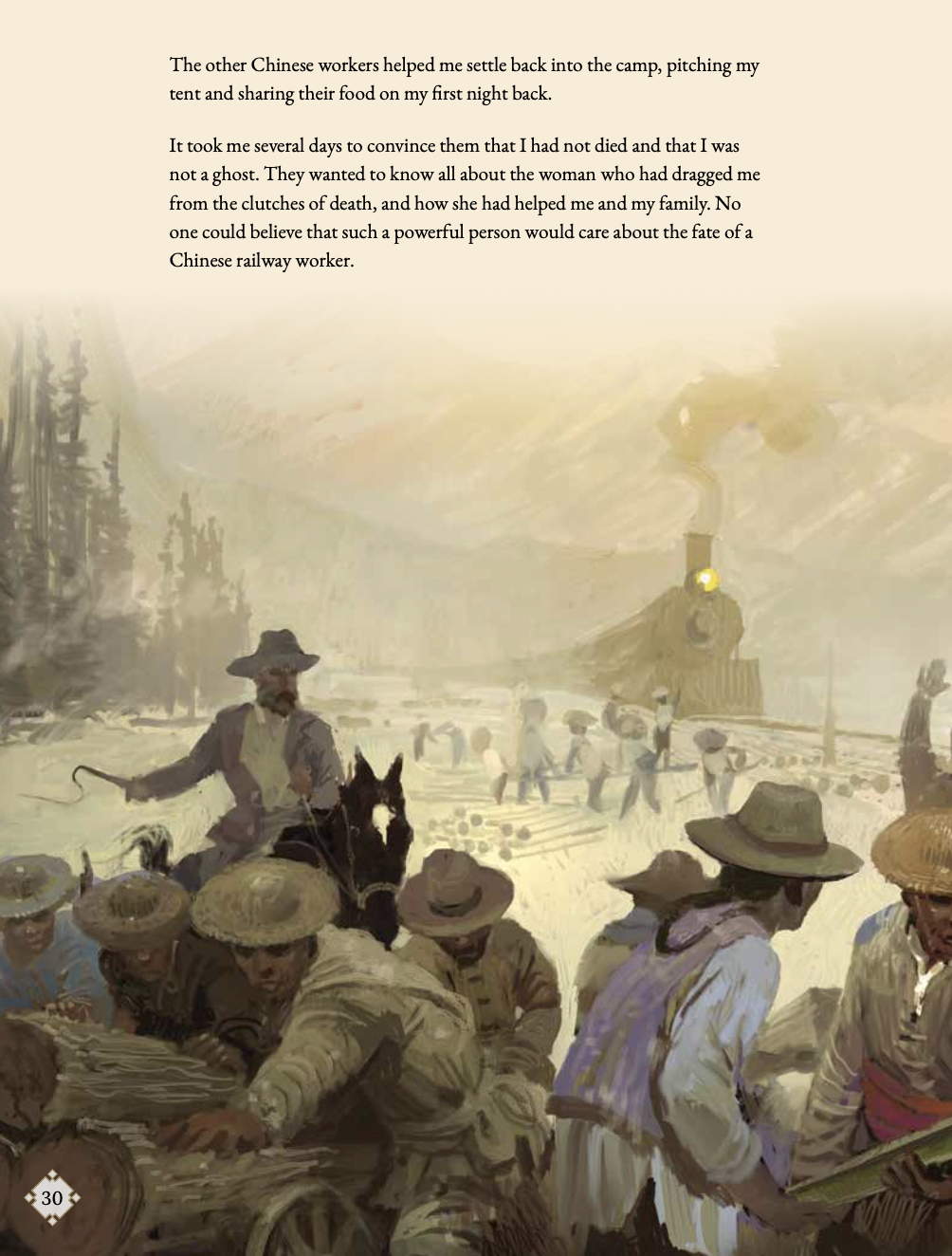
With the seriousness of the story and the realism of a historical narrative, the art of Sean Huang adds to the story, taking us from frozen landscapes of workers in canvas tents or collapsed in snowbanks, to the opulence of a fine lady's Victorian home, to the busyness of countless workers on the railway. Combining both a heaviness and lightness to his brushstrokes and the classic palette of old masters, Sean Huang takes us into the past of David Bouchard and Zhong-Yang Huang's story, and tells a history where a man is disregarded because of his heritage and taken for dead because he might not have mattered enough to be helped.

If you're a teacher of Canadian history for young people and want a fresh take on the building of the railway, I Am Not a Ghost provides a very personal story that goes beyond the placement of that last spike and reminds us that achievements are often on the backs of others who should be recognized and their stories told.

February 21, 2020

The Silence of Bones

Written by June Hur
Feiwel and Friends
978-1-250229557
336 pp.
Ages 13+
April 2020

The eyes that stare out from the cover of The Silence of Bones are haunted. They are the eyes of sixteen-year-old Seol, a girl indentured to the Capital Police Bureau, who has lost her parents, wants to find her brother or his grave, and is far too curious about those she serves and the investigations in which she must assist. In 1800s Korea, time of the Joseon dynasty, Seol knows her place and, like all servants, knows to "Be cautious. Cross no one. Obey always." (pg. 14)

As a police damo, Seol goes where she is needed to help with female criminals and victims whom the male police are forbidden from touching, according to Confucian tradition. When Lady O, daughter of Cabinet Minister O of Southerner faction, is stabbed and her nose cut off, Seol finds herself talking to her maid, Soyi, and learning about a man and a letter that took the young woman to her death. When Inspector Han discovers Seol eavesdropping and trying to learn more about the murder, he informally mentors her about motives for murder, how to tell if someone is lying, etc. After she saves the inspector's life from a tiger and the two share stories of their families, Seol becomes devoted to Inspector Han. So when evidence is revealed that a man in the blue robe of the inspector was seen near the scene of the crime, Seol tries to help. But the mystery is complicated and Seol begins to wonder if the man she has grown to respect is guilty after all.

Sometimes my reviews cannot do justice to the complexity of the story and such is the case for the extraordinary historical mystery of The Silence of Bones. June Hur has woven countless characters, each with their own motivations revolving around class structure, religion, and family, into an intricate story in which the honourable may not be and the lowly may be of the highest integrity, and vice versa. Amidst the class hierarchy, largely based on birth, in which there are aristocrats, palchŏn (low class), and even baekjeongs (outcasts), June Hur's characters are real but flawed, looking for family and acknowledgement for their efforts, humble and otherwise. But among those characters is evil and...
"...evil comes from the unfulfilled need for significance." (pg. 192)
This is June Hur's debut novel and it is an accomplishment of plot and writing, taking readers into the Korean dynastic kingdom of Joseon at the turn of the 19th c., a time of Confucian traditions, prohibition of Western teachings, and the persecution of Catholics. From behind the covers of the book, you will cheer for those who looked beyond their station, ignoring censure–"This is what happens when a foolish girl thinks she can be someone of consequence. She creates chaos, utter chaos." (pg. 131)–and search for truths, to honour the dead and the living, while you suspect character after character of murder and misdeeds, never guessing where June Hur will take her story. The Silence of Bones has given us a new voice in YA CanLit for which I'll be listening from now on.

February 12, 2018

The Journey of Little Charlie

Written by Christopher Paul Curtis
Scholastic Canada
978-1-4431-4263-2
234 pp.
Ages 8-13
February 2018

Little Charlie Bobo, the son of a white sharecropper on the South Carolina plantation of Mr. Tanner, can hardly be called little for his size. At twelve, he is 6'4".  So, when Little Charlie's father is killed and cap'n Duke, the abusive overseer on the plantation, claims that he'd paid him fifty dollars upfront to help him retrieve money stolen from Mr. Tanner, Little Charlie has no recourse but to accompany the man.

Heading to Detroit, Little Charlie knows enough to listen and not say much to the brutal and racist cap'n Duke.
You can learn from anybody.  Even dimwits can teach you if you listen careful and pick at the kernels of corn from the horse crap they's dishing out. (pg. 71)
He quickly learns that the "thieves" they are searching out are slaves Lou and Cleytus and their young son Sylvester who'd escaped from the Tanner plantation ten years earlier.  With some assistance from the equally reprehensible Sheriff Turner and his associate Keegan, cap'n Duke captures the parents who have made a good life for themselves and their family and  now go by Eloise and Chester Desmarest.  But cap'n Duke is determined to get all the family, including the two-year-old twin daughters and son Sylvanus, a student at a school in Saint Catharines, Canada.  Though warned about going into Canada to retrieve escaped slaves, cap'n Duke with Little Charlie in tow get themselves cleaned up and travel by ferry and train to deceive Sylvanus into returning to the United States with them.

The Journey of Little Charlie may begin as a debt the young man is trapped into repaying but it becomes a journey of learning beyond any his poor existence at home had provided him.  Though his parents imparted some wisdom to him about survival and living a life of subservience, Little Charlie has had few opportunities–he cannot read–and never expected much from his life. Accompanying the vile cap'n Duke, Little Charlie is able to see for himself how the world outside of Possum Moan, South Carolina works, including entering Canada, a country which had abolished slavery decades earlier. For the first time, he could see, not just learn second-hand, what life was like for others, including the poor, the rich, "colored folk" and everyone.  The Journey of Little Charlie is a coming-of-age story of historically immense proportions; it is Little Charlie's journey outside of what he has always known and been taught. And he heeds the words of the old railway man, Ol'Jerry, they meet outside of "Dee-troit."
"I 'membered thinking at the time 'tis too bad this can't be a reg'lar part of living, where we all gets a chance to walk away from whatever train wreck we's made of our lives and run off to start up building something new." (pg. 79)
Just as he did in The Madman of Piney Woods (Scholastic, 2014), Christopher Paul Curtis brings together very different voices on a similar journey, though their intentions and perspectives vary greatly.  In The Madman of Piney Woods, he gives voice to a boy living in the shadow of his grandmother's harrowing immigration from Ireland and a distinct one to another whose family and friends live with the legacy of slavery.  They, like Little Charlie and cap'n Duke, live ordinary lives for the times.  But from the ordinary comes the extraordinary.  It is the righting of wrongs and redemption that carries the story forward, delivering history from the every day and teaching compassion from cruelty.
They never once looked back.                                                    If I was them, I wouldn't-a neither. (pg. 232)

July 23, 2015

Rivals in the City (The Agency, Book #4)

by Y. S. Lee
Candlewick Press
978-0-7636-5914-1
293 pp.
Ages 12+
March, 2015

Since wowwing readers with her first book, A Spy in the House (Candlewick, 2010), in the Mary Quinn Victorian mystery series, Y. S. Lee has gripped readers with the authenticity of her social and cultural landscapes, the complexity of her plotting, and the intricacies of relationships between her characters.  The stories provide a glimpse into life in Victorian England, though not always a pleasant one, while tantalizing readers with convoluted mysteries that have former homeless thief turned spy Mary Quinn and her love interest and fellow investigator, engineer James Easton, looking over their shoulders constantly.

In Rivals in the City, Mary Quinn and James Easton have set up their own enterprise, Quinn and Easton, though Mary's former Agency employers, Miss Anne Treleaven and Mrs. Felicity Frame, now estranged, connect with the young couple separately to enlist their help with regards to the first investigation Mary ever pursued (The Spy in the House, Candlewick, 2010).  Seems the shipping magnate Mr. Henry Thorold, accused of insurance fraud and piracy, is now dying in Newgate prison, and everyone is anticipating the return of his wife, Mrs. Maria Thorold, who had attempted to murder James while fleeing accusations of being the true perpetrator of the piracy and countless deaths of Lasgars.  Thorold's daughter, Angelica, too is scheduled to return to her father's bedside from her studies in Austria.

While everyone is watching for the appearance of the devious and dangerous Mrs. Thorold, Mary and James are distracted somewhat from their discussions of marriage–a wholly beneficial state for Victorian men but not so for women of the day–by matters demanding their personal attention.  James and the family firm of Easton Engineering have been contracted to build a series of new underground vaults for the Bank of England's storehouses of gold, and Mary is becoming acquainted with a young Chinese boxer who holds the secrets to her father's past.  Can the two continue on their path to matrimony without being steered off course by the interests of The Agency's former matrons or by those who purport to have their interests at heart?  Can the truth of Thorold's crimes be revealed without further danger from the elusive and deadly Mrs. Thorold?

Y. S. Lee plunges the reader into the grimy underworld of criminal activity of 1860s London while tempering it with the loveliness of a first and true romance, all of it revolving around the unique Mary Quinn.  Y. S. Lee’s protagonist has grown into a strong young woman, still hampered by her past of shame and loneliness, but enjoying the benefits of her accomplishments, including independence.  Perhaps she has such a bountiful future because she does not deny her past.
This was her London: brutal, coarse, dangerous.  It was part of her history.  It had molded her character.  But she would not allow it to shape her destiny. (pg. 67)
And that future includes the gracious James Easton whose wits and engineering prowess are only shadowed by his thoughtfulness and insight.
She’d changed him more than he’d ever dreamed possible.  He was no longer entirely at home with his peers, thanks to her.  If he lost her now, what on earth would become of him? (pg. 80)
You can see how these two incredible characters create a story on their own, irrespective of a grand mystery wrapped up in the criminal activity involving the British Museum and the Bank of England.  There’s much to delve into in Rivals in the City: the history, the mystery, the atmosphere, and the romance.

And while Y. S. Lee is 4 for 4 in The Agency series, sadly there will be no Book #5.  Y. S. Lee has written that, “The publication of Rivals also marks the end of the Agency quartet – the last Mary Quinn adventure, the last time I write dialogue between Mary and James, and probably my last romp through London, 1858-1860.” (Retrieved today from a post dated March 10th, 2015 at http://yslee.com/tag/the-agency/) So, enjoy this finale for Mary Quinn, as I did, but look forward to other novels by her true birth mother, Y. S. Lee.


May 07, 2015

Mad Miss Mimic

by Sarah Henstra
Razorbill
978-0-14-319236-7
272 pp.
Ages 13+
For release May, 2015

Fitting in is a dilemma for young people the world over and throughout time, whether it be contemporary Canada or 1870s London.  But the constraints of Victorian England were highly embedded in the strict social hierarchy of the day.  Young women of standing, such as seventeen-year-old Miss Leonora Somerville, niece of the Countess of Hastings, were expected to make suitable marriages, partaking in endless social engagements, while the men were to engage themselves with business and politics.  But, as lovely as she is, Leonora’s stammering and learned ability to mimic others–she has heard them call her Mad Miss Mimic–have put her at a great social disadvantage, and one which her older sister Christabel, wife of Dr. Daniel Dewhurst and mother of two, is determined to hide–afterall, “Madness will take the shine off gold” (pg. 21)–in order to procure an engagement for Leonora and finally move her out of Hastings House.

Currently, Christabel’s efforts are focused on the wealthy merchant seaman Mr. Thornfax, a new business partner of Daniel’s and the son of the Lord Rosbury.  And all Leonora has to do it not speak.  But when Mr. Thornfax asks her questions directly, she has no choice but to answer, unconsciously mimicking her sister.
“Mimic had leapt in to rescue me from trouble. She’d allowed me to adopt my sister’s voice and manners wholesale, so that I could say whatever Christabel would say–or whatever I might imagine her to say–in precisely the way Christabel would have said it.” (pg. 30)
Fortunately, her cousin Archie Maverty, a reporter, who knows of her mimicry, rescues her, though more for her benefit than for Thornfax whom he regards as suspicious. But it is Daniel’s work at his surgery, where a young man named Tom Rampling assists him, that makes Leonora suspicious, especially after a young servant girl, Hattie, dies.

Because of her household interactions with Hattie, and her curiosity about Hattie’s involvement with Daniel and Mr. Thornfax, Leonora develops a rapport with the clever and creative Tom, to whom she is drawn because of his compassion for others and his acceptance of her mimicry.  However, Leonora is still being courted by Thornfax, London is still being held hostage by the dangerous Black Glove and his fatal explosions, and Leonora is troubled with doubts about Tom’s honesty, Christabel’s frequent agitation, and Daniel and Thornfax’s business.  That very simple but necessary betrothal begins to be the least of Leonora’s worries soon enough.

At its heart, Mad Miss Mimic is a Victorian mystery, all the more perplexing because of the information that the characters choose to share of themselves.  Yes, the Black Glove chooses to remain concealed, but everyone else–Tom, Thornfax, Christabel, Daniel– including our narrator herself also chose what secrets and fears and guilt they share and which they do not.  The reluctance of all to speak with their own voices–save perhaps their Aunt Emma, but I suspect age and privilege have helped beget that courage–creates the mystery of Mad Miss Mimic.  And, with Sarah Henstra’s brilliant characterizations and historical setting, the mystery and an unexpected and sweet romance at its core, Mad Miss Mimic reveals the need for voices to be given the freedom for expression if life is to be worth living.

 *   *   *   *   *   *   * 

Special post tomorrow: Q & A with author Sarah Henstra about her first novel, Mad Miss Mimic

January 25, 2015

The Case of the Missing Moonstone: The Wollstonecraft Detective Agency, No. 1

Written by Jordan Stratford
Art by Kelly Murphy
Alfred A. Knopf
978-0-385-75440-8
216 pp.
Ages 9-13
January, 2015

Devastated with the loss, to marriage, of the only governess she has ever known, eleven-year-old Ada Byron finds comfort in numbers and the wicker basket of her hot air balloon tethered to the house in Marylebone Road, London.  Except for the silent butler, Mr. Franklin, and two house maids, Ada is virtually alone.  Her father, Lord Byron, was killed years earlier and her mother, Baroness Wentworth, bitter with her husband's infidelity and life choices, is often absent.  But all changes for Ada when her new tutor, Mr. Percy Snagsby, and fellow student, Mary Godwin, 14, arrive.

While Ada is disinclined to accept her new educational situation, calling Mr. Snagsby "Peebs" and imaging a cannon from which to shoot him, Mary is very appreciative of it, thrilled with being tutored alongside the titled and wealthier Ada at her much grander home.  With time and the benefit of Mary's compassion and social competencies, the two girls become friends, complementing each other beautifully.  In fact, reading about criminals in the newspaper, the two decide to become a secret constabulary, the Wollstonecraft Detective Agency.  Still trying to work within the social confines experienced by women at the time, the girls take on the case of Miss Rebecca Verdigris, whose maid falsely confesses to stealing her Acorn of Ankara pendant, a birthday gift from Rebecca's late uncle. With Ada's quirky brain and logic and Mary's benevolence and civility, the partners attempt to exonerate the maid, Rosie Sparrow.

Although based on historical figures, Ada and Mary are truly unique young ladies, befitting those of different social standings and family situations.  Ada has learned to be self-reliant, appreciative of her books and numbers i.e., that upon which she can depend. Mary, more mature and attentive to those around her, is fully aware of society's expectations and allowances, and acts as the voice of reason in their friendship and the Wollstonecraft Detective Agency.  Take this sample dialogue between the two girls.
"Because," Mary said guiltily, "sometimes you need to be careful about what you say and when you say it."
"That's silly.  There are just things to know, and people should know them and that's that."
(pg. 127)
Luckily, Jordan Stratford plays up their differences, similarly depicted in Kelly Murphy's quaint drawings, and demonstrates the innate humour of their attitudes.
"How are we to find Rosie in here?"
Ada pointed to the right. "This way."
"How do you know?" asked Mary.
"I don't.  I'm just guessing. But if I'm wrong, the other way will still be there."
(pg. 111)
Though Jordan Stratford takes some liberties with historical timelines–making Ada eleven and Mary fourteen years of age–he stays true to the essence of the two girls and their interests and personalities.  Ada who will become better known as Ada Lovelace (1815-1852), mathematician, writer and essentially the world's first computer programmer, is the beautiful mind of The Case of the Missing Moonstone.  Mary Godwin, daughter of writer Mary Wollstonecraft, will marry poet Percy Bysshe Shelley, and become Mary Shelley, author of Frankenstein (1818).  Similarly, Jordan Stratford uses the known friendship between Percy Shelley and Lord Byron, as well as Ada Lovelace's relationship with Charles Babbage, for additional historically-accurate subplotting.

The Wollstonecraft Detective Agency is a welcome series for middle-grade readers, providing an offbeat historical perspective to solving mystery.  I look forward to further cases, including The Case of the Girl in Gray, No. 2 in the series, scheduled for release August, 2015.

October 12, 2014

The Gospel Truth: Book launch (Ottawa)


Governor General Literary Award-winning author
Caroline Pignat

is launching her latest book


The Gospel Truth

Red Deer Press
978-0889954939
328 pp.
Ages 12+
Released October 1, 2014

A novel in verse, The Gospel Truth takes the reader to a tobacco plantation in 1858 Virginia, and shares the interactions and perspectives of slaves, their masters and a visiting bird-watcher.


Visit 
Caroline Pignat

at

the All Saints Christmas Craft Fair
All Saints Catholic High School
5115 Kanata Avenue
Kanata (Ottawa), Ontario

from 9 a.m. to 4 p.m.


to purchase The Gospel Truth
do some Christmas shopping, and 
support a great cause.


Admission 
to the Christmas Craft Fair
with over 150 vendors
is 
$1 or a canned good


Proceeds from sales of The Gospel Truth
will be going towards
a school, Todo los Santos,
sponsored by All Saints DR Experience Team and the All Saints community. 


September 07, 2014

Graves of Ice: The Lost Franklin Expedition, George Chambers, The Northwest Passage, 1845

by John Wilson
Scholastic Canada
978-1443107945
208 pp.
Ages 9-12
January 2014

The lost Franklin expedition has been in the news again  recently with an armada of Canadian Arctic vessels hunting new locations for the ships and men lost in 1848.  Now, courtesy of the incomparable John Wilson and Scholastic Canada's I Am Canada series, young readers will be able to accompany eighteen-year-old George Chambers on his own journey as a cabin boy on  the HMS Erebus, 1845.

Growing up in Woolwich, England listening to his father's tales of fighting Napoleon under Nelson in the Royal Navy and saving the life of a young John Franklin when sailing under Captain Cooke, George William Chambers is desperate to join Franklin's advertised expedition to complete the Northwest Passage.  Assigned as a cabin boy to Sir John and Commander James Fitzjames, George is essentially a servant and errand boy, but he takes advantage of any opportunities to learn all he can in training for a possible future as a marine.

The arduous journey of the Erebus and Terror ships, with numerous and necessary stops for water and provisions, sees them through the Orkneys, to Greenland, through Baffin Bay and then into the Arctic archipelago in which their truest hardships arise.  Time and time again, ice bars their travels, and the men must endure the cold, darkness, spoiled food and relentless boredom.
"I began to see us as mere toys at the whim of a cruel and uncaring nature." (pg. 88)
Though they wait out their first winter at Beechey Island, there is a second winter trapped in the ice off the north end of King William Island.  The cruelty of nature slams them with further losses of life and the ships' integrity, with conflicts arising more often as the men anxiously consider their few options.  George recounts the events until September, 1849, including the numerous search parties that set out by sled and the deaths of key figures on the expedition, notably Sir John Franklin, explorer Francis Crozier, marine William Braine, and Commander James Fitzjames whose last words to George emphasize the enormous nature of Arctic exploration:
"This land does not forgive.  Either meet it on its own terms, as the natives who live here do, or it will destroy you, as we are destroyed." (pg. 164)
The immensity of this expedition is well conveyed by John Wilson's formal accounts by George and other participants, whether in discussion with others or in their journals and notes.  The gravity of their exploration is easily depicted in the determination of the officers and marines to fulfil their mandate even while starving and confused.

Though John Wilson presents a plausible, albeit fictional, account of the outcome for the Franklin expedition of 1845, he provides the historical background in text and photographs that support his story.  It may only be with the ultimate discovery that completes the evidence picture that we will ever know how much of Graves of Ice is definitive or conjecture.  From John Wilson's pen, I suspect much legitimacy.

June 13, 2014

Taking the Reins: Guest Review

by Dayle Campbell Gaetz
Coteau Books
978-1-550-505528
232 pp.
Ages 10-14
2013

Taking the Reins was a great, enjoyable book that had me sitting on the edge of my seat for the whole book. As an avid historical fiction reader, this book surpassed my expectations, and gave me more of a knowledge about the difficulties and hardships girls living in these times had to face. 

Another favourite of mine is horses, so the blend of historical fiction and horses was a perfect fit for me. Not many books have this unique feature, so it has become one of my favourite books I have ever read!

I loved this book because I could clearly connect to Emma’s reluctance to keep Nugget’s name the same because I am very stubborn, but normally, like Emma, I can be persuaded. The only feedback I would give you is that if I had a horse that I loved, like Katherine and Nugget, I would not have sold him as quickly as Katherine did. I know that Katherine's family needed the money, but if I were in her shoes, I would have gotten a job so that I would be able to keep my horse and still help my family.

Thank you so much for writing this amazing book and I am crossing my fingers that there will be more awesome books like this one! 

Grace D., Age 12

June 12, 2014

Taking the Reins

by Dayle Campbell Gaetz
Coteau Books
978-1-550-505528
232 pp.
Ages 10-14 
2013

Though only fourteen, Katherine Harris has already felt the need to take the reigns, figuratively- and literally-speaking, in order to help her family who'd come from England to make a new life for themselves in Canada.  The family's hopes had been dwindling, along with their savings, since an extended stay in San Francisco (before they reached Hope, BC) when they all had fallen ill and Katherine's older sister Susan died.  Then starting their farm, for which they are sorely ill-prepared, Katherine's father is mauled by a bear and requires medicine, and Katherine must retrieve her nineteen-year-old brother George who has run off in search of gold in the Cariboo.  Returning home on her bay mare, Nugget, Katherine's adventure masquerading as a boy and travelling with a guide, William, must be forgotten as she must return to behaviour befitting a young girl and think about selling Nugget for some much needed money.

Fortuitously, the man who purchases horses from miners returning from the Cariboo and takes them to Victoria for wealthy buyers is Mr. Charles Roberts, the very man who had given her Nugget as a thank-you for her sister Susan's devotion to his niece Baby Rose when his brother's family was also travelling from England.  Katherine hatches a plan with Mr. Roberts to enlist her parents to care for his store so that he might travel to Jamaica to visit his brother and family, that her parents might leave the farm even temporarily (though George would remain behind to tend to it), and that she might go to school in Victoria. And since Nugget would be sold in Victoria, Katherine might have opportunities to visit him.

Meanwhile, Emma Curtis, who is just shy of 14 years of age, is gifted with Nugget from her newly-found father, Tall Joe, who'd left her and her mother in England to find his riches in the new world.  Left destitute, and her mother dead, Emma had accepted the  opportunity to travel to Canada via brideship, although she skirted marriage by taking a position at the home of Governor and Mrs.Douglas.  Still too proud, too angry and too scared to show herself as she is, Emma is reluctant to accept Nugget, though her father insists she learn to ride as he intends to travel to the interior next spring to start his own farm.

Emma and Katherine become acquainted at Beckley Farm, where Nugget is boarded, and become friends, though they each keep secrets about themselves, afraid of being judged for their heritage, their weaknesses, and griefs.  But the two girls must sidestep those issues in order to work together to find the happiness they both deserve.

You will hear me say time and time again that I am not a horse person.  My greatest affinity is to cats.  And, though I will always share an affection and compassion for all animals, my understanding of horses is negligible.  But Taking the Reins allowed me to share in the bond between Katherine and Nugget, while understanding Emma's initial trepidation for this large animal.  Even more, though, Dayle Campbell Gaetz made Taking the Reins into a story about facing an uncertain future in the context of prejudice and insecurity, emotional and financial, and allowing others into your life so that you might move forward.  Nugget is the bridge that allows Katherine and Emma to share of themselves and see beyond their needs and instead focus on what others need.  It's an inspiriting story that could be from any time, but told especially well in the tumultuous settlement times in British Columbia in the 1860's when new ways had to be built on the land and between people in order to survive.  Fortunately, women such as Katherine and Emma, as well as Susan and Mrs. Douglas, showed the courage and good will to take the reigns for more than just themselves.

April 04, 2014

Brothers at War

by Don Cummer
Scholastic Canada
978-1-4431-1382-3 
204 pp.
Ages 8-14
October, 2013

There are many divisions in twelve-year-old Jacob Gibson's Upper Canada in 1811.  There are the towners and the dockers; the supporters of the Americans and of the British; those who have and those who have not pledged allegiance to the King; entitled, rich boys like William Dunwoody II and his best friend Henry Ecker and the regular boys like Jake and his friend Eli; the Iroquois and the British subjects of Upper Canada; and those itching to get to war and those opposed to it.  Sometimes the lines blur between the groups but most people differentiate themselves from others based on some criteria or another.

When Jake Gibson meets new boy Eli McCabe, son of the new tanner from America, he accepts him readily, especially after Eli helps him from a fall into a ditch during a snowball fight and then later from the frigid Niagara River when challenged by William and Henry.  Of course, Eli confirms the gossip that his father will not swear allegiance to King George, only coming to Upper Canada to be left alone and not deal in politics.  Now the McCabe family may be evicted from the Canadas.  And though William and Henry are relentless in their harrassment of Eli, calling him Turd Boy and pulling vicious pranks to make him look suspicious of vandalism and mischief, Jake and Eli are brought closer together, becoming blood brothers and determined to stand up to the menacing duo.  Sadly, with the dissolution of the Assembly by General Brock and the subsequent elections, coupled with the talk of war between across the Niagara River, Jake and Eli's friendship is tested and loyalty questioned.

Predictably, Upper Canada in 1811-1812 was no less corrupt than some political regions in Canada today.  There are those with wealth who happily use their money to corrupt others and the electoral process, without any concern for the rights and freedoms of all.  And though there are many who are forthcoming and demonstrate much integrity, the unscrupulous ones first must be challenged and blocked. Don Cummer has written a credible story of two boys whose friendship both spans their different worlds and resists that separation. Though it is difficult to always know the appropriate action when balancing friendship and country, Mr. Willcocks who publishes the Upper Canada Guardian advises Jacob,
"Stay close to your friends.  Protect them and keep them out of trouble.  No matter how difficult that may be at times.  In the end, they will thank you." (pg. 134)
This is wise advice, particularly as the War of 1812 will still not have begun at the conclusion of Brothers at War.  But the boys will need to wrestle with their loyalties to their families and their friendship, as well as to their own evolving politics, and fight themselves and each other when dealing with extraordinary circumstances that put those for whom they care in jeopardy. They are indeed brothers at war.

><><><><><><><><><><><><><><

I came across this quirky video titled Don Cummer arrested for Brothers at War on YouTube and thought readers might enjoy a chuckle as Don Cummer, the author of Brothers at War, attempts to sell copies of his book and is challenged by Mr. Joe Willcocks.  Luckily, the ending indicates that books are good for everything!

 Don Cummer arrested for Brothers at War
Uploaded by Don Cummer on November 2, 2013 to YouTube.

September 24, 2012

A Sea of Sorrows: The Typhus Epidemic Diary of Johanna Leary, Ireland to Canada East, 1847

by Norah McClintock
Scholastic Canada
978-1-4431-0710-5
175 pp.
Ages 9-12
September 2012

Norah McClintock, three-time Arthur Ellis award-winning author for Best Juvenile Crime Book, surprising treats readers with this first foray into historical fiction.  However, this should not be surprising as Norah McClintock graduated with a degree in history from McGill University and shows great skill in bringing the past in Dear Canada's newest title, A Sea of Sorrows, to reside comfortably amongst her more contemporary award-winning volumes.

A Sea of Sorrow follows the story of thirteen-year-old Johanna Leary and her family from the blight-ravaged potato fields of Ireland to Canada in 1847.  Sorrows will plague the Learys, Ma, Da, fourteen-year-old Michael, Johanna and baby Patrick, each step and nautical mile of their journey from the hunger and poverty of their homeland to the farm of Da's brother, Liam, in the New World.  From their long walk to Dublin to catch a steamer for Liverpool and then boarding the sailing ship for Canada, the journey is arduous, sorrowful and forlorn.

Although never recognized at the time, the ships carrying the Learys and other families became known as coffin ships for the rabid spread of cholera and typhus that claimed the lives of young and old alike.  By the time the ship comes into the Gulf of the St. Lawrence, Johanna's family has lost little Patrick, and Connor Keenan, a young man who'd disguised himself as a girl to evade arrest for threatening and robbing some landlords, has lost his father, sister Colleen, and brother Kevin.  But arriving in Canada does not lead to landing and disembarking in Canada, as the countless line of ships anchored in the harbour indicate.  Those who are deemed ill, including Ma and Mrs. Keenan, are sent to the hospital on Grosse Isle.  The others must remain on the ship in quarantine to contain the spread of the disease.  Not surprising that during their days in quarantine, without fresh food or water, and waiting for medical inspection, even more people fall ill.

Following ten days in quarantine, only Da, Michael and Johanna with Connor and his little brother Daniel, are sent by steamer to Montreal. Again, the sorrows of separation and loss overtake the joys of officially arriving in Canada, as Da, who is ill, is taken away to the immigrant sheds, and Johanna and Daniel are taken with all the girls and youngest boys to an orphanage to be cared for by nuns.

And so, for the Learys, their new life in Canada alongside Uncle Liam has dissolved with each death and separation, just as it did for so many who travelled from Ireland at that time.  The mass exodus contributed to the horrific conditions on board the ships, which in turn led to illness and death.  Unfairly, the Irish immigrants were seen as bringing disease with them and became a spectacle and deemed worthy of prejudice and discrimination from the Canadians.  Even their starvation was twisted to be indicative of laziness by some.

A Sea of Sorrows is not a happy story, although Norah McClintock's epilogue offers some tidbits of happiness for some characters. But, it is a dramatic glimpse into the ghastly situations many Irish immigrants experienced circa 1847, leaving one horrific situation of poverty, starvation and discrimination for another that offered a glimmer of hope but within similar circumstances.  And Norah McClintock never sugar-coats Johanna's accounts, just as the girl would not have been able to do so; there was no sweetness to spare for her tale.  As rotten as the potatoes they fled, many of the Learys' lives festered along with numerous of their countrymen, with only the occasional murphy or Leary able to survive, albeit scarred.

A powerful telling of a historic tragedy.