Showing posts with label guest post. Show all posts

January 24, 2023

I Got You Babe: Guest interview with author Paul Coccia

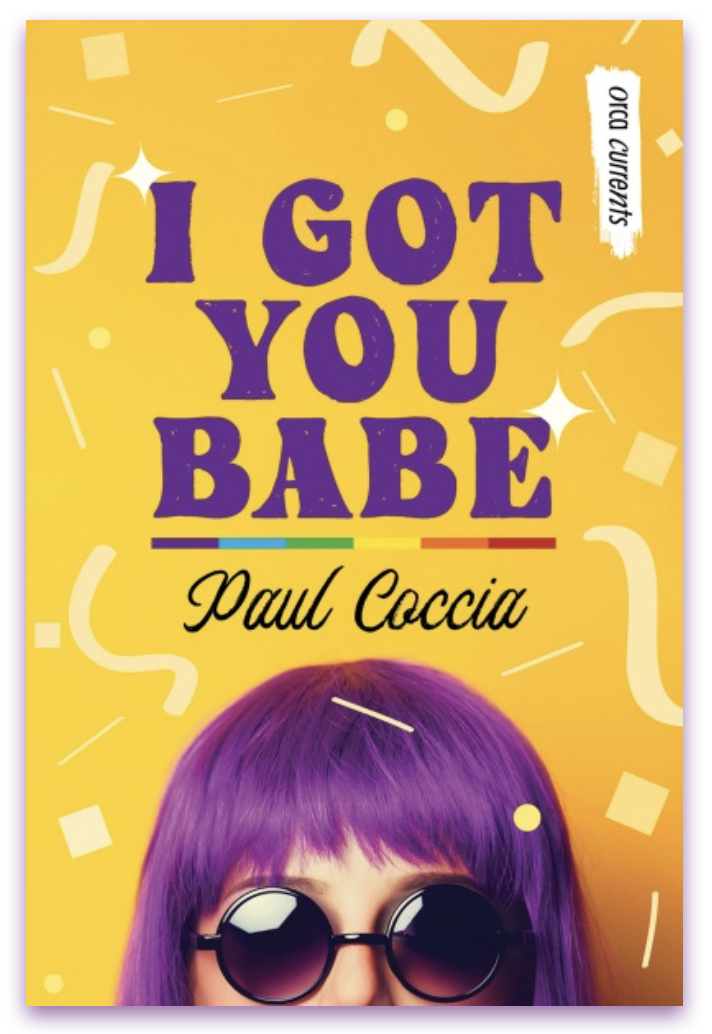
I Got You Babe
Written by Paul Coccia
Orca Book Publishers
978-1-459834705
120 pp.
Ages 9-13
Release February 14, 2023


Yesterday CanLit for LittleCanadians reviewed Paul Coccia's upcoming novel, I Got You Babe. Today I present an interview conducted by student Hasini K. with author Paul Coccia. 13-year-old Hasini read I Got You Babe and prepared questions for author Paul Coccia to delve a little deeper into his new book. Paul Coccia, ever gracious, agreed to answer her questions and even visited with Hasini virtually to chat about the book. 

Here is their Q & A.
 
Author Paul Coccia

 • • • • • • •
Hasini:  In the novel, Mac and Amy propose to change the annual Fun Fair into a Pride Carnival theme. Their idea is welcomed and the committee supports the change.  What would you say to your LGBTQ+ readers if they find themselves in a less than supportive environment?


Paul Coccia:  My first concern would always be whether a reader is in harm’s way. I wouldn’t want to see someone in physical or emotional trouble due to advocating for something they believe in nor would I want them in an environment that is damaging to their well-being. That aside, I would advise trying to open a dialogue. Be forthcoming about how you see the issue and try to understand why someone may object. The opposition may be something practical like budget constraints as in I Got You Babe. If the environment or people can’t or won’t be supportive, then I would suggest finding spaces and people that can. Too often, we give too much time and space to negative people or situations and, if possible, actively choosing positive things and giving them time in your life is a healthy move.


Hasini:  I really appreciated Mac’s desire for scheduling and organizing all the tasks needed for the Pride Carnival Fun Fair.  Would you say that this represents you or how might you be different?

 
Paul Coccia:  I do enjoy planning and organization and am impressed by someone who can pull off a big event and make it seem effortless. Where I differ from Mac is, as a writer, sometimes it’s a lot more satisfying to plan something in my mind than it is to actually do the work to get it going in reality. When I’m writing (or reading for that matter), there are more possibilities. In my mind, I throw these really elaborate parties with the best food and all my friends get to come. I plan them, but I might need an Amy in my life to push me to get it done.


Hasini:  When brainstorming for the Fun Fair, Mac had a lot of great ideas for the Pride Carnival theme.  Naturally, he was disappointed when the committee told him too many were unrealistic and they didn’t have the budget for all of it.  What would you say to kids who have to deal with disappointment?

 
Paul Coccia:  Disappointment, unfortunately, is something we all deal with. Authors and illustrators will tell you, we get these fantastic ideas, and sometimes they don’t end up turning into books. At least not easily. A lot of times, it is due to factors entirely out of our control. I started trying to get published at 17. It took me a couple of decades to get one of my great ideas turned into my first book. Being patient and waiting for a moment to arrive is incredibly frustrating and disheartening. Sharon Jennings’ Unravel is a great example of a book that took her over a decade to get published and it became a Governor General’s Award Finalist. So, don’t give up. Your best ideas will find their time and place if they’re important to you.


Hasini:  Mac and Amy have a very strong friendship.  How might this friendship inspire the readers of your book?  Also, do you have a friendship that inspired these characters?

 
Paul Coccia:  The backstory! Mac and Amy were inspired by my younger brother and his friend. They met before kindergarten and have remained close since. In eighth grade, they put on a Sonny and Cher routine for the school talent show where she was Sonny and he was Cher.

I hope one takeaway is that in a friendship, there can be room for two divas with lots of mutual respect. That can mean taking time to listen to someone and hear what they want and need not just try to pull them into orbit around you no matter how fabulous you are.


Hasini:  I noticed that pronouns weren’t used for Mac for the first 50 pages of the book.  Was there a specific reason you delayed using the pronoun ‘he’?

 
Paul Coccia:  I wish I had been clever enough to notice! I would have removed the rest of the masculine pronouns and left the decision on pronouns up to the reader. Readers are already active participants in books so I’d be happy to let them decide. Alas, I was not that smart. From a craft perspective, the story is told from the first-person point of view and Mac usually refers to himself as ‘I’ or ‘me’ while others call him by name or ‘you.


Hasini:  I love that the name Chandra was used in your book.  I am not used to seeing my culture represented in books.  Was there a reason for the name choices of your characters?  

 
Paul Coccia:  I, and so many authors and illustrators I know, intentionally try to be inclusive when we create stories. Part of that means finding ways and places for all sorts of characters to exist in the worlds we write. First and last names are an understated tool for any writer as they have the benefit of characterizing quickly and efficiently by hinting at cultural heritage. Amy’s and Mrs. Khatri’s surnames did this too. That aside, Chandra is a beautiful name. There is a goldmine of names that are not used enough that authors can look up. When I am trying to include a character that has a specific heritage or background, I look up the most popular baby names or surnames in the country the character’s family would have originated from for the year I imagine the character was born.


Hasini:  Mac is insistent on representing a strong woman in the Pride Carnival Talent Show.  Why did you choose for him to want this?  How might you have participated in the show if you were one of the characters?

 
Paul Coccia:  Personally, I was so lucky to grow up in a house with many strong women so I tend to bring that into my writing whenever I can. I also really, really love Cher. She is the Goddess of Pop!

The LGBTQ+ community, in particular gay men, has looked toward strong and often transgressive people, notably women, as icons. Often, these women are such strong allies to the Queer Community. When I think of Mac, he really does have a strong sense of who he is and that, like many icons, he’s ahead of his time. He would naturally identify with a larger-than-life celebrity like Cher who has remained relevant for decades throughout her career. 
 
As for a talent show routine, I lean more toward visual art or culinary arts. If I could bake on stage, I’d have a decent shot at winning something. I can’t sing or dance though, not that that stopped Mac.


Hasini:  It is mentioned briefly in the story that Mac deals with bullies in the school. What would you say to kids reading the book who are dealing with bullying?

 
Paul Coccia:  If you’re being bullied, seek help. This could mean finding an adult or authority figure to intervene or seeking professional help. This may be hard to do as I’ve found an element of shame and self-doubt accompanies being bullied. Finding a way to stop the bullying and healing from it is important.

If you are a bully, I would strongly suggest you reflect and consider if this is the person you want to be. Perhaps you didn’t intend what happened. Then you should apologize and make amends. If you did intend to hurt someone, I wonder if this is a moment to be proud of. We all make mistakes and our actions have the effect of bringing us closer to a version of ourselves we’re proud for the world to see or farther away.


Hasini:  In the book, Mac’s mom makes some creative meals like kimchi hot dogs.  I see on Twitter that you are quite the baker.  Did you have creative meals at home growing up that influenced you and your character, Mac?
 
Paul Coccia:  We are an adventurous family for eating and cooking. I think having parents and grandmothers from different backgrounds in the house helped, as well as growing up in an area of Toronto different from our backgrounds. My family loves trying different foods from around the globe, whether we cook it or it is takeout. Our most inventive and peculiar dishes always come out of repurposing leftovers.  Thanksgiving dinner does really well with a Tex-Mex influence. Spaghetti makes a non-traditional but surprisingly satisfying pad Thai. It’s fun and a challenge to see how we can switch up a dish and turn it into something new. Similarly, in my first novel, Cub, the main character is particularly interested in fusion when he cooks. Food culture is one more place to literally feed my curiosity.

 • • • • • • •
 
Many thanks to both Hasini K. and author Paul Coccia for this interview. Hasini asked wonderfully in-depth questions about the writing and story of I Got You Babe and Paul Coccia gave us great insight into his process and motivation.  I'm so pleased to share their interview with CanLit for LittleCanadians readers.

Graphic from Orca Book Publishers

October 10, 2022

Celebrating Meredith Tutching, Director of the Forest of Reading: Guest post by CANSCAIP president Sharon Jennings

This Friday, the Ontario Library Association's Forest of Reading will announce the nominees for its readers choice book awards.  This announcement is the culmination of year-round work led by Meredith Tutching, Director of the Forest of Reading. We'd like to give her a little love and recognition ahead of this year's announcement.
 
The following article, written by author Sharon Jennings, was first published in the Fall 2022 edition of CANSCAIP News Vol 44 (4): 13-15. It is reprinted here with the author's permission.
 
📕📕📕📕📕 

Sharon Jennings
One of the nicest things about this cross-our-fingers-and-hope-it-dies period of Covid is meeting up with people whom we haven’t seen for over two years—not even on Zoom. So I was thrilled when Meredith Tutching agreed to let me take her out for lunch and interview her for this column. She did note, however, that there are far more interesting people to interview than her. Not for those of us toiling in the children’s book world!
 
Meredith is the Director of the Forest of Reading Program. As such,
whether you know it or not, she is one of the most important people in our lives. Why? Meredith gets our books (the ones that make it onto the Tree lists) out to the most important people: our young readers. If you are fortunate enough to find your book nominated for a Tree (as most creators have fondly dubbed the awards), you will see more sales than ever before and be asked to more schools and libraries than you thought possible. In other words, royalties and income. Most publishers have little to no money for marketing and promotion, and some publishers (we all secretly believe) don’t seem to have much interest in some of our books. But if you make it to a Tree list, your marketing dreams will come true. (Not Fifty Shades of Grey true, but still.)
Meredith Tutching
Newcomers, or those of us not paying attention, may be wondering: what exactly is a Tree award and why is it important? The program is made up of ten reading categories or divisions, from primary grades to high school young adult, English and French. The
tenth category is for adult titles. There are also ten juries of approximately fifteen volunteers each—educators, library professionals, booksellers. These juries choose ten books for their lists. They are mindful of the fact that these awards are about the enjoyment of reading. It is a recreational (not literary) program. In other words—FUN!
 
The truly brilliant aspect of this program is that once the titles have been selected and the books received by participating schools/libraries, it is the kids who vote (excluding the Evergreen, adult division). Over a few months, they read each (most) of the books and get into heated arguments with their classmates about why this book or that should win. Then they vote; the votes are counted; the winners are announced. Some of us think that our
book should have won. But how do you rant against a bunch of six-year-olds? Or sneer at teenagers rolling their eyes? There isn’t a cash prize for winning, but, even better, there is the bulk sales of our books and the adoration of our fans. On a side note, sometimes a reader will tell you, “I didn’t vote for your book.” Why, thank you for sharing, young man.
 
Back to Meredith. She didn’t set out to have this career. She graduated from Queen’s University with a degree in geography. She is also a professional synchronized skating coach and consultant, in addition to mentoring with Skate Ontario and Skate Canada. This last may seem irrelevant to us, but as she enthused over lunch about her ideas and goals for the Forest program, I could picture her out on the ice, demanding precision and sharp lines and keeping many athletes working smoothly together.

Meredith took a two-week job with OLA (Ontario Library Association) back in 2001. She’s now been there for over twenty years. In the early days, Meredith was the assistant to the Executive Director of the OLA, and the Forest job took up 30% of her time; in 2009 it became her full-time job. Meredith had so many ideas for going bigger and better, and she was so enthusiastic about kids and reading and promoting creators that the job couldn’t be contained in a few hours a week.
 
Now, the Forest is the largest recreational reading program and the largest children’s literary event in Canada. And Meredith has still more plans for further growth. She has always dreamed of expanding the program to fill the gaps in other provinces, and to do so, she finally managed to remove the program from the OLA website and obtain a standalone Forest website–forestofreading.com. This made it easier to reach out to schools across Canada with a program that could be seen as national, rather than piggybacking on an Ontario institution. Historically, there have been four schools outside of Ontario; this year there are almost fifty. Meredith wants to get to 200 by June 2023.
 
Just to be clear: books from published creators across Canada have always been eligible for the Forest Program. Meredith wanted to change the number of schools that would participate in the Program. So, if you live in Saskatchewan and your book is nominated for the Blue Spruce, you can now (or hopefully soon) get school visits in your home province and not have to travel to the participating schools in Ontario. (But then you might miss the ‘I feel like a rock star’ ceremony in Toronto as you are swarmed by autograph-seeking readers.)
 
The Program is always changing as it receives feedback. There are occasionally some complaints and grievances from creators and publishers (I’m shocked!) and, therefore, the team continues to take steps towards greater transparency. Once the books have been chosen, Meredith holds a meeting every September, in partnership with the Official Wholesaler, so that the publishers can learn about any new developments with the program and ask questions. The lists of nominated books are kept confidential until the official announcement in mid-October. And before that announcement, the wholesaler has pre-packaged listed books in order that they may go out immediately. Last year, the Official Wholesaler, Tinlids, sold over 105,000 books alone.
 
Occasionally, the Program has been accused of ‘hiding’ things (Hmmm. That sounds intriguing!) Meredith is careful to make sure the rules for submission and participation are clear and understood. Also, there is a ten-clause contract between the wholesaler and publisher which must be upheld. For example, there is a fee for each nominated book ($550.00 for a Silver Birch title), the book must be published and available by October 15, and there must be a guaranteed number of books ready to ship (approximately 3500 copies for each Silver Birch title).
 
Smaller publishers pay willingly and order in the books because this is marketing that they can’t afford and offers big dividends. Interestingly, it is some of the larger publishers who get huffy.
 
Sometimes, publishers get huffy as well when a book they expected to be on a list isn’t there. On the other hand, I mentioned to Meredith that some of my colleagues aren’t sure if their books got submitted. If we have such doubts, we are allowed to ask; however, she won’t divulge the reasons why the book was declined. Another way our books are getting into our readers hands: all one hundred titles are sent to a company (AERO—Alternate Education Resources for Ontario) that makes each title accessible in several formats for young people with print disabilities.
 
So much work done on our behalf, and that isn’t all of it! For years, library staff ran the program in their individual schools. Now the Forest and its volunteers do it all because of, as Meredith stated, “the erosion of school libraries.” And, by the way, Meredith liaisons with over 250 volunteers. Another by the way, only 7% of the Forest budget comes from government funding. And one more: Meredith divulged that she doesn’t read our books. What?! She feels that if she reads one, she will have to read them all. So why is she in this job? “I love the logistics of it.” Yup. Out there on the ice with her whistle!
 
Two hours flew by. We finished our lunch—chicken and avocado sandwiches and lemon-mint slushies. To be accurate, Meredith finished; I still had half a sandwich to get through as I scrambled to take notes, hoping that I would be able to decipher my own shorthand. She left, and I kept scribbling. Meredith’s final words were about what a close and supportive and helpful community we have. “There is room for everyone in this program.” She also
mentioned that, “Sometimes, creators are hard to herd.” Don’t we know it!

~ Sharon Jennings is the author of over 60 books for young people and current president of CANSCAIP.
 
📕📕📕📕📕

September 30, 2019

A Box of Bones: Guest blog post

Today's review has been submitted by Grade 6 student Bronte L.

Written by Marina Cohen
Roaring Brook Press
978-1-250-17221-1
288 pp.
Ages 8-12
May 2019

In Marina Cohen’s book A Box of Bones, the main character, Kallie, is very logical and intelligent for her age, yet she lacks imagination. When her beloved grandfather takes her to the Festival of Fools, she doesn’t enjoy it as much as the other visitors do. During the Festival, a faceless man in a fedora gives Kallie a wooden box. Later, she figures out that the box is a puzzle. Against her father's advice, she starts solving the puzzle, and uncovering secrets. Finally she finds the right combination and unleashes something that seems like magic.

While Kallie tries to figure out what’s happening to her world, Liah, a young bone carver, goes on a long journey with her master to sell bone carvings to the empress.  On the journey, she ends up accidentally wrecking a valuable cup that her master made.  She tries to hide this fact from her master along the way.  Although Kallie and Liah's worlds are far apart in time and place, their stories connect in many ways. 

A Box of Bones by Marina Cohen is great for readers in Grades 4-8 seeking a book full of adventure and suspense. It's a book on developing friendships and uncovering family secrets. The large font, short chapters and 281 pages makes it great for a light read. The cliff hangers will make you stay up past your bedtime. The emotional description is fantastic.

Out of ten, I would give A Box of Bones an 8. I loved how the two worlds intertwined. Trying to put together all of the clues and secrets made me feel like a sleuth. All of the characters are original and interesting, their back stories are emotional and deep. Both worlds had their share of drama and suspense. This book gives the reader many chances to draw connections and imagine a new and exciting world.  Once you read this book, you will be drawn into the magic of it all.

~ Bronte L.

May 02, 2018

Polly Diamond and the Magic Book: Blog Tour Guest Post by author Alice Kuipers

This month sees the release of Alice Kuipers' newest children's book

Polly Diamond and the Magic Book
 Written by Alice Kuipers
Illustrated by Diana Toledano
Chronicle Books
978-1-4521-5232-5
120 pp.
Ages 6-9
May 2018

and

CanLit for LittleCanadians 
is pleased to be participating in the Blog Tour for the book's release


Today's guest post blog is from
author Alice Kuipers 
who shares with readers
about a free online course
she has created for children to get them writing.
✎✎✎✎✎✎✎✎

Welcome Alice Kuipers!
Thank you for having me here today! I love all your book suggestions and you always give me great ideas for books to share with my kids.

In my new book, Polly Diamond and the Magic Book, my main character loves to write. This got me thinking about making a course for young writers, one that they could do with their parents or on their own online. I filled the course with PDFs and downloadable movies, and hopefully lots of inspiration for up-and-coming writers to get their words on the page. Here’s a peek at one of the steps on Character, that I thought I could share with you today.


Your CHARACTERS are the people in your stories and poems. Here’s Polly Diamond!


Other characters in the book are her mom, her dad, and her sister Anna, who Polly turns into a BANANA!

As a super-star writer, you’re going to need to get to know your characters really well. And I’m going to show you how to do that!

I loved making the course—turns out I could talk and think about writing books all day long. I have a black piece of fabric from Fabricland here in my house which I hung up behind me (very high tech at this end!), so that the video content would be easy to watch, and tried to make the course as energetic and fun as possible. I thought of as many writing prompts as I could. Getting my four children to help out, I tested some of the ideas on them (mainly on the older two, who are eight and six, although my five year old surprised me with his storytelling!), and then, I sent everything over to Children’s Book Insider. I’ve been working with them for a number of years, and I’m the teacher for two of their courses: Chapter Book Blueprint, and Middle Grade and YA Blueprint. They put everything together and the FREE course for Super Star Writers is ready to go.

Sometimes, it’s easy to underestimate how brilliant kids are at telling stories—we have an innate ability, I think, to connect to stories, and I know from my work in classrooms and from hanging out with my own children that when I give just a few tips and hints, kids just love to make stories come alive (kind of how Polly makes stories ACTUALLY come alive in her magic book!)

Hopefully you and your children (or your class) enjoy the course—please let me know what I need to change or add to make it even more fun for the young writers in your life. And for those of you who enjoyed getting to know your characters, here are the first ten questions from the character worksheet for you to enjoy with the kids in your life.

GETTING TO KNOW YOUR CHARACTER
You can try this with one character or with ALL of the characters in your stories!
Draw a picture of your character—like the picture of Polly Diamond!

Imagine you can sit down with your character and ask him or her questions.
Write the answers YOUR CHARACTER would say. For example, if I was interviewing Polly Diamond, I'd ask: “What is your name?” And she would answer, “My name is Polly Diamond.”
Question 1: What is your name?
Question 2: How old are you?
Question 3: What is your favorite thing to do?
Question 4: What do you do when you first wake up?
Question 5: What do you love to eat?
Question 6: Do you go to school? If yes, what grade are you in?
Question 7: Do you have any brothers or sisters? Can you describe them if you do?
Question 8: Tell me about your best friend.
Question 9: Do you have a secret?
Question 10: Have you ever been in trouble?

Here’s the link to the rest of the course:
https://writingblueprints.com/p/writing-course-ages-6-10/


Thank you so much for letting me share my ideas about writing with you.

Alice Kuipers
✎✎✎✎✎✎✎✎

Many thanks 

to Alice Kuipers for introducing young readers
and their teachers and families
 to her new online writing course for children

and 

to her publicist Susan Busse for arranging for this stop on the blog tour.

CanLit for LittleCanadians is always pleased to host Alice Kuipers 
whose books continue to inspire young Canadian readers 
and now get them writing too!

✎✎✎✎✎✎✎✎

Be sure to check out the other stops on Alice Kuipers' blog tour for Polly Diamond and the Magic Book:

May 3: Book Time
May 7: Yoyomama
May 11: Savvy Mom

February 07, 2018

Sadia: Blog Tour Guest Post by author Colleen Nelson


Yesterday I reviewed Colleen Nelson's newest novel, Sadia, from Dundurn Press. I adore Colleen Nelson's novels for their variety of themes and strong characters with voices that resonate with all.  Today Colleen Nelson shares a few things you need to know about Sadia, so please join me in welcoming her.
🏀🏀🏀🏀🏀🏀🏀🏀

Colleen Nelson


Hello CanLit for LittleCanadians!


My newest book, 

Sadia

launches this month 
and 
 I thought I’d share

  5 Things you didn’t know about Sadia.

1. I hear voices. Yep, that’s how all my books start. The character talks to me when I’m doing random things, like washing dishes or driving to work, and all of a sudden a whole story is spinning in my head. I liked Sadia as soon as I heard her talking in my head and even more once I made her into a basketball player.

2. I don’t play basketball. I’m not good at any sports except yoga (and I don’t think that counts as a sport). But my husband went to Gonzaga University and I’ve been forced to watch many of their games. My boys both like basketball, so I asked them for help when it came to the basketball scenes in the book.

3. I would love to do a project like ‘If You Give a Kid a Camera’. I’ve done versions of photography projects with my elementary students. If any teachers want to try it, reach out to me. I’d love to see what your students come up with. Photography is such a powerful way to communicate ideas. A picture is worth a thousand words, after all.

4. The original manuscript was called ‘The Brilliance of Bees’ (The old cover is still floating around in cyber space), but had to be changed because it didn’t really capture what the story was about. Mr. Letner used to be an entomophile, which is a lover of insects. I sprinkled facts about bees throughout the book, but ended up deleting them. There are a lot of similarities between bee hives and classrooms: bees are hard-working and cooperate, everyone has a job and no job is more or less important than another’s. I now have a lot of bee facts ‘buzzing’ in my head so maybe they will appear in another book.

5. Sadia was written because a student of mine requested books with Muslim characters. I couldn’t find any in our library except Deborah Ellis’ ‘Breadwinner’ series, which she’d read. I asked other Teacher-Librarians and our local book seller, but no one had any suggestions. About the same time, I came across an article about a team of Muslim girls who sewed their own basketball uniforms so they could play games. From that point on, the plot came quickly and Sadia was written in six weeks over summer holidays.

I hope you enjoyed discovering more about Sadia.

Thanks for having me on your blog!

~ author Colleen Nelson


🏀🏀🏀🏀🏀🏀🏀🏀

It is always my pleasure to welcome Colleen Nelson
to CanLit for LittleCanadians
and to continue reviewing her stellar YA novels.

Support Canadian authors and #youngCanLit
by checking out Sadia and Colleen Nelson's other books


Sadia (Dundurn, 2018)
Blood Brothers (Dundurn, 2017)
Finding Hope (Dundurn, 2016)
250 Hours (Coteau, 2015)
The Fall (Great Plains Teen Fiction, 2013)
Tori By Design (Great Plains Teen Fiction, 2011)

April 11, 2017

Me (and) Me Blog Tour: Guest post by author Alice Kuipers


Today is the official release date for Alice Kuipers'
new young adult novel, Me (and) Me.  
Happy book birthday! 

Me (and) Me
Written by Alice Kuipers
HarperCollins Canada
9781443448826
288 pp.
Ages 14+
April 11, 2017

ORDER NOW:


As part of the blog tour for Me (and) Me, Alice Kuipers is sharing with us a little bit about her experiences with writing YA novels and I am delighted to post that here. 


Why I Write YA Novels? 
By Alice Kuipers


When I was eighteen, I wrote a novel about a girl who split into two people. She didn’t know which life was the best for her to live. Me (and) Me, my fifth YA novel is about the same theme: the main character, Lark, has to make a decision between two lives. And she can’t. The book I wrote when I was eighteen was never published. In fact, it was never read by anyone else. But I loved writing it. I loved the way writing made me feel: calm and focused. So I started work on another book. This book, like the first, was planned for adult readers. Again the character was young and lost—her baby boy had drowned. Again the book didn’t work on the page. But, again, I loved writing it.

When I’d written four books like this, books that I loved but that didn’t seem to work on the page, I had a conversation with someone who’d read one of them. She said, have you ever thought about writing for younger readers. It was as if a light went on in my head (total cliché, but I swear that’s what happened).
I didn’t know much about writing for young readers, but I had read a lot of books for teens and kids. And all my characters were young—they were at that place in their lives where they were becoming adults. They were making decisions that would forever mark them in their future lives. Writing about teenagers made me connect with the confused and frustrated teenager I’d been.

Everything lined up in my head after this reader made her comment. I quickly wrote a book for middle grade readers. It wasn’t good enough to be published, but it was the first book I’d written that I felt fully proud of: something about it worked. The book after that was called Life on the Refrigerator Door. It was about a teenager and her mother going through a terrible situation. This ended up being my first published novel—and weirdly, although I’d written it for teens, in many countries it was published as an adult novel. But I’ve always seen it as my first true YA book.


I’ve discovered that novels for young adult readers can be read by any age. But YA novels need to explore that moment of dramatic choice—when a teen takes the path that makes them the adult they are going to be. It took me many, many years and many books to figure out what sort of writer I was, and it took me four published YA novels to work out how to tell the story I began when I first attempted a novel. It seems to me that Me (and) Me is the original book I started trying to write when I was eighteen. The final version of this novel came alive when seventeen-year old Lark walked into my mind.

Lark, in the novel, eventually has to make a choice in her life. Just as making the choice to write YA led me to tell the stories that swirl around my head all the time.

For those of you who are writers yourselves, you can find the first of my online workshops free here or sign up to my free online writing course on my website. Hopefully these writing ideas help you find the writer you’re meant to be a whole lot more quickly than I did.


Many thanks to Alice Kuipers
for sharing her writing with us,
 in Me (and) Me and in this guest blog post,
 and for allowing us a glimpse into her world.


If you would like to connect with author Alice Kuipers or partake in her worthwhile writing course online, check out her various links here:

May 08, 2015

Mad Miss Mimic: Q & A with author Sarah Henstra

Sarah Henstra
author 
of Razorbill's newest #YACanLit 
and historical romantic mystery

Mad Miss Mimic
Razorbill
978-0-14-319236-7
272 pp.
Ages 13+
For release May, 2015


has graciously agreed to allow 
CanLit for LittleCanadians 
to explore her writing world 
and learn more details about her and Mad Miss Mimic.

 *   *   *   *   *   *   * 

HK:  Mad Miss Mimic delves into a great number of issues. When you set out to write Mad Miss Mimic, which was the issue (stuttering and mimicry, explosives, overuse of opium, morphine and laudanum, etc.) that spurred you on and why?

SH:  The first idea that started to grow in my imagination into something like a story was Leonora’s ability to mimic other people’s voices. A talent like this could mean trouble for an upper-upper class girl like Leo who is expected to speak with perfect decorum and sincerity at all times. She’d have to keep her mimicry tightly under wraps, right? But what if she couldn’t keep it under wraps? What if she couldn’t control when she falls into mimicry or whom she imitates? What if, despite her beauty and her good connections and her inheritance, Leo has to be hidden away from society for fear of gossip? What if she keeps accidentally scaring away the eligible bachelors who come to court her? Now that would be a story!


HK:  Did you always intend to make Mad Miss Mimic into a historical romantic mystery, or did the plot take you there without your knowledge?

SH:  I started to think about Mad Miss Mimic on a research trip to London. Mornings were spent at the British Library, reading about mourning customs during the Victorian period. In the afternoons I would ramble all around the city, searching out tiny shops in back alleys and sitting under trees in the public gardens. Because of my academic work my mind was already in the nineteenth century, I guess. I love London for the way history is crammed cheek by jowl with the modern commercial stuff. Right behind a Topshop there’ll be a cobblestone lane with huge wooden doors on iron runners and a trough to feed the carriage- horses—that sort of thing. So the historical setting came first, followed by the romantic mystery plot.


HK:  As a professor at Ryerson, your teaching of Gothic literature and women in literature has undoubtedly helped enhance your own writing.  Whose writing most influenced your own?

SH:  I’m a big believer in the role repression plays in romance: the steamiest scenes result from what the lovers are unable, or unwilling, to say to one another. Nineteenth century fiction perfected this formula: Jane and Rochester, Catherine and Heathcliff, Lizzie and Darcy. So I had lots of models to work from.

I was teaching Bram Stoker’s Dracula while writing Mad Miss Mimic, so that book in particular made an impact on mine. The newspaper articles written by Leo’s cousin Archie and scattered throughout the novel are a structural trick I lifted straight from Stoker. In fact, at one point Dracula led me astray when it came to historical accuracy in my manuscript. Stoker has his characters employ all the latest gadgets and medical theories and communication technologies to outmaneuver the vampire (who wants to colonize the ‘new world’ of London but is stuck in the past). Telegrams, phonographic recordings, cinema shows, blood transfusions, steamships— Stoker geeked out about all this newfangled stuff in his 1897 novel.

In one of Mad Miss Mimic’s last rounds of editing, my hawk-eyed copy editor/fact-checker flagged a scene in which Archie is speaking to Leo while trying to meet his deadline for reporting the train derailment. I’d described Archie typing furiously and then tearing the paper out of the typewriter with a flourish and handing it off to the printers. Except that my novel takes place in 1872, and the first QWERTY typewriter—which of course gets heavy play in Dracula—wasn’t manufactured until 1873. Oops!


HK:  I find so much to love about youngCanLit but I'm especially enamoured with writing that is rich and evocative and your writing is both.  I wrote down quote after quote, loving how your words mean so much more than their simple meanings, such as this one passage:
“Where I balanced now, though, was a world askew. Oh, it was still peopled by beer-sellers and fishwives and scavenging children, but all these poor souls went about their business in perfect ignorance.  They did not know what I knew.  How could they?  They had not leapt as I had. They couldn't possibly see how disordered the world had become, how its most basic elements had been shuffled and scattered and turned on end.” (pg. 158)
What experiences (e.g., education, workshops, reading, etc.) were most important in shaping your writing?

SH:  I’ve been reading for pleasure and keeping some kind of journal since I was very young. I first learned to write fiction by copying out passages from my favorite books and writing my own stories in the style of my favorite authors—in other words, through mimicry! Graduate school taught me to read texts more carefully, to notice how they were put together and what effects they created for readers. But what taught me how to write novels was writing a novel. It’s such a long, solitary task, and when you’re finally finished the first draft is when the real work begins! Nothing can really prepare you for that ahead of time.


HK:  This is your first novel.  Was Mad Miss Mimic the book that you always dreamed of writing or are there still more books in your future?

SH:  Mad Miss Mimic is the first novel I finished—there were others I got partway through, including a first installment of a YA fantasy trilogy. I have more ideas for books than I’ll ever be able to write in this lifetime. Luckily, I’ve discovered that writing is like yoga or multivitamins: doing it every day makes me a healthier, happier person. So stay tuned…!


 *   *   *   *   *   *   * 

Many thanks to author Sarah Henstra for answering these questions for CanLit for LittleCanadians and to Vikki VanSickle, publicist extraordinaire, for facilitating this author interview.

October 10, 2014

Villains: Guest post by author Catherine Egan


I am quite thrilled to be helping author Catherine Egan launch Bone, Fog, Ash & Star, the final book of The Last Days of Tian Di series, with a review yesterday and a guest post today. Today's post, Isn't he scary? Isn't he beautiful? will be the first in her blog-series about villains. Check in at her blog for more details about these posts, including a giveaway that will accompany each.

Catherine Egan grew up in Vancouver, Canada, and wrote her first novel at age 6. It was about a group of kids on a farm who ran races. Each chapter ended with “Cathy won the race again!” Since then, she has lived in Oxford, Tokyo, Kyoto, a volcanic Japanese island that erupted and sent her hurtling straight into the arms of her now-husband, Beijing, an oil rig in China’s Bohai Bay, and now Connecticut, where she is still writing books (but Cathy doesn’t win every race anymore). Her first novel, Shade & Sorceress, won a 2013 Moonbean Children’s Book Award (Gold) and was named an Ontario Library Association Best Bet for 2012 in the Young Adult Fiction category.

You can connect with Catherine Egan through these social media links:

Website: www.catherineegan.com
Blog: bycatherineegan.wordpress.com
Twitter: @bycatherineegan
Facebook: https://www.facebook.com/byCatherineEgan


Now, I welcome author Catherine Egan


Isn't he scary? Isn't he beautiful?
by Catherine Egan

I was sitting at the big kitchen table writing, because that’s what I like to do, and my three-year-old was sitting next to me sticking toothpicks in a lump of play-doh, because that’s what he likes to do. He showed me his creation and said, “Look, it’s a spiky monster!” Of course it was a monster. He is all about monsters. Looking over his toothpick-spiked play-doh monster with immense satisfaction, he said: “Isn’t he scary? Isn’t he beautiful?” Yes, I said, yes, he is both of those things.

The first germ of an idea for the Tian Di books began with Eliza (my beloved heroine) and Nia (my beloved villain) in conversation and in conflict. I knew that they were in some kind of prison, but I didn’t yet know how they got there or even really who they were. Still, much of the scene I wrote is right there, barely changed, near the end of the the first book:

“Look at you,” said Nia with an affectionate little smile, not putting down her teacup. “Adorable! A child with the barest smidgen of Magic and the sad delusion that you could last five seconds against me.” She stood up and bent close to Eliza. Eliza could smell the sugary tea on her breath. “Well, little smidgen, you’ve come running straight into the only place left where I still have power, eager as anything, and now that you’re here, what fun we’re going to have!”

Nia was wonderfully freeing to write. Every scene she was in came so easily. She could say or do anything. I wanted her to be sympathetic but monstrous at the same time, and whether or not I succeeded for the reader I can’t say, but for myself, she was pure joy to write. I felt about her just as my little boy felt about his spiky play-doh monster. Isn’t she terrible? Isn’t she wonderful?

The best villains terrify us, yes, but they beguile us too. In the ultimate Good vs. Evil story, Milton’s Paradise Lost, Satan is so charismatic – his rage, rebelliousness and pride providing all the best poetry – that William Blake claimed Milton was “of the Devil’s party without knowing it.” While the Emperor in the original Star Wars trilogy is perhaps the truer villain, the movies are dominated by the terrifying figure of Darth Vader, who represents not only a physical threat but a spiritual one – the dark, seductive power Luke must resist, the evil good men fall may fall prey to. Volde… sorry, He-Who-Shall-Not-Be-Named is and will remain the uber-villain for generations of young readers – and he is all the more horrifying because he is so deeply connected to our beloved hero Harry. They may be complex, comic, or simply terrifying, but they captivate us, these villains. Think of Lady MacBeth, unable to scrub the blood from her hands; the murderous Captain Hook, smoking two cigars at once; Dracula, the bloodthirsty (sorry) seducer, setting off a love affair with vampire literature that has lasted more than a hundred years; Bluebeard with his roomful of murdered wives; the wicked witches and vicious stepmothers that make fairytales such dark fare; the Big Bad Wolf – as primal as it gets – all those teeth! The mad, the miserable, the megalomaniacal and the vengeful – villains have a way of swaggering onto the page (or the screen) and taking over.

The villain comes along and says to the hero: OK, now you have to be the hero, because here I am. Or maybe the villain whispers in the hero’s ear: You think you are the hero, but are you, really? Deep down, aren’t you just like me? Maybe the villain says, suddenly, at some crucial point in the story: Actually I am your father / mother / sister / lover – surprise! And then you (the hero) have to figure out what to do with that tangle of love and fear, of loathing and longing. Maybe the villain just thinks you look tasty and wants to gobble you up or drink your blood, and maybe some part of you actually takes that as a compliment, which is weird, but people are  weird. Maybe the villain is so unrepressed, so powerful, gleeful and sexy and leaving destruction in his or her wake, that you wish… I mean not really but you sort of wish that you could be like that too. That you didn’t care so much. That you didn’t feel so much.

It can be simpler than all that, of course. Maybe when the Big Bad Wolf opens his jaws and you see those rows of teeth, it is like staring at death, but at a remove – because this is a book, or a movie, or maybe your grandma is telling you the story, but anyway, it’s not real. That’s what you keep telling yourself under the covers at bedtime – it’snotrealit’snotrealit’snotreal – but you see this shadow move across the wall and you think you can hear something breathing.

I don’t have any grand philosophy about villains. I just love to write them, and I love to read them, and I recognize the same shivery pleasure in my children when we read some horrible tale and they huddle saucer-eyed on either side of me. Sometimes I’ll think, hmm, maybe this is a little too much, but we get to the end and I look at them and they look at me and they whisper: Read it again.

So I do.

 * * * * * 
This is the first in a blog-series about villains – you can follow along by checking my blog http://bycatherineegan.wordpress.com next week. Each post will include a giveaway. Let me know in the comments: who are your favorite fictional villains? Choose villains from books / movies / comic books / TV – just not real life! A winner will be selected by random number generator (I’ll post a screenshot) and I will send you a book bundle – all three books in The Last Days of Tian Di series – chock-a-block with villains and their villainy.
-Catherine Egan

September 17, 2014

Becoming Fierce: Teen Stories IRL: Authors share

Stories by Chris Benjamin, Ben Boudreau, Gerard Collins, Alison DeLory, Jamie Fitzpatrick, Patti Larsen, Cale Liom, Chad Pelley, Lee D. Thompson and Jo Treggiari 
Forward by Susin Nielsen
Edited by Allister Thompson
Fierce Ink Press
978-1-927746-61-5
205 pp.
Ages 13+
For release September 23, 2014

Yesterday's review of Becoming Fierce is a great introduction to the ten Canadian writers who gave life to their stories about becoming and being fierce.  Like greatness, some people have fierceness (is that ferocity?) thrust upon, while others grow into that fierceness with age and experience.  I wonder if some of us never become fierce.

These ten authors have agreed to answer this very simple request:  If you could tell your pre-fierce self something in three little words, what would it be?

I expected something similar to "It gets better".  Now we know why they are the writers and I simply give them space for their words.  Sometimes the answer can't be restricted to a mere three words, the idea of becoming fierce being such an overwhelming concept.  But here are the gracious and personal responses of the authors: 


Jamie Fitzpatrick 
(Newfoundland)
These Memories Can’t Wait 


You are lucky


......................................................................................................


Ben Boudreau
(Nova Scotia)
Say It’s Okay


Keep aiming higher


......................................................................................................


Jo Treggiari 
(Nova Scotia)
Love You Like Suicide


Create and Live


......................................................................................................


Chris Benjamin 
(Nova Scotia)
Cuisvé 


Hunger for Justice


......................................................................................................


Gerard Collins
(Newfoundland)
The Long Last Year 


Don't be afraid


......................................................................................................


Alison DeLory 
(Nova Scotia)
Some of My Parts


Embrace your uniqueness


......................................................................................................


Chad Pelley 
(Newfoundland)
Before I Was Me


For better or for worse, the real world could not be more different than the bizarre and temporary world of high school.


......................................................................................................


Lee D. Thompson 
(New Brunswick)
Diary of a Fluky Kid


Always be yourself


......................................................................................................


Patti Larsen 
(Prince Edward Island)
Prince Nameless


Trust the Universe
Just keep writing
You got this

......................................................................................................


Cale Liom
(Prince Edward Island)
I Used to Think I’d Make a Good Boy


Learn martial arts

......................................................................................................


Each author's words will resonate with the reader after you've read each of their stories and perhaps even before you do.  And for anyone who is in need of becoming fierce, the stories will tell you in so many different ways that it does get better.  Learn from those who have been through it.  Read Becoming Fierce: Teen Stories IRL.