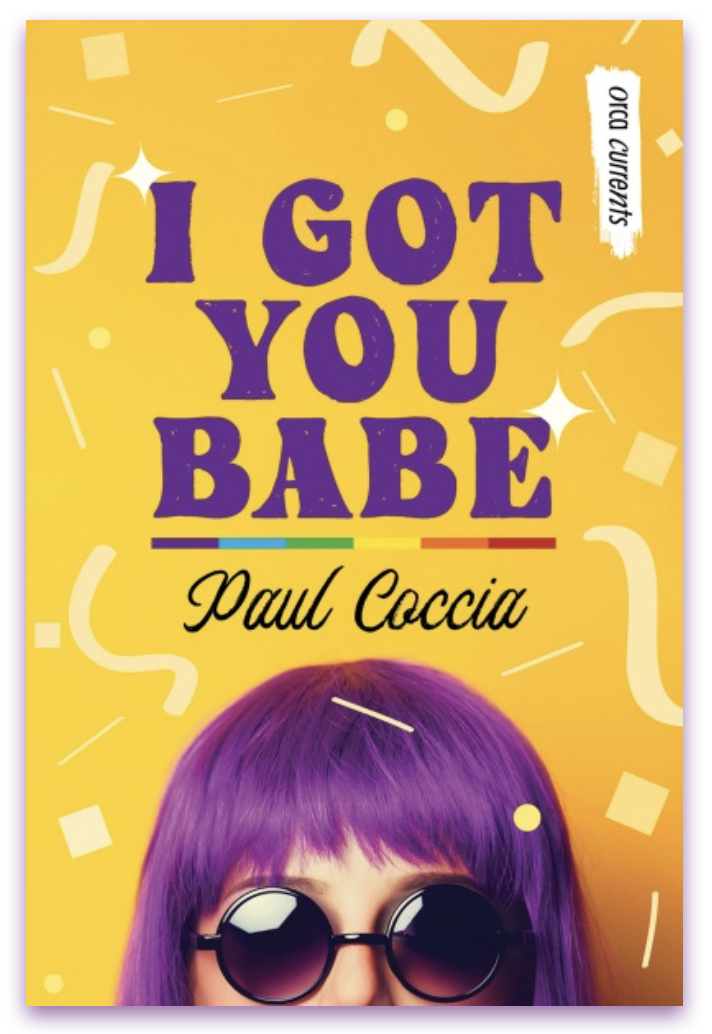
I Got You Babe
Written by Paul Coccia
Orca Book Publishers
978-1-459834705
120 pp.
Ages 9-13
Release February 14, 2023
Yesterday CanLit for LittleCanadians reviewed Paul Coccia's upcoming novel, I Got You Babe. Today I present an interview conducted by student Hasini K. with author Paul Coccia. 13-year-old Hasini read I Got You Babe and prepared questions for author Paul Coccia to delve a little deeper into his new book. Paul Coccia, ever gracious, agreed to answer her questions and even visited with Hasini virtually to chat about the book.
Here is their Q & A.
 |
| Author Paul Coccia |
• • • • • • •
Hasini: In the novel, Mac and Amy propose to change the annual Fun Fair into a Pride Carnival theme. Their idea is welcomed and the committee supports the change. What would you say to your LGBTQ+ readers if they find themselves in a less than supportive environment?
Paul Coccia: My first concern would always be whether a reader is in harm’s way. I wouldn’t want to see someone in physical or emotional trouble due to advocating for something they believe in nor would I want them in an environment that is damaging to their well-being. That aside, I would advise trying to open a dialogue. Be forthcoming about how you see the issue and try to understand why someone may object. The opposition may be something practical like budget constraints as in I Got You Babe. If the environment or people can’t or won’t be supportive, then I would suggest finding spaces and people that can. Too often, we give too much time and space to negative people or situations and, if possible, actively choosing positive things and giving them time in your life is a healthy move.
Hasini: I really appreciated Mac’s desire for scheduling and organizing all the tasks needed for the Pride Carnival Fun Fair. Would you say that this represents you or how might you be different?
Paul Coccia: I do enjoy planning and organization and am impressed by someone who can pull off a big event and make it seem effortless. Where I differ from Mac is, as a writer, sometimes it’s a lot more satisfying to plan something in my mind than it is to actually do the work to get it going in reality. When I’m writing (or reading for that matter), there are more possibilities. In my mind, I throw these really elaborate parties with the best food and all my friends get to come. I plan them, but I might need an Amy in my life to push me to get it done.
Hasini: When brainstorming for the Fun Fair, Mac had a lot of great ideas for the Pride Carnival theme. Naturally, he was disappointed when the committee told him too many were unrealistic and they didn’t have the budget for all of it. What would you say to kids who have to deal with disappointment?
Paul Coccia: Disappointment, unfortunately, is something we all deal with. Authors and illustrators will tell you, we get these fantastic ideas, and sometimes they don’t end up turning into books. At least not easily. A lot of times, it is due to factors entirely out of our control. I started trying to get published at 17. It took me a couple of decades to get one of my great ideas turned into my first book. Being patient and waiting for a moment to arrive is incredibly frustrating and disheartening. Sharon Jennings’ Unravel is a great example of a book that took her over a decade to get published and it became a Governor General’s Award Finalist. So, don’t give up. Your best ideas will find their time and place if they’re important to you.
Hasini: Mac and Amy have a very strong friendship. How might this friendship inspire the readers of your book? Also, do you have a friendship that inspired these characters?
Paul Coccia: The backstory! Mac and Amy were inspired by my younger brother and his friend. They met before kindergarten and have remained close since. In eighth grade, they put on a Sonny and Cher routine for the school talent show where she was Sonny and he was Cher.
I hope one takeaway is that in a friendship, there can be room for two divas with lots of mutual respect. That can mean taking time to listen to someone and hear what they want and need not just try to pull them into orbit around you no matter how fabulous you are.
I hope one takeaway is that in a friendship, there can be room for two divas with lots of mutual respect. That can mean taking time to listen to someone and hear what they want and need not just try to pull them into orbit around you no matter how fabulous you are.
Hasini: I noticed that pronouns weren’t used for Mac for the first 50 pages of the book. Was there a specific reason you delayed using the pronoun ‘he’?
Paul Coccia: I wish I had been clever enough to notice! I would have removed the rest of the masculine pronouns and left the decision on pronouns up to the reader. Readers are already active participants in books so I’d be happy to let them decide. Alas, I was not that smart. From a craft perspective, the story is told from the first-person point of view and Mac usually refers to himself as ‘I’ or ‘me’ while others call him by name or ‘you.
Hasini: I love that the name Chandra was used in your book. I am not used to seeing my culture represented in books. Was there a reason for the name choices of your characters?
Paul Coccia: I, and so many authors and illustrators I know, intentionally try to be inclusive when we create stories. Part of that means finding ways and places for all sorts of characters to exist in the worlds we write. First and last names are an understated tool for any writer as they have the benefit of characterizing quickly and efficiently by hinting at cultural heritage. Amy’s and Mrs. Khatri’s surnames did this too. That aside, Chandra is a beautiful name. There is a goldmine of names that are not used enough that authors can look up. When I am trying to include a character that has a specific heritage or background, I look up the most popular baby names or surnames in the country the character’s family would have originated from for the year I imagine the character was born.
Hasini: Mac is insistent on representing a strong woman in the Pride Carnival Talent Show. Why did you choose for him to want this? How might you have participated in the show if you were one of the characters?
Paul Coccia: Personally, I was so lucky to grow up in a house with many strong women so I tend to bring that into my writing whenever I can. I also really, really love Cher. She is the Goddess of Pop!
The LGBTQ+ community, in particular gay men, has looked toward strong and often transgressive people, notably women, as icons. Often, these women are such strong allies to the Queer Community. When I think of Mac, he really does have a strong sense of who he is and that, like many icons, he’s ahead of his time. He would naturally identify with a larger-than-life celebrity like Cher who has remained relevant for decades throughout her career.
The LGBTQ+ community, in particular gay men, has looked toward strong and often transgressive people, notably women, as icons. Often, these women are such strong allies to the Queer Community. When I think of Mac, he really does have a strong sense of who he is and that, like many icons, he’s ahead of his time. He would naturally identify with a larger-than-life celebrity like Cher who has remained relevant for decades throughout her career.
As for a talent show routine, I lean more toward visual art or culinary arts. If I could bake on stage, I’d have a decent shot at winning something. I can’t sing or dance though, not that that stopped Mac.
Hasini: It is mentioned briefly in the story that Mac deals with bullies in the school. What would you say to kids reading the book who are dealing with bullying?
Paul Coccia: If you’re being bullied, seek help. This could mean finding an adult or authority figure to intervene or seeking professional help. This may be hard to do as I’ve found an element of shame and self-doubt accompanies being bullied. Finding a way to stop the bullying and healing from it is important.
If you are a bully, I would strongly suggest you reflect and consider if this is the person you want to be. Perhaps you didn’t intend what happened. Then you should apologize and make amends. If you did intend to hurt someone, I wonder if this is a moment to be proud of. We all make mistakes and our actions have the effect of bringing us closer to a version of ourselves we’re proud for the world to see or farther away.
If you are a bully, I would strongly suggest you reflect and consider if this is the person you want to be. Perhaps you didn’t intend what happened. Then you should apologize and make amends. If you did intend to hurt someone, I wonder if this is a moment to be proud of. We all make mistakes and our actions have the effect of bringing us closer to a version of ourselves we’re proud for the world to see or farther away.
Hasini: In the book, Mac’s mom makes some creative meals like kimchi hot dogs. I see on Twitter that you are quite the baker. Did you have creative meals at home growing up that influenced you and your character, Mac?
Paul Coccia: We are an adventurous family for eating and cooking. I think having parents and grandmothers from different backgrounds in the house helped, as well as growing up in an area of Toronto different from our backgrounds. My family loves trying different foods from around the globe, whether we cook it or it is takeout. Our most inventive and peculiar dishes always come out of repurposing leftovers. Thanksgiving dinner does really well with a Tex-Mex influence. Spaghetti makes a non-traditional but surprisingly satisfying pad Thai. It’s fun and a challenge to see how we can switch up a dish and turn it into something new. Similarly, in my first novel, Cub, the main character is particularly interested in fusion when he cooks. Food culture is one more place to literally feed my curiosity.
• • • • • • •
Many thanks to both Hasini K. and author Paul Coccia for this interview. Hasini asked wonderfully in-depth questions about the writing and story of I Got You Babe and Paul Coccia gave us great insight into his process and motivation. I'm so pleased to share their interview with CanLit for LittleCanadians readers.
 |
| Graphic from Orca Book Publishers |


