Showing posts with label support. Show all posts

October 06, 2025

Together: A Book about Community

Written and illustrated by Elise Gravel
North Winds Press (Scholastic Canada)
978-1-0397-1283-6
40 pp.
Ages 6–9
October 2025
 
As Canadians head into their Thanksgiving weekend, many will be thinking about the concept of community. What is a community? Why should we have communities? Do I have a community? How do I make a community? While a big concept in general, community will be a vague concept for young children. They might know the benefits of community, but grasping the nuances of community may be more challenging. Thankfully, Elise Gravel, author-illustrator of concept books like It's My Brain! (2024),  It's My Body! (2022), and Everybody! (2021), is heartily up for that challenge.
 
From Together: A Book about Community, written and illustrated by Elise Gravel
In Together: A Book about Community, Elise Gravel begins with statements about living in groups because it makes us feel safe and wanted. She show her colourful monsters helping those in need with medical attention, or sharing their food with those without, or lending a hand as needed. She even depicts one monster helping another who is being bullied for being different. The message is clear: Together we are better, safer, and happier.
From Together: A Book about Community, written and illustrated by Elise Gravel
Still, Elise Gravel is realistic in accepting that we don't always like other people, whether it is because they make us feel inadequate or unsafe. But, by rectifying injustice, sharing, and helping others, we build communities that are strong and safe and in which everyone feels respected.
From Together: A Book about Community, written and illustrated by Elise Gravel
Elise Gravel's little monsters again help young children understand a challenging concept like community. It's clear that her message is that we all belong and, with that belonging, comes strength and goodness. She doesn't make Together: A Book about Community a preachy book about getting along with others—although that message is clear—or how to make a community. Instead, Elise Gravel presents it as something to consider. In other words, if you help build community, these are the great things that happen for you and others. And because Elise Gravel's monsters are so adorable and completely unscary, as well as diverse in so many ways, the idea is demonstrated with delightful humour and unusual clarity. Togetherness has never been so much fun or so understandably constructive.
From Together: A Book about Community, written and illustrated by Elise Gravel

February 28, 2024

Everyone Gets a Turn

Written and illustrated by Marianne Dubuc
Princeton Architectural Press
978-1-7972-2729-0
60 pp.
Ages 3-6
March 2024 

Turtle, Hare, Bear and Mouse are spending a beautiful day in the forest, when they discover an egg. They decide they will each take turns caring for it. 
From Everyone Gets a Turn, written and illustrated by Marianne Dubuc
At Mouse's house, a voice from within the egg declares that it is cold so Mouse hurries to remedy that. First, Mouse lays a fire and then he wraps the egg in a scarf and a hat. Mouse is very kind and accommodating,

The next day Mouse takes Little Egg to Bear's house. But Bear's lifestyle is a little more active, and while he exercises Little Egg cracks. Though it's apparently too tight inside the shell for Little Egg now, it needs a little help to get out. When Little Bird finally emerges, exhausted for her efforts, Bear offers comfort.
From Everyone Gets a Turn, written and illustrated by Marianne Dubuc
Then, it's on to Hare's house where the rabbit is surprised to see a bird, not an egg. But now Hare has to meet another need for their new ward: food. And though Hare has a stacked pantry, it's a bit of a mystery what Little Bird will eat.  
 
Finally Little Bird is taken to Turtle's place, a house of wonders. It’s filled with trinkets that have stories and that sparkle and that amaze Little Bird and make her dream.  
From Everyone Gets a Turn, written and illustrated by Marianne Dubuc
But when Turtle wakes up the next day, he is bereft that she is missing. All the friends are in tears, until they realize that Little Bird’s absence is just the next step in the bird’s development. Gone from one place, or four places, does not mean gone forever.

 
Each of the friends gets a turn with Little Egg/Little Bird and each excels at giving their ward exactly what she needs, whether it’s a little warmth, a little assistance in cracking the shell, sustenance, or the inspiration to dream. Like parents who must support and encourage their children until they are ready to become independent, the four friends learn to work together to be everything Little Egg/Little Bird needs until she can do for herself. And just because she has become independent, it doesn’t mean that she longer wants them in her life. Marianne Dubuc gives us a story that all parents will need to learn sometime in their children’s journey to adulthood. Her message is one of love and support but also the courage to let them fly and be their own selves. 
 
Marianne Dubuc has always created soft worlds, just as she did in On Baba's Back, Bear and the Whisper of the Wind, and Little Cheetah's Shadow. Like Beatrix Potter, who could see worlds and relationships within the animals of the natural world, Marianne Dubuc takes us into their homes, the forests, and the meadows with her subtle use of ink, watercolour, and coloured pencil. She shows us ourselves as we are or could be: friends, parents, children, good people. And she teaches sophisticated lessons of sharing and caring delivered by sweet creatures who are uniquely themselves, while being supportive and cooperative. And though a message about sharing and taking turns may seem paramount according to the title, Everyone Gets a Turn also speaks to the steps we all take in our development, going from needing to be nurtured to shifting to self-actualization.

November 10, 2023

All We Need is Love and a Really Soft Pillow!

Written and illustrated by
 Peter H. Reynolds and Henry Rocket Reynolds
Orchard Books (An Imprint of Scholastic Inc.)
978-1-338-57233-9
40 pp.
Ages 4-8
October 2023 

In yet another heartfelt book in his collection, Peter H. Reynolds, this time in collaboration with his son Henry Rocket Reynolds, shows us that the Beatles were always right: all you need is love, though a really soft pillow doesn't hurt either!
 
All We Need is Love and a Really Soft Pillow! is a touching dialogue between Little One and their caregiver Poppy. As they are cutie-pie furry creatures, young readers can engender them or not, because it doesn't really matter whether Poppy is mother or father, grandparent, or older sibling. What matters is the love, and the love is stronger than the labels.
 
From All We Need is Love and a Really Soft Pillow!, written and illustrated by Peter H. Reynolds and Henry Rocket Reynolds
It all starts when Little One asks Poppy whether they need anything. That simple question leads to a sweet heart-to-heart discussion about what we really need. 
Little One,
I’ve got YOU!
We’ve got LOVE!
Love is all
we need!
But then Little One thinks about all the other things that might be nice to have, starting with a really soft pillow. Poppy always concurs with Little One’s ideas, from that pillow to a roof, walls, water and more. With each addition, Poppy acquiesces to Little One’s suggestions, recognizing that it would certainly be useful or sweet, something to add to their life together. Their simple life, now immortalized in a wall hanging, grows with their new shelter and water, as well as chocolate, a cooking pot, a bathtub, a toilet, vegetable garden and books. It’s a lovely life. That is, until a storm hits, and all is lost. Poppy reassures Little One that they still have each other and love, so that’s all they really need.
From All We Need is Love and a Really Soft Pillow!, written and illustrated by Peter H. Reynolds and Henry Rocket Reynolds
Disasters have always hit, from fires and floods to hurricanes and tornadoes, and people have experienced extraordinary losses. While never diminishing the impact of those disasters, Peter H. Reynolds and Henry Rocket Reynolds remind us that, even with the loss of our material things, with love, we can move forward.
Each day
is a new day.
A new chance to count
our blessings and
savor the journey with
those we love.
All We Need is Love and a Really Soft Pillow! is a delightful take on being grateful for what you have and more importantly for the love and support you get. I know many adults who need to understand this message but entitled children who get whatever they want, framing their requests as "I need..." could also benefit from a read of All We Need is Love and a  Really Soft Pillow! Children see what others have and think they need the same, but if this picture book does anything it shows that a close caregiver-child relationship based in love can make room for other things but can also sustain itself with that affection.
From All We Need is Love and a Really Soft Pillow!, written and illustrated by Peter H. Reynolds and Henry Rocket Reynolds
Though Peter H. Reynolds often has stylized people for his characters (see some samples below), the warm-fuzzy creatures of All We Need is Love and a Really Soft Pillow! are anything but human. They may have two eyes, two arms and two legs and walk upright but their similarities to people end there. By drawing them as something other than humanistic, Peter H. Reynolds surprisingly makes the story even more inclusive. Children don't have to see themselves in the characters to empathize with their situations. They will simply understand what it could mean to feel love and to give love and to support those we love, even in times of great loss. Poppy and Little One could be any caregiver and young person, furriness or hairiness aside.
From All We Need is Love and a Really Soft Pillow!, written and illustrated by Peter H. Reynolds and Henry Rocket Reynolds
There's an eyes-wide-open quality to Peter H. Reynolds's stories, demonstrating for us how we can be the best we can be, whether in pursuing our dreams, being ourselves, accepting others, or being grateful for what we have. In collaboration with his son, Henry Rocket Reynolds, Peter H. Reynolds has given us another important message and reminded us that, if we have love, we might just have everything.

• • • • • • •

Some books of the Peter H. Reynolds collection (with Orchard Books)

Be You! (2020)
Little Happy Dreamer (2020)
Our Table (2021)
Love You By Heart (2022)
All We Need is Love and a Really Soft Pillow! (2023)

October 03, 2023

We Belong Here

Written by Frieda Wishinsky
Illustrated by Ruth Ohi
North Winds Press (Scholastic Canada)
978-1-4431-9403-7
32 pp.
Ages 6-8
October, 2023  
 
Eve Bloom hated being called a greenhorn especially since, although she'd been born in another country, she'd lived here since she'd been little. She often found solace, and the privacy to cry, at a special place on a high rock in the park.
From We Belong Here, written by Frieda Wishinsky, illustrated by Ruth Ohi
When a new boy, Mark Nakamura, comes to her school, he is ridiculed for being Japanese. Eve goes to his defense to stop the bullies and takes him to her special rock. In gratitude, he gives her a small turtle he'd carved. Together the two enjoy imaginative storytelling and talk about their families. They became fast friends, spending time at the back of Eve's parents' store, Bloom's Delicious Foods, and at Mark's apartment. 
From We Belong Here, written by Frieda Wishinsky, illustrated by Ruth Ohi
But then Mark's father, a craftsman with wood, loses his job at the factory because a customer didn't want a Japanese man to make his furniture. Moreover, Eve's parents are shaken when a faulty shelf almost injures a customer who threatens that no one will shop there with a new market opening nearby. By bringing their families together, both the Blooms and the Nakamuras get what they need: support, work, customers, and the welcome that says they are appreciated in their community.
From We Belong Here, written by Frieda Wishinsky, illustrated by Ruth Ohi
We Belong Here may seem like a simple story of children and families of two different cultures, Jewish and Japanese, helping each other to be accepted by their community. But, because of Frieda Wishinsky and Ruth Ohi's back stories, We Belong Here is a much bigger story and one of great historical and contemporary relevance. The need to belong and be accepted is universal. And to not be accepted because of arbitrary qualities like place of birth, religion, language, physical differences, and such is unacceptable. But, differences are what create us and bond us. They improve our lives by opening our minds and our hearts. And with that comes understanding, compassion, and harmony. When Frieda Wishinsky and Ruth Ohi brought Eve and Mark and their families together, they could confront the prejudice both head on and discreetly. Whether challenging those who mistreat a classmate or supporting someone by hiring them for a work project, these efforts remind everyone that strength and courage come with compassion, not force.

This is a story borne of deeply personal stories. As readers will learn tomorrow in my interview with Frieda Wishinsky and Ruth Ohi, their connections are very real and make the story even more personal. But the way they tell the story, readers will not be left with remembering the nastiness but instead smell the rugelach in Eve's family's store, feel the smoothness of Mark's carvings, and appreciate the coming together of people to shop, to work, to play. Through Frieda Wishinsky's sincere words, I hear friendship, and through Ruth Ohi's art, I see kindness in a different time. Together they are melded into one story, one lesson in compassion, and one to uplift and reassure that intolerance can be overcome.
 
• • • • • • •
 
For a little something extra about We Belong Here, check back tomorrow for my interview with author Frieda Wishinsky and illustrator Ruth Ohi.
• • • • • • •

January 24, 2023

I Got You Babe: Guest interview with author Paul Coccia

I Got You Babe
Written by Paul Coccia
Orca Book Publishers
978-1-459834705
120 pp.
Ages 9-13
Release February 14, 2023


Yesterday CanLit for LittleCanadians reviewed Paul Coccia's upcoming novel, I Got You Babe. Today I present an interview conducted by student Hasini K. with author Paul Coccia. 13-year-old Hasini read I Got You Babe and prepared questions for author Paul Coccia to delve a little deeper into his new book. Paul Coccia, ever gracious, agreed to answer her questions and even visited with Hasini virtually to chat about the book. 

Here is their Q & A.
 
Author Paul Coccia

 • • • • • • •
Hasini:  In the novel, Mac and Amy propose to change the annual Fun Fair into a Pride Carnival theme. Their idea is welcomed and the committee supports the change.  What would you say to your LGBTQ+ readers if they find themselves in a less than supportive environment?


Paul Coccia:  My first concern would always be whether a reader is in harm’s way. I wouldn’t want to see someone in physical or emotional trouble due to advocating for something they believe in nor would I want them in an environment that is damaging to their well-being. That aside, I would advise trying to open a dialogue. Be forthcoming about how you see the issue and try to understand why someone may object. The opposition may be something practical like budget constraints as in I Got You Babe. If the environment or people can’t or won’t be supportive, then I would suggest finding spaces and people that can. Too often, we give too much time and space to negative people or situations and, if possible, actively choosing positive things and giving them time in your life is a healthy move.


Hasini:  I really appreciated Mac’s desire for scheduling and organizing all the tasks needed for the Pride Carnival Fun Fair.  Would you say that this represents you or how might you be different?

 
Paul Coccia:  I do enjoy planning and organization and am impressed by someone who can pull off a big event and make it seem effortless. Where I differ from Mac is, as a writer, sometimes it’s a lot more satisfying to plan something in my mind than it is to actually do the work to get it going in reality. When I’m writing (or reading for that matter), there are more possibilities. In my mind, I throw these really elaborate parties with the best food and all my friends get to come. I plan them, but I might need an Amy in my life to push me to get it done.


Hasini:  When brainstorming for the Fun Fair, Mac had a lot of great ideas for the Pride Carnival theme.  Naturally, he was disappointed when the committee told him too many were unrealistic and they didn’t have the budget for all of it.  What would you say to kids who have to deal with disappointment?

 
Paul Coccia:  Disappointment, unfortunately, is something we all deal with. Authors and illustrators will tell you, we get these fantastic ideas, and sometimes they don’t end up turning into books. At least not easily. A lot of times, it is due to factors entirely out of our control. I started trying to get published at 17. It took me a couple of decades to get one of my great ideas turned into my first book. Being patient and waiting for a moment to arrive is incredibly frustrating and disheartening. Sharon Jennings’ Unravel is a great example of a book that took her over a decade to get published and it became a Governor General’s Award Finalist. So, don’t give up. Your best ideas will find their time and place if they’re important to you.


Hasini:  Mac and Amy have a very strong friendship.  How might this friendship inspire the readers of your book?  Also, do you have a friendship that inspired these characters?

 
Paul Coccia:  The backstory! Mac and Amy were inspired by my younger brother and his friend. They met before kindergarten and have remained close since. In eighth grade, they put on a Sonny and Cher routine for the school talent show where she was Sonny and he was Cher.

I hope one takeaway is that in a friendship, there can be room for two divas with lots of mutual respect. That can mean taking time to listen to someone and hear what they want and need not just try to pull them into orbit around you no matter how fabulous you are.


Hasini:  I noticed that pronouns weren’t used for Mac for the first 50 pages of the book.  Was there a specific reason you delayed using the pronoun ‘he’?

 
Paul Coccia:  I wish I had been clever enough to notice! I would have removed the rest of the masculine pronouns and left the decision on pronouns up to the reader. Readers are already active participants in books so I’d be happy to let them decide. Alas, I was not that smart. From a craft perspective, the story is told from the first-person point of view and Mac usually refers to himself as ‘I’ or ‘me’ while others call him by name or ‘you.


Hasini:  I love that the name Chandra was used in your book.  I am not used to seeing my culture represented in books.  Was there a reason for the name choices of your characters?  

 
Paul Coccia:  I, and so many authors and illustrators I know, intentionally try to be inclusive when we create stories. Part of that means finding ways and places for all sorts of characters to exist in the worlds we write. First and last names are an understated tool for any writer as they have the benefit of characterizing quickly and efficiently by hinting at cultural heritage. Amy’s and Mrs. Khatri’s surnames did this too. That aside, Chandra is a beautiful name. There is a goldmine of names that are not used enough that authors can look up. When I am trying to include a character that has a specific heritage or background, I look up the most popular baby names or surnames in the country the character’s family would have originated from for the year I imagine the character was born.


Hasini:  Mac is insistent on representing a strong woman in the Pride Carnival Talent Show.  Why did you choose for him to want this?  How might you have participated in the show if you were one of the characters?

 
Paul Coccia:  Personally, I was so lucky to grow up in a house with many strong women so I tend to bring that into my writing whenever I can. I also really, really love Cher. She is the Goddess of Pop!

The LGBTQ+ community, in particular gay men, has looked toward strong and often transgressive people, notably women, as icons. Often, these women are such strong allies to the Queer Community. When I think of Mac, he really does have a strong sense of who he is and that, like many icons, he’s ahead of his time. He would naturally identify with a larger-than-life celebrity like Cher who has remained relevant for decades throughout her career. 
 
As for a talent show routine, I lean more toward visual art or culinary arts. If I could bake on stage, I’d have a decent shot at winning something. I can’t sing or dance though, not that that stopped Mac.


Hasini:  It is mentioned briefly in the story that Mac deals with bullies in the school. What would you say to kids reading the book who are dealing with bullying?

 
Paul Coccia:  If you’re being bullied, seek help. This could mean finding an adult or authority figure to intervene or seeking professional help. This may be hard to do as I’ve found an element of shame and self-doubt accompanies being bullied. Finding a way to stop the bullying and healing from it is important.

If you are a bully, I would strongly suggest you reflect and consider if this is the person you want to be. Perhaps you didn’t intend what happened. Then you should apologize and make amends. If you did intend to hurt someone, I wonder if this is a moment to be proud of. We all make mistakes and our actions have the effect of bringing us closer to a version of ourselves we’re proud for the world to see or farther away.


Hasini:  In the book, Mac’s mom makes some creative meals like kimchi hot dogs.  I see on Twitter that you are quite the baker.  Did you have creative meals at home growing up that influenced you and your character, Mac?
 
Paul Coccia:  We are an adventurous family for eating and cooking. I think having parents and grandmothers from different backgrounds in the house helped, as well as growing up in an area of Toronto different from our backgrounds. My family loves trying different foods from around the globe, whether we cook it or it is takeout. Our most inventive and peculiar dishes always come out of repurposing leftovers.  Thanksgiving dinner does really well with a Tex-Mex influence. Spaghetti makes a non-traditional but surprisingly satisfying pad Thai. It’s fun and a challenge to see how we can switch up a dish and turn it into something new. Similarly, in my first novel, Cub, the main character is particularly interested in fusion when he cooks. Food culture is one more place to literally feed my curiosity.

 • • • • • • •
 
Many thanks to both Hasini K. and author Paul Coccia for this interview. Hasini asked wonderfully in-depth questions about the writing and story of I Got You Babe and Paul Coccia gave us great insight into his process and motivation.  I'm so pleased to share their interview with CanLit for LittleCanadians readers.

Graphic from Orca Book Publishers

August 16, 2022

Blanket

Written and illustrated by Ruth Ohi
Groundwood Books
978-1-77306-614-1
32 pp.
Ages 3-6
August 2022 
 
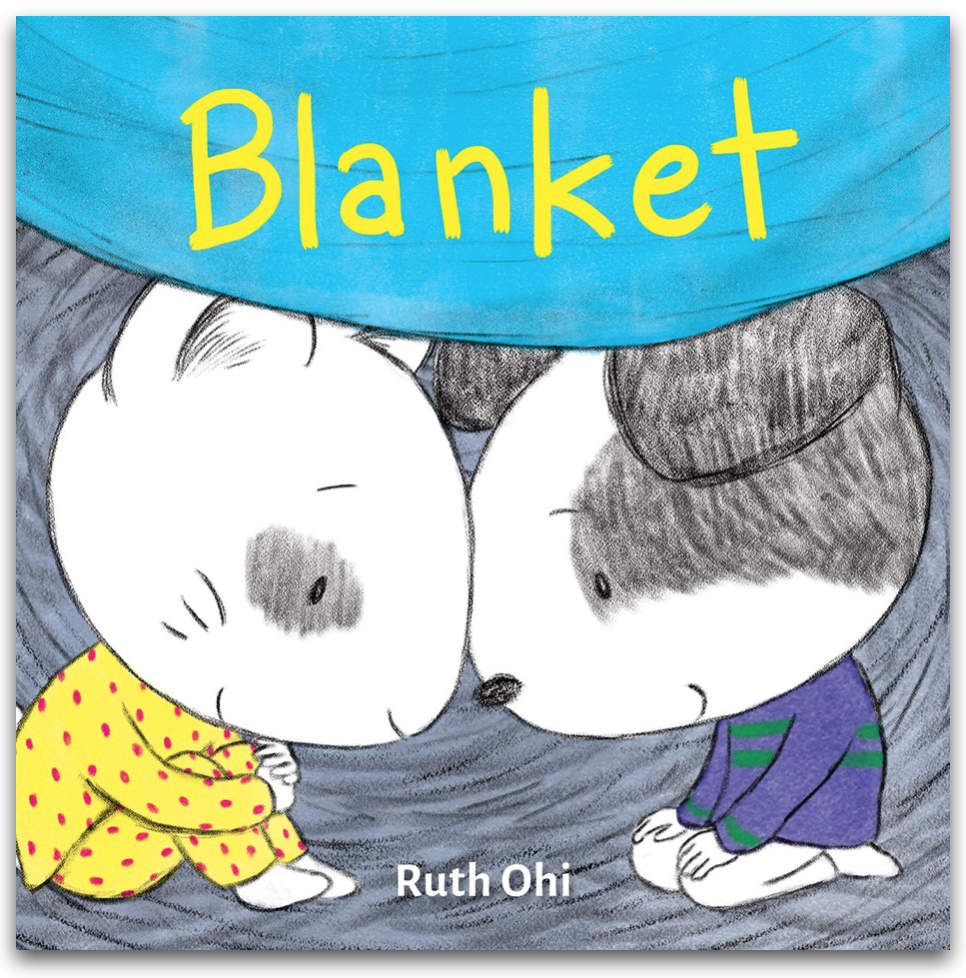
Readers and writers know the power of words. Words can evoke and reassure, anger and subdue, and enlighten and confuse. They can do it all, or it would seem. But sometimes words aren't needed for an impact to be made. Author and illustrator Ruth Ohi makes this subtle and powerful point with her first wordless picture book, Blanket.
From Blanket by Ruth Ohi
Sometimes it doesn't matter if it's sunny outside and the birds are chirping and the flowers are blooming. Inside, really deep inside, is where it can still be grey and that sunshine cannot reach. Yet.
From Blanket by Ruth Ohi
When Cat awakens to the grey inside, they take their turquoise blanket and burrow under it. When Dog shows up, they see the lump that is Cat beneath the blanket, but Dog does not demand anything of Cat. Dog sits down nearby and quietly reads. With time and still beneath the blanket, Cat snuggles over to Dog. Eventually, Cat lifts the blanket and allows Dog to enter and share their protected space.

It's obvious that, while the darkness beneath the blanket offers Cat security, it is also a place where fears can grow and take over. But Dog has a flashlight and the two play with the light before Dog suggests using the blanket to create a shelter over two chairs. It gives Cat the security they need but offers more light and something else. It's a first step to feeling safe enough to venture outside and transform the blanket from shield to shared comforter.
From Blanket by Ruth Ohi

While Ruth Ohi's charming animals are easily recognizable for their sweetness and emotional depth, Blanket is so different from her earlier picture books because of its wordless nature. I've always been delighted with Ruth Ohi's books (e.g., No Help Wanted; Fox and Squirrel, The Best Christmas Ever; Kenta and the Big Wave); still, Blanket is so impressive in its story and messaging that it will sit with me for a very long time. (Though I love sharing books with others, I'll be holding on to Blanket for myself.) Blanket reminds us that, if someone is dealing with sadness or depression, it is not up to others to decide how to help them. When an individual is dealing with an internal greyness, everyone wants to help but seldom–only in dire circumstances–should another decide what is needed. Dog knows this. With time and patience, a flashlight and some playfulness, Dog is able to offer Cat opportunities to come out from the shadows of the blanket. It's still up to Cat when they are ready to move from beneath the blanket into the light. And with few colours and strategic lines of smiles and eyes that are dim and then bright, Ruth Ohi tells us all this in her moving illustrations. Even in the darkness of Cat's sadness, Ruth Ohi has given us light through her art.

A blanket can be so much more than a coverlet for a bed. It can be shelter and armour, defense and offense, and love and fear. It can hide and reveal. This is Cat's blanket. It offers them the opportunity to hide from the world but also reveals Cat as they are to Dog. There is power in that blanket for good and I'm so glad that Cat used it as they needed and that Dog was there to take their cues from Cat.

June 23, 2022

Annie's Cat is Sad


Written by Heather Smith
Illustrated by Karen Obuhanych
Feiwel and Friends
978-1-250-80684-0
32 pp.
Ages 4-8
June 2022
 
When Annie comes home from school and her cat Delilah does not rush to see her or even want to hang out with her, Annie is convinced that Delilah is sad. But what to do when your cat is sad?
From Annie's Cat is Sad by Heather Smith, illus. by Karen Obuhanych
Though Annie is delighted to see Delilah, having missed her while at school, she needs to seek out her cat. But Delilah seems to want to be alone, hiding beneath the sofa. Annie understands and tries to do whatever she can to draw Delilah out and make her happy.
From Annie's Cat is Sad by Heather Smith, illus. by Karen Obuhanych
She warms some milk, tops it with whipping cream, makes a joke–it's a cattuccino–and offers a hug. Then Annie turns on the TV and invites Delilah to join her in some yoga, making up her own colourful poses.
From Annie's Cat is Sad by Heather Smith, illus. by Karen Obuhanych
But as she tries to engage Delilah, it's obvious that it's Annie who has had a bad day, and it may be Delilah who will help the orange-haired child deal with her sadness when the other strategies don't work.

No one likes to see someone they care for in distress, whether from fear or sadness or trauma. While a young reader will undoubtedly understand a beloved pet who is not acting like itself and be concerned, they will also empathize with coming home from a bad day at school and looking to their furry friend for solace. As a parent and a kind person, Heather Smith understands this and makes sure that children will accept that bad days happen and there are different ways to cope. Sometimes those strategies work and sometimes they don't. But the best thing to do is try to find what works for you. It may just be a cuddle with a cat who understands better than you that sadness has taken hold. 

It's a very light touch that Heather Smith has taken with Annie's Cat is Sad. She can do angsty and heavy (The Agony of Bun O'Keefe and Chicken Girl are but two young adult examples) but Heather Smith excels at the subtle, allowing young people to take from the text the meaning that they need to read. (Her award-winning The Phone Booth in Mr. Hirota's Garden is another prime example.) That's especially poignant when her readers need to read between the lines and with cues from Hawaii's Karen Obuhanych's illustrations. Take the understated line, "I just want you to know. It's okay to cry." with an illustration of a tear dropping from Annie's eye as a large-eyed Delilah watches. We as readers may be watching Delilah for most of the story, wondering what it would take to make her less sad, and charmed by Karen Obuhanych's grey tabby with the pink nose and green eyes. But, Annie with her voluminous ginger hair is really the star and young readers will want to go back over the story is find the clues that it was really Annie who was dealing with the bad day.

Whether feline or human, child or adult, we have bad days. And, as Annie ostensibly strives to help Delilah through hers, she provides examples for all to distract themselves from their temporary troubles, and assure them that support can be found, especially when you share your burdens.

December 24, 2021

On the Line

Written by Paul Coccia and Eric Walters
Orca Book Publishers
978-1-45982-713-4
312 pp.
Ages 9-13
March 2022
 
"...if you're down twenty points in the last two minutes, you still play your best..." (pg. 52)
What's on the line for thirteen-year-old Jordan Ryker? Everything. His parents can't stop arguing. The auto plant where his dad works, being the town's major employer, is shutting down. Even basketball, which is everything to Jordan and his best friend Junior, is somewhat tenuous with the school's new basketball coach who really doesn't know what he's doing. And now Jordan has to figure out how to work with new kids, brother and sister Aaron and Tammy, who are very different and both want on the boys' basketball team.  

Most unexpectedly, Jordan's dad moves out and reveals that he's gay. In a community where everybody knows everyone else's business, Jordan is not dealing well with it. Junior tries to help Jordan see the courage his dad is showing in being true to himself finally, and Tammy with whom Jordan starts going out is all about supporting social justice issues and even starts a Gay-Straight Alliance club at the school. But it's all too much for Jordan who responds to his parents' separation and his father's coming out with frustration and anger. 

At thirteen, Jordan is already dealing with a lot of new situations. He's thinking about girls but is both intrigued and uncomfortable with them. He's been struggling with an unstable home situation, which then becomes even more dubious as he tries to adjust to two different lives and a father different than the one he thought he always knew. Worse yet, Jordan takes it all personally, convinced that he is the aggrieved party, rather than seeing beyond himself what others may be feeling and experiencing. He can't see the efforts that everyone around him are making to support him and themselves in what they need. Sadly, though Junior, Tammy and others try to help him accept their support, there are some whose homophobic and narrow-minded perspectives on the Ryker family cause more tension for all. 

There's a great story here but it's Paul Coccia and Eric Walters's characters that carry On the Line. With Jordan, they have given us a typical young man in a somewhat unusual familial situation. They've created a kid who loves his family, hates their fighting, is starting to have romantic feelings, and is angry and frustrated because none of his life feels straightforward or easy anymore. I don't know many who would choose to go through puberty again but to compound that tension with confusion about your father and his relationship with you would be overwhelming, as it is for Jordan. Then there's his father who is trying to navigate a new relationship with his son, with his wife, with his community and even a new partner but most of all with himself. There's Tammy who strives for the world to be fair to her and to others. She challenges the school for her right to be on the boys' basketball team. She's all about diversity and inclusion and she wants others to be the same. Even Junior and Aaron are developed into full characters that add contrast and meaning to On the Line.

This is the first writing collaboration between Paul Coccia and Eric Walters and, having reviewed books by both previously, I can attest to a new synergy to their writing as they bring their strengths in plotting, character development, and voice and meld them with LGBTQ+ issues and sports into something new and important. They've given us a story that challenges young readers to see beyond themselves and from different perspectives and with compassion for the struggles that others may be experiencing. With heart and intention, they've put themselves out there and helped us see from that angle what's really meaningful: friends, family, and fair play for all.

October 04, 2021

Sorry For Your Loss

Written by Joanne Levy
Orca Book Publishers
978-1-4598-2707-3
250 pp.
Ages 8-13
October 2021 

Yes, Sorry For Your Loss is about death and grief. But it's also about respect and honour, life and support, and friendship and family. It's about being there for people, both the living and the dead.
"...being there for people in their time of need is an honor." (pg. 32)
During the summer between her Grade 7 and Grade 8 school years, 12-year-old Evie Walman is working part-time at her family's funeral home, Walman Memorial Chapel. She replenishes supplies like toilet paper and paper towels, ensures visitors have a ready supply of tissues, and does general tidying and vacuuming. She doesn't mind. She wants to be a funeral director like her dad and intends to learn all she can from him and her mother whose counselling background makes her a full partner in the family business. Evie has learned much about the Jewish funeral traditions and how to be respectful but sometimes her chattiness gets the better of her. However, that talkativeness may be just what is needed when she meets Oren Katzman.

After a terrible car accident which killed his parents and left him with bruises and in stitches, as well as an arm cast, Oren no longer speaks. Evie meets Oren while his uncle, Jared Silver, makes arrangements at Walman's, but, though she tries to help, she ends up feeling like she says all the wrong things. She does put her craft skills to work creating a paper quilling project for Oren to represent him and his parents but it's not until a chance meeting at the cemetery has Oren spending days at the Walman's house with Evie while his uncle is at work that the two really learn about each other. They're not going to become friends–Evie is determined not to have friends–but they form a seemingly tenuous bond based on grief, compassion, and their common need for support.

Though I know author Joanne Levy is no longer of middle-grade age, she easily gets into the head of any twelve-year-old who wants to fit in and be liked, and who experiences loss and doesn't know how to ask for help. At first glance, the silent Oren and talkative Evie might seem like complete opposites with Oren having lost his parents and Evie's family still intact. But the two kids are more complementary of each other, giving what the other needs, even if they don't know it. Their relationship is crafted on small things like watching TV, eating ice cream and paper quilling, but founded in loss and hurt that both are experiencing. Through the exploration of the Jewish traditions, from the tahara to the shiva, Oren and Evie search for understanding with the help of the other, and create something new for themselves and those around them, easing the grief a little bit at a time.

January 29, 2020

What's Up, Maloo?

Written and illustrated by Geneviève Godbout
Tundra Books
978-0-7352-6664-3
40 pp.
Ages 3-7
January 2020

Tackling issues of mental health in picture books requires a special touch. You can be neither silly about it nor aggressive while still getting the message out that there is help. Geneviève Godbout's text and art, always thoughtful and serene in soft pastels and coloured pencils, meets the challenge with style and compassion.
From What's Up, Maloo? by Geneviève Godhout
When kangaroo Maloo is happy and hopping, she is on top of the world. Life is a bed of roses, pink ones in fact. But when she's not, the hop goes out of her and a grey cloud envelopes her thinking. She walks to her friends who all ask, "What's up, Maloo?" and all she knows is that she's not hopping. There's the baking wombat, the swimming crocodile, and the koala, all who want to help. They attempt to lull her into play with balls in the water, and levitate her with the air from fans but the black cloud around Maloo does not dissipate and she isn't hopping.
From What's Up, Maloo? by Geneviève Godhout
The friends continue on their walking journey until they find a sail-like sheeting which they spread out and upon which Maloo bounces, hoping for her hop to come back. A bit of fun, a lot of friendship and a little time and Maloo is hopping again, now with her friends in tow!
From What's Up, Maloo? by Geneviève Godhout
Geneviève Godbout's illustrations are so serene and thoughtful, emphasizing a tenderness to Maloo's plight and the compassion of her friends. But still Geneviève Godbout's story stays inspirited, playing with graphic idioms such as Maloo's lack of a spring, or hop, in her step, the black cloud around her as an analogy for depression, and the bed of roses that make up her landscape when she is happy. Geneviève Godbout's What's Up, Maloo? makes me hopeful that, with a little help from friends who are supportive without being controlling or taking charge of her feelings, Maloo can get her hop back whenever the dark cloud descends again.

🌸🌸🌸🌸🌸🌸

It seems highly appropriate that I review What's Up, Maloo? on January 29th which is Bell's Let's Talk Day.  This is the day when media corporation Bell Canada contributes 5¢ to mental health initiatives in Canada for every applicable text, call, tweet, or social media video view in support of Bell Let's Talk.  So let's talk about What's Up, Maloo? to get our own conversation going about using Canadian picture books to support mental health. You'll find me on social media doing just this and I hope you'll do the same.

July 08, 2019

No Help Wanted!

Written and illustrated by Ruth Ohi
North Winds Press (Scholastic Canada)
978-1-4431-6360-6
32 pp.
Ages 3-8
July 2019

Posy would be considered a keener, though in the adult world we might think of her as a bit of a control freak. She insists on taking control of any situation regardless of the efforts others make to share and support. So when Posy is tasked with the classroom job of taking care of their fish Bluey, Posy is all in. She feeds him, reads to him, sings to him and presents him with popsicle-puppet performances. (There are free downloadable pdfs of the jellyfish and fish shapes used, as well as a mask.) But when others offer to join in with their own puppets or play vet, Posy's signs of "Private" and "Keep Out!" make it clear that she is all Bluey needs.
From No Help Wanted! by Ruth Ohi
But, when Bluey starts to look unwell, regardless of Posy's extraordinary efforts, including a full-scale–love the pun!–fish-themed musical, Posy hides his fish bowl behind books, thinking that everyone would blame her.  It's not until she see Bluey resting at the bottom of the bowl that Posy recognizes the need to ask for help. With kindness, the kids ask "What can we do?" and "How can we help?" and come to Posy and Bluey's rescue.
From No Help Wanted! by Ruth Ohi
While Ruth Ohi's artwork was first introduced to youngCanLit readers via the text of others, I'm so glad that she has been writing her own picture books for many years now. From her Chicken, Pig, Cow series, or Fox and Squirrel books, or her many stand-alone picture books, Ruth Ohi always blends important messages about teamwork, compassion, and friendship with text and illustrations that are designed for young, young readers. These stories could be the basis of any character education program. Moreover by ensuring that there is no hyperbole or exhaustive language that reaches beyond the reading abilities and comprehension of her readers. Ruth Ohi sees and tells the story from the perspective children need in order to appreciate the message. As adults, we recognize Posy's enthusiasm for Bluey as somewhat high-handed but young children will just see it as bossy. What they will also see is that bossy kids need to learn how to work with others and that a little help is always welcome and not always a condemnation of efforts made.
From No Help Wanted! by Ruth Ohi (Image retrieved from http://www.ruthohi.com/books-recent#/no-help-wanted/)
Though her text is faultless, precise and communicative, it's still Ruth Ohi's illustrations that will draw children into the story. They will see themselves among the many children of different skin tones and hair types, of different abilities and personalities. One boy is in a wheelchair, a girl wears glasses, and some are shyer relative to Posy's exuberance. In fact, the class itself could be any class from kindergarten with its role-play props, or a Grade 1 or 2 class with numerous books and kids who can read and write. Moreover, by choosing a palette of pencil crayons and watercolours that are light and soft, Ruth Ohi makes sure that the message is swimming in subtlety and far more peaceful than one emboldened in colour and text.

There are many ways to send a message to children and No Help Wanted! finds an affable way in words and art to demonstrate that everyone at one time or another needs a little help and it's okay to ask.
From No Help Wanted! by Ruth Ohi