Showing posts with label Marianne Dubuc. Show all posts

February 28, 2024

Everyone Gets a Turn

Written and illustrated by Marianne Dubuc
Princeton Architectural Press
978-1-7972-2729-0
60 pp.
Ages 3-6
March 2024 

Turtle, Hare, Bear and Mouse are spending a beautiful day in the forest, when they discover an egg. They decide they will each take turns caring for it. 
From Everyone Gets a Turn, written and illustrated by Marianne Dubuc
At Mouse's house, a voice from within the egg declares that it is cold so Mouse hurries to remedy that. First, Mouse lays a fire and then he wraps the egg in a scarf and a hat. Mouse is very kind and accommodating,

The next day Mouse takes Little Egg to Bear's house. But Bear's lifestyle is a little more active, and while he exercises Little Egg cracks. Though it's apparently too tight inside the shell for Little Egg now, it needs a little help to get out. When Little Bird finally emerges, exhausted for her efforts, Bear offers comfort.
From Everyone Gets a Turn, written and illustrated by Marianne Dubuc
Then, it's on to Hare's house where the rabbit is surprised to see a bird, not an egg. But now Hare has to meet another need for their new ward: food. And though Hare has a stacked pantry, it's a bit of a mystery what Little Bird will eat.  
 
Finally Little Bird is taken to Turtle's place, a house of wonders. It’s filled with trinkets that have stories and that sparkle and that amaze Little Bird and make her dream.  
From Everyone Gets a Turn, written and illustrated by Marianne Dubuc
But when Turtle wakes up the next day, he is bereft that she is missing. All the friends are in tears, until they realize that Little Bird’s absence is just the next step in the bird’s development. Gone from one place, or four places, does not mean gone forever.

 
Each of the friends gets a turn with Little Egg/Little Bird and each excels at giving their ward exactly what she needs, whether it’s a little warmth, a little assistance in cracking the shell, sustenance, or the inspiration to dream. Like parents who must support and encourage their children until they are ready to become independent, the four friends learn to work together to be everything Little Egg/Little Bird needs until she can do for herself. And just because she has become independent, it doesn’t mean that she longer wants them in her life. Marianne Dubuc gives us a story that all parents will need to learn sometime in their children’s journey to adulthood. Her message is one of love and support but also the courage to let them fly and be their own selves. 
 
Marianne Dubuc has always created soft worlds, just as she did in On Baba's Back, Bear and the Whisper of the Wind, and Little Cheetah's Shadow. Like Beatrix Potter, who could see worlds and relationships within the animals of the natural world, Marianne Dubuc takes us into their homes, the forests, and the meadows with her subtle use of ink, watercolour, and coloured pencil. She shows us ourselves as we are or could be: friends, parents, children, good people. And she teaches sophisticated lessons of sharing and caring delivered by sweet creatures who are uniquely themselves, while being supportive and cooperative. And though a message about sharing and taking turns may seem paramount according to the title, Everyone Gets a Turn also speaks to the steps we all take in our development, going from needing to be nurtured to shifting to self-actualization.

March 14, 2022

Bear and the Whisper of the Wind

Written and illustrated by Marianne Dubuc
Princeton Architectural Press
978-1-64896-119-9
80 pp.
Ages 4-8
March 2022

There is something special about a Marianne Dubuc picture book. You know the artwork will be remarkable, blending softness and power through line and colour. But, scaffolded by the illustrations is always a story with a profound message of living life well. It could be about self-reliance (On Baba's Back, 2022), compassion (What Do You Want, Little Friend?, 2020), community (Your House, My House, 2020) or empathy (Little Cheetah's Shadow, 2020) but Marianne Dubuc's books always show young children how to be their best selves. Bear and the Whisper of the Wind does just this flawlessly too.

Bear has a comfortable life, living in a nice house, and enjoying the company of his friends and his favourite strawberry pie. 
But that was before. One day, the wind changes and Bear senses that it is time to go.
 What he hears is, "It's time for something new."
From Bear and the Whisper of the Wind by Marianne Dubuc
And Bear heads out on a journey, knowing it is something he must do, though not knowing where he will be going. Sometimes he feels free as the wind but sometimes he is lonely. When he meets Rabbit and is invited in from the dark, Bear accepts. Though he has not spoken to anyone for ages, he feels better than he has in days. Still, after he helps Rabbit repair his house, Bear continues on his journey. 
From Bear and the Whisper of the Wind by Marianne Dubuc
But now Bear is not sure if he hasn't made a mistake. He's not sure if he should have stayed with Rabbit, or even stayed at home. And then he realizes he is lost. Moreover, he is lost, wet and uncomfortable in a thunder storm with only the meagre shelter of a pine tree. When it's all over, a little mouse welcomes him to the valley he had not noticed in his fears. It's a valley with a stream, a blueberry patch and a new friend, where the wind is quiet again and his search ends.
From Bear and the Whisper of the Wind by Marianne Dubuc
Many of us have felt the trepidation of leaving the comfort of our homes. It could be after the pandemic or as young adults moving out on their own or young children who have moved onto new homes, schools and even families. It's undertaking something that makes us feel uncomfortable but, as Bear learns, there is value in trying something different. In fact, it could actually be finding something better, something that allows us to be more of ourselves than before.  There may be initial discomfort and worries about leaving the security of the known but sometimes, as Marianne Dubuc's Bear shows us, it's worth it.

Marianne Dubuc also takes us with Bear on his journey through the subtlety of her pencil and watercolour illustrations. Whether he is enjoying his strawberry pie and visiting friends or crossing streams and walking through a forest, readers are there with him. While his journey may be a challenge for him, we are not scared to accompany him as he follows the whisper of the wind–as seen by a floating leaf–to something new.

The allegory of a pilgrimage may not be picked up by the youngest of readers but others, including the adults in their lives, will recognize a lesson in the change that happens when you go beyond your comfort zone. Striking out on your own or trying something new can be challenging and scary–the unknown often is–but it can open up opportunities which could never have been foreseen and offer perspectives never imagined.

January 19, 2022

On Baba's Back


Written and illustrated by Marianne Dubuc
Princeton Architectural Press
978-1-61689-912-7
24 pp.
Ages 1-4
January 2022

In a sweet board book perfect for the very young and their caregivers, Marianne Dubuc charms with a story of family, protection, patience, risk-taking and letting go. And it's all with koalas!
From On Baba's Back by Marianne Dubuc
A young Koko enjoys being carried on Baba's back. But Koko does everything a little koala would do while on Baba's back: eat, play, pee, bathe, and go for walks.
From On Baba's Back by Marianne Dubuc
But sometimes the young want to do something different than what their elders have chosen for them to do. When Koko sees a blue butterfly, a "There!" signals to Baba what Koko wants.
From On Baba's Back by Marianne Dubuc
Still, Baba keeps walking so Koko climbs down to follow the pretty insect. And though taking a risk and leaving the protection of Baba's back might not necessarily be the safest decision, what Koko finds brings joy to both Koko and Baba.
From On Baba's Back by Marianne Dubuc

There will always be a time when a child will take their first steps to independence. It may come with first steps literally or by making choices different than their elders or by leaving the intimate protection of family. For Koko, it is all of these. And though Koko's self-assertion could've been a little scary for both Koko and Baba, there's a satisfaction that comes from taking those independent steps, especially knowing that the safety of family is still there at the end of the day. Though these steps can be milestones, Marianne Dubuc keeps the story very simple, with the text perfect for an early reader or for reading to a baby or toddler who will soon learn the limited phrases. Likewise, Marianne Dubuc doesn't overwhelm her artwork with too much of anything. The stars are Koko and Baba, clearly identifiable as koalas by their ears, with an emphasis on only a few other details like an ice-cream cone, a pee puddle, a ball or a butterfly.

While Baba is a term for father in a number of Asian cultures, it also can refer to a grandmother in eastern Europe. Either way, it is a loving elder who can provide protection for the youngest family members and that's what Koko finds on Baba's back: the security and freedom to learn to become independent.

March 19, 2021

Your House, My House

Written and illustrated by Marianne Dubuc
Kids Can Press
978-1-55253-0490-3
24 pp.
Ages 3-7
October, 2020
 
Now, when our homes are more important than ever, being our places of safety and comfort, sometimes our schools and our workplaces, our gyms and our doctors' offices, Your House, My House from the incomparable Marianne Dubuc reminds us how much our homes really mean to us.
 
This is 3 Maple Street and there is so much life here. The text may be focusing on Little Rabbit whose birthday it is but it's what's going on in and around the apartment of four floors that makes for a bigger celebration of life. So while Little Rabbit prepares invitations and bakes his cake with Mama Rabbit and little sister Lily, multiple stories evolve in and around the homes at 3 Maple Street.
From Your House, My House by Marianne Dubuc

There's a phone call from Mr. Fox asking if Mama Rabbit can watch Little Fox but it's Marianne Dubuc's intricate illustration, with an empty nursery and a very pregnant Mrs. Fox, that hints at what is really going on with that family. Then there's the Cat family moving in and everyone–Rabbits, Mice, Hedgehogs–helping. There's Mr. Bear who is sick in bed, but who pops downstairs to drop off his gift, while Mr. Owl returns from his nightly ventures and heads to bed. And there's a trio of mice up to no good while their parents help their neighbours. (Did I mention a golden-haired little girl making herself at home at the Foxes while a wolf searches for a red-caped little one, and three little pigs come visiting too? Seems there's a fairy tale or three making themselves at home in the neighbourhood as well.)

From Your House, My House by Marianne Dubuc
I was especially looking forward to what was happening with the Hedgehogs as Little Hedgehog crosses off dates on a calendar labelled "Papa," anticipating the return of his father. And there's even a little drama in the tree above the moving van as parents seek worms and a little one leaves the nest for the first time.
From Your House, My House by Marianne Dubuc
Ah, but there's so much happening at 3 Maple Street and most of the fun of Your House, My House is looking into each apartment and on the street and on the stairs and in the trees to see everything. (It's like looking into the homes of Zoom meeting participants.) The details on characters' faces and in the apartment decors tell more of the story and become a treasure hunt for young readers (and perhaps a lesson in visual literacy for their teachers). From the little bird covering its ears from squawking parents, the ear plugs used by the sleeping owl, or the little attic ghost that grabs the postal worker's hat, there is so much to see and about which to smile. Marianne Dubuc's words tell a story of community, most coming together for a party, but each with their own lives of joys and troubles, normalcy and the unusual. But it's always her illustrations that will charm. Every double-page spread (which I could sadly not reproduce from the large book of 28 x 35 cm size) is essentially the same in scope, encompassing the four-storied building with trees on either side and a portion of street in front. But, and it's a big but, every spread is different in detail of action, content, expression and story. It reminds us that there may be one story upon which we all focus but there are many more that may never be seen. Thankfully Marianne Dubuc has invited us in to this city of homes, where your home is my home, and shared with us glimpses of lives and the abodes of foxes, cats, mice, rabbits, hedgehogs, birds, a bear, an owl, and a ghost and those who might venture into their community intermittently.
From Your House, My House by Marianne Dubuc
On this one day, there are at least a dozen stories playing out, and Little Rabbit's is but one of them, but together they make a world of complexity and community.

November 20, 2020

What Do You Want, Little Friend?

Written and illustrated by Marianne Dubuc
Princeton Architectural Press
978-1-61689-944-8
24 pp.
Ages 0-4
October 2020

At its simplest, What Do You Want, Little Friend? is a story about a kitten trying to help a fly and listening to what the fly needs. In twelve short lines of text, a relationship is formed and compassion extended. Ah, if all interactions were this positive.

From What Do You Want, Little Friend? by Marianne Dubuc

While flying a kite, a little kitten steps on a fly that is on the ground. Desperate to make things okay, the kitten encourages the fly to walk like the ants or to fly like the birds but there is no response from the fly. Each time, the kitten comes back to ask the fly, "Don't you want to?" to check with the fly as to its needs.

From What Do You Want, Little Friend? by Marianne Dubuc

It's only when the kitten stops to listen, that things are made right for the fly and thus for the kitten as well. By speaking up, the fly gets what it needs, and by listening, the kitten gets to help.

From What Do You Want, Little Friend? by Marianne Dubuc
Although Marianne Dubuc's premise may be a simple one of showing caring for others, What Do You Want, Little Friend? reminds us that sometimes the best way to help others is to listen. Not to decide what is best for them. Not to always offer suggestions as to what they would do. Not even to advise them as to the most logical action to take. It's just to listen. Whether an injured fly, a weeping child or a depressed person, sometimes just offering support by listening will make things better. As the little kitten realizes soon enough, a solution is at hand if they only listen and hear. (Of course, it is also incumbent upon the fly to ask.)

Like many of Marianne Dubuc's picture books (see Little Cheetah's Shadow, The Fish and the Cat, and The Lion and the Bird), What Do You Want, Little Friend? is about the interaction of two unlikely allies. The story that results from their meeting is the stuff of legends. It's simple but powerful, all the more so because of Marianne Dubuc's uncluttered illustrations. There is a lightness in the austerity of her shapes and colours which brings focus to the text and the kitten's expressions. (We never see the fly's visage.)

The messages are clear in What Do You Want, Little Friend? First, if you do harm, make it right. Secondly, ask and listen to those who might need help. These mighty messages may be aimed at our youngest children because of the delicate board book in which they are found but they are messages which we should all heed.

March 25, 2020

Little Cheetah's Shadow

Written and illustrated by Marianne Dubuc
Princeton Architectural Press
978-1-61689-840-3
30 pp.
Ages 3-7
April 2020

For most of us, our shadow is just something that follows us around when it is sunny and invisible when in the dark. For others, their shadow is something much more. It could be a companion, a sibling, a partner and someone that makes them better than when alone. These shadows, when absent, are truly missed. It's no wonder Little Cheetah is keenly aware when his shadow is not with him.

From Little Cheetah's Shadow by Marianne Dubuc
When Little Cheetah's shadow goes missing, he finds him saddened and sitting in a tree. When asked why he ran away, Little Shadow explains that Little Cheetah always gets to go first and always chooses where they go and then, to add insult to injury, Little Shadow's tail always catches in the door after they leave a shop.

From Little Cheetah's Shadow by Marianne Dubuc
Little Cheetah vows to change things and experiences what it has been like being Little Shadow, including his shadow's reluctance to enter the dark where he disappears. With a flashlight and sticking together, they are able to face the dark. Together they are better.

From Little Cheetah's Shadow by Marianne Dubuc
I'm always charmed by Marianne Dubuc's stories and her artwork. Though her characters are often animals such as cats or mice or lions and birds, she seems to see the world as young children might. In Little Cheetah's Shadow, the characters may be cheetahs but they are children at heart, children who aren't aware of how others perceive their actions or that their actions may actually be unintentionally harmful. Given an opportunity to show empathy and do what's right, Little Cheetah is happy to do so, learning first from Little Shadow's perspective before helping develop solutions that can work for them both.

Using pencil crayons and watercolours, Marianne Dubuc gives us a child-like glimpse at Little Cheetah and Little Shadow's world. The house is homey with its curtains, plants and furnishings, the town and its inhabitants adorable–bunny dad strolling with baby in a pram, a frog tipping his hat in greeting, and an armadillo going shopping–and the darkness oppressive without a light. It feels like a microcosm in which each part is important and contributes to the whole. Part of the wholeness is Little Shadow in Little Cheetah's life. With an awareness of Little Shadow and his perspective, Little Cheetah can ensure that his companion will always be by his side and not obscured in the darkness.
From Little Cheetah's Shadow by Marianne Dubuc

December 17, 2019

And Then the Seed Grew

Written and illustrated by Marianne Dubuc
Kids Can Press
978-1-5253-0207-7
32 pp.
Ages 3-7
September 2019

Above ground, a seed falls onto the soil and, observed by a green sprite and a gnome, begins to grow. But its impact below ground is as impressive as what the world sees sprouting above for And Then the Seed Grew is as much about a plant's life cycle as it is about community.
From And Then the Seed Grew by Marianne Dubuc
In a garden above ground live little Jack and Mr. Gnome, though the inhabitants below ground–Yvonne the mole, the Field Mouse family, Paulie the earthworm and Colette the ant–often make their way up there too. When a new seed begins to grow, it sends its root into the bathroom of the mole's home–she has a multi-chamber abode–and blocks Colette's path. Though Yvonne sets to work with her tools to repair the damage, the root continues to grow, repeatedly blocking the ants' paths and even interrupting Susie's birthday party at the Field Mouse home.

The below-ground animals are not pleased with the changes they have to make and are exhausted in trying to deal with the encroaching plant. Yvonne can no longer use her bathroom, the Field Mouse family have to move and the ants are dizzy with the detours they've had to make. Even Mr. Gnome is impacted by the growth of the plant's stem and leaves and now yellow flowers, all virtually trapping him in his house. At an emergency meeting, they agree to cut the plant down. That is, until little Jack helps them see the plant's value in shade, in sight lines and in its newly formed fruit.
From And Then the Seed Grew by Marianne Dubuc
Teachers will find And Then the Seed Grew a charming way to teach a plant's life cycle. From the breaking of the seed coat to the first root and leaves to the flowers and fruit and then seed again, young readers will learn about how a plant grows. And though there are supernatural elements–I have yet to see a sprite or gnome around my tomato plants–there are important lessons about the interrelationship of living things and the complexity of ecosystems below ground. Marianne Dubuc's cutaway illustrations make a segment of the natural world, albeit a fantastic one, up-close and revelatory. But there is so much more to And Then the Seed Grew than just a science lesson.

Marianne Dubuc's story, originally published in French as Le jardin de Jaco (2018),  does much to support Ralph Waldo Emerson's idea that a weed is but a plant whose virtues have not yet been discovered. All the creatures of this community are feeling the impact of a new arrival, so different than anything they've known, but they all benefit from its presence, not the least of which is the building of that community to one of friendships. I know it's just a tomato plant and just a few mythical and some earthly creatures, but And Then the Seed Grew could be an allegory of accepting new members into our community who may be unfamiliar and even initially unsettling because of our own perceptions of their impacts. But, the creatures of And Then the Seed Grew recognize in time that with tolerance comes fruitful blessings. It's a universal lesson of acceptance.
From And Then the Seed Grew by Marianne Dubuc

August 08, 2018

The Fish and the Cat

Written and illustrated by Marianne Dubuc
Princeton Architectural Press
978-1-61689-505-1
92 pp.
Ages 3-7
April 2018

In a lovely floral-wallpapered room, a fish in a fish bowl is visited by a curious cat who proceeds, much to the fish's distress, to attempt to capture it.

From The Fish and the Cat by Marianne Dubuc
Amidst the swirling water produced by the cat's pawing, the fish is propelled into the air and flies out through the window. The cat gives chase as the fish, flying now, goes from rooftop through a house, among a forest of trees with red birds, in which the fish is camouflaged and into a starry sky.  Still, the cat pursues.
From The Fish and the Cat by Marianne Dubuc
Onto the moon, the cat touches down, temporarily losing sight of the fish but witnessing the grandeur of the night sky before catching a ride on a falling star to continue his pursuit.
From The Fish and the Cat by Marianne Dubuc
Through a dark cave and a town, the fish leads the cat to the sea where the fish promptly finds home and the cat, though willing to check out the water, gives up his quest and partakes in a glowing sunset.

The Fish and the Cat is Marianne Dubuc's most recent wordless picture book. Her intense message without words or with very little text has garnered her many awards for works such as In Front of My House (Kids Can Press, 2010), The Lion and the Bird (Enchanted Lion Books, 2014) and The Bus Ride (Kids Can Press, 2015) and she does the same in this book, a new edition of the previously published La mer (La Pastèque, 2007) and The Sea (Officina Libraria, 2012).
While I've given away more of the story than I intended, I've actually told very little, only the meaning I have taken from the story.  Because each reader will find a different story within, The Fish and the Cat is much more than I've described here. It's the wonder and the interpretation of the illustrations that makes wordless books so rich. With Marianne Dubuc illustrating the book, the expansiveness of the story is even greater. Using only black and white with red reserved for the fish and the birds among which it hides, there is an inherent simplicity that actually lends a boldness to the story.  It's saying, "This is it. Take what you will from it." Well, from it, I take a message of chasing a dream, whether to reach the sea or to capture a fish, and finding what you need, though not always what you desire.

March 20, 2017

Mr. Postmouse Takes a Trip

Written and illustrated by Marianne Dubuc
Kids Can Press
978-1-77138-354-7
24 pp.
Ages 3-7
April 2017

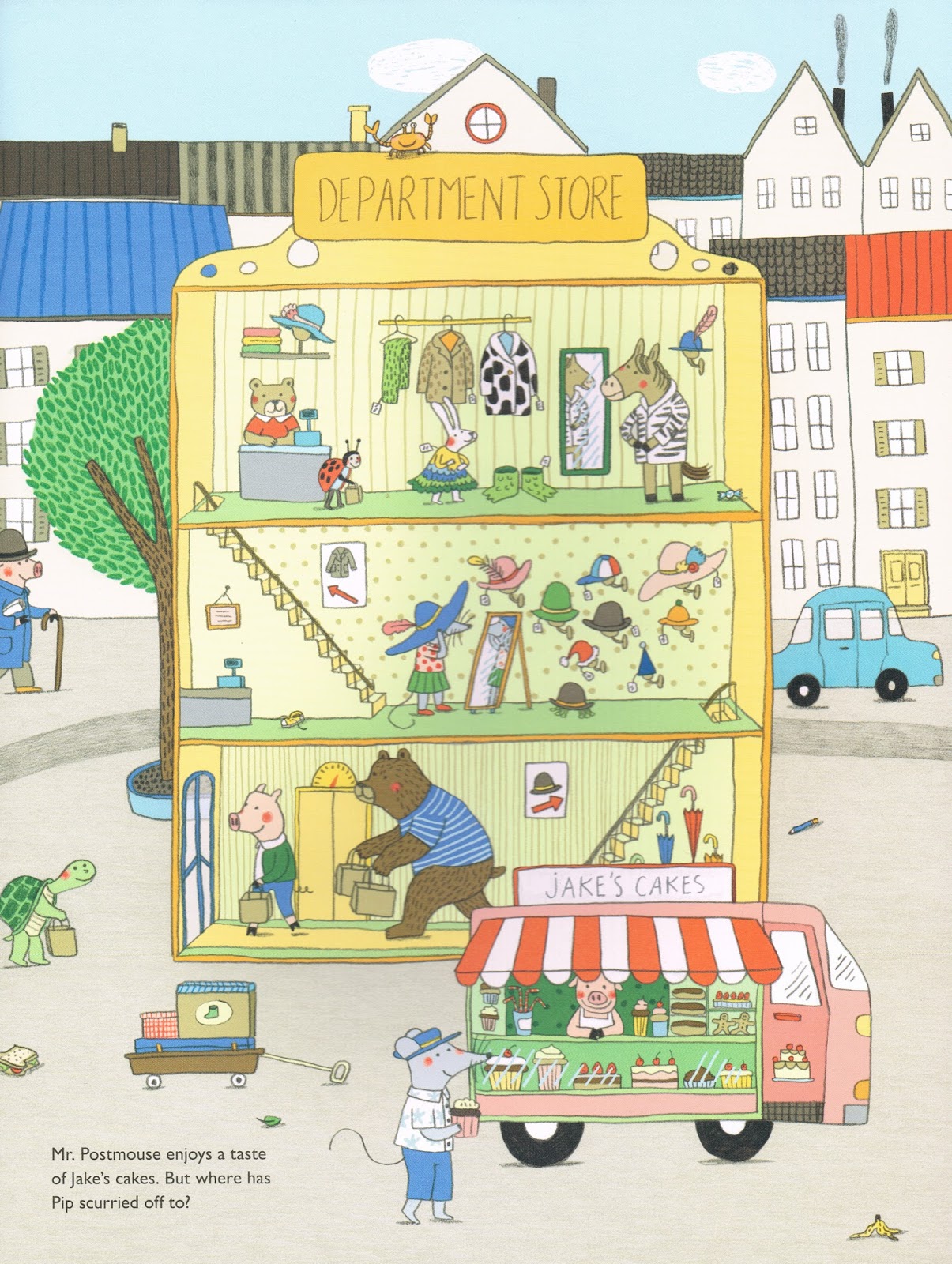
Mr. Postmouse is the postmaster but he's closing up the post office and going on vacation with Mrs. Postmouse and his mouselings Pip, Milo and Lulu.  But this is a busman's holiday, if ever there was one, because each stop involves a delivery.  Half the fun of Mr. Postmouse Takes a Trip is looking for what package has disappeared from Mr. Postmouse's wagon and to whom it has been delivered.  The other half of the fun is taking in all the intricate details of Marianne Dubuc's astounding illustrations, overflowing with characters, activity and novelty. If you could only take one picture book on vacation, it would be Mr. Postmouse Takes a Trip, for the sheer volume of stories told within the minutiae of each illustration.

The trip, which is more inclusive than a world cruise, begins with the family Postmouse leaving their rural neighbourhood (I recognize the rural mailbox with its flag up) and bidding adieu to Mr. Bear and heading to a campground.  Amidst the woods of hikers and multitudinous fauna, Marianne Dubuc provides a glimpse into the tidy camper of Aunt Claudette and the family's own tent with cozy sleeping bags.

These pen and ink and pencil illustrations of structures from the camper to a department store and volcanic mountain are quintessential to the Mr. Postmouse series, taking down that fourth wall (or mountain side or ground) to expose an interior of intricacy and wonder.  It's a peek into unseen worlds, more whimsy than real (except for the human structures of food trucks and buildings), always imaginative and elaborate.
From Mr. Postmouse Takes a Trip
by Marianne Dubuc
Next stop: the beach.  Take a glimpse inside the sandcastle Lulu is building for Mr. Crab or into the ladybug’s ground hovel or the ice-cream truck of Mr. Panda. Or look for which package Milo is delivering to a seagull.
From Mr. Postmouse Takes a Trip 
by Marianne Dubuc
The trip continues with a foray onto the seas in an extraordinary cruise ship named the Rosetta, a stop on a volcanic island (and delivery for Tarzan to his tree house), a trek through the desert and into a jungle which seems to pay homage to Rousseau. The trip ends with stops in a bustling city, in the mountains, on an ice field, and with a venture into the heavens via hot-air balloon.  With each new destination, the Postmice deliver packages or envelopes, enjoy the attributes of the new locale and readers witness new worlds burgeoning with life and joie de vivre.
From Mr. Postmouse Takes a Trip 
by Marianne Dubuc
I hope Mr. Postmouse, Mrs. Postmouse, Pip, Milo and Lulu think to send lots of postcards–I'm sure Mr. Postmouse has a healthy supply of stamps!–to help them remember their trip because it is certainly a memorable one.  Even locales which may seem ordinary to some readers are teeming with delightfulness and amusing distractions for both Postmouses (Postmice?) and readers.  There’s Mr. Lizard’s dinner on a plate, meerkats playing chess under ground, the operatic cat putting an audience member to sleep, King Kong hiding, a marmot with booties on his ears, and ants in every location.  Without naming places, Marianne Dubuc may have taken everyone on a seven-continent tour via all manner of transportation.  But, it’s not like Mr. Postmouse Takes a Trip is a picture book to support your geography curriculum.  It is there to entertain and tickle, and it does, providing rich discussion fodder and a fascination with all that goes on, both inside and outside around the world.  Bon voyage!