Showing posts with label mountains. Show all posts

March 20, 2017

Mr. Postmouse Takes a Trip

Written and illustrated by Marianne Dubuc
Kids Can Press
978-1-77138-354-7
24 pp.
Ages 3-7
April 2017

Mr. Postmouse is the postmaster but he's closing up the post office and going on vacation with Mrs. Postmouse and his mouselings Pip, Milo and Lulu.  But this is a busman's holiday, if ever there was one, because each stop involves a delivery.  Half the fun of Mr. Postmouse Takes a Trip is looking for what package has disappeared from Mr. Postmouse's wagon and to whom it has been delivered.  The other half of the fun is taking in all the intricate details of Marianne Dubuc's astounding illustrations, overflowing with characters, activity and novelty. If you could only take one picture book on vacation, it would be Mr. Postmouse Takes a Trip, for the sheer volume of stories told within the minutiae of each illustration.

The trip, which is more inclusive than a world cruise, begins with the family Postmouse leaving their rural neighbourhood (I recognize the rural mailbox with its flag up) and bidding adieu to Mr. Bear and heading to a campground.  Amidst the woods of hikers and multitudinous fauna, Marianne Dubuc provides a glimpse into the tidy camper of Aunt Claudette and the family's own tent with cozy sleeping bags.

These pen and ink and pencil illustrations of structures from the camper to a department store and volcanic mountain are quintessential to the Mr. Postmouse series, taking down that fourth wall (or mountain side or ground) to expose an interior of intricacy and wonder.  It's a peek into unseen worlds, more whimsy than real (except for the human structures of food trucks and buildings), always imaginative and elaborate.
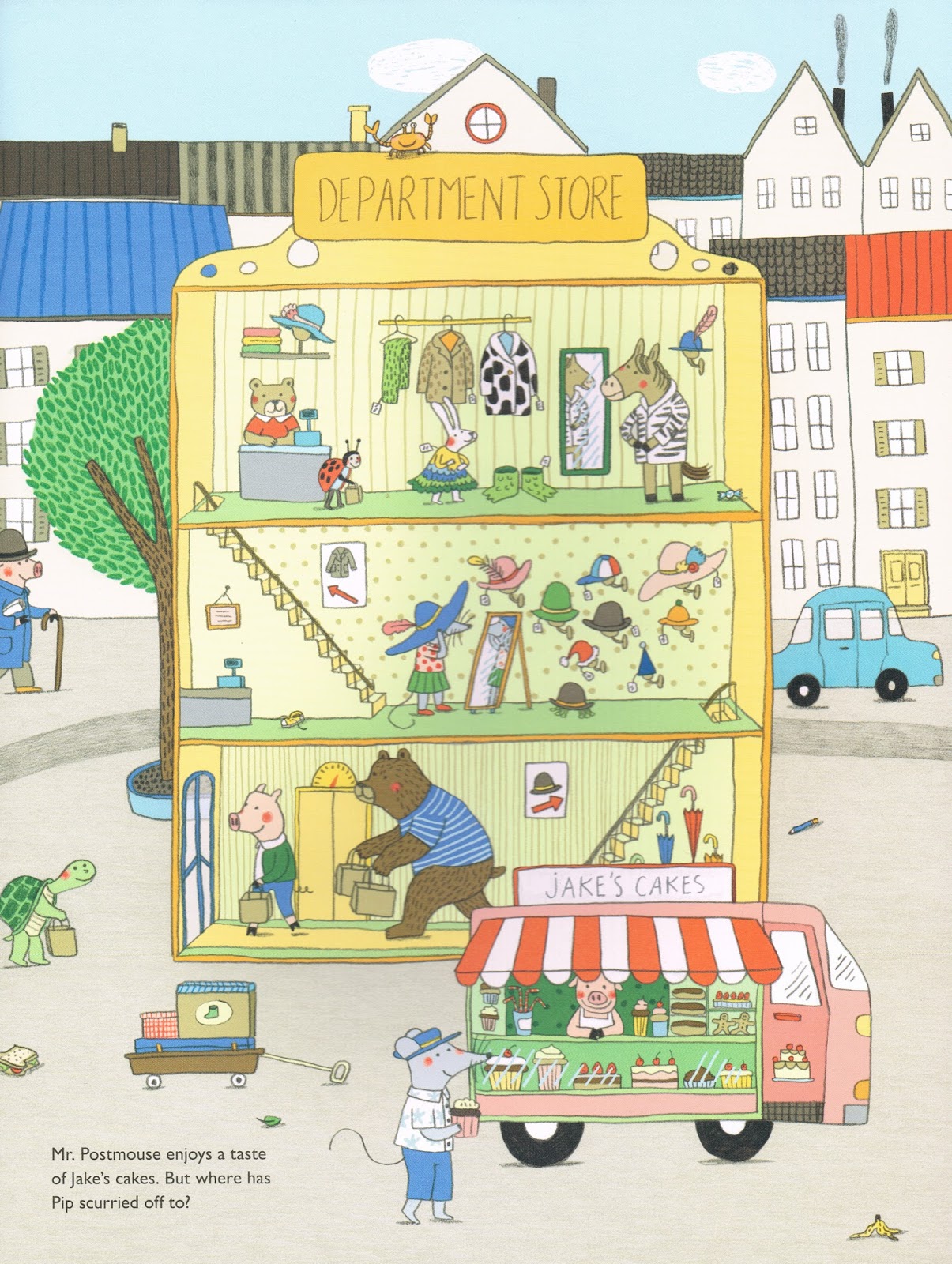
From Mr. Postmouse Takes a Trip
by Marianne Dubuc
Next stop: the beach.  Take a glimpse inside the sandcastle Lulu is building for Mr. Crab or into the ladybug’s ground hovel or the ice-cream truck of Mr. Panda. Or look for which package Milo is delivering to a seagull.
From Mr. Postmouse Takes a Trip 
by Marianne Dubuc
The trip continues with a foray onto the seas in an extraordinary cruise ship named the Rosetta, a stop on a volcanic island (and delivery for Tarzan to his tree house), a trek through the desert and into a jungle which seems to pay homage to Rousseau. The trip ends with stops in a bustling city, in the mountains, on an ice field, and with a venture into the heavens via hot-air balloon.  With each new destination, the Postmice deliver packages or envelopes, enjoy the attributes of the new locale and readers witness new worlds burgeoning with life and joie de vivre.
From Mr. Postmouse Takes a Trip 
by Marianne Dubuc
I hope Mr. Postmouse, Mrs. Postmouse, Pip, Milo and Lulu think to send lots of postcards–I'm sure Mr. Postmouse has a healthy supply of stamps!–to help them remember their trip because it is certainly a memorable one.  Even locales which may seem ordinary to some readers are teeming with delightfulness and amusing distractions for both Postmouses (Postmice?) and readers.  There’s Mr. Lizard’s dinner on a plate, meerkats playing chess under ground, the operatic cat putting an audience member to sleep, King Kong hiding, a marmot with booties on his ears, and ants in every location.  Without naming places, Marianne Dubuc may have taken everyone on a seven-continent tour via all manner of transportation.  But, it’s not like Mr. Postmouse Takes a Trip is a picture book to support your geography curriculum.  It is there to entertain and tickle, and it does, providing rich discussion fodder and a fascination with all that goes on, both inside and outside around the world.  Bon voyage!

December 10, 2014

Blue Mountain

by Martine Leavitt
Groundwood Books
978-1-55498-423-7
165 pp.
Ages 8-12
November, 2014

The struggle for survival may bring readers of adventure stories regularly to the brink of their seats, anticipating the worst and hopeful for the best outcome but always calmed by the fictional nature of the story.  But, though a fictionalized account of a herd of bighorn sheep in the Rocky Mountains, Blue Mountain reads as authentic and harrowing as any biography of an explorer or a leader making life-and-death decisions for others.  Blue Mountain may be about bighorn sheep but the story of Tuk and his herd mates is a heart-rending tale of life on the edge, an account of the struggle to survive in both the natural and man-made worlds.

The story of Tuk, a male lamb, begins on the lambing cliffs with the other new lambs– Ovis, Rim, Nai, Mouf, Sto and Dall–learning the story about the mountain's gifts to the animals.  Lord Denu, the first bighorn, was gifted with tricky feet, strong jaws, and powerful horns, providing his descendants with the moniker of peaceable, since they did not fight but rather stayed in herds that helped protect their numbers.  When the lambs and their mothers return to the main herd at the summer range, meeting the yearlings and the barren ewes, Kenir the matriarch declares that Tuk is reminiscent of the strong lambs of many years ago and has been gifted to them by the mountain to help keep the herd from dying.  This is corroborated by his vision of a great blue mountain, so rarely seen that it is called story mountain.

This is a heavy responsibility placed on Tuk and, though he suffers ridicule from a yearling named Balus and others, one that he does not take lightly or is convinced belongs to him, especially after he fails to save a lamb from an eagle.  But when a mother puma and her kitten put the herd at risk, Tuk uses his lamb horns to bat the kitten off a ledge, resulting in its death and its mother's vow of revenge.  Ultimately, the king of the rams instructs Tuk,
"You must find a way west from the winter valley to blue mountain before she hunts again."..."Son, it is the only way to save the herd." (pg. 38)
And so begin Tuk's journeys, the first being one of personal growth and learning so that he might lead the second one, a trek through inhospitable territories to one where the herd might thrive.  Enduring food shortages, threats from wolves, men with shotguns, monster machines, and unusual altercations with a wolverine, a bear and an otter, Tuk brings them to a place where
Tuk saw that the herd would always be, and that he had been part of the always. (pg. 159)
He couldn't have asked for a better legacy.

Martine Leavitt tells of her father, James Webster, and his love for the natural world and particularly the Rocky Mountain bighorn sheep that he studied.  Blue Mountain is her own story based on his notes of observations of these majestic animals through the seasons and years.
My story became a very different thing than his beautiful and perfectly accurate rendering, but we tell the stories we can. (pg. 164)
As Tuk succeeds so nobly after questioning his own leadership as a bighorn sheep, I believe Martine Leavitt has honoured her father's research and reconfigured it into a splendidly beautiful and accurate saga.  I'm sure he couldn't have dreamed of a finer gift.