Showing posts with label change. Show all posts

November 25, 2025

Call Me Gray

Written by Andrew Larsen and Bells Larsen
Illustrated by Tallulah Fontaine
Kids Can Press
978-1-5253-1135-2
32 pp.
Ages 4-8
October 2025 
 
For a four-letter word, "gray" packs a lot of meaning. It can mean the colour that is between black and white, the two sides that allow no middle ground. It can mean the dullness of a cloudy day with the absence of sun pulling a pall over everything. It can also reflect a feeling of detachment or depression, far more profound than the blues of sadness. But, for the child in Andrew Larsen and Bells Larsen's story, it's a name that holds colour and brightness, sunshine and joy.
From Call Me Gray, written by Andrew Larsen and Bells Larsen, illustrated by Tallulah Fontaine
It's the beginning of winter, and an unnamed child is looking forward to some wonderful traditions that they and their father partake in, starting with the building of their ice rink. But this year, this child knows something has changed.
But this year feels different.
 
It's not the snow
and it's not the cold.
 
It's me. 
 (pg. 6)
 
From Call Me Gray, written by Andrew Larsen and Bells Larsen, illustrated by Tallulah Fontaine
As they build their ice rink, the child hesitantly tries to gain some clarity to their feelings. A  recent incident, in which their best friend doesn't invite them to her sleepover because it's only for girls, has them saddened and perplexed. Talking to their dad, the child asks some very big questions including, "Do you ever feel mixed up about who you are?" (pg.12) Their dad tries to answer this and other questions but it's obvious that he's not grasping exactly what his child is asking. Still, as their work progresses, there is one statement that makes their dad stop and think and appreciate what his child is saying. 
"I look like a boy but
sometimes I feel more
like a girl."  
   (pg. 15)
And with that meaningful communication,  a subtle but monumental change begins to take place in the midst of enduring winter traditions.
From Call Me Gray, written by Andrew Larsen and Bells Larsen, illustrated by Tallulah Fontaine
I have reviewed so many Andrew Larsen books, both picture books and middle-grade fiction, including Goodnight, Hockey Fans (2017),  Dingus (2017), and 
Me, Toma and the Concrete Jungle (2019), and each one seems deeply personal. Call Me Gray has that same overtone, perhaps because Andrew Larsen has written it with his son, and the two have spoken of Bells Larsen's own experiences as a transgender person. I don't know if Andrew Larsen and Bells Larsen built ice rinks together and enjoyed hot chocolate afterwards, but the relationship between father and child in Call Me Gray is a touching one without being saccharine. In fact, it's quite real. They speak, they interact, and they question as they try to understand themselves and the other. And it's obviously a safe space in which to question and to make choices. 
From Call Me Gray, written by Andrew Larsen and Bells Larsen, illustrated by Tallulah Fontaine
This is the first children's picture book that Edmonton's Tallulah Fontaine has illustrated,  though her work has been featured on advertising displays and in numerous publications including the New Yorker, the New York Times, and The Economist. Rendered in gouache and finished digitally, her illustrations focus on that which is important: the relationship between the child and their father, as well as others. Tallulah Fontaine shows them pounding stakes, shovelling snow, and chatting while they work. She shows them putting on their skates and skating and always interacting, either in silence or in important conversations. Their work, together to build rink or to build understanding, is the goal. And Tallulah Fontaine always conveys much in the faces of her characters, whether it be disappointment, confusion, contentment, or hope.

Call Me Gray may become a wonderful story starter for challenging conversations about gender identities or about encouraging self-expression or about building an ice rink. It might help children share their feelings, or help their parents establish safe spaces to discuss big issues. But Call Me Gray may also take "gray" out of the unfavourable realm and move it into one of inclusivity and association and positive change.

November 13, 2023

The Yellow Leaves Are Coming

Written by James Gladstone
Illustrated by François Thisdale
Red Deer Press
978-0-889956834
32 pp.
Ages 4-9
November, 2023
 
While some may think that reviewing a book titled The Yellow Leaves Are Coming in November, after many of our leaves have already fallen, may be ill-timed, the story within tells another story. That story starts now, as indicated by this first line:
The yellow leaves are coming, thought the last leaf just fell.
From The Yellow Leaves are Coming, written by James Gladstone, illustrated by François Thisdale
As a young boy and an even younger girl stand out in the grayness of a cool day, they watch a single yellow leaf fall. But as they walk away, accompanied by one of François Thisdale's ubiquitous animals, they anticipate the next seasonal change. They wait and watch as the empty branches do.
From inside they watch the snow come.
I see it falling, growing thick on a hundred cold arms
reaching out for a warm, winter-coat friend.
As the grayness of winter, still magical, passes into the melting season with old leaves revealed to return some colour, the children are again wearing bright rain gear.  Then kids are outside playing baseball without coats and the trees are festooned with green leaves. Even on the balcony of the children's plex, clay pots are again filled with greenery and flowers. And François Thisdale ensures that there's always animal to watch over the seasonal scene, from a black-and-white cat to a rabbit, a butterfly, and blue jay.
From The Yellow Leaves are Coming, written by James Gladstone, illustrated by François Thisdale
The seasons may be changing, with summer transitioning to a return to school and ultimately the return of the yellow leaves, but James Gladstone continues to give us a sensory experience of seeing, hearing, and feeling. He reminds us with every poetic revelation, of the kids listening to the soft rustle of new leaves, slopping through the melting, or watching old leaves floating down curb rivers. And everything will be familiar to many Canadian children, from feeling the weather changing, watching the natural world transform, and altering their own clothes and activities with those changes. But more than telling us about those changes, James Gladstone, who has always blended science with storytelling in a compelling way (see Turtle Pond and A Star Explodes: The Story of Supernova 1054), makes us feel the seasons' changes.
From The Yellow Leaves are Coming, written by James Gladstone, illustrated by François Thisdale
The illustrations have been created by artist  François Thisdale, a recent finalist for the Governor General's Literary Award for Children's Illustration (French language) for Boucar Diouf's book Le Bourlingueur de Matungoua. Blending drawings with photographs and acrylic painting as well as digital art, François Thisdale makes the illustrations both surreal and very personal. He makes us look closely but just as fittingly he makes us see the big picture. It's quite extraordinary. By giving us both the perspective from the children and of the children, François Thisdale evokes time and place while helping us see and feel what the children might. 

Our own yellow leaves are mostly on the ground now here in southern Ontario but, like the seasons that come and go and come again, I trust that they will appear again. No matter where young readers may be situated, they will recognize the cycle of seasons and nature, and anticipate the next, personalizing what they see just as James Gladstone and François Thisdale have done in The Yellow Leaves Are Coming.

April 12, 2023

Otis & Peanut

Written by Naseem Hrab
Illustrated by Kelly Collier
Owlkids Books
978-1-77147-496-2
80 pp.
Ages 6-8
April 2023

Otis is a long-haired guinea pig. Peanut is a naked mole rat. And they are as different in their personalities as they are physically. Yet, they are the best of friends, being for the other what they are not easily themselves. Together, they will touch your heart and remind you that diversity gives the world a soul.
From Otis & Peanut by Naseem Hrab, illus. by Kelly Collier
Told in three graphic stories, author Naseem Hrab, recent finalist for the Governor General's Literary Award for Weekend Dad, introduces us to her unlikely friends Otis and Peanut. In the first story, The Haircut, the two set off for the barbershop to get Otis a much-needed haircut. Unfortunately, their fears about the process and what they might look like causes them much anxiety. As Peanut tries to help Otis embrace change, Peanut realizes that they too would enjoy change. While that could be a new hat, a new coat, and new shoes, it might include a new friend. Fortunately, with a haircut, Otis becomes that new friend!
From Otis & Peanut by Naseem Hrab, illus. by Kelly Collier
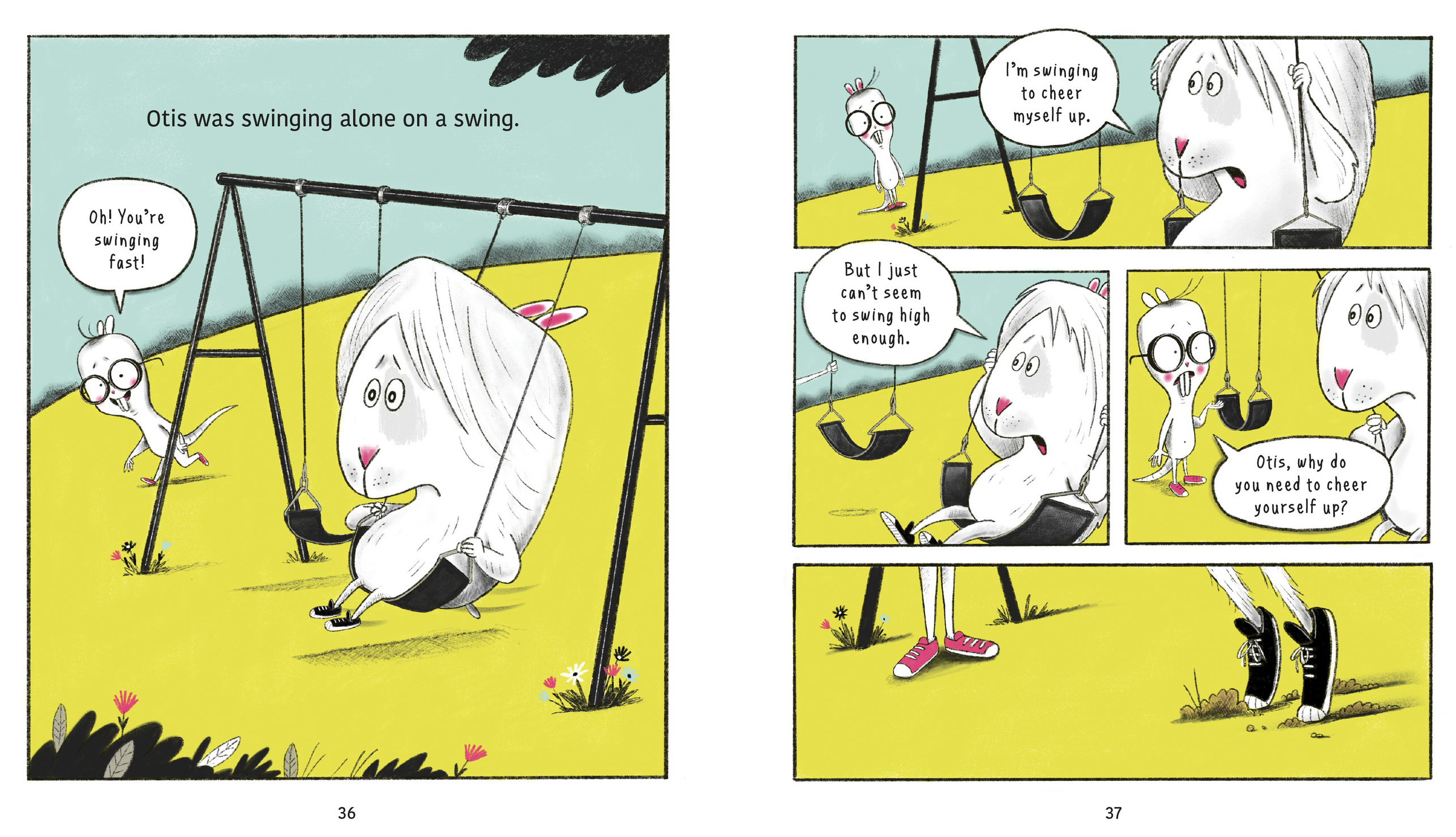
The Swing is the second story in the book and focuses on Otis missing their friend Pearl. As Otis tries to subdue the sadness that keeps him from enjoying a swing, Peanut recognizes that recalling the good memories of Pearl is important, as is accepting that grief and joy can coexist.
From Otis & Peanut by Naseem Hrab, illus. by Kelly Collier

In the final chapter titled The House, Otis is decorating their new house to make it a true home. 

"Well, I want to feel like my heart is here. So I'm painting it my favorite colors. And putting special things inside of it and outside of it."
From the front door to the lilac bush, Otis has reminders of friends that make the house truly his. But when there still feels like something is missing, Peanut becomes the solution.

There have been many comparisons of Otis and Peanut to the celebrated Frog and Toad as a duo of friends that learn from their interactions with each other and others. But I think Otis and Peanut are far more diverse both in their appearance and their demeanors. Naseem Hrab has made Peanut the confident and extroverted character, eager to take on change and challenges, while Otis is more sedate and thoughtful, more sensitive to their feelings and surroundings. But both are capable of expressing themselves beyond those personalities, with Peanut showing compassion and insight beyond what might be expected of an exuberant extrovert and Otis able to enjoy things beyond self and feeling. Through their self-expression and Nassem Hrab's storytelling, Otis and Peanut have loads to teach young readers about friendship, grief, change and self.

Those important lessons come by way of a lightness of text and art. Kelly Collier–whose Steve the Horse series was reviewed here–illustrated this early graphic novel digitally and yet it has the delicacy of ink and watercolour. Surprisingly, the economy of her palette brings a boldness to the illustrations. While Otis and Peanut are essentially black and white with only the barest hints of pink for ears and nose and such, Kelly Collier saves the chartreuse yellow, pale turquoise and bright pink for backgrounds and large swaths of coats and furniture and such. It is a limited palette but it's fabulous to highlight Otis and Peanut, the stars of the stories.

It's tough to write an early reader that doesn't talk down to kids while addressing big issues like grief and friendship and home. But Naseem Hrab has done so with her words and, with Kelly Collier's graphic novel illustrations, Otis & Peanut is sure to be a hit. And, since this is only Book #1, there will be more stories with which we can visit Otis and Peanut, and I look forward to all of them.

January 27, 2023

When Sally Met Harry


Written by Paulette Bourgeois
Illustrated by Brooke Kerrigan
North Winds Press (Scholastic Canada)
978-1-4431-7508-1
32 pp.
Ages 2-8
January 2023

Whether you're an adult, a child or a dog, change can be difficult. Even when the status quo is challenging, it's familiar. But when the norm is wonderful, filled with love and attention, adoration and praise, change can be especially effortful, as Sally a goldendoodle learns.
I was a bundle of absolute puppy adorableness.
Sally can do no wrong. She sleeps on their bed, chases squirrels, plays and is cuddled. Even when she does do something inappropriate, like getting into their underwear, chewing it and getting sick, she is consoled with, "Poor baby." And then Sally learns that her people are having a baby. 
From When Sally Met Harry by Paulette Bourgeois, illus. by Brooke Kerrigan
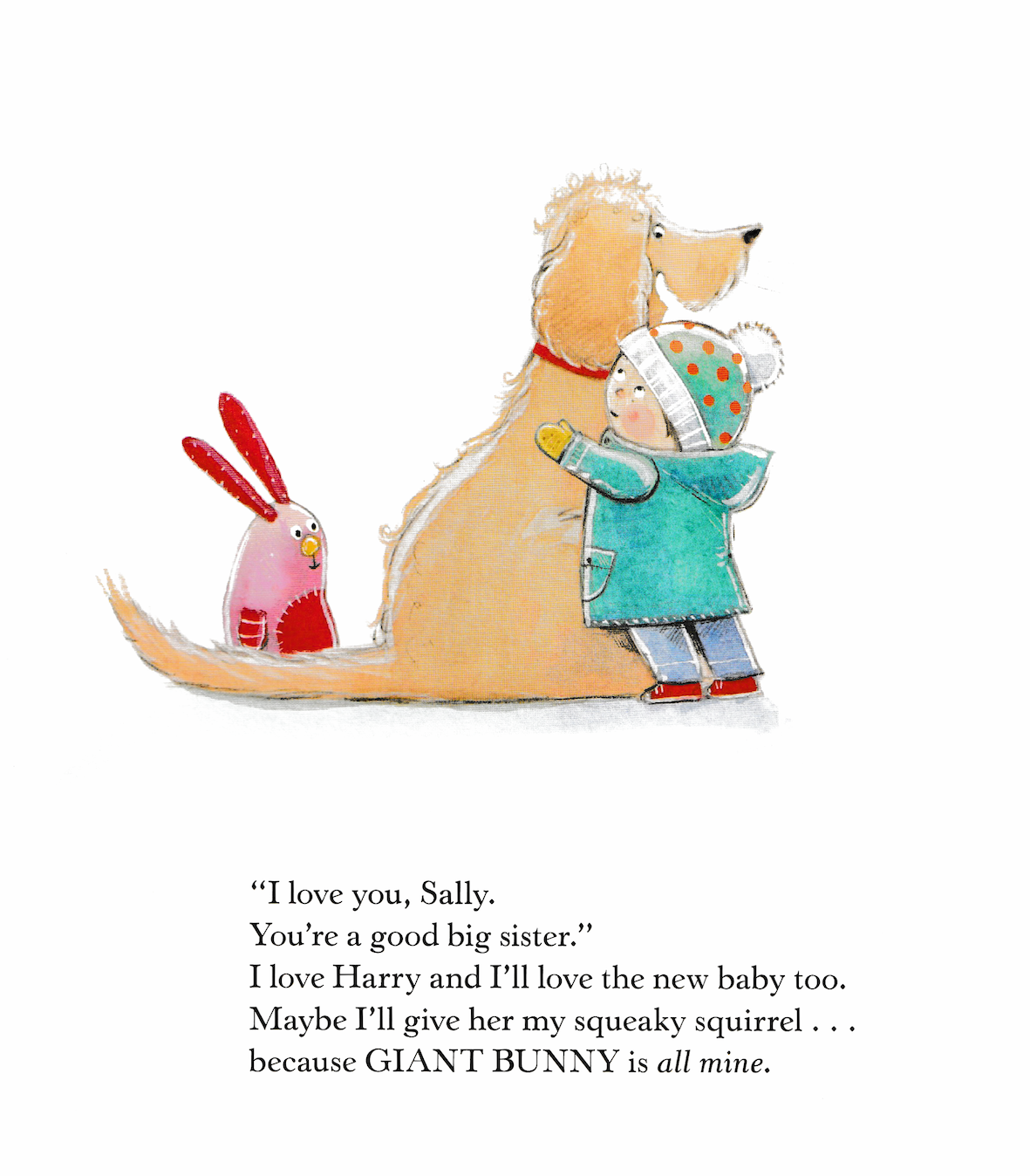
Immediately after Harry arrives, Sally knows things are going to change. She lets herself out when her people are too engrossed with the noisy baby.  Sure, she gets a blanket and a new squeaky squirrel, but Harry gets a giant red bunny! And when Sally tries to show affection for Harry as she would her own pup, they yell at her to get away and she is told, "No." Now Sally has a dog walker, and she sleeps in a basket because Harry sleeps with them. 
From When Sally Met Harry by Paulette Bourgeois, illus. by Brooke Kerrigan
Though Sally tries to think of a way to make her people love her again, she really doesn't have to do anything special. Sally's specialness comes through with the simplest of acts and makes Harry realize that Sally is part of his loving family.
I look deep into Harry's eyes.
I let him know that I love him.
From When Sally Met Harry by Paulette Bourgeois, illus. by Brooke Kerrigan
Many will recognize the name of Paulette Bourgeois as the author of the Franklin the Turtle series but it's obvious she knows more than turtles. She knows babies and children and dogs. She knows the confusion of a new baby in a home with a pet who has been the only "child" and used to getting all the attention and love. But, Paulette Bourgeois, a grandmother herself, also probably knows about finding a way to make all feel appreciated and loved–which will be all the more important when Baby #2 comes along–while bringing seemingly unconnected family members to becoming part of the whole. Telling the story from Sally's perspective, feeling what she does, hearing from others, and seeing for herself, Paulette Bourgeois makes Sally the star of When Sally Met Harry and restores her place of importance when we all know that a helpless baby must become the center of his parents' attention, at least for a time. And then when that baby is a toddler and can be a little brother to big sister Sally, the family circle is complete again.

That sweetness of story and familial bonding comes through in Brooke Kerrigan's illustrations. Rendered in watercolour, pencil crayon and gouache on paper before digitally enhanced, the artwork screams cuteness. From the playful and loving Sally to the cherubic Harry–look at that round head!–and all the little details of toys, squirrels, cats, and other dogs, When Sally Met Harry depicts many a household in which a baby is introduced to a family pet. Still, with Paulette Bourgeois's words and Brooke Kerrigan's illustrations, When Sally Met Harry tells the story of a one-of-a-kind relationship that could earn a cinematic rendering of its own.

December 29, 2022

The Bird Feeder

Written by Andrew Larsen
Illustrated Dorothy Leung
Kids Can Press
978-1-5253-0483-5
40 pp.
Ages 3-7
October 2022

As I watch the birds seek food at our feeders–2 nyjer feeders, a hopper, a tray and two suet holders–I am reminded how much joy is derived from just watching the birds. It's sitting back and observing their feeding, their interactions with other birds, and making a connection with the natural world, often from the confines of our man-made one. But this connection can be far greater than at first glance as Andrew Larsen shows us in his latest picture book The Bird Feeder.
From The Bird Feeder by Andrew Larsen, illus. by Dorothy Leung
After their grandmother comes to live with them, a child spends special time with her: chatting about their secret wishes, drawing, and enjoying the birds at the bird feeder Grandma brought with her. But when Grandma is taken into hospice, the child is initially bereft, not wanting to fill the bird feeder as they'd done for her.
From The Bird Feeder by Andrew Larsen, illus. by Dorothy Leung
After seeing the big picture window in Grandma's hospice room, the child surprises their grandmother by hanging the bird feeder on the tree outside.
"Oh, my! says Grandma. "You brought the birds!"
Together they watch the birds, eat purple Jell-O, draw, and visit with Suki, the therapy dog. And the next spring, as three tiny beaks poke out of a nest, Grandma passes.
From The Bird Feeder by Andrew Larsen, illus. by Dorothy Leung
In a touching story of a special grandmother-grandchild connection and the cycle of life, Andrew Larsen shows us that even in great sadness there can be joy and comfort. With that extraordinary bond between the two generations comes learning, art, togetherness, and support. Both give and take from the other, filling their lives with affection and contentment. And though Grandma is in hospice, that connection is re-established via a bird feeder, which gives Grandma solace and the two of them a link of focus, purpose, and appreciation. I must admit that I shed a tear with Grandma's passing, so subtly handled with Andrew Larsen's text that evokes love and loss without the fear and despair that often accompany death. It's this simplicity of message and story that Dorothy Leung emulates in her digital artwork. There is a clarity in her illustrations that conveys tenderness and caring and family while giving readers just enough detail in a framed family photo or leaves on a tree or weariness on a face to scaffold a memorable story.

I know there are birds in the story, but The Bird Feeder is more than a grandmother and grandchild sharing a love of birds. There is an intimacy here that transcends all. It's a tender story of life and love and the blessings that come with both.

May 06, 2022

The Not-So-Uniform Life of Holly-Mei

Written by Christina Matula
Inkyard Press
978-1-335-42488-4
288 pp.
Ages 8-12
April 2022

Twelve-year-old Holly-Mei Jones knows she needs to filter more. After she costs her class a pizza party when she reveals cheaters–she also loves following rules–and loses her best friend, Holly-Mei might have despaired but she's still hopeful about turning things around. Then her mom announces that they are moving to Hong Kong and without Holly-Mei's dearest grandmother, Ah-ma. So off they go: her mom to a posting as chief operations officer for Asia-Pacific for Lo Holdings International; her dad, a prof, to a leave and an opportunity to write; and Holly-Mei and her eleven-year-old sister Millie to the prestigious and very expensive Tai Tam Prep. 
 
As they begin their new lives, Holly-Mei is confident that this fresh start will offer her unique opportunities, particularly in making friends. Fortunately the girls' cousins, Rosie and Rhys, and Aunt Helen and Uncle Charlie already live in the same building complex and the twins are in Grade 7 of the upper school along with Holly-Mei. Tai Tam Prep, with its own beach, sailing club, tennis courts, organic vegetable garden, swimming pool with retractable roof, and restaurant-quality caf–the food, oh, the food!–may be the school of the rich and famous but it's also where Holly-Mei hopes to find new friends. Among those she meets, there's queen bee Gemma Tsien, daughter of a toy factory magnate and a former film star; her sidekicks Rainbow Hsien and Snowy Wong, a YouTuber; Jinsae Kim; Henry Lo, of the Lo family of mom's company; his cousin Theo Fitzwilliam-Lo; and Dev Singh, a skilled field hockey player. But as she meets new people and works hard to fit in, she is reminded constantly by her mother that this is her opportunity to meet "the right people" and to always make a good impression. It's all about giving the family face i.e., honour and respectability.
"Guanxi, my darlings, is the Chinese word for connections, but it's so much deeper that that. It's not just knowing someone. It's about trust and loyalty. Opportunity." (pg. 113)
Of course, with her tendency to blurt things out and need to adhere the rules as she knows them, Holly-Mei has a few fumbles. Worse yet, they happen while she is working with a small group of her peers for a performance to celebrate the opening of the new Tsien Wing, named for its benefactors, Gemma's family. Holly-Mei is reminded of Ah-ma's Taiwanese saying ku jin gan lai which means bitterness finishes, sweetness begins, but she's starting to see that sometimes someone is "seemingly sweet like chocolate but bitter like raw cocoa." (pg. 125) Can Holly-Mei make some new friends, not alienate others with her unfiltered comments, and uphold her own family's standing in this new and very different society?
 
If you blended "Crazy Rich Asians" with "Mean Girls," you'd have The Not-So-Uniform Life of Holly-Mei. It's the opulence of a wildly wealthy community and the tricky family expectations experienced by a group of preteens trying to find their ways with each other and their families. The struggles of Holly-Mei and her peers may be familiar to young readers but set in the gloriously exotic Hong Kong, rich in architecture, history and culture, The Not-So-Uniform Life of Holly-Mei becomes an incomparable story. Many, nay most, young readers will not be familiar with affluence depicted but they will know about messing up, fitting in and pleasing their families. They'll know that things don't always go smoothly and sometimes they work out well and that how things turn out may or may not be up to them. But, like Holly-Mei, they have some of the means to make things right to move from bitterness to sweetness. 
 
This is Christina Matula's debut children's book and her "Author's Note" suggests she knows much about what Holly-Mei lives. Christina Matula's Chinese heritage comes from her mother's Taiwanese side while her father is European–Holly-Mei's is British, Christina Matula's Hungarian–and the opportunity to live abroad is part of her background. She brings that familiarity with being biracial and culturally diverse to Holly-Mei and several of her peers to help young readers understand the challenges of fitting in and being oneself while loving who you are as you are. Hopefully Holly-Mei will learn to grow into herself and be comfortable with who she is in possible later stories, as HarperCollins lists this book as A Holly-Mei Book: Volume Number 1, suggesting a sequel. Here's hoping we get to revisit Hong Kong and Holly-Mei and her family and friends soon to enjoy more tasty treats (two recipes append the story), take in a tourist attraction or two, and have some sensational fun.

March 14, 2022

Bear and the Whisper of the Wind

Written and illustrated by Marianne Dubuc
Princeton Architectural Press
978-1-64896-119-9
80 pp.
Ages 4-8
March 2022

There is something special about a Marianne Dubuc picture book. You know the artwork will be remarkable, blending softness and power through line and colour. But, scaffolded by the illustrations is always a story with a profound message of living life well. It could be about self-reliance (On Baba's Back, 2022), compassion (What Do You Want, Little Friend?, 2020), community (Your House, My House, 2020) or empathy (Little Cheetah's Shadow, 2020) but Marianne Dubuc's books always show young children how to be their best selves. Bear and the Whisper of the Wind does just this flawlessly too.

Bear has a comfortable life, living in a nice house, and enjoying the company of his friends and his favourite strawberry pie. 
But that was before. One day, the wind changes and Bear senses that it is time to go.
 What he hears is, "It's time for something new."
From Bear and the Whisper of the Wind by Marianne Dubuc
And Bear heads out on a journey, knowing it is something he must do, though not knowing where he will be going. Sometimes he feels free as the wind but sometimes he is lonely. When he meets Rabbit and is invited in from the dark, Bear accepts. Though he has not spoken to anyone for ages, he feels better than he has in days. Still, after he helps Rabbit repair his house, Bear continues on his journey. 
From Bear and the Whisper of the Wind by Marianne Dubuc
But now Bear is not sure if he hasn't made a mistake. He's not sure if he should have stayed with Rabbit, or even stayed at home. And then he realizes he is lost. Moreover, he is lost, wet and uncomfortable in a thunder storm with only the meagre shelter of a pine tree. When it's all over, a little mouse welcomes him to the valley he had not noticed in his fears. It's a valley with a stream, a blueberry patch and a new friend, where the wind is quiet again and his search ends.
From Bear and the Whisper of the Wind by Marianne Dubuc
Many of us have felt the trepidation of leaving the comfort of our homes. It could be after the pandemic or as young adults moving out on their own or young children who have moved onto new homes, schools and even families. It's undertaking something that makes us feel uncomfortable but, as Bear learns, there is value in trying something different. In fact, it could actually be finding something better, something that allows us to be more of ourselves than before.  There may be initial discomfort and worries about leaving the security of the known but sometimes, as Marianne Dubuc's Bear shows us, it's worth it.

Marianne Dubuc also takes us with Bear on his journey through the subtlety of her pencil and watercolour illustrations. Whether he is enjoying his strawberry pie and visiting friends or crossing streams and walking through a forest, readers are there with him. While his journey may be a challenge for him, we are not scared to accompany him as he follows the whisper of the wind–as seen by a floating leaf–to something new.

The allegory of a pilgrimage may not be picked up by the youngest of readers but others, including the adults in their lives, will recognize a lesson in the change that happens when you go beyond your comfort zone. Striking out on your own or trying something new can be challenging and scary–the unknown often is–but it can open up opportunities which could never have been foreseen and offer perspectives never imagined.

August 13, 2021

The House Next Door

Written and illustrated by Claudine Crangle
Groundwood Books
978-1-77306-368-3
44 pp.
Ages 3-6
August 2021 
 
This is the story of a house, one house in an open field of long grasses. It stands alone but secure, standing its ground, whatever the winds and snows and rain may blow in. But when other houses blow in, how will the house respond?
From The House Next Door by Claudine Crangle
When the little red-roofed house with a red door and blue shutters first notices two other houses, far off but in his periphery, he ensures the back and side shutters are bolted tight so that only his grassy land is visible.
From The House Next Door by Claudine Crangle

Putting on those domestic blinders does work for a number of years but then the construction of a road tears a gash through the middle of his field. 
Soon they began moving in.
They lined up along the road.
And the road began branching into more
roads.
And more of them arrived.
Row upon row of blank faces stared back at the little house.

The suburbs had arrived and were upon his doorstep with their countless faceless houses. His response? He shuts his front shutters and waits in the dark.

From The House Next Door by Claudine Crangle
Occasionally he peeks outside but all he sees are more and more of those anonymous structures. So the house stays dark and still. After winter and spring pass into summer, he sees something a little different when he glances outside. He sees some colour and even a yellow house with a curtain waving out of an open window. In the dark the curtains reveal a golden light within. This is all it takes for the little house to open its shutters the next day to uncover a real neighbourhood of diverse homes.
 
Toronto author-illustrator Claudine Crangle's story of urban sprawl changing the landscape is really an allegory about shuttering oneself off from change and opening oneself to new possibilities. Though living harmoniously with others around you is not always easy (I was reminded of Norman McLaren's 1952 NFB short film "Neighbours"), perhaps what was worse for the little house was change. He did not know what to expect having never had neighbours and, rather than adapt, he shuts himself off. A little courage and recognition of the familiar help him feel safe enough to open the door, or rather the shutters, to the unfamiliar and see brightness where only anonymity once was.
 
The illustrations were created with paint and a variety of materials including cardboard and paper but also found objects and those scavenged from recycling bins. There's asphalt shingles, fabric and red wooden discs. By bringing life from waste, Claudine Crangle lets her artwork further the idea that there can be beauty and hope in the unlikeliest of places.
 
I know that The House Next Door is recommended for ages 3 to 6, undoubtedly because of its ease of readability, but I hope that parents and teachers will see the value in reading this book with older children. There's an important lesson here for all about anticipating the worse because it's different or unexpected to only discover that the worry is often worse than the reality.

July 12, 2021

Percy's Museum

Written by Sara O'Leary
Illustrated by Carmen Mok
Groundwood Books
978-1-77306-252-5
32 pp.
Ages 4-8
April 2021

Percy loved living in his busy urban neighbourhood in which friends and activity were plentiful. But a move to the country, where houses are separated and playmates undiscovered, Percy isn't sure what to make of his new home.
From Percy's Museum by Sara O'Leary, illus. by Carmen Mok
But discovery reveals the unexpected. There's a special "Percy-sized house" at the edge of the yard and a plethora of natural wonders. There are "bees kissing flowers, ants on parade, and birds putting on air shows." There are wild strawberries to taste, and trees to sit upon, and everywhere there is change.

From Percy's Museum by Sara O'Leary, illus. by Carmen Mok

Taking in all these wonders, he collects and documents them, putting them on display in his small pink house. Even though he realizes that he isn't lonely because there is always something to see and do in his new place, it might be nice to share. So, with some balloons and drinks and a sign pointing out "Percy's Museum," Percy is delighted to discover that sometimes friends find you.

From Percy's Museum by Sara O'Leary, illus. by Carmen Mok

Change is hard for many of us and more so for some than others. It's evident from Carmen Mok's first illustration of a forlorn Percy sitting alone on a bench in an expansive yard that his new situation is uncomfortable. But this child opens his eyes and heart and begins to explore his new surroundings. He sees things he'd never imagined, from fish in a creek and baby birds in a tree to a patch of edible wild strawberries. He immerses himself in the nature of his new home and uncovers new wonders, or at least new to him and, through Sara O'Leary's words, we go with him.  She takes us into Percy's heart and lets us see with his eyes. She's very good at doing this, giving readers the perspective of young children, for example imagining their parents as children (When I Was Young, 2011) and seeing their familiar neighbourhood in the unfamiliarity of night (Night Walk, 2020). There's a innocence and sweetness to Percy's perception of his new world and his openness to new experiences. He's never critical or complaining. He doesn't whine that his new home isn't as good as his old. He simply knows it's different, and different doesn't mean bad or wrong. And don't Carmen Mok's gouache and coloured pencil illustrations mirror that freshness of outlook? 

Percy's Museum is a reflection of this little boy's heart: it's cheerful, bright and full of wonders, and an invitation is sure to enrich, in more ways than one.

March 29, 2021

This House is Home


Written by Deborah Kerbel
Illustrated by Yong Ling Kang
Owlkids Books
978-1-77147-380-4
32 pp.
Ages 4-8
March 2021

The concept of home has always been an important focus in literature: finding it, establishing it, cultivating it, holding onto it, and sadly even losing it. For some, it's ephemeral, fleeting in its nature, and for others it is the bedrock of life. For the families in This House is Home, it is both.
From This House is Home by Deborah Kerbel, illus. by Yong Ling Kang
Lily and her rabbit family live in a home that her grandmother says is "old and steady as mountains." But when a pair of suited foxes with clipboards approach Grandma about buying the house, she politely declines.
This house is home, and we'll live here for the rest of forever.
From This House is Home by Deborah Kerbel, illus. by Yong Ling Kang
Problem is that everyone else around them sells to the developers, and there is much upheaval as friends pack up and goodbyes are shared. And then the diggers arrive, flattening houses and trees, and constructing a road that like a "long gray tongue snaked toward our house, closer and closer, until it had pushed right up to our door. It didn't bother knocking."
From This House is Home by Deborah Kerbel, illus. by Yong Ling Kang
The construction workers might have placed pylons around their house but their house is now situated in the middle of a wide road of noisy, smelly vehicles racing past their windows. The impact on their garden was evident but also clear was the impact within their home: dirt, noise, irritability, and distress.
From This House is Home by Deborah Kerbel, illus. by Yong Ling Kang
But a solution to their problem comes to Lily, the artist, in a dream in which, "The road had melted into a sea. The cars had shrunken to fish. My house had grown sails." Their house would remain their home, just in a different location.

Having a development threaten your house, your home is a nerve-racking prospect. Undoubtedly it's a frustration of many whose abodes stand in the way of planning projects that look at the big picture and not the individual lives affected. The menace of the foxes' repeated efforts to get Grandma to sell are tangible, though she is always polite and gracious, but Deborah Kerbel's words focus on the calm and love inside the home and leaves the destruction and disquiet outside. Sadly, there comes a time when the outside encroaches on the inner sanctum of home. Still Grandma's strength of conviction that their house would remain steadfastly their home and Lily's problem-solving ensure that home will endure as such.

Illustrator Yong Ling Kang, who illustrated Tanna's Owl (2020), continues to charm with her watercolour art that adds the whimsy of a bunny family living in their home, having picnics, playing, knitting, and growing. She brightens those pages with all colours, saving the greys and browns for the mayhem of the construction, and gives fluidity to the story, indicative of the transitional nature of the house, with her brushstrokes and lines. As such, Yong Ling Kang's art echoes the joys and frustrations of Deborah Kerbel's characters from comfort through distress and back to buoyant.

This House is Home reminds us that home is more than a structure. It has roots that are grown of family, and, though it can change, as necessary, it carries the promise of steadfastness, even if in transition.

August 19, 2020

Please Don't Change My Diaper!

Written by Sarabeth Holden
Illustrated by Emma Pedersen
Inhabit Media
978-1-77227-273-4
28 pp.
Ages 0-4
June 2020 

As adults, we know why babies must have their diapers changed and why children should bathe. We know about cleanliness and hygiene and good health. But babies don't have any understanding of this. So, it's not surprising that when a mom swoops in for a diaper change, this little guy is screaming in his mind, "Please Don't Change My Diaper!"

From Please Don't Change My Diaper! by Sarabeth Holden, illus. by Emma Pedersen

In a charming rhyming voice, a toddler is excited at the prospect of heading outside to play in the snow with his puppy. Sure he smells something malodorous but,
I think I know...but let's just go!
Don't worry about where it's coming from.
Oh no, what's that you say, Mum?
And when his mother, only seen from his perspective as a pair of legs in slippers, socks and leggings, brings out the diaper, decorated in pale aqua with teddy bears, it's as if his whole world has collapsed. 

From Please Don't Change My Diaper! by Sarabeth Holden, illus. by Emma Pedersen
The toddler is tormented by the vision of a multitude of diapers. He's begging for her not to do this, and imaging telling his friends how much he cares for them, as if he would never see them again.
I will miss my fluffy puppy.
I will miss the sparkly snow.
To my best friends, near and far,
I love you, you must know!
From Please Don't Change My Diaper! by Sarabeth Holden, illus. by Emma Pedersen
With face grimacing with irritation and perhaps even fear, the little boy's diaper is changed.  Of course he survives the trauma and, in fact, is gratified by the "fresh, delightful feeling" while still recognizing that the world remains as it had. (That is, until another inevitable change is required.)

From Please Don't Change My Diaper! by Sarabeth Holden, illus. by Emma Pedersen
While Sarabeth Holden can only imagine what this little one is thinking, she ensures an authenticity with the innocence of his perspective, the mindfulness of the moment i.e., play over diaper change, and the singularity of his needs and wants. She makes him sweet and emotive while also timid and fearful, giving him a candid voice that rhymes with wonder and simple acceptance of his circumstances.  Emma Pedersen, whose artwork was reviewed in Queenie Quail Can't Keep Up (Jane Whittingham, 2019), emulates that simplicity of wonder in a child's life. His big eyes and cherubic arms anticipate both goodness and caring, even if he doesn't really want that diaper change. His worries, completely reflective of a very young child's point of view, are ephemeral in nature, regularly supplanted by new opportunities for a hug, for a cuddle with a puppy, for play. By the end of the book, the child has forgotten his discontent with a diaper change and accepts his life as one of comfort and affection.

I know this picture book is about a toddler who doesn't want his diaper changed, and so would be an appropriate book to help the very young accept their own diaper routines as normal, but Please Don't Change My Diaper! is also a reassuring take on circumstances that might cause some anxiety. The trepidation is real but perhaps recognizing the transient nature of some worries can be enough to put them aside like a dirty diaper, never to soil a perfectly good day.

April 16, 2019

My Forest is Green

Written by Darren Lebeuf
Illustrated by Ashley Barron
Kids Can Press
978-1-77138-930-3
32 pp.
Ages 3-7
April 2019

Earth Day will be upon us soon and the wonders of the natural world will call. For some it calls from an apartment balcony while for others it's from the ground beneath a canopy of deciduous or coniferous trees, and for one little boy, it's both.
From My Forest is Green by Darren Lebeuf, illus. by Ashley Barron
A little boy looks out from a high-rise balcony over a forest, perhaps park or ravine or woodland green space. But he also has an inside forest of artwork depicting that world.  He has seen the contrasts of height and textures, size and sound, and colour, through different seasons and weather. He sketches it, paints it, collages it, makes cut-paper art, sculpts snow, takes photos, and combines mixed media to capture the essence of the forest.
From My Forest is Green by Darren Lebeuf, illus. by Ashley Barron
This is BC author Darren Lebeuf's first picture book and he gives life to a child's appreciation of the forest as the child uses all his senses to gather information about it before depicting it in his artwork. It's evident how much the child enjoys exploring the forest of his neighbourhood, seeking out the wonders above and below, from milkweed pods to resourceful ants, making bark prints and using rocks and leaves to create his own forest of art. The child accepts the dynamics of a world rich with life, plant and animal, and appreciates that his impression of the forest will change with its evolution.
My forest is so many things...
I can't wait to see what my forest is tomorrow.
From My Forest is Green by Darren Lebeuf, illus. by Ashley Barron
The child's art is all the more lavish because it is the artwork of Ashley Barron. Her cut-paper collages have graced many a picture book including Up! How Families Around the World Carry Their Little Ones (Owlkids, 2017) and Kyle Goes Alone (Owlkids, 2015), but now she goes beyond that style to show how a child interprets the natural world through his art. From his leaves taped to paper, or his sponge-painted moss and Polaroids, Ashley Barron brings his perspective to us, from a child's eye to a reader's. It's detailed and colourful, like nature itself, and takes us all on a walk into a forest that is mostly green but much more.
From My Forest is Green by Darren Lebeuf, illus. by Ashley Barron