Showing posts with label Brooke Kerrigan. Show all posts

October 15, 2024

The Rock and the Butterfly

Written by Kathy Stinson
Illustrated by Brooke Kerrigan
Orca Book Publishers
978-1-4598-3700-3
32 pp.
Ages 6-8
October 2024 
 
There was a rock and there was a butterfly. Together their story is far greater than the sum of their parts. 
From The Rock and the Butterfly, written by Kathy Stinson, illustrated by Brooke Kerrigan
Once there was a rock that sat solidly on the ground.
 
And once there was a butterfly that flitted and fluttered everywhere.
The contrast in the rock and the butterfly is best understood when the butterfly tires from too much flitting and tucks itself into a groove in the rock to rest and keep the world from spinning. The rock offers comfort and safety. That is, until one day, the rock is gone.
From The Rock and the Butterfly, written by Kathy Stinson, illustrated by Brooke Kerrigan
The butterfly really needs the rock and it is perplexed because a "rock was always where you left it...wasn't it?" Bereft, the butterfly looks for that comfort and safety elsewhere. It tries a hanging leaf and the space between blades of grass, but it cannot find a refuge that replicates that rest and security.
From The Rock and the Butterfly, written by Kathy Stinson, illustrated by Brooke Kerrigan
Still, relegated to take shelter on the ground itself, the butterfly finds that this last resort offers new possibilities to feel the warmth of the sun and the calm of the moonlight and get just a bit of that quivering joy back into its wings. The rock may be gone but the ground that cradled it can now offer support to another.

Oh my. There's no way a reader would know that this is a story about friendship and support, but also loss and grief and finally acceptance. That's a lot for a picture book. But it's not an "in-your-face" message about dealing with loss. Author Kathy Stinson has given younger readers a lovely story about two friends but, with a little help from an older reader, adult or otherwise, they may be able to see beyond the obvious and see a deeper relationship. They could see sadness and coping, joy and growth. Kathy Stinson, author extraordinaire of everything from picture books like Red is Best, The Man with the Violin and The Dog Who Wanted to Fly to young adult novels like What Happened to Ivy, always finds a way to tell important stories but in discrete plots and, often, with few words that are staggeringly impactful. It may be a story about a rock and a butterfly, but it goes beyond that simple premise, and speaks to the connection that bolsters life.
From The Rock and the Butterfly, written by Kathy Stinson, illustrated by Brooke Kerrigan
Brooke Kerrigan, who illustrated one of my favourite Christmas stories (The Christmas Wind by Stephanie Simpson McLellan), uses a blend of watercolour, gouache, pencil crayon and ink, with digital layering to achieve extraordinarily simple but robust artwork. As the title suggests, there are few characters that progress the story line, but Brooke Kerrigan focuses on the butterfly as it struggles, despairs, and rallies. Her nuance in the butterfly's disposition keeps the focus on that character while placing it in a vast and gorgeous world of land and sea, sky and weather. (Just look at those flowers in the illustration above.)
 
The Rock and the Butterfly released today, and I hope that parents and teachers will grab it for meaningful discussions. I believe that it's a story that encompasses much depth that would make it a basis for numerous lessons, from those about loss and grief to visual literacy–what does the butterfly show in its demeanour?–and speculation about the outcome for the rock. I could even see science lessons about living and non-living things and their relationships, and creative writing about the future for the butterfly, and even the absentee rock. But, most of all, The Rock and the Butterfly reminds us that loss is not limited to humans and that dealing with loss is a natural process that requires self-care, time, and a support system. Fortunately for this butterfly, healing is realized.

January 27, 2023

When Sally Met Harry


Written by Paulette Bourgeois
Illustrated by Brooke Kerrigan
North Winds Press (Scholastic Canada)
978-1-4431-7508-1
32 pp.
Ages 2-8
January 2023

Whether you're an adult, a child or a dog, change can be difficult. Even when the status quo is challenging, it's familiar. But when the norm is wonderful, filled with love and attention, adoration and praise, change can be especially effortful, as Sally a goldendoodle learns.
I was a bundle of absolute puppy adorableness.
Sally can do no wrong. She sleeps on their bed, chases squirrels, plays and is cuddled. Even when she does do something inappropriate, like getting into their underwear, chewing it and getting sick, she is consoled with, "Poor baby." And then Sally learns that her people are having a baby. 
From When Sally Met Harry by Paulette Bourgeois, illus. by Brooke Kerrigan
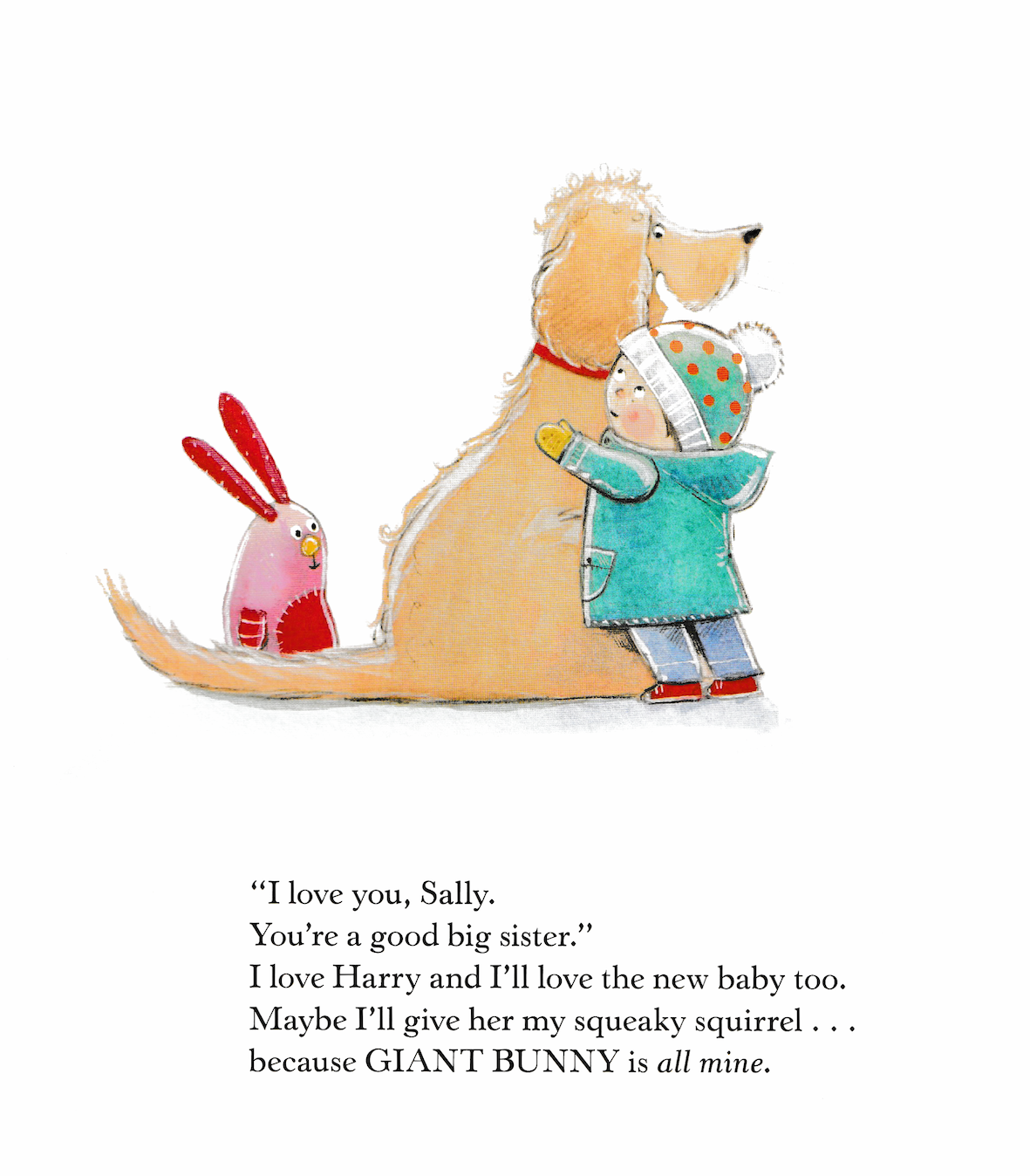
Immediately after Harry arrives, Sally knows things are going to change. She lets herself out when her people are too engrossed with the noisy baby.  Sure, she gets a blanket and a new squeaky squirrel, but Harry gets a giant red bunny! And when Sally tries to show affection for Harry as she would her own pup, they yell at her to get away and she is told, "No." Now Sally has a dog walker, and she sleeps in a basket because Harry sleeps with them. 
From When Sally Met Harry by Paulette Bourgeois, illus. by Brooke Kerrigan
Though Sally tries to think of a way to make her people love her again, she really doesn't have to do anything special. Sally's specialness comes through with the simplest of acts and makes Harry realize that Sally is part of his loving family.
I look deep into Harry's eyes.
I let him know that I love him.
From When Sally Met Harry by Paulette Bourgeois, illus. by Brooke Kerrigan
Many will recognize the name of Paulette Bourgeois as the author of the Franklin the Turtle series but it's obvious she knows more than turtles. She knows babies and children and dogs. She knows the confusion of a new baby in a home with a pet who has been the only "child" and used to getting all the attention and love. But, Paulette Bourgeois, a grandmother herself, also probably knows about finding a way to make all feel appreciated and loved–which will be all the more important when Baby #2 comes along–while bringing seemingly unconnected family members to becoming part of the whole. Telling the story from Sally's perspective, feeling what she does, hearing from others, and seeing for herself, Paulette Bourgeois makes Sally the star of When Sally Met Harry and restores her place of importance when we all know that a helpless baby must become the center of his parents' attention, at least for a time. And then when that baby is a toddler and can be a little brother to big sister Sally, the family circle is complete again.

That sweetness of story and familial bonding comes through in Brooke Kerrigan's illustrations. Rendered in watercolour, pencil crayon and gouache on paper before digitally enhanced, the artwork screams cuteness. From the playful and loving Sally to the cherubic Harry–look at that round head!–and all the little details of toys, squirrels, cats, and other dogs, When Sally Met Harry depicts many a household in which a baby is introduced to a family pet. Still, with Paulette Bourgeois's words and Brooke Kerrigan's illustrations, When Sally Met Harry tells the story of a one-of-a-kind relationship that could earn a cinematic rendering of its own.

August 07, 2020

The Girl with the Cat

Written by Beverley Brenna
Illustrated by Brooke Kerrigan
Red Deer Press
978-0-88995-531-8
32 pp.
Ages 5-10
April 2020

Based on a true story, The Girl with the Cat recounts a fortuitous visit to an art gallery that leads to an act of activism and the permanent installation of a bronze sculpture in Saskatoon.
From The Girl with the Cat by Beverley Brenna, illus. by Brooke Kerrigan
When a young girl and her older brother go exploring one Saturday shortly after the family's move from Toronto to Saskatoon, they discover an art gallery of epic proportions. Within the walls, the girl discovers a plethora of art which cannot be touched; that is, until she finds a bronze sculpture of a girl in a rocking chair with a cat on her lap. Without a sign about touching, lonely Caroline touches the chair and sees it rock. She pats the cat, and takes in the details of the artwork, from the girl's bare feet and shorts to the ripples of the cat's fur. Everything reminds Caroline of the home and cat she left behind and of playing with her friends. She makes a connection and returns to talk to the girl and her cat, identified as Nina and Sammy, time and time again.
From The Girl with the Cat by Beverley Brenna, illus. by Brooke Kerrigan
I sit beside them and the Gallery breathes softly around us. In the stillness I start to really see the paintings. This room is full of summer. There are trees for treehouses and beaches for swimming. I bet Nina likes this place. Maybe that's one of her secrets. I tell her my secrets in return.
But when Caroline learns that the sculpture is being returned to Ottawa where the artist lives, Caroline is devastated.
It feels as if there's a hole in the roof and all the light is leaking out.
Nine-year-old Caroline gathers up the little bit of money she and her brother have and delivers it with a letter to the director. Though he suggests there's nothing he can do, the next morning her letter graces the front page of the newspaper, and a month later Caroline is pleased to hear that the "Girl With Cat" would not be moved.

From The Girl with the Cat by Beverley Brenna, illus. by Brooke Kerrigan
According to the notes at the conclusion of The Girl with the Cat, Caroline Markham was the little girl who wrote the letter that saved this sculpture at the Mendel Art Gallery in 1966. That sculpture, by the artist Arthur Price of his own daughter and her cat, remains in Saskatoon though it has been relocated with the gallery's collection to the city's new art museum. But this child's small act of activism, championing a piece of art with which she made a connection and helped her become accustomed to her new home, reminds us that small deeds can enact important changes. Beverley Brenna, who has penned everything from picture books and early readers (I reviewed Sapphire the Great and the Meaning of Life last year) to middle grade, YA and short stories, is very astute about getting into the heads of children and giving voice to that which matters to them. This story may be about taking action but at its most heartfelt it's about the anguish a child feels about her family's move and her need for reassurance and a friend. She finds both in a bronze sculpture that also leads her to real friends. Not surprising she returns the favour.
From The Girl with the Cat by Beverley Brenna, illus. by Brooke Kerrigan
With Brooke Kerrigan's illustrations created with the softest of media like pencil crayon and watercolours, The Girl with the Cat is both muted and dramatic. Brooke Kerrigan makes the gallery itself impressively monolithic and the art it houses striking, which is how a child would perceive them to be. Her distinctive art styling has both a grace and a magic that consistently draw me in to the story. (Read my reviews of The Christmas Wind, The Little Boy Who Lived Down the Drain, and Fishermen Through & Through for a sampling of some of my favourites by Brooke Kerrigan.)

I'm glad Arthur Price created his sculpture and that it was there to comfort Caroline in 1966 and that she was able to help safeguard its presence in Saskatoon, but I am most thankful that Beverley Brenna and Brooke Kerrigan were able to share this story about how a small act can lead to transformation.

May 13, 2020

Sophie Trophy Too

Written by Eileen Holland
Illustrated by Brooke Kerrigan
Crwth Press
978-1-7753515-7-3
96 pp.
Ages 6-9
March 2020


Sophie Trophy, the third grader from Eileen Holland's first early reader in the series (Sophie Trophy, 2019), returns with a story about learning to manoeuvre through school and social situations that regularly put her at odds with other students and even her principal.

When a new student, Hailey, joins their class, Sophie is intrigued, especially as Hailey seems not to be scared or shy. Sophie is perplexed by the ease with which Hailey is making friends, especially with Enoli, one of Sophie's best friends and the girl Hailey sits beside. But, as much as Sophie would like to be friends with Hailey, all she does seems to get her in trouble and give Hailey a bad impression.

Much of the poor impression is related to Sophie's enthusiasm for the class's upcoming assembly presentation. Their teacher, Miss Ruby, has planned on a performance of a song about the sun and the moon with all the students using flashlights to enhance the production. Sophie is so enthralled with her flashlight that she carries it with her and gets caught using it in the bathroom, the school's sick room and the staff room. Each time, the principal Mr. Homewood has to get involved.

Moreover, even when she's just being herself, painting in class, showing interest in Hailey's show-and-tell plant or trying to help Hailey when she drops her flashlight, things go awry, and Sophie causes more accidents and has Hailey declaring, "It's wrecked, because of you." (pg. 75) These are harsh words for a little girl who never intends to do harm but whose actions regularly bring about some upset. Happily Sophie's good nature and determination to make things right ultimately deliver Hailey's forgiveness and friendship.
From Sophie Trophy Too by Eileen Holland, illus. by Brooke Kerrigan
Though Eileen Holland never labels Sophie as a child with a learning disability or ADD/ADHD or on the spectrum, the child's actions suggest some character which may challenge her, particularly in her impetuousness or decision-making or social interactions. She is a bright and imaginative girl who is compassionate but whose complexity of thought sometimes gets her into trouble. Whether choosing to sneak into the school's sick room or into the staff room closet to play with her flashlight, or falling when she tries to sneak a peek at a box of surprises, Sophie's actions are seen as irresponsible or inappropriate. Her classmates may get a laugh from her antics but even Sophie wonders whether they are laughing at her or with her. That's something many parents and teachers forget about children who are dealing with some invisible disability like Sophie. These young people are confused by their peers' reactions, and those of the adults in their lives, regarding their actions which are done without malice but may have unfortunate repercussions. When Sophie gets paint on Hailey's new boots, it is an accident but one that could have been prevented. Unfortunately, Hailey just saw the consequences of that situation and Sophie could not look back and see what she could have done differently.

Eileen Holland keeps Sophie's story at the emotional level of children in the younger grades, making Sophie Trophy Too an exceptional early reader. Young readers will feel for the girl with joie de vivre who gets caught doing thinks she shouldn't be doing. They'll know that feeling, unfortunately. And they'll understand wanting to fit in and be liked and sometimes messing up. Still Eileen Holland takes a light approach to Sophie's foibles, something that illustrator Brooke Kerrigan depicts sweetly in her few sketches, and Sophie Trophy Too becomes the story of any child struggling to fit in.

May 14, 2019

Sophie Trophy

Written by Eileen Holland
Illustrations by Brooke Kerrigan
Crwth Press
978-1-7753319-3-3
120 pp.
Ages 6-9
March 2019 

No, her last name is not Trophy but when her friend Brayden thinks she deserves it as a nickname for her goofy ideas, he's actually applauding her imagination which is stellar. Unfortunately, her classmate Jordy begins to use it as a taunt whenever she does something a little...different.  But it's just Sophie's creativity getting ahead of the third grader.

When Brayden brings a spider to school in a jar, it sets off a series of unfortunate events, all thanks to Jordy's removal of the lid and his exaggerated response to the spider. "It attacked my nose! I may have to go home sick." (pg. 7) But what's worse is that Miss Ruby, their teacher, obviously does not like spiders.  The next day, when Sophie, who sits in the front row, spots the spider first jiggling above Miss Ruby's voluminous hair and then falling into it and onto her hoop earring, Sophie ends up getting sent to the principal's office because of her outrageous and seemingly rude directives to her teacher.

At the office, Sophie's thoughts go wild, launching off of the secretary's pencil, an eraser she finds, and a gold pen she discovers on the floor.  But nothing is ever simple when Sophie gets an idea. Before all is resolved with Sophie and her teacher and the spider safely returned to its new home outdoors, the little girl breaks a special pen belonging to Mr. Homewood (whom she calls Mr. Homework), finds herself stuck hanging out his office window before falling and getting covered in mud and accidentally tripping Jordy.  In the end, the whole story comes out and Sophie makes sure Jordy knows she doesn't appreciate the way he uses her nickname. There may even be a happy dance from a spider.
From Sophie Trophy by Eileen Holland, illus. by Brooke Kerrigan
Early reader fiction is tough to write well. Too often the books are too juvenile–children tend to read up i.e., higher than their age–or lack the content to develop stories fully. They can't rely on illustrations to carry the bulk of the story as is possible in picture books–though Brooke Kerrigan's black-and-white sketches enrich the story–and don't have the volume of text to establish characters and plots as read in middle grade novels. But, when it's done well, as BC's Eileen Holland does in Sophie Trophy, young children get to know a few great characters, can empathize with their stories and cheer for an ending that makes sense without being artificial. Sophie is likeable and, while prone to day dreaming which includes musings about the mundane and the fantastic, it all comes from a good place. Her intentions are driven by her heart as she tries to protect her teacher from a spider, to prevent her friend from getting in trouble for bringing the spider to school, to repair her principal's special gold pen, and to keep the spider safe. For Sophie, doing the right thing just happens to occur while she's imagining ears flying off to overhear conversations and readying herself to swat at her teacher with a fish net. Never a dull day for Sophie Trophy, queen of the quirky ideas.

November 22, 2017

The Christmas Wind: Book launch (Toronto, ON)

Last week I reviewed this very special picture book 
which I believe will be heralded as a Christmas favourite
like The Polar Express and The Night Before Christmas 

Now I'm pleased to announce its book launch.

🎄🎄🎄🎄🎄🎄🎄

Join 

author Stephanie Simpson McLellan

for the launch of

The Christmas Wind
Written by Stephanie Simpson McLellan
Illustrated by Brooke Kerrigan
Red Deer Press
978-0-88995-534-9
32 pp.
All ages
November 2017

on

Sunday, December 3, 2017

at

1 p.m.

at

Ella Minnow Children's Bookstore
991 Kingston Road
Toronto, ON

🎄🎄🎄🎄🎄🎄🎄

This event will include:
• an interactive reading
• crafts for kids
• treats
• book signing
and
Christmas Wind loot bags.

I can't think of a better way to start the holiday season 
than by attending this launch with your children or without.


Just be sure to RSVP at


November 13, 2017

The Christmas Wind

Written by Stephanie Simpson McLellan
Illustrated by Brooke Kerrigan
Red Deer Press
978-0-88995-534-9
32 pp.
All ages
November 2017

The Christmas Wind is special.  It is very, very special.  And I suspect that it will be the Christmas book for this year and many to follow because of its secular telling of the Christmas story without getting bogged down in the religion.
The wind shoved Jo sideways, stealing feeling from her fingers and toes.  It chased her with ghostly moans and creepy shrieks.  The day before Christmas and still no snow.  She should have been glad, but the skinny road seemed colder without it.
Jo and her mother Merry and baby brother Christopher have had to leave a bad situation.  There may not be snow but it is cold and windy and the bus station, their destination, is still a long way away.  The young girl has taken charge, carrying her baby brother and helping her mother who is obviously unwell and weak.  When she realizes they must find shelter immediately but she cannot shoulder the weight of both her mother and the baby, she takes Christopher and heads to the barn of Franklin Murdock, "an old man as unfriendly as the wind."  Cautiously, she approaches, wary of the man who'd turned crusty after the loss of his wife and child, but Jo is determined to be brave and help her family.
From The Christmas Wind 
by Stephanie Simpson McLellan 
illus. by Brooke Kerrigan
Laying Christopher in a manger amidst the cows and sheep, Jo goes to retrieve her mother.  But when the two return to the barn, the manger is empty.  With a fury and a shovel, Jo heads to the house to confront Mr. Murdock.  But as she berates him and he questions her about why they are in his barn, he offers shelter in his home, first carrying her mother from the cold of his outbuilding.
From The Christmas Wind
by Stephanie Simpson McLellan
 illus. by Brooke Kerrigan
As they stepped into the rising storm, the wind blew both ways at once and a path of light from a single star opened before them.  Jo and Murdock found themselves momentarily suspended between where they came from and where they were going, until an eager blast of air hurried them to the house.
Though he provides them shelter in his house, Murdock seems immobilized by grief, their presence a reminder of his own losses on a past Christmas Eve.  Jo will have none of it.  "You can't give up like that." She swept her arm around the room.  "Things won't get better on their own."

From The Christmas Wind
by Stephanie Simpson McLellan 
illus. by Brooke Kerrigan
How the story ends is secreted away in the glorious final pages of The Christmas Wind.  Suffice it to say that the Christmas wind brings snow and so much more.

Though Stephanie Simpson McLellan touches on the Christmas story with the homeless Josephine, Merry and Christopher, a barn and a manger and a man's name that encompasses the gifts of the magi, The Christmas Wind is not the story of the birth of Christ.  It is a story of compassion and grief and determination and acceptance. Though Brooke Kerrigan's outstanding illustrations suggest another time, perhaps the 1940s, The Christmas Wind is a story for our time.  There is too much misunderstanding and jumping to conclusions and fears about others when we feel vulnerable but it is compassion for others that bridges all that separates us.  Like the wind that carries the family to Mr. Murdock's farm and heralds a new world blanketed in snow, The Christmas Wind portends the need for a deeper meaning to the holidays that should supersede all else.  
From The Christmas Wind 
by Stephanie Simpson McLellan 
illus. by Brooke Kerrigan
The excerpts I've included above speak to the gift of Stephanie Simpson McLellan's words. They are rich and atmospheric, and deep in spirit.   Partnering her text with Brooke Kerrigan's impressive artwork is inspired.  The softness of the watercolour and pencil of Brooke Kerrigan's images conveys much about the characters' strengths and pains, the briskness of that wind, and the inner shelter of barn and house.  The Christmas Wind is a complete package of words and art about that which is right or should be for the holiday season and always.

I'd like to leave the last words to author Stephanie Simpson McLellan who writes about her book and the meaning of The Christmas Wind to her.
“Some of the classic Christmas stories such as Chris Van Allsburg’s Polar Express, Susan Wojciechowski’s Christmas Miracle of Jonathan Toomey, Jean Little’s Room for a Little One and Peter Collington’s A Small Miracle were as integral to our holiday traditions as stockings hung by the fire. I wanted to contribute to that tradition. If you read closely, you’ll see that many elements of the original Christmas story are in The Christmas Wind, but jumbled and thinly disguised, suggesting that we all have the capacity for new beginnings. My young heroine, Jo, is my favourite kind of protagonist – someone who becomes fearless through necessity, squaring off against adversity to create something bigger than herself. She and Murdock are, unexpectedly, exactly what each other needed, enabling each to access the true spirit of the season.”
•••••••••••••••••••••••••••••••••••••

The Christmas Wind Project
Teachers, Stephanie Simpson McLellan has been promoting the Christmas Wind project for several years though the book only launches this fall. You can read all about it on her website at http://stephaniemclellan.com/teachers-corner-3/christmas-wind-story-project/. Stephanie Simpson McLellan describes it as a "unique literacy experiment" with "students from JK-Grade 6 listening to a story in a format akin to an old, serialized radio show."

•••••••••••••••••••••••••••••••••••••

Book launch
The Christmas Wind launches on Sunday, December 3, 2017 at 1 p.m. at Ella Minnow Children's Bookstore in Toronto.  I will post details soon.

October 17, 2017

The Little Boy Who Lived Down the Drain

Written by Carolyn Huizinga Mills
Illustrated by Brooke Kerrigan
Fitzhenry & Whiteside
978-1-55455-395-2
32 pp.
Ages 3-6
October 2017

Mondegreens, the mishearing of a word or phrase, is typical with songs for which the listener does not see the words they are hearing.  It seems reasonable that the same could be applied to any repetitive rhyme that is misheard like the nursery rhyme "Baa Baa Black Sheep."  When little Sally hears her mother repeating that old English nursery rhyme to her baby brother, she is convinced that she hears,

"Baa baa black sheep
Have you any wool?
Yes sir, yes sir,
Three bags full.
One for my master.
One for my dame.
And one for the little boy...
Who lives down the DRAIN.
"
From The Little Boy Who Lived Down the Drain 
by Carolyn Huizinga Mills 
illus. by Brooke Kerrigan
No wonder her ears perk up.  And, boy, does she have a lot of questions about what's happening with that wool and about his living arrangements.  
From The Little Boy Who Lived Down the Drain 
by Carolyn Huizinga Mills
 illus. by Brooke Kerrigan
As a child who seems to be dealing with busy parents, a  crying baby, and twin sisters who won't let her play with them, Sally is in need of a little companionship and conversation.  That little boy who lives down the drain seems like a perfect friend.  At least, he's available, sitting down the very drain of the tub in which she takes her baths. 
From The Little Boy Who Lived Down the Drain 
by Carolyn Huizinga Mills 
illus. by Brooke Kerrigan
After the water lets out, Sally shouts down a cheery "Hello" to the little boy.  Her voice echoes and as she talks away about herself and her family, she envisions him using the wool to fish in the drain.  The little boy down the drain listens as she laments the attention she lacks and the annoyance of her brother and sisters.  When she can't hear his responses, she speaks more emphatically into the drain, telling him "I know you're probably trying, but you need to try something different!

What she hears back is the echo of her final words "Try something different" which gives her the courage to do just that with her family.  Her own words help bring some resolution to her issues with her family but the story doesn't end there.  You see, Sally eventually hears a different ending for the rhyme and interprets it in her own charming way.

The Little Boy Who Lived Down the Drain was just nominated yesterday for a Blue Spruce award.  That's high praise indeed for Carolyn Huizinga Mills' first picture book.  Sally is so spontaneous and sweet, honest and innocent, never assuming she's misheard the words.  She is determined to speak with the little boy who lives down the drain, and treats him with such reverence and curiosity.  There is a surprise ending here that will have readers laughing out loud with its simplicity and cleverness.  And Brooke Kerrigan, who has illustrated several Blue Spruce-nominated titles including Fishermen Through and Through (written by Colleen Sydor, Red Deer Press, 2014) and Kiss Me! (I’m a Prince!) (written by Heather McLeod, Fitzhenry & Whiteside, 2011) brings a sweetness to Sally and her bathtub antics, as well as to her efforts to engage her family.  Just like Sally, Brooke Kerrigan's illustrations have a guilelessness to them.  Her characters are so natural, her settings clean and subtle, and yet they are enriched with detail as appropriate. (See the illustration of Sally trying to get her busy family's attention in the illustration above.) Together Carolyn Huizinga Mills and Brooke Kerrigan have created a picture book about a little girl's naiveté but turned it into a lesson in empowerment.  For good advice about being empowered, you really must listen, like Sally did, to The Little Boy Who Lived Down the Drain.

🚰🚰🚰🚰🚰

To see a list of all the Blue Spruce nominated titles for the 2018 Forest of Reading® readers choice awards, including The Little Boy Who Lived Down the Drain,  go to my awards page here.

December 12, 2014

Fishermen Through & Through

by Colleen Sydor
Illustrated by Brooke Kerrigan
Red Deer Press
978-0-88995-517-2
32 pp.
Ages 4+
November 2014
There once lived three fishermen: Peter, Santiago, and Ahab. They were tough. They were as salty as the bottom of a pretzel bag. They were as weathered as a twisted stick of driftwood. (pg. 3)
These three men are the titular fisherman, a companionable trio whose lives on the sea do not preclude their ability to dream. Peter dreams of camel travel across a desert of sand,  Santiago imagines balloon travel on the wide expanse of sky, and Ahab is enamoured with the vision of endless fields of coloured tulips. But, as Fishermen Through & Through, they continue to fish, until one day, blow me down, a beautiful, white lobster becomes entangled in their nets.

Not wishing to be selfish, the three take their catch to the Fisherman's Net, a local restaurant, to be honoured by placement in a grand seawater tank, for all to enjoy.  News of the albino lobster spreads and everyone, from reporters to biologists and photographers, come to visit and witness the splendour of the lobster.  But, when the fishermen are offered a great deal of money for the lobster, they find themselves considering their dreams, the lobster and life on the sea to help them make the right decision.

Whether Colleen Sydor's three fishermen represent Saint Peter, Hemingway's old fisherman from The Old Man and the Sea, and Moby Dick's captain Ahab is irrelevant–though fitting–they are a credit to their vocation, fishermen through and through.  And their respect for the ocean, and what it gives and takes, is uncompromising.  With Brooke Kerrigan creating the graphics, the pencil illustrations are beautifully awash in soft watercolours, bringing the gentle waters and straightforward characters to complement the positive text.  Illustrator of Wellington's Rainy Day (Beck, 2011) and award-winning Kiss Me! (I'm a Prince) (McLeod, 2011) Brooke Kerrigan doesn't just add the pictures; she creates the spirit of Colleen Sydor's story through line and colour. Fishermen Through & Through is a complete story, through and through.

January 19, 2012

Wellington's Rainy Day

Written by Carolyn Beck  
Illustrated by Brooke Kerrigan
Orca Book Publishers
978-1-55469-284-2
32 pp.
Ages 4-7
2011

Wellington is a hound who enjoys a good life with Master Horace.  And even though Master Horace seems to be having an exceptionally deep and long nap today, Wellington is clever enough to arrange for his needs to be met.  His bowl may be empty but he knows where there's always a deep porcelain bowl filled with water.  As for his food, Wellington can smell a delicious meatloaf on the table.  Though a short hound, he finds creative ways to reach this food, and to eat "every last gorgeous, every last worgeous, every last squorgeous bit." He even cleans up, though more to hide the evidence than for housekeeping purposes.

But, Honey, the marmalade cat (with a mouse as a sidekick), has been watching Wellington and, like any younger sibling, would delight in Wellington's downfall.  But, as every child who has every tattled knows, "telling" doesn't always work out the way one anticipates. 

Carolyn Beck must love animals and dogs especially, with three of her five picture books based on canine critters: The Waiting Dog (Kids Can Press, 2003), Dog Breath (Fitzhenry & Whiteside, 2011) and now Wellington's Rainy Day (Orca, 2011).  The rhyme and rhythm of Carolyn Beck's text support the sweeping nature of Wellington's day, enhancing the mundane (e.g., trash in a garbage can) to extraordinary (e.g., "The garbage was a poem").  Brooke Kerrigan's pencil and watercolour drawings are light but evocative of the important aspects of Wellington's life with Master Horace and Honey.  Although Master Horace's face is never evident, the important parts, like his legs (for walking) and finger (for pointing) and voice (for snores and calling), are definite.  The details in Kerrigan's illustrations add charm and whimsy, and children will delight in looking for small details including the little mouse.

After reading Wellington's Rainy Day, it would seem that Sir Winston Churchill was correct when he declared that, "Dogs look up to us. Cats look down on us."  And for that reason, the book's ending seems a justifiable and fair one.  (By the way, the end of Churchill's quotation, "Pigs treat us as equals", offered his explanation for liking animals of the porcine variety.)