Showing posts with label sensitivity. Show all posts

April 12, 2023

Otis & Peanut

Written by Naseem Hrab
Illustrated by Kelly Collier
Owlkids Books
978-1-77147-496-2
80 pp.
Ages 6-8
April 2023

Otis is a long-haired guinea pig. Peanut is a naked mole rat. And they are as different in their personalities as they are physically. Yet, they are the best of friends, being for the other what they are not easily themselves. Together, they will touch your heart and remind you that diversity gives the world a soul.
From Otis & Peanut by Naseem Hrab, illus. by Kelly Collier
Told in three graphic stories, author Naseem Hrab, recent finalist for the Governor General's Literary Award for Weekend Dad, introduces us to her unlikely friends Otis and Peanut. In the first story, The Haircut, the two set off for the barbershop to get Otis a much-needed haircut. Unfortunately, their fears about the process and what they might look like causes them much anxiety. As Peanut tries to help Otis embrace change, Peanut realizes that they too would enjoy change. While that could be a new hat, a new coat, and new shoes, it might include a new friend. Fortunately, with a haircut, Otis becomes that new friend!
From Otis & Peanut by Naseem Hrab, illus. by Kelly Collier
The Swing is the second story in the book and focuses on Otis missing their friend Pearl. As Otis tries to subdue the sadness that keeps him from enjoying a swing, Peanut recognizes that recalling the good memories of Pearl is important, as is accepting that grief and joy can coexist.
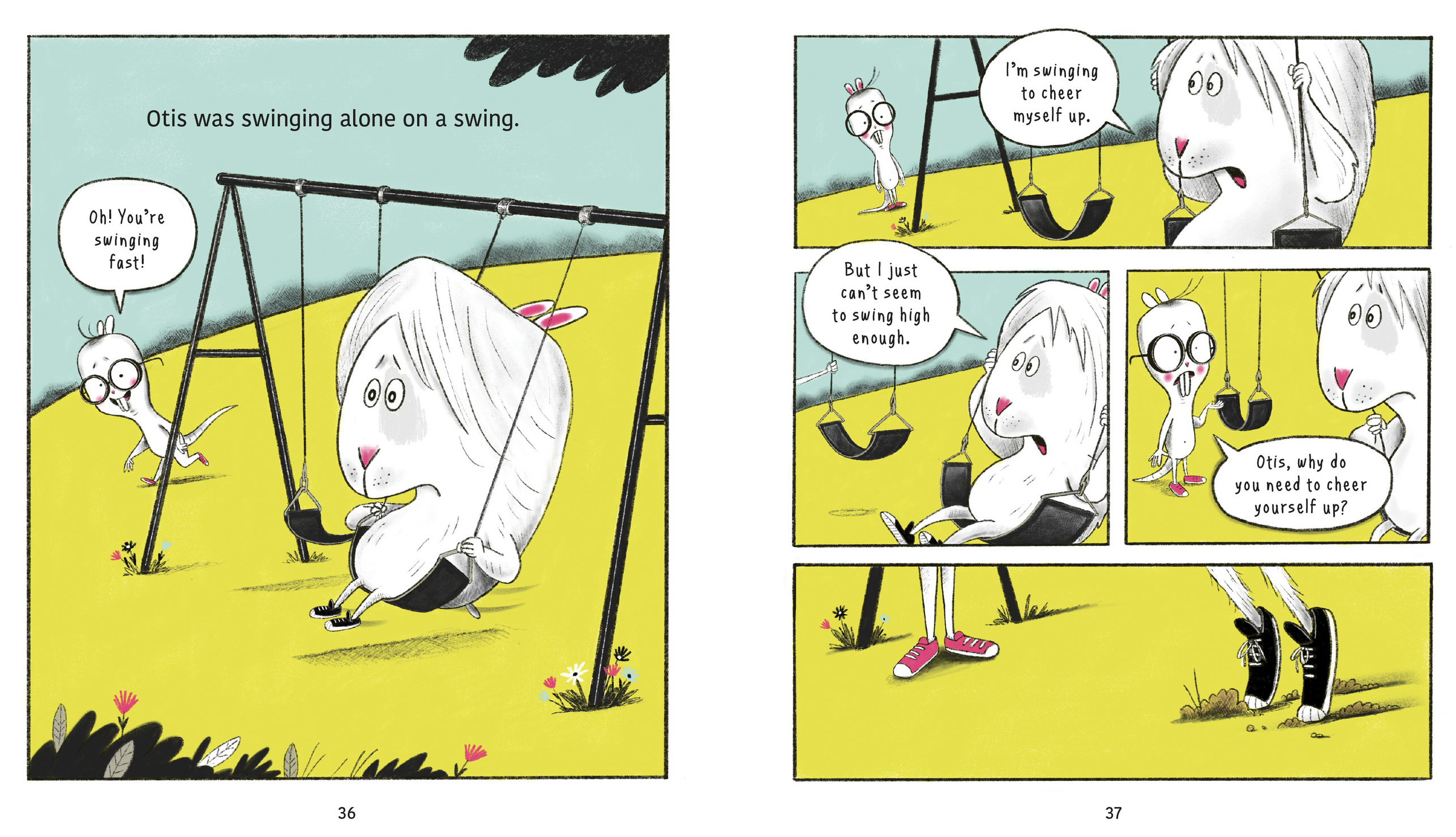
From Otis & Peanut by Naseem Hrab, illus. by Kelly Collier

In the final chapter titled The House, Otis is decorating their new house to make it a true home. 

"Well, I want to feel like my heart is here. So I'm painting it my favorite colors. And putting special things inside of it and outside of it."
From the front door to the lilac bush, Otis has reminders of friends that make the house truly his. But when there still feels like something is missing, Peanut becomes the solution.

There have been many comparisons of Otis and Peanut to the celebrated Frog and Toad as a duo of friends that learn from their interactions with each other and others. But I think Otis and Peanut are far more diverse both in their appearance and their demeanors. Naseem Hrab has made Peanut the confident and extroverted character, eager to take on change and challenges, while Otis is more sedate and thoughtful, more sensitive to their feelings and surroundings. But both are capable of expressing themselves beyond those personalities, with Peanut showing compassion and insight beyond what might be expected of an exuberant extrovert and Otis able to enjoy things beyond self and feeling. Through their self-expression and Nassem Hrab's storytelling, Otis and Peanut have loads to teach young readers about friendship, grief, change and self.

Those important lessons come by way of a lightness of text and art. Kelly Collier–whose Steve the Horse series was reviewed here–illustrated this early graphic novel digitally and yet it has the delicacy of ink and watercolour. Surprisingly, the economy of her palette brings a boldness to the illustrations. While Otis and Peanut are essentially black and white with only the barest hints of pink for ears and nose and such, Kelly Collier saves the chartreuse yellow, pale turquoise and bright pink for backgrounds and large swaths of coats and furniture and such. It is a limited palette but it's fabulous to highlight Otis and Peanut, the stars of the stories.

It's tough to write an early reader that doesn't talk down to kids while addressing big issues like grief and friendship and home. But Naseem Hrab has done so with her words and, with Kelly Collier's graphic novel illustrations, Otis & Peanut is sure to be a hit. And, since this is only Book #1, there will be more stories with which we can visit Otis and Peanut, and I look forward to all of them.

October 16, 2018

The Zombie Prince

Written by Matt Beam
Illustrated by Luc Melanson
Groundwood Books
978-1-55498-997-3
24 pp.
Ages 4-7
September 2018

With Halloween around the corner, a zombie prince sounds like a great costume. It oozes power and fear and may be just the thing to help Brandon destroy his enemies. But Brandon's is not a costume. It's an imaginary coat of armour to help the boy fight off, virtually, a schoolyard bully. 

Three boys, Brandon, Oscar and our narrator, hang out on the grass of the school yard, problem-solving how to deal with a bully, Sam, who has called Brandon a fairy. And though Ms. Gomez has declared that fairies are fearless creatures, Brandon is devastated by the bully's evident malice. So, each of the boys imagines himself as powerful enough to fight off Sam's hurtful words. Brandon sees himself as "a zombie who will destroy his enemies with the tears falling down his face." Oscar sees himself as a ghost who will block the mean words hurled at Brandon.  Our narrator declares himself a vampire who will suck bad things from the air, including "pollution and Mrs. Clark's perfume clouds and Sam's mean words."
From The Zombie Prince by Matt Beam, illus. by Luc Melanson
Finally our narrator suggests that "Sam was wrong, Brandon," and that Brandon would "make an awesome fairy, but you actually looked more like a prince." That delights Brandon and the three boys while away the rest of recess imagining planes, yetis and lasers in themselves and their surroundings.
From The Zombie Prince by Matt Beam, illus. by Luc Melanson
Anxiety about bullying often comes from ruminating over words said and abuses inflicted, and anticipating the worst as a consequence of overthinking. But, what the boys learn is that that same busy brain can be used to fuel an imagination that can allay that anxiety and produce calm and joy instead. Matt Beam's The Zombie Prince applauds the solace that comes from applying creativity to distracting and comforting rather than worrying, and with friends to help bolster that creativity with emotional support, Brandon glows with the relief of being a zombie prince.
From The Zombie Prince by Matt Beam, illus. by Luc Melanson
There's a similar glow to Luc Melanson's quirky illustrations that have a lovely green tinge, though not quite like that of a zombie's skin. The green is soft like grass and warm like sunshine, and uplifting like the support the three boys give each other. Moreover, by making the three children so different in their features, Luc Melanson supports Matt Beam's story assertion that all boys can be sensitive and supportive and never less for feeling vulnerable.

While littlest ones might be enamoured with the idea of a zombie prince–creepy and powerful–Matt Beam and Luc Melanson's illustrated story approaches the idea that power comes from something within, not from external appearances, and strength is built upon compassion and awareness, enhanced with a healthy dose of imagination.

August 25, 2018

Weave a Circle Round

Written by Kari Maaren
Tor Books
978-0-7653-8628-1
367 pp.
Ages 12+
2017

After fourteen-year-old Josiah and adult (but not mother) Cuerva Lachance move in to the house on Grosvenor Street, everything in Freddy Duchamp's life goes topsy-turvy. That's saying a lot since life hasn't been that stable to begin with. Maybe Freddy has always been too sensitive–something she doesn't appreciate, knowing that "Sensitive people got stomped on by life" (pg. 12)–but with her parents' hostile relationship transitioning into divorce and her mother marrying Jordan Fukiyama whose irascible son Roland, also 14, seems to hate Freddy, the teen finds little solace anywhere or with anyone. She feels ignored at home (Mom and Jordan are essentially absentee parents) and at school (maturing friends Rochelle and Cathy have left Freddy behind). She's angry at Roland who's a jerk and gets special attention because of his hearing impairment and treats her like she doesn't belong in her own home. And she's frustrated with her brilliant younger sister Mel who gets along with Roland and is often involved in his role-playing games (RPGs).

Though Freddy clashes with the disagreeable Josiah, he seems to be the only one around actually being friendly to her. But Roland has a real problem with Josiah and Cuerva Lachance and warns Freddy and Mel to stay away from them, without any explanation. There are hints of chaos on the horizon: Cuerva Lachance aggravating all with her bizarre behaviour; Mel's surveillance of their neighbours revealing Josiah in two places at the same time; and Freddy and Roland's conflict escalating into verbal assaults and threats.

And then, without warning, Freddy is in 9th c. Sweden in the midst of a battle between feuding Viking families. Josiah is there, explaining that they have time-travelled and that no matter where or when they reappear in the past, Josiah will be there as himself, with Cuerva Lachance as a new character and a third person whom they call Three. Jumping from times that include ancient China, the Upper Palaeolithic, 18th c. England (where they meet Sam Coleridge whose poem Kubla Khan gives the line "Weave a circle round him thrice") and the future of the 32nd century, Freddy attempts to make sense of the dynamics between the three characters and her role while surviving abductions, battles, and Josiah's perplexing attitude.

Weave a Circle Round is all about the struggle between balance and chaos, with a choice that needs to be made as to which will override the other.  In the case of Josiah and Cuerva, the balance of power shifts regularly and Freddy is forced to look within and around her to make sense of the world, both in her personal timeline and in those of Josiah, Cuerva Lachance and Three. How it is resolved is all on Kari Maaren.

Short-listed for the 2018 Sunburst Award for excellence in Canadian literature of the fantastic in the YA category as well as the Andre Norton Award for Young Adult Science Fiction and Fantasy, Weave a Circle Round has already made its mark for Kari Maaren who has blended a story that balances its own chaos with harmony and produced a tale of fantasy with complex characters seeking to fit in. They evolve, they mature, and they learn. From her protagonists Freddy, Roland, Josiah, Cuerva Lachance, and Mel, to her secondary characters like Freddy's mom and friends Rochelle and Cathy, all the characters in Weave a Circle Round are complex beings who are motivated by fear and uncertainty and follow their instincts, good or bad, to pursue becoming the characters they choose to be.

The writing is brilliant, both intricate and honest, giving voice to those who seek understanding of self and others.
As far as I can tell, crying about something you can't change is a slightly more sophisticated version of throwing a tantrum because the sun has melted your ice cream. (pg. 17)
And even through the complexities of time travel and the characters' personal development, there is humour.
"...and it doesn't really matter for me. I eat paradox for breakfast. I'm also fond of waffles." (pg. 131)
Weave a Circle Round is A Wrinkle in Time meets Dr. Who. It's a wonderful fabric woven of a fantastic plot and rich characters on a backing of science and history. The message is clear that all lives fluctuate between stable and chaotic, sometimes one more than the other, but the need for balance is irrefutable. And, with the introspection and problem-solving Freddy achieves via her time-travels and interactions with all, Weave a Circle Round becomes her coming of age story. She learns, a little later than sooner, that it's all about writing your own narrative and choosing the roles you'll play and that, if you want to see how things are going to work out, it's best to look where everything begins.

•••••••••••••••••••••••••••••
I'm pleased to announce that writer Kari Maaren will be joining YA authors Lesley Livingston and Natasha Deen on a speculative fiction panel at the Eden Mills Writers' Festival on Sunday, September 9, 2018.  Do come out to hear these authors speak, to ask a few questions, and to get a book or two autographed.  It's a wonderful outdoor event to celebrate words.