Showing posts with label Sean Huang. Show all posts

January 08, 2025

The Moon's Journey

Written by Beryl Young
Illustrated by Sean Huang
Red Deer Press
978-0-889957473
32 pp.
Ages 6-8
November 2024 
 
When Faith and her family are set to leave Wales and join her father in Canada, Faith is devastated with all she must leave behind, from their home and their cat Blackie to her best friend and even the caterpillars she was nurturing. And what about the moon?
 
I especially can't leave the moon.
 
From The Moon's Journey by Beryl Young, illustrated by Sean Huang
   
But her brother Gareth has a way to reassure her.
 
After boarding the ship, finding their berths, and exploring the ship, Faith looks for the towline tethering the moon to the ship's funnel. And though she cannot see it and worries that the rope has come loose, Gareth always reassures her, as he does day after day and night after night of their journey.

From The Moon's Journey by Beryl Young, illustrated by Sean Huang
When they finally arrive in Canada and are picked up by the children's father, Faith's concerns continue.
Would the captain remember to untie the rope so the moon could stay in Canada?
And though their dad does everything to ensure that their new home feels like home, including a new kitten, it's not until the moon reappears, seemingly bigger and closer than in Wales, that Faith that knows she's home.
 
While Faith's family's experience aboard the ship may be far more upscale than those of most immigrants, with gleaming silverware and white serviettes, Beryl Young still encompasses the tenuous nature of migration from the familiar to the unknown. By tethering Faith's disquiet about the move with the moon, a familiar and ever-present entity, even when it's not always visible, Beryl Young gives a common feature to which all immigrants can relate. The sun and moon are forever present, no matter where we are. It's a shared experience and one that we can all rely on, at least most of the time. And by reconnecting with the moon in her new country, Faith gets the reassurance she needs that things would be okay.

In addition to coping with migration, Beryl Young includes a sweet brother-sister relationship that helps Faith persevere and look for the familiar. How lovely for Gareth to create a scenario in which the moon is dragged along by the ship to their new country just to comfort the young girl.
From The Moon's Journey by Beryl Young, illustrated by Sean Huang
For historical fiction, Saskatchewan artist Sean Huang's illustrations are an excellent fit. Previously he illustrated I Am Not a Ghost: The Canadian Pacific Railway, another picture book of historical relevance, and his realistic art here in The Moon's Journey just as capably transports us to the 1950s and post WW2 immigration by ship.  Even though his artwork is digitally rendered, it leans towards the realism of classic oil paintings from the 19th c., focusing on landscapes of the sea and the ship along with portraits of the children at play or contemplation. For the historical events of post-war immigration, Sean Huang's art is befitting.
 
The Moon's Journey is a simple tale of how a natural connection between places can make all the difference in easing the hardship of something like immigration. In this case, it was most fortuitous that the moon was able to join Faith and her family on their journey and in their new country.


October 23, 2023

Endgame: The Secret Force 136

Written by Catherine Little
Illustrated by Sean Huang
Plumleaf Press
978-1-738898244
32 pp.
All ages
October 2023

This is a picture book. But Endgame: The Secret Force 136 is more than a picture book. It's a story within a story with another story. There's an intergenerational story which segues into a story from World War II that is framed by the playing of a game of Chinese chess that is depicted as an actual battle in illustrations. It may sound complicated and yet it all works.
From Endgame: The Secret Force 136, written by Catherine Little, illus. by Sean Huang
A child regularly visits his great-grandfather Tai Gong with his mother and is gifted with his elder's Chinese chess set on his tenth birthday. The boy enjoys learning the new game, called Xiangqi or elephant chess, with its two battling armies of generals, advisers, elephants, chariots, cannons, and soldiers, but he can never win over his Tai Gong.  Tai Gong advises him:
“You have to plan ahead, Alex,” Tai Gong replied. “As I have told you many times, slow down and plan your strategies. Focus on the big picture.”
From Endgame: The Secret Force 136, written by Catherine Little, illus. by Sean Huang
During one visit, Tai Gong shows Alex some faded photographs he keeps in his wallet. The photos show groups of men, some in uniforms, and Tai Gong says he needs to tell Alex about the stories of these photos. As he recalls discrimination he and other Chinese Canadians endured, many still felt the need to fight for their country during World War II. Though they were rejected initially, when the enemy occupied much of Southeast Asia, they were accepted into Secret Force 136 for special missions. And though he speaks of dangerous situations, Alex's tai gong is convinced it was all worth it because of the progress that happened upon their return. It was all about the endgame, something he hopes to impart to his great-grandson as they play Xiangqi.
From Endgame: The Secret Force 136, written by Catherine Little, illus. by Sean Huang

There is a history lesson in Endgame: The Secret Force 136, and Catherine Little provides extensive historical notes about the racial discrimination Chinese Canadians faced, about the Secret Force 136 including bios of several of the team's members, and about the impact of the Chinese Canadian war effort. While her focus may be on the history, as shared through a boy's interaction with his great-grandfather, she also embeds in the playing of the ancient game of Xiangqi which she also highlights in her appended notes. This could have been a very dry exposé of a WWII special operation but by tying the story of the strategies employed in a game of chess with the memories of an elderly Chinese Canadian, Catherine Little makes the story more personal. This is his story, and he speaks of it because he knows of it. And he learned valuable lessons for war but also for life but now he can share that strategizing so that his great-grandson may also benefit.

The realism of the child's interactions with his great-grandfather and his Tai Gong's experiences are depicted well in the lush paintings of Saskatchewan artist Sean Huang who takes readers from a contemporary setting to that of World War II and also to a time when warriors wore lamellar armour and carried spears. Because the story is one based in history, it's appropriate that Sean Huang maintains that realism so that a young reader might visualize their own interaction with a grandparent, or asking about the past, or looking to understand who is in photos. (The illustration of the Tai Gong's hands and the photographs is so lifelike that it will be immediately familiar and evocative of age and nostalgia.)

Players of chess and other games often speak of the endgame as the final stage and Alex learns about the perspective he must take to have a successful endgame. But his Tai Gong knows that there are many endgames in life, those final steps that can lead to success, to progress, and to resolution. His life has had many endgames and while they may or may not have always felt triumphant, they were surely noteworthy, if not for him then for others.

April 17, 2023

I Am Not a Ghost: The Canadian Pacific Railway

Written by David Bouchard with Zhong-Yang Huang
Illustrated by Sean Huang
Plumleaf Press
 ‎978-1-778242816
40 pp.
Ages 7-12
May 2023
 
While the building of the Canadian Pacific Railway in the 1880s was considered an achievement in connecting eastern Canada with British Columbia, its history is clouded in infamy. From its treatment of Chinese workers to the expulsion of First Nations from their lands, the construction of that national railway is a bigger story and one made up of many. I Am Not a Ghost is one story.
From I Am Not a Ghost by David Bouchard with Zhong-Yang Huang, illus. by Sean Huang
Granddaughter, you and your children must know this story, and you must remember. (pg.9)
 
As a grandfather remembers, he recalls the hardship of finding work in China and leaving his family to find a better life. But what he found were tireless working conditions, hunger, cold and the bigotry that had the white men calling every Chinese man by the name Johnny. Still, he persisted, hopeful of a prosperous future, eventually saving enough money to send for his wife and son.
From I Am Not a Ghost by David Bouchard with Zhong-Yang Huang, illus. by Sean Huang
When he falls ill, laying in the snow as if already dead, and is ignored by the foreman, Lady Amelia Douglas, the visiting wife of the late Governor of BC, comes to his aid and demands he be taken to her home in Victoria. Although the men at the camp tell his family he has died, Mrs. Douglas gets him medical attention and, once she learns of his family days later, brings them to him. After several weeks, his family returns to Chinatown and he to the railway.
From I Am Not a Ghost by David Bouchard with Zhong-Yang Huang, illus. by Sean Huang
But, upon his return, his countrymen are aghast, convinced they are seeing a ghost. He has to persuade them with the words of the book's title that he is not a ghost and recounts the goodness and compassion of Mrs. Douglas, a Métis woman, who was their friend like other Indigenous people. 
 
Because of the kindness of Mrs. Douglas, he was able to survive the building of the railway, build a business and extend kindness to other Chinese immigrants, helping to grow a compassionate and vibrant community.
From I Am Not a Ghost by David Bouchard with Zhong-Yang Huang, illus. by Sean Huang
Non-fiction books that teach history, especially those used in schools, tend to be verbose and comprehensive, skimming over many topics, using dense text, and leaving no memorable impression. I Am Not a Ghost is not such a text. By focusing on the immigrant experience of one Chinese Canadian in the 1880s, Victoria's David Bouchard with Regina's Zhong-Yang Huang effectively place young readers into the treacherous life of working on the railway as a Chinese immigrant in the 1880s. The toil, the racism, and the unfairness of conditions and treatments all speak to oppression and perseverance in that oppression. The story of this man is heartbreaking and very real, as is the true story of the building of the railway and Mrs. Douglas with her  compassionate nature. ("Historical Notes" at the end of the book give further details about the context for the story of I Am Not a Ghost.)
 
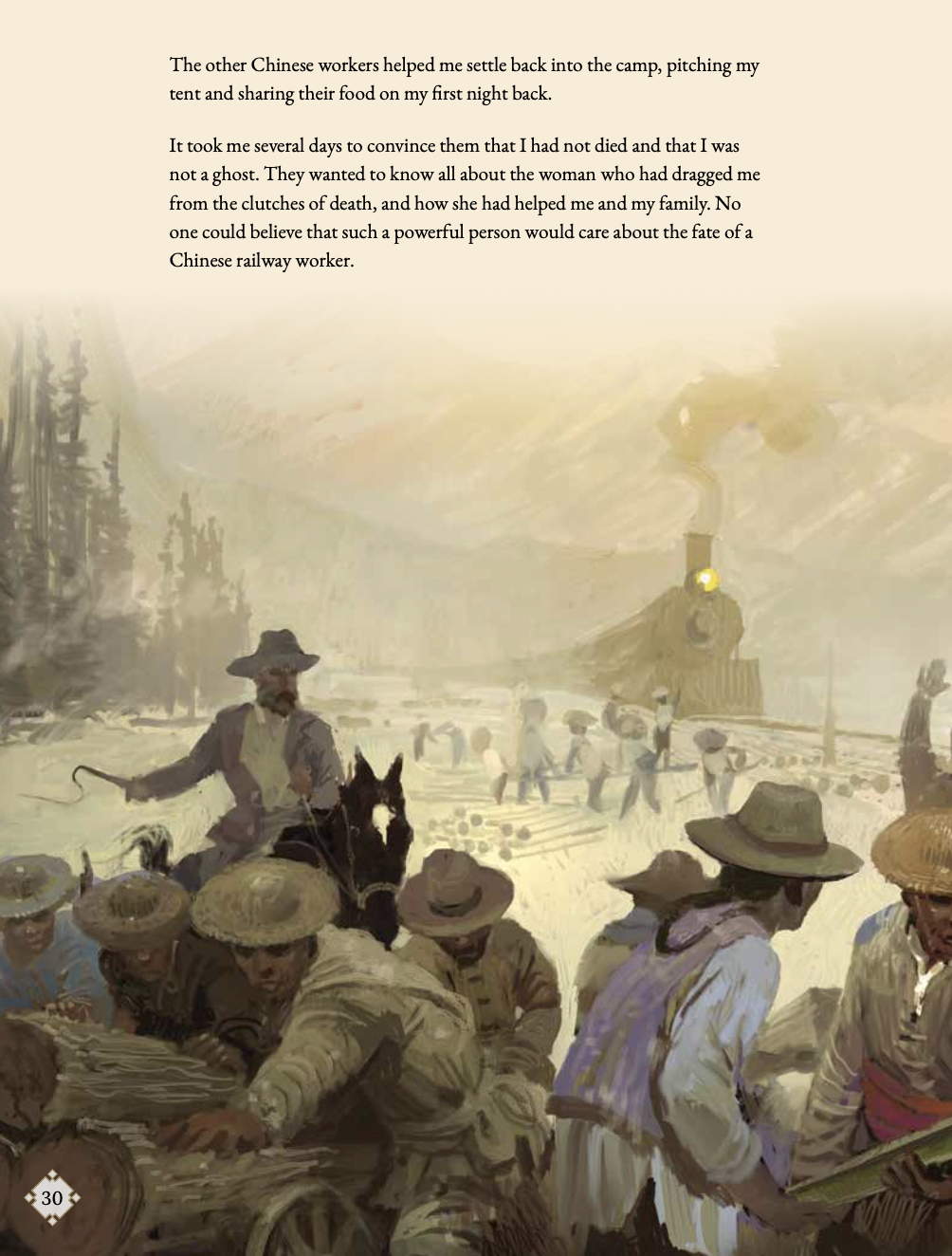
With the seriousness of the story and the realism of a historical narrative, the art of Sean Huang adds to the story, taking us from frozen landscapes of workers in canvas tents or collapsed in snowbanks, to the opulence of a fine lady's Victorian home, to the busyness of countless workers on the railway. Combining both a heaviness and lightness to his brushstrokes and the classic palette of old masters, Sean Huang takes us into the past of David Bouchard and Zhong-Yang Huang's story, and tells a history where a man is disregarded because of his heritage and taken for dead because he might not have mattered enough to be helped.

If you're a teacher of Canadian history for young people and want a fresh take on the building of the railway, I Am Not a Ghost provides a very personal story that goes beyond the placement of that last spike and reminds us that achievements are often on the backs of others who should be recognized and their stories told.