Showing posts with label observations. Show all posts

September 22, 2025

The Case of the Tagalong Twin (A Gumboot Kids Nature Mystery)

by Eric Hogan and Tara Hungerford (Gumboot Kids Media)
Firefly Books
978-0-2281-0570-1
32 pp.
Ages 3–8
September 2025
 
Scout and Daisy, characters of multiple TV series starring The Gumboot Kids, are off exploring the outdoors yet again and learning about new science concepts. In The Case of the Tagalong Twin, Scout and Daisy have a new mystery to solve and, only by working through a number of clues, will they understand what they are actually seeing.
From The Case of the Tagalong Twin by Eric Hogan and Tara Hungerford
Daisy tells Scout that on her walk over to his place she'd noticed something very odd. She'd noticed someone following in sync alongside her. Scout calls this her tagalong twin and the two retrace her steps to try to solve the mystery of this twin. Even though they don't see this twin on their walk, Scout and Daisy peruse her field notes for clues she may have noticed. Even putting together the clues of the sun, the sidewalk, and Daisy herself, they can't replicate Daisy's tagalong twin. But when the clouds part and the sun shines again, both Daisy and Scout discover they have tagalong twins that show up on the sidewalk.
From The Case of the Tagalong Twin by Eric Hogan and Tara Hungerford
At the library, they discover a science book that teaches them about shadows and how they are formed. 
From The Case of the Tagalong Twin by Eric Hogan and Tara Hungerford
For young children, the concept of shadows and how and when they are created is a complex one. They may or may not notice them—helping children use their senses to make observations is an important part of The Gumboot Kids mysteries—but when they do, they will also notice that shadows don't always appear, that they may change size and shape, and that even lamp lights can produce them. (The appended "Field Notes" will help kids discover more about shadows, as well as introduce them to new words like opaque and light source.) The Gumboot Kids creators Eric Hogan and Tara Hungerford know how to blend science concepts like shadows (or spider webs, tides and woodpeckers) into easy-to-understand terms for young children. And with adorable, felted mice in three-dimensional landscapes—incredibly detailed with tea cups, flowerpots, quilts and books—learning about shadows is easy, engaging, and informative. With Eric Hogan and Tara Hungerford's supplementary notes and a nature craft, The Case of the Tagalong Twin becomes a STEM concept book as well as an art lesson all embedded in a story.
From The Case of the Tagalong Twin by Eric Hogan and Tara Hungerford
Kindergarten and primary elementary teachers would be wise to pick up all the books in The Gumboot Kids Nature Mystery series. (I've posted a list below.) Whether as a lesson starter or a read-aloud, these books will allow teachers to engage children and get them to see their world with new eyes, and nose, and ears... And with their textured, 3D artwork, and tie-in to a popular TV series, The Gumboots Kids will make discovery-based learning the norm for STEM education.
 
 • • • • • • •
 
The Gumboot Kids Nature Mystery series:
The Case of the Vanishing Caterpillar (2019)
The Case of the Story Rock (2019)
The Case of the Wooden Timekeeper (2019)
The Case of the Growing Bird Feeder (2019)
The Case of the Singing Ocean (2020)
The Case of the Buzzing Honey Makers (2020)
The Case of the Shrinking Friend (2021)
The Case of the Hanging Food Catcher (2021) 
The Case of the Tagalong Twin (2025)
The Case of the Buried Treasure (2025) 

July 09, 2025

Out on the Trail

Written by Bonnie Morgan
Illustrated by Molly Margaret
Running the Goat, Books & Broadsides Inc.
32 pp.
Ages 0–4
June 2025 
 
 
Out on the trail
Just you and me.
I look to the left
And what do I see?
 
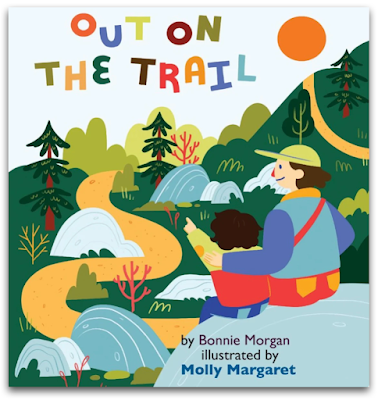
Newfoundlanders Bonnie Morgan and Molly Margaret takes young readers out on the trail to see an ocean, a brook, a cloud, a beach, a rock, and footprints. Those are the words that Bonnie Morgan emphasizes–they are the only bolded and coloured text–in her rhyming text. But Out on the Trail is not just about learning a few simple words from the natural world; it's also about seeing that natural world. 
From Out on the Trail, written by Bonnie Morgan, illustrated by Molly Margaret
As readers are instructed to look up and down and elsewhere, they are treated to amazingly bold and detailed digital artwork by Molly Margaret. We get to walk along a trail to see different forests and ecosystems; to witness the abundance of life and activity on land, in the sea, and in the air; and to think about what they are seeing and compare it to other scenes they've witnessed. While Molly Margaret doesn't always seem to use typical colours in her natural settings, she actually stays true to their essence. That purple ocean could be reflective of the wild waters and those blue stones just edging towards steel grey. But forget the colours and just focus on those vivid shapes that carry the reader along those trails and into those scenes of the spirited environment.
From Out on the Trail, written by Bonnie Morgan, illustrated by Molly Margaret
While Out on the Trail is not a concept book, it could be used effectively as one. Between those simple concepts from nature, there are also the positional words like left and right, up and down, and ahead and behind. Moreover, as that child is out on the trail for a walk with their parent, our very youngest can develop their early observational skills and, as such, their visual literacy skills. That's a lot of story from a picture book with minimal text and basic rhymes.
From Out on the Trail, written by Bonnie Morgan, illustrated by Molly Margaret
Bonnie Morgan and Molly Margaret may be taking readers along trails in Newfoundland and Labrador–the ocean and icebergs are giveaways to the setting–but Out on the Trail offers much more than a guide to local surroundings. It's an opportunity for a child to connect with a parent or guardian, enjoy the outdoor world, even vicariously, and to discover more beyond their own world.

June 16, 2025

Steve, a Rare Egg

Written and illustrated by Kelly Collier
Kids Can Press
978-1-5253-1300-4
64 pp.
Ages 6-9
June 2025 
 
Steve the Horse, being the pretty exceptional horse that he is (Steve, a Pretty Exceptional Horse), has starred in a number of picture books but now is being introduced to young readers in an early graphic novel series, of which Steve, a Rare Egg is the second. It's just another way for author-illustrator Kelly Collier to shine a light on this remarkable and unique and singular character. Steve is not just a horse. He's a headliner.
From Steve, a Rare Egg, written and illustrated by Kelly Collier
Steve is just trotting along, singing as he does, when he spots some remnants of a party in a trash can. There's cake and a party hat, and then he's distracted by an errant red balloon trapped beneath a stick. It's red and intriguing and Steve calls it fabulous, though his friends Gopher and Bob the Raccoon warn him to be careful. But it's Steve and his argument that it's a law that nothing fabulous is dangerous overrides all. Soon the friends are trying to name it, study its form and figure out what it is. And Steve is taking control and ownership of a red balloon he decides is an egg. In fact, it's a very rare Thingamabob Horse Egg and its parents must be found.
From Steve, a Rare Egg, written and illustrated by Kelly Collier
But until the parents are found, they must babysit this rare egg. That includes putting it down for a nap before Steve's "snuggum-wuggums becomes a cranky-panky." (p. 29) Young readers will know it's a balloon but will laugh as Steve decides that his rare egg is about to hatch and he's going to help nurture it, even incubate it, like a "mama horse-chicken." (p. 48) It's not until the inevitable happens that Steve accepts that the red thingamabob was not egg. But will Steve accept that his scientific process of observations and hypotheses and conclusions might not be the strongest?
From Steve, a Rare Egg, written and illustrated by Kelly Collier
Kelly Collier makes a simple discovery of an unknown object into an informal science experiment with a wild result. Steve and his friends make observations, hypothesize about the red thing's nature and even give it a name, and, based on those premises, Steve concludes what is needed to happen. Unfortunately, he is mistaken–something Steve rarely accepts–but turns it around to see himself in an ever-positive light. Surprisingly, it's Steve's antics that make Bob the best comedic foil, getting laughs with his composure and his insight. Steve's egocentricity–he always knows best–bring on the laughs but, with Bob and Gopher's as counterpoint, the story of Steve, a Rare Egg is hysterical. Steve is gullible and self-interested, but his pals show more insight and guide him to see different perspectives on the same circumstances. Steve may race ahead with all his ideas, but they rein him in as much as they can to keep him safe emotionally and physically.
 
The story of Steve, a Rare Egg is a funny one and it's all the better with Kelly Collier's digital artwork. She keeps her illustrations uncluttered so that Steve and his friends and the balloon, with only a few key embellishments, like a nest, a blanket and some lost posters, are the focus. That red balloon and the trio tasked to monitor it are everything. Even her choice of colours draw the eye to the white horse and the red balloon, the protagonists (?) of the story.  
 
Through her illustrations and dialogue, Kelly Collier gives young readers a story of colour and humour, and so many laughs, and even a bit of the scientific method. With a horse and a balloon, it's a rare combination but it's one that is successful in its silliness.
 
• • • • • • •
If you want to read more about Steve the Horse and his antics, both in picture book or in early graphic novel, or pre-order his upcoming story, here is a bit about the books in the series:
 
Picture books: 
 
Early graphic novels:
Steve, a Rare Egg (2025)
Steve, Born to Run (coming Sept. 2025)
 

September 19, 2023

Garden of Lost Socks

Written by Esi Edugyan
Illustrated by Amélie Dubois
HarperCollins
978-1-443464734
32 pp.
Ages 4-7
September 2023 

Sometimes when you go looking for something that's lost, you find something else. And what's better than finding a friendship for one who looks for things with one who writes about things he finds.

Akosua calls herslef an exquirologist because she can find anything, though her family might think that what she often finds is trouble. When Akosua meets Max, he is struggling, having lost one of his favourite socks, a yellow, green, and red sock with black stars. Though Max loves finding stories from around his neighbourhood and recording them in his notebook, whether it's discovering a dog allergic to humans or a girl who would perform as a waterspout in a play, finding that missing sock has been a challenge. Fortunately, exquirologist Akosua offers to help.
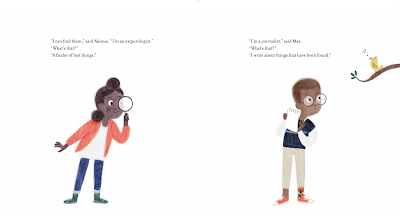
From Garden of Lost Socks, written by Esi Edugyan, illus. by Amélie Dubois
The two children go in search of the AWOL sock, starting at Max's home and then venturing out to the laundromat, the barbershop, and even to the park. They find a variety of socks, some as decorations, as on a hot air balloon, and some in different versions, like as wrapping around trees. But nowhere do they find Max's missing sock.
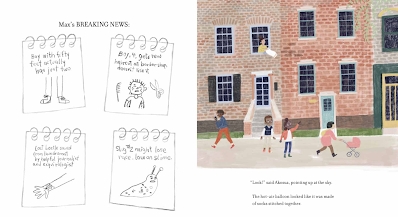
From Garden of Lost Socks, written by Esi Edugyan, illus. by Amélie Dubois
They do find other amazing things which Max records enthusiastically. Ultimately, Akosua uses her keen observational skills to follow a clue and discover the location of the lost sock, only to realize that Max needs it less than someone else.

The convergence of Akosua and Max in Garden of Lost Socks demonstrates that sometimes things and people that appear very different are actually meant to be together. Akosua seems like a bit of a dynamo, an extrovert who puts herself out there. Max, on the other hand, seems more inside his thoughts and his words, sitting quietly on his stoop, considering his options and his stories. By questioning him, Akosua begins a conversation that brings the two together, as unlikely as that might have been originally. (And to think Akosua's brothers suggest she has difficulties finding friends.) Finding that lost sock may have been their original mission, but they find so much more in their search, from new stories to new friends.
From Garden of Lost Socks, written by Esi Edugyan, illus. by Amélie Dubois
Though many fans of CanLit will know Esi Edugyan as a two-time Giller winner, Garden of Lost Socks is her first children's picture book. But, if Esi Edugyan shows a comparable curiosity to that shown by her young characters–illustrated by Quebec's Amélie Dubois–then I foresee more heartfelt literary explorations for young readers. Esi Edugyan's story on its surface is a simple one with two children of different strengths coming together for one purpose and finding more than expected. But like the two children whose eyes see well but differently, whether with analytic or artistic sight, Garden of Lost Socks is more than a story of looking for a sock. It's a story of finding friends without looking and working with your own strengths. It's cheering for diversity in personality and in purpose.

Amélie Dubois, whose art was first seen by this reviewer in A World of Mindfulness (2020), has an incredibly light touch. Searching for a lost sock might not seem a big deal but, to a child, missing a favourite anything is a very big deal. Still Amélie Dubois does not emphasize the angst or the frantic nature of a search for a missing object but keeps it more exploratory than hunt. They walk, they look, they ask, and they delve, but they do not panic, and they are not intrusive. Instead Amélie Dubois takes us on our own journey of discovery, from a laundry where a tutu shares a line to dry with an astronaut suit and a safety suit of orange and yellow, to a doorstep where dozens of shoes rest, and to a park of flowers, knitted tree protectors, and animals. Her lines produced by the strokes of her coloured pencils emulate the movement of the kids in their own quest while giving the story an airy texture.
 
The world is a garden of lost socks, from a laundry to a drawer, to a park or a nest, but Esi Edugyan reminds us that finding one sock may just be the start of something far greater.

June 02, 2021

Outside, You Notice

Written by Erin Alladin
Illustrated by Andrea Blinick
Pajama Press
978-1-77278-193-9
32 pp.
Ages 4-7
April 2021

How often do we notice things, especially things in the outdoors, that are right under our noses? Erin Alladin wants us to open our eyes, ears, noses and touch the world to know the wonders that our world holds outside, no matter what your outside looks like.
 
From Outside, You Notice by Erin Alladin, illus. by Andrea Blinick
As children and others participate in the world outside, whether it be a backyard, a park, a playground, a sidewalk or something else, there are so many things to check out, and Erin Alladin makes sure we see it all. Each double-spread asks the reader to notice one attribute of nature like the rain, the soil, leaves or colours, and then info boxes provide brief content related to that focus. For example, when asked to notice "How after the rain everything smells greener," we learn about leaves capturing rain, how a tree's canopy provides cover, why the rain can smell like it does, and why plants get the rain they need.
 
From Outside, You Notice by Erin Alladin, illus. by Andrea Blinick
We discover how animals make the outdoors their homes, how they live, and the sounds they make. We learn about life cycles of plants, from seeds and germination, to flowers and fruits. Above ground and below, along water ways and at farmers' markets, there is so much to see and learn.
From Outside, You Notice by Erin Alladin, illus. by Andrea Blinick
With Outside, You Notice, Erin Alladin has invited the reader to explore and make observations and grow themselves into sentient beings beyond the confines of our indoors. She may provide information tidbits that instruct and direct inquiry, so perfect for science lessons with little ones, but she also asks us to be mindful of our worlds. Outside, You Notice gives us the prompts to stop and smell and look and touch in the moment, wherever that moment may be. The experiences will be as diverse as the children who are doing the noticing, and the learning as fulfilling and filling as can be. With that, a calmness will envelop the reader, taking away the bustle and the tech, as the focus is on the world we too often take for granted.
Outside, you notice
The breath in your body
Your feet on the ground
Your self in the world
Toronto artist Andrea Blinick uses gouache, coloured pencils, collage and chalk pastel to create the diversity of textures, colours and shape that convey the sensory nature of the text and take us into the outdoors. The eyes that see, the dog that sprints, the dandelions being picked, the sweetness of a strawberry about to be eaten–Andrea Blinick takes us there, to appreciate and acknowledge the outdoors and its moments.
 
Whether a child of the city or the country, of a place of rain or sunshine, trees or fields or concrete, there is a world of wonder that is the landscape of our lives. With Outside, You Notice inviting us to explore and appreciate the sensations and marvels of the outdoors, young readers can only flourish.

From Outside, You Notice by Erin Alladin, illus. by Andrea Blinick