by Eric Hogan and Tara Hungerford (Gumboot Kids Media)
Firefly Books
978-0-2281-0570-1
32 pp.
Ages 3–8
September 2025
Scout and Daisy, characters of multiple TV series starring The Gumboot Kids, are off exploring the outdoors yet again and learning about new science concepts. In The Case of the Tagalong Twin, Scout and Daisy have a new mystery to solve and, only by working through a number of clues, will they understand what they are actually seeing.
From The Case of the Tagalong Twin by Eric Hogan and Tara Hungerford
Daisy tells Scout that on her walk over to his place she'd noticed something very odd. She'd noticed someone following in sync alongside her. Scout calls this her tagalong twin and the two retrace her steps to try to solve the mystery of this twin. Even though they don't see this twin on their walk, Scout and Daisy peruse her field notes for clues she may have noticed. Even putting together the clues of the sun, the sidewalk, and Daisy herself, they can't replicate Daisy's tagalong twin. But when the clouds part and the sun shines again, both Daisy and Scout discover they have tagalong twins that show up on the sidewalk.
From The Case of the Tagalong Twin by Eric Hogan and Tara Hungerford
At the library, they discover a science book that teaches them about shadows and how they are formed.
From The Case of the Tagalong Twin by Eric Hogan and Tara Hungerford
For young children, the concept of shadows and how and when they are created is a complex one. They may or may not notice them—helping children use their senses to make observations is an important part of The Gumboot Kids mysteries—but when they do, they will also notice that shadows don't always appear, that they may change size and shape, and that even lamp lights can produce them. (The appended "Field Notes" will help kids discover more about shadows, as well as introduce them to new words like opaque and light source.) The Gumboot Kids creators Eric Hogan and Tara Hungerford know how to blend science concepts like shadows (or spider webs, tides and woodpeckers) into easy-to-understand terms for young children. And with adorable, felted mice in three-dimensional landscapes—incredibly detailed with tea cups, flowerpots, quilts and books—learning about shadows is easy, engaging, and informative. With Eric Hogan and Tara Hungerford's supplementary notes and a nature craft, The Case of the Tagalong Twin becomes a STEM concept book as well as an art lesson all embedded in a story.
From The Case of the Tagalong Twin by Eric Hogan and Tara Hungerford
Kindergarten and primary elementary teachers would be wise to pick up all the books in The Gumboot Kids Nature Mystery series. (I've posted a list below.) Whether as a lesson starter or a read-aloud, these books will allow teachers to engage children and get them to see their world with new eyes, and nose, and ears... And with their textured, 3D artwork, and tie-in to a popular TV series, The Gumboots Kids will make discovery-based learning the norm for STEM education.
• • • • • • •
The Gumboot Kids Nature Mystery series:
The Case of the Vanishing Caterpillar (2019)
The Case of the Story Rock (2019) The Case of the Wooden Timekeeper (2019) The Case of the Growing Bird Feeder (2019) The Case of the Singing Ocean (2020) The Case of the Buzzing Honey Makers (2020) The Case of the Shrinking Friend (2021) The Case of the Hanging Food Catcher (2021)
While many people got into birding during the pandemic, watching birds and studying their behaviours has long been a pastime of anyone who has a window or who steps outside. Regardless of whether we're enjoying urban or rural landscapes, wooded areas or open fields, there are birds that pepper our skies, our feeders, our balconies and allow us to glimpse their worlds from afar. This time, though, Chris Earley, a University of Guelph biologist and educator, brings us a little closer to seeing 47 different species of birds.
From Birds Life Size: Up Close and Personal with 47 Bird Species, written by Chris Earley
For each of these species, Chris Earley provides key info like the scientific name, size, habitat, diet, and location as well as migration movement. Several images are included but always one that is a life-size representation of the whole bird or a part of the bird for larger species. There is definitely a ton of information in info boxes, text and photographs but those photos that are deemed life size are perhaps the most compelling. Whether it's the head of a Trumpeter Swan, a portion of the American White Pelican's beak—the longest of North American birds—or the tiny body (13 cm) of the Elf Owl, the life-size depictions are the most fascinating.
From Birds Life Size: Up Close and Personal with 47 Bird Species, written by Chris Earley
In addition to the many profiles of birds, Chris Earley also includes information about how birds are classified, how they are measured, how they are studied, and even how to get into birding.
From Birds Life Size: Up Close and Personal with 47 Bird Species, written by Chris Earley
The 47 species presented in Birds Life Size are all North American with the majority found in Canada. So, for any STEM lessons dealing with life cycles, adaptation, habitats and such in a Canadian school—and for any in American schools as well—Birds Life Size offers a visually-stunning and thorough presentation. It has the content to make it a comprehensive resource but also the visuals to captivate and perhaps even attract young readers, and their families, to launch their own birding pursuits.
As there were two Gumboot Kids Nature Mystery books released this month, I won't repeat myself about the virtues of the series in teaching young children science concepts in a playful and mindful manner, as I did in yesterday's review of The Case of the Noisy Neighbor. But I would still like to share the story of The Case of the Disappearing Castle so that teachers and parents might consider the value of its scope.
From The Case of the Disappearing Castle by Eric Hogan and Tara Hungerford
This time, Daisy is building a sandcastle on the ocean's beach when Scout comes along. When they return from taking a walk, Daisy's beautiful sandcastle is gone. It's a new mystery for the nature sleuths and they take to Daisy's field notes to solve it. Daisy had, of course, made note of the sand and the ocean and even the moon that was visible during the day. With their clues and a trip to the knowledged-filled library, the two learn about tides.
From The Case of the Disappearing Castle by Eric Hogan and Tara Hungerford
Told with accuracy and simplicity, the two friends realize that the castle was swept away by the ocean tides. And with a mindful moment or two, Daisy and Scout take the time to breathe and appreciate the waves and the sounds of the ocean.
From The Case of the Disappearing Castle by Eric Hogan and Tara Hungerford
In addition to learning about tides and gravity, children will learn to make a sand clay handprint as their Nature Craft. As a support for early STEM learning, the Gumboot Kids Nature Mystery series does its job well but I am most impressed with the stories' focus on children being mindful in natural settings. Daisy and Scout always take a moment to breathe and relax as they contemplate what they've observed. With this multifaceted focus on science and self-awareness and relaxation, The Case of the Disappearing Castle reveals more than it disappears.
From The Case of the Disappearing Castle by Eric Hogan and Tara Hungerford
by Eric Hogan and Tara Hungerford (Gumboot Kids Media)
Firefly Books 978-0-228104735 32 pp. Ages 3-8 September 2024
It's spring in Dandelion Town when Scout hears a knocking at his house. But when he opens the door, there's no one there. When it repeats and still no caller, Scout is perplexed. He sees Daisy outside and when she tells him she heard something similar in the forest, the two friends know they have a new nature mystery on hand. And what do you do when you have a mystery? You investigate!
From The Case of the Noisy Neighbor by Eric Hogan and Tara Hungerford
Using Daisy's field notes to help them organize the evidence, the two friends head into the forest and look at additional clues of a tree trunk and a hole in a trunk before they spot a bird emerging and banging away. A trip to the library helps them identify the bird as a woodpecker.
From The Case of the Noisy Neighbor by Eric Hogan and Tara Hungerford
Though a simple story of figuring out who is making all the noise, The Case of the Noisy Neighbor is a far more important story about being mindful of one's surroundings by listening and seeing. Daisy and Scout are always present while they enjoy time together in nature and because of that they appreciate all the elements of the natural world to which they are exposed. While it is extraordinary that the woodpecker they see is a Pileated Woodpecker–one which many people will never see as it is far less common than Downy or Hairy Woodpeckers–it is striking in its appearance and the volume of its pecking is certainly noteworthy. The observations that Daisy makes in her field notes, which always append the Gumboots Kids' story, reveal much to feed inquiry in STEM education. And if that's not enough educational value, authors Eric Hogan and Tara Hungerford, the creators of the Gumboot Kids series, also provide a fun nature craft for very young children that extends their learning. (In The Case of the Noisy Neighbor, the craft is a tin can drum.)
From The Case of the Noisy Neighbor by Eric Hogan and Tara Hungerford
The Gumboot Kids Nature Mystery series, as well as the Gumboot Kids series, speaks to the wonders of the natural world and provide easy access to learning about everything from woodpeckers and oceans to spiders and bees. With charming felted characters set in a variety of settings, both in and outdoors, Eric Hogan and Tara Hungerford merge young children's love of stuffies–FYI stuffies of Daisy and Scout are available–and early STEM concepts. The context is delightful and the learning happens organically. Not surprising that the Gumboot Kids have been ever so popular.
By my count, The Case of the Noisy Neighbor is the tenth volume in the Gumboot Kids Nature Mystery series and, with a wide world of science and learning that can happen, Eric Hogan and Tara Hungerford have many more opportunities to entertain and teach with their friends Scout and Daisy.
• • • • • • •
Gumboot Kids Nature Mystery series
The Case of the Vanishing Caterpillar (2019) The Case of the Story Rock (2019) The Case of the Wooden Timekeeper (2019) The Case of the Growing Bird Feeder (2019) The Case of the Singing Ocean (2020) The Case of the Buzzing Honey Makers (2020) The Case of the Shrinking Friend (2021) The Case of the Hanging Food Catcher (2021)
With much in the media about climate change and extreme weather events that include droughts, floods, heatwaves, and fires, it's not surprising that young people may be confused about what is real and what is not. Because much of the information about climate change and extreme weather can be tainted with rhetoric, opinion, and even conspiracy, sorting the facts from the misinformation can be challenging. Environmental biologist Rachel Salt sifts through all the info out there and organizes it into an accurate STEM book that both clarifies and elaborates.
From Is It Weather or Is It Climate Change? by Rachel Salt
First, Rachel Salt introduces the concept of climate change and provides evidence for its existence, both historically and in current times. She then looks at extreme weather before taking a global tour of some events that provide evidence of climate change. These highlights begin with the wildfires, heatwaves, and rain (who knew there were things called atmospheric rivers?) in British Columbia. Also included are droughts in Mexico; winter storms in Texas; heatwaves and flooding in Germany; floods and droughts in Ethiopia; the melting glaciers and snowfields of the Third Pole, an extensive system of mountain ranges in Asia; and wildfires in Australia. In addition to these weather events, Rachel Salt addresses how they are impacting human life and what people are doing to adapt and even mitigate the impacts.
From Is It Weather or Is It Climate Change? by Rachel Salt
Is It Weather or Is It Climate Change? could be a rather depressing or distressing book but Rachel Salt consistently reminds young readers that there are people around the world taking action to fight climate change. She provides examples of adaptation that include Indigenous-led resistance to fossil-fuel projects, growing climate-resistant plants, replacing power sources with those without carbon emissions, and protecting and restoring wetlands.
While all the information is valuable and intrinsic to telling the big picture, several asides certainly caught my attention. One is the gender imbalance of climate change and climate-sensitive health impacts, both addressed in the exposé on Ethiopia but sadly applicable globally. Also, teachers will undoubtedly find an info box titled "Beware of Climate Lies" worthwhile for lessons in misinformation and fake news. Another relates to the "Confidence Meter" by which scientists measure how confident they are that climate change is influencing extreme weather, and demonstrates the complexity of discerning what extreme weather event constitutes evidence of climate change. Inclusion of all these help complete the story of climate change and extreme weather.
From Is It Weather or Is It Climate Change? by Rachel Salt
Is It Weather or Is It Climate Change? is
best suited for a teen (or adult) audience as it is a comprehensive book
of non-fiction that lays out everything from types of greenhouse gases
(including carbon dioxide, methane, nitrous oxide, and
chlorofluorocarbons) to the methods used to measure climate change (such as ice cores, marine sediment, ocean acidification and
temperature records). The text is extensive and well-balanced
with photographs, information boxes, graphs, and maps, and completed
with important features of non-fiction books such as a glossary, an
index, and a list of additional resources.
This will be a fabulous book for teaching climate change, media literacy, and weather events. Whether a teaching resource for educators of social studies, geography or science, or a reference for students, Is It Weather or Is It Climate Change? will answer questions, spark enquiry, and perhaps inspire action. With accurate knowledge such as this, good change can happen.
Although hate speech has been around since time immemorial, there seems to have been a deluge of it in recent years with the news inundated with misinformation, fake news, and bigotry. Sadly, with social media, the dissemination of hate speech has been especially facile. But hate seems to always be there, sometimes overt and sometimes less conspicuous, until it isn't. In 1983, one Alberta teacher who denied the Holocaust in his social studies teaching and promoted hatred of the Jewish people was called out by a parent, leading to dismissal, charges and more. And a basketball game.
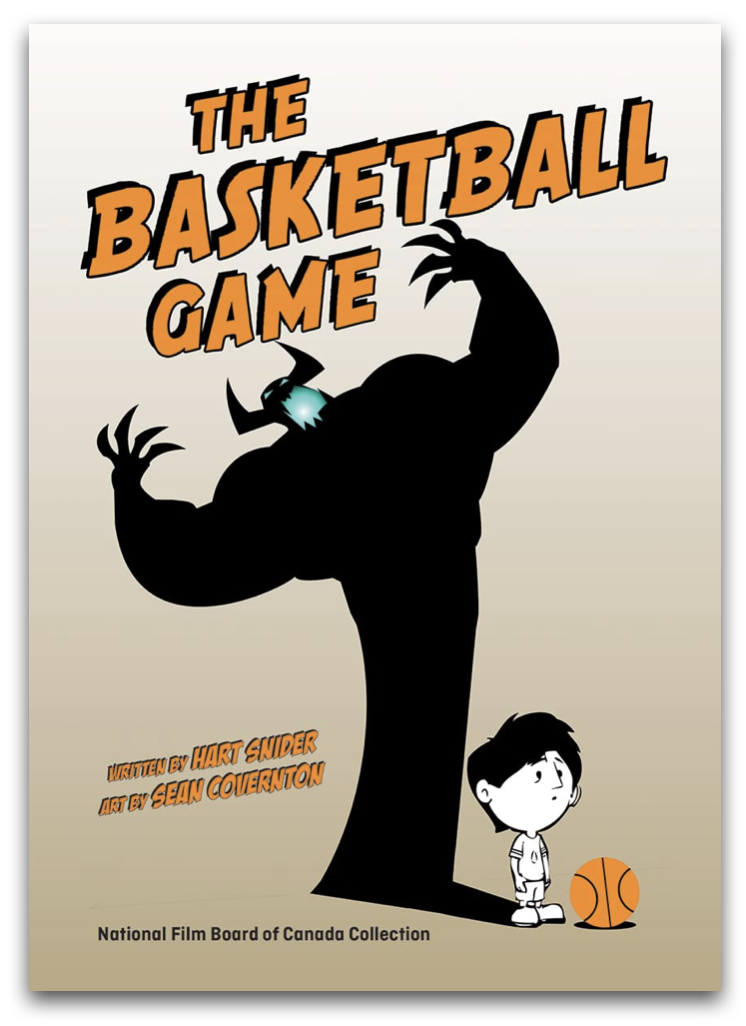
Author Hart Snider was just a child in Edmonton when the story of teacher Jim Keegstra of Eckville, Alberta was headline news. However, he was a Jewish child who was attending Camp BB in Pine Lake when his world and that of the news came together. This story, based on a National Film Board of Canada animated short film of the same title, is his camp story from the summer of 1983.
From The Basketball Game by Hart Snider, illus. by Sean Covernton
It was Hart's first summer at Camp BB, and he was just as happy to sit under a tree and read comic books. But, distractedly, he signs up with a pretty camp counsellor for a "social mixer to encourage cultural understanding." When Bill, the larger-than-life camp director, tells them that their day of fun and fellowship, which would include a picnic and a basketball game, would be with Jim Keegstra's former Eckville students, Hart and others wonder how these kids would approach them. And when one boy asks Hart if he actually has horns, Hart wonders if the Jewish kids are all seen as demonic supervillains with horns, or global banking conspirators, or maybe even magical wizards. But then he looks at the Eckville kids and sees them as being no different from skinheads, Nazis or the KKK. Ultimately, it's just a basketball game between a bunch of kids, Jewish or not, having fun.
From The Basketball Game by Hart Snider, illus. by Sean Covernton
The Basketball Game may be a personal graphic memoir of Hart Snider, but it's also a compelling reminder of the impact of hate on children. From Jim Keegstra's antisemitic teachings, which coerced young people to adopt his opinions in order to pass, to the children of Camp BB who enjoyed the familiarity of their Jewish community but anticipated conflict because of it, the story of The Basketball Game is a sobering reminder how vulnerable they are to fake news, misinformation and worse. The stereotypes were embedded in their learning and, with no other basis, it's all they had to go on. The camp boys who are depicted as monstrous members of a blue team must compete against the equally scary members of the Eckville red team. Like the fear they pose, the team members are frightening and powerful. (And fully coloured.) In reality, they are a bunch of young boys, drawn in black-and-white, still open to colour and ideas and not quite grounded in themselves. Canadian animator Sean Covernton contrasts the innocent with the horrific, making the expected far scarier than the reality and reminding us that young children are open to suggestion and vulnerable to those who might mislead them with hateful opinions. He also shows them as kids who want to make friends, read comic books, play basketball, and enjoy the positive traditions of their community.
There is a warning that prefaces the book, cautioning the reader about hateful language and depictions of antisemitism. However, though the book is intended for those twelve years of age and older, The Basketball Game may offer an opportunity for discussion with younger kids with the right approach. (Discussion questions are appended to the story.) It helps children see that not all adults are right, that questioning and discussing difficult topics is worthwhile to ensure understanding, and that kids are kids, no matter what their backgrounds.
From The Basketball Game by Hart Snider, illus. by Sean Covernton
If your children are familiar with Scout and the Gumboot Kids, a CBC Kids' TV series, then you're already aware of the show's exploration of nature for young children. To date, creators Eric Hogan and Tara Hungerford have transferred those stories into 8 picture books, all based on investigations into the natural world. The latest, The Case of the Hanging Food Catcher, has young readers joining mice Scout and Daisy in the field as they amass clues to solve their newest mystery.
From The Case of the Hanging Food Catcher by Eric Hogan and Tara Hungerford
As Scout checks out his fall pumpkins, Daisy declares that she nearly walked into a hanging food catcher. Together they note the clues that might help them understand. The clues include the gate, silky thread, and a fly, leading them to a beautiful spider web as it catches a fly. In keeping with the education aspect of the series, Scout and Daisy do their own research on spider webs and ties it into their own appreciation of the natural world and some delicious food of their own.
From The Case of the Hanging Food Catcher by Eric Hogan and Tara Hungerford
I don't know who creates the felted mice or their woollen sweaters, hats and scarves, but that labour-intensive work has paid off in charming characters and scenes. (Not surprising that there are plush toys of Scout and Daisy available.) By wrapping very simple nature stories for young children in these characters and scenes, Eric Hogan and Tara Hungerford are speaking to children at their level without talking down to them. They take a basic scientific method approach to exploring nature, embed it in an uncomplicated plot, and enhance that learning and entertainment with some science–notes on the spider's morphology and behaviour are included–and a nature craft of weaving. The Gumboot Kids Nature Mysteries may not be intricate and highly detailed but they shouldn't be for this age level. They provide meaningful introductions to a variety of topics based in the natural world by captivating youngsters with delightful characters and inspiring creativity and an interest in that outside world. With The Case of the Hanging Food Catcher, children will probably never look at a spider or its web in the same way again, and instead be inspired to organize their own explorations of the natural world.
Cordell Barker's short NFB film Runaway was released in 2009 but its black humour and commentary on greed and self-importance will now reach a new audience of young readers with this adaptation to print medium. Though the 9–minute film has very little discernible dialogue, Sarah Howden's adaptation fills in the narrative about a cow walking on railway tracks when a train is left without its conductor.
From Runaway by Cordell Barker, adapted by Sarah Howden
Sarah Howden's narrative begins with a commentary about how uncomplicated cows are compared to humans who are "always up to something." (pg. 9) There are the wine-drinking, cigar-smoking and billiards-playing top-hatted rich men, and one lady with her black dog, in the first car behind the engine. In the next car with their livestock are the pointy-hatted folk who are crowded to the rafters and who pass the time with music and beer. In the caboose, three train crewmen sleep. As "They were all going about their business, no questions asked" (pg. 14), the little dog escapes into the locomotive. The Captain, not missing an opportunity to ingratiate himself with a rich patron, shoves back the fireman and is promptly bitten by the urchin-like canine. While the rich woman takes the Captain back into her chamber to tend to his wound, the train is left without a man at the helm. The train is now a runaway and all the more after the Fireman falls onto the levers when the cow is hit. (It's okay. The cow survives.)
As the Fireman searches for the Captain, the oblivious patrons continue with their preferred activities. The train loses its caboose on a wild ride down a mountain and destroys a bridge after passing over it but the worst is when there is insufficient fuel to get the train up the slope on the other side of the bridge. Will the passengers work together to find a solution?
From Runaway by Cordell Barker, adapted by Sarah Howden
How the story in the print edition of Runaway ends is up for interpretation though the cow does live to see a glorious sunset. The rich people do take advantage of the common people, promising them money for their clothes to be used for fuel, and then unhitch their car and take back the money. The Captain and lady and her dog eventually reappear and get caught up in the efforts to save the train. But how much can they do when a train is hurtling up and over hills out of control?
Cordell Barker's story takes the reader on an alarming ride of both a train without a conductor and a culture without goodwill. A little benevolence and the tale of this train and its occupants could have had a far different ending. But, with greed and self-importance overriding all common sense, this train is doomed. Regrettably, Runaway is a stark metaphor for our narcissistic world, even more so than in 2009, by reflecting a society that emphasizes taking care of the self before all else. Only the Fireman can see the need to put self aside but even he cannot prevent the disaster when all work against the whole and think only of the self.
From Runaway by Cordell Barker, adapted by Sarah Howden
As in any graphic novel, the art helps tell the story. The art in Runaway is strong in its depiction of the different classes of people, with the rich in their train car decorated in rose with food artwork and the commoners in their earthy-coloured attire living with their food animals. Even the conductor, expecting to be called Captain, aspires to more in his highly-decorated bicorn hat and jacket festooned with golden epaulets. But the art also tells us what the Fireman is thinking, how the cow conducts herself as she needs, and that the rich on the train take glee in taking advantage of the poor and even delight in their demise.
Because Cordell Barkeruses dialogue sparingly in the short film, Sarah
Howden needed to "fill-in-the-blanks" for young readers for whom the complexity of the circumstances might not be evident. They will understand the story, just as they might understand a fairy tale, but to give them insight into the greater picture of Runaway, Sarah Howden highlights the humans' actions from a distant perspective, trying to understand what they do and why, all which will help explain the outcome of the story. Her words give landscape to the story without explaining everything, allowing young readers to apply their own visual literacy skills and interpretation to the allegory of what can go wrong when self and greed override all.
🎥🎥🎥🎥🎥🎥🎥
The original short film is available on the NFB's YouTube channel at https://youtu.be/qUGHv2VAESE and is an accomplishment of movement, tension and social statement. Just be prepared: it's only a happy ending for the cow in this version.
Though not Robert Munsch's first book, Love You Forever is perhaps his best known, with astronomical sales over the decades and inclusion on multiple lists of top books of all time. Published in 1986, Love You Forever is an iconic picture book about a parent's love for her child and it is now available in a pop-up version.
From Love You Forever Pop-Up Edition
The story begins with a mother holding her new baby and singing a lullaby to him:
I'll love you forever, I'll like you for always, As long as I've living my baby you'll be.
Then the boy becomes a toddler and gets into much mischief but still his mother sneaks into his room and rocks him back and forth while she sings the lullaby to him. This continues as the boy becomes nine, and then a teenager and finally an adult who moves away. Still his mother sneaks into his room, rocks him and sings her lullaby. But when she is too old to come see him, he visits her and sings the lullaby she cannot, revising it appropriately:
I'll love you forever, I'll love you for always, As long as I'm living My Mommy you'll be.
From Love You Forever Pop-Up Edition
The story ends with the son returning home, supposedly after his mother has passed, and he sings the lullaby to his own daughter, just as his mother sang to him.
Because of the alternative format with fold-out flaps and pull- and push-tabs to create three-dimensional illustrations, this Love You Forever is only 14 pages long. Still the whole story is there, Robert Munsch's original words and Sheila McGraw's illustrations, now brought to life with the paper engineering of Bruce Foster, an American paper magician. (You can see a demonstration of the rocking chair pop-up on his website Paperpops.) There's not much I can say about the book Love You Forever that has not already been said time and time again but I can address the novelty of Bruce Foster's paperwork in adding a third dimension to the art and hence the story. Though some of the illustrations may appear dated–check out the clothing, the computer and the hairstyles–there is a freshness that comes with the pop-ups, bringing new life to the pages of Love You Forever. Parents may still be reading the story and singing the lullaby to their children but now children can interact with the story, pushing and lifting and pulling tabs, to help tell that story and appreciate the love between parent and child.
•••••••••••••••••••••
For anyone who will be reading Love You Forever and has never heard the melody to the lullaby the mother sings, Robert Munsch shares it on a YouTube video uploaded on January 13, 2011 by tvoparents at https://youtu.be/YFX6pdwJWpA.
The National Film Board of Canada has been a part of Canada since 1939, impressing audiences, critics and award juries around the world for its entirety. Films from documentaries to animations have delighted and now Firefly Books is partnering with the NFB to bring some of its stories to publication. Starting next month, Firefly Books is launching the National Film Board of Canada Collection with the publication of two picture books including this one, My Grandmother Ironed the King's Shirts, based on the 1999 Oscar®-nominated NFB animated film of the same name.
Torill Kove recounts a story she'd heard from her grandmother, Aslang Bech of Norway, of her activities just before, during and prior to World War II in Oslo. Though I have no doubts that Torill Kove’s grandmother, whose photo prefaces the story, truly ironed the King’s shirts, there is an air of a tall tale to her story of civil disobedience against the Nazis that may or may not be true. I choose to believe it as it would be so satisfying if it were. Regardless of its veracity, the story is charming.
The book begins with a history lesson about Norway and the country’s decision to have a king lead them when it became an independent country. Prince Carl of Denmark was selected and became King Haakon VII of Norway with Queen Maud and young Prince Olav in tow. Though the family became proud Norwegians, embracing the people and culture readily, their wrinkled appearance had Norwegians shaking their heads. So a clothing shop called Hoff agree to iron the royal family’s clothing, and years later this is the shop to which Torill Kove’s grandmother came to work. A little investigative work led her to learn that she truly was ironing the King’s shirts.
From My Grandmother Ironed the King's Shirts
by Torill Kove
All that changed when Norway was drawn into war against the Germans in 1940. Proudly, the King refused to surrender and urged Norwegians to resist. Now relegated to ironing the shirts of the German army, Torill Kove's grandmother began to sabotage their uniforms and encouraged the other Hoff pressers to do the same. “Word of their activities spread and soon all the shirt pressers in Norway were involved in a nationwide shirt sabotage.”
From My Grandmother Ironed the King's Shirts
by Torill Kove
Though history books may attribute the departure of the Germans in 1945 to Europe-wide capitulation, Torill Kove suggests they left because they had no undamaged clothes and fled in near-nakedness. For this act of civil disobedience, her grandmother and others were decorated as resistance fighters.
From My Grandmother Ironed the King's Shirts
by Torill Kove
Tall tale? Maybe. Enthralling? Absolutely! Between the story details and Torill Kove’s illustrations, which are playful yet factual as seen by the accuracy of Torill Kove’s depiction of the King, My Grandmother Ironed the King’s Shirts is a splendid side story that illuminates how a country outside of the the key players could withstand and triumph during World World II. By keeping her tale absorbing while boisterous in colour and cartoon-like illustrations, Torill Kove tells history in a way that goes beyond both truth and tragedy, something few stories of WWII can achieve.
NFB NFB NFB NFB NFB NFB
Do check out the animated short upon which this picture book is based at the NFB's channel on YouTube. The link is https://youtu.be/5LfJrv1_sZI