Showing posts with label greed. Show all posts

November 18, 2024

Raven Gets Tricked (Coast Salish Tales)

Written and illustrated by Andrea Fritz
Orca Book Publishers
978-1459836273
32 pp.
Ages 6-8
September 2024
 
Andrea Fritz of the Lyackson First Nation brings us a new story for her Coast Salish Tales series, continuing to connect young readers to the teachings of the Coast Salish peoples through storytelling. 

It's winter and Smuy (little deer in the Hul'q'umi'num' language) finds his food stores empty except for some berries. When he realizes that he always shares with his cousin Spaal' (raven) who never reciprocates but often tricks Smuy instead, Smuy concocts a plan.
From Raven Gets Tricked, written and illustrated by Andrea Fritz
Smuy's plan begins with mashing up his remaining berries and pouring them out onto the snow beneath Spaal's tree. When Spaal' sees the red snow and asks Smuy to share it, Smuy does so. But Spaal' needed more space for this wonderful red snow so deposits his dried salmon and leaves it on the beach. While Spaal' continues to help himself to the red snow and even trying to hide that he'd taken more than his share, Smuy helps himself to the discarded salmon. 

Back after a night near Spaal's fire, all the red snow melts and floods his house. Smuy kindly takes Spaal' to his house and feeds him salmon, and even gives him some to take home as all his food is now gone. (At least Spaal' thanks Smuy with "Huy ch q'u!")
From Raven Gets Tricked, written and illustrated by Andrea Fritz
Between the art and the story, Andrea Fritz teaches, entertains, and delights with Raven Gets Tricked. The story has much to say about greed and sharing, self-sufficiency and helping others. It never occurs to Spaal', the raven who is known as a trickster, that he should think of others. He wants what he wants, never sharing–except when tricked into it–but always wanting from others, never wondering if they need something more than he. He asks, he takes, and he holds. Smuy, on the other hand, needs food. Whether his stores were always inadequate or because he shared with others or whether someone like Spaal' stole from him is irrelevant. I don't know why he didn't just ask but I suspect he knew that Spaal' would have many excuses not to share. Regardless, Andrea Fritz has created two very different characters. She makes Spaal' the selfish and manipulative creature upon whom misfortune occurs because of his own greed and Smuy, the kind animal who is compelled to reciprocate trickery but still shows goodness to help another.
From Raven Gets Tricked, written and illustrated by Andrea Fritz
Andrea Fritz even differentiates the two animals in the style of her art. Using a lovely and generously emotive Woodland style of art, Andrea Fritz gives Smuy a softness while Spaal' is somewhat sharper in shape and line. Of course, with a beak and talons, there is more sharpness to a raven, but the little deer looks lithe and muscular and still delicate. Moreover, Andrea Fritz's illustrations take us beyond the two characters, placing us in a northern environment of coniferous trees, laden with snow, purple and blue waters, and wooden plank houses. (The grain of the wood is reflected in many surfaces, from water and beach to sky and land.)

The story in Raven Gets Tricked offers a lesson in sharing but Andrea Fritz takes that teaching a step further by appending it with a discussion of Coastal Salish Plank Houses. She shares her personal experiences of building plank houses and even moving them to foraging grounds in the summer. Along with time spent in the houses, there is discussion about sharing and trading with local Nations.

Spuy may have to trick Spaal' in order to get food to survive but the little deer still does it with kindness and generosity, a lesson Spaal' should have learned.
 

• • • • • • •
 
Coast Salish Tales by Andrea Fritz
Otter Doesn't Know (2023)
Crow Helps a Friend (2024)
Raven Gets Tricked (2024)
Woolly Dog Warms His Family (expected 2025 or 2026)


July 19, 2023

Cat's Cradle: The Mole King's Lair

Written and illustrated by Jo Rioux
First Second
978-1-250-62538-0
256 pp.
Ages 8-12
June 2023

When we met twelve-year-old Suri, the would-be monster tamer, in Jo Rioux's first Cat's Cradle book, The Golden Twine, she had purchased a dragon's tooth that she hung from some golden twine she'd discovered. She believed that tooth gave her incredible powers and would enable her to become the monster tamer she was destined to be. 
From Cat's Cradle: The Mole King's Lair by Jo Rioux
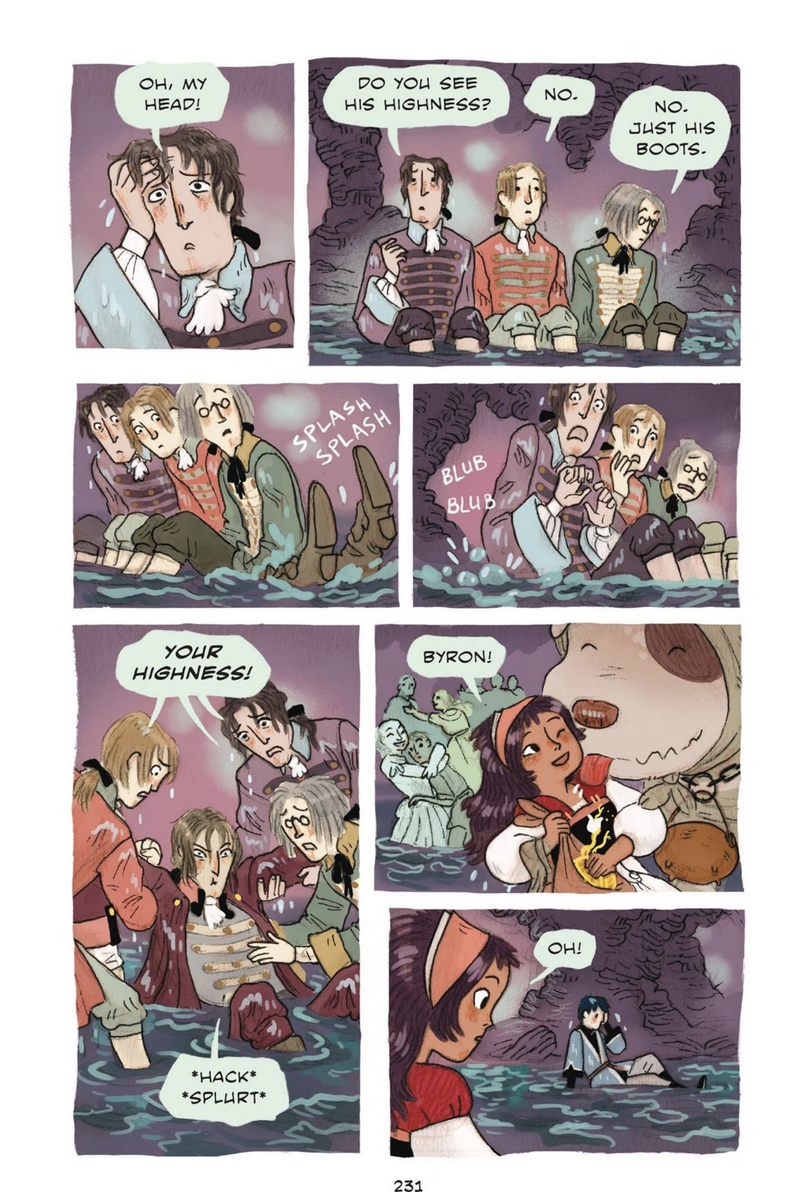
Now Suri is heading to the Monster's Cradle, the land of the giants, to help find a giant for whom her companion Byron, the monster-dog, could be a lap dog. Created by a greedy imp named Caglio, Byron is a lovable but massive dog with few monster tendencies, but he is threatening enough for the prince and his entourage to pursue for monster-hunting sport. But, not only is the trio being followed by the hunters, there are also three caitsiths named Siska, Toska and Mouska who are following them, determined to retrieve the golden twine Mouska had dropped.
From Cat's Cradle: The Mole King's Lair by Jo Rioux
When Suri, Caglio and Byron are confronted with a monster, Byron takes off and Suri and Caglio hide in a mountain cave which Suri believes must belong to the Mole King, according to her monster guidebook. She tries to use the power of her dragon tooth to ward off the Mole King but it's only when Byron reappears, and she feels intensely that it works for her. They soon meet Kolya, a young thief, who had been stealing from the Mole King's treasure room filled with gold coins–this gets Caglio's attention–which explains the Mole King's anger. But when they open Kolya's one bag they realize all he grabbed was a small, three-legged table.
From Cat's Cradle: The Mole King's Lair by Jo Rioux
Suri and her companions now head into the tunnels of the Mole King's lair, but their motives are all a little different. Suri just needs some gold to pay for food as they journey. Caglio just wants money. And Kolya is stealing so that he might redeem himself with the leader of his thieving ring. But Kolya is also drawn to the golden twine he saw in Suri's bag. If he is a caitsith, that golden twine would be handy in disguising his monster-ness. 
 
But going after the treasure is not as simple as finding their way to the treasure room. The prince is still determined to hunt a monster and is now accompanied by Toska, Siska and Mouska as his trackers and by the people of the impoverished town of Tancredi who'd lost many families and friends to the mines of the mountain. It's now a race to the treasure and to capturing a monster while a ball of gold twine draws attention from the caitsiths and Kolya. Who can work together and who cannot will undoubtedly determine the outcome for Suri and others in The Mole King's Lair, and in Book 3, Suri's Dragon.
From Cat's Cradle: The Mole King's Lair by Jo Rioux
Jo Rioux has given us a full range of characters from spunky Suri who wants to be a monster tamer, to the freaky Caglio who is all about himself, the cuddly Byron, the farcical prince and his courtiers, the caitsiths, and new characters like Kolya and his leader Lutrov. There's more coming with hints of a relationship between Lutrov and Toska and someone called Baron Grim. There's a lot of story here and Jo Rioux weaves it together flawlessly, taking us from Suri and her group to the prince and his entourage, from the Mole King's lair to the town and the forests. The story is engaging and will keep middle-grade readers engrossed with who is doing what and why and do they know what the others are up to. Nothing is straightforward except Suri who just wants to be a monster tamer and do the right thing, whatever that might be.
 
Like The Golden Twine, The Mole King's Lair is a delight for graphic-novel fans. It has a little bit of everything, from sweet characters and monsters, and idiots and villains, to dark scenes and humour, and a pursuit or two that keeps the action strong and the adventure compelling. Jo Rioux's artwork gives us all of this with expressive faces that show fear and trepidation, suspicion and affection. Readers will laugh when Byron gobbles up Caglio when he insults the dog, or when Caglio explains his origin–"I congealed in a cauldron of bone soup that spoiled on the fire" (pg. 86)–and cheer when the prince is trampled by Byron. There is so much to engage the young reader and all with a degree of innocence and humanity, even for monsters.

I don't know when Suri's Dragon comes out but, after The Golden Twine and The Mole King's Lair, I know there's lots more story to come and adventures and laughs from Jo Rioux. I'll be cheering for Suri and Byron–not so much Caglio–and hoping that their dreams come true.
 
Cat's Cradle: The Golden Twine (2022)
Cat's Cradle: The Mole King's Lair (2023)
Cat's Cradle: Suri's Dragon (still to come)


December 19, 2019

Runaway (National Film Board of Canada Collection)

Story and characters by Cordell Barker
Adapted by Sarah Howden
Firefly Books
978-0-2281-0079-9
pp.
Ages 8-12
October 2019

Cordell Barker's short NFB film Runaway was released in 2009 but its black humour and commentary on greed and self-importance will now reach a new audience of young readers with this adaptation to print medium. Though the 9-minute film has very little discernible dialogue, Sarah Howden's adaptation fills in the narrative about a cow walking on railway tracks when a train is left without its conductor.
From Runaway by Cordell Barker, adapted by Sarah Howden
Sarah Howden's narrative begins with a commentary about how uncomplicated cows are compared to humans who are "always up to something." (pg. 9) There are the wine-drinking, cigar-smoking and billiards-playing top-hatted rich men, and one lady with her black dog, in the first car behind the engine. In the next car with their livestock are the pointy-hatted folk who are crowded to the rafters and who pass the time with music and beer. In the caboose, three train crewmen sleep. As "They were all going about their business, no questions asked" (pg. 14), the little dog escapes into the locomotive. The Captain, not missing an opportunity to ingratiate himself with a rich patron, shoves back the fireman and is promptly bitten by the urchin-like canine. While the rich woman takes the Captain back into her chamber to tend to his wound, the train is left without a man at the helm. The train is now a runaway and all the more after the Fireman falls onto the levers when the cow is hit. (It's okay. The cow survives.)

As the Fireman searches for the Captain, the oblivious patrons continue with their preferred activities. The train loses its caboose on a wild ride down a mountain and destroys a bridge after passing over it but the worst is when there is insufficient fuel to get the train up the slope on the other side of the bridge. Will the passengers work together to find a solution?
From Runaway by Cordell Barker, adapted by Sarah Howden
How the story in the print edition of Runaway ends is up for interpretation though the cow does live to see a glorious sunset. The rich people do take advantage of the common people, promising them money for their clothes to be used for fuel, and then unhitch their car and take back the money. The Captain and lady and her dog eventually reappear and get caught up in the efforts to save the train. But how much can they do when a train is hurtling up and over hills out of control?

Cordell Barker's story takes the reader on an alarming ride of both a train without a conductor and a culture without goodwill. A little benevolence and the tale of this train and its occupants could have had a far different ending. But, with greed and self-importance overriding all common sense, this train is doomed. Regrettably, Runaway is a stark metaphor for our narcissistic world, even more so than in 2009, by reflecting a society that emphasizes taking care of the self before all else. Only the Fireman can see the need to put self aside but even he cannot prevent the disaster when all work against the whole and think only of the self.
From Runaway by Cordell Barker, adapted by Sarah Howden
As in any graphic novel, the art helps tell the story. The art in Runaway is strong in its depiction of the different classes of people, with the rich in their train car decorated in rose with food artwork and the commoners in their earthy-coloured attire living with their food animals. Even the conductor, expecting to be called Captain, aspires to more in his highly-decorated bicorn hat and jacket festooned with golden epaulets. But the art also tells us what the Fireman is thinking, how the cow conducts herself as she needs, and that the rich on the train take glee in taking advantage of the poor and even delight in their demise.

Because Cordell Barker uses dialogue sparingly in the short film, Sarah Howden needed to "fill-in-the-blanks" for young readers for whom the complexity of the circumstances might not be evident. They will understand the story, just as they might understand a fairy tale, but to give them insight into the greater picture of Runaway, Sarah Howden highlights the humans' actions from a distant perspective, trying to understand what they do and why, all which will help explain the outcome of the story. Her words give landscape to the story without explaining everything, allowing young readers to apply their own visual literacy skills and interpretation to the allegory of what can go wrong when self and greed override all.

🎥🎥🎥🎥🎥🎥🎥

The original short film is available on the NFB's YouTube channel at https://youtu.be/qUGHv2VAESE and is an accomplishment of movement, tension and social statement. Just be prepared: it's only a happy ending for the cow in this version.

Uploaded by NFB to YouTube on May 26, 2017.