Showing posts with label monsters. Show all posts

August 08, 2026

Frostbite

Book cover of "Frostbite" by Ian Boothby and Pia Guerra shows a clawed hand reaching out of the snow as a young man runs towards a cabin in the mountains.
Written by Ian Boothby
Illustrated by Pia Guerra
Graphix (Scholastic)
978-1-5461-1117-7
208 pp.
Ages 12+
August 2026 
 
This isn't the Ian Boothby I've read and reviewed before. His Sparks graphic novel series (illustrated by Nina Matsumoto) is fun and bright and funny and perfect for middle-grade readers who like stories of superheroes, cats, and weirdness. Frostbite is for older readers who like the darkness of a thriller with danger, the supernatural, and things that go bump in the night.
Teens look through their hockey bags on a school bus stranded in the snow when they hear something outside.
Illustration by Pia Guerra from Frostbite, written by Ian Boothby
The first chapter is essentially a prologue in which a hockey team of teens and their coaches and driver get stranded on a snow-covered mountain road. When they trudge through the snow to a cabin they spot, they are attacked.
 
Now a sister-and-brother team of extreme athletes are dropped by chopper to snowboard down a mountain. At a stop along the way, their cameraperson, Bev, joins them on her board as Jen and Dante continue down to the meeting point with the chopper. But when they arrive, the helicopter is empty. The three make their way to a trading post where they meet Callum, a local, and Amber, a new employee, who take them by snowmobile to follow a guy who has stolen their snowboards. Tyler, the thief, is told by a trapper he comes across to run to the nearby cabin and to get to the roof, and he shares this info with his pursuers. Soon they learn why.
A girl lays in the snow after a fall as movements beneath the snow slither around her.
Illustration by Pia Guerra from Frostbite, written by Ian Boothby
What lurks below the snow isn't just more snow and frozen ground. It's things with claws. And whether they will all survive and get to leave will be up to Ian Boothby and Pia Guerra. 
A brother and sister are reunited just as a monster jumps on them and attacks the boy.
Illustration by Pia Guerra from Frostbite, written by Ian Boothby
Ian Boothby's story is definitely one of horror, but it also has supernatural elements, sport, a complicated sibling relationship, a clash of cultures, and more. The interaction of the characters—Dante and Jen, with Bev, Callum, Amber, and others—is rife with entitlement, trauma, problem-solving, and courage. How these young people work together, with some a little from outside, will be familiar to many teens. We've got the privileged young woman who things she's better than others. There's Bev who endures verbal abuse because she needs the job, though she aspires to more. There's someone who feels like they can't do anything right, and another who feels that the influencers are looking down on those who live in this remote community. Teen readers may have their own monsters and challenges in their lives, but Ian Boothby still makes these monsters and kids relatable. And he does it with a great story. 
 
Illustrator Pia Guerra, partner of Ian Boothby, knows how to bring the terror without the gore and excessive violence. Sure, there are monsters coming after everyone, but they mostly stay beneath the snow's surface. When they do show themselves, portrayed with sharp teeth, extended claws, and odd verbalizations, they are creepy but not nightmarish. (Well, maybe we have to ask Jen and Amber and the others.) And Pia Guerra emphasizes the threat rather than the attacks. Just seeing the seething forms beneath the snow is frightening enough. By suggesting more about the monsters through their actions beneath the surface, Pia Guerra keeps the horror set correctly for readers of YA genre. 
 
If you're a fan of horror, I might suggest squirrelling Frostbite away until winter when you can see heaps of snow on the ground and the possibility of snow monsters lurking below the surface is at its greatest. If being scared isn't your favourite thing, get the book now, read it in the sunshine and warmth of summer, knowing you'll have a great story and graphics ahead without fear of something invading your space from below ground.

July 24, 2023

Eerie Tales from the School of Screams

Written and illustrated by Graham Annable
First Second
978-1-250-19503-6
368 pp.
Ages 8-13
July 2023

School has never been so scary and it's all courtesy of the scary stories told by the kids in Eerie Tales from the School of Screams. Or is it?
From Eerie Tales from the School of Screams by Graham Annable
As child after child is called to tell their eeriest story, Davis and his sister Emily are far more reluctant. So, Alvin goes first with his story of "The Village That Vanished." His story involves two government officials looking for the village of Wattersburg to collect unpaid taxes. The men end up in a field of sheep where an elderly man finds them and invites them to a lone cabin where he tells them what happened to the 232 people of Wattersburg. It's a story about a town that made a pact with the original amphibious people with whom they trade livestock for fish until an unfortunate accident ruins everything. 
From Eerie Tales from the School of Screams by Graham Annable
After Alvin tells his tale, his classmates critique it before Janine tells her story of "The Face in the Forest." Now told in shades of orange–the classroom scenes are greenish, and Alvin's story was coloured in olive drab–Janine's story focuses on little Luanne who lives with her abusive uncle and aunt since her father died, leaving his lottery winnings to her which would become available on her 18th birthday. One day as she gathers wood, she discovers a head who speaks to her. He doesn't remember much but he helps her locate his limbs and more. Determined to sew him back together, she goes to fetch a needle and thread but is accosted by her aunt and uncle from whom she defends herself. Distraught, she returns to the forest, where she does a good turn for the man with the separate body parts and he in turn for her.
From Eerie Tales from the School of Screams by Graham Annable
Bernie's story, "The Ghastly Ghost Chase", illustrated in red, features some kids, a ghost and a drone, while Emily finally tells her science fiction story, "The Infinite Loop of Lunacy", about an alien breach on a spaceship. Finally, Davis is ready to tell his story "The Door to Demons" which the teacher criticizes for not being fictionalized. The kids find out soon enough how right she is.
From Eerie Tales from the School of Screams by Graham Annable
A cover in black and red generally signals a book of horror to me and Eerie Tales from the School of Screams does deliver on the scariness of horror and the creepiness of monsters, aliens, the unknown and more. But, Graham Annable who has delighted young readers with his graphic novels about sloths Pete & Ernesto, always keeps it light and droll. There's a cheekiness to the individual stories and to the big story in which they are embedded. A head propped up in the woods looking to be reunited with its limbs, a grandfather with wild tufts of hair, and kids chasing a scaredy ghost tone down the revulsion of multi-limbed monsters, amphibious creatures, and body-swapping aliens. And he gives them saucy lines like the head telling Luanne "Don't be a stranger!" (pg. 107), Janine telling Alvin that she's not buying his story (pg. 76), or Poppi declaring "Stupid diabetes" (pg. 282) as he looks at his vegetable snacks. For lovers of scary stories, Graham Annable delivers multiple tales that surprise and chill without being gruesome. And his illustrations match that balance of frightening with entertaining. He keeps the landscapes austere whether it's a space ship, a field, a house or a classroom. The characters, human and not, are the stars, with their clothes boldly coloured compared to the backgrounds and their expressions and actions propelling the stories on. 

Eerie Tales from the School of Screams might become a hit for Halloween but really it's a weirdly fun read for anytime a middle-grade reader might like to be entertained with some fast-paced stories, quirky characters and the very familiar task of getting up in front of a class to tell a story. OK, it's a little different from most classroom activities but you'll only know how very different when you read the book. Do read it. It's worth the spine tingles.

July 19, 2023

Cat's Cradle: The Mole King's Lair

Written and illustrated by Jo Rioux
First Second
978-1-250-62538-0
256 pp.
Ages 8-12
June 2023

When we met twelve-year-old Suri, the would-be monster tamer, in Jo Rioux's first Cat's Cradle book, The Golden Twine, she had purchased a dragon's tooth that she hung from some golden twine she'd discovered. She believed that tooth gave her incredible powers and would enable her to become the monster tamer she was destined to be. 
From Cat's Cradle: The Mole King's Lair by Jo Rioux
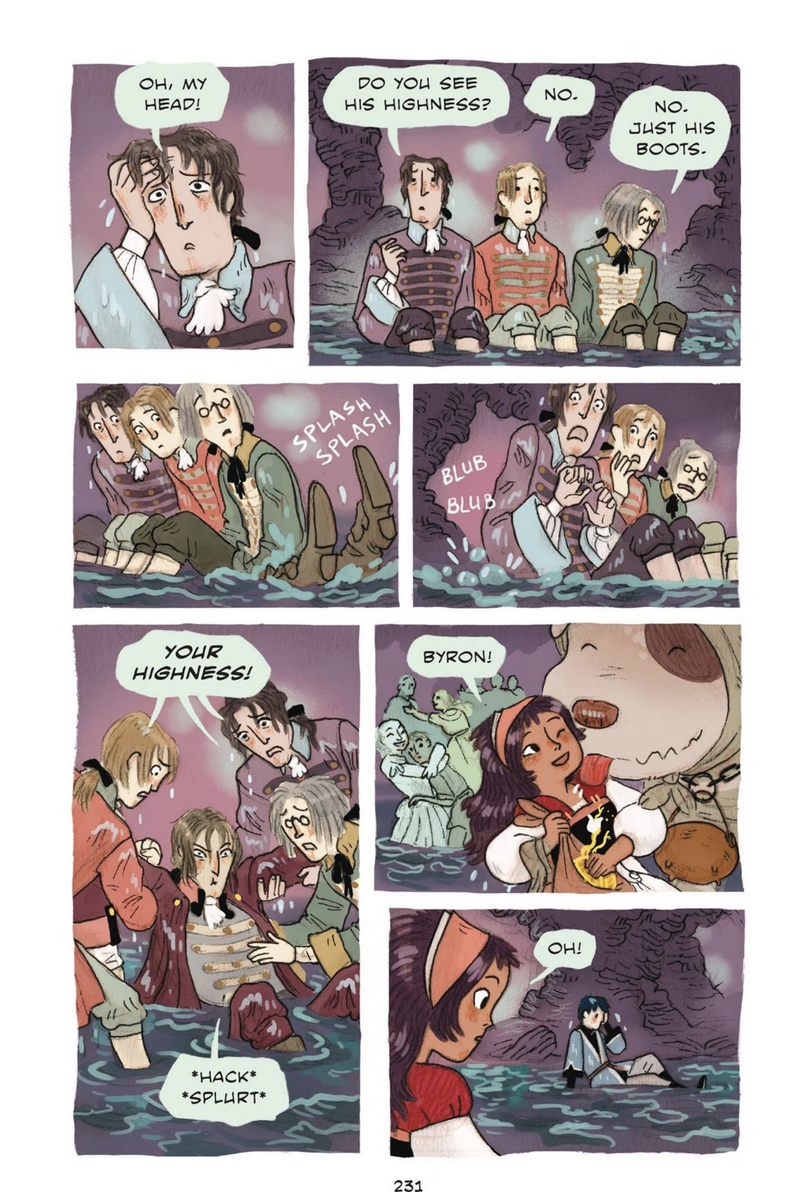
Now Suri is heading to the Monster's Cradle, the land of the giants, to help find a giant for whom her companion Byron, the monster-dog, could be a lap dog. Created by a greedy imp named Caglio, Byron is a lovable but massive dog with few monster tendencies, but he is threatening enough for the prince and his entourage to pursue for monster-hunting sport. But, not only is the trio being followed by the hunters, there are also three caitsiths named Siska, Toska and Mouska who are following them, determined to retrieve the golden twine Mouska had dropped.
From Cat's Cradle: The Mole King's Lair by Jo Rioux
When Suri, Caglio and Byron are confronted with a monster, Byron takes off and Suri and Caglio hide in a mountain cave which Suri believes must belong to the Mole King, according to her monster guidebook. She tries to use the power of her dragon tooth to ward off the Mole King but it's only when Byron reappears, and she feels intensely that it works for her. They soon meet Kolya, a young thief, who had been stealing from the Mole King's treasure room filled with gold coins–this gets Caglio's attention–which explains the Mole King's anger. But when they open Kolya's one bag they realize all he grabbed was a small, three-legged table.
From Cat's Cradle: The Mole King's Lair by Jo Rioux
Suri and her companions now head into the tunnels of the Mole King's lair, but their motives are all a little different. Suri just needs some gold to pay for food as they journey. Caglio just wants money. And Kolya is stealing so that he might redeem himself with the leader of his thieving ring. But Kolya is also drawn to the golden twine he saw in Suri's bag. If he is a caitsith, that golden twine would be handy in disguising his monster-ness. 
 
But going after the treasure is not as simple as finding their way to the treasure room. The prince is still determined to hunt a monster and is now accompanied by Toska, Siska and Mouska as his trackers and by the people of the impoverished town of Tancredi who'd lost many families and friends to the mines of the mountain. It's now a race to the treasure and to capturing a monster while a ball of gold twine draws attention from the caitsiths and Kolya. Who can work together and who cannot will undoubtedly determine the outcome for Suri and others in The Mole King's Lair, and in Book 3, Suri's Dragon.
From Cat's Cradle: The Mole King's Lair by Jo Rioux
Jo Rioux has given us a full range of characters from spunky Suri who wants to be a monster tamer, to the freaky Caglio who is all about himself, the cuddly Byron, the farcical prince and his courtiers, the caitsiths, and new characters like Kolya and his leader Lutrov. There's more coming with hints of a relationship between Lutrov and Toska and someone called Baron Grim. There's a lot of story here and Jo Rioux weaves it together flawlessly, taking us from Suri and her group to the prince and his entourage, from the Mole King's lair to the town and the forests. The story is engaging and will keep middle-grade readers engrossed with who is doing what and why and do they know what the others are up to. Nothing is straightforward except Suri who just wants to be a monster tamer and do the right thing, whatever that might be.
 
Like The Golden Twine, The Mole King's Lair is a delight for graphic-novel fans. It has a little bit of everything, from sweet characters and monsters, and idiots and villains, to dark scenes and humour, and a pursuit or two that keeps the action strong and the adventure compelling. Jo Rioux's artwork gives us all of this with expressive faces that show fear and trepidation, suspicion and affection. Readers will laugh when Byron gobbles up Caglio when he insults the dog, or when Caglio explains his origin–"I congealed in a cauldron of bone soup that spoiled on the fire" (pg. 86)–and cheer when the prince is trampled by Byron. There is so much to engage the young reader and all with a degree of innocence and humanity, even for monsters.

I don't know when Suri's Dragon comes out but, after The Golden Twine and The Mole King's Lair, I know there's lots more story to come and adventures and laughs from Jo Rioux. I'll be cheering for Suri and Byron–not so much Caglio–and hoping that their dreams come true.
 
Cat's Cradle: The Golden Twine (2022)
Cat's Cradle: The Mole King's Lair (2023)
Cat's Cradle: Suri's Dragon (still to come)


July 13, 2023

Monster vs. Boy

Written by Karen Krossing
Charlesbridge
978-1-62354-356-3
240 pp.
Ages 10+
July 2023
 
...people believe the strangest things, especially when they're scared or upset. I think the stories people share are part truth and part not-truth. The hard part is figuring out which is which. (pg. 126)
This is a story about a boy and a monster. Yes, a real monster that lives in his closet. I know you'll say that monsters don't exist but in the town of Morsh (from "monstrous marsh") where 11-year-old Dawz lives with his little sister Jayla with their uncle Pop, there is a history of monster sightings. Problem is that Dawz hasn't really seen the monster because he doesn't go into that large bedroom closet. Still, his fears about it are very real, especially as the kids were abandoned by their mother after she got weird, talking about a monster with yellow feathers and a scorpion tail.

As Karen Krossing tells her story from two perspectives, we know Dawz is right about a monster living there. Mim is small, with purple scales, gray fur, two hearts, several horns, and she can release smoke and ash from her nostrils. She loves the nest she has built among the boxes and bags. Most of all, she loves when the grown-up opens a book and tells a story from it. She thinks it's absolutely magical.
Books were powerful. Wonders dwelled inside them. Wonders that Mim was missing, alone in her dusty closet. (pg. 6)
But Mim didn't understand how something in the book turned into a story told aloud. She had a book in her nest, and nothing happened when she opened it. Her aim was to learn how to make the book work for her.

But Dawz and Mim's status quo is disturbed when Pop decides to clean the closet and excavate some aprons Dawz's mom had made long ago for the annual Baker's Brawl baking contest which she used to enter with her brother and which Dawz now entered with his best friend Atlas. When Mim tries to scare them away, Dawz realizes that only he can see and hear her. With her nest eliminated–"Her world had cracked open... (pg. 41)"– Mim ventures out, grabbing a pillowcase, a sock, and a book, and finds herself pursued by Dawz and company, including Ronny the pest control guy and Officer Rashmi.

As Mim befriends a cat she calls Raar and struggles to find a new nest, deal with her hunger and her surprising growth, Dawz and Thea, one of Atlas's moms, cope with their injuries from encounters with Mim. It takes a while but both Dawz the Horrible, as Mim calls him, and Mim will need to find their way back to each other in order to alleviate their fears, understand their needs, and appreciate the other for whom they are.

While some readers may pick up Monster vs. Boy because of the promise of a horror story, Karen Krossing's latest middle-grade novel is more a reflection of what we see and fear in others before we know them. Dawz has a lot of baggage because of what he remembers of his mother before she abandoned them and, with his nightmares of monsters, he has essentially created one that lives in his closet. On the other hand, Mim knows the comfort of her closet nest and has no interest in the outside except for the opportunity to hear the stories that come from books. When forced out, she tries to make connections, such as with the cat, but finds herself drawn back to the familiar even if it makes her nervous. Because neither understands the other, until the end, they interpret their actions as threatening or horrible and try to prevent further dangers to themselves. There's much learning about themselves and others as the two go from monster vs. boy to monster and boy.

But beyond the conflictual theme of her story, Karen Krossing also reminds us of the magic of books and reading. Whether being a writer who puts words to paper or a listener who has the words read aloud to them, the process of reading is miraculous, taking us from the mundane to the fantastic. Even the text of a recipe, which Dawz reads to Mim, enthralls her. It's the translation of letters to words to meaning that elevates books from paper and ink to the extraordinary, and even a purple-scaled monster knows this. 

So, open your own closet and see what opportunities there are for new learnings and relationships. Taking a chance on the unknown may be trepidatious but the rewards can be so un-horrible.

June 21, 2022

Cat's Cradle: The Golden Twine

Written and illustrated by Jo Rioux
First Second
978-1-250-62535-9
128 pp.
Ages 8-12
June 2022
 
Discovered as a foundling by some merchants in a travelling camp, Suri is both sheltered, by most of the merchants, and vilified, by the leader Leon. Like other kids in the camp, she tries to earn her keep, and telling stories is one of her occupations, though her aspiration is to be a monster tamer. In their valley of Galatea, protected by the mountain range called the Giant's Belt through which monsters occasionally enter via a gap named the Monster's Cradle, there are those who capture monsters for bounty. In fact, there is currently a monster being held captive, ready for sale to the Prince, in the wagon of a strange little man who clangs when he walks. (It is said he has a cold, dead heart that clangs in his chest.) But while telling her story to her paying customers, Suri takes them to the wagon to show them she isn't afraid of the monster. She not only approaches the creature who is only visible by its glowing eyes but she communicates with it and learns that, like her, it's lonely. That connection will serve her well.
From Cat's Cradle: The Golden Twine by Jo Rioux
After her encounter with the monster, she purchases a dragon’s tooth which she is assured will awaken great power within her. Still, while evading Leon, she meets a boy with a package of fish doughnuts and a pile of pillows he sells. When she starts telling him that she is a monster tamer and can recognize a caitsith–even when in human form they have a tail–the boy races away from her, leaving behind several items including a ball of golden twine which she uses to secure her dragon’s tooth as a necklace.
From Cat's Cradle: The Golden Twine by Jo Rioux
Later Suri is pursued by the boy and his friends for the return of his property. Convinced they want her dragon’s tooth, she takes shelter in the monster’s wagon before escaping with the creature’s help and beginning a new adventure away from the camp and heading into the land of the monsters to do a good deed and hopefully stay ahead of some nasty beasts, both human and monster, and become the monster tamer she aspires to be. 
 
This is Jo Rioux's first graphic novel as author and illustrator, having previously provided the compelling artwork for picture books like The Legend of Lightning and Thunder and graphic novels like The Daughters of Ys and A Sam and Friends Mystery series. Some may recognize the title, Cat's Cradle: The Golden Twine as a previous publication (Kids Can Press, 2012) but this edition has been reimagined and completely redrawn by Jo Rioux, making it fresh and new and ready to complete Suri's adventures in the remaining books of this trilogy. 
 
Middle-grade graphic novels are always a hit and especially when they include fantasy elements like jackalopes, leshii and basilisks, mythological creatures from across cultures. Then add a young protagonist who must deal with being abandoned and trying to find her place in the world and working towards a goal that others think impossible for a girl, and you've got a full story of empowerment, fantasy, and action. With Book 2, The Mole King's Lair, in the works, young readers should know soon enough how successful Suri is in her quests.
From Cat's Cradle: The Golden Twine by Jo Rioux

September 03, 2021

The Serpent's Fury (A Royal Guide to Monster Slaying, Book 3): Guest review

 This review was written by guest reviewer Matthew Green
 
 Written by Kelley Armstrong
Puffin Canada
978-0-73527-015-2
352 pp.
Ages 10-14
June 2021
 
 
The Serpent's Fury by Kelley Armstrong is the captivating third installment of the Royal Guide to Monster Slaying series. It’s just as exciting and action-packed as the previous two books, featuring many of our favourite characters as well as some new ones!
 
The Serpent’s Fury tells the story of 12-year-old Princess Rowan, Tamarel’s Royal Monster Hunter elect. Rowan and her fearless companions try to figure out why all the monsters, who up until recently lived in a large forest adjacent to Rowan’s country, are migrating south and interfering with the livelihood of Tamarel’s people. This migration is becoming a danger to Tamarel’s citizens who are getting hurt or even killed. While trying to figure out this mystery, Rowan, Dain, Alianor and some other old and new companions also have to deal with poachers who are trying to take advantage of the disruption. While on the journey, Rowan and her friends learn a lot about the intentions of people and their motives. Whether it’s greed or goodwill, even unconsciously, these intentions will show.

Like the two previous books, one of the many things that I loved is that The Serpent's Fury is told from Rowan's point of view and, like the two previous books, I enjoyed seeing Rowan’s thought process. Another thing that I loved in the Royal Guide to Monster Slaying series is that a few pictures of the monsters that we see throughout the book are compiled after the last chapter. It really helps me visualize the monsters in the book.

In the first two books, the squad that goes adventuring primarily stays the same but, in The Serpent’s Fury, a new character is introduced: Trysten! The “kinda-sorta” prince from Dorwynne was sold into slavery because his father didn’t want any competition for the throne. Now, after he has been saved by Rowan and the crew, he is indebted to them. But his loyalty is questioned by Rowan and the others.
 
The Serpent’s Fury explains all of the things that you need to know, in case you haven't read the previous books (A Royal  Guide to Monster Slaying, 2019, and The Gryphon's Lair, 2020), but I think that you would enjoy The Serpent’s Fury more if you first read the earlier two books.

All in all, I really loved this book! For me, it was super exciting to see Rowan react to these situations with her unique perspective that not every monster that you run into has to be killed. Even though it is a book meant for middle school kids, I think it’s a fun book for all ages. Lastly, and all things considered, I would give this book a 9/10.

P.S. I can’t wait for the next book!

~ Matthew Green, 12 years old, Grade 8

A Royal Guide to Monster Slaying Books 1-3


October 29, 2020

Poesy the Monster Slayer

Written by Cory Doctorow
Illustrated by Matt Rockefeller
First Second
978-1-62672-362-7
40 pp.
Ages 4-7
July 2020
 
Her parents may be typical in their frustration with a little girl who just won't go to sleep but her reason is very atypical: she has monsters to slay.

From Poesy the Monster Slayer by Cory Doctorow, illus. by Matt Rockefeller

With Halloween only days away, there may be much talk of monsters and creatures of the night. Some children will be frightened just as many already are of those horrors that tend to come out when the lights are dimmed. But for Poesy Emmeline Fibonacci Russell Schnegg, whose parents use her full name the more frustrated they become with her, it's her parents who frustrate her. 

"Parents! Always with the bedtimes!"

From Poesy the Monster Slayer by Cory Doctorow, illus. by Matt Rockefeller

After her father finally leaves with a "PLEASE stay in bed tonight" Poesy is ready. She's been reading her monster book and she knows about all of their weaknesses. When the werewolf appears, she's ready with her wand and Princess Frillypants silver tiara. Of course, her father hears and chastizes her for playing with her toys. (She doesn't explain about the werewolf.)

Then there's the Great Old One who "made a noise like a frightened teakettle in a blender rolling down a hill" which she swiftly dispatches with her bubblegum perfume in its eye. This time it's her tired mom yelling at her to get back to bed.

From Poesy the Monster Slayer by Cory Doctorow, illus. by Matt Rockefeller

Kindly Poesy realizes she must "take care of the rest of the monsters more quietly" though, of course, her parents hear her as she disposes of a vampire and Frankenstein's monster. When morning finally comes around, it's her parents who look the worse-for-wear.

A prolific writer, Toronto-born Cory Doctorow is better known for his science fiction and tech non-fiction writing. Though he has written for YA readers, this is his first picture book and I suspect the premise of getting a child to bed, especially one whose name is almost identical to that of his own daughter, may be a very personal one. But with much humour, about how Poesy sees her parents–"He was so tired that he stepped on a Harry the Hare block and said some swears. Poor Daddy! Rotten monsters!– and how she slays the monsters, Cory Doctorow takes something from the scary side to the funny side. Matt Rockefeller's illustrations, rendered in pencil, graphite powder and coloured digitally, have a cheekiness to them, surprising because of the dark nature of the story. But together, words and art suggest that those monsters in the dark can be handily taken care of by a child.

Poesy the Monster Slayer will empower your little ones if they have any fears about the monsters that may lurk in their rooms after dark, though it might not hurt to ask them politely to keep the noise down so their hard-working caregivers can get some well-earned sleep.
 
From Poesy the Monster Slayer by Cory Doctorow, illus. by Matt Rockefeller


October 24, 2018

Monsters: The Reckoner, Book Two

Written by David A. Robertson
HighWater Press
978-1-55379-748-7
246 pp.
Ages 14+
October 2018

Trust comes from truth. (pg. 199)

In Strangers, the first book in David A. Robertson's The Reckoner series, Cole Harper returned to the Cree community of Wounded Sky, a reserve constantly in recovery from tragedy. At that time, he'd been lured back by Coyote a.k.a. Choch with whom Cole had made a deal when the supernatural being helped save Cole's two friends, Eva and Brady, from a school fire ten years earlier that killed so many others. Though treated as a pariah, Cole helped stop a murder spree and provided a cure, with his unique blood, for a flu affecting the community. Now, in Monsters, that trickster Choch expects Cole to stick around and try to expose the truths about the mysterious experimentation that had taken place at the research facility and help heal a community.

Cole's first step is to recover the files he'd discovered in Strangers that revealed how he and others had been test subjects at the former Mihko Laboratories research facility. However, with Mihko returning to the community and quarantining all those who had been cured but now were looking worse, and Victor, a local resident, and Jayney, a spirit girl, talking about a monster or bogeyman or perhaps even Upayokwitigo, Cole's task becomes more complicated. Who is this creature? Why are the "flu" patients looking sick again? Why are guards posted at the clinic and the research facility? With the residents of Wounded Sky vacillating between acclaiming Cole as a hero and a criminal, Cole is finding it hard to learn anything. And did I mention how flummoxed he is about his feelings, particularly for best friend Eva, who has a boyfriend, and for another girl, Pam? Cole's probably feeling like it sucks to be him. No wonder his anxiety is out of control and he's struggling between choosing to take meds and trying to cope without. But can he quash that debilitating anxiety sufficiently to save himself and Wounded Sky from monsters of so many manifestations?
"...if there's somethin' that evil, there's gotta be somethin' that good." (pg. 236)
There is a lot of evil hanging around Wounded Sky and, at this time of year, many will think those monsters will all be vicious creatures that inspire fear. But, though there are a lot of monsters in Monsters, not all are physical beings. Some are inner demons, like Cole's overwhelming anxiety founded in his past but pervading his present and undoubtedly ready to affect his future. But they are also the community's fears that it will be unable to recover from its tragedies and that it's in danger of losing its identity. Those are monsters like no other. Fortunately, there is still much goodness and strength in Cole and the community, and readers will be hopeful that there are some happy endings for both.

David A. Robertson continues the thriller he began in Strangers by setting up new mysteries built on those established in Book One. However, although Monsters may answer a few questions, David A. Robertson leaves the reader still wondering about that research facility and what they did to Wounded Sky's inhabitants, past and present, and hoping that Cole will not lose himself in his struggle to find the answers.

Still, without spoiling the ending, readers need to be prepared for David A. Robertson's plot twist. A monster may be revealed, seemingly tying up a plot line, but Monsters closes out with a shock and a gasp that will have readers waiting for Book Three in the series, Ghosts, to learn how Cole, the Reckoner, is able to make peace for himself and Wounded Sky.  Spring 2019 can't come soon enough.
••••••••••••

Just a quick note that

MONSTERS

launches

Tuesday, October 30, 2018

7 p.m.

at

McNally Robinson
Grant Park in the Atrium
Winnipeg, MB

and

will be hosted by
Katherena Vermette

A portion of book sales from that night will be donated to
Anxiety Disorders Association of Manitoba

November 24, 2017

The Gnawer of Rocks

Written by Louise Flaherty
Illustrated by Jim Nelson
Inhabit Media
978-1-77227-165-2
60 pp.
Ages 9-14
October 2017

Author Louise Flaherty prefaces the telling of her story with its origins, the storytelling tradition of an Inuk storyteller Levi Iqalugjuaq who would visit their school in the 1970s.  This legend was one of many he told the students.
From The Gnawer of Rocks 
by Louise Flaherty 
illus. by Jim Nelson
As an Inuit camp prepares to pack up for the trek to its winter grounds, two girls, with babies in their care, go off for a walk, to soothe the children.  As they walk, they find beautiful smooth stones, and even lovelier ones as they continue, until they are lead to the mouth of a cave strewn with bones.  Drawn to the shinier stones within, the girls and their charges become trapped when the cave slams behind them.  Forced to enter further, they are horrified to discover a cache of human heads and bones which they suspect are those of missing children. One of the heads warns them that they are in the dwelling of Mangittatuarjuk and to escape by digging through the gravel walls but the warning comes too late as the hideous creature crawls out of the shadows.
From The Gnawer of Rocks 
by Louise Flaherty 
illus. by Jim Nelson
The old woman with extraordinarily long arms blocks their way but one of the girls taunts her to show them her strength, challenging her to bite down on a stone. Whilst Mangittatuarjuk attempts to gnaw at the rock, the other girl uses a bone to dig through the wall, ultimately allowing the girls to escape.  Returning to camp with their news, the hunters set out to kill the creature to ensure the safety of all their children.  Mangittatuarjuk is called forth from her cave, the men claiming they have come to honour her.  Tending to her feet, one of the hunters ties a rope around one so that their dogs could drag her from the cave entrance and across the sharp rocks to kill her.  Only after hours does the creature die of her injuries, at which time the hunters cut up her body so that her spirit could not return to life.

Louise Flaherty honours the storytelling tradition of her parents, grandparents and ancestors with this telling of Mangittatuarjuk, The Gnawer of Rocks.  This legend, like all, is rife with cautions to children who might stray too far, as well as honouring those who rise to the challenge of protecting children.  Inuit legends abound with scary creatures like Mangittatuarjuk and are told in such a way that one might never question their veracity.  Somewhere someone knows whose ancestor was one of the hunters or the girls, and it is just repeat tellings of the story that makes it sound more incredible.  American artist Jim Nelson's shadow-rich graphics convey the cold of that Arctic landscape and the gloom and blackness of the creature's cave and force.  Coupled with the graphic novel format, the illustrations support the grisly story's premise while advancing the story at a brisk pace.

True or not, The Gnawer of Rocks is splendid storytelling, horrific in its content but wise in its consul.
From The Gnawer of Rocks 
by Louise Flaherty 
illus. by Jim Nelson

June 27, 2017

Julia Defiant: The Witch's Child Book 2

Written by Catherine Egan
Alfred A. Knopf Books for Young Readers
978-0-553-53335-4
464 pp.
Ages 14+
June, 2017

Julia Defiant, the sequel to Catherine Egan's Julia Vanishes (2016), the first book in her Witch's Child series, is as epic a fantasy as all her books.  There are battles of good vs. evil for power but amidst so much deception that it is hard to tell whom to trust, and Julia, who is still blaming herself for her role in the kidnapping of young Theo, doesn't even know if she can trust herself to do the right thing.

The core cast of characters from Julia Vanishes are still aiding and abetting Julia, the Fraynish girl who can vanish as well as  transport herself between locations and into a dark and burning other world called Kahge. Mrs. Och, one of the three immortal Xianren who’d been tasked with guarding and keeping separate the fragments of The Book of Disruption to prevent the overflow of magic, is leading the group in search of a monk named Ko Dan.  It is hoped that they can enlist Ko Dan to undo the magic he used to transfer the fragment of Gennady, another Xianren, into his baby son.   Theo, not yet two, does not know that he is at the centre of it all, with the third Xianren, Casimir, determined to reassemble the book and reestablish their immortality.

Mrs. Och’s plan is for the group to separate in Tianshi, the capital of Yongguo, and learn what they can. Julia resides with Mrs. Och, Theo and the boy’s mother, the witch Bianka, and Frederick the scholar in the modest Nanmu Triangle, while Julia’s brother Dek and her former lover Wyn live in the seedier Dongshui Triangle.  The others, Julia’s thieving compatriots–Esme, Gregor, Csilla–as well as the learned Professor Baranyi, pose as members of an aristocratic household in the Xihuo Triangle.

While their task is simple enough–find Ko Dan and save Theo from the fragment within him–there is much to learn, primarily about and by Julia.  When permission is granted by the grand librarian, Si Tan, for them to visit the Imperial Library, the search is on for clues to Ko Dan’s whereabouts but also, Julie learns when vanished, into Kahge and Julia’s powers.  At the Imperial Library, she is accosted by a witch who works magic on her, flooding her with visions, possibly memories, including one in which her mother worked with a two-spouted pot, similar to one she’d observed in a painting of the witch Marike.  This pot which she later learns is called the Ankh-nu may be a key to Julia’s heritage.

But Julia’s wanderings as she vanishes about Yongguo and into the horrific world of Kahge bring her more questions, though rarely answers.  Who is Lidari and why do the creatures of Kahge call out to Julia with this name?  Who is the Fraynish girl obviously under protection in the monastery?  And the biggest question is: Who can she trust? Mrs. Och who seems to want to help Bianka and Theo but shamelessly pulls life forces from Bianka and Frederick to strengthen herself?  The young man Jun to whom she is attracted and who has come to her rescue?  Her brother Dek who is acting less like himself because of the freedoms he now has in Yongguo?  Or Pia, the assassin who sees herself in Julia, knowing how they’ve been treated and the life Julia could have under Casimir’s contract?  Can Julia even trust herself to be there to save Theo when she’s already let him down at least once?

The constraints of a single post for a review of Julia Defiant suggest the story is much less than it is.  This space is far too meagre for me to acquaint the reader with its plot and still find room to applaud it sufficiently.  The plot and myriad of subplots, as well as rich contingent of characters, both of Frayne and Yongguo and Kahge, are too much for these few words.  I desperately want to tell you of Ragg Rock and her bunny; Silver Moya, Count Fournier and Princess Zara; the telling of stories to Theo; Dek’s new life with Ling; adorable Theo as he learns to walk, talk and do magic; and so much more.  This is especially so as it is all told in the opulent prose of Catherine Egan who can make everything sound, read bigger and better and more.
Stars, this boy.  Handsome, mysterious, quick on his feet, and now sweet.  I struggle not to give him a melty look. (pg. 81)
Even crushing on a boy reads powerfully.  This is how Catherine Egan writes. Every word is authoritative and woven with magic to create worlds that may have familiar elements–there is definitely an Asian feel to the world of Yongguo with its names, dress and customs–but are so distinct and extraordinary that nothing compares.  All I can say is that, having introduced Julia in Julia Vanishes, Catherine Egan's second book brings Julia into worlds where she can define herself and her power, so that she is never inconsequential again.  She will only vanish when she so chooses, making Julia Defiant fantastic in more ways than one. 

January 20, 2017

Julia Vanishes

Written by Catherine Egan
Alfred A. Knopf
978-0-553-52484-0
375 pp.
Ages 12-17
2016

I’ve always been on the Catherine Egan-bandwagon, an auspicious venue for readers of fabulous fantasy and struggles in other worlds. The Last Days of Tian Di, her trilogy  (Shade and Sorceress, 2012; The Unmaking, 2013: Bone, Fog, Ash & Star, 2014), took readers to imaginary lands of  Mancers, Faeries and Sorceresses and an exceptional evil vs. good conflict.  But now I’ve joined the ranks of fans of her Witch’s Child series, debuted with Julia Vanishes, who’ve recognized Catherine Egan’s latest high fantasy as something truly special, not unlike Julia herself.

Whilst miscellaneous persons are being murdered and their brains messed with after encountering a mysterious woman and her baby Theo, sixteen-year-old Julia works reconnaissance as the housemaid Ella at the home of the elderly and wealthy Mrs. Och.  After Julia’s mother Ammi was drowned as a witch in one of Prime Minister Agoston Horthy’s ritual Cleansings of those practising outlawed element worship and magic, Julia and her older brother Dek, a great mechanical tinkerer, were taken in by Esme who runs the criminal underworld. As part of Esme’s band of crooks, which includes Gregor and Csilla and Julia’s love interest, the artistic Wyn, Julia has been charged with staking out Mrs. Och’s household from within, watching the lady herself, as well as her guests Professor Baranyi, who had once been in prison for his heretical writings and continues to dabble in mysterious work with his assistant Frederick, and Mr. Darius whose bizarre behaviour and entrapment in the cellar draws her curiosity.  Thankfully Julia has an inane ability to vanish, to be unseen.

There is a space I can step into, a space between being myself in the world and I know not what, where people’s eyes simply pass over me.” (pg. 7)
Julia’s vanishings allow her to learn of Mrs. Och’s smuggling of witches, and of strange experiments on the kind Mr. Darius, and of concerns that the murders and other mysterious goings-on indicate a search for  someone or something.  When Julia reports to their client, Pia, a cagey woman in goggle spectacles, that Mrs. Och has two new house guests, Bianka Betine and her young child, Theo, Julia becomes enmeshed in a dangerous plot that pays phenomenally well but costs her much in self-respect and remorse and leads her to face evil, both inside and out.

It is so easy to get swept up in the world of Spira City (a map is included and necessary) and beyond, a world of magic and subterfuge, witches and immortals.  There is menace and kindness, compassion and cruelty, and the difference is not always clear. Catherine Egan, who knows a few things about writing of evil and villains (see her guest post here), riddles her evocative and atmospheric writing with characters, like Julia, who appear to bridge that continuum of good vs. evil–yes, even Julia has some things of which she is not proud–making them as real as you and me but in a world of fantasy where writings can become wishes and owls can become cats.  Her characters are exceptional for their diversity and natures, and her plotting has the highs of turrets and the depths of dungeons, the twists of secret staircases and darkness, so much darkness.  But it is Catherine Egan’s writing that draws me in so fully.  It’s rich in the textures of shadows and excitement, going far beyond words into realms of new worlds.
A hand jerks his head up by the hair.  A wetness at his forehead, a spreading blackness.  He thinks of struggle, but fleetingly, as if from a great distance–already this sudden, brutal ending has become part of somebody else’s story.” (pg. 28)
When Wyn draws the Twist, he makes all the ugliness, filth, and poverty beautiful somehow–this is his gift, his magic: to transform with love.  And he works his magic on me as well, so that when he touches me, my horrible dress and uncombed hair are nothing, nothing at all to the beauty he draws forth.  I am not the same Julia–motherless, broke, badly dressed, a crook.  In his arms, for a short while at least, I am perfect.” (pg. 87)
From the depths of cruelty to the sublime of love, Catherine Egan writes with a fluid pen and transports readers to worlds where magic is possible. Thankfully Julia Vanishes is but the beginning of that story. Julia Defiant, out in June 2017, will carry us further.

October 24, 2016

Tank and Fizz: The Case of the Battling Bots

Written by Liam O’Donnell
Illustrated by Mike Deas
Orca Book Publishers
978-1-4598-0813-3
163 pp.
Ages 8–11
2016

We all know cheaters, those vile people who manipulate circumstances in their favour, regardless of others.  At the simplest, they are kids who cheat on tests or lie to cover up some misdemeanour.  At worst, they are adults who perpetrate crimes for their own purposes.  It is so satisfying when a cheater gets caught because that’s what they deserve and it’s a small step in making the world a safer and better place for all.  It’s not surprising, thus, that when Tank and Fizz, our intrepid detectives from The Case of the Slime Stampede (Orca, 2015)  are asked by the school Troll Patrol to prove that wealthy and reprehensible classmate Rizzo Rawlins is cheating in the local battle bot competition, that the two monsters are eager to take on the case. If only all cheaters could be caught by Tank and Fizz.
All year, I had watched Rizzo cheat in class.  Math test, science quizzes, coloring contests.  You name it, Rizzo Rawlins cheated.  He bribed the school math whizzes for test answers.  His goons sabotaged classmates’ experiments.  He hired professional artists to do his cut-and-past craft projects. Rizzo Rawlins had to win at everything, every time, any way he could.  I had seen the trail of broken dreams in my schoolmates’ tears.  When I’d seen the sad faces of the Troll Patrol,  I knew Rizzo’s cheating had to stop.  And I was the goblin to make it happen. (pg. 21-22)
But, as is usually the case, everyone knows about the cheating but proving it is far more difficult.  Even with Tank’s code sniffer–her invention to sniff out codes originating from beyond the school–that proves Rizzo’s bot, the Rawlins Reaper, should be disqualified, Principal Weaver refuses to believe Rizzo is anything but a model student, probably because Rizzo’s father makes huge financial donations to the school.  When the two detectives follow Rizzo to the almost complete new stadium, Slurp Stadium, they witness his acquisition of a new illegal part for his bot and his interactions, by screen, with a masked hacker called the Codex.  But the search for evidence of Rizzo’s cheating becomes linked to a situation in which the Codex threatens Mayor Grimlock to suffer unforeseen consequences if the new stadium is ever opened.  The goblin and troll duo undertake surveillance, alongside magic-spinning friend, Aleetha, a lava elf, and discover a conspiracy involving Sanzin Balazar, the wealthy entrepreneur behind SlugCo and the new stadium, a banished demon of goblin legends, and a threat to Slick City of monstrous proportions.  But can they stop the chaos before everything is lost?

Liam O’Donnell has a fun way with words, and more so in his creation of the world in which Tank and Fizz live.
You know that feeling you get when you try to stop a demon from being summoned but accidentally help summon it?  It definitely takes the shine off your scales. (pg. 136)
There are double grubnug-fudge smoothies, glowshroom groves, spicy lizard dogs and choco-slug cookies, and mothers who scratch the scales behind your ears. (Aw.)  And Tank’s inventions, like her spybot and springers, are the contraptions of kids’ dreams. Mike Deas’ graphic novel-type illustrations suggest he got as much amusement as the author in creating the assortment of monsters that populate Slick City and the Tank and Fizz books in general. (Books 3, The Case of the Missing Mage is set for release April 2017.)

From Tank and Fizz: The Case of the Battling Bots 
by Liam O'Donnell, illus. by Mikes Deas
Since the book’s dedication is “To goblin detectives and troll tinkerers everywhere”, it seems only right to review The Case of the Battling Bots in October, the month of goblins, trolls, witches, elves and more. Moreover, the book was just nominated for the 2017 Silver Birch Express award, so it’s review at this time is only fitting.  But the outrageous antics of Tank and Fizz, all in good fun and with the best of intentions, will always entertain, regardless of the time of year, as long as early and middle-grade readers enjoy a bit of fun with their creepy and a bit, but not too much, of the graphic-novel  format to dress up a strongly-plotted story.

October 17, 2016

If I Were a Zombie

by Kate Inglis
Illustrated by Eric Orchard
Nimbus Publishing
978-1-77108-356-0
32 pp.
Ages 4-8
April 2016

With Halloween almost upon us and young children (OK, adults too) thinking about costumes, consider reading If I Were a Zombie to jump start those creative juices and delight young readers with the back-and-forth poems of two friends, Evan and Poppy,  imagining life as monsters and other-worldly creatures.

The list of creatures that Kate Inglis includes is extensive: zombie, fairy, robot, giant, vampire, witch, ninja, ghost, alien, superhero, sea monster, goblin, skeleton, mermaid, and even adult. There’s something a little scary and a lot funny about all of them. Each double-spread has a full-page illustration and a multi-stanza rhyming poem about the entity each child envisions for themselves.

If I were a zombie
I’d package my drool
Put it in Mason jars
Sell it at school. 

I’d mumble and stumble to sniff out some lunch
Chase Ben and Lucy…
(Think they’d be juicy?)
And sweet little Tilly?
“Quit runnin’, silly!
All I want’s a good nibble and munch.
(pg. 3)

So begins Evan’s speculative verse about being a zombie, and the two children’s remaining proposals are just as evocative.  There are discussions of the robot’s price tag and robospeak (AFFIRMATIVE for yes, NEGATIVE for no, And DOES-NOT-COMPUTE for “I ain’t gonna go.”; pg. 7); the ninja’s "collection of secrets and dark-of-night prizes" (pp. 15); a pirate ghost who knows of Oak Island and eluding the Mounties; an alien called Zeekoid the Freakoid ready to take over New Brunswick; and a photo-bombing sea monster that has ...

...stingers for fingers
Seaweed for hair
Flip-floppy gills
And a bum that’s bare.” (pg. 23)

From If I Were a Zombie 
by Kate Inglis, illus. by Eric Orchard
But most wonderful of all is the cool dad who declares that,

I’d stay up past midnight
And my kids would too
We’d eat pretzels with pop
That turned our tongues blue.
(pg. 31)

Eric Orchard, who illustrated The Terrible, Horrible, Smelly Pirate (Nimbus, 2008), easily gets down and dirty in his imaginings of these weird and wacky characters.  The illustrations are as bold as their colours and more fun than scary, sure to entertain young readers with their quirky whimsy.

From If I Were a Zombie
by Kate Inglis, illus. by Eric Orchard
If I Were a Zombie pairs Kate Inglis’s imaginative rhymes with Eric Orchard’s fanciful but goofy creatures in such a way that life as an other-worldly creature seems almost cool, even if it requires eating nachos with brain dip.