Showing posts with label Arctic. Show all posts

July 24, 2026

The Old Man, the Boy, and the Dog: An Inuit Retelling of an Aesop's Fable

Book cover of The Old Man, the Boy, and the Dog: An Inuit Retelling of an Aesop’s Fable shows a boy and an older man with a dog pulling a sled through the snow in an Artic community.
Written by Kevin Kaukuarjuk Qamaniq-Mason 
Illustrated by Vienno (Vinicius Xavier)
Inhabit Media
978-1772276411 
28 pp.
Ages 6–8
June, 2026 
 
When Aesop wrote his fable titled "The Miller, His Son, and the Donkey," he wouldn't have been writing about a northern setting such as Nunavut, the home of author Kevin Kaukuarjuk Qamaniq-Mason (though perhaps more like the home of Brazilian illustrator Vienno). By adapting one of Aesop's fables to a northern landscape, Kevin Kaukuarjuk Qamaniq-Mason is able to teach an important moral lesson in a fresh and northernly way.
A boy helps his grandfather raise sled dogs in a northern environment of snow. Scenes show the dog as a pup, and growing up and learning to obey and to pull a sled.
Illustration by Vienno from The Old Man, the Boy, and the Dog, written by Kevin Kaukuarjuk Qamaniq-Mason
Anguti is a boy who helps his grandfather, Ittuq, raise sled dogs. When Anguti's aunt needs a dog to help her with her work, they select one of their most promising sled dogs, hitch him to a small qamutiik (sled) and head off to deliver the animal.
Two women sew skins outdoors, as an older man sits on a sled being pulled by a sled dog. A young boy speaks to the man on the sled.
Illustration by Vienno from The Old Man, the Boy, and the Dog, written by Kevin Kaukuarjuk Qamaniq-Mason
But, as proud as Anguti is of this strong and clever animal, he listens to others they pass who all have something to say. First, a man building an iglu questions why the dog isn't pulling anyone on the sled. When Anguti gets on the sled, two women comment that the older grandfather shouldn't be walking while Anguti sits. So, at Anguti's urging, his grandfather gets on the qamutiik instead. Of course, someone has another opinion about the dog and how much it can pull, and Anguti gives in again. His grandfather has some wise words about not being able to please everyone—“Grandson,” said Ittuq, “when you try to please everyone, you please no one.” (pg. 13)—which is a lesson his grandson learns too late.
A boy, alongside an older man, both wearing parkas, pulls a sled dog who sits on a sled. Others in the snow, all in winter outer clothing, play or work.
Illustration by Vienno from The Old Man, the Boy, and the Dog, written by Kevin Kaukuarjuk Qamaniq-Mason
As with all Aesop's Fables, Kevin Kaukuarjuk Qamaniq-Mason wraps an important message in the story. It doesn't matter whether the story is told in Ancient Greece, in Nunavut, or in Toronto, because everyone knows how common it is to have others impose their opinions on us and for us to want to please them. Often we trust others before that which we already know to be true. (Anguti knew the dog was smart and strong but continued to feel the need to prove it to others.) But, by setting the story in Nunavut, Kevin Kaukuarjuk Qamaniq-Mason speaks to those children for whom the Arctic is home and familiarizes others with its landscape and its people. 
Speaking to an older man in a winter parka, a small boy, also in a parka, points to a sled and a brown and white sled dog. They all stand in a snowy landscape.
Illustration by Vienno from The Old Man, the Boy, and the Dog, written by Kevin Kaukuarjuk Qamaniq-Mason
Illustrator Vienno (a.k.a. Vinicius Xavier) puts the reader directly into that wintery landscape of snow and cold. But, even more so, he puts us into an Indigenous community where a man uses a pana (snow knife) to build an iglu, where a girl dries fish, and where boys chip ice for drinking water. These are people who are just going about their day, and Vienno's bright art helps the reader feel part of it.
 
With a timeless lesson about trusting your own judgement and disregarding opinions that may be harmful, The Old Man, the Boy, and the Dog respects the classic while giving it new life with a northern setting, with an Indigenous community, and with a handsome dog that will captivate children.
 

November 08, 2024

Lemming's First Christmas

Written by Jamesie Fournier
Illustrated by Tim Mack
Inhabit Media
978-1-77227-543-8
28 pp.
Ages 0-5
October 2024
 
Avinngaq (lemming in Inuktitut) lives under a house and hears children singing, "Santa Claus is coming to town." When she asks Qimmiq (a sled dog), he tells her that Santa Claus puts presents under the tree. That just leads to more questions because Avinngaq doesn't know what a tree is. And so begins Avinngaq's quest to ensure Santa Claus visits her.
From Lemming's First Christmas, written by Jamesie Fournier, illustrated by Tim Mack
Qimmiq has a simple explanation about a tree–"It grows out of the ground, and you decorate it"–and he goes with Avinngaq to find one. The other Arctic animals bring forth what they suggest might be a tree. From Natsiq (a ringed seal) who brings some seaweed, and Tuktu (a caribou) who brings a purple saxifrage, Qimmiq can only tell what is not a tree. Other animals include Tiriganiaq (an Arctic fox) and Ukaliq (an Arctic hare) but it's not until Avinngaq rests on a piece of driftwood that Qimmiq confirms she's found a tree.
From Lemming's First Christmas, written by Jamesie Fournier, illustrated by Tim Mack
So, the friends decorate the driftwood with the seaweed, the purple saxifrage, arctic willow, and berries, sing, "Santa Claus is coming to town" and are delighted to find presents under the tree the next morning.
From Lemming's First Christmas, written by Jamesie Fournier, illustrated by Tim Mack
For our very youngest children, Lemming's First Christmas would be a bright beginning to the holiday season. Of course, they'll start singing the song too and it could get tiresome for the next seven weeks but maybe you could break that up with a reading or two of Lemming's First Christmas and some discussions about Arctic animals and plants, about cultural traditions, and even the magic of the holiday season. Jamesie Fournier, a writer in Iqaluit, keeps the story positive and simple, which is perfect for an early picture book–it has thicker pages and a reinforced cover–while introducing them to the Arctic and its plant and animal species, and teaching them a few words of Inuktitut. (A double-spread at the back posts the Inuktitut names and their pronunciations along with illustrations of the animals depicted.) It's very sweet and all the more so for Tim Mack's illustrations. I've reviewed several books which Tim Mack has illustrated (It's Time For Bed and What's My Superpower?) and his cartoon style of digital art will resonate with very young readers. His characters are cute and recognizable, and even if unfamiliar with an Arctic environment, children will recognize the play of shadows at night, the magic of snow and stars, and the quest for answers from those we know.
From Lemming's First Christmas, written by Jamesie Fournier, illustrated by Tim Mack
Get into the holiday season in a gentle way with Lemming's First Christmas. It's an easy introduction for those who may become overwhelmed with the customs of the holiday and let them see it from the perspective of a group of animals who interpret a tradition in their own way and make it a very sweet first Arctic Christmas.


April 28, 2023

The Woman and Her Bear Cub

Adapted and retold by Jaypeetee Arnakak
Illustrated by Dayna B. Griffiths
Inhabit Media
978-1-772274660
36 pp.
Ages 3-6
April 2023
 
Many children take it upon themselves to adopt animals they believe have been abandoned. They do it with the best of intentions, though sometimes without regard for the bigger picture. The Woman and Her Bear Cub is a traditional Inuit story of such a fostering but with the wisdom that comes with living in conjunction with the natural environment and not overriding it.
From The Woman and Her Bear Cub by Jaypeetee Arnakak, illus. by Dayna B. Griffiths
A child and her mother are out on the ice hunting when they discover a polar bear cub stranded behind some broken ice. The mother wisely looks for tracks and evidence that the mother bear is nearby but can find none, so they help the cub from its location and take it home.
From The Woman and Her Bear Cub by Jaypeetee Arnakak, illus. by Dayna B. Griffiths
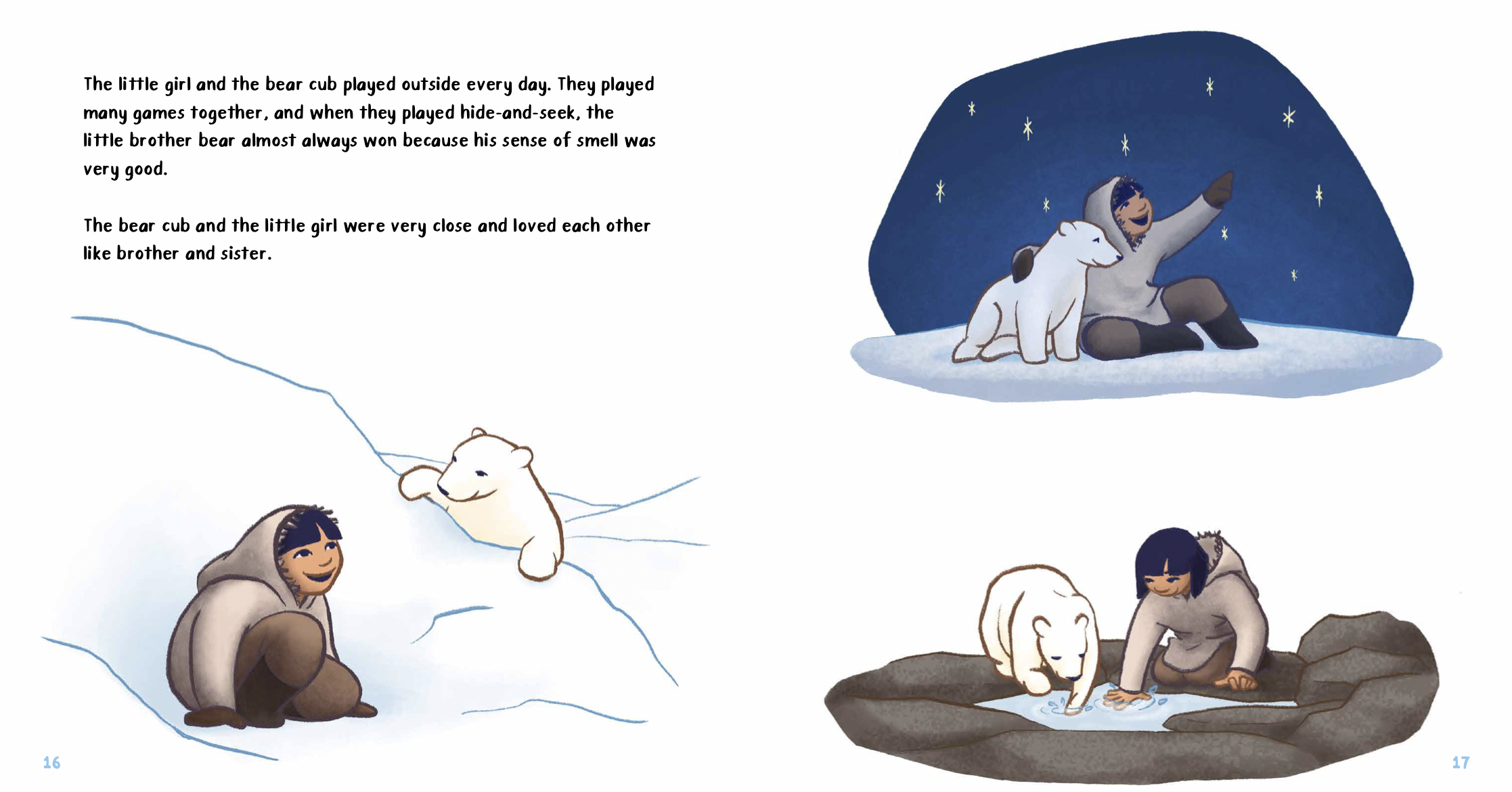
The child calls the cub her baby brother and their bond is as strong as siblings. They spend time together, playing and such, with the bear becoming an integral part of their family, even bringing back seals and fish that he has caught for them.
From The Woman and Her Bear Cub by Jaypeetee Arnakak, illus. by Dayna B. Griffiths
But when the cub is no longer a baby bear, and he becomes so big that the others in the village are concerned, the mother prepares her child for the time he would have to leave them. Still, it isn't until her brother bear returns from hunting one day with his own mother that the mother and child are able to say goodbye.
From The Woman and Her Bear Cub by Jaypeetee Arnakak, illus. by Dayna B. Griffiths
Jaypeetee Arnakak is a multi-talented Inuit linguist, translator, educator, and writer who grew up in Clyde River on Baffin Island. He has edited a collection of traditional stories from oral recordings of Inuit Elders and adapted several into picture books. The Woman and Her Bear Cub is one such traditional story and one that tells of compassion for living things and letting go when the time is right. There is no willful removal of a wild animal to provide companionship or entertainment. Neither is there a selfishness to take and keep what does not belong to them. The mother and her child give sanctuary to a lost bear cub only until he is reunited with his mother. It's not about their needs but about his needs. 

That quietness of purpose and landscape is portrayed in the illustrations of The Woman and Her Bear Cub by artist and designer Dayna B. Griffiths of Toronto. By creating art that appears stark, with a restrained palette of blue, white, and grey-brown, Dayna B. Griffiths makes the Arctic landscape of blue sky and white snow dotted with an occasional qarmaq (dwelling) very powerful. As such, the interjection of a white bear and grey-brown-clad people, with the occasional dog of both grey and white, in that landscape makes them both an important and insignificant focus.

As with most traditional stories, even those that may take on fantastical proportions, there is a germ of truth, and I suspect this one is based in reality. Adopting a lost animal and caring for it until care is no longer necessary is a story for all times. Here, a polar bear and an Arctic landscape may make this story unique, but its premise is grounded in the authenticity of compassion for those in need and dictated only by the one most affected. It is a lesson in selflessness and benevolence and a true reflection of the graciousness of Inuit values.

February 28, 2022

I Can See You

Written by Rosemarie Avrana Meyok
Illustrated by Michelle Simpson
Inhabit Media
978-1-77227-420-2
28 pp.
Ages 0-4
February 2022
 
Concepts books, i.e., those that teach concepts such as the alphabet, colours and numbers, are always valuable resources for parents and teachers. These books introduce young children to early learning but, if handled well, will entertain while that learning is happening. With bright illustrations, a simple rhythm of repetition and a unique cultural foundation for that learning, I Can See You will teach, delight and enlighten.

From I Can See You by Rosemarie Avrana Meyok, illus. by Michelle Simpson
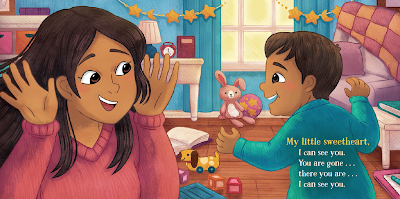
In I Can See You, mothers and grandmothers endearingly play with babies, based on the senses of seeing, hearing, smelling, feeling and even tasting. Embraced with obvious adoration, a baby, always called "my little sweetheart" is experienced fully by the parent or caregiver.
 
From I Can See You by Rosemarie Avrana Meyok, illus. by Michelle Simpson
From playing peek-a-boo to giggles, hugs and kisses and cuddles, each baby is well-loved and the basis for readers, and undoubtedly young listeners, to understand how the five senses can be the vectors for that love.

From I Can See You by Rosemarie Avrana Meyok, illus. by Michelle Simpson  
Born in NWT and residing in Nunavut, author Rosemarie Avrana Meyok speaks from experience both of people and place. As a great-grandmother, she has undoubtedly done her fair share of baby cuddling and nurturing. Her words are simple, as appropriate for a concept book, but never shallow. Rosemarie Avrana Meyok gives depth of feeling to those words but also experience with their message. From the baby in an amautik (parka with a hood for a baby) receiving kunik (nose kisses) from her mother to an Arctic landscape of cottongrass and saxifrage or northern lights–depending on the season– I Can See You takes young readers to the far north. In her joyful artwork, Niagara Falls illustrator Michelle Simpson brings that landscape to life, in its people and its place. The vegetation is distinctly that of the tundra, the stilted houses are raised above the permafrost, the stuffies include walrus, narwhal and snowy owls, and there are earrings that are beaded or resemble the ulu. Everything speaks to an Arctic community and an Inuit culture at its heart. And more at its heart is the love of mother or grandmother, perhaps aunt or sister, for babies who are seen, heard, touched, tasted and smelled with tenderness, knowing all the love that every child deserves.

November 08, 2021

Animals Illustrated: Wolverine: Guest review

Occasionally I invite young readers to share a review of a Canadian book they've read and enjoyed. Here I'm pleased to share a review of Animals Illustrated: Wolverine by Grade 3 student Hudson G.

Written by Allen Niptanatiak
Illustrated by Patricia Ann Lewis-MacDougall
Inhabit Media
978-1-77227-298-7
28 pp.
Ages 6-8
September  2021 

When I picked out this book, I didn’t know much about wolverines, but I was a little scared of them.  I was hoping to learn more about them so I wouldn’t be scared at all.  This book had good information about wolverines on each page.  The number of words was just the right amount for young readers.  The "Table of Contents" has a good amount of topics covered including: diet, survival adaptations, babies, and tough animals.  The overall information in the book was really good to help the reader understand about wolverines.  These animals are really important to Indigenous people and there is a section on traditional uses.  This section is a great idea to explain to children all of the uses for their fur.  For example, their fur makes parka trim and mittens.  The "Fun Facts" section was also good, but I would have liked more than just three main facts.  Instead of sentences, dot jots would be better to fit in more fun facts on the double-page spread.

This book is illustrated by Patricia Ann Lewis MacDougall and I really like the drawings and how realistic they are.  I felt like it was real life and I was right there with the wolverine.  The muted colours she used seem to represent the wildlife in the Arctic and helps the reader feel the location better.  The art also has labels on the pictures to help the reader understand the text better.  A combination of the information I learned and the beautiful illustrations have helped me to feel better about wolverines and they are no longer scary to me.

~Review by student Hudson G., Gr. 3
 
From Animals Illustrated: Wolverine by Allen Niptanatiak, illus. by Patricia Ann Lewis-MacDougall

• • • • • • •

Inhabit Media's popular Animals Illustrated series currently comprises of nine titles.

Narwhal (2016)
Muskox (2016)
Walrus (2017)
Bowhead Whale (2018)
Arctic Wolf (2018)
Caribou (2019)
Wolverine (2021)
Ringed Seal (2021)

November 13, 2020

Kits, Cubs, and Calves: An Arctic Summer

Written by Suzie Napayok-Short
Illustrated by Tamara Campeau
Inhabit Media
978-1-77227-274-1
32 pp.
Ages 7-11
September 2020

I know summer is over and it has definitely passed in the far north but learning about other cultures and ecosystems, life cycles and food chains, is never out of season, and certainly not in schools so Kits, Cubs, and Calves: An Arctic Summer is undoubtedly a great read at any time of year.
From Kits, Cubs, and Calves: An Arctic Summer by Suzie Napayok-Short, illus. by Tamara Campeau
Akuluk, who lives south of the Arctic and had been spending time in Nunavut with her grandparents, has just arrived in Saattut to visit with her aunt and uncle. Even though it is summer, she is dressed warmly in her atigi, a duffle parka, when the northern float plane delivers her and her stuffed polar bear, Piulua. Even driving from the dock, Akuluk can see new life on the tundra in the form of fox kits playing and at the house, there are seven month-old puppies born to their sled dog Blackie. 

The next day, Akuluk's Aunt Sulie and Uncle James, along with Uncle Tommy, take her out on the boat to check out their summer camp grounds, now inhabited by polar bears. With a wealth of food, that includes dried Arctic char, palaugaaq bannock and aqpiit (a glossary of Inuktitut words explains these and more at the conclusion of the story), they begin their foray on the Arctic Ocean.
From Kits, Cubs, and Calves: An Arctic Summer by Suzie Napayok-Short, illus. by Tamara Campeau
Their sighting of a pod of creamy white beluga whales, including a grey calf, mesmerizes Akuluk, and even more so when they use a recording device to hear the mother's cooing, clicking, chattering and whistling sounds. Based on the Inuktitut word for small, mikilaaq, Akuluk names the baby Miki. But when another lone calf appears, they watch as the mother and the other whales check it out, perhaps to adopt the orphan.

From Kits, Cubs, and Calves: An Arctic Summer by Suzie Napayok-Short, illus. by Tamara Campeau
Finally they arrive near their old camp and see the polar bear and her cubs who'd previously found their fishing nets filled with char and now return annually. The family willingly gave up "their traditional land to help these large animals survive." (pg. 21) They place themselves between the bears on land and the whales and watch the bears eat their catch of seal meat, as seagulls, hopeful of remnants, look on.  Akuluk learns that normally the Arctic foxes would be following the bears, eating any meat left behind, but in the summer they have their kits and stay away from the nanuit (sing. nanuq) who would prey on the very young.
"Everywhere we go, Inuit and animals, we all have a need to stay close, so we can help one another," she says, putting an arm around Akuluk. "The wildlife do what they can to help one another, in their own way, and we do what we can in ours. We have to share our earth with all the wildlife that live here. We need to look after our land, and the plants in it, too." (pg. 29)
Suzie Napayok-Short who was born in Frobisher Bay and has lived on Baffin Island and Nunavut takes delight in Akuluk's visiting and learning, perhaps because these were her own experiences. Not only does Akuluk get to spend time with family and witness animal wonders in the Arctic, she learns of the traditional ways, piusituqait, and their importance in maintaining ecosystems. Author Suzie Napayok-Short embeds her storytelling, perhaps recounting, with a respectful gravitas, recognizing Akuluk's visit as pivotal for the young girl. 
From Kits, Cubs, and Calves: An Arctic Summer by Suzie Napayok-Short, illus. by Tamara Campeau
Illustrator Tamara Campeau who also illustrated The Muskox and the Caribou and In the Sky at Nighttime stays true to her artistic style of realism with a hint of the personal. She doesn't make her illustrations frivolous or silly; instead, the art depicts the true nature of the familial relationships and the wonder of the natural world. By blending the authentic with the deferential, Tamara Campeau dignifies Suzie Napayok-Short's story while giving it colour and shape.

Kits, Cubs, and Calves: An Arctic Summer goes beyond summer and gives a picture of life in Nunavut for its people, its animals and the land, and it's a great place to visit through Suzie Napayok-Short and Tamara Campeau's work.

October 21, 2019

In My Anaana's Amautik

Written by Nadia Sammurtok
Illustrated by Lenny Lishchenko
Inhabit Media
978-1-77227-252-9
24 pp.
Ages 3-7
September 2019

Love and security are often found with a person or a place but to find them together in both is extraordinary. In My Anaana's Amautik is about a child finding them both in the pouch at the back of its mother's parka.
From In My Anaana's Amautik by Nadia Sammurtok, illus. by Lenny Lishchenko
In its anaana's amautik, a child travels, sleeps and enjoys the closeness of being with its mother and experiencing its world of land, water and sky from a position of safety and intimacy. They feel the sun and compare it to the warmth of her skin, see the clouds and compare them to being swaddled, and are reminded of summertime flowers with her scent.
In my anaana's amautik, I feel safe. The protection of the hood around me is like my own tiny iglu. I love peeking out from inside my anaana's amautik. (pg. 11)
From In My Anaana's Amautik by Nadia Sammurtok, illus. by Lenny Lishchenko
The child likens everything about being in its anaana's amautik to those familiar attributes of its own Arctic environment: sun, clouds, flowers (like Arctic poppy, blueberry and dock), cottongrass, iglu, ocean, stream. But most importantly it's about home.
In my anaana's amautik, I feel loved. The gentleness of her movements reminds me of her hugs and her love for me. I love my anaana's amautik. (pg. 19)
While the earlier books of Nadia Sammurtok's which I reviewed (The Caterpillar Woman, 2016; Siuluk: The Last Tuniq, 2018) had a distinct ambiance of darkness and legend, In My Anaana's Amautik is all lightness and affection. While still based in the Inuit culture, Nadia Sammurtok's heritage, and the Arctic environment, In My Anaana's Amautik enfolds the readers in the experience familiar to the very young Inuit. It brings us into that amautik to feel the bond of mother and child and of the land.
From In My Anaana's Amautik by Nadia Sammurtok, illus. by Lenny Lishchenko
In a series of double-spread illustrations depicting only a child's head or hand, the only body parts that would ever be exposed from rest in an amautik, Lenny Lishchenko also focuses on the feeling, not the logistics. She makes the sun, or the clouds, the cottongrass or the water, all things with which the child analogizes their amautik experiences, the emphasis. In this way, the child is but a small part of everything but still part of it all.

In My Anaana's Amautik is an experiential picture book filled with the sensory reality of being close and safe and warm and loved. Oh, that every child could feel this.

June 21, 2019

In the Sky at Nighttime

Written by Laura Deal 
Illustrated by Tamara Campeau
Inhabit Media
978–1-77227-238-3
28 pp.
Ages 3-6
May 2019

While getting a child to sleep with familiar imagery is not unusual, it is when it embraces the northern environs of the Arctic and culture of its indigenous people.

In the Sky at Nighttime is a northern bedtime story. It's late and it's dark, and outside there is the crunch of winter snow and the cold crisp air. There are northern lights "painting bright colours across the endless sky" and a hunter on snowmobile returning home. Far above the snow-covered buildings and streets, a raven roosts, calling to others. But deep within a house illuminated in the darkness, there is an intimacy as a "mother's delicate song to her child rises like a gentle breeze."
From In the Sky at Nighttime, illus. by Tamara Campeau, text by Laura Deal
Nunavummiuq Laura Deal's text is very simple, usually with two lines per double-spread, often starting with "In the sky at nighttime." It takes us from outside in, leading from the expansive outdoors of both rural and urban landscapes, then drawn into the world of a mother and child. It sees the day ending and the outlook for a new day.
At peace for the day ahead
and the one we leave behind.
Quebec's Tamara Campeau brings the chill of the text to the book's landscapes through her snow-covered homes and streets, her people bundled in hooded parkas, and red-nosed and -cheeked children. The snow glistens as it provides still insulation but also as it sparkles with the stars and luminous northern lights in the darkened sky.
From In the Sky at Nighttime, illus. by Tamara Campeau, text by Laura Deal
I've just updated my Read a Book of Bedtime booklist to include Laura Deal and Tamara Campeau's splendid bedtime picture book In the Sky at Nighttime. Children in northern areas will be tickled with the book's familiarity and homeyness of people and place, while those in other climes will learn bedtime in the far north can be as warm and as cozy as a mother's embrace amidst shelter from the cold.

November 27, 2018

It's Time for Bed

Written by Ceporah Mearns and Jeremy Debicki
Illustrated by Tim Mack
Inhabit Media
978-1-77227-227-7
28 pp.
Ages 3-5
September 2018

You know the mayhem of getting little ones to sleep? Try managing it when your little one wants to play with all the animals of her Arctic landscape.

Little Siasi is told and asked repeatedly,
It's time for bed. The sun has set.
Siasi, have you ... ?
And she is asked about brushing her teeth, putting on her PJs, putting away her toys, picking a good night story, climbing into bed and closing her eyes. But Siasi's responses are always the same. She doesn't want to. Instead she wants to dance with the polar bear, or run with the caribou, fly with the geese, howl with the wolves, hop with the rabbits, and swim with the fish. But when she says she's done it all, she's definitely ready for bed.
From It's Time for Bed by Ceporah Mearns and Jeremy Debicki, illus. by Tim Mack
It's Time for Bed is based on parents Ceporah Mearns and Jeremy Debicki's own Siasi who would make excuse after excuse to put off her bedtime. Her refusal will be familiar to all caregivers of very young children but it's her unique reasons that will make It's Time for Bed a favourite new bedtime story to read. Children will love her reasons and delight in making up new ones of their own to continue her story for themselves. Even better, It's Time for Bed opens the world of the Arctic to those who have never lived there and reinforces the experiences of those children who have and do.
From It's Time for Bed by Ceporah Mearns and Jeremy Debicki, illus. by Tim Mack
Astutely, Tim Mack, who also illustrated Aviaq Johnson's What's My Superpower? (Inhabit Media, 2017), never makes Siasi's requests seem ridiculous or farfetched. All the animals with whom she wishes to play, even the fish beneath her bed, seem adapted to her bedroom. Moreover, Tim Mack has made Siasi determined, perhaps not to go to bed quite yet, but also boisterous and brash, wide-eyed and imaginative, and no one would want a child to be otherwise. And when she finally closes her eyes, angelic in her quiet, Tim Mack makes sure to include her Arctic animal friends in the shadows to watch over her.
From It's Time for Bed by Ceporah Mearns and Jeremy Debicki, illus. by Tim Mack
Fortunately, for Siasi's guardians and all parents who might read the story, Siasi does eventually follow through on all her bedtime routines, as little children must learn to do, when they know It's Time for Bed.

July 10, 2018

The Muskox and the Caribou

Written by Nadia Mike
Illustrated by Tamara Campeau
Inhabit Media
978-1-77227-163-8
36 pp.
Ages 5-7
February 2018

While The Muskox and the Caribou is obviously a story rooted in the Arctic where both species co-exist, children everywhere will appreciate the story of Baby Muskox and Baby Caribou and Mother Caribou who loved them both.

The story begins with the birth of Baby Caribou who is born to a loving Mother Caribou and learns to walk and gallop with the herd. One day, Mother Caribou spots Baby Muskox wandering helplessly alone and lost and leads him along with her own offspring back to the herd. Baby Muskox knows he is different. He has long and dark shaggy hair and his legs are short and stocky, very different from the caribou. Sadly, Baby Caribou and his friends don't seem to like Baby Muskox very much and tease him about his differences.  It is only with Mother Caribou that Baby Muskox feels love and comfort.
From The Muskox and the Caribou by Nadia Mike, illus. by Tamara Campeau
Months pass and the young animals grow. Even when the young are prodded by Mother Caribou to go out and explore independently, Baby Muskox returns to the safety and love of his adopted mother. Finally, when fully grown, Mother Caribou takes Baby Muskox on a long walk to see animals such as himself. For the first time, the muskox understands why he never fit in and, though he is sad to learn he isn't a caribou at all, he is excited to get to know others who are just like him.
But most of all, he was grateful for Mother Caribou because she had always shown him love. (pg. 26)
From The Muskox and the Caribou by Nadia Mike, illus. by Tamara Campeau
All children will feel different from others at one point or another.  It may be the way they look or what they can do or can't do or the way they feel.  Some may not feel like they belong in the family to which they were born or with whom they live.  But if The Muskox and the Caribou teaches anything it is that love can make things tolerable and allow growth. Baby Muskox may never have realized he was a muskox but he knew he wasn't like the caribou and that caused him much sadness. Only Mother Caribou made things right. Unfortunately Baby Caribou who'd always known that he belonged could have been a better sibling to Baby Muskox but he did not see the impact of his actions on the young muskox.

Nadia Mike's humble story of a baby muskox taken in by a mother caribou and loved and sheltered along with her own young provides may teachable moments about love and differences and empathy.  Children who live in the Arctic will more likely recognize the two animals and how different they are, but all children will accept that the muskox and the caribou could be any individuals who are different and can still coexist. With love, all is possible.

Northern Quebec illustrator Tamara Campeau provides a natural landscape for The Muskox and the Caribou, emphasizing the rugged terrain and tundra vegetation as the backdrop for the story.  While the animals as babies are softened and simplified, they are true and realistic, and Tamara Campeau makes The Muskox and the Caribou as much a teaching book about the Arctic as she does enhancing Nadia Mike's story with art.

Though all children will delight in a story about baby animals, The Muskox and the Caribou should be read to send a message that we all belong somewhere and, until that somewhere is found, love can help brook time and place.

May 24, 2018

Sun Dog

Written by Deborah Kerbel
Illustrated by Suzanne Del Rizzo
Pajama Press
978-1-77278-038-3
32 pp.
Ages 4-7
May 2018

Falling asleep at night during the summer can be difficult in the Arctic because the sun never falls below the horizon, hence its moniker of "land of the midnight sun." Imagine being a little pup who knows she's supposed to go to bed with her boy but feels compelled to go outside and play. This is Juno, the Husky pup who lives with her boy in "a red house overlooking a faraway town perched on the edge of an invisible circle at the very top of the world.
From Sun Dog by Deborah Kerbel, illus. by Suzanne Del Rizzo
Juno, born in the spring, loves the sun and playing outdoors, though she yearns to be big like the sled dogs.  But when her boy goes to bed, Juno isn't ready to sleep. The pup sneaks out to play but finds the world a strange place to be without her boy. "She feels like an iceberg adrift on a giant sea.
From Sun Dog by Deborah Kerbel, illus. by Suzanne Del Rizzo
But when a polar bear approaches the house whose door Juno left open in her rush to go outside, the little dog finds a storehouse of courage within her big heart and is able to withstand her fear and give warning and, with a little help, keep her boy safe.

Children will love the story of Juno as Sun Dog, not least of which because she is an adorable dog, thanks to Suzanne Del Rizzo's elaborate and emotive dimensional art.  But I think that Deborah Kerbel's message that "Juno might be little, but there's a big dog inside her" is an meaningful one for young children who often feel too little to do anything significant and wish to be big so they can stay up late or go somewhere alone or just not be hindered by their youth or size. Juno takes it upon herself to do all those things, though she puts herself and others in danger.  Still, that small body holds a big heart filled with love for her boy and life and from that a boundless courage bursts forth.  Juno may have been frightened but she did all she could to ensure a happy ending.

The joy of being outside and the beauty of the Arctic landscape are beautifully conveyed through Suzanne Del Rizzo's artwork.  I've oohed and aahed over her polymer clay and acrylic paint art that graced her own My Beautiful Birds and other picture books and Sun Dog is no exception.  Those summer skies of yellow, pink, purple, and blue, with many shades in between, took me to that land of the midnight sun and the home of children who rarely saw themselves in books. Within that landscape, Suzanne Del Rizzo brought playfulness and charm, with the reality necessary to tell Deborah Kerbel's sweet story.
From Sun Dog by Deborah Kerbel, illus. by Suzanne Del Rizzo
It's lovely for me to review books by creators like Deborah Kerbel and Suzanne Del Rizzo whose work I've seen transform and evolve with each imaginative work.  Now, with their collaboration, a charming story has been synthesized from message and art into the brilliant and heart-warming combination that is Sun Dog.

May 23, 2018

Sun Dog & My Deal with the Universe: Double Book Launch (Toronto, ON)

What's better than a book launch?  

A double book launch!


Author Deborah Kerbel  
is launching two new books 


 Her first picture book 
with amazing plasticine artist
 Suzanne Del Rizzo

is

Sun Dog
Written by Deborah Kerbel
Illustrated by Suzanne Del Rizzo
Pajama Press
978-1-77278-038-3
32 pp.
Ages 4-7
May 2018

as well as

a new middle grade novel

My Deal with the Universe
 
Written by Deborah Kerbel
Scholastic Canada
978-1443157568
240 pp.
Ages 9-12
May 2018

😊😊😊😊😊😊😊😊😊

Join Deborah Kerbel and Suzanne Del Rizzo

on 

Saturday, June 2, 2018

2 p.m.

at

Indigo Yorkdale
Yorkdale Shopping Centre
Toronto


There will:
• readings by author and illustrator
• prizes
• refreshments
• plasticine activities, and
• book signings.

A little bit about the books:

Sun Dog, from Pajama Press website at http://pajamapress.ca/book/sun_dog/
Juno and her boy live in a red house at the top of the world. One day Juno will be big and strong enough to help pull a sled across the tundra, but for now she is just a small puppy with a big-dog heart. Small puppies have to go to bed when their boys do, but Juno can’t sleep with the midnight sun shining out across the town. She slips outside to play. Returning to see a hungry polar bear sniffing around the open door, Juno has no time to be afraid. It’s time to find her voice, summon the big dog inside her, and save her beloved boy.

My Deal with the Universe, from Scholastic Canada's website at http://www.scholastic.ca/rights/titles/special/my-deal-with-the-universe/
Maybe "normal" isn't all it's cracked up to be.... All twelve year-old Daisy Fisher wants is to be normal — or at least to not stick out like a sore thumb. But growing up in the house disparagingly referred to as the “Jungle” makes that pretty much impossible. When your parents’ activism brands them as a nuisance and your house is overrun with vines and critters, it’s not so easy to fit in. And it definitely doesn’t help when the neighbours declare your family public enemy number one. Or when your best (and possibly only) friend leaves for summer camp and forgets you exist. Or when your twin brother’s cancer might be growing back.

Will this be the summer Daisy changes things for the better? She can’t help where she lives, but if she could find a new friend, cultivate some courage, and figure out a way to keep her brother healthy, maybe life will finally be normal. Or will it? When her anxiety about her brother getting sick again threatens to boil over just as the Jungle comes under investigation, Daisy has to face down her greatest fears, not to mention the neighbours who are threatening her home. In the process, she learns some surprising truths about herself, and that maybe “normal” isn’t all it’s cracked up to be. My Deal with the Universe is a contemporary middle-grade novel by Deborah Kerbel about tolerance, diversity, individuality, friendship and the strength of family.

April 03, 2018

Siuluk: The Last Tuniq

Written by Nadia Sammurtok
Illustrated by Rob Nix
Inhabit Media
978-1-77227-178-2
28 pp.
Ages 5-8
April 2018


The Inuit stories about the Tuniit are of a legendary people akin to friendly giants.  They were considered to be immensely strong, massive in size and gentle in demeanour. It was not surprising then that Siuluk, a very large man of considerable strength who lived quietly by himself, should be considered the last Tuniq by his Inuit neighbours. 
From Siuluk: The Last Tuniq by Nadia Sammurtok, illus. by Rob Nix
When several of the Inuit men taunt Siuluk about his size and strength, he knows they are being mean but he responds with a challenge for them to lift a sheet of rock.  Of course, none can lift the massive rock except Siuluk who lifts it with ease and leaves his legacy in a message he carves into the stone.
From Siuluk: The Last Tuniq by Nadia Sammurtok, illus. by Rob Nix
Though you can read about the Tuniit in Rachel and Sean Qitsualik-Tinsley’s Tuniit: Mysterious Folk of the Arctic (Inhabit Media, 2015) and in How Things Came To Be: Inuit Stories of Creation (Inhabit Media, 2015),  Siuluk: The Last Tuniq takes a different perspective on the Tuniit.  Nadia Sammurtok tells a very simple story about teasing and differences in which a man finds a straightforward but elegant response to dismiss his intimidators.  So while children will learn about Siuluk and his status as the last Tuniq, they will also learn that anyone can be ill-treated by others and still  handle that treatment with self-possession and poise.  Siuluk, who is given graphic life by American illustrator Rob Nix, could have hurt the men who teased him about his size and strength but instead he demonstrated his brawn in a quiet but impactful manner, and even left a message for generations to come.
From Siuluk: The Last Tuniq by Nadia Sammurtok, illus. by Rob Nix

The best part of this story is revealed in Nadia Sammurtok’s afterword in which she reveals that her father had been told as a child a story about a man purported to be the last of the Tuniit who'd allegedly lived close to Chesterfield Inlet in Nunavut.  In fact, there’s a photo of her father, Tom Sammurtok, with Siuluk’s rock.  So it seems that Siuluk: The Last Tuniq, which is also available in Inuktitut, may be a traditional story about the last remaining Tuniq from the oldest community in Nunavut but it’s all the more special for the evidence of its veracity and the life lessons it encompasses.