Showing posts with label Ojibwe. Show all posts

August 17, 2026

Makade Asin / Black Stone

A boy runs through water above scary creatures on the book cover of "Makade Asin / Black Stone"
Written by Darcy Whitecrow and Cail Judy
Illustrated by Maya McKibbin
Translated by Waskonegabowiik / Pamela Johnson 
Groundwood Books
978-1-77946-015-8
32 pp.
Ages 3–8
August 2026
 
There is never one way to deal with fears. But Makade Asin / Black Stone is based on an Ojibwe story of dealing with fears through a vision quest. The text of the book is minimal, even when presented in two languages (Anishnaabemowin and English), with much told through the digital art of Maya McKibbin.
A child awakens in bed with swirls of fearful entities behind him.
Illustration by Maya McKibbin from Makade Asin / Black Stone
written by Darcy Whitecrow and Cail Judy
When a child awakens from a nightmare, he goes to his grandfather, Mishoomis. Mishoomis comforts him and advises him to search for the black stone if he wants to stop being afraid.
...  when you do, your fears
will lose their power,
Ninoozhis. (pg. 8)
 
A boy running from a frighteneing dream tells his grandfather what he experienced.
Illustration by Maya McKibbin from Makade Asin / Black Stone
written by Darcy Whitecrow and Cail Judy
His fears are many, including everything from being chased by a leopard, stepping into quicksand, having eyes watching him, falling from a boat, being attacked by a whale and a snake, and surviving the desert. But through the practice of a vision quest, always guided by the words of his Mishoomis, the boy faces all these fears and more. 
A grandfather shows his grandson a path he must take through a forest.
Illustration by Maya McKibbin from Makade Asin / Black Stone
written by Darcy Whitecrow and Cail Judy
In an appended note, translator Waskonegabowiik / Pamela Johnson, a member of Mitaanjigamiing First Nation, describes the vision quest as a cultural practice whereby the vision seeker goes out without food, water or warm clothing, and, in isolation, experiences dreams that take them back to the elders. And, although authors Darcy Whitecrow, a member of the Seine River First Nation,  and Cail Judy, tell of a boy facing his fears through a vision quest, this story could be for any person, child or adult, with fears. Just as the boy faces his fears and ends up being guided by them, we must all face them or be ruled by them. Whether there is a black stone to be found or just peace of mind will be determined by the nature of the person seeking solace.
 
As mentioned, even with the story in both Anishinaabemowin and English, the text of Makade Asin / Black Stone is sparse. As such, Maya McKibbin's digital illustrations have to convey much of the story. And she shows us the breadth of the boy's fears in the swirling masses of dark threats, toothed creatures, and alarmingly powerful waters. Her main illustrations speak to the formidable power of the boy's fears, using double-spreads and larger-than-life depictions to reveal their magnitude. Maya McKibbin also uses spotlight illustrations, bordered in a tight zigzag stitch similar to those used to keep fabric from fraying, to focus on the boy's personal experiences. From those borders to the colours of a dry desert or a raging storm on the water, Maya McKibbin gives a visceral experience to the boy's vision quest through her art.
 
Makade Asin / Black Stone has a deeply Indigenous perspective on tackling one's fears, but it's message of facing them and letting them guide us, along with some help from others, is one that transcends the Ojibwe culture and will speak to all.
 

February 02, 2026

It's a Mitig!

Written and illustrated by Bridget George
D & M Kids (Douglas & McIntyre)
978-1-771-624817
32 pp.
Ages 3–5
January 2026 
 
Giizis is rising, the day is brand new.
Let's learn some words nature's gathered for you. (pg. 3)
 
So begins Bridget George's It's a Mitig!, a picture book originally published in 2020 and now available as a board book, perfect for a concept book for teaching Ojibwe (Anishinaabemowin) words. 
 
With the rising of the sun (giizis), readers are taken from place to place to meet a variety of animals and plants. From the ashigan (bass) to the gaag (porcupine), Bridget George introduces Ojibwe words. She never uses the words "sun" or "bass" or "porcupine" but the children to whom the text is read will put the visual and textual clues together and determine what these new words mean. And, because she uses short rhyming verse, Bridget George makes the text playful and easy to remember. Moreover, her text is always informative and clear in evoking the name of each subject. For example, the text for a bird tells the reader that, "This animal whistles and lives in a tree. Building a nest, it's a bineshiinh." (pg. 11) Bineshiinh is obviously the Ojibwe word for "bird."
From It's a Mitig!, written and illustrated by Bridget George
Though Bridget George's digital illustrations in The Animals Choose a Leader (written by Richard Wagamese, 2024) and  The Inquisitive Raven (also by Richard Wagamese, 2025) are of a Woodland style, her artwork in It's a Mitig! is less defined as of an Indigenous art style. However, this Anishinaabe author-illustrator continues to embed readers fully in the natural world of trees and acorns, rivers and fish. By pairing new words with familiar natural elements like the moon (dibiki-giizis) or a river (ziibi), Bridget George teaches twelve Ojibwe names with informative and bright art.
From It's a Mitig!, written and illustrated by Bridget George
While the original book includes a glossary page with a pronunciation guide, these are not included in this edition of It's a Mitig! But, for a concept book, they are not really necessary. This is a board book, so most likely read by an older reader to a young child. Those to whom the book is read will pick up on the words by listening and looking at the pictures, not by reading them themselves. And they will learn these words. Whether these children are Anishinaabe or not, there will be learning of new words, and it will happen with colour, bright shapes, and descriptive rhyme.
From It's a Mitig!, written and illustrated by Bridget George

November 23, 2025

The Inquisitive Raven

Written by Richard Wagamese
Illustrated by Bridget George
D & M Kids (Douglas & McIntyre)
978-1-771624497
32 pp.
All ages
September 2025 
 
Last year, the first book in the Richard Wagamese Storybook CollectionThe Animal People Choose a Leader, was published. This beautiful book, a retelling of a short story by the late Richard Wagamese with illustrations by Bridget George, introduced new readers to his writings. Now, with The Inquisitive Raven, the second book in this collection, a story of curiosity, determination, and self-acceptance, there will be new readers of all ages who will be drawn to the wisdom in Richard Wagamese's Ojibwe storytelling and the beauty of Bridget George's digital artwork.
From The Inquisitive Raven, written by Richard Wagamese, illustrated by Bridget George
Rueben is the titular inquisitive raven. Some might see him as nosy, but he just finds the world to be an amazing place. He is especially curious about the other animals and what they do.  Grampa Raven, ever supportive, tells Rueben, "Wonder is the glue that holds everything together. It keeps you searching, eager for more." (pg. 10) 
 
When Rueben sees a magnificent eagle with its impressive wingspan and ability to soar, his grandfather tells him of Migizi and that she is blessed with many gifts. Sadly, Rueben then sees himself as lacking and decides to learn to soar like Migizi. 
He craved the sensation of becoming more: bigger somehow, more beautiful, less a raven and more revered and respected like an eagle, through the singular act of soaring. (pg. 17) 
From The Inquisitive Raven, written by Richard Wagamese, illustrated by Bridget George
With great determination and much practice, Rueben learns to soar, but when he goes to demonstrate his newfound ability, fatigue and fear get the better of him and he plummets to the ground. He is devastated to think that others will not respect him as they do Migizi, but Grampa Raven has wise words to share about Rueben's own gifts and the blessing that is respect.
From The Inquisitive Raven, written by Richard Wagamese, illustrated by Bridget George
Taken from Richard Wagamese's One Drum: Stories and Ceremonies for a Planet (Douglas & McIntyre, 2013), The Inquisitive Raven has an important message about self-acceptance. Like many of us, Rueben aspires to be admired, though he doesn't recognize that he already is appreciated by the other animals for his curiosity and enthusiasm for learning. In fact, it is that curiosity and passion for knowledge that takes him to try something new and work hard at achieving it. He may not reach the heights of Migizi, but his skill at soaring and his consequent plummeting are recognized as amazing just the same. Through Rueben, Richard Wagamese helps us respect the best in ourselves.
 
Bridget George is an Anishinaabe illustrator who has also authored her award-winning picture book It's a Mitig! (D & M Kids, 2020). Her art is created digitally with a Woodland style to her animals, giving shape and movement with the internal lines. While Rueben and many animals are in earthy browns and blacks, Bridget George adds colour in her landscape features like the blues and pinks of her skies and water, and in her decorative, embroidery-like flowers.
From The Inquisitive Raven, written by Richard Wagamese, illustrated by Bridget George
The Inquisitive Raven will be a much-cherished gift that will be appreciated for many years and countless generations. Beautifully covered
 in textured buckram, and decorated with Bridget George's Woodland-style art, The Inquisitive Raven lets us connect once again with Richard Wagamese and share in his insight into the value of curiosity and recognizing the gifts we have.
 
• • • • • • •
 
For teachers, there is a Teacher's Guide available from Douglas & McIntyre here.
 
 • • • • • • •

October 03, 2025

Kokum, Are These Moose Tracks?: Celebrating Fall

Written by Tyna Legault Taylor
Illustrated by Michelle Dao 
HighWater Press
978-1-774921470
40 pp.
Ages 5–8
October 2025 
 
When Tyna Legault Taylor introduced Joshua in her series Joshua Learns from the Land, her focus was on traditional and seasonal practices of her Indigenous family and ancestors. In Dad, Is It Time to Gather Mint? (2025), Joshua looked forward to summer and gathering mint for his mother's mint iced tea, though there were other seasons filled with activities like fishing, foraging, and hunting. That picture book celebrated all the seasons while Kokum, Are These Moose Tracks? focuses on the fall alone with the boy spending time with his Kokum (grandmother) tracking animals. 
From Kokum, Are These Moose Tracks?, written by Tyna Legault Taylor, illustrated by Michelle Dao
Joshua and Kokum have a special intergenerational relationship. But Tyna Legault Taylor's dedication indicates that it was even more memorable as Joshua's Kokum was the author's mother, Mary (Okimawinninew) Legault. And when fall comes, Joshua is delighted to join his Kokum or Nookomis (grandmother in both Omushkegomowin [Swampy Cree language] or Anishinaabemowin [Ojibwe language] respectively) in hunting moose, all for her delicious moose meat stew.
From Kokum, Are These Moose Tracks?, written by Tyna Legault Taylor, illustrated by Michelle Dao
As the two explore forests close to streams, muskeg and lakes, they watch for tracks. Dressed safely in orange and walking quietly, the two find multiple footprints. First there are the tracks of the red fox (osawakaysho / miskowaa waagosh), then the wolf, and the black bear before the moose tracks are spotted. With each animal track found, and all identified in both Omushkegomowin (Swampy Cree language) and Anishinaabemowin (Ojibwe language), Kokum reminds Joshua of the attributes of each. There's the fox's tail that is used for balance, the wolf that runs on its toes, and the black bear that stocks up on food in the fall. 
From Kokum, Are These Moose Tracks?, written by Tyna Legault Taylor, illustrated by Michelle Dao
Finally, they spot the tracks of a moose; in fact, they spot the tracks of a cow moose and a calf. And though Kokum uses her birchbark call, the day ends without finding a bull moose. Still, there is a full fall of hunting, fishing and foraging, and ultimately they bring home a bull moose for stew and a new pair of moccasins. 
From Kokum, Are These Moose Tracks?, written by Tyna Legault Taylor, illustrated by Michelle Dao
I know that many teachers and parents will use this book for teaching Indigenous traditions and fall activities, but I think it's important to see Kokum, Are These Moose Tracks? and the series as more. There is a great story here of a charming grandmother-grandson relationship, of an outing into the natural world to learn about animals, while picking up some words of Omushkegomowin and Anishinaabemowin. Tyna Legault Taylor, a member of Attawapiskat First Nation (Kattawapiskak), gives readers a lot to think about, discuss, and appreciate.
From Kokum, Are These Moose Tracks?, written by Tyna Legault Taylor, illustrated by Michelle Dao
As she did in Dad, Is It Time to Gather Mint?: Celebrating the Seasons, illustrator Michelle Dao drops us into the natural world through her use of colour and shape, and welcomes us in joining her characters on their hike. Her blend of golden shades with some reds and greens reflect the striking character of the season outside, while her characters give us the joy of togetherness and discovery.
 
I hope we get to enjoy more seasonal visits with Joshua and his family in the Joshua Learns from the Land series. After all, I know we'd love to experience winter or spring or summer activities with the boy and his moshom or perhaps his nimâmâ, and enjoy vicariously his jaunts outdoors and his exploration of traditional Indigenous practices.

May 07, 2025

Dad, Is It Time to Gather Mint?: Celebrating the Seasons

Written by Tyna Legault Taylor
Illustrated by Michelle Dao 
HighWater Press
978-1-774921227
36 pp.
Ages 5-8
May 2025 
 
A boy and his father walk the land through the seasons. With each season, there are new things to forage or fish or gather but always the child asks his Notawe/Baabaa, "Dad, is it time to gather mint?" That mint, a key component in his mother's teas, both cold and hot, drives this child to ask each time they head out to walk the land.
From Dad, Is It Time to Gather Mint?, written by Tyna Legault Taylor, illustrated by Michelle Dao
The text of Joshua's story is told in English but it is peppered with translations into Omushkegomowin, Swampy Cree, as well as Anishinaabemowin which is Ojibwe. As Joshua learns about the land and its plants and animals, so too do the readers in multiple languages.
 
Although Joshua would love for it to be summer (nipin in Swampy Cree, niibin in Ojibwe) when he can gather mint (katakipanik, gaaminomaagobagak in Swampy Cree and Ojibwe respectively), it is still fall when this story begins. His father (Notawe, Baabaa) reminds him that now it is a time of hunting, gathering Labrador tea (the plant), and fishing for whitefish.
From Dad, Is It Time to Gather Mint?, written by Tyna Legault Taylor, illustrated by Michelle Dao
As he and his father venture out into the season of winter, Joshua asks again and is reminded of those winter activities like snowshoeing, fishing for lake trout and herring, and gathering cedar branches for tea and for cleansing the indoor air. 
From Dad, Is It Time to Gather Mint?, written by Tyna Legault Taylor, illustrated by Michelle Dao
When winter turns to spring and the animals and the plants respond to the warming temperatures, Joshua is reminded that it is a time for hunting geese and gathering spruce buds and fishing for lake trout. Alas, it is still not time to gather the mint.
 
But when it finally is summer, Joshua rejoices, not just for the pickerel they'll fish and the sweetgrass, blueberries and cranberries they pick but for that much-anticipated walk with his father and the inevitable mint iced tea–recipe included–that his mother will share with the family.
From Dad, Is It Time to Gather Mint?, written by Tyna Legault Taylor, illustrated by Michelle Dao
There are many picture books about the seasons, but Tyna Legault Taylor's story has a richness of Indigenous heritage that makes it unique. Tyna Legault Taylor, a member of Attawapiskat First Nation, ensures a completeness of the year of seasons with the abundance of activities that Joshua and his dad enjoy together with the changing weather and circumstances. She brings us to Joshua's traditional lands in northeastern Ontario and to the culture of his Omushkego Cree and Anishinaabe family.
 
Michelle Dao, a Vietnamese Canadian illustrator, gives both a storytelling flavour and a non-fiction character to Dad, Is It Time to Gather Mint? Her digital artwork conveys the deep relationship between Joshua and his father, as well as the rest of the family, but also details the important elements that are hunted, fished, or gathered through the seasons.
 
Dad, Is It Time to Gather Mint? is but the first book in the Joshua Learns from the Land series, with the second book set to be released this October. For teachers of young students who are just learning the way seasons work, Dad, Is It Time to Gather Mint? would be a fabulous and sensitive introduction, with an Indigenous emphasis on language–two languages in fact–and traditional practices of hunting, fishing, gathering and more.
 
• • • • • • •
 
Joshua Learns from the Land
 
Dad, Is It Time to Gather Mint?: Celebrating the Seasons (May 2025)
Kokum, Are These Moose Tracks?: Celebrating Fall (October 2025)
Mom, Is It Time for the Spring Niska Feast?: Celebrating Spring (forthcoming)

September 25, 2024

Little Moons

Written by Jen Storm
Illustrated by Ryan Howe
Coloured by Alice RL
Lettered by Nickolej Villiger
HighWater Press
978-1-774921074
64 pp.
Ages 12–18
September 2024
 
Little Moons is a story of great loss. It's also a story of family and connection, even after loss. Sadly, it's also a story based too much in reality.
From Little Moons, written by Jen Storm, illustrated by Ryan Howe, coloured by Alice RL, lettered by Nickolej Villiger
Reena lives on the reserve with her mom, Andrea, 15-year-old sister Chelsea, young brother Theo and grandmother Koko. The kids' dad, Anthony, also lives there though Mom and Dad are not together anymore. Mom works tirelessly at traditional bead work which Chelsea learned to do, beading her own regalia after her woman's ceremony. 
 
And then Chelsea does not return from going shopping after school. Even with a community helping in the search and getting news out via social media and with involvement of the police, she is not found. The seasons come and go and still no Chelsea. 
From Little Moons, written by Jen Storm, illustrated by Ryan Howe, coloured by Alice RL, lettered by Nickolej Villiger
But what changes is the family. While Reena tries to connect with Chelsea, wearing her regalia to a Pow Wow, beading, and watching flickering lights that may mean Chelsea's spirit is around, Mom has gone beyond her depression and has headed to the city. First, it's just for a break but then she decides to move there. 
"I don't want to live and die on the Rez." (p. 23)
From Little Moons, written by Jen Storm, illustrated by Ryan Howe, coloured by Alice RL, lettered by Nickolej Villiger
Mom may think this will work to alleviate her grief, meeting new people, getting a non-Indigenous boyfriend–who is both a jerk and racist–and getting a job away from the Rez but Dad convinces her to let the kids remain with him. And Theo reveals to Reena that he sees ghosts that look like little moons, and that "Sister" has told him that she's sorry.

When Chelsea's bag is found buried in the forest near the highway, the family finds a way to connect with each other and to follow their traditions "to light her way to the other side." (p. 52)
From Little Moons, written by Jen Storm, illustrated by Ryan Howe, coloured by Alice RL, lettered by Nickolej Villiger
Little Moons may be another story of another missing or murdered Indigenous woman but it's not just another story. Jen Storm, an Ojibwe writer from Couchiching First Nation, has put her own experiences with a loved one who went missing and was later found dead into her story. She witnessed the range of expressions of grief and guilt and coping that family and friends showed. Most just do their best with what they have available and with what is familiar. Running away, looking for answers, insulating from others, these are just some ways, and Jen Storm does not judge. She just shows what it can be like. But she always shows that there is solace in spirituality and in traditions. Theo, based on Jen Storm's own son, is reassured when he connects with Chelsea who approaches him via his toys and the orbs that he sees. Reena buries medicine pouches, burning her cut braid in the sacred fire, and more. We all know there is no one way to grieve but it all changes when it is a missing and then presumed murdered Indigenous woman. Connecting with their sacred traditions and each other worked for this family.
From Little Moons, written by Jen Storm, illustrated by Ryan Howe, coloured by Alice RL, lettered by Nickolej Villiger
A lot of talent went into the creation of the graphics for Jen Storm's story. Saskatoon's Ryan Howe has created people and places that reflect the reserve on which this family resides, as well as the city to which Andrea moves. He gives us a family of a wise elder, a young and playful child, a forlorn Reena, and a restless Andrea, as well as a present but reserved Anthony. We see a community that sits around a fire but will take to social media when needed. He's given us the traditional and the urban, and his concepts of people and place evoke both the familiar and the less familiar. Ryan Howe's artwork is brought to life by the colouring of Alice RL, a non-binary Ojibwe artist living in Winnipeg, and the lettering of comic book artist and illustrator Nickolej Villiger of Lethbridge. Without these, the book would not be the graphic novel that is both heartrending and uplifting. There is no happy ending but there is still family and traditions that bind and elevate.

September 18, 2024

The Hawk Shadow

Written by Jan Bourdeau Waboose
Illustrated by Karlene Harvey
Kids Can Press
978-1-5253-1084
32 pp.
Ages 4-7
September 2024
 

When Serenity's older brother, Big Ed, decides to go fishing with his shiny new store-bought rod, she tags along with the hand-made one of spruce and moose sinew that her father has given her. But, though Big Ed is focused on the fishing he will do, Serenity's focus is elsewhere.
From The Hawk Shadow, written by Jan Bourdeau Waboose, illustrated by Karlene Harvey
As the two head out along Big Ed's fishing path to the river, Serenity revels in all the wonders of the natural world, from the sun and the singing robin, to a raven and some chokecherries. Big Ed may walk faster than Serenity but, even as she dawdles, he watches out for her. He also teaches her about their cultural beliefs from why the river is called Hawk River, the value of the cedar tree, and more.
From The Hawk Shadow, written by Jan Bourdeau Waboose, illustrated by Karlene Harvey
But when they start fishing and Serenity is distracted by a Red-Tailed Hawk that circles around her, and then leaves and returns, she realizes that he wants her to follow him. Fortunately, she does and finds that a little sister's help is needed.
From The Hawk Shadow, written by Jan Bourdeau Waboose, illustrated by Karlene Harvey
It's always a treat to read a Jan Bourdeau Waboose picture book. It's been far too long since her The Spirit Trackers (illustrated by François Thisdale) and it's lovely to revisit a sibling relationship that is embedded in an Indigenous community. The Hawk Shadow may be considered an Indigenous story–Jan Bourdeau Waboose is First Nation Anishinaabe of the Ojibway Bear Clan–but it also speaks to the interactions of an older brother and younger sister, an appreciation for the natural world, and a mindfulness to it and the messages within. Serenity is like her brother's shadow, following him, listening to his teachings, asking him questions, and ultimately freeing him from a dangerous situation. If she hadn't been mindful of him and of her surroundings, including listening to the Hawk, the siblings' outing may have had a far worse outcome. Jan Bourdeau Waboose shows us that even though  Serenity is watching and listening to everything around her, and is ostensibly distracted from her brother's words and quicker step, she is fully engaged. It's a lesson in being wholly present in place and with people.

Karlene Harvey, who has illustrated several other picture books including Melanie Florence's Kaiah's Garden, is a Tsilhqot'in and Syilx illustrator who respects the Indigenous basis for the story without highlighting any of the major styles such as the Woodland Style.  The realism of the Hawk's morphology is blended with the bold and the bright of the characters as they journey and fish but Karlene Harvey still adds light touches to remind readers of the community from which Big Ed and Serenity were born. In addition to the glorious end papers of beaded flowers, there's Big Ed's beaded bear paw medallion necklace and the bead work on Serenity's collar.
From The Hawk Shadow, written by Jan Bourdeau Waboose, illustrated by Karlene Harvey
Here's to listening, seeing, and being a part of something, whether it be a sibling relationship, the natural world, or a community. There is always much to learn and appreciate, even from the shadows.

August 19, 2019

Gaawin Gindaaswin Ndaawsii, kimotinâniwiw itwêwina, & Nibi Emosaawdang

This September, Second Story Press will release a trio of translations for previously-published picture books of stories based in Indigenous peoples' experiences. By sharing these stories in dual-language editions, the publisher is inviting new readers of Plains Cree, Anishinaabemowin (Ojibwe) and Nishnaabemwin (Ojibwe) to draw personal connections with the text while also encouraging discussion and influence on English-language readers. This is especially meaningful and appropriate as we become more and more aware of the necessity to embrace all cultures and meet demands for multilingual editions of stories.

The English-language editions of the three picture books, both non-fiction and fictionalized accounts based on true events, have all been reviewed here on CanLit for LittleCanadians but here are their translations, presented in dual-language editions, which are set for release September 10, 2019:

Gaawin Gindaaswin Ndaawsii/I Am Not a Number
Gaa-zhibiigeuwaad/written by Jenny Kay Dupuis minwa/and Kathy Kacer
Gaa-mzinbiiged/illustrated by Gillian Newland
Gaa-aankanoobiigewaad/translated by Muriel Sawyer minwa/and Geraldine McLeod
Gaa-waadookaaged/with contributions by Tory Fisher
Second Story Press
978-1-77260-099-5
44 pp.
Ages 7-11
September 2019

English edition (978-1-927583-94-4), 2016


kimotinâniwiw itwêwina/Stolen Words
omasinahikêw/written by Melanie Florence
otâpasinahikêw/illustrated by Gabrielle Grimard
translated by Dolores Sand êkwa
Gayle Weenie kî-nêhiyawastâwak
Second Story Press
978-1-77260-101-5
28 pp.
Ages 6-9
September 2019

English language edition (978-1-77260-037-7), 2017


Nibi Emosaawdang/The Water Walker
Gaa-zhi-biiyang miiniwaa gaa-mzinbiiyaang/written and illustrated by Joanne Robertson
Gaa-aankinootimaagejig/translated by Shirley Williams miiniwaa/and Isadore Toulouse
Second Story Press
978-1-77260-100-8
40 pp.
Ages 6-9
September 2019

English language version (978-1-77260-038-4), 2017


Each of these poignant stories take on issues which are at the heart of the Indigenous experience, whether it be residential schools, loss of language and culture, or environmentalism and activism. The stories are well told and heartfelt but, with these translations, readers will gain a different perspective that opens up possibilities for learning, discussion and impact. I encourage teachers to make use of these editions, even if they have copies of the original English language versions, to promote those discussions and inclusivity, especially in a land where we need to do so much more to build supportive communities.

September 19, 2017

The Water Walker

Written and illustrated by Joanne Robertson
Second Story Press
978-1-77260-038-4
36 pp.
Ages 6-9
September 2017

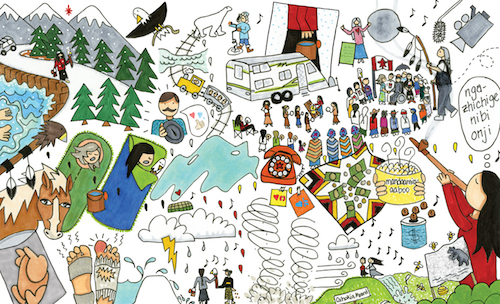
At first glance from title and illustration, The Water Walker may look like an Aboriginal myth or a picture book story.  It is neither.  It is an illustrated piece of creative non-fiction that recounts the efforts of Ojibwe Grandmother (Nokomis) Josephine Mandamin originally of Manitoulin Island and her extraordinary efforts to raise awareness about the need to protect our water (Nibi).  Her story is true, as attested by three knee surgeries and countless pairs of sneakers.

As a child, Nokomis loved Nibi in all its attributes: cold, warm, calm, wild.  Every day she would thank Nibi for its gift of life. "Gichi miigwech, Nibi, for the life you give to every living thing on earth.  I love you.  I respect you." (pg. 9)  But after hearing an elder (ogimaa) speak of water's fate and Nokomis realized that water was being disrespected and wasted, she banded with her sister and women friends (kwewok niichiis) to formulate a plan to protect Nibi.  Four days later, a copper pail full of Nibi in one hand and a Migizi (bald eagle) Staff in her other, Nokomis lead the Mother Earth Water Walkers in their walk around the Great Lakes and the St. Lawrence River.  For the next seven springs, they walked, prayed and sang, offering sacred tobacco (seema) at every Nibi encountered.

From The Water Walker by Joanne Robertson
Though the media picked up on their walking for Nibi, Nokomis knew there was more to do.  The Water Walkers went to the waters surrounding Turtle Island (North America) and sang Nibi's praises and demonstrated their respect.  They went to the Pacific Ocean, an oil spill in the Gulf of Mexico, the Atlantic Ocean and the Arctic Ocean.  Still Nokomis prays and sings to Nibi and hopes everyone will help protect Nibi.
From The Water Walker by Joanne Robertson
The Water Walker in the story of a grassroots crusade to demonstrate respect and inform people about the importance and potential destiny for Nibi if we continue as we have.  With water rights being given away for pennies and contamination through industry and pollution, Nibi is at risk.  It is no longer the limitless commodity generations before us believed it to be.  Nokomis Josephine Mandamin did not wait around for disaster to compel her to act.  She let her heart drive her into action.  Now Joanne Robertson, a member of Atikameksheng Anishnawbek and founder of the Empty Glass for Water campaign, is sharing that story through her invigorating illustrations, bold in line and colour.  Though most of her characters are seemingly lacking in detail, with their similarly rounded heads, expressionless faces and stiff walking postures, Joanne Robertson fashions them to be unique and distinct in dress and hair.  The illustration of the parade of Mother Earth Water Walkers with the sun blazing behind them is simple but powerful, as is the collage of memories of places and people visited on their walks.
From The Water Walker by Joanne Robertson
The Water Walker may be an illustrated biography of Nokomis Josephine Mandamin's walking for Nibi but it is also a tale of action, both accomplished and endless, to do for Nibi as it has always done for us.

~~~~~~~~~~~~~~~~~~~~~~~~~~~~~~~~

The book launch for the book will take place on Tuesday, September 26, 2017 at A Different Booklist in Toronto.  Both Grandmother Josephine Mandamin and author/illustrator Joanne Robertson will be in attendance to speak from 12:30 -2:30 p.m. with a book signing and reception fro 5-7 p.m. The events are posted here