Showing posts with label environmentalism. Show all posts

August 08, 2024

Momma's Going to March

Written by Jennifer Maruno
Illustrated by Vivian Rosas
Groundwood Books
978-1-77306-551-9
32 pp.
Ages 3-6
August 2024

Protest marches have long been a part of history. They are a kind of activism that can inspire change. In a series of vignettes through different periods of time, Jennifer Maruno and Vivian Rosas show us protest marches that brought mother and child out to fight for positive societal change. 
 
In  the first spreads, a mother and her daughter prepare signs for their march for freedom. It's a march for a myriad of civil rights, from voting and integrated schools and decent housing. It's a 1960s march by Black Americans for recognition of their equal rights and the racial discrimination they continued to endure.
From Momma's Going to March, written by Jennifer Maruno, illustrated by Vivian Rosas
Then in the late 1970s, a child and her momma, both dressed in white, join a march for equality, advocating for the ERA (Equal Rights Amendment), emboldened to fight for equal rights for women, from voting to employment. 
From Momma's Going to March, written by Jennifer Maruno, illustrated by Vivian Rosas
There's a pro-peace and anti-war march, sadly one which we must repeat with each new conflict. There is one advocating for clean water in Indigenous communities, and another for the environment by initiating a global climate strike. In each case, a mother and child head out to march to encourage positive change.
From Momma's Going to March, written by Jennifer Maruno, illustrated by Vivian Rosas
Jennifer Maruno's message of "march, March, MARCH" is loud and clear, and she adds to that message with notes about what makes a march, like signs and clothing, flags and banners, as well as identifying the historical marches represented in her story. In each case, her emphasis is on the relationship between mother and child, with one inspiring the other to do good by fighting for something important. It may be promoting social justice or bringing attention to causes too often neglected or unanswered but it's always about doing something. Whether it's walking or carrying a sign, riding in a wagon or shouting slogans, these mommas and their ones are community activists at a grass roots level.

Vivian Rosas, the Toronto artist who also illustrated Queer History A to Z: 100 Years of LGBTQ+ Activism, seems to have found a social justice niche for her art, though I suspect her style is equally effective across all genres. Her digital illustrations, though, strongly support diverse communities, depicting people of all ages, ethnicities, races, abilities, and more, making for inclusive marches and encouraging empowerment. Moreover, Vivian Rosas's vibrant colours and strong shapes lend themselves to Jennifer Maruno's messaging about standing up and marching for important causes.
 
Mommas, and Pappas and little sisters and big brothers and everyone, have always marched to do right and make people see and hear what needs to be done. Now, with Jennifer Maruno and Vivian Rosas's story of Momma's Going to March, young readers can see the big impact a little marching can kickoff.

February 26, 2024

Ary's Trees

Written by Deborah Kerbel
Illustrated by Sophia Choi
Fitzhenry & Whiteside
978-1-55455-509-6
32 pp.
Ages 5-8
October 2023
 
On March 21, the world will recognize the United Nations-designated International Day of Forests. Sadly, no matter how long forests have been around, in their different forms around the world, there are still those who might take a lesson from Ary and her friends about the importance of forests and see beyond what they can do for us and what we should do to ensure their constancy.
 
From Ary's Trees, written by Deborah Kerbel, illustrate by Sophia Choi
When their island home is longer viable, Ary's father goes searching for a new home, and finds it in a flourishing island.
As they begin to prepare the island for their new community, Ary, who delights in the trees, begs him, "Please don't cut too many this time."
She closed her eyes and took a deep breath. The air smelled green. Leaves swished overhead as the tree covered her with a blanket of cool shade. How she'd missed that sound!
Not surprising, with every "chop-chop of busy axes," Ary's heart aches. And though she is assured by her father that, "There are lots to spare," she sees that more and more are being cut, for building, and then for crops, and to construct boats, and then because everyone wants more, more, more.
From Ary's Trees, written by Deborah Kerbel, illustrated by Sophia Choi
Ary is bereft for and with the trees. As the palm trees are cut, brown tears rain down. And when the people can't be bothered cutting, they burn down the trees.

Ary is furious, and some of her friends join her in protest. Still, no one listens. They are but children and know not of what they speak, apparently. Ah, but an island without trees suffers. The land crumbles, the structures crack and splinter, and there is no relief from the sun. Ary's father and the other adults choose to find a new island. Ary and a handful of friends find a different solution, one borne of loyalty and regeneration.

Deborah Kerbel's story of environmental responsibility is still one that needs to be heard and empowered in all. Ary's Trees reminds us that it may be the children who will be the ones to change the attitude of their own generation and the subsequent ones, especially when their elders are not getting it. Ary sees the truth, that thinking that "a little bit more (cutting) won't make a difference" is flawed, that "The trees are here for our use" is selfish and short-sighted, and that the trees are their friends and worthy of consideration and charity.

Though I've reviewed many of Deborah Kerbel's books, from picture books like Snow Days and Before You Were Born (still my go-to book for expectant parents) to middle-grade novels like My Deal with the Universe to her YA (e.g., Under the Moon), this is my first opportunity to review a book illustrated by Toronto's Sophia Choi. Also a surface pattern designer, Sophia Choi creates art that speaks of bold colours and shapes, whether it be palm trees or flowers in the understories, or tree stumps and birds. There's a folk-art vibe to her art that speaks of a natural world that will mesmerize and delight, but that also will be missed when gone.
From Ary's Trees, written by Deborah Kerbel, illustrated by Sophia Choi
Whether you read Ary's Trees with your children or students for International Day of Forests, or save it for World Tree Day on June 28th, or for Earth Day on April 22, or to teach a science curriculum, Deborah Kerbel and Sophia Choi's picture book will demonstrate that trees are more than just a producer of materials for human consumption. Trees are living entities that can provide shade and soil stability, habitat, and food, and provide oxygen while absorbing carbon dioxide. As they live, so do we. Fortunately, the youngest inhabitants of the island, Ary and her friends, were able to realize that we humans have an interrelationship with trees, and all living things, and if we sustain them, then they will help sustain us. (Still a lesson too many developers and even politicians haven't learned.)
 

April 22, 2023

Walking Together

Written by Elder Albert D. Marshall and Louise Zimanyi
Illustrated by Emily Kewageshig
Annick Press
978-1-77321-776-5
36 pp.
Ages 4-7
April 2023

Many will be undertaking Earth Day activities this weekend and next, whether picking up garbage, planting trees or setting up rain barrels. But Earth Day should be every day, as we look out for our planet, for its water, land and air, and its plants and animals. And Elder Albert D. Marshall and Louise Zimanyi promote a message of Two-Eyed Seeing in Walking Together so that perhaps we can see the big picture and ensure that caring for our world goes beyond a single day of environmental attention.
From Walking Together by Elder Albert D. Marshall and Louise Zimanyi, illus. by Emily Kewageshig
When we walk together in a good way...
...good things happen and that is the message that resonates throughout Walking Together. It's acknowledging the many gifts that Mother Earth shares. It's hearing the stories that come from the ancestors and paying attention to the song of the spring birds and the awakening of plants and animals who have lain seemingly dormant over winter. It's hearing nature as it talks, whether it's the deer or the beaver or the frog or the flowers. The teachings of Elder Albert D. Marshall of the Moose Clan of Eskasoni Mi'Kmaw Nation in Unama'ki-Cape Breton remind us that to see fully means to blend both the Indigenous lessons of the ancestors and the knowledge that comes from non-Indigenous ways. With Two-Eyed Seeing will come respect for the Land and Water, so that it may continue to sustain us.
We take only if there is enough.
We ask before we take
And we listen for the answer.
We share.
From Walking Together by Elder Albert D. Marshall and Louise Zimanyi, illus. by Emily Kewageshig
The message that Elder Albert D. Marshall offers with education professor Louise Zimanyi is that Mother Earth offers many gifts but gifts that must be respected, not just received. Walking Together is a thoughtful treatise in being grounded in the lessons of the past with those still to come for greater clarity and compassion. It's keeping both eyes and mind open to hearing and listening what lessons are being shared.
From Walking Together by Elder Albert D. Marshall and Louise Zimanyi, illus. by Emily Kewageshig
Those same important messages are conveyed in the Woodland art of Anishnaabe artist Emily Kewageshig who furthers the stories with her illustrations. The boldness of her lines and colours draw readers in to see, to witness, to walk together in landscapes through the seasons. There is a continuity of place and people that comes through Emily Kewageshig's illustrations, drawing from the past and moving to the future. She shows the sense of grounding that comes with connection and the life that comes with respect for Mother Earth.
 
Today, on a day when we celebrate Mother Earth and on every day on which she should be honoured, I recommend taking a walk under the guidance of Elder Albert D. Marshall, Louise Zimanyi and Emily Kewageshig as they remind us how to see best.

🌎 🌎 🌎 🌎 🌎

November 08, 2022

Berani: Guest review

 This book was reviewed by Grade 9 student Bronte.

Written by Michelle Kadarusman
Pajama Press
978-1-77278-260-8
224 pp.
Ages 8-13
August 2022

Malia is a courageous girl who stands up for what she believes in, but activism can be a risky business. When she gets into some trouble with her school for circulating a petition against palm-oil, a product that many families in her town rely on for their income, she has to make a difficult decision that could result in lots of trouble for many people. Meanwhile she is trying to convince her Canadian-born mother not to move the family from Indonesia where Malia has lived all her life, and where her late father is buried.

Ari spends his days attending school, playing chess, and doing chores around his uncle’s restaurant in exchange for a chance to live with him, and get an education at the local public school. But the guilt of leaving behind his dear cousin, Suni, and the rest of his family has been gnawing on him. Furthermore, Ginger Juice, his uncle’s pet orangutan, has been suffering from her poor living conditions, and he’s worried her days are numbered. 
 
Berani alternates between the points of view of Ari and Malia as they help others and try to solve problems around their communities, as well as that of Ginger Juice, who longs for home. It is an inspiring story ideal for grades 4-6, written by Michelle Kadarusman, award-winning author of books such as Music for Tigers and The Theory of Hummingbirds. As someone who cares for the environment, I think Berani is a fantastic way to introduce some of our world’s problems to kids. This book touches on so many important issues: animal rights, climate change, preserving the environment, the loss of family members, and the struggles of moving. The main characters Ari, Malia, and of course Ginger Juice are brave, kind, and thoughtful. The book’s colourful descriptions and Indonesian words sprinkled throughout (a glossary is provided) really set the scene, and the way the chapters flip between the kids' and orangutan's perspectives is a nice touch as well. It’s a great way to start conversations about our world, and our responsibilities as inhabitants of it. (Michelle Kadarusman includes a section with information on orangutans and how we can help them.) Berani, which I would rate 9 out of 10 stars, is definitely worth a read!

~ Written by Bronte, Gr. 9

January 20, 2020

Nibi's Water Song

Written by Sunshine Tenasco
Illustrated by Chief Lady Bird
North Winds Press (Scholastic Canada)
978-1-4431-0789-1
32 pp.
Ages 4-8
2019

Though I've already started reviewing books being released in 2020, I'm still finding gems from last year that I really, really want to bring to the attention of young readers and the adults in their lives. Nibi's Water Song is one such title. Its premise of an Indigenous young person searching for potable water is both a cautionary tale and one of resilience and hope, and supportive of the need for clean water in all communities.

Nibi means water in Anishinaabemowin. Considering this young person's thirst, it is highly appropriate that it is her name. But when Nibi is desperate for water to quench that thirst, she finds no clean water at her home or that of her neighbour, only brown water.

From Nibi's Water Song by Sunshine Tenasco, illus. by Chief Lady Bird
So begins Nibi's search for clean drinking water. When she finds only dirty water in the river, she skips to the next town of "big, shiny houses." Though a nice lady gives her a teeny-tiny plastic bottle of water, she is given no more, no matter how much knocking she does at the doors of the big, shiny houses. Finally she dances in the street with her sign that "Water is Life."
From Nibi's Water Song by Sunshine Tenasco, illus. by Chief Lady Bird
Desperate for more water, thirst overpowering her, Nibi is joined by her friends, all begging for water. Their signs shout "Clean Water" and "We All Need Water."
From Nibi's Water Song by Sunshine Tenasco, illus. by Chief Lady Bird
It is only when their voices are joined together in volume and purpose that the people in the big, shiny houses fall in to help Nibi get clean water.
With a lot of hard work, digging and singing, everyone worked together. And finally, thirsty, thirsty Nibi got her clean water...and she shared with all of her friends.
From Nibi's Water Song by Sunshine Tenasco, illus. by Chief Lady Bird
Nibi's Water Song reminds us that we are part of a larger community, one whose members may not all have water safe for drinking or washing. The United Nations may have declared it a human right to have safe drinking water and sanitation but there are numerous Indigenous communities who have lived with drinking water advisories as well as compromised water and waste water systems for decades. Author Sunshine Tenasco, Anishinabe from Kitigan Zibi Anishinabeg, Quebec makes it clear that improvements will only be realized when the people in the "big, shiny houses" get involved. It may only take one person, like Nibi, to step forward and start a movement but it will take a concerted group effort from within and outside these unhealthy situations to make them safe. Still Nibi sings and dances to get the attention needed to address the problem.

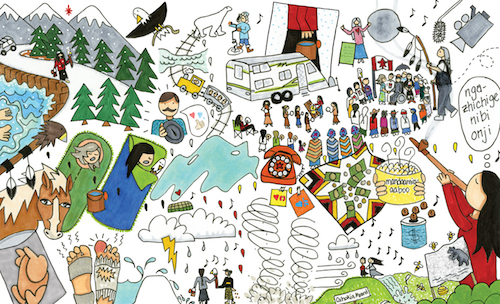
Nibi's hope is reflected in the bold and bright illustrations of Toronto artist Chief Lady Bird of the Rama First Nation and Moose Deer Point First Nation. Her colours are vivid and lively, from the blue of the clean water to the greens of the grass. Her characters wear red and pink, and blue and orange, and traditional clothing and regalia like moccasins, fringed shawls, and beadwork. Most important are the flowers that surround Nibi, symbolic of the hope for water, the element that grows and sustains life. Chief Lady Bird's highly-stylized plants surround Nibi and reach forward, stretching to advance her quest for clean water.

The message of Nibi's Water Song is a simple one: everyone deserves clean water. I hope that the words and art of Sunshine Tenasco and Chief Lady Bird will reach all communities to spur to action those of us in our big, shiny houses so that we might help everyone quench their thirst and realize that human right to clean water. 

🚰🚰🚰🚰🚰

Nibi's Water Song is also available as a French-language edition, Nibi a Soif, Très Soif.

 ðŸš°ðŸš°ðŸš°ðŸš°ðŸš°

n .b. As of May 2025, there is a dual-language edition with text in both English and Anishinabemowin.
 
Nibi nigomon/Nibi's Water Song
Written by Sunshine Quem Tenasco
Illustrated by Chief Lady Bird
Scholastic Canada
978-1-0397-0067-3
32 pp.
Ages 4-8
2025

September 05, 2019

Our Future: How Kids are Taking Action

Written and illustrated by Janet Wilson
Second Story Press
978-1-77260-103-9
32 pp.
Ages 7-12
September 2019
Together, we want to show that everyone can do something for our future and that together, as a world family, we can solve these problems.
With that hopeful message, Janet Wilson begins her latest non-fiction book about young activists who are working to make a difference.

In each double-spread, Janet Wilson dedicates original art and story to one warrior for world justice and then also mentions two other influencers who have taken on a similar cause. In the breathtaking mixed media technique of hot wax painting–applying layers of hot beeswax mixed with resin and oil colour–Janet Wilson depicts young activists in rich landscapes of place and triumphs. Her art is deep in texture and colour, luxuriant in its content and in its composition. 
From Our Future: How Kids are Taking Action by Janet Wilson
Canada's Autumn Peltier from Wiikwemkoong Unceded Territory on Manitoulin Island is profiled for her advocacy for clean drinking water for her community which supported the work of her aunt, Water Walker Josephine-ba Mandamin.  Stella Bowes and Marcus Deans are also showcased for their work to ensure water quality in Canada and elsewhere.

American Jaelun Parkerson encouraged his youth football team to emulate Colin Kaepernick's taking of the knee to protest racism and police brutality while Hebh Jamal organized protests against Islamophobia and Claudette Colvin's actions in 1955 helped end bus segregation in Alabama.

In Indonesia, sisters Melati and Isabel Wijsen organized themselves to get plastic bags banned where they live, and Edgar Edmund Tarimo and Hannah Testa have both taken action to combat plastic pollution at home and globally.
We youth may only be 25 percent of the world's population but we are 100 percent of the future. 
(Melati and Isabel Wijsen, pg. 11)
From Our Future: How Kids are Taking Action by Janet Wilson
Jesse Thompson fought against discrimination leveled against him as a transgender hockey player and Ke'Shon Newman has spoken out against the prevalence of gun violence in America.
"Our voices are LOUD. Our voices are CLEAR. And, our voices are about to change HISTORY."
(Ke'Shon Newman, pg. 25)
From Our Future: How Kids are Taking Action by Janet Wilson
These are young leaders who are fighting against pollution, climate change, against cruelty to animals, in support of those struggling in war-torn countries and seeking refuge. They are fighting gun violence, bullying and supporting mental health. They live in Canada and the U.S. as well as in Kenya, Hong Kong, New Zealand, Indonesia, Colombia and elsewhere. Their stories are as diverse as their issues of concern and their homelands. It becomes evident that there is much in our world that needs fixing and that there are many young people around the globe who are willing to step up and take action.

With Our Future: How Kids are Taking Action, Janet Wilson has added new stories to her impressive series (see other titles in this series below) regarding laudable young people who recognize their obligation to do something to make the world a better place than the one they have inherited. Kudos to them for putting themselves out there and encouraging others to do the same, and to Janet Wilson for shining a light on their extraordinary efforts.

Our Earth: How Kids are Saving the Planet (2010)
Our Rights: How Kids are Changing the World (2013)
Our Heroes: How Kids are Making a Difference (2014)
Our Future: How Kids are Taking Action (2019)

August 23, 2018

My River: Cleaning up the LaHave River

Written by Anne Laurel Carter
Formac
978-1-4595-0551-3
96 pp.
Ages 7-12
September 2018

Stella Bowles, her parents, younger brother William and dog Zappa live on the LaHave River in Nova Scotia. Though they have a wharf, a motorboat and her brother and father sail, Mom expects them to swim in their above-ground pool rather than the river where many swim regularly. After an issue with their septic system, eleven-year-old Stella learns that many people on their 97 km-long river, that runs from the Annapolis Valley to the Atlantic Ocean, still use straight pipes i.e., pipes that let toilets flush directly into the river.
From My River: Cleaning up the LaHave River by Anne Laurel Carter
After meeting Dr. Maxwell, a man who had been testing the water of the LaHave for several years and reporting it to the government without any action, Stella posts a large sign-"This river is contaminated with fecal bacteria"-to warn people about the dangers hidden in the river and begins a science project, under the guidance of Dr. Maxwell, to test the water for contamination. Readers learn much about the scientific method and Stella's experimental process while she endeavours to inform herself and others about the health of her river, garnering much attention both locally and online.
"My poop river project had gone viral." (pg. 43).
From My River: Cleaning up the LaHave River by Anne Laurel Carter
Though Stella finds much physical evidence of toilet waste (you don't really need the details), it's her test results for enterococci bacteria that are startling, revealing that several sites were not even safe for skin contact. Stella presents her findings at her local and regional school science fairs but the biggest hurdle is getting three levels of government to become involved in helping residents replace straight pipes with septic systems.  It's an arduous task, especially for one so young, but Stella Bowles is passionate about her river and getting it cleaned up.

Award-winning author Anne Laurel Carter caught wind of Stella Bowles's story after purchasing a property in the area in 2003. By telling Stella Bowles' story in the voice of the young teen, Anne Laurel Carter, best known for her acclaimed fiction, has made My River: Cleaning up the LaHave River a worthwhile read of citizen science and activism.
While My River does include some of the features of non-fiction text like photographs, information boxes and diagrams that can help provide clarification and greater depth to the story, it is the text of Stella Bowles's story of helping to put a stop to polluting practices on the LaHave River that carries the tale. It's the small steps in learning and discovery that make My River an exemplar of activism by young people with the message that, with perseverance and science, while looking in your own backyard, you can help change the world.

September 19, 2017

The Water Walker

Written and illustrated by Joanne Robertson
Second Story Press
978-1-77260-038-4
36 pp.
Ages 6-9
September 2017

At first glance from title and illustration, The Water Walker may look like an Aboriginal myth or a picture book story.  It is neither.  It is an illustrated piece of creative non-fiction that recounts the efforts of Ojibwe Grandmother (Nokomis) Josephine Mandamin originally of Manitoulin Island and her extraordinary efforts to raise awareness about the need to protect our water (Nibi).  Her story is true, as attested by three knee surgeries and countless pairs of sneakers.

As a child, Nokomis loved Nibi in all its attributes: cold, warm, calm, wild.  Every day she would thank Nibi for its gift of life. "Gichi miigwech, Nibi, for the life you give to every living thing on earth.  I love you.  I respect you." (pg. 9)  But after hearing an elder (ogimaa) speak of water's fate and Nokomis realized that water was being disrespected and wasted, she banded with her sister and women friends (kwewok niichiis) to formulate a plan to protect Nibi.  Four days later, a copper pail full of Nibi in one hand and a Migizi (bald eagle) Staff in her other, Nokomis lead the Mother Earth Water Walkers in their walk around the Great Lakes and the St. Lawrence River.  For the next seven springs, they walked, prayed and sang, offering sacred tobacco (seema) at every Nibi encountered.

From The Water Walker by Joanne Robertson
Though the media picked up on their walking for Nibi, Nokomis knew there was more to do.  The Water Walkers went to the waters surrounding Turtle Island (North America) and sang Nibi's praises and demonstrated their respect.  They went to the Pacific Ocean, an oil spill in the Gulf of Mexico, the Atlantic Ocean and the Arctic Ocean.  Still Nokomis prays and sings to Nibi and hopes everyone will help protect Nibi.
From The Water Walker by Joanne Robertson
The Water Walker in the story of a grassroots crusade to demonstrate respect and inform people about the importance and potential destiny for Nibi if we continue as we have.  With water rights being given away for pennies and contamination through industry and pollution, Nibi is at risk.  It is no longer the limitless commodity generations before us believed it to be.  Nokomis Josephine Mandamin did not wait around for disaster to compel her to act.  She let her heart drive her into action.  Now Joanne Robertson, a member of Atikameksheng Anishnawbek and founder of the Empty Glass for Water campaign, is sharing that story through her invigorating illustrations, bold in line and colour.  Though most of her characters are seemingly lacking in detail, with their similarly rounded heads, expressionless faces and stiff walking postures, Joanne Robertson fashions them to be unique and distinct in dress and hair.  The illustration of the parade of Mother Earth Water Walkers with the sun blazing behind them is simple but powerful, as is the collage of memories of places and people visited on their walks.
From The Water Walker by Joanne Robertson
The Water Walker may be an illustrated biography of Nokomis Josephine Mandamin's walking for Nibi but it is also a tale of action, both accomplished and endless, to do for Nibi as it has always done for us.

~~~~~~~~~~~~~~~~~~~~~~~~~~~~~~~~

The book launch for the book will take place on Tuesday, September 26, 2017 at A Different Booklist in Toronto.  Both Grandmother Josephine Mandamin and author/illustrator Joanne Robertson will be in attendance to speak from 12:30 -2:30 p.m. with a book signing and reception fro 5-7 p.m. The events are posted here

July 11, 2017

Stealth of the Ninja

Written by Philip Roy
Ronsdale Press
978-1-55380-490-0
225 pp.
Ages 10+
March 2017

When Alfred Pynsent set out in his twenty-foot, diesel-electric submarine three years ago, he was an explorer. He's navigated the Maritimes near his home in Newfoundland, the St. Lawrence River, the Atlantic, Arctic, Indian and Pacific Oceans, South Africa, India and saw more in a few short years, both travel-wise and experientially, than most people do in their whole lives.  And he's just on the cusp of turning seventeen.  But, Al has turned from explorer to eco-warrior having seen the desecration of the oceans first hand.
I know that the sea is dying.  I mean, the water will always be there, of course, but the life in it won't.  And even though there are still days when whales breach in front of my sub, and dolphins race playfully past, and flying fish soar over my head with the funny whispering of their fins, there are much longer stretches  when I see nothing on the water but garbage and torn nets with rotting sea animals, as if the sea were nothing but one humongous human garbage patch. (pg. 2)
Heading to Japan, Al is apprehensive, as months earlier (Eco Warrior, 2015) he had helped the Sea Shepherd Society prevent a tanker from refuelling Japanese whaling ships and he was accused of sabotaging a Japanese tanker in Australia (he didn't).  But, when he discovers an old barnacle-laden freighter, seemingly abandoned, six hundred miles southeast of Japan, it's the beginning of a new adventure for Al that has him learning the ways of ninjutsu, being tossed around in his sub by a tsunami, robbing a new acquaintance's home, and saving a life.

Aboard the rusty freighter, Alfred meets Sensei, a 100-year-old Japanese man, a ninja, who has made the ship his home, growing a garden and collecting the plastic detritus of the oceans within the holds.
His face was gentle, kind and wise.  It was cut with laugh wrinkles, which meant he had probably spent most of his life laughing.  And yet there was something about him that was sad, as if he carried happiness on the outside, but sadness on the inside. (pg. 11)
Sensei teaches Alfred the ways of the ninja– jumping, stealth, stick fighting–and instills in him the disciplines of meditation and exercise, though the perseverance and determination Alfred demonstrates are all his.  When they witness a tsunami encroaching, Alfred and his canine first-mate, Hollie, seek the shelter of the sub but cannot convince Sensei to join them.  Except for a few cuts and bumps on the sub explorers, the submarine survives but the old freighter has flipped and is sitting between 130 and 140 feet below the surface.  Alfred is convinced the plastics have buoyed the ship and that Sensei is still alive.  Heading to the port of Choshi for help, Alfred finds the streets almost deserted because, he soon learns, of the tsunami's impact, most notably on the Fukushima nuclear reactor.  How will he get the help he needs to save Sensei without putting his own life in jeopardy, without getting caught by the authorities looking for him, and without breaking an agreement he made with Ziegfried, his friend and engineer of the submarine?

Stealth of the Ninja is the eighth book (!) in the Submarine Outlaw series and it is as riveting and fresh as any book in the series.  Still amazing is that, although I encourage you to read the whole series because it is so engrossing, Stealth of the Ninja and all its predecessors can stand alone as adventure novels, rife with action and extraordinary characters.  And those characters are truly extraordinary.  From Alfred and his first-mates Hollie and Seaweed to Sensei (whose name we never learn or even need to know) and the Japanese men Yoshi and Hitoshi whom he meets, the characters are so real that I could imagine finding photos of them online and recognizing them instantly.  Moreover, Philip Roy always bathes his stories in such distinctive settings that they are virtual characters.  From the submarine and Sensei's ship to the ocean and the streets of Choshi and Okinawa, Philip Roy creates worlds to which readers can travel in their minds to experience Alfred's  ventures and vicariously face dangers beyond the norm.  Still, though they are wonderful adventure stories, Philip Roy has much to tell us about the oceans and the world and the impact we have on them.  Alfred may seem disheartened at times–though he finds some hope at the conclusion of Stealth of the Ninja–but I think Alfred himself is a source of hope that there are amazing young people out there who care about this world and, recognizing its problems, see themselves as part of the solution. They may not all do it as stealthily as Sensei and Alfred but there's still hope that it's getting done.  By telling the stories of the Submarine Outlaw, Philip Roy gives us all hope as well.

Submarine Outlaw series by Philip Roy

March 14, 2016

Tokyo Digs a Garden

by Jon-Erik Lappano
Illustrated by Kellen Hatanaka
Groundwood Books
978-1-55498-798-6
32 pp.
Ages 3-7
March 2016

Imagine a small house that was once part of a countryside lush with forests and meadows and wildlife now dwarfed by skyscrapers and hidden among the overdeveloped city buildings and billboards.  This is the house of Tokyo and his parents and his grandfather, the original owner of the country home, and Kevin the cat.

When an elderly woman on a bicycle hands Tokyo three seeds, telling him “…they will grow into whatever you wish”, the boy removes a brick from their yard and plants them in the soil beneath. The next day, there are three small wildflowers. After breakfast, there is moss covering the bricks.  By dinner, there are trees and shrubs and more wildflowers. And by the next day, “the garden had grown up and over the buldings, across the streets, dwon the road, over the cars and into the expressway.” With time, the city is made over into a wild entity of rivers and forests and wildlife and the people adapt to these changes because “Gardens have to grow somewhere, after all.

From Tokyo Digs a Garden
by Jon-Erik Lappano, illus. by Kellen Hatanaka
The message is clear.  Mother Nature will not be stopped and, no matter how much humans develop the land into unrecognizable entities, it will grow and become what it should.  Tokyo and his grandfather’s honest acceptance of this phenomenon is both educational and calming.  Jon-Erik Lappano gets the tone just right, never preachy, always intuitive, and even playful. (Kevin’s love of ice cream is quite clear.)  And Kellen Hatanaka, whose artwork first decorated Work: An Occupational ABC (Groundwood, 2014), dignifies that tone with his astute and beautiful illustrations.  Think of a Henri Rousseau jungle but with an art deco flair and you’ll get an idea of the lushness of Kellen Hatanaka’s garden in Tokyo Digs a Garden.  More brilliant in colour and stronger in line, the artwork carries the story from message to revelation.

Tokyo Digs a Garden plants the seeds for discussion of nature and land development and sows the dramatic beauty of transformation.

From Tokyo Digs a Garden by
Jon-Erik Lappano, illus. by Kellen Hatanaka

February 09, 2016

Hannah and the Wild Woods

by Carol Anne Shaw
Ronsdale Press
978-1-55380-440-6
240 pp.
Ages 10+
September 2015

Author Carol Anne Shaw introduced West Coast Hannah and her supernatural affinities in Hannah and the Spindle Whorl (Ronsdale Press, 2010) and followed up with Hannah and the Salish Sea (Ronsdale Press, 2013).  In both stories, Hannah, a teen who lives in Cowichan Bay, had been touched by First Nations spirits of the past, giving her a greater appreciation for their history and for the environment.  Though Hannah and the Wild Woods is the third book in the series, I  am pleased to say that it can be read without reading Books 1 and 2, capably standing alone with a new set of characters and story line, while keeping Hannah tethered in spirit to her roots and passions.

It’s spring break and fifteen-year-old Hannah is heading to the Pacific Rim National Park Reserve to work with the Coast-is-Clear program, clearing beach debris, much washed up from the Japanese tsunami of 2011.  Surprisingly, also going is Sabrina Webber, Hannah’s rich-girl nemesis, who has to do some eco-community service to avoid juvie for shoplifting.

Things at home are a little tenuous with Hannah’s dad considering moving them from their houseboat at Cowichan Bay to a home in Victoria with his girlfriend, Annie.  Moreover, Hannah’s boyfriend Max is in Mexico vacationing with his family and seemingly at arm’s length.  But Hannah does have Jack, her raven buddy, who follows her to the Tofino area where she will be staying at the lodge called the Artful Elephant with other Coast-is-Clear volunteers.  Led by the program facilitator, Peter, and his girlfriend Jade, Hannah and Sabrina are joined by an older teen, Kimiko, who reveals that she lived through the tsunami and has lost her father.  But there is something unsettling about Kimiko, from the way she moves and disappears sometimes to her relentless questioning of Hannah, and it’s evident that the lodge’s resident dog, Norman, thinks things are off with Kimiko too, kicking up a fuss whenever she’s around.

When a glass ball with curious markings on a gold chain that Jack finds for Hannah goes missing, Hannah begins to suspect Kimiko.  But, Hannah has no idea how weird things are going to get, especially when she spies a fox with multiple tails and the glass ball and chain hanging from one of them.  There’s also a lone wolf that appears to be watching the lodge and the volunteers.  With Jack’s help, Hannah tries to learn Kimiko’s secret and that of the fox and wolf, and make things right for the whole lot of them, while still working to clean up the environment.  She’s one busy girl.

It’s evident that Carol Anne Shaw has great affection for the West Coast, its people and environment, and she takes the reader into that milieu easily.
I push my hair under my hat and face the sea, leaning into the wind at a forty-five degree angle.  It's as though the wind up here is on steroids! I hang for a couple of moments, feeling weightless before allowing myself to be blown back upright.  I feel a little bit like the shrubs and western hemlock out on the point, all of them growing in the same direction, shaped by years of being hammered by the relentless winds. (pg. 38-39)
Everything Hannah feels and does is embedded in that caring and concern and she is a totally believable character.  She wants to be good and do good but is still human with her distress, frustration, suspicion, worry and anger.  But by tying in elements of Japanese folklore, specifically the kitsune and Okami, Carol Anne Shaw makes Hannah and the Wild Woods into a bigger story of finding oneself and one’s family and accepting mistakes as learning steps.  Kimiko has lots of learning to do (even if she is almost 900 years old!) but, at 15, Hannah has lots of life wisdom to share.  Though there are multiple harrowing circumstances and even a devastating loss, Hannah and the Wild Woods will deliver the reader to a calm that can only appear after the storm.  Look forward to the ending.

September 26, 2015

Eco Warrior

by Philip Roy
Ronsdale Press
978-1-55380-347-8
200 pp.
Ages 10+
March, 2015

If readers were ever trepidatious during Alfred’s world-wide adventures in the first six books in Philip Roy’s Submarine Outlaw series, nothing will match the opening scenes of Eco Warrior. In all Alfred’s zealousness for safety and for anticipating all possible outcomes, he could never foresee being set adrift in the ocean, watching the sub still runnng and pulling away from him.  It’s a shocking beginning but brings Alfred to a new appreciation for all he has.

Not surprising that the sixteen-year-old, already on a quest to become an environmentalist, is overhwlemed by the pessimism of an elderly sailor, Margaret, who believes “You can’t save the oceans now.  Nobody can.  It’s too late.” (pg. 30), though she is still impressed by his hope.  That hope takes him to Australia where he meets a passionate barrister who’d fought, unsuccessfully, to prevent a tanker from heading illegally into the Southern Ocean to refuel Japanese whaling ships that actually claim to be doing research!  That innocent conversation has Alfred suspected of sabotaging that tanker, and an outlaw again.

As he evades authorities in Australia and then Tasmania, Alfred becomes enmeshed in the anti-whaling activities of the Sea Shepherd Society, and accepting risks that he normally would not.  And between being swayed repeatedly by a persuasive environmentalist-inventor named Merwin, stalking and then colliding with a tanker, enjoying the company of a mother blue whale and her baby, and witnessing illegal activities asssociated with whaling, Alfred’s experiences in the Southern Ocean are more than plentiful.

It’s exciting to travel alongside Alfred, Hollie and Seaweed in the sub, and to visit continents and oceans worldwide.  Best is that Philip Roy is able to embed the reader in those adventures and onto the sub so easily.  As he has consistently done in all his Submarine Outlaw books, Philip Roy simply tells a story that includes making the setting more than just the time and place.  It is an integral character in the story, creating plotlines that are more than just the filler of many books.  While books can often take readers to new worlds that they could never imagine, Philip Roy takes those same readers to worldly situations and places they might someday experience but get to enjoy safely from within the pages of his books.  Some of those situations are truly harrowing, like Alfred’s near-death dumping into the ocean or the altercations of environmentalists with the illegal whalers and co-conspirators.  Luckily, young readers can immerse themselves in these same scenarios without tragedy and even face them as Alfred does, with the uncertainty of youth  but the wisdom of a seasoned traveller.  An extraordinary feat for Eco Warrior, a book of a mere 200 pages but a captivatingly deep one just the same.

February 22, 2013

Real Mermaids Don't Hold Their Breath

Written by Hélène Boudreau
Sourcebooks Jabberwocky
978-1-4022-6446-7
234 pp.
Ages 9+
2012

If you're reading this review before the one I wrote yesterday for Real Mermaids Don't Wear Toe Rings, stop.  Now.  Go read my review and details about Hélène Boudreau's first book in her Real Mermaids series, Real Mermaids Don't Wear Toe Rings, here. Come back only after you've read that review.

Back already? Alright. Now onto Real Mermaids Book 2: Real Mermaids Don't Hold Their Breath.

Jade's mom, Michaela, is safe from Finalin and Medora for now but she still is a mermaid until she can transform back into a human by accessing a special tidal pool. This was the information that the Freshies had hoped to squeeze out of Michaela.  The mer-people had heard tales of the Webbed Ones, humans who originated as mer, and the partial webbing between Michaela's third and fourth toes marks her as one.  By keeping her prisoner, Finalin and Medora had hoped to discover the means to break out of their freshwater prison, Talisman Lake. 

Back on land, school is out and Jade is working at Bridget's Ice Cream Parlour with best friend Cori and Chelse Becker, a sixteen-year-old cellphone aficionado, whose family has a cottage across the lake from Jade's Gran.  While waiting for Mom to get approval from the Mermish Council to use the tidal pool, whose location Michaela sadly cannot recall, Jade and her dad have enlisted the help of Jade's friend (or is it boyfriend?) Luke, and his grandfather Eddie, to speed things along.  Dad and Eddie have created the Merlin 3000, a mer-to-human synthesizer that is essentially a fake tidal pool that would allow the transformation from mer to human to take place over several days.  And Luke introduces Jade to a couple of mers, Reese and Renata, in the hopes of finding the elusive tidal pool. Unfortunately, when Cori and Jade find the tidal pool, it is on the guarded property which Lainey Chamberlain's dad is developing for the new wing of the mall.

The effortless storylines that keep you reading and wondering and laughing come together when: 
• they learn the tidal pool site is also a known habitat of the Monarch butterfly;
• Chelse Becker decides to get even with an ex-boyfriend by posting a video, and helps the tidal pool cause by setting up a Facebook page dedicated to Butterflies vs. Boutique;
• an Environmental Assessment comes under question;
• Finalin and Medora's daughter Serena takes a liking to Lainey's dog Cedric;
• the Mermish Council plans on imprisoning those who broke the Mermaid Code of Silence; and
• it becomes evident that not everyone is who they seem to be, good or bad.

And I can't even share with you the little secrets about Eddie, Luke, Reese, Renata, Serena, accusations of murder, the men in the dark sedan, and how Jade and Luke's young romance is progressing!  However, I can tell you that Hélène Boudreau has a magnificent way of intertwining the plot lines with such fluency, like seaweed rippling together and apart, extending into new waters.  As a reader, you never know where the plant could take hold but you know it'll be spectacular when it does.  And no angst or trepidation to hound you until the next book!

June 01, 2012

The Woefield Poultry Collective

Written by Susan Juby
HarperCollins Canada
978-1554687442
336 pp.
Ages 14+
2011

Reviewed from audiobook
Audible Audio edition
ASIN: B006ODFCK0
Narrated by Carter Hayden, Kate Griffin, Jennifer Walls, Michael Fletcher
7 hours, 51 minutes
2011

Whether reading the hardcopy or ebook or listening to the audiobook of The Woefield Poultry Collective, ensure that you are in a secure location where your outbursts (n.b. plural) will not disturb others, because they will be frequent and they will be hearty. Luckily they won't be prolonged because there isn't time to laugh endlessly - the next chortle is imminent.  So you will end up laughing, looking around to make sure you haven't caught anyone's attention, continue reading and then laugh again.  Ah, it's a vicious cycle.  But, if you need to explain, just tell your audience to read Susan Juby's The Woefield Poultry Collective to fully comprehend the nature of your lack of self-control and note that it had been shortlisted for the 2012 Stephen Leacock Memorial Medal for Humour. 

Though an apartment-dwelling New Yorker, Prudence Burns lives by the principles and practices of environmental responsibility.  She has vermi-composting with red wigglers; she installed solar panels; she passionately sorts her waste for recycling; she buys organic, free-trade and local; and her only foray into writing, a YA novel titled, "The Sun Doesn't Always Forgive," focuses on the consequences of global warming.  Luckily for her, just as her relationship with the pompous Leo goes down the tubes and she considers her options for a career, she inherits Woefield Farm from her great uncle, Harold, her only relative and one she'd never met.

Convinced her dream has come true, Prudence embraces the opportunity to become a farmer and packs herself up to move to Woefield Farm, a scrubby piece of land off the coast of B.C.  With her passion for challenges and all things earthly, Prudence sees the limitless potential in the overgrown, rocky land with its old house, burned down barn, Bertie, the half-sheared sheep, and the elderly curmudgeon, Earl, who lives at the cabin on the property.

With her energetic charm, Prudence has no problems drawing people to her vision and to helping out, usually without them even realizing they've been snagged by her.  First, there's Hugh the cabbie who drops her off at Woefield.  Then it's Earl, the cantankerous banjo playing, TV documentary fan, who was her uncle's right-hand man, who first sticks around to protect and advise Prudence but ultimately grows to care, in his own way, for her passionate ways. Then, Seth, an alcoholic, heavy metal and celebrity gossip blogger, who has secluded himself for a few years (there was an unfortunate incident at the high school) until his mother kicks him out, joins the farm.  Finally, eleven-year-old Junior Poultry Fancier, Sara Spratt, becomes a regular fixture at Woefield after Mrs. Spratt pays to have a coop built there to house her daughter's chickens.

Prudence learns from the bank that Woefield is essentially a negative asset and she is responsible for paying the mortgage, a home equity loan and long-overdue taxes and bills.  But, far from discouraged, Prudence finds the means to make Woefield the farm of her dreams, armed only with her limitless energy, menagerie of sidekicks, and positive attitude.

The Woefield Poultry Collective has been acclaimed as adult humour but I believe that teens in high school would delight in Prudence's story, especially as Susan Juby's skills are founded in YA literature.  Prudence may be a twenty-something character, but her voice and those of Susan Juby's other characters are so distinctive and familiar that teens will revel in their humour and odd perspectives.  Seth, from whom expletives pour like beer, may be twenty-one but he's still living in his high school years since having never graduated or achieved closure after the "incident" at the school play.  Sara may be smart enough to manage in a dysfunctional family and share her knowledge of poultry practices, but she is still a child, naive enough to misunderstand Seth's drunkedness, her dad's "misappropriateness" at the bank (which cost him his job) and Earl's swearing and lack of initiative.  With Susan Juby's evocative text, the narrators on the audiobook of The Woefield Poultry Collective do not just read the words, they become their characters.  Listen to a preview of it at Audible.com to share in the flavour that is Earl.

While Prudence may seem far too upbeat and environmentally-conscious for some readers, I know a few persons just like her, and the virtue that is Prudence's is that she doesn't preach or tell others how to live their lives.  Even when Seth is falling down drunk, Prudence tries to find a way to help rather than just berate him.  She's just the embodiment of the old adage, "If life gives you lemons, make lemonade."  Prudence makes lemonade with sparkly ice-cubes made of well water.