Showing posts with label connections. Show all posts

March 22, 2026

The Cedar Mother (Mothers of Xsan)

Written by Hetxw'ms Gyetxw (Brett D. Huson)
Illustrated by Natasha Donovan
HighWater Press
978-1-77492-158-6
32 pp.
Ages 9–12
February 2026
 
Eight years ago, Hetxw'ms Gyetxw, who is also known as Brett D. Huson, started his Mothers of Xsan graphic novel series to share his knowledge of the stories of the Gitxsan Nation of the Northwest Interior of BC. This series, now of eight books, has covered insects, fish, birds, amphibians, and mammals, and now I'm delighted to share his book about the cedar tree. Not only does The Cedar Mother speak to the life cycle of a cedar tree and its connection with other living things, but Hetxw'ms Gyetxw also shares his knowledge of the Gitxsan Nation and their Moons.
From The Cedar Mother, written by Hetxw'ms Gyetxw, illustrated by Natasha Donovan
This story of the western red cedar begins in April and the Spring Salmon's Returning Home Moon (Lasa ya'a). This tree, which has been around for over 300 years, now sits by a road that was "only a trail used by the Gitxsan, who had never seen a car, wagon, or horse." (pg. 2) Its growth from a tiny seed is helped by nutrients, rain, and sun. (Words that might be new to young readers, including nutrients, foliage, photosynthesis, and reverence, are defined in info boxes throughout the book.) 
 
But Hetxw'ms Gyetxw also explains how Nox Sim Gan (the cedar mother) is connected to other organisms in the ecosystem. She provides shelter and feeds animals with foliage and oxygen. She gives materials to the Gitxsan for clothing, for home-building, for medicines and, at the end of her life cycle, she will become a story pole. Because of her persistence and vitality, "she is a beacon of hope and a symbol of the enduring strength of the natural world. (pg. 15)
From The Cedar Mother, written by Hetxw'ms Gyetxw, illustrated by Natasha Donovan
Hetxw'ms Gyetxw writes with reverence for Nox Sim Gan in The Cedar Mother and for the role she plays in the environment and for the Gitxsan Nation. From birth through death, she provides. And, because of this, Hetxw'ms Gyetxw gently reminds us that attention must be paid, and our stewardship is required so that she may continue to share herself with the earth and its living things. Not a boring life cycle story, The Cedar Mother tells us how a western red cedar is a part of something far greater. It is part of a community.
From The Cedar Mother, written by Hetxw'ms Gyetxw, illustrated by Natasha Donovan
Natasha Donovan, who illustrated the earlier books in Mothers of Xsan series and Tasha Spillett's Surviving the City series, takes readers into the forests where Nox Sim Gan grows and flourishes, giving and sharing. Its majesty is evident from the scale at which she draws it, and the benevolence of its presence is clear in all illustrations as it interacts with other species. Natasha Donovan keeps the focus on Nox Sim Gan always, whether at the base of its trunk or buried in its foliage, preserving the natural elements in earthy colours of browns and greens. With Natasha Donovan's illustrations and Hetxw'ms Gyetxw's occasional contributions of formline art (see the spirit pole above), as well as his text, The Cedar Mother is a respectful acknowledgement of the connection between the natural world and the Gitxsan, and the reverence necessary to appreciate and to sustain its place.

 • • • • • • •
 
Mothers of Xsan series
The Sockeye Mother
(2018)
The Grizzly Mother (2019)
The Eagle Mother (2020)
The Frog Mother (2021)
The Raven Mother (2022)

January 12, 2026

Sometimes I Feel That Way Too

Written by Hannah Beach
Illustrated by Rebecca Bender
Plumleaf Press 
978-1-069093561
36 pp.
Ages 4–8
January 2026 
 
Giving voice to your feelings is not always easy and it is especially challenging for children who don't always have the words to do so. Hannah Beach, an emotional health and play-based learning consultant, gives both an appropriate and playful means by which children might express those feelings, especially with Rebecca Bender's lively artwork to give them context.
From Sometimes I Feel That Way Too, written by Hannah Beach, illustrated by Rebecca Bender
A child awakens and sees their teddy bear snuggled up against the dog, and declares that, "Sometimes I feel that way too." In a series of double-page spreads, this child goes through their day, sensing how a balloon might be excited, or how a lone tree leaf in autumn might feel sad, or how all the boots lined up at school feel like they belong. In each case, he expresses the circumstances in which he might feel the same way. At school, at home, or on a walk in the rain, at play, at learning, or eating, this little boy feels a lot and can always find something that mirrors his feelings. Sometimes they're joyous and exuberant emotions like the popping of popcorn, but sometimes they're less so like when they feel lonely, angry or disappointed. In each case, the child sees something in their everyday life that reflects that feeling.
From Sometimes I Feel That Way Too, written by Hannah Beach, illustrated by Rebecca Bender
The words Hannah Beach uses, via her little character, are words that young children will understand, as are the feelings. Whether it's a snail tucked up in their shell, or a lonesome orange that doesn't get picked for a snack, or a stacking block game that topples, it's all seen from this child's point of view. Illustrator Rebecca Bender does the same, emphasizing what the child sees and feels. Her artwork, created with a soft blend of gouache, watercolour, pencil, collage, and digital media, emphasizes the child who appears throughout the day, inside a school or home and outside, displaying a full range of emotions. We see that range in his face, in his eyes, in his body language, and in his smile. Rebecca Bender makes us see all the feelings he's feeling. Just as she has consistently done in all her books—including her award-winning Giraffe and Bird series (see Giraffe and Bird Together Again [2018]) and How Do You Feel? (2016)—Rebecca Bender gives us a lightness to a big message. 
From Sometimes I Feel That Way Too, written by Hannah Beach, illustrated by Rebecca Bender
If you're a teacher or a parent who wants to help a child express their emotions in their own terms, Sometimes I Feel That Way Too would provide a perfect starting point. Children could find their own examples of what looks sad or lonely, angry or disappointing from within their own activities and experiences. Feelings are very personal, so it only makes sense to connect them to a child's own daily life. And, when they communicate those feelings in their own way—this child likes to draw the items that mirror his emotions—those who care for them will be better equipped to help.
From Sometimes I Feel That Way Too, written by Hannah Beach, illustrated by Rebecca Bender

October 27, 2025

Songs for Ghosts

Written by Clara Kumagai
Penguin Teen Canada
978-1-774882825
399 pp.
Ages 14+
August 2025 
 
Reviewed from audiobook
Penguin Random House Canada Audio 
Narrated by Kenichiro Thomson and Susan Momoko-Hingley  
 
Each story from the past is one for the future. (p. 368)

There are two stories in Song for Ghosts. From different times and different places, these two stories run parallel until they converge. How they converge and why comes from the blending of music with family and the supernatural and Japanese culture. And in the end, a Japanese-American teen learns more about himself from a young Japanese woman from a century earlier. 
 
The story of seventeen-year-old Adam is a contemporary one. He hangs with friends—though he did just have a bad breakup with his boyfriend Evan—plays the cello, goes to Japanese school on Saturdays, and spends time with his family: stepmom Kate, baby half-brother Benny, and Dad when he's not away on military business which is often lately. The second story comes into play when Adam discovers an old book of letters in a wooden box with Japanese writing on it. Thinking it might be connected to his Japanese mom who passed when he was a baby, Adam begins to read the dated letters from a young woman who writes to her recently deceased Obasama (grandmother). And when a ghost begins to appear in his house, Adam is both terrified and intrigued. He wants answers, so he looks to the diary.
 
In this diary of letters, the young woman, who lives in Nagasaki, plays the biwa, a Japanese lute important in storytelling, and begins to take lessons from a blind biwa hōshi. Soon the diary writer is playing for ghosts in order to appease them. Meanwhile, her uncle decides it is time for her to marry, and, though not a man he has selected, she is courted by an American lieutenant. The connection she makes with him, and with his associate Mr. S–, changes the trajectory of her life. And when Adam is approved for a homestay in Nagasaki, he expands his search for information on the diary writer and her story. 
 
Songs for Ghosts, recently nominated for the White Pine award of the Forest of Reading, is a far more involved story than I can possibly recount here. First, Clara Kumagai immerses the reader, through both the diary writer's letters and Adam's visit to Japan, in the richness of Japanese stories and music, and of Japanese history, and of its culture from food to festivals. There is also romance, both for the diary writer and for Adam, though their relationships are complicated. Third, there is much to learn about Adam and his family, both in the U.S. and in Japan, and the bonds he has with them. Needing to learn more about his mother's family takes him to learn more about himself. Finally, I haven't even mentioned the correspondence of Adam's story and that of the diary writer to Puccini's Madama Butterfly. Even with all these distinct storylines and plot elements, Clara Kumagai is subtle and elegant in wrapping them together across time and place, and bringing Adam and the diary writer as well as other characters to merge in a satisfying and redemptive way. As such, readers as well as the ghosts who want to be remembered are appeased.

January 06, 2025

My Grammie's House

Written by Lana Button
Illustrated by Skye Ali
Tundra Books
978-1-774880784
40 pp.
Ages 3-7
September 2024
 
Over the holidays, many children will have visited the home of their Grammie or Grandpa, Baba or Opa. Hopefully, with those visits came many great memories. But what if Grammie is no longer there? What happens to those memories? For this child, those memories are still intact and significantly linked to their Grammie's house.

As a couple drive up to a house for sale, they are met by a child who has lots to tell them. 
You're going to love my Grammie's house.
You'll love every single thing about it.  
From My Grammie's House by Lana Button, illustrated by Skye Ali
So begins the most personal house tour ever. The child takes them through the house and yard, showing them everything that they did with their Grammie and how Grammie lived there. (Skye Ali's illustrations brilliantly depict what had been in place, now gone, with light pink sketches of plants and picture frames, lamps and furniture.) The house hunters learn how the kitchen floor is great for skating, where Grammie used to sit to do her sitting exercises, and where the cranberry juice and cereal were kept, and where Jethro, the cat, likes to hide.
From My Grammie's House by Lana Button, illustrated by Skye Ali
They find Grammie's old sweater, and they play in Grammie's yard on the old swings and in the climbing tree. There is nothing this child doesn't about this house.
 
Even with all the attributes of Grammie's house laid out to them–the child calls it, "The best house ever. You are so lucky!"–there is still one thing they'll need and the child is happy to fill it.
From My Grammie's House by Lana Button, illustrated by Skye Ali
For many children, visiting a grandparent at their home will be as much about the place as it is the person. Their memories are what they saw and did there are as crucial as the feelings evoked by the grandparent. For this child, Grammie's house is a bundle of memories of food and smells, activities and sounds. Grammie may no longer live there, whether by a move or a death, but that house is still filled with her and continues to evoke wonderful memories for this child. Better yet, Lana Button does not convey any sadness or anger from the child at other people moving into Grammie's house. She tells it as the grandest of all welcomes, a sharing of memories and an invitation of appreciation. Lana Button makes this child the best real estate agent on the planet. (No surprise how the story ends.)

From My Grammie's House by Lana Button, illustrated by Skye Ali
Skye Ali, an American illustrator who works in gouache and coloured pencils, keeps the house tour by the child bright and inviting, using bold colours and lines that evoke movement and expectation. As they walk (or run) room to room and outside, Skye Ali brings us with them to experience a shag rug, cold water out of the hose outdoors, and flying to the clouds on a swing singing, "Weebly Womp. Weebly Womp."

Though Grammie no longer lives in this house, she still lives in this child through their memories of the time spent in Grammie's house. The connection of child and grandmother with place is almost tangible, palpable in the cookies that were eaten, the texture of the flooring, the warmth of the sun through a window, and the comfort of a climbing tree. This was and always will be Grammie's house, with or without Grammie.

BTW we need the recipe for those scotch cake cookies. The child promised to share.

June 01, 2023

The Remembering Stone

Written and illustrated by Carey Sookocheff
Groundwood Books
978-1-77306-589-2
40 pp.
Ages 3-6
March 2023

Sometimes a stone is more than a stone. Sometimes it's a memory, sometimes it's a connection, and sometimes it's an opportunity.

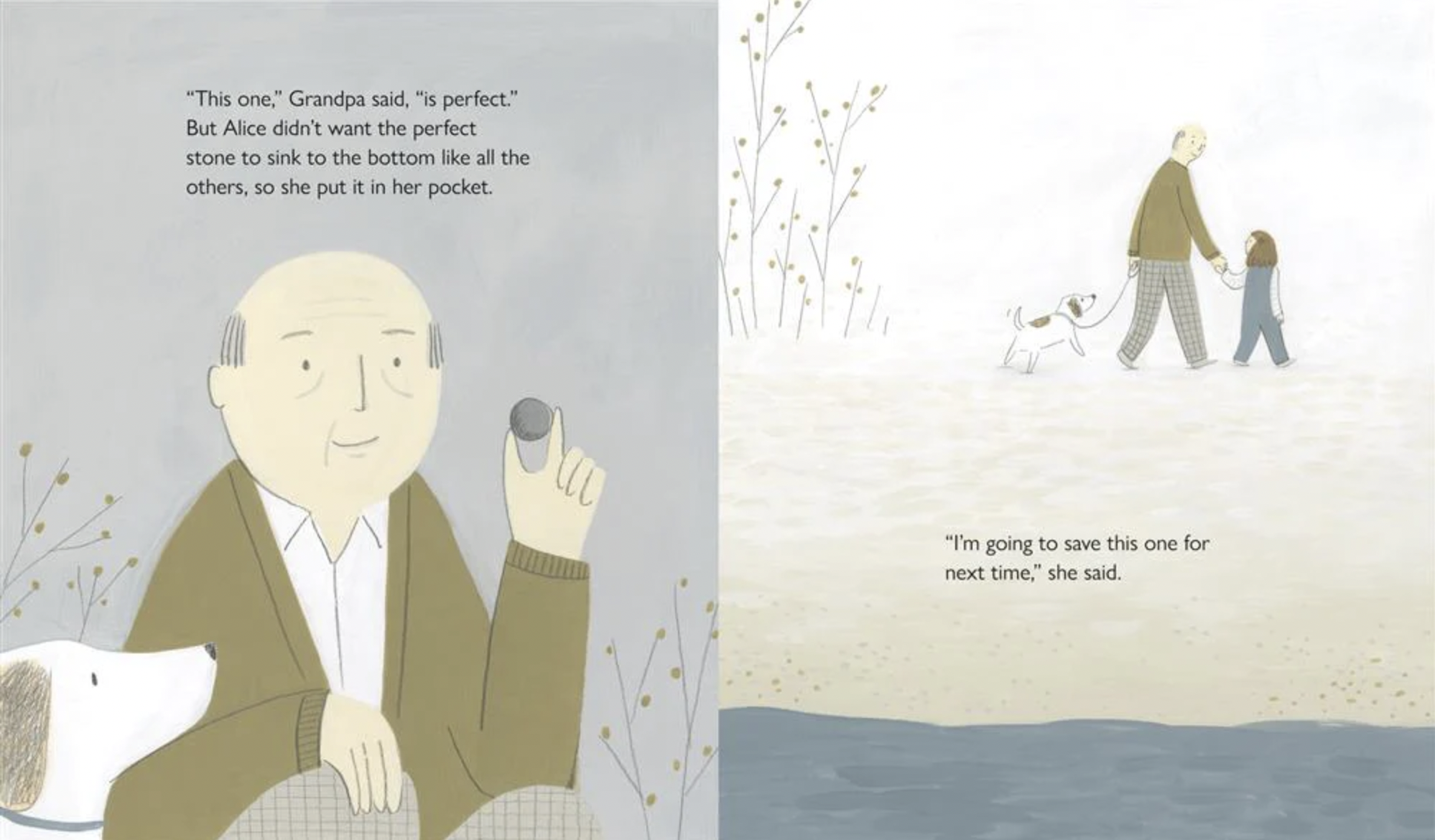
Alice has brought a stone for show-and-tell. Of course, her classmates see it as a stone. A rock. A piece of earth. Though she has lots of stories about using it to trick her dad or as a shape for tracing, it's the memory of skipping stones with her grandpa that is most important. Her grandpa knew how to skip stones and pick out the perfect ones. When he'd found this perfect stone, Alice had kept it in her pocket, probably for their next outing but perhaps because she didn't want to give it up to the water.
From The Remembering Stone by Carey Sookocheff
But when her grandpa got sick and passed away, the stone became something more.
From The Remembering Stone by Carey Sookocheff
The response to her show-and-tell stone may not have been what Alice expected but, when she realizes she's lost her stone on the playground, her classmates understand how important it is to her and they all start looking. They find a lot of stones, though not her special stone. Still, her new stones become something more too.
From The Remembering Stone by Carey Sookocheff
Carey Sookocheff's story is as deceptively simple as her illustrations. It may appear only to be about a girl and a stone which connects her to her grandfather. But Carey Sookocheff uses that stone as a bridge beyond that intergenerational relationship and allows Alice to see that it is both something special and something ordinary. The stone's value is what she places on it. It can remind her of her grandpa or help make new connections with her classmates or it can be just a skipping stone. Regardless of what the stone or stones have been or become, they have meaning, even when they're gone. 

The Remembering Stone truly becomes Carey Sookocheff's story because she illustrates it. Using acrylic gouache and graphite, she embeds the story in reality. Her art is clean and smooth and gives a calmness to being with others. It's the reality of going to school, participating in show-and-tell, spending time with a grandparent, and losing a grandparent. It's all about what a child might experience so it will speak to many children. But, while the story connects with young readers, it will also give them an opportunity to see that there are opportunities beyond the obvious. A skipping stone becomes a memory first but then it transforms both in its presence and in its absence. It's a remembering stone even when it's not.

February 21, 2023

A Blanket of Butterflies: The Spirit of Denendeh, Volume 1

Written by Richard Van Camp
Illustrated by Scott B. Henderson
Colours by Donovan Yaciuk
HighWater Press
978-1-77492-040-4
56 pp.
Ages 12 +
2022 
 
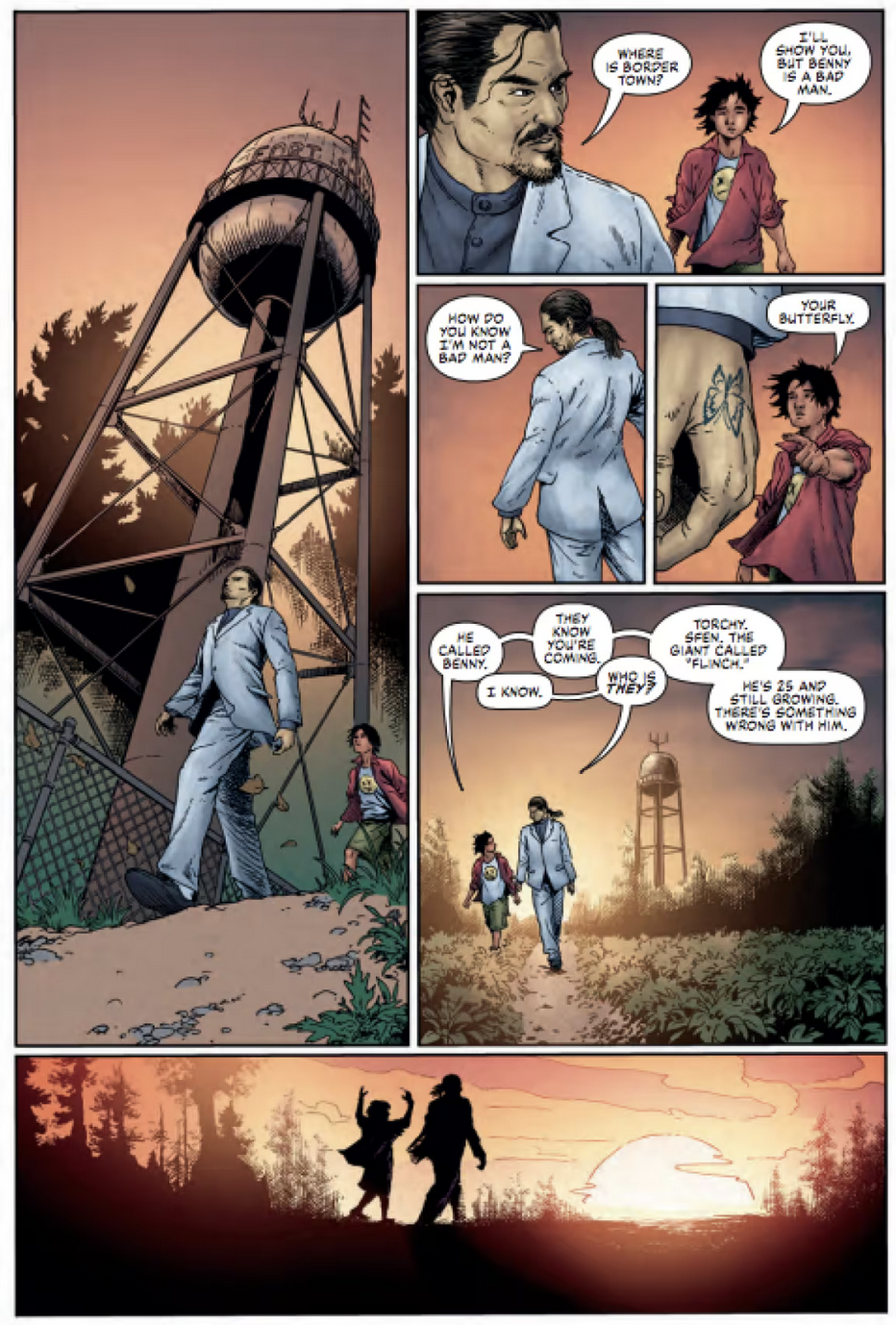
When Shinobu arrives in the Northwest Territories to reclaim his family's samurai armour housed at the Fort Smith museum, he learns that the sword has gone AWOL after Benny, the last museum manager, gambled it away. Sonny, a Tłı̨chǫ Dene boy who was at the museum, offers to take Shinobu to Benny's residence, though Sonny warns that the man will undoubtedly be supported by a trio of thugs named Torchy, Sfen and Flinch. 
From A Blanket of Butterflies by Richard Van Camp, illus. by Scott B. Henderson, coloured by Donovan Yaciuk
Not surprising Shinobu is attacked and, though he valiantly defends himself, he is left almost dead. Sonny and some friends take the man to Sonny's grandmother's house. Though Shinobu's extensive tattoos  frighten Sonny's Ehtsi, she tends to his wounds. With Sonny's support for "the butterfly man"–because of his butterfly tats–and a visitation from the spirit of Sonny's sister, Sonny's grandmother wants to know more. Shinobu tells her he is from Nagasaki, Japan and she realizes the connection their people have with the Japanese linked to the atomic bombing of 1945. She relates this in terms of a powerful bird being fed black eggs and "a fire so bright it left only their shadows on what was left of their homes" (pg. 24).
From A Blanket of Butterflies by Richard Van Camp, illus. by Scott B. Henderson, coloured by Donovan Yaciuk
Shinobu tells them the story of the creation of the sword by his 2 times great grandfather and his need to reclaim it before the August full moon. Because that full moon was that very night, the three head out together to Benny's. Again they are set upon but Sonny's grandmother is a formidable woman whose words stop the thugs. And with words and memories, as well as a blanket for Benny, Sonny's Ehtsi finds a connection between the men and the opportunity for benevolence.
From A Blanket of Butterflies by Richard Van Camp, illus. by Scott B. Henderson, coloured by Donovan Yaciuk
Originally published in 2015, A Blanket of Butterflies has been reissued with full colour, additional background information and cultural context. Still the story is fresh as an intersection of two cultures, one Indigenous and the other Japanese, and how they connect both on a historical and a more personal level. Richard Van Camp, Tłı̨chǫ Dene from Fort Smith NWT, has borrowed from his youth a story of an unlikely suit of samurai armour but he has developed it into a far greater story by asking a series of What If? questions. Sadly, how that suit was lost from a Japanese family is undoubtedly tied to the theft and seizure of the possessions of those interned. Still, Richard Van Camp doesn't emphasize that part of the story but rather the connections that both the Indigenous and Japanese communities have experienced through a history of loss and the substance of family. 

There is a darkness to this story because of that history and that loss. And that darkness comes through in Scott B. Henderson's illustrations, expertly coloured by Donovan Yaciuk. The artwork plays up the conflict that converts remarkably to connection both in its action, expression and colour.

The Spirit of Denendeh tells stories of the People of that land and A Blanket of Butterflies gives us glimpses into the natural and supernatural elements of those lives. I suspect that when Volume 2,  As I Enfold You in Petals, releases in April of this year, there will be another story from Denendeh, the Land of the People, again rooted in reality and upholding a legacy of kinship.

August 22, 2019

Ping

Written and illustrated by Ani Castillo
Little, Brown Books for Young Readers
978-0-316-42464-6
48 pp.
Ages 4-8
September, 2019 

Ping is both subtly complex and powerfully simple in its message about communication and connecting with others. It says loads about how to do it, when to do it, and the need to accept how others return that communication. Like the game of ping-pong–the premise upon which the story is based–there is a give and take between communicants that must be respected to ensure successful connections are made.
My friend,
in this life...

...we can only PING.

The PONG belongs to the other.
From Ping by Ani Castillo
Ani Castillo highlights the multitude of ways you can Ping (note that the verb "Ping" is always capitalized). It can include using your voice or painting or using a computer. It can be with small or large gestures, and you can Ping to one or many. But it's the approaches to Pinging that are most impressive. With many adverbs, Ani Castillo recommends Pinging freely, generously, wisely, kindly, persistently, hopefully, and mindfully. However, even with those intentions, you must still wait for the Pong and accept it as given. It may come as expected or not but it will be the basis for new connections regardless.
From Ping by Ani Castillo
Best known for her cartooning, Ani Castillo's illustrations of amorphous characters in Ping will be relatable to all children. They're cute but unrecognizable and could be any person reading this book. But, with Ping, her debut picture book, Ani Castillo has found a voice that communicates with heart as well as art. She helps us see the importance of self-expression but always with thoughtful intent and consideration for the recipients of that expression. In a world of social media and the constant airing of opinions, we need to follow the sage advice that Pinging requires wisdom and responsibility. Regardless of the reciprocating Pong, we must Ping with humanity.  Shouldn't this always be the way with communication?
From Ping by Ani Castillo
Ping is about thoughtful discussion and that is exactly what it will inspire: conversations about how we communicate and how we should. It is learning and teaching in one, all with tenderness and understanding for our need to connect with others and how to do it effectively and with compassion.

October 05, 2016

Friend or Foe?

by John Sobol
Illustrated by Dasha Tolstikova
Groundwood Books
978-1-55498-407-7
32 pp.
Ages 4-7
October 2016

The beginning of Ottawa author John Sobol’s debut picture book Friend or Foe? is only missing the “Once upon a time…” because the sentiment is definitely that of a traditional tale, here based on a lonely, dark mouse who lives in a small house beside a great palace in which a white cat lives.

The two creatures have their evening routine, with the mouse creeping out onto the roof of the house, and the cat peering down from the palace’s tower window, each staring at the other. When the mouse notices a tiny hole in the palace’s exterior wall, he decides to slip into the palace, hopeful that he might find a friend in that cat with whom he feels a connection.  As he makes his way through the palace, he continues to wonder whether the cat really is a friend or perhaps a foe.
As the mouse climbed the stairs to the palace tower, he began to grow afraid.
What if he was wrong? If he was, the cat would tear him to pieces.  Still he kept climbing.
Was the cat friend or foe?
He had to know.
(pg. 11)
But as he approaches the feline from behind, asking her aloud whether she is a friend or foe, the feline is startled and tumbles off the palace tower.  John Sobol ends Friend or Foe? with a twist, both in the animals’ reversal of fortunes and in the answer to the titular question that is probably reflective of many relationships though nebulous in its honesty.

From Friend or Foe? 
by John Sobol, illus. by Dasha Tolstikova

John Sobol's story is aptly illustrated by American Dasha Tolstikova’s austere artwork which emphasizes the disparity in the characters’ sizes and situations, powerfully using hues and tints of greys with only dashes of brightness in a red brick wall or orange light bulb.  Though there is little colour in Friend or Foe?, supporting the idea that there really is a subtle differentiation between the two situations of the title, Dasha Tolstikova uses colour cleverly both to reflect that contrast and suggest their similarity. Friend or Foe? is a very artful examination of connection in which only differences and likenesses are normally perceived.
From Friend or Foe? 
by John Sobol, illus. by Dasha Tolstikova

^^^^^^^^^^^^^^^^^^^^^^^^^^^^^^^^^^^^^^^


A very special launch event is in the works for John Sobol’s Friend or Foe? 


Be part of Small Print Toronto’s Cat & Mouse City 
with author John Sobol 

for young readers 
(ages 2-8, who must be accompanied by an adult) 

on Saturday, October 22, 2016 

from 11 a.m. – 1 p.m. 

at 

Lillian H. Smith Library 
(Toronto Public Library) 
239 College Street 
Toronto, ON 

The event is free but participants must sign up early as space is limited so register at https://www.eventbrite.ca/e/cat-mouse-city-with-john-sobol-tickets-27655152305

Small Print Toronto’s invitation describes the event as follows: 
Our popular model city-building workshop, Mouse City, is about to face its its biggest urban planning challenge yet: the arrival of cats! Urban planners aged 2-8 can decide how Mouse City will accommodate its new, feline citizens. 
Ottawa author John Sobol will unveil his new book, Friend Or Foe?, and help young planners find the best place for their cardboard buildings on a large city grid.