Showing posts with label Natasha Donovan. Show all posts

March 22, 2026

The Cedar Mother (Mothers of Xsan)

Written by Hetxw'ms Gyetxw (Brett D. Huson)
Illustrated by Natasha Donovan
HighWater Press
978-1-77492-158-6
32 pp.
Ages 9–12
February 2026
 
Eight years ago, Hetxw'ms Gyetxw, who is also known as Brett D. Huson, started his Mothers of Xsan graphic novel series to share his knowledge of the stories of the Gitxsan Nation of the Northwest Interior of BC. This series, now of eight books, has covered insects, fish, birds, amphibians, and mammals, and now I'm delighted to share his book about the cedar tree. Not only does The Cedar Mother speak to the life cycle of a cedar tree and its connection with other living things, but Hetxw'ms Gyetxw also shares his knowledge of the Gitxsan Nation and their Moons.
From The Cedar Mother, written by Hetxw'ms Gyetxw, illustrated by Natasha Donovan
This story of the western red cedar begins in April and the Spring Salmon's Returning Home Moon (Lasa ya'a). This tree, which has been around for over 300 years, now sits by a road that was "only a trail used by the Gitxsan, who had never seen a car, wagon, or horse." (pg. 2) Its growth from a tiny seed is helped by nutrients, rain, and sun. (Words that might be new to young readers, including nutrients, foliage, photosynthesis, and reverence, are defined in info boxes throughout the book.) 
 
But Hetxw'ms Gyetxw also explains how Nox Sim Gan (the cedar mother) is connected to other organisms in the ecosystem. She provides shelter and feeds animals with foliage and oxygen. She gives materials to the Gitxsan for clothing, for home-building, for medicines and, at the end of her life cycle, she will become a story pole. Because of her persistence and vitality, "she is a beacon of hope and a symbol of the enduring strength of the natural world. (pg. 15)
From The Cedar Mother, written by Hetxw'ms Gyetxw, illustrated by Natasha Donovan
Hetxw'ms Gyetxw writes with reverence for Nox Sim Gan in The Cedar Mother and for the role she plays in the environment and for the Gitxsan Nation. From birth through death, she provides. And, because of this, Hetxw'ms Gyetxw gently reminds us that attention must be paid, and our stewardship is required so that she may continue to share herself with the earth and its living things. Not a boring life cycle story, The Cedar Mother tells us how a western red cedar is a part of something far greater. It is part of a community.
From The Cedar Mother, written by Hetxw'ms Gyetxw, illustrated by Natasha Donovan
Natasha Donovan, who illustrated the earlier books in Mothers of Xsan series and Tasha Spillett's Surviving the City series, takes readers into the forests where Nox Sim Gan grows and flourishes, giving and sharing. Its majesty is evident from the scale at which she draws it, and the benevolence of its presence is clear in all illustrations as it interacts with other species. Natasha Donovan keeps the focus on Nox Sim Gan always, whether at the base of its trunk or buried in its foliage, preserving the natural elements in earthy colours of browns and greens. With Natasha Donovan's illustrations and Hetxw'ms Gyetxw's occasional contributions of formline art (see the spirit pole above), as well as his text, The Cedar Mother is a respectful acknowledgement of the connection between the natural world and the Gitxsan, and the reverence necessary to appreciate and to sustain its place.

 • • • • • • •
 
Mothers of Xsan series
The Sockeye Mother
(2018)
The Grizzly Mother (2019)
The Eagle Mother (2020)
The Frog Mother (2021)
The Raven Mother (2022)

August 23, 2024

We Are the Medicine (Surviving the City, Vol. 3)


Written by Tasha Spillett
Illustrated by Natasha Donovan
Coloured and lettered by Scott B. Henderson
HighWater Press
978-1-77492-110-4
64 pp.
Ages 12–18
August 2024
 
The Indigenous teens that Tasha Spillett introduced in the first two books in her Surviving the City series, illustrated by Natasha Donovan, are set to graduate from high school and they're thinking about their futures. But how can they look forward when the remains of 215 children are revealed at a former residential school in BC? What future is there when the injustices of the past continue to be disclosed, and discrimination and wrongs persist in new forms?
From We Are the Medicine, written by Tasha Spillett, illustrated by Natasha Donovan, coloured and lettered by Scott B. Henderson
Now that Dez has accepted themself as a Two-Spirit person and is in a relationship with Kacey, and Miikwan is dating Riel, the teens are enjoying stronger connections with others and in their community. But when the unearthing of hundreds of unmarked graves of children at a former residential school makes the news, the impact on the teens, particularly Riel, is palpable. Speaking in their school's sharing circle with Elder Geraldine, they express their fears, dismay, hurts, and anger. Miikwan wants to help Riel as he lashes out, but Elder Geraldine recognizes the "We have a right to feel angry. We just have to find something to do with that energy so it doesn't harm us or anyone else." (p. 10)
From We Are the Medicine, written by Tasha Spillett, illustrated by Natasha Donovan, coloured and lettered by Scott B. Henderson
With Riel trying to find a way to turn his anger into something healing, they come up with the idea of a powwow for people to gather safely–it's still a time of masking and social distancing–to honour those whose young lives were taken from them. But when Riel is drawn to a protest nearby and his Afro-Indigenous cousin Ginebig follows him, it's Ginebig who is accosted by the police, as is Riel who comes to his defense. It is there, in jail, that Riel, after dreaming of the spirits of those children from the residential school, realizes that they themselves are the medicine for healing.

From We Are the Medicine, written by Tasha Spillett, illustrated by Natasha Donovan, coloured and lettered by Scott B. Henderson
Tasha Spillett takes on a lot of important social justice issues in We Are the Medicine, including residential schools, truth and reconciliation, police violence, monuments that are reminders of systemic racism, and more. It's a lot. But, just as they are issues that Indigenous people have been forced to experience historically and now, Tasha Spillett blends them authentically for these teens, who come from different places and narratives. Some are reminded of their own losses, like Riel whose brother Wayne was murdered by the police, or Dez whose beloved Granny had endured abuse at a residential school. They are understandably confused and angered and stymied by questions about why things have happened and are still happening, and how to make a difference and heal. The healing, for the past and for now, is imperative for them if they are to have a future for themselves and for others to make for themselves.

It's a new day. Let's do something good with it. (p. 15)
 
Natasha Donovan's illustrations, coloured and lettered by Scott B. Henderson, honour the characters in their diversity. Their experiences, at school, in relationships, with family and in the city, are distinct and reveal how they approach challenges and injustices. They may be different, but none are wrong. Natasha Donovan lets us see these teens in their struggles and their joys, from the harshness of police violence, told in sharp shapes and crushing colours, to the spirits who watch over the kids in muted blues. There's real darkness and sorrow in the news of the graves of residential school children and joy and colour in powwow regalia and in the gardening of medicinal plants. Natasha Donovan's art sets the mood and serves Tasha Spillett's story.

Dez and Miikwan and their friends carry heavy loads of history, family, fears, and abuse. The city has not made it easy for them. But their supports are growing, and they are finding ways to move forward, though never forgetting their pasts or that of their ancestors. Fortunately, they will heal and they will survive because the medicine comes from them.
 • • • • • • •
 
Surviving the City series
From the Roots Up (2020)
We Are the Medicine (2024)


May 15, 2024

The Bee Mother (Mothers of Xsan, Book 7)

Written by Hetxw'ms Gyetxw (Brett D. Huson)
Illustrated by Natasha Donovan
HighWater Press
978-1-774920800
32 pp.
Ages 9-12
May 2024

Hetxw'ms Gyetxw (Brett D. Huson) and Natasha Donovan's latest volume in their illustrated non-fiction series, Mothers of Xsan, takes readers into the insect world for the first time, having previously highlighted mammals, birds, fish, and amphibians. Though the bee may be the smallest of the species showcased, it is no less significant.
From The Bee Mother, written by Hetxw'ms Gyetxw, illus. by Natasha Donovan
The story begins with the recession of winter and the awakening of the bee mother, Nox Ap. The bee mother first looks to make a new home in a burrow or hollow tree. Also making new homes for themselves are the yellow jacket wasps and introduced honeybees. With new moons, Nox Ap builds a nest and lays her eggs which pupate and emerge as worker bees to collect pollen and nectar to sustain the nest. And once pollination is done, the bumblebee queen, as well as those of the yellow jacket and honeybee, must find an overwintering space.  
 
As with all books in the series, the life cycle of the bee is paramount, but The Bee Mother goes beyond a compendium of natural history facts. It is a story, and it all takes place within the Gitxsan Nation, Indigenous Peoples of the unceded territories of the Northwest Interior of British Columbia. Hetxw'ms Gyetxw ensures that the reader understands that the bee mother's story is not one of isolation. It is a story that includes her connection with the environment and those within it. As such, Hetxw'ms Gyetxw speaks of the contributions of Nox Ap and the other bee relatives, from the provision of honey and the pollination of flowers to help provide fruits and vegetables, to pest control and providing food for other species. They are a part of everything.
From The Bee Mother, written by Hetxw'ms Gyetxw, illus. by Natasha Donovan
Hetxw'ms Gyetxw's text certainly speaks to life, as do Natasha Donovan's illustrations. They are vibrant, most especially in colour and shape. From the oomph of pinks and fullness of line and shape in the book's cover to the warmth of greens and golds in close-up art of the bees in their natural habitats, Natasha Donovan gives us stylized but realistic depictions of flowers and plants, bees and other animals, water and snow. Because the topic is the small bee, Natasha Donovan takes us up close to focus on the bee, creating art akin to macrophotography to ensure details are not missed.
From The Bee Mother, written by Hetxw'ms Gyetxw, illus. by Natasha Donovan
Because of the Indigenous roots of both the author and illustrator–Hetxw'ms Gyetxw is from the Gitxsan Nation and Natasha Donovan is Métis– The Bee Mother goes beyond a rehashing of STEM facts and takes on a new life of storytelling and appreciation for the connection of living things. In fact, because the Gitxsan Nation follows a matrilineal line which suggests that the stories come from the mothers, highlighting the mother of each species in the Mothers of Xsan series is both reasonable and respectful. (Hetxw'ms Gyetxw provides notes about the Gitxsan Nation and the Gitxsan Moons, along with a map of their territories.) And, by making the story specific and still broad, it demonstrates to readers  who the bee mother is and what she does and what happens every year, but also that she is part of something bigger. You can read it as a story of a life cycle but read beyond that and recognize that there is far more to the story that needs to be appreciated.

• • • • • • •
Mothers of Xsan series
The Sockeye Mother (2018)
The Grizzly Mother (2019)
The Eagle Mother (2020)
The Frog Mother (2021)
The Wolf Mother (2021)
The Raven Mother (2022)
The Bee Mother (2024)

October 06, 2021

The Wolf Mother (Mothers of Xsan)


Written by Hetxw'ms Gyetxw (Brett D. Huson)
Illustrated by Natasha Donovan
HighWater Press
978-1-55379-978-8
32 pp.
Ages 9-12
September 2021

The Mothers of Xsan series from Hetxw'ms Gyetxw (Brett D. Huson) and Natasha Donovan are a series of illustrated non-fiction books for middle-grade readers that examine one animal species in depth and with an Indigenous perspective. The Wolf Mother is the fifth volume in the series and focuses on the life of one wolf pup as she grows into a wolf mother and on the communities and ecosystem in which she thrives.
From The Wolf Mother by Hetxw'ms Gyetxw, illus. by Natasha Donovan

Beginning in the Gitxsan Moon of Lasa'Yan'tsa, The Wolf Mother's story opens with a description of the young wolf pups' capabilities and needs, focusing on a small charcoal black female.

The smallest of the pups is a charcoal black female, who has a tiny strip of white fur above her left eye. The black wolf already has a sense of smell 100 times better than any human, and even domesticated dogs cannot compare to her ability. Right now, she only has a nose for mother’s milk. Her ears grow larger every day, her eyesight gets sharper, and her legs stretch farther, and she is beginning to desire to explore beyond their cozy den among the pines.

From The Wolf Mother by Hetxw'ms Gyetxw, illus. by Natasha Donovan
With each new lunar cycle (the list of Gitxsan Moons is appended to the story), the grey wolves develop new skills, hunting prey like gax, the rabbit, and venturing further and further into their habitat.
From The Wolf Mother by Hetxw'ms Gyetxw, illus. by Natasha Donovan
After two years, the small black pup is now ready to become Nox Gibuu, the Wolf Mother. She sets out alone, eventually welcomed by another pack and bonding with a young male, ready to grow her own family.
From The Wolf Mother by Hetxw'ms Gyetxw, illus. by Natasha Donovan
As she grows that family, the Wolf Mother along with her pack become a community of caregivers, each with a role to play with respect to the young and their environment, keeping all in balance and thriving.

From The Wolf Mother by Hetxw'ms Gyetxw, illus. by Natasha Donovan
Though the text of The Wolf Mother reads as a story, rather than organized as much children's non-fiction, the wealth of its information about the grey wolf's biology and behaviour cannot be disputed. By telling it as a natural history story, Hetxw'ms Gyetxw invites us to witness the wonders of these animals and their communities and place in the world. There are still several non-fiction features, like the purple-boxed footnotes to identify new words like "natal" and "domesticated" and a map of the Gitxsan Nation of their unceded territories of the Northwest Interior of British Columbia, but that information sweetens the story rather than impedes it. There is no distraction from the Wolf Mother's story from pup to mother and leader.

Natasha Donovan's artwork continues that gentle storytelling, giving us the real depictions of the animals and the land, appropriate for a non-fiction book, but also embedding elements of West Coast art. From a stylized moon or a wolf, Natasha Donovan reminds young readers of the First Nations' framework for the story, brightening that realism with a sense of connection between the grey wolves and the land and its people.

The Mothers of Xsan series is a popular one for children, especially for those who love non-fiction and are too often told they're not reading if they're not reading fiction. With this series, they are reading, they're learning about an animal and its place in a bigger world and they're gaining an appreciation for the richness of a First Nation in terms of its community and customs. As the newest addition to that series, The Wolf Mother echoes that storytelling, taking the book beyond information book, and treating readers to textual and graphic art that is dramatic both in its content and heart.

The Sockeye Mother (2018)
The Grizzly Mother (2019)
The Eagle Mother (2020)
The Frog Mother (2021)
The Wolf Mother (2021)

February 20, 2019

Surviving the City

Written by Tasha Spillett
Illustrated by Natasha Donovan
HighWater Press
978-1-55379-756-2
56 pp.
Ages 13+
November 2018

Though of different Indigenous heritage, Dez, who is Inninew, and Miikwan, who is Anishinaabe, are more like sisters than best friends. They completed a year-long Berry Fast together and have been important supports as Dez worries about the health of her kokum with whom she lives and Miikwan struggles with the loss of her missing mother.
From Surviving the City by Tasha Spillett, illus. by Natasha Donovan
Walking everywhere in the city, the two girls are seen among blue spirits of Indigenous women watching over them while scary black shadows partner with some men to encroach on their spaces and safety.  When Dez sees her grandmother with the social worker at their house, she is fearful of being sent to a group home. So Dez walks away, her phone battery draining, and ends up sleeping on a park bench, watched over by the spirits of murdered Indigenous women but vulnerable to the predators of white men shadowed by monsters.
From Surviving the City by Tasha Spillett, illus. by Natasha Donovan
When Miikwan does not hear from Dez for several days, she is scared that her best friend may be lost as her own mother was. After talking to the elder of the school's culture room, Miikwan agrees to participate in a march to recognize missing women, girls and two-spirit persons.

Fortunately, while Miikwan helps support her community in a march that attends to those who have been lost, Dez is helped by another Indigenous woman to the Ka Ni Kanichihk Indigenous centre and the two are ultimately reunited.
From Surviving the City by Tasha Spillett, illus. by Natasha Donovan
With extensive notes, including statistics and references, about murdered and missing Indigenous women, girls and two-spirit people, Tasha Spillett takes Dez and Miikwan's story from very personal to big picture. But don't be deceived that this story is anything less than personal.  It may reassure that the spirits of those missing and murdered are always there to guide and protect, and that there are those on this earth who want to help but the ubiquity of glowing blue spirits and shadowy monsters suggests that the stories of those missing and murdered and the families left behind are still too common. Sitting on a park bench should not be an invitation for assault. Being followed and in fear for your safety because of your heritage should not have become the norm for girls like Miikwan and Dez. But sadly Tasha Spillett reveals the very real worries of Indigenous women, girls and two-spirit persons go beyond the everyday concerns and expand into those about personal safety and loss of home and family.
From Surviving the City by Tasha Spillett, illus. by Natasha Donovan
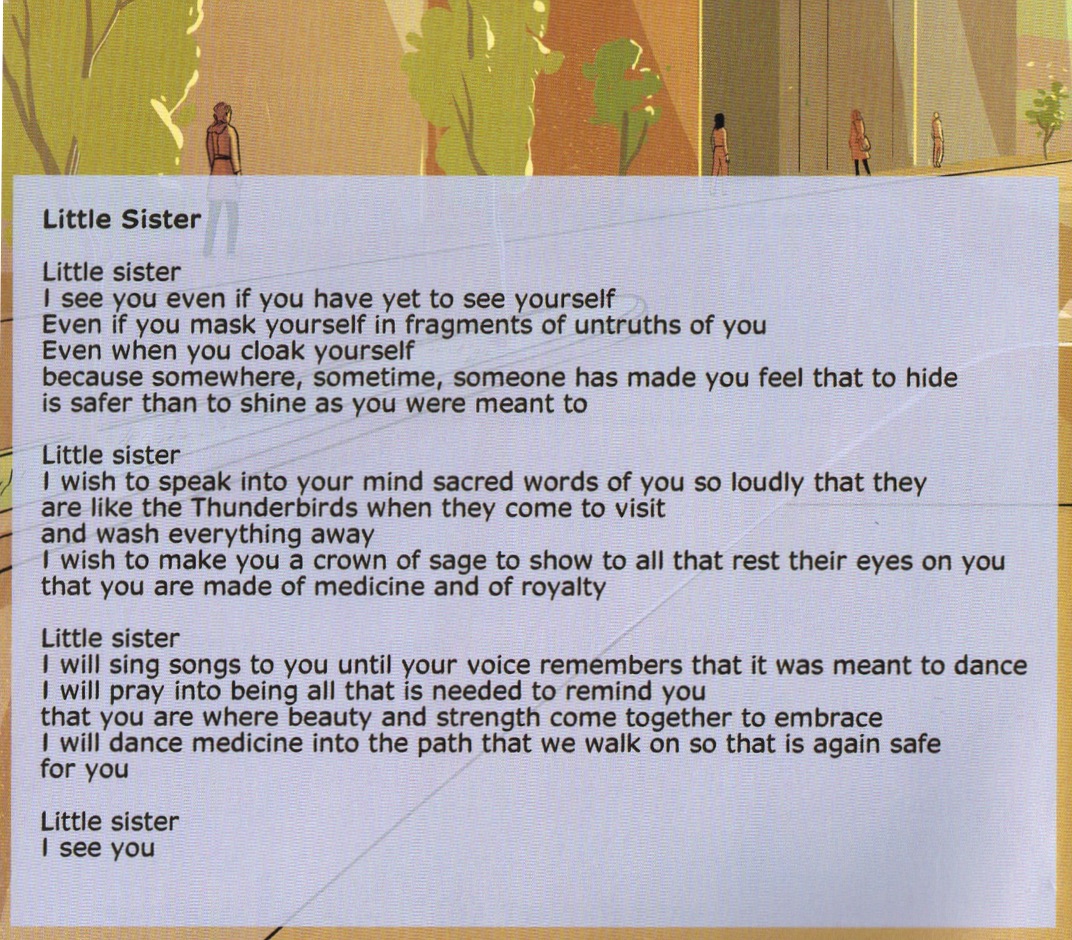
Author Tasha Spillett is of Nehiyaw and Trinidadian ancestry and dubs herself as a PhD student by day and a poet by night. Relevantly she begins Surviving the City with a poem titled "Little Sister" which, with poignant words, notes the starkness and vulnerability of being a young Indigenous woman but offers support, hope, and recognition.

Métis artist Natasha Donovan likewise focuses on the teen realities of Dez and Miikwan, from school to home and in between but overlays it with the supernatural blanket of spirits. The starkness of the city is conspicuous, with colour and brightness only evident when the teens honour their cultures and people and each other.

Surviving the City is not a happy-ending story of everything working out. It's a story about reality for far too many Indigenous women, girls and two-spirit persons who are negatively targeted rather than honoured for being just as they are. But, with Tasha Spillett and Natasha Donovan telling the story of Dez and Miikwan, reality is brought to the light and little sisters are seen.