Showing posts with label missing women. Show all posts

February 20, 2019

Surviving the City

Written by Tasha Spillett
Illustrated by Natasha Donovan
HighWater Press
978-1-55379-756-2
56 pp.
Ages 13+
November 2018

Though of different Indigenous heritage, Dez, who is Inninew, and Miikwan, who is Anishinaabe, are more like sisters than best friends. They completed a year-long Berry Fast together and have been important supports as Dez worries about the health of her kokum with whom she lives and Miikwan struggles with the loss of her missing mother.
From Surviving the City by Tasha Spillett, illus. by Natasha Donovan
Walking everywhere in the city, the two girls are seen among blue spirits of Indigenous women watching over them while scary black shadows partner with some men to encroach on their spaces and safety.  When Dez sees her grandmother with the social worker at their house, she is fearful of being sent to a group home. So Dez walks away, her phone battery draining, and ends up sleeping on a park bench, watched over by the spirits of murdered Indigenous women but vulnerable to the predators of white men shadowed by monsters.
From Surviving the City by Tasha Spillett, illus. by Natasha Donovan
When Miikwan does not hear from Dez for several days, she is scared that her best friend may be lost as her own mother was. After talking to the elder of the school's culture room, Miikwan agrees to participate in a march to recognize missing women, girls and two-spirit persons.

Fortunately, while Miikwan helps support her community in a march that attends to those who have been lost, Dez is helped by another Indigenous woman to the Ka Ni Kanichihk Indigenous centre and the two are ultimately reunited.
From Surviving the City by Tasha Spillett, illus. by Natasha Donovan
With extensive notes, including statistics and references, about murdered and missing Indigenous women, girls and two-spirit people, Tasha Spillett takes Dez and Miikwan's story from very personal to big picture. But don't be deceived that this story is anything less than personal.  It may reassure that the spirits of those missing and murdered are always there to guide and protect, and that there are those on this earth who want to help but the ubiquity of glowing blue spirits and shadowy monsters suggests that the stories of those missing and murdered and the families left behind are still too common. Sitting on a park bench should not be an invitation for assault. Being followed and in fear for your safety because of your heritage should not have become the norm for girls like Miikwan and Dez. But sadly Tasha Spillett reveals the very real worries of Indigenous women, girls and two-spirit persons go beyond the everyday concerns and expand into those about personal safety and loss of home and family.
From Surviving the City by Tasha Spillett, illus. by Natasha Donovan
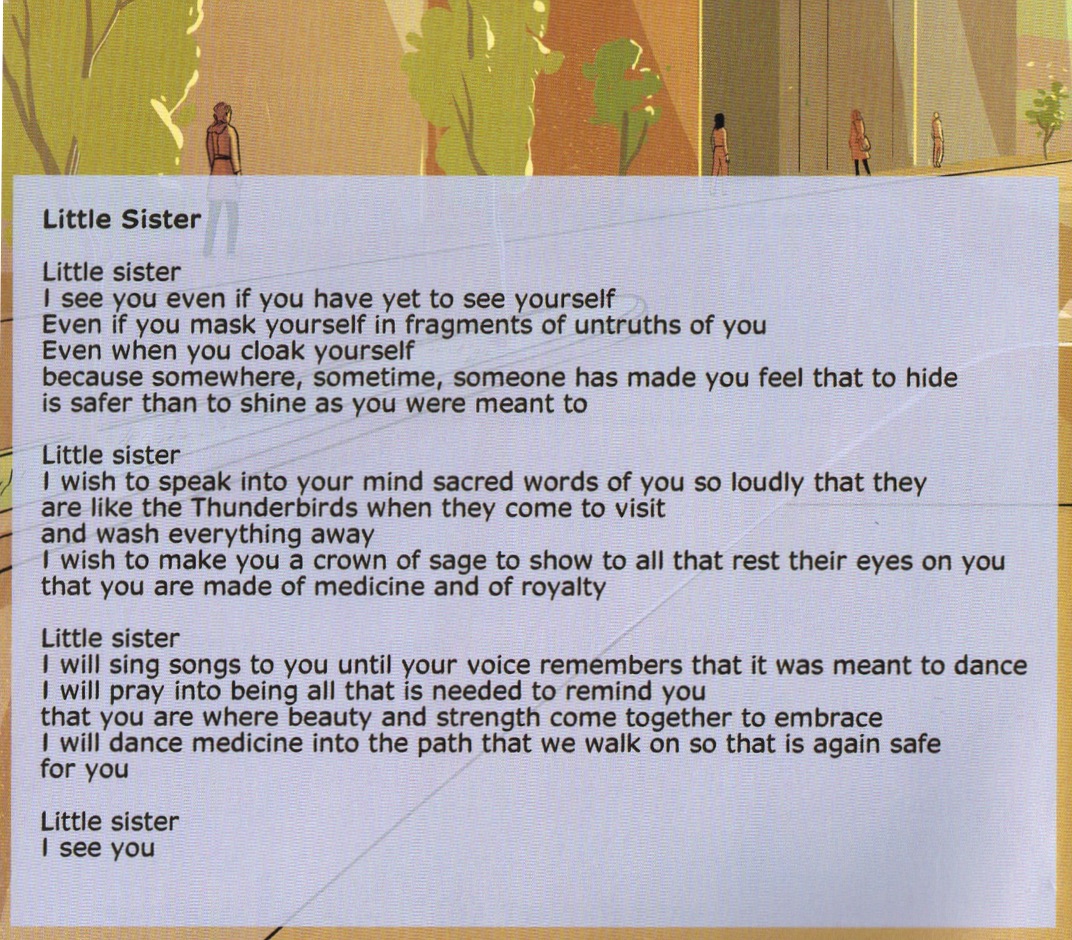
Author Tasha Spillett is of Nehiyaw and Trinidadian ancestry and dubs herself as a PhD student by day and a poet by night. Relevantly she begins Surviving the City with a poem titled "Little Sister" which, with poignant words, notes the starkness and vulnerability of being a young Indigenous woman but offers support, hope, and recognition.

Métis artist Natasha Donovan likewise focuses on the teen realities of Dez and Miikwan, from school to home and in between but overlays it with the supernatural blanket of spirits. The starkness of the city is conspicuous, with colour and brightness only evident when the teens honour their cultures and people and each other.

Surviving the City is not a happy-ending story of everything working out. It's a story about reality for far too many Indigenous women, girls and two-spirit persons who are negatively targeted rather than honoured for being just as they are. But, with Tasha Spillett and Natasha Donovan telling the story of Dez and Miikwan, reality is brought to the light and little sisters are seen.

November 02, 2015

Missing Nimâmâ

Written by Melanie Florence
Illustrated by François Thisdale
Clockwise Press
978-0-9939351-0-7
32 pp.
Ages 8+
October, 2015

Missing Nimâmâ is a stunning accomplishment in story telling, though a story that shouldn’t have to be told because no mother should go missing and be lost to a little girl who would grow up without her.  Reading Missing Nimâmâ (nimâmâ is Cree for my mother) is like exposing an wound and it hurts.

Missing Nimâmâ is told in two voices,  distinguished both on the page and with the font.  The first voice is that of Kateri, a young girl, who lives with her nôhkum (grandmother) and dreams and longs for nimâmâ who is one of the lost Indigenous women whose disappearances have been shamefully ignored.  The second voice, in italicized text, is an ethereal one, that of Kateri’s mother, who calls her daughter kamâmakos, her beautiful little butterfly, and who watches over her as she goes to school, is loved by her nôhkum, grows into a young woman, marries and becomes a mother herself.  With every milestone, Kateri wishes for her mother to be with her, occasionally sensing her spiritual presence, while her mother appreciates all that her daughter has become, reassurring her that,

I’m here, kâmamakos.
I’ve never left you. 
When you feel me with you, I’m there. 
You’re never alone.
Your mother is still watching over you.
(pg. 17)

But like far too many of the Missing and Murdered Aboriginal Women, Kateri’s nimâmâ is only a spiritual presence in her daughter’s life and it will be years before Kateri will get the phone call telling her of her mother’s fate.  It is not a happy ending, and there are no happy endings for these women or their families.  But Melanie Florence still allows for Kateri and vicariously for her mother to find some happiness.

Missing Nimâmâ is heartbreaking.  It’s soulful and breathtakingly painful, and all the more so because of Melanie Florence’s free verse text. Never have I read free verse so aptly applied in a picture book.  Melanie Florence, an Indigenous writer, has demonstrated a powerful skill at creating rhythmic emotions with words.  The tugs at the heart are aching for the story they tell and the artistry with which François Thisdale tells it.

The matching of François Thisdale’s art with Melanie Florence’s text is wondrous.  As poignantly as he used mixed media (digital and drawn images) in earlier texts (The Stamp Collector by Jennifer Lanthier, Fitzhenry & Whiteside, 2012; That Squeak by Carolyn Beck, Fitzhenry & Whiteside, 2015), François Thisdale fluidly bridges the concrete world of a little girl and her nôhkum with the ethereal one of her mother.  His choice of colours and the ability to enrich stark outdoor scenes of yards and forests and simply furnished indoor rooms create ghostly landscapes that epitomize the shadows of a girl's longing for her mother, a mother lost but never, never forgotten.


Missing Nimâmâ is a haunting story of lives lost and lived and shared, beautifully rendered in words and art.  Expect to see this one on award lists in the near future.

September 02, 2014

Rabbit Ears

by Maggie De Vries
HarperCollins Canada
978-1-44341-662-7
222 pp.
Ages 13+
March, 2014
 
Don't be deceived by the innocuous, seemingly innocent, title. Rabbit Ears is neither.  It is a tough story, and it's based on a true story which is devastating. 

Kaya is only 13 but life has not been kind to her, though almost no one knows what she has and continues to endure.  Her sister Beth, 16, watches out for her as best she can but she doesn't understand what motivates Kaya, and their mom continues to want to save Kaya from herself, sending the police out for her, excusing her adopted daughter's attitude, and giving her opportunities to recover from her troubled times.  It's an endless cycle of running away to unsafe situations, returning home, trying to stick with the "normal" life, and then abandoning it yet again.

Told in the alternating voices of Kaya and Beth, Rabbit Ears takes readers into the unseemly and dangerous dark side of Vancouver's Downtown Eastside, to which Kaya is introduced by another student, Michelle, who rescues Kaya from a beating at school.  Though she enjoys the freedom of hanging with street kids, taking pot and avoiding school, Kaya tries to do the right thing, knowing that her sister and mother have her best interests at heart.  But, with school feeling more and more impossible, especially after a girl, Diana, whom Kaya obviously knows, starts going to her high school, and home not feeling like the right place for her to be, Kaya goes downtown with Michelle again. This time, though, Michelle trades sex for heroin and Kaya meets a sex trade worker, Sarah, who tells her to go home.  But Kaya returns and begins her own descent into heroin use and prostitution.

Though Kaya is gone for weeks, and her mom and sister continue to search for her, there is a trip to Kamloops which rekindles Beth's fascination with magic and reminiscences of her dad's passing. It's those memories that help Beth put together the fragments of Kaya's life that may explain her sister's thinking and feelings.

Just like the toy rabbit in Beth's box-to-box trick–in which it is made to appear in a different box from the one in which it originated–there is much that is mysterious about Kaya's disappearances and reappearances.  Her thinking is unpredictable, based on circumstances unknown to her family, even to herself.  She knows that home is the better place to be, but it continues to feel wrong to her.  No child should ever feel that, especially when the option is to find consolation on the streets at age 13.  Like those rabbit ears, barely poking out of the box, Kaya tries to stay put and on her mom and Beth's radars, but sometimes going elsewhere is her only choice.

As I plainly announced in the introduction, Rabbit Ears is a tough read.  There are drugs, violent sex, rape, swearing, assault, and painful emotional trauma. Maggie De Vries does not minimize the horror, though she does create a less horrific ending than the one that her sister sadly experienced. Kaya's very existence is so vulnerable, so fragile; it's able to splinter with a single word.
"Diane has shattered a very, very fragile thing.  And no claws, needles, or paid-for sex acts are going to piece it back together." (pg. 168)
But never deny the fragility of the whole family, finding ways to deal with that shattering, with food, magic, work, therapy, anger.  This is Kaya's story but Beth and their mom are taken along, nay, join her in it, as the significant supporting cast that they are.  Rabbit Ears is the gnawing heartache that no child or family should ever endure, but Maggie De Vries tells it as it needs to be told and she tells it very well.