Showing posts with label risk-taking. Show all posts

May 13, 2026

Worm on the Job

Book cover of Worm on the Job , written by Maureen Fergus, illustrated by Paul G. Hammond shows a worm with a cap
Written by Maureen Fergus
Illustrated by Paul G. Hammond
Kids Can Press
978-1-5253-1316-5
36 pp.
Ages 3–7
May 2026
 
If there's one lesson to learn from Worm, it's that anything is possible if you can see your strengths for what they are and apply them to each situation. Not surprising that Worm is the guy for every job because he believes in himself. 
A head librarian worm sorts library books
From Worm on the Job, written by Maureen Fergus, illustrated by Paul G. Hammond
After being the head librarian for many years, Worm decides it's time for a new job. And he's willing to try anything. Even when the job may be hazardous to Worm, like life-guarding in the hot sun or deep-sea fishing among sharks, Worm gives it a try. But when he sees a sign advertising for a "courageous night security guard to keep dastardly thief from stealing nifty inventions," (pg. 8) Worm thinks he's found just the job for him. And though the manager is reluctant to hire him, Worm easily proves his value with his unique strengths.  
A worm cleans windows while pigeons look on
From Worm on the Job, written by Maureen Fergus, illustrated by Paul G. Hammond
When that dastardly thief shows up just as Worm is checking out all the cool inventions, Worm puts his many strengths of flexibility and sliminess to work to catch the bad guy.

 "And when I believe I can do something . . ."
 "I usually can." (pg. 33-34)
A security worm scooches around a convention center filled with inventions
From Worm on the Job, written by Maureen Fergus, illustrated by Paul G. Hammond
It's not often that a worm can inspire risk-taking and self-confidence, but Maureen Fergus's Worm does just that. He believes he can, so he does. He may have to adjust his choices, but they are still his to make. And because he believes in himself, every choice is a step closer to finding another job that he will challenge himself to take on. He is tenacious, courageous, and positive, and he could be a role-model for any non-worm who may be anxious about trying something new. 
 
Because Maureen Fergus's story of Worm is couched in much humour which illustrator Paul G. Hammond strengthens with his whimsical digital art—do check out the clever details like Worm sorting library books on soil, composting, or crawling, or the striking inventions in the convention center—Worm on the Job is not a preachy tale. It's fun and inspiring and entertaining. And perhaps it will give all readers an opportunity to see their own attributes with fresh eyes.  

January 25, 2025

Life in the Wild: The Collected Adventures of the Bear, the Moose and the Beaver


Written and illustrated by Nicholas Oldland
Kids Can Press
978-1-5253-1292-2
200 pp.
Ages 4-8
September 2024

Nicholas Oldland's Bear, Moose and Beaver have returned and they're in an amazing collection of six previously published books so young readers won't just be introduced to these characters but really get to know them.

The six stories included in this collection are Big Bear Hug, Making the Moose Out of Life, The Busy Beaver, Up the Creek, Walk on the Wild Side, and Hockey in the Wild. Playing up some fun puns, Nicholas Oldland truly takes us into the wild lives of his trio of friends.
From Life in the Wild, written and illustrated by Nicholas Oldland
Big Bear Hug is a story of how a bear loves to give hugs to everyone and everything but most especially trees. But when a man with an axe arrives to chop down one of the most beautiful trees, the bear has other ideas.
From Life in the Wild, written and illustrated by Nicholas Oldland
Making the Moose Out of Life has a moose who starts to wonder if he's missing out on life and decides "to take life by the antlers." (p. 49) Instead, a sailing misadventure leads to new experiences, a new friend, and the catalyst for courage to try new things.
 
A very busy but careless beaver learns the error of his ways when hospitalized after a tree-felling mishap in The Busy Beaver. However, his rehabilitation for his injuries gives him the opportunity to make right his mistakes.
From Life in the Wild, written and illustrated by Nicholas Oldland
Up the Creek's tale focuses on the three friends learning to cooperate on a canoeing trip filled with disasters and bickering. It is only through teamwork that the bear, moose and beaver can survive.
 
The theme of cooperation is revisited in Walk on the Wild Side when a mountain hike becomes a competition that becomes dangerous.
From Life in the Wild, written and illustrated by Nicholas Oldland
Finally, in Hockey in the Wild (reviewed here in 2020), the trio anticipate the start to their hockey season on the ice but patience is necessary to keep themselves safe to enjoy their winter pastime.
 
In all these stories, Nicolas Oldland infuses his characters with honest friendships while they learn lessons in patience, cooperation, teamwork, compassion and more. And he does so by example, not by preaching. Nicholas Oldland ensures that each animal is unique, quirky in their own ways, and yet willing to change when needed to help others and help themselves grow as individuals.
From Life in the Wild, written and illustrated by Nicholas Oldland
Teachers and parents may love the stories for the important lessons Nicholas Oldland imparts but kids will adore them for the silliness of these very realistic stories–who hasn't had a competition with a peer or sibling that ended in disaster?–and Nicholas Oldland's digital art. The simplicity of the shape and lines of his characters and settings make everything easily recognizable but it's the details in the expressiveness of his characters' faces and gestures that will be more relatable and still very cute. Whether chagrined at a capsized canoe or standing in a bathing suit on an ice-covered lake, the bear, moose and beaver emote according to all life's circumstances and tell children that they know how they feel.
 
Nicholas Oldland offers readers a great opportunity to take a comprehensive walk on the wild side with the bear, the moose and the beaver in Life in the Wild because whether it's winter or summer, spring or fall, there's always something happening, including ways to live in the not-so-wild.

February 23, 2024

Dropped! (Orca Anchor)

Written by Alice Kuipers
Orca Book Publishers
978-1-4598-3774-4
96 pp.
Ages 12+
RL 1.9
February 2024
 
When Dex is dumped by his girlfriend Lola and then deserted by his friends and his social media after an embarrassingly pathetic display to get her back, he is desperate to regain his popularity. So, he signs up for a reality show called Dropped! on which he and other contestants are dropped on Adventure Island and have five days to attract the greatest number of followers through their feeds if they are to win $250,000 and a trip to Dubai. As he says goodbye to his mother and boards a chopper, he becomes Determined Dex.
 
After being dropped on the island and being told "Don't risk too much," Dex checks the game's feed to meet the other contestants and view photos and live streams of their progress. There's gorgeous Amina whose efforts and story are racking up more followers than anyone else. There's buff identical twins Salvo and Kai, geeky Deepak, and timid Em. Through an app, they are given tasks to complete, like finding a treasure chest of  supplies or sharing their personal stories with their audience. Soon Dex realizes that by associating himself with Amina or engaging in risky or wild activities, he can pull in those much-needed followers. But will he go too far?

Told in chapters according to the date and time, Dex narrates what he does, what he sees, and what he thinks, sometimes in his head and sometimes live in his feed. With each new endeavour or challenge he wonders how he will be seen. Will it be Dangerous Dex or Daring Dex, or will it be Desperate Dex? At one point, he hopes they see him as Decent Dex. But, when he worries that the audience may see him as Deadly Dex, he has a revelation that takes his game from competition to cooperation. Dex may or may not win Dropped! but he still will get more than what he came for.
 
Orca Anchor is just one of the many series from Orca Book Publisher, with this one aimed at young adults reading below Grade 2.0 level. But don't let that detract you from the great story that Alice Kuipers tells. Dropped! may be a fast read but it's a great read for teens and adults, filled with action and social commentary, and embedded in contemporary situations with which many young people will be familiar. Saskatchewan's Alice Kuipers is an accomplished storyteller of YA (e.g., 40 Things I Want to Tell You and The Death of Us), early chapter books (e.g., Polly Diamond and the Magic Book) and even non-fiction (e.g., Always Smile: Carley Allison's Secrets for Laughing, Loving and Living) so it's not surprising that she can write an extraordinary hi-lo story for teens. By merging social media, how many young people derive validation, support, and identity, with reality shows that put teens in unfamiliar circumstances in which their true selves are exposed, Alice Kuipers has let Dex find himself. He struggles with his identity and what he wants to do or who he wants to be, labelling himself constantly and temporarily, as he reflects on his actions and thoughts. But Alice Kuipers has always been very good at seeing teens from their own perspectives, recognizing their challenges and confusion without judging them. Some might see Dex's obsession with his cell phone and with social media as ill-advised, but Alice Kuipers lets us see Dex as flawed by nature of his being human, looking for approval and solidarity as we all do but from virtual communities until he finds it within a real one. He may have been dropped from one community, but he builds a new one or two, both real and virtual, and by recognizing the value of those worlds, and by letting his good sense and self-awareness finally guide him, he'll find himself dropped into much finer ones.

January 19, 2024

Zander Stays

Written by Maureen Fergus
Illustrated by Scot Ritchie
Pajama Press
978-1-77278-296-7
36 pp.
Ages 4-7
October 2023
 
Zander is a goose, a lovely white goose with bright orange legs and an orange bill. He's like the other geese except for this autumn when Zander decides to stay. While the other geese pack up to fly south for the winter, Zander decides he's going to try something different this year.
From Zander Stays, written by Maureen Fergus, illustrated by Scot Ritchie
After his compadres have left, Zander enjoys new endeavours like jumping in leaf piles, and racing the wind. He may be alone, but he never feels lonely. But then winter arrives. He's advised by a squirrel that he should prepare for winter by collecting and storing nuts. Too bad he doesn't eat nuts. The other animals have their own advice for surviving the winter, but none seem to quite work for Zander. And though he enjoys his first encounter with snow, he soon realizes that he is at a disadvantage, and there is no one to help him.
From Zander Stays, written by Maureen Fergus, illustrated by Scot Ritchie
Miraculously, when Zander is about to give up, a little girl named Grace finds him and shows him what she does to survive the winter. Finally, Zander finds some adaptive techniques that work for him. And won't he have some wonderful stories to tell his friends when they return!
From Zander Stays, written by Maureen Fergus, illustrated by Scot Ritchie
While it might not be recommended that wild geese like the snow goose not migrate as they normally would, Maureen Fergus has actually created a STEM story about migration and adaptation by having Zander stay. (Her "Author's Note" provides worthwhile information for young readers about how different animals adapt and what hibernation and migration mean.) It might be exciting to try something new but not migrating became a dangerous undertaking for Zander and one that he only survived with human help. With warm shelter and food, Zander learned from Grace that winter could be enjoyed but only with respite from the challenging conditions. Moreover, her compassion for Zander saves him, reminding children to be mindful of the needs of animals and their welfare.
From Zander Stays, written by Maureen Fergus, illustrated by Scot Ritchie
Scot Ritchie has illustrated both picture books and non-fiction texts (e.g., Federica; Dinos Driving; Follow That Map!; If You Can Dream It, You Can Do It; On the Line) and as such has demonstrated a deftness of touch for creating sweet and yet realistic artwork. In Zander Stays, Scot Ritchie gives us identifiable red squirrels, bats, a bear, a rabbit, and geese, but placed them in landscapes of lake shores, sunsets, and even a cozy home garnished with a fireplace, scattered winter clothing, artwork, and food. Any child reading this book will know the cool autumns of fallen leaves, the snowy cold winter days, and the warmth of being inside from Scot Ritchie's artwork. By using ink and digital watercolour art to give substance to Maureen Fergus's story, Scot Ritchie keeps it gentle–a story of a goose that might not survive the cold of winter definitely needs a light touch–and engaging, while still reminding us that survival is still an issue for animals in winter.
 
As different parts of Canada experience their own cold spells this winter,  help young children understand the basics of adaptation, about migration, and about animal welfare, while cheering for a silly goose who was fortunate to survive the winter with a little help from a friend.

November 15, 2019

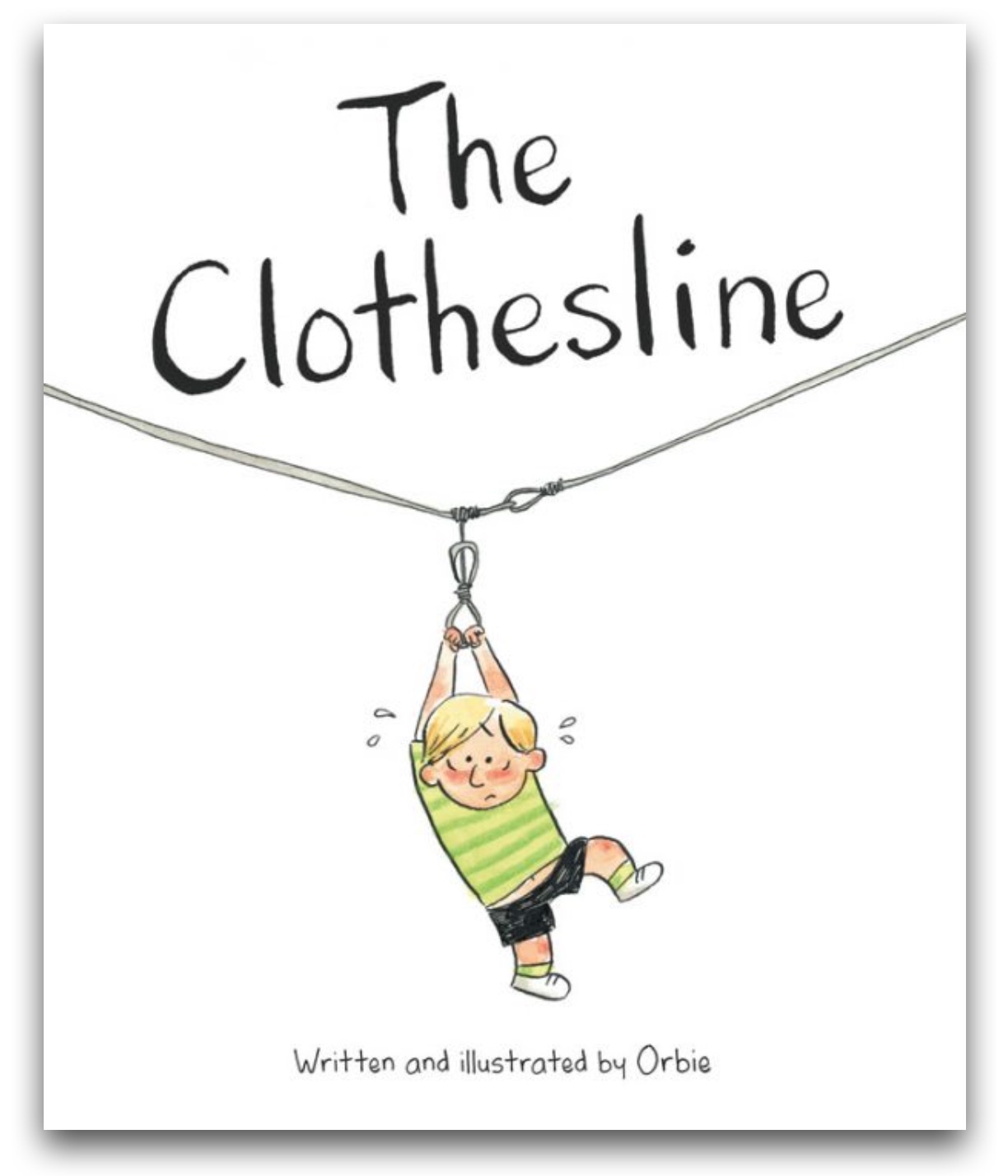
The Clothesline

Written and illustrated by Orbie
Translated by Karen Li
Owlkids Books
978-1-77147-390-3
64 pp.
Ages 5-8
October 2019

From The Clothesline by Orbie
Reggie is five and lives in an apartment above a corner store. When he gets his allowance for doing chores, he races down the outside stairs heading to the store, always yanking on a knot that hangs from the adjacent clothesline.  The sound it makes–ftoiiing–is something he enjoys.

From The Clothesline by Orbie
But one day, coins in hand destined for a candy purchase, Reggie races down faster than ever, yanks at that knot but loses his footing and, grabbing at the knot, is propelled halfway across the clothesline. And there he hangs.
My name is Reggie.
I'm five years old.
And I'm stuck in the
middle of a clothesline.
From The Clothesline by Orbie
He knows this is a dilemma. He cannot use his right hand since it grasps his coins. His left hand is hurting and he knows he cannot hold his weight indefinitely. He's scared that he will fall. So Reggie hangs from the clothesline, looking down, up, across and wonders what to do. Of course he shouts for help but his mother does not hear. He tries to move himself along so he might climb down the pole but to no avail. So he waits. Only the cat comes, though it's focused on washing itself.

In the end, Reggie gets down by accident, and with a few scrapes and tears, and learns to avoid getting himself in trouble again while still enjoying the "ftoiiing" he'd always loved.

Originally published in French as La corde à ligne by Quebec illustrator Orbie, The Clothesline translates easily into English. The story is universal after all in that all children "try" things that look like fun but may get them into a spot of trouble. And though he tries to find a solution to his dilemma, thinking through the possibilities and the consequences, thereby giving children an opportunity to see how problem-solving can happen, Reggie must finally accept his fate. Thankfully he is not badly injured and Orbie's lightness of illustration with pen and ink and watercolour conveys that same impression. Ultimately Reggie finds a way to learn and compromise his need for daring with safety, all courtesy of an old-fashioned clothesline.

September 23, 2016

Hungry Bird

Written and illustrated by Jeremy Tankard
Scholastic 
978-0-545-86417-6
32 pp.
Ages 3-5
September 2016

Jeremy Tankard’s award-winning Bird is back in his third volume, after the successful Grumpy Bird (Scholastic, 2007) and Boo Hoo Bird (Scholastic, 2009), and this time the little blue guy with the attitude is hungry.  He and his friends–Fox, Beaver, Sheep, Raccoon and Rabbit–have gone off for a hike when Bird, who continues to look grumpy, suffers a grumbling stomach.

While his friends are well prepared for their hike, sporting backpacks some of which contain their favourite snacks, Bird is supply-less, though he is the first one to feel peckish.  Unfortunately,  instead of asking his friends politely if they might share a treat with him, he wants to know if they packed anything for him.  Worse yet, when each answers him, politely offering to share, Bird declines.  At first, he refuses with relative politeness, but, just as in Grumpy Bird and in Boo Hoo Bird, Bird’s responses become more impassioned, ranging from “Are you crazy?” and “YUCK! That sounds DISGUSTING!” to demanding food and shouting, “HOW ON EARTH CAN I EAT A CARROT?!”  At last, Bird’s pleas escalate till he is convinced he will starve to death –of course, he won’t–and crawls with weakness to his friends, finally agreeing to try their snacks.

From Hungry Bird by Jeremy Tankard
As egocentric as Bird is, he’s not unlike the very young children (and self-centered adults!) who see everyone as there to meet their demands and needs immediately.  Only when he’s desperate does Bird relent and recognize that his friends have always been there to help him and are more than willing to share.  The only impediment to having his needs met is the petulant Bird himself.

Jeremy Tankard’s animals are distinct, walking on two legs, and colourful in bold colours of blue, orange, gold, tangerine, red and white.  With distinctive features like large buck teeth and characteristic tails and ears, the six creatures are easily identifiable while still unlike any other animals ever created in illustrations.  These coarsely-outlined creatures, displayed in landscapes of generally single colours, always stand out, never lost in backgrounds of irrelevant details.  Hungry Bird, like its predecessors, is all about the characters, both in illustration and story, with subtle messages about responsibility, courtesy, sharing, and trying new things. Lots of life lessons for an ornery but lovable, little blue bird.
From Hungry Bird by Jeremy Tankard

September 15, 2016

Bear's Winter Party

by Deborah Hodge
Illustrated by Lisa Cinar
Groundwood Books
978-1-55498-853-2
32 pp.
Ages 4-7
September 2016

Bear has a sweet life of living in the forest on the side of a mountain.  He has trees, berries, water and fresh mountain air.  But he’s a little lonely. He is a bear, after all, and Deer, Beaver, Chickadee, Squirrel, Hare and Fox all run away when he’s around. Worse yet, he hears them talking about him and what made him so feared. With winter coming and his long hibernation sleep, he decides to take action, inviting the other members of his forest community to his Winter Party, depositing written invitations where they might find them.

Bear cleans and decorates and cooks and prepares for his guests.  Just when he thinks no one is coming, he sees them all peeking out from behind trees. It’s the brave Chickadee who scouts out the scene inside and encourages the rest to come forward.  Though still a little apprehensive being in bear’s lair, the animals are polite and they begin to enjoy themselves, first with the delicious food and drink, and then with a sing-along and dancing. Finally, Bear’s new friends depart, each with a parting gift, and he can rest knowing that he'll be able to welcome the spring with a forest full of friends.

From Bear's Winter Party
by Deborah Hodge, illus. by Lisa Cinar
Deborah Hodge, best known for her countless non-fiction books, has written a heart-warming story perfect for the onset of cold weather.  It’s a story of friendship and diversity and acceptance and risk-taking.  And, though the youngest may wonder why all the animals don’t just get along from the onset –and we as adults wonder this all the time about our own species–Bear’s Winter Party will open doors for discussion and repeated story-telling. Lisa Cinar, whose art portfolio is as varied as her lush illustrations for Bear’s Winter Party, uses watercolours to create colourfully textured animals and forest landscapes, as well as a finely-furnished home for Bear.  But it’s the style of Lisa Cinar’s watercolours that creates such movement and richness in her illustrations in which the characters are always ample and bold, not a shrinking violet amongst the group. By pairing Lisa Cinar’s art with Deborah Hodge’s story, Bear’s Winter Party becomes a party in itself, deep in colour and friendship.

From Bear's Winter Party 
by Deborah Hodge, illus. by Lisa Cinar
* * * * * * * * * * * * * * * 

Deborah Hodge is coming to the Eden Mills Writers' Festival this Sunday.  Come and meet her and get your copy of Bear's Winter Party signed, ready for reading when it's time to hibernate (or party with friends).

January 04, 2015

Butterflies Don't Lie

Written by B. R. Myers
Nimbus Publishing
978-1-77108-162-7
288 pp.
Ages 12+
September 2014

A review of Butterflies Don't Lie may have been better posted in September when the book was first released and when summer was hardly the distant memory it is now in January. But perhaps this is a great time to think about summer jobs, sun and sand and summer-time romances, when we need to enjoy the lightness that comes with being sixteen and working at a restaurant on the water and crushing on a guy.  Think back, whether it's years or months, and enjoy the warmth, be it the sun on your skin or the butterflies in your belly, that comes with B. R. Myers' first novel, Butterflies Don't Lie.

Sixteen-year-old Kelsey has her whole summer at home in Mariner's Cove ahead of her, and she's got one goal:  to grab the attention and hopefully a kiss from Blaine Mulder, a gorgeous classmate on whom Kelsey has been crushing. Her best friend, Francine, who is going to be away all summer, has helped Kelsey devise a plan (spreadsheet and all) that includes bumping into Blaine as he teaches sailing at the yacht club near the restaurant, the Queen's Galley, where Kelsey will be bussing tables.  But the best laid plans...well, you know the way they can go awry.

First, she becomes more responsible for her little brother, Chet, whom she adores but requires special attention.  Mom and Dad are not acting like themselves, and Mom is decidedly cool towards Kelsey's need to be a regular teen.  And, most unexpected of all, one of the Stunders (summer residents at Mariner's Cove) is working at the Queen's Galley and always seems to catch Kelsey at her worst: almost getting Chet injured, ruining the flower beds, losing Chet, mixing up sugar and salt, and getting drunk.  And while she doesn't stray from her Blaine spreadsheet, Kelsey is certainly taken with Luke (sadly known as How-Hole through most of the book) and his beautiful blue eyes and the butterflies that swoop inside when he looks at her.

It's pretty obvious that Kelsey and Luke are somehow going to get together, but neither is working that angle.  In fact, the multitude of magazine quizzes that Kelsey does regularly hint at nothing more than the outcome she wants for herself i.e., Blaine is the boyfriend for her.  Luke may be fairly private, and rumours of his sanity questioned, but he can see through Kelsey and the quizzes she cheats at, more insightful into her personality than she herself is.  What the reader will be waiting to learn is how the two will ever get together when Kelsey continues to be smitten with Blaine and things at home are so messed up.

While Butterflies Don't Lie may not be an emotionally shattering love story, it's as a first love, a summer love should be: light-hearted, playful, absurd, tenuous, and promising.  And B. R. Myers gets it all right.  Teens will enjoy second-guessing Kelsey's motivations, cheering her on, shouting at her to "Forget Blaine!" and encouraging her to be nice to Luke, while still wondering whether things can work out.  Again, even though B. R. Myers dangles several secrets as potential obstacles to Kelsey and Luke's romance,  the greatest complications are the teens' inability to be honest with themselves and second guessing the other's intentions.  Luckily, their mistakes aren't life- or relationship-threatening, only fodder for more humour.

Based on Butterflies Don't Lie, I think we can look forward to another youngCanLit author to follow here on CanLit for LittleCanadians; fortunately, B. R. Myers is set to release another young adult novel in 2015.

***********************

After posting this review of Butterflies Don't Lie, B.R. Myers shared that a sequel to the book would be coming out in the fall of 2015.  Just Jesse will be published by Nimbus Publishing and will focus on the best friend of Chloe, the popular girl at the Queen's Galley who befriends Kelsey.  Chloe shares with Kelsey that her friend, Jesse, is also away and she misses her, just as Kelsey misses Francine.  There is a suggestion that Jesse has had a hard time dealing with the passing of her father, but we never meet Jesse, only her mom–the caterer hired after Kelsey drives away the cake decorator–and grandmother. Check out B. R. Myers' blog at http://bethanymyers.blogspot.ca/p/busgirl-blues.html to learn about Just Jesse and her other books, already published and forthcoming.

February 05, 2014

Blues for Zoey: Blog Tour stop

by Robert Paul Weston
Razorbill
978-0-14-318328-0
272 pp.
Ages 13+
For release February 2014

Although the title of this book is Blues for Zoey, the reader would be hard-pressed not to sing the blues for sixteen-year-old Kaz whose life is filled with responsibilities and worries.  Though his family once lived comfortably in Rosemount, the death of Kaz's dad and his mother's illness has the family now living above the Sit N' Spin laundromat and dry cleaners where Kaz works for Mr. Rodolfo.  Mom suffers from somnitis, a disorder which causes her to fall asleep at anytime and for days, and she can no longer perform as an orchestral musician.  Between taking care of his eight-year-old sister Nomi, worrying about his mother, saving frantically so he can take her to an expensive treatment facility in New York City, working, and going to school, Kaz has little time for socializing.  But when Calen, his only Rosemount friend to stick by him, asks Kaz to join him and his girlfriend Alana at the big summer party of rich boy Topher Briggs, it's the beginning of something new.

Though Kaz's former girlfriend Becky is now going out with the pompous Topher, and Kaz is looking to grab the attention of the beautiful Christina Muniez, it's the girl with the blond dreadlocks who makes the biggest impression.  Kaz has spotted Zoey Zamani several times on the street near Dave Mizra's jewelry store, carrying a large cross-shaped structure which Kaz learns is a musical instrument she created and calls a rood.  When he hears her play it and sing the obscure music of Shain Cope (a curiously talented but tragic musician), Kaz is hooked.

But Kaz is soon burdened with more concerns. First, as he tries to get to know Zoey, he suspects a very dangerous situation with her father.  Then, Kaz starts watching and spying on his boss Mr. Rodolfo who Zoey suspects of being involved in illegal activities like gambling and laundering money.  Finally, amongst the various characters Kaz knows in the community of Evandale, two homeless veterans, A-Man and B-Man, draw Kaz's attention with regards to their enigmatic interactions with  Mr. Rodolfo, especially after B-Man disappears. 

A more welcome situation has Kaz scrambling to do the right thing after a producer shooting a TV pilot around Evandale spots Zoey's rood hidden at the Sit N' Spin and recognizes it as an instrument made by Shain Cope and stolen after his death.  His offer to buy it has Kaz contemplating the money he could make for his mother's treatment and his relationship with Zoey.

Though Robert Paul Weston's Blues for Zoey is a complete departure from his fantastic stories of Zorgamazoo (Razorbill, 2008), Dust City (Puffin, 2010), Prince Puggly of Spud and the Kingdom of Spiff (Puffin, 2013) and The Creature Department (Razorbill, 2013), his characteristically detailed plotting is still evident.  To young adult readers, the subplots and secondary characters may appear to be simple add-ons but they do so much more than just add flavour, never revealed until those "aha" moments closer to the story's conclusion.  Never overlook the inclusion of any story element in Robert Paul Weston's books.  He doesn't do filler.  Others might need more words to fully elaborate on criss-crossing story-lines but never Robert Paul Weston.  I was convinced I knew where the story was going, and appreciated where it was heading, until that one piece of information dropped into the text.  Then those story-lines sorted themselves out, again, and Blues for Zoey transformed from a story about a teen with worries and smitten with a girl to a teen with worries and still smitten with a girl. You'll see the difference when you read Blues for Zoey and recognize that Robert Paul Weston has found a new avenue for his writing, drawing older teens in now too.  Fortunate readers, I'd say.

ΩΩΩΩΩΩΩΩΩΩΩΩΩΩΩΩΩΩ

Check out my interview with Robert Paul Weston soon in which he shares some details about Blues for Zoey and this new writing venture.

ΩΩΩΩΩΩΩΩΩΩΩΩΩΩΩΩΩΩ

July 03, 2013

Scaredy Squirrel Goes Camping

Written and illustrated by Mélanie Watt
Kids Can Press
978-1-894786-86-8
32 pp.
Ages 4-8
April, 2013

Everyone's favourite squirrel, Mélanie Watt's Scaredy Squirrel, is back and thinking about camping.  But, he's not thinking about going camping because there are too many hazards and preparations.  So, content to experience the camping experience digitally, Scaredy Squirrel starts setting up his TV.  Oh no! The electrical outlet for the TV is so far away he'll need to prep himself for entering the wilderness after all.

Ever the compulsive planner, Scaredy Squirrel lists the supplies he needs, all the gear for his wilderness outfit, a detailed schedule, training routines, and an elaborate map of the area.  As always, Scaredy Squirrel is prepared for everything, except the one thing that is never part of the plan! Luckily, Scaredy Squirrel always finds a way to accommodate the unexpected, even if he panics at first, and resolves the situation triumphantly.

When Mélanie Watt introduced young readers to this rodent in Scaredy Squirrel (Kids Can Press, 2006), he was an immediate hit.  He's cute, he's compulsive, he's troubled, and he's quick thinking.  And things always seem to go wrong, no matter how prepared he is.  While his books never have predictable endings, they're always satisfying.  And, in Scaredy Squirrel Goes Camping, young readers can look forward to Scaredy drifting off into the sunset.  Natural bliss!

If you and yours are planning to enjoy Scaredy Squirrel Goes Camping or just a little camping, Kids Can Press provides a few accompanying activities at their website here.


If you haven't enjoyed the full range of Mélanie Watt's Scaredy Squirrel books, check out these available or coming soon from Kids Can Press:
  • Scaredy Squirrel (Kids Can Press, 2006)
  • Scaredy Squirrel Makes a Friend (Kids Can Press, 2007)
  • Scaredy Squirrel at the Beach (Kids Can Press, 2008)
  • Scaredy Squirrel at Night (Kids Can Press, 2009)
  • Scaredy Squirrel Has a Birthday Party (Kids Can Press, 2011)
  • Scaredy Squirrel Prepares for Christmas (Kids Can Press, 2012)
  • Scaredy Squirrel Goes Camping (Kids Can Press, April 2013)
  • Scaredy Squirrel Prepares for Halloween (Kids Can Press, August 2013)

March 10, 2013

Arrow

Written by R. J. Anderson
Orchard Books
978-1-40831-262-9
357 pp.
Ages 11-15
2011


Every once in a while I decide to review a book that was published a few years ago just to bring attention to a worthwhile read that I may have missed.  In fact, I have enjoyed the first two books of R. J. Anderson's Faery Rebels series, Spell Hunter (HarperCollins Canada, 2009) and Wayfarer (HarperCollins Canada, 2010), reading them when they were published, and had looked forward to a third book in the series.
However, the third book was never published in Canada, only in the United Kingdom, and its name follows the alternate titles for the books published in Great Britain.  Arrow is the title of this third book, following Knife (Orchard Books, 2009) and Rebel (Orchard Books, 2010).


So, now that I've tried to clarify that there were only two books in the series prior to Arrow, but with different titles depending on where they were published, I insist that you read them before this third book just because you'll not want to miss out on the superb story-telling and strong characterizations of the very different faeries and how they all come together in Arrow.  And in case you're convinced that faeries are for little girls, I might remind you of a mermaid prejudice I had that was completely unfounded. These faery books are not for little girls.  There is romance and treachery and bullying.  In Spell Hunter, there is talk of stealing children, a suicide attempt and a man using laudanum as a pain-killer.  Not your typical faery book.  What is typical of each of R. J. Anderson's books is the flavourful and robust language (e.g., "Great Gardener" is the faery expletive) and the intricate plots and subplots, chock full of connections and relationships, and secrets and revelations.  And I haven't even mentioned the humour.

Just for a little background, in Knife (a.k.a. Spell Hunter), a world of faeries live in the Oak, rarely leaving, for fear of death or losing their powers, except as dictated by their queen. Knife has become the Queen's hunter and freely leaves the Oak, reacquainting herself with a human young man, Paul. Together they learn the truth of the Sunderling, an event that cost the faeries their magic.

With the last vestiges of magic, fifteen-year-old faery, Linden, leaves the Oak in Rebel (a.k.a. Wayfarer), and with a human ally, Timothy, attempts to find other faeries and help the Oakenfolk recover their magic as well as ensure the people don't die off.  Together they bring back the Stone of Naming from the Green Isles, home of the Children of Rhys, to help protect them from the Empress, a self-appointed ruler who learns the true names of faeries to bind them to her forever.

Now the Oakenfolk, all female faeries under Queen Valerian, with Rob and the rebel faeries who escaped the Empress' control, and Garan and other Children of Rhys, who'd taken the Stone of Naming and left the Green Isles without permission, are preparing for an attack by the Empress. 

Back on the Green Isles, the Elders of the Children of Rhys are convinced that they have been cursed by the removal of the Stone of Naming, but are assured that they are not threatened by the Empress.  Rhosmari, formerly betrothed to Garan, is determined to retrieve the Stone of Naming.  Leaving the Green Isles through its secret portal, Rhosmari heads to the mainland and meets Martin, a faery who is trying to evade the Empress and her "enforcers", the Blackwings.  Having heard that the Empress has already attacked the Oak and burned it to the ground, Martin offers to work with Rhosmari to find Garan.

R. J. Anderson's newest faery rebel book plays on several keys themes, including trust vs. deceit, and freedom vs. bondage. While the power and control that the Empress seeks, at all costs, is the obvious example of bondage, Martin recognizes that the Children of Rhys have their own bondage.  Moreover the subjugation to which Rhosmari and others subconsciously relinquish control goes beyond these extraordinary constraints, often including the much more typical ones of guilt, remorse, survival, and love. The extent to which the individual chooses to accept or reject these restraints or even see them as such depends on the individual.  And the submission of one's trust to another, for their affections, or their loyalty or their admiration.

But if you're not looking for understanding or clarification with regards to these themes, and would still enjoy a fantastical romp, Arrow (after Knife and Rebel) provides an inviting portal into the faery realm.  But be forewarned:  Arrow's world of faeries has little in common with those in which faeries scatter sparkly dust and flit around granting wishes.  This one is immersed in politics, love, and allegiances - all the issues sure to cause heated discussions among humans and faeries alike.