Showing posts with label social media. Show all posts

June 08, 2026

Still Alive (Kidnapped From Ukraine, Book 3)

Book cover of "Kidnapped From Ukraine: Still Alive" by Marsha Forchuk Skrypuch shows two girls in winter jackets with a destroyed city behind them
Written by Marsha Forchuk Skrypuch
Scholastic Press
978-1-5461-0457-5
320 pp.
Ages 8–12
April 2026 
 
 
While the war on Ukraine by Russia continues to this day, Marsha Forchuk Skrypuch is ready to resolve the story of twins Dariia and Rada Popkova. The story that began with Dariia's perspective on the attack and invasion of Ukraine in Under Attack (2025) after the girls' separation, and that led to Rada's story in Standoff (2025) comes full circle with a story that brings families together. They are still alive and fighting for themselves, each other, and their country.
 
Still Alive begins in November of 2022 with Rada and her mom living in a ski village in the Carpathian Mountains. Mom works as a manicurist at the Hotel Karpaty, and they are preparing to move into their prefab home in a new refugee area in nearby Prytulok. They receive unexpected messages from Dariia, who has been "adopted" by a Russian family in a Moscow suburb, with details about her "new" name and birthday, as well as those of other Ukrainian children who had been kidnapped to Russia. So begins their fight to get Dariia and the other children back to Ukraine.
 
With the help of Save Ukraine, a Ukrainian charitable organization whose initiatives includes rescue and reunification of children taken from Ukraine, Mom and Rada and their new family of friends get to work trying to find families of others so that they might rescue as many as possible. But it's an arduous task as all must be done legally, finding legal guardians, obtaining powers of attorney, and more.
 
The second part of the story comes after Dariia is rescued and comes to live with Mom and Rada. She may be back with much of her own family—the whereabouts of her soldier father are still unknown—but she must navigate a new reality. She and Rada may be twins but they have always been different. With the traumas that they have endured, it's not just being together like it had been. Here's healing that has to happen but still with the mission to help their country. In fact, they do even more. They find a way to...
...take a shattered world and make it into something beautiful. (pg. 273) 
A series titled Kidnapped From Ukraine does not intimate a story of joy.  Of course, a story based in the ongoing war on Ukraine could be nothing less than horrific. While Marsha Forchuk Skrypuch is an author who tells real stories, she is also one who handles them with sensitivity, aware that there is a way to tell an impactful story and still offer reassurance. With Still Alive, Marsha Forchuk Skrypuch remind us that this war is not over, and that people are still suffering. Rada's question about the senselessness of this war—"How much hate does it take to kill your neighbour with missiles aimed at churches, children, hospitals?" (pg. 43)—resonates throughout the book as Ukrainians consider atrocities, new or repeated. Their reactions are as diverse as their experiences but their resolve to do what they can—build drones, sew camouflage nets, feed abandoned animals—to save Ukraine is unmistakable. 
 
The Kidnapped From Ukraine trilogy may be disheartening in the nature of its story, but Marsha Forchuk Skrypuch heartens it by comforting young readers with a narrative of families, made and found, and hope for a new future.
 
Standoff (2025)
Still Alive (2026)

April 03, 2024

Spotting Dottie (Orca Currents)

Written by Gail Anderson-Dargatz
Orca Book Publishers
978-1-4598-3483-5
112 pp.
Ages 9-12
R: 2.5
April 2024 


There's Nessie, the Loch Ness monster. There's also Chessie, the Chesapeake Bay creature,  and Champ, the lake monster of Lake Champlain. But in Gail Anderson-Dargatz's latest hi-lo novel for Orca Currents, we have Dottie, a cryptid that lives in the deepest part of Dorothy Lake. Or does she?

Charlotte believes wholeheartedly in Dottie, just as her grandmother Donna always has. Ever since Donna saw the lake monster when she was 14, as Charlotte is now, she has been interested in Dottie, collecting memorabilia and photos, interviewing prospective witnesses, and patiently watching through her spotting scope and binocs. This has earned her the moniker of Dottie Donna, and though her grandmother doesn't mind, it really bothers Charlotte's mom Anna who is not a believer in the creature.  When Anna gives Charlotte a drone with a camera for her birthday, Charlotte (a.k.a. Lottie) and Grandma and Charlotte's friend Scott witness something large, with humps rolling out the water. Convinced they have footage of Dottie, Charlotte shares it with the Dorothy Lake News website. 

That posting starts everything, from media attention, local ridicule–Charlotte becomes known as Dottie Lottie–self-doubt, and an undesirable draw of tourists and cryptid hunters to the lake. All Charlotte had wanted was to get her mother to believe Grandma in her assertion that Dottie existed. Instead, she has brought chaos and perhaps danger to her friends and family and perhaps, worse of all, to Dottie.
 
There is a natural interest in the unknown, attempting to understand the unexplainable, to prove that which has not been proven. It's wondering about things we don't know and defending those whose beliefs may be different than our own. Charlotte is a sweet granddaughter who really just wants to help her mother and grandmother get along better. The two strong women in her life are pulling Charlotte to different perspectives and Charlotte is convinced that if she can find evidence of Lottie and prove it to her mother, then everything will be alright. Unfortunately, beliefs can be entrenched and making someone believe something other than what they've always held true is a tall order. It doesn't help when there are those who ridicule you for those beliefs. But Gail Anderson-Dargatz doesn't force Charlotte or Anna or even Donna to believe something they don't. She lets them be a family who can love and accept differences and bend as needed. Spotting Dottie may lead young readers to investigate the real story of BC's cryptid–Ogopogo in Lake Okanagan–but that mystery is one that will remain while families come together, and sometimes fall apart. And Gail Anderson-Dargatz will let us watch them and learn.

Whether Nessie or Chessie or Champ are logs, mega eels or cryptids, it doesn't matter to Dottie's story. Dottie is as real as she needs to be for all the families involved. And we're going to keep her secrets safe.

February 23, 2024

Dropped! (Orca Anchor)

Written by Alice Kuipers
Orca Book Publishers
978-1-4598-3774-4
96 pp.
Ages 12+
RL 1.9
February 2024
 
When Dex is dumped by his girlfriend Lola and then deserted by his friends and his social media after an embarrassingly pathetic display to get her back, he is desperate to regain his popularity. So, he signs up for a reality show called Dropped! on which he and other contestants are dropped on Adventure Island and have five days to attract the greatest number of followers through their feeds if they are to win $250,000 and a trip to Dubai. As he says goodbye to his mother and boards a chopper, he becomes Determined Dex.
 
After being dropped on the island and being told "Don't risk too much," Dex checks the game's feed to meet the other contestants and view photos and live streams of their progress. There's gorgeous Amina whose efforts and story are racking up more followers than anyone else. There's buff identical twins Salvo and Kai, geeky Deepak, and timid Em. Through an app, they are given tasks to complete, like finding a treasure chest of  supplies or sharing their personal stories with their audience. Soon Dex realizes that by associating himself with Amina or engaging in risky or wild activities, he can pull in those much-needed followers. But will he go too far?

Told in chapters according to the date and time, Dex narrates what he does, what he sees, and what he thinks, sometimes in his head and sometimes live in his feed. With each new endeavour or challenge he wonders how he will be seen. Will it be Dangerous Dex or Daring Dex, or will it be Desperate Dex? At one point, he hopes they see him as Decent Dex. But, when he worries that the audience may see him as Deadly Dex, he has a revelation that takes his game from competition to cooperation. Dex may or may not win Dropped! but he still will get more than what he came for.
 
Orca Anchor is just one of the many series from Orca Book Publisher, with this one aimed at young adults reading below Grade 2.0 level. But don't let that detract you from the great story that Alice Kuipers tells. Dropped! may be a fast read but it's a great read for teens and adults, filled with action and social commentary, and embedded in contemporary situations with which many young people will be familiar. Saskatchewan's Alice Kuipers is an accomplished storyteller of YA (e.g., 40 Things I Want to Tell You and The Death of Us), early chapter books (e.g., Polly Diamond and the Magic Book) and even non-fiction (e.g., Always Smile: Carley Allison's Secrets for Laughing, Loving and Living) so it's not surprising that she can write an extraordinary hi-lo story for teens. By merging social media, how many young people derive validation, support, and identity, with reality shows that put teens in unfamiliar circumstances in which their true selves are exposed, Alice Kuipers has let Dex find himself. He struggles with his identity and what he wants to do or who he wants to be, labelling himself constantly and temporarily, as he reflects on his actions and thoughts. But Alice Kuipers has always been very good at seeing teens from their own perspectives, recognizing their challenges and confusion without judging them. Some might see Dex's obsession with his cell phone and with social media as ill-advised, but Alice Kuipers lets us see Dex as flawed by nature of his being human, looking for approval and solidarity as we all do but from virtual communities until he finds it within a real one. He may have been dropped from one community, but he builds a new one or two, both real and virtual, and by recognizing the value of those worlds, and by letting his good sense and self-awareness finally guide him, he'll find himself dropped into much finer ones.

November 10, 2022

Killer Underwear Invasion!: How to Spot Fake News, Disinformation & Conspiracy Theories

Written and illustrated by Elise Gravel
Chronicle Books
978-1-797214917
104 pp.
Ages 8-12
September 2022

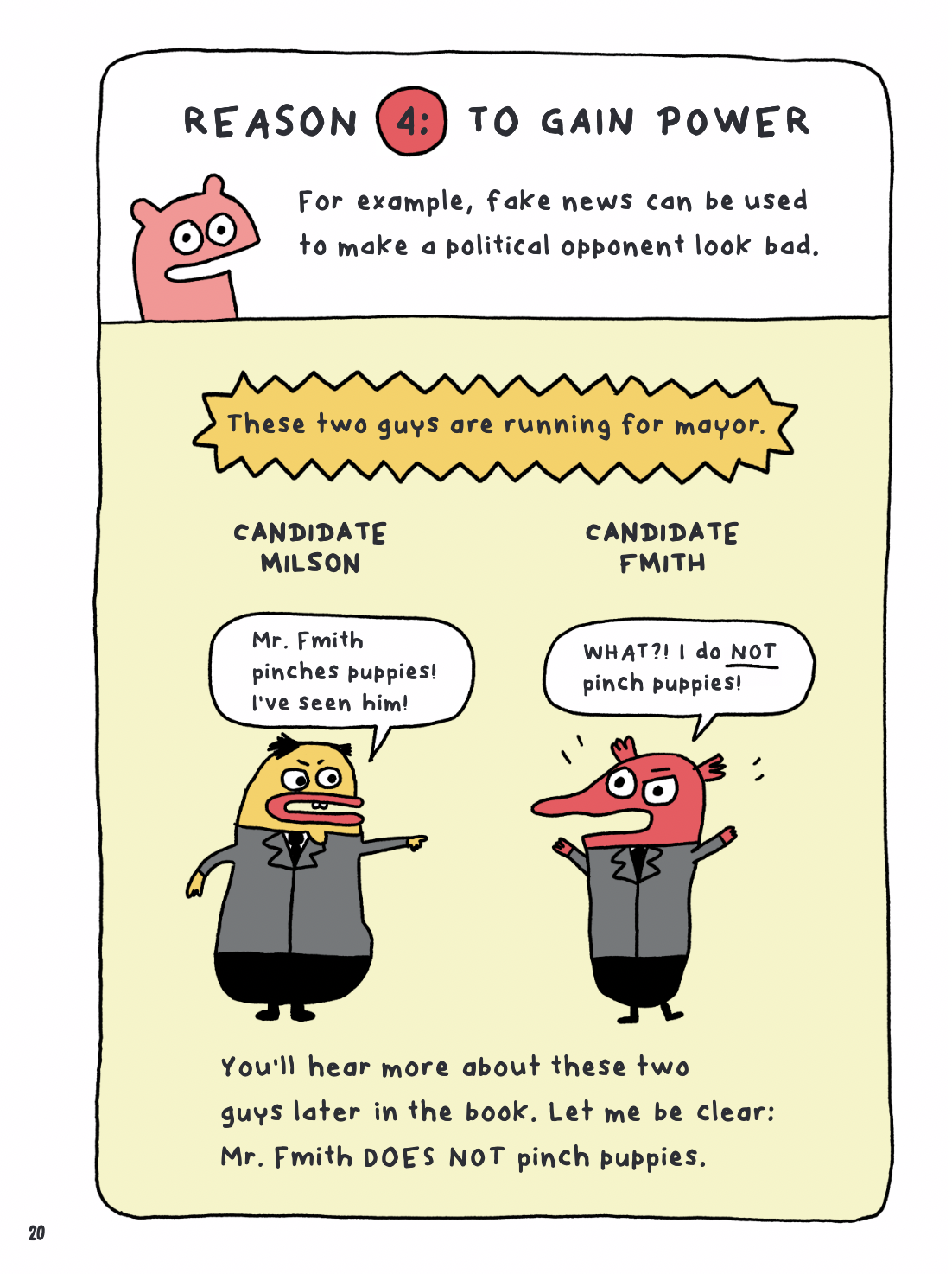
A killer underwear invasion? It must be true if it's been posted in the media, or you heard it from your mother! Right? Or is it? With her quirky art and common sense bathed in tongue-in-cheek humour, Elise Gravel helps young readers recognize the news that isn't real out there, from peanuts that enhance your muscles, and a politician who pinches puppies, to underwear that kills, and how to critically think about the news that is out there.
From Killer Underwear Invasion! by Elise Gravel
In six chapters, Elise Gravel describes what fake news is, why people create it and believe it, why it's bad and how it blows up, and how to differentiate it from the real news. Starting with a fabricated scorpion invasion, Elise Gravel shows how her little monsters create it and disseminate it. To demonstrate the reasons people create it, she uses the nefarious peanut-seller Nerbert. His aim may start with selling a product and making money, but it morphs into dreams of celebrity and power. There's also the aim to spread beliefs and ideas and engage social media. And so, we have fake news.
From Killer Underwear Invasion! by Elise Gravel
The danger of fake news is explicit, especially when it dissuades us from listening to the real experts and compels us to make harmful decisions about ourselves, our environment, our democracies. And when disinformation is woven together, it can overwhelm.
From Killer Underwear Invasion! by Elise Gravel
In the shadow of the disinformation perpetuated on social media, infiltrating everything from our health to our elections, Elise Gravel's Killer Underwear Invasion! is a sobering read. But, because of her comic approach, silly examples, and un-human-like characters, Elise Gravel teaches young readers thoroughly about fake news in a way that they will remember. It's informative without being heavy-handed or preachy, and terms such as clickbait, conspiracy theories, confirmation bias and satire are explained in the simplest of terms, making Killer Underwear Invasion! a perfect read for middle graders and even some younger children. (Especially helpful would be the teacher's guide at https://cdn.shopify.com/s/files/1/0261/7291/5805/files/KillerUnderwearInvasion_EducatorGuide.pdf which includes pre-reading activities, chapter by chapter discussion questions and activities, and guidance on evaluating the news.)
From Killer Underwear Invasion! by Elise Gravel
As illustrated non-fiction, Killer Underwear Invasion! will reach young people through its humour and irreverence. But it will teach them to become responsible readers of news and hopefully help them guide others to become better informed participants and patrons of social media and other broadcast accounts.

September 05, 2022

Can You Believe It? How to Spot Fake News and Find the Facts

Written by Joyce Grant
Illustrated by Kathleen Marcotte
Kids Can Press
978-1-5253-0322-7
56 pp.
Ages 9-12
June 2022
 
With young people returning to schools soon here in Ontario, educators will be scrambling for great resources for teaching media literacy. Toronto's Joyce Grant has just that resource in Can You Believe It? How to Spot Fake News and Find the Facts.
From Can You Believe it? How to Spot Fake News and Find the Facts by Joyce Grant, illus. by Kathleen Marcotte
Using the best features of non-fiction texts, such as info boxes, labelled diagrams, a glossary, and important terms bolded, Joyce Grant covers everything from using critical thinking skills to search for clues of authenticity, looking for bias and understanding the importance of perspective, differentiating between facts, opinion, satire and ads, and clarifying new threats to credibility like clickbait, deepfakes and the proliferation of bots. First she introduces middle-graders to the concepts, giving them samples of news meant to sensationalize and draw in readers, before inviting them to practise their critical thinking skills. Can You Believe It? is a comprehensive examination of how to differentiate between the fake and the authentic, a tough endeavour with today's bombardment of news from all sources, including social media. To end, Joyce Grant offers lists of trustworthy sources, including websites and games, to help young people navigate the deluge of news offered on different platforms.
From Can You Believe it? How to Spot Fake News and Find the Facts by Joyce Grant, illus. by Kathleen Marcotte
The idea of fake news is a disheartening one as readers are manipulated or deceived for various purposes, especially for young people who have less experience with authenticating sources of information. (With the proliferation of fake news in recent years, we know how difficult it is for all adults to do the same.) But Joyce Grant adopts a positive take on this endeavour, encouraging young people that they can sieve through the detritus of fake news and highlight the real. She does it with a bit of humour–a few headlines like "Dog Lovers WAY Dumber than Cat Lovers: Study" or "Kids Are Better than Adults at Everything, New Study Shows" offer a chuckle or two–and thoroughness, and Kathleen Marcotte, an artist from Ohio, gives the text that added lift of colour, diversity, and scaffolding with her digital illustrations.
From Can You Believe it? How to Spot Fake News and Find the Facts by Joyce Grant, illus. by Kathleen Marcotte
Joyce Grant, co-founder of Teaching Kids News, has been talking to kids about the news for years, whether in the classroom or online. She offers links to legitimate sources and stories and proposes lessons to help build critical media literacy skills.  Can You Believe It? How to Spot Fake News and Find the Facts is just one more fine tool in her arsenal to help educators develop a foundation for teaching media literacy and for kids to be empowered to read the news with confidence.

June 18, 2022

Denial

Written by Lorna Schultz Nicholson
Lorimer
978-1-4594-1671-0
176 pp.
Ages 14-18
RL 2.7
February 2022
 
When September started, seventeen-year-old Nova's senior year was looking pretty good. She was excelling at her school work and already had early acceptance to U of T for science, as a precursor to med school. She was part of their high school's power couple, having dated star swimmer Leo for the past 5 months. She had a regular gig tutoring students and she was on the swim team too. But Denial begins the following May with Nova covered in blood and worried about what she'd done. Evidently, life wasn't as perfect as Nova had thought.

Though he's not pressuring her to have sex, Leo makes it clear that's what he's interested in. Fortunately, Nova wants her first time to be perfect and to ensure she gets on the pill first, having heeded her mother's own experiences with a teen pregnancy that resulted in Nova's half-brother Brad, currently living in Thailand after dropping out of university. But, while she's anxious and excited at the prospect of losing her virginity to the guy she loves, Nova is also considering it in the context of quitting the swim team–she's probably the weakest on it–and of leaving Leo exposed to the machinations of the star female swimmer, Jada, who seems to be trying to drive a wedge between Nova and Leo.

But that perfect senior year with the love of her life slowly seems to become something else. Battling tension within the family, between her parents who've had to restructure their lives after Dad lost his job and between her parents and Brad after he ditched university, and with her jealousy of Jada and Leo's increasing unavailability as he tries out for the national team, Nova is finding it hard to cope. And, with Lorna Schultz Nicholson peppering the chapters that document the school year with the glimpses into the May fiasco that may result in a death, Denial becomes a heavy but relatable story of first loves and school stresses with a touch of family drama.

Being in denial is an easy attitude. It's sticking with the status quo, the familiar, even if the familiar is unhealthy, suspicious, or jeopardous. And there's a lot of denial in Denial. (Duh.) But, as easy as denial can be, it is also a powerful force. It makes you see things you don't and ignore things that are evident to everyone. So when you're a teen and don't have decades of life experience to inform you, denial is really easy and Lorna Schultz Nicholson gets that. While she is well-known for her stories rich in sports (e.g., rowing in When You Least Expect It and hockey in Taking the Ice), it's her finesse in addressing issues important to teens that has always impressed me. Whether it's trauma or disabilities, peer pressure or teen sex, Lorna Schultz Nicholson knows how to write about the angst of being a teen and balancing friends, family, school and love. She allows teens to be human and make mistakes, even huge mistakes based in denial, but also to recover from them and move forward. And when you're a teen and everything is monumental and seems life-ending, Lorna Schultz Nicholson gives you hope that life-changing is the norm and can be transformative rather than ruinous.

June 08, 2022

Me Three

Written by Susan Juby
Puffin Canada
978-0-735268722
224 pp.
Ages 10+
March 2022 
Reviewed from audiobook

Rodney's dad used to be famous as the author of the best-selling poker book Get Lucky and the host-poker player of Get Lucky TV who took celebrities to high-stakes poker games. Now it's because of accusations by Missy Stephenson of inappropriate behaviour. Eleven-year-old Rodney believes his dad when he says it's all a misunderstanding but his father is still at a facility, apparently to help him deal with how it feels to have his actions, like hugs, misconstrued. Meanwhile, Rodney, his older sister Kate and their mom, now using Mom's maiden name, have moved from the opulence of their life in Las Vegas to the small home of cousin Maria in Stony Butte, Arizona, four hours away.
From Me Three by Susan Juby
Rodney is desperate to connect with his best friend Larry, the son of Get Lucky TV's producer Isbell, but all his texts, etc. have gone unanswered. So Rodney writes unsent letters to Larry to tell him about life in Stony Butte and about trying to fit in and make friends. But Rodney has a lot to learn about navigating a new school that is very different from his private school Circle Square. He tries to follow Dad's "10 Rules for Living a Lucky Life" but it doesn't always work. That's especially so when Kate, who is furious with her father and believes her brother is in denial about their father, is losing weight and obsessed with her food consumption. And their mother has to take a job at an insurance company and teach Pilates in her off-hours so they can afford anything extra. And he really misses his old friend and has to keep his old life under wraps though he looks forward to when things will be back to normal.

Then things start to look up. He makes friends with Ben who comes from a family of stunt people and who gives Rodney his first taste of danger. Rodney also begins to hang out with a few other kids including Rigmor and Fisherman and Dave. But when popular Van Johnson, a wild man YouTuber, performs a song about J. Crederman and the allegations made against him, and a classmate discovers an online photo of him with Rodney, the family is devastated with being exposed and with the negative attention.
My emotions felt tired out. Like someone smeared all the colors together and now I just felt muddy.
In a time of #MeToo and social media, Susan Juby has given young readers a new perspective, taking us into the head and heart of a child whose father has been accused of sexual harassment and perhaps worse. (Details are suggested but never revealed.) Rodney's dad is a jerk, caring more about his brand, his reputation and the impact on his finances, though he is learning to say all the "right" things, but he's squirreled away in a treatment facility while his family is forced to live in diminished circumstances and under a cloud of shame and acrimony. Rodney, Kate and their mom are the heroes of their own lives, getting on with things, regardless of the "power shamer" J. Crederman. They're learning to balance the past with their present circumstances, even if Kate has become "a Death Star of bad mood." Wisely, their mom tells them that...

The best thing you will ever learn is to deal with what is versus what you wish was.

Sexual harassment and abuse are heavy topics for a middle grade novel but even more so when allegations are made involving a parent. Still Susan Juby keeps her story balanced with humour and candour. The honesty is in the plot and the humour comes through her characters. Both Rodney and Kate are cheeky and have a dry, almost dark, humour. He groans at her fashion sense–"Kate dresses like she wants to hurt people's eyes"–and she can laugh at their situation, claiming that "What doesn't kill you makes a better Instagram poet." But I would expect nothing less from Susan Juby who has won the Stephen Leacock Medal for Humour. She makes us laugh while she makes us think and feel. 

Though the full extent of the sexual abuse perpetrated by Rodney's father is unknown, it is the driving force behind the story of Rodney, Kate and their mother in Me Three. But by making Rodney the focus of the story and giving him the voice of a child who develops from one completely in support of his father to one who wants to know the truth and then hears his father's words as sound bites of rationalizations and mandatory apologies, Susan Juby gives us a different viewpoint. She lets us lace up a pair of Rodney's shoes and deal with the aftermath of his father's misconduct as he, Rodney, experiences it, with a loss of friendship, security and support in the shadow of shame and secrecy, and yet still able to come out with a solid support system of family and friends.

June 10, 2021

The Player

Written by Paul Coccia
Lorimer
978-1-4594-1576-8
181 pp.
Ages 14+ (RL 2.0)
March 2021

Cooper knows he's gay. He was out to his old hockey team and even had a boyfriend on the team but, since it folded and his boyfriend moved away, Cooper is now back to keeping  this sexual orientation a secret to his new team, the Great Blues. So when his teammate Pesh makes a move on Cooper in their hotel room at an away game, he's pleased. But Pesh is an enigma to Cooper. The teen, the son of British Sri Lankan parents who aren't behind his hockey dreams of becoming the team's centre and captain on his path to going pro, is also going out with Bobbi, a girl who wants to go into sports PR and handles Pesh's social media and brand. 
 
Pesh likes flirting with Cooper and making out with him on away games but also starts wanting to fool around before games, convinced it improves their game. But, regardless of this "secret pre-game action" (pg. 110), Pesh is always one of the guys, leading the locker room chatter about girls, while driving his team with practices and high-handedness to ensure he'll look good to the scouts. Meanwhile Cooper can't resolve Pesh's egotism and expectations with the excitement of being in a relationship, albeit a secret one.

While Bobbi takes on helping Cooper with his image, having figured out that he is gay and determined to help him come out in a sport with little practice in being inclusive, Cooper works to keep his relationship with Pesh a secret from her, not wanting to hurt his new friend or jeopardize his position on the team or with Pesh.  But secrets are a dangerous currency and Cooper has to balance what he wants, what he feels and what he knows is right if he's to survive the evolving hockey drama.
 
Because The Player is part of Lorimer's SideStreets hi-lo series, addressing mature teen issues and written with text to engage the reluctant or less experienced reader, Paul Coccia helps all teens hear the voices of young men who are gay, or bicurious, or something else. As he did in his earlier book Cub (2019) and now in The Player, Paul Coccia makes sure that we see relationships like between Cooper and Pesh for what they are: young love, intoxicating and fulfilling, born of attraction and common interests. But as in any relationship, things can go wrong when the individuals have different expectations about exclusivity, openness and needs. The fact that Cooper is gay and Pesh bicurious or perhaps bi is irrelevant. What is important is what Cooper thinks and feels, because The Player is told in his voice. It's through him that we experience Pesh's actions and his own discomfort with Pesh's less-than-straightforward approach to their relationship and that with Bobbi. But, as in any relationship, it's being yourself first and foremost that gives you the strength to be able to give to another. By standing up for himself and what he needs, not only trying to be something for someone else, Cooper opens himself up to greater things in hockey and love.

December 04, 2019

Second Story Press: 30th Anniversary and Contest

Second Story Press has been celebrating 30 years of publishing children’s fiction, nonfiction and picture books, along with young adult and adult fiction and nonfiction. They've championed feminist rights and social justice stories from the onset. Their books have been honoured with many awards and accolades and they continue to produce outstanding series like Janet Wilson's Kids Are Making a Difference and their Holocaust Remembrance Series for Young Readers as well as a diverse collection of titles for all ages. While I have not been able to review all the children's and YA books from Second Story, I have reviewed quite a few in the last few years including:

If you have a favourite, you might want to get in on Second Story Press's social media contest, another part of their 30th anniversary celebrations.


What do you have to do?
Post on Twitter, Facebook or Instagram (using the hashtag #SSP30Years) a photo of your favourite book from Second Story Press and why you love it

When?
Until 11:59 p.m. on December 13, 2019

Who?
Open to Canadian and American of legal age (sorry young readers!)

Details
Full contest rules are posted here

Also part of their 30th anniversary celebrations, Second Story Press has asked ten guests to share their favourite books. I was honoured to be one of these ten individuals and share with you below the posts that Second Story Press sent out on December 2, 2019.


Read my original review of Stolen Words by Melanie Florence and illustrated by Gabrielle Grimard at https://canlitforlittlecanadians.blogspot.com/2017/09/stolen-words.html

Happy 30th Anniversary, 
Second Story Press! 

June 30, 2016

May I suggest . . . ? Five ways to help me help you promote your youngCanLit


While I am loathe to share my reviews as opinions—I firmly agree with Paulo Coelho who said, “The world is changed by your example, not by your opinion”—my mandate for CanLit for LittleCanadians has always been to promote great Canadian literature for children and young adults. To that end, may I suggest a few ways that authors, illustrators, publishers and publicists can help me to help you?

First, let me thank those generous authors, illustrators, publicists and publishers who are so kind to provide me with copies of their books for review, as well as include me in blog tours and allow me to interview our contemporary youngCanLit A-listers. Without these donations, I could not afford to review as many books as I do on CanLit for LittleCanadians.

That said, please limit the books you send for review to those written for young people. Just because there is a young person in the book does not mean that it is a book appropriate for or of interest to younger readers. Imagine expecting Timothy Findley’s The Piano Man’s Daughter (HarperCollins, 1995) or Heather O’Neill’s Lullaby for Little Criminals (HarperCollins, 2006) to be reviewed as youngCanLit? Not going to happen. And just because a younger reader is able to read the book doesn’t mean it’s youngCanLit. If your catalogue is publicizing a book as adult fiction, it’s not a juvenile or teen read, regardless of the age of the protagonist. Save yourself the review copy and the disappointment, and save me my reading time and the communication explaining why I’m not reviewing the book.

If I do review your book, there are several ways to ensure that review gets read by more and more people. While I may not get the million hits of a kitten playing with a bird on YouTube, CanLit for LittleCanadians does very well as a book blog. It is linked through multiple school boards and universities with teacher education programs, English and creative writing programs and library studies, as well as the Canadian Children’s Book Centre and other blogs. But it could always do better.  

Add a link to CanLit for LittleCanadians (www.canlitforlittlecanadians.blogspot.caon your website with a quote from the review or add me to your blog roll or become a subscriber. Doesn’t hurt, always helps.


Post a comment on the review. Thank you to author Monica Kulling, commentator extraordinaire, who always lets me know what she thinks of my reviews of her own books and those of others. Judging by the numbers on Google Analytics, this always brings in more readers. And don’t be dissuaded by my need to moderate the comments. I do this to avoid horrific amounts of spam, both commercial and irrelevant.


Support CanLit for LittleCanadians on social media. Each time I post on my blog, I will tweet several times about the book or the review or the event, ensuring the relevant parties (author, illustrator, publisher) know. Your retweets and likes bring in more and more followers and links and you know that in the end that means sales, the all-important bottom line. Whether I’m using the hashtags for youngCanLit or for teachers or teacher-librarians, those tweets are getting read. And don’t be shy about retweeting multiple times or multiple tweets about the same book. What catches one reader on Twitter may not be the same as for another. They all count. Toot your own horn, or at least join the band as I’m tooting away. I adore publicist Winston Stilwell at Fitzhenry & Whiteside, the king of retweeting and replying to my tweets for F & W books and Red Deer Press, Inhabit Media and Fifth House Publishers and Whitecap Books, because I know he makes an effort to get my tweets and reviews out there. And all those publishers who bring attention to my reviews through your Facebook pages, thank you.

Please don’t take it personally if I don’t review your book or don’t do it in a timely fashion. Sometimes life takes precedence over blog, and I get backlogged in reviews and can’t catch up. And sometimes the book just doesn’t grab me and I’d rather not review it than write a rant of an opinion piece. I alone write posts for CanLit for LittleCanadians, except for rare student reviewers, and do the best I can under constraints of time, health and motivation. I do what I can. With the plethora of outstanding Canadian authors and illustrators out there ready to have their works promoted and applauded, it’s a daunting task.

And while I’m asking for help, if you know of any one who is looking for someone to speak to teacher candidates or schools about youngCanLit or wants to hire a writer who peddles herself as an aficionado of Canadian children’s books or can think of a way for me to segue this blog into a salaried career, please leave a comment below.  Always happy to hear from my readers and writers.

Read youngCanLit!