Showing posts with label coping. Show all posts

January 28, 2026

Planting Sunshine

Written by Andrée Poulin
Illustrated by Enzo (Enzo Lord Mariano)
Groundwood Books
978-1-77946-095-0
116 pp.
Ages 9–12
February 2026 
 
As is often the case, Theo's day is normal enough until it isn't. And what changes everything is watching the news coverage of war breaking out far, far away.
Theo's father
turns on the TV— 
     and war arrives
in their living room. (pg. 9)
Theo cannot believe what he is hearing and seeing. Horrified by the sights and sounds of bombs and guns, tanks and drones, and most of all the destruction of people and place, Theo is troubled. He wants to know why this happens, whether they are safe, and asks why humans are so cruel.
From Planting Sunshine, written by Andrée Poulin, illustrated by Enzo
Though the countries involved are never identified, readers might recognize some of the images described as those from the attack on Ukraine by Russia, such as the elderly woman who confronts a Russian soldier with sunflower seeds and suggests that if he puts them in his pocket. . .
At least when you die here
     on the soil of my country
     the sunflowers will grow 
                    around you. (pg. 20)
Theo asks his neighbour Mrs. Lena, an elderly woman who grew up in "the country now caught in this terrible war" (pg. 21), about the war and this incident, and she tells him of the sunflower—soniashnyk, in Ukrainian—being the "flower that feeds hope." (pg. 22) Seeing Theo's continued distress, day after day, she gives him sunflower seeds to plant.
From Planting Sunshine, written by Andrée Poulin, illustrated by Enzo
Each day there is more horrific news from the war, and the details stay with Theo. He thinks about the numbers, about the images, about the losses, and all he can do is wonder why no one is stopping it. 
Each day Theo asks, "Will the war end today?" (pg. 38) The war may be very far away but it's impacting Theo in the way he sees life. The word "bomb" no longer reminds him of diving board cannonballs. His friends playing war angers him. His dad refuses to let Theo watch the news anymore, so Theo hides his tablet and watches at night. And then the nightmares start, a mix of anger, fear, hatred and more.
 
When he meets a girl drawing doves on a wall as protest, Theo is finally able to share what he's feeling–never wanting to burden Mrs. Lena or his teacher or his father—and feels a little less alone. And he finds his own way to express his anger and his grief. 
From Planting Sunshine, written by Andrée Poulin, illustrated by Enzo
Still, he is unconvinced that the war will end or that things would change, until Mrs. Lena offers him the idea of hope. She tells him, "Hope lives in the after." (pg. 91) And, with a little help from those around him, Theo finds a way to settle his anger, remember what should never be forgotten, work to help a cause, and find "a small way to start building peace." (pg. 110)

I could quote page after page of eloquent text that clutches at the heart of Theo's bewilderment and trauma. Andrée Poulin has always had a knack for telling tough stories lightly—not lightheartedly—for a young audience. Whether it's sanitation (Burying the Moon, 2021), diversity and tolerance (Tickled Pink, 2020), or abandonment (The Biggest Poutine in the World, 2016), Andrée Poulin recognizes that her audience is young, and will be impacted differently about important issues. Theo is just such a child, significantly impacted by a war thousands of kilometres away, and not understanding fully what is happening. He's feeling a lot and needs help understanding those emotions and directing them into activities that help. Andrée Poulin takes Theo full circle, from unfamiliarity with war, to an introduction by media, to immersion in images and sensory overload, to impact and trauma, and finally purposeful attention. And she does so eloquently in words and in verse form. This book will become an exemplar of telling a story with sensitivity and compassion, and awareness of how world events can impact children in powerful ways. 
From Planting Sunshine, written by Andrée Poulin, illustrated by Enzo
Enzo (a.k.a. Enzo Lord Mariano), a Montreal-based illustrator, provides the artwork that frames Andrée Poulin's story. Using Procreate with watercolour textures, Enzo gives us some war images—the ones of a blue tractor in a field of sunflowers that is later devastated by bombs is especially heartrending—but generally it's all about Theo because this is his story. It is not a story of war. It is a story of a boy who struggles with the concept of war and his emotions with the senseless destruction it perpetuates. Enzo helps us see Theo's anguish and his anger, the trauma of his sleepless nights, and his despondency. But Enzo also shows us family, friendship, and community, and how those can soften the suffering.
 
I don't think I can say enough about Planting Sunshine. (A French-language version, Semer des soleils, was published in 2024 by La courte echelle.) Not only does it remind all that there is an ongoing conflict in Ukraine, but that there are children beyond the borders of that war that are struggling with it. Highly sensitive children like Theo can be impacted by what they see and hear in the news and cannot always articulate what they are feeling or recognize how to grapple with those emotions. In a world of strife and public media, children will continue to be exposed to all manner of frightening news. Awareness of their potential struggles and attention to their needs might help them find ways to plant sunshine and to unearth hope.

March 21, 2023

When Things Aren't Going Right, Go Left

Art by Peter H. Reynolds
Words by Marc Colagiovanni
Orchard Books
978-1-338-83118-4
32 pp.
Ages 4-8
March 2023
 
Of course, things don't always go right. That's life. But how we handle it when things don't go right makes for a good story when we get back on track.
From When Things Aren't Going Right, Go Left by Marc Colagiovanni, illus. by Peter H. Reynolds
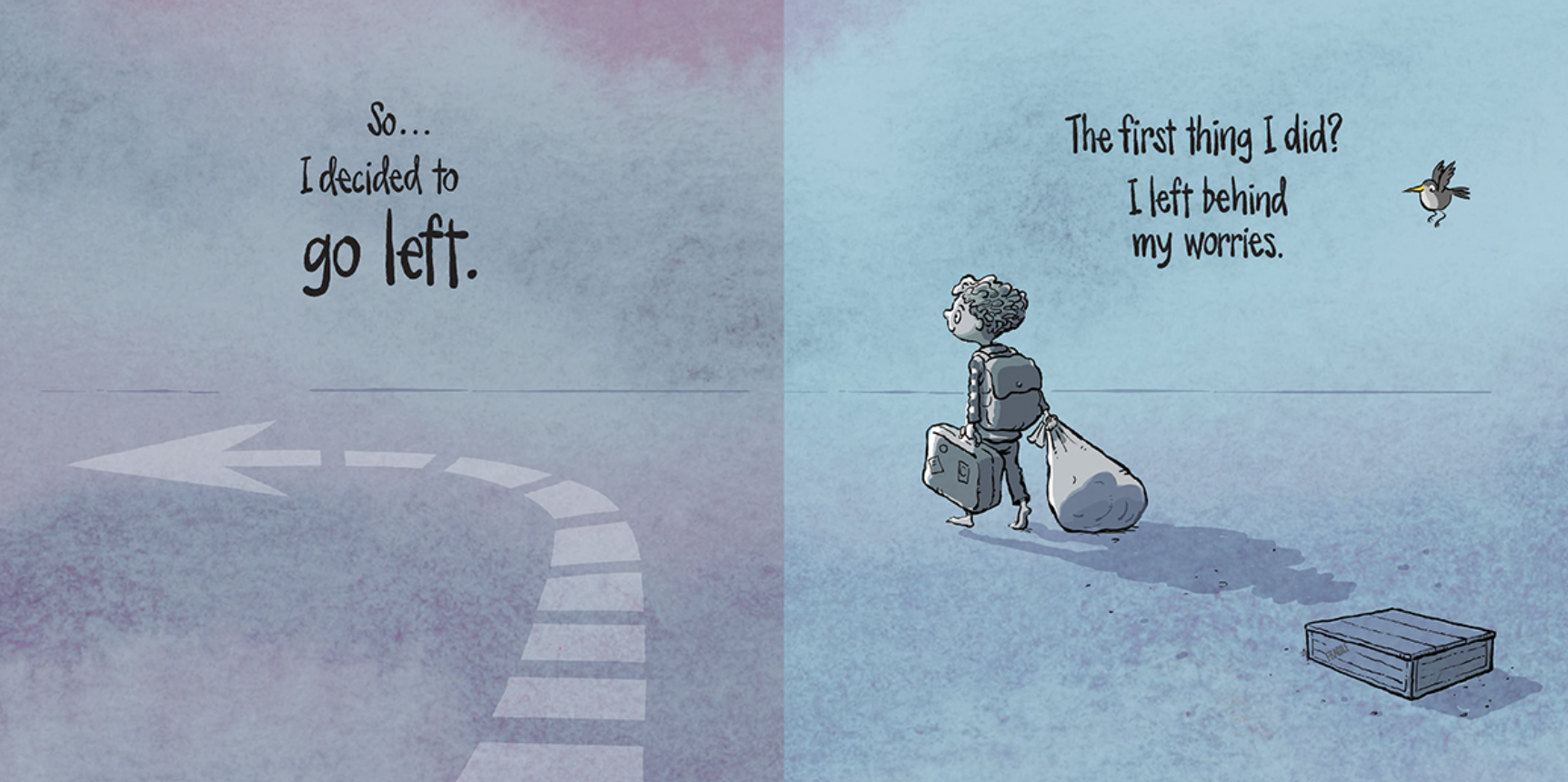
In Rhode Island's Marc Colagiovanni's debut picture book, a child is burdened by a box of worries, a sack of doubts, a suitcase of fears and a knapsack of frustrations. He wants to try something that has frustrated him, worried him, scared him, and made him doubt himself. It's a pool with a diving board.
From When Things Aren't Going Right, Go Left by Marc Colagiovanni, illus. by Peter H. Reynolds
He'd attempted a dive once and had been unsuccessful, and now considers another attempt. Ah, but there are those doubts and those fears and more. Worse yet, as he attempts to leave them behind, one encumbrance at a time, the annoying creatures shout back at him. Can he make them manageable or leave them behind to take control?
From When Things Aren't Going Right, Go Left by Marc Colagiovanni, illus. by Peter H. Reynolds
The message that it's okay to put down your burdens is an important one for all of us who sometimes feel we need to power through everything and anything. Marc Colagiovanni obviously knows this and, by using an example of a child attempting something that both scares and frustrates him, he reminds us that not everything is going to go right or be easy. It could be trying a formidable dive or making a new friend or overlooking those pesky demons that cause us stress and worry. We all have them, and we all need to find coping strategies to get beyond them. The message is meaningful, but the medium is everything.
From When Things Aren't Going Right, Go Left by Marc Colagiovanni, illus. by Peter H. Reynolds
The artwork from Peter H. Reynolds takes When Things Aren't Going Right, Go Left from social emotional advice to a visualization for coping. Though some may see a child attempting a dive as trivial, to that child those burdens of worry and fear are great. They are heavy loads of disquiet and cannot be diminished because others might seem them as negligible. Peter H. Reynolds makes us feel the weight of those burdens in the child's face and body language and, most clearly, in the palette of the art. From the grey blues and purples of the child's troubled steps, through the times of lighter oranges and pinks, until his world is bright and sunny yellow, this child feels everything, and so do we. 

Peter H. Reynolds's books are always a treat of messaging and graphics, and his collaboration with Marc Colagiovanni reminds us again that we have the capacity to make things better for ourselves while inspiring all of us to do our best.

 ⇨⇦ ⇨⇦ ⇨⇦

When Things Aren’t Going Right, Go Left by Marc Colagiovanni and Peter H. Reynolds | BOOK TRAILER

Uploaded by Scholastic to YouTube on February 222, 2023.

October 22, 2022

The Brass Charm


Written by Monique Polak
Illustrated by Marie Lafrance
North Winds Press (Scholastic Canada)
978-1-4431-5758-2
32 pp.
Ages 5-9
September 2022
 
Everyone has troubles in their lives sometime. Some are horrific and life-changing, some are temporal but seem overwhelming.  Most of us cannot see past our own issues when we're immersed in them. It's that bubble of now. It is probably especially the case for young children many of whom, thankfully, have not had to endure great hardships. So, when the roof of their home is destroyed in a storm, Tali is devastated.
From The Brass Charm by Monique Polak, illus. by Marie Lafrance
As the family heads to stay with Oma while repairs may be undertaken, Tali's mother reminds her that "People survive worse" and to "Think of Oma." Tali knows her grandmother survived World War II but she never talks about it. Still Tali is "too sad to think of anyone" but herself, even when she meets a little neighbour girl who obviously craves some company. That is, until her Oma shows her a tiny brass charm of a monkey man and shares a memory of her own hardship.

From The Brass Charm by Monique Polak, illus. by Marie Lafrance
Telling her story in the third person, Oma tells of a girl forced to leave home and sent to a prison called Terezin. The people kept there were worked tirelessly and fed very little and on the day of her birthday, the child was overcome with how her life had changed for the worse. A woman, hearing her cry, bestows upon her a small brass charm of a monkey man that a stranger gave her when her own life had seemed stormy. Now Oma remembers that lady whose own life had been difficult and could still find "it in her heart to be kind to a stranger."
 
In a message of paying it forward, Monique Polak has Tali sharing the story of the brass charm with Elodie, the little neighbour girl, bolstering them both through their challenges.
From The Brass Charm by Monique Polak, illus. by Marie Lafrance
In a story within a story, Montreal author Monique Polak is actually telling her mother's own history of surviving Terezin as a child and receiving the charm. Because of Terezin's history and its common role as a transit camp for those moved onto other concentration camps, as Monique Polak's Afterword details, the woman who shared that charm was never seen again. Yet the kindness she extended in such trying circumstances, just as Tali's Oma did for her grandchild, speak to a strength of character beyond the typical. It speaks to empathy and compassion and feeling beyond self. And for Tali to listen and learn and then apply that lesson to another makes that small brass charm a greater gift than any gold or diamond trinket could replace.
From The Brass Charm by Monique Polak, illus. by Marie Lafrance
There is a lesson from history here with Tali's Oma remembering Terezin and an experience from World War II. But it is in the context of connecting with others and a grandmother-granddaughter relationship. Not surprising that, even with a story that includes both historical and contemporary scenes, Marie Lafrance whose artwork was rendered with graphite on paper before digitally coloured and texturized via collage, is able to meld the two time periods by focusing on the child in each. It's Tali's experience and then her oma's when she was a child. It is from their perspective: what they see, what they feel, how they respond. So when the two come together in the present, as elderly woman and young child, they are feeling and understanding as the same. And Marie Lafrance gives the two similarities in their physical appearances, with the golden curls of their hair and delicate chins and ears, and makes it clear they are related. But she also gives a softness to a hard story, a story of destruction and hatred, loss and generosity. By keeping the dark grey tones for the camp and the storm and using soft colours of blues and rose and such for everything else, Marie Lafrance emphasizes the tenderness of being there for others, not the damage of the negative.

I can't think of a gentler way to introduce children to the Holocaust and Nazi concentration camps than a reading and discussion of The Brass Charm, though its story is far greater than those historic concepts. Read for a memorial day such as the International Holocaust Remembrance Day (January 27) but also for lessons about empathy and the goodness of paying it forward. The best acts of kindness do not require recompense or recognition. They come from making someone's life a little easier, whether during storms, times of trouble or now.

• • • • • •

Author Monique Polak will be launching her new book on November 20, 2022 at 2 PM at the Gelber Conference Centre, Musée de l'Holocauste Montréal / Montreal Holocaust Museum. Reserve your free tickets at Eventbrite here

June 08, 2022

Me Three

Written by Susan Juby
Puffin Canada
978-0-735268722
224 pp.
Ages 10+
March 2022 
Reviewed from audiobook

Rodney's dad used to be famous as the author of the best-selling poker book Get Lucky and the host-poker player of Get Lucky TV who took celebrities to high-stakes poker games. Now it's because of accusations by Missy Stephenson of inappropriate behaviour. Eleven-year-old Rodney believes his dad when he says it's all a misunderstanding but his father is still at a facility, apparently to help him deal with how it feels to have his actions, like hugs, misconstrued. Meanwhile, Rodney, his older sister Kate and their mom, now using Mom's maiden name, have moved from the opulence of their life in Las Vegas to the small home of cousin Maria in Stony Butte, Arizona, four hours away.
From Me Three by Susan Juby
Rodney is desperate to connect with his best friend Larry, the son of Get Lucky TV's producer Isbell, but all his texts, etc. have gone unanswered. So Rodney writes unsent letters to Larry to tell him about life in Stony Butte and about trying to fit in and make friends. But Rodney has a lot to learn about navigating a new school that is very different from his private school Circle Square. He tries to follow Dad's "10 Rules for Living a Lucky Life" but it doesn't always work. That's especially so when Kate, who is furious with her father and believes her brother is in denial about their father, is losing weight and obsessed with her food consumption. And their mother has to take a job at an insurance company and teach Pilates in her off-hours so they can afford anything extra. And he really misses his old friend and has to keep his old life under wraps though he looks forward to when things will be back to normal.

Then things start to look up. He makes friends with Ben who comes from a family of stunt people and who gives Rodney his first taste of danger. Rodney also begins to hang out with a few other kids including Rigmor and Fisherman and Dave. But when popular Van Johnson, a wild man YouTuber, performs a song about J. Crederman and the allegations made against him, and a classmate discovers an online photo of him with Rodney, the family is devastated with being exposed and with the negative attention.
My emotions felt tired out. Like someone smeared all the colors together and now I just felt muddy.
In a time of #MeToo and social media, Susan Juby has given young readers a new perspective, taking us into the head and heart of a child whose father has been accused of sexual harassment and perhaps worse. (Details are suggested but never revealed.) Rodney's dad is a jerk, caring more about his brand, his reputation and the impact on his finances, though he is learning to say all the "right" things, but he's squirreled away in a treatment facility while his family is forced to live in diminished circumstances and under a cloud of shame and acrimony. Rodney, Kate and their mom are the heroes of their own lives, getting on with things, regardless of the "power shamer" J. Crederman. They're learning to balance the past with their present circumstances, even if Kate has become "a Death Star of bad mood." Wisely, their mom tells them that...

The best thing you will ever learn is to deal with what is versus what you wish was.

Sexual harassment and abuse are heavy topics for a middle grade novel but even more so when allegations are made involving a parent. Still Susan Juby keeps her story balanced with humour and candour. The honesty is in the plot and the humour comes through her characters. Both Rodney and Kate are cheeky and have a dry, almost dark, humour. He groans at her fashion sense–"Kate dresses like she wants to hurt people's eyes"–and she can laugh at their situation, claiming that "What doesn't kill you makes a better Instagram poet." But I would expect nothing less from Susan Juby who has won the Stephen Leacock Medal for Humour. She makes us laugh while she makes us think and feel. 

Though the full extent of the sexual abuse perpetrated by Rodney's father is unknown, it is the driving force behind the story of Rodney, Kate and their mother in Me Three. But by making Rodney the focus of the story and giving him the voice of a child who develops from one completely in support of his father to one who wants to know the truth and then hears his father's words as sound bites of rationalizations and mandatory apologies, Susan Juby gives us a different viewpoint. She lets us lace up a pair of Rodney's shoes and deal with the aftermath of his father's misconduct as he, Rodney, experiences it, with a loss of friendship, security and support in the shadow of shame and secrecy, and yet still able to come out with a solid support system of family and friends.

December 01, 2021

Oliver Bounces Back!

Written by Alison Hughes
Illustrated by Charlene Chua
North Winds Press (Scholastic Canada)
978-1-4431-8988-0
32 pp.
Ages 3-7
September 2021
 
Oliver is not having a good day. From struggling with his tangled hair and his favourite shirt being in the wash, his baby sister Annie throwing mushy banana in his face and the burning of his toast, the day doesn't start out well. In fact, it gets worse.
From Oliver Bounces Back! by Alison Hughes, illus. by Charlene Chua
With each new mishap, from breaking a shoelace and Carter taking Oliver's blue spot on the reading-time carpet, Oliver's mood slips from annoyed to irritable and then angry. With each new struggle, Oliver's circumstances are recounted through testimonials from his parents, his classmates, the bus driver and his teacher, attesting to the impact these unexpected troubles have on the little boy.
From Oliver Bounces Back! by Alison Hughes, illus. by Charlene Chua
But, he still is able to hope that the day will get better, and he finds small successes help him through, as does an amazing bouncing apricot that helps him see that he could bounce back too, metaphorically and physically. 

So I tried to make the day get better. I drew a picture. I helped out. I thought of my family and friends, and how nice they were being. I even laughed thinking about my sister chucking that banana at my head! Bullseye!

Resiliency has become a big buzz word in the last decade though teaching someone to become resilient is near impossible. However, what is possible is to share strategies that can improve resiliency and author Alison Hughes notes several of these in a page titled "Learning to Bounce" at the end of the story. Strategies like connecting with others, keeping things in perspective and actual bouncing are all demonstrated somewhere in Oliver Bounces Back! but so discretely that it never reads like a PSA or a directive to a child. Young readers will certainly sympathize and empathize with the boy and will see that he is able to pull himself out of that bad day and make it into something better but they won't feel like they are being schooled. However, they will remember a strategy that might work for them when they too are faced with a day when everything seems to go wrong.
From Oliver Bounces Back! by Alison Hughes, illus. by Charlene Chua
Because key figures in Oliver's day give their takes on what happens and Oliver's reactions to those circumstances–it feels like a reporter asking bystanders what they witnessed before talking to Oliver–Oliver Bounces Back! offers different perspectives on the child's day and shows young readers that they are part of something bigger beyond their own troubles. Oliver is part of several supportive communities, at home and at school, that will help him get through anything, if he asks and listens. Even Charlene Chua's artwork promotes the idea that, though Oliver's troubles may seem insurmountable to him, they are small enough to be manageable and put aside or seen through a different lens, thereby allowing coping and recovery. The brightness of her digital art, the affective faces of the children, and the progression of Oliver's reactions as he struggles and overcomes contribute to the message of childhood troubles survived.
 
Without instructing children how they should become resilient, let Alison Hughes, Charlene Chua and Oliver demonstrate that bad days happen but, with a few tools, it's possible to bounce back from any challenges that need to be faced.
From Oliver Bounces Back! by Alison Hughes, illus. by Charlene Chua

November 10, 2020

Duck Days

Written by Sara Leach
Illustrated by Rebecca Bender
Pajama Press
978-1-77278-148-9
120 pp.
Ages 7-11
November 2020
 
Third grader Lauren who is autistic is delighted to have a real friend in Irma, a little girl who'd arrived from Sweden the year before. Still, there is still some hesitation about her first time visiting Irma at her home. A lover of routines and the predictable, Lauren is reminded by her father to "go with the flow" (pg. 10)–which she visualizes with a hand gesture that looks like waves rippling on the water–when things might not necessarily go to plan. However, though Lauren and Irma have much in common, from their interests in insects to a love of reading and Swedish meatballs, a casual statement made by Irma that her neighbour Jonas is her friend sends Lauren's mind off into a tizzy.
 
From Duck Days by Sara Leach, illus. by Rebecca Bender
Lauren utilizes her strategy of focusing on things she likes and her square breathing to stop herself from overreacting but she still politely refuses to play with Jonas, a fifth grader, when he invites them to join him in bike riding and trying out his obstacle course of ramps. 
From Duck Days by Sara Leach, illus. by Rebecca Bender
When all the Grade 3 students learn that they will be participating in a day-long mountain biking event at school, Lauren is unnerved, embarrassed that she still uses training wheels and convinced that she'll never be brave enough to go without. Fortunately with some very gentle nudging from her parents and Irma, a new strategy from Jonas to think like a duck and let words flow off of her like water, Lauren is able to expand her friendships, face her fears about riding her bike with training wheels at school and trying new things.

Author Sara Leach introduced young readers to Lauren, a young child living with Autism Spectrum Disorder, in Slug Days (2017) and Penguin Days (2018) and, with each new story we get to celebrate Lauren's successes in developing coping strategies that give her the comfort to endure typical childhood situations from school to spending time with relatives to making new friends and keeping them. Though it's evident that Lauren becomes uncomfortable with anything that detracts from her routines primarily as a result of her ASD, Sara Leach helps young readers see that anyone can use a little help when having a hard time. Most children do better with routines and the predictable and have worries about friendships and looking foolish. So while Sara Leach helps them understand some of the challenges faced by children with ASD, she also encourages them to find coping strategies, including visualization and focusing on breathing, to help get through uncomfortable or irregular circumstances.
From Duck Days by Sara Leach, illus. by Rebecca Bender
Accompanied by the charming pencil and digitally-rendered artwork of Rebecca Bender whose illustrations have graced her own picture books like Giraffe and Bird Together Again and How Do You Feel?, Duck Days will captivate early readers with both the familiarity and distinction of Lauren's circumstances and recognize that being brave is in everyone.
 

December 11, 2019

When Molly Drew Dogs

Written by Deborah Kerbel
Illustrated by Lis Xu
Owlkids Books
978-1-77147-338-5
32 pp.
Ages 4-8
September 2019 

On the night before the first day of school, a pack of stray dogs moved into Molly Akita's head.
Deborah Kerbel's story of a little girl's anxiety manifesting as a pack of dogs is both gripping and reasonable, especially as the dogs are both her distress and her salvation.

From When Molly Drew Dogs by Deborah Kerbel, illus. by Lis Xu
Like anxiety, the dogs make their way into her thoughts and her sleep, "restless, they scratched at her brain, begging to be let out." So Molly drew the dogs, everywhere and all the time. "When Molly drew dogs, her heart sat up and smiled." But her art was not always appreciated, especially by her teacher Ms. Shepherd who believed Molly needed to focus on her work and restrict her drawing to art class.  Even her after-school tutor demands that no dogs be allowed when Molly's math problems became drawings of dogs.

From When Molly Drew Dogs by Deborah Kerbel, illus. by Lis Xu
Distraught, the child runs away, knowing that "she couldn't erase them, even if she wanted to." Getting lost, Molly finds shelter from the rain in a garden shed and uses her chalk to draw her dogs. But she does more than draw the dogs. She gives them life and concerns herself with their well-being, giving them coats so they aren't cold, as she is, and food, as they were all probably hungry like Molly. The dogs don't nip at her or attack but rather curl up and give her solace. Moreover, when discovered the next morning by her teacher, Molly learns that a pack of dogs in coats had chased off a robber in the neighbourhood and finally Ms. Shepherd realizes the inherent value of Molly's dogs to the little girl.

From When Molly Drew Dogs by Deborah Kerbel, illus. by Lis Xu
It's an apt metaphor to use dogs as an expression of anxiety.  Dogs can be demanding and relentless with their need for attention and care but, on the flip-side, they are companionable and comforting and even inspiriting. Deborah Kerbel's text is astute but profound, recognizing the immensity of Molly's distress and lack of control over her anxiety until she tends to her "dogs" as a coping strategy. By caring for them, she tames them and they abide by her needs, not their own, and offer her safety.

Toronto artist Lis Xu's illustrations, soft and understated in pencil crayon, give Molly's story a delicate texture that reminds us that this is a child's world.  It's a world in which the dogs may be very real or completely imaginary, not unlike her worries and angst. At night the dogs are smoky dark–and aren't worries always worse through the night?–but by day they are pink and yellow, blue and orange. That is, until Molly takes care of them in the garden shed and the dogs are all in comforting shades of brown. In other words, the dogs become as real as Molly needs them to be.

Molly's anxiety, like that of many, is a debilitating disorder that interferes with her daily life. It's affecting her sleep, her learning, and her interactions with others. Her anxiety is real. But she has found a way to cope with that anxiety and that includes drawing dogs and ultimately embracing them as protection.  By acknowledging them and accepting them as friend not antagonist, she will survive and do much better when others recognize her coping strategy as effective for her.

November 06, 2019

Larkin on the Shore

Written by Jean Mills
Red Deer Press
978-0-88995-577-6
310 pp.
Ages 13+
October 2019
"...her words have stayed with me, just like Jonah's. Words do that. Words spoken and words in books. Words you write. They start to breathe and live and just take over. And right now, I've been taken over by the words of other people–people talking–and I can't find myself or my own words." (pg. 221)
After she is traumatized by something that happened with a boy, Jonah, and ejected from a moving car, sixteen-year-old Larkin Day is sent from her home in Toronto to stay with her grandmother Granne in Tuttle Harbour, Nova Scotia for the summer.  Larkin had managed to finish her Grade 10 exams but the gossip and social media about what happened have left her feeling isolated and unsafe and contemplating the relief of suicide. Her dad decides his mother, a retired principal, would be the best bet for his daughter while he heads to Vancouver to deal with Larkin's mom, a woman addicted to painkillers and bouncing between the unsafe streets and rehab. 

But for Larkin, Granne and Tuttle Harbour are unfamiliar and she must learn to assess every person she meets for sincerity and safety. That includes neighbour Will Greenfield who is helping his dad Billy renovate an old house for Granne into the Tuttle Harbour Café and Reading Room. As Larkin helps Granne with the book donations for the reading room, she deals with her anxiety which tempers her interactions with others, even with nice-guy Will. But when Will takes her to a local campfire with his peers, Larkin meets the gregarious Casey Henwood, his girlfriend Beth and others, and overdoes the drink when "...it tastes so good and goes down easily." (pg. 70). Could she be putting herself in harm's way?

When a fire destroys the back of the café, Casey and Beth and others are quick to point fingers at Will's dad, a recovering alcoholic, who'd apparently once burned down a shed he was building at the Henwood's farm. Hearing the gossip about Billy as well as about Will from Beth, and reflecting on the talk that went on about her after she was injured, Larkin is perplexed about whom to believe or to trust. What's worse is the news coming from her dad about her mother's health situation.  Walking out into the water until the darkness envelopes her or trying to swim out to Prince Edward Island, knowing she'd never make it, continue to overshadow her regular visits to the shore until she starts to live beyond others' words.

Jean Mills, who wrote the Red Maple-nominated Skating Over Thin Ice (Red Deer Press, 2018), knows how to tell a story about dealing with expectations from family, school and self. She gets what it's like to trust and not trust your own feelings and to be confused about how those you care about conduct themselves around you. From an addicted mother to an unfamiliar grandmother and peers that are both charming and deceptive, Larkin must look at every interaction as a potential disaster and possibly harmful. Sadly this is probably not unusual for teens who are trying to understand a world in which they are expected and allowed to take on greater responsibilities but may be unsure whether they have the strength or understanding to meet them. For Larkin, it may not always be evident which is the safe world or the dangerous one, not unlike a shore that borders land and water, but she is developing the courage to choose her heading and a solid intuition about good people that will guide her.

June 12, 2019

I'm Worried

Written by Michael Ian Black
Illustrated by Debbie Ridpath Ohi
Simon & Schuster Books for Young Readers
978-1-5344-1586-7
40 pp.
Ages 4-8
June 2019

While I am loathe to call any book bibliotherapeutic, there is something reassuring and healing about Michael Ian Black and Debbie Ridpath Ohi's books that offer children a comforting perspective on common emotions with which they may be dealing. Here, they tackle, with great sensitivity and much humour, the worry that comes from dwelling on the future and the possibility that bad things might happen.
From I'm Worried, illustrated by Debbie Ridpath Ohi, text by Michael Ian Black
When Potato shares with his friends that he is worried, he may say it could be anything but he's visualizing snakes, spiders, a meteorite crashing to earth, a marauding T-Rex, an alien reading about cooking with potatoes, an erupting volcano, a pop quiz, and even a circus clown. Though he'd like the little girl to reassure him that nothing bad will ever happen, the insightful child knows that she cannot do so "because nobody know what's going to happen."
From I'm Worried, illustrated by Debbie Ridpath Ohi, text by Michael Ian Black
That, regrettably, gets Flamingo worrying too. So the girl gives them examples of when bad things did happen, from bruising to a struggle with peanut butter and even a broken arm, and reminds them that they survived and some good even came from those experiences.
All of those things were bad at first...
...but over time they turned out okay.
From I'm Worried, illustrated by Debbie Ridpath Ohi, text by Michael Ian Black
Unfortunately Flamingo's solution is to protect them in bubble wrap. Fortunately, when that goes awry, the girl's suggestion that living in the moment might be preferable to worrying about the future seems to work.

In our stressful lives of competitive activities, intense social media and uncertainty about the future, it's not surprising that children are now far more anxious about life than in generations earlier. We might wish their lives to be filled with more play and for them to demonstrate more resilience but we're not giving them that kind of a world. So, without preaching mindfulness, Michael Ian Black proposes simply "enjoying the now" and it seems that, with a few friends, anything can be tolerated.

Just as she did in I'm Bored (2012) and I'm Sad (2018), Debbie Ridpath Ohi's illustrations give life to Michael Ian Black's text. From the perceptive little girl with her flower barrettes and striped tights, to the fuchsia flamingo and the potato with dramatic eyebrows and even worry lines, Debbie Ridpath Ohi makes the simple detailed, giving spirit and personality through her bold palette and wobbly edges. (I don't know what it is about those edges that I adore. Maybe it's the depth or dimensionality they create but they make me smile.)
From I'm Worried, illustrated by Debbie Ridpath Ohi, text by Michael Ian Black
There will be, of course, some children for whom I'm Worried will not be enough to allay their worries. However, for many, the lesson that living in the moment, enjoying the goodness of friends and the immediacy of the task at hand, will be enough to ground and hopefully help endure the unknowns of the future.


February 06, 2019

The Creepy-Crawly Thought

Written by Alison Hughes
Illustrated by Jennifer Rabby
978-1-9993934-0-3
32 pp.
Ages 3-7
February 2019

We all get them, those creepy-crawly thoughts that interfere with sleep, daytime thinking and life in general. When they come, everything is tainted with worry and anticipation of something bad.
From The Creepy-Crawly Thought by Alison Hughes, illus. by Jennifer Rabby
So what can I do with creepy thoughts
that move right in to stay?
I'll plan a plan, I'll list a list
for shooing them away ...
A list of strategies is what Alison Hughes, author of picture books, middle-grade and YA novels, recommends for the young afflicted with the creepy-crawly thoughts. You can flush them down the toilet, blow them away, chuck them in the fireplace, or sing them away (apparently "bad thoughts hate harmony"). There are loads of suggestions for dealing with those fears and all are manageable for young children. No logic is needed to convince a child that those creepy-crawlies aren't real because reason doesn't always come into play with fears. But by placing control of those bad thoughts directly into the imagination of a child, something can be done.
I'll crowd out the creepy-crawlies
when all my happy thoughts appear,
and squeeze and squeeze and squeeze them out
until they disappear.
And even if those thoughts return, as they are want to do, a child has the means to send them into oblivion once again.
From The Creepy-Crawly Thought by Alison Hughes, illus. by Jennifer Rabby
As a teacher, I know how anxiety can affect children and telling them they have nothing to worry about just doesn't work. Invalidating their feelings while trying to reassure often creates new problems. But by placing the control in their small hands, children can visualize getting rid of these pesky thoughts with action and imagination. And with a variety of strategies for dealing with those creepy-crawlies, Alison Hughes ensures that there's at least one that will work for any child. Moreover her rhyming text, sure to annoy those monstrous thoughts, brings a lightness and manageability to the plight of a child dealing with anxiety.
From The Creepy-Crawly Thought by Alison Hughes, illus. by Jennifer Rabby
Jennifer Rabby's illustrations are relatively simple but effective in giving form to the creepy-crawlies. After all, how do you illustrate a negative thought that pervades without creating new fears for children? By making the creepy-crawly thoughts vague and nebulous blobs of different colours and facial (?) expressions, Jennifer Rabby suggests that there are a variety of detrimental thoughts that cause anxiety and worry and need to be eliminated. Moreover, their fuzzy shapes suggests the enigmatic nature of most fears and worries, allowing children to see their own within these amorphous forms.

Alison Hughes and Jennifer Rabby hope to donate copies of The Creepy-Crawly Thought to local, provincial and national child protection agencies and children's social services but you should purchase your own copy because you know that those creepy-crawlies can slither in at any time and rejection can be just a playful rhyme away.

December 31, 2018

Penguin Days

Written by Sara Leach
Illustrated by Rebecca Bender
Pajama Press
978-1-77278-053-6
104 pp.
Ages 7-10
November 2018

Eight-year-old Lauren of Sara Leach's Slug Days (Pajama Press, 2017) has returned and now the young child on the autism spectrum must find new coping strategies beyond the school and home situations with which she contended in her first book.
From Penguin Days by Sara Leach, illus. by Rebecca Bender
Lauren and her parents and baby sister Lexi have driven from western Canada to North Dakota for the wedding of her Auntie Joss, who is getting married to Almost-Uncle Charlie. It's a long drive but far better than a repeat of the screaming plane fiasco years earlier. But the travel stress is just step one in the journey that Lauren must take to act as Auntie Joss's flower girl. She must also prepare herself for the many people who will be present, including her cousins: Sophia, 12; Zoe, 10; and Kevin, 9.
I didn't want to have a restful summer. I wanted to have a fun summer with Irma ... I had to meet my cousins instead. Which wasn't restful at all. It made my insides feel like squirmy snakes. (pg. 25)
But Lauren's unrest moves into the realm of confusion when Kevin mentions that he has to wear a penguin suit (slang for a tuxedo) and Lauren thinks wearing a penguin onesie would be preferable to the itchy purple flower girl dress she must wear. Unfortunately, when she learns that Zoe and Sophia will also be flower girls, and she twirls in her dress like Sophia, she makes herself dizzy and throws up.
From Penguin Days by Sara Leach, illus. by Rebecca Bender
The reactions of those around her embarrass her and she dashes outside and encounters Kevin who takes her to see the cows in the barn. Though he warns her about being in the barn, she climbs onto fence and falls into a stall with calves. In the mayhem of her screaming, the calves run out and Almost-Uncle Charlie comes to the rescue.
From Penguin Days by Sara Leach, illus. by Rebecca Bender
From the dress to the barn and the rehearsal and its dinner, things always get resolved when Lauren remembers to use her strategies like square breathing or focusing on things she likes to talk about, like lizards and penguins, and when those around her consider how stressful new situations are for her and attempt to make things work for Lauren. But there are many circumstances which Lauren must endure first in order to get through to the other side of okay. Thankfully Sara Leach shows us that Lauren can have slug days when everything goes wrong, and penguin days when she has to dress up and get along with people she rarely sees, and still have wonderful butterfly days when all is right with the world. With the addition of Rebecca Bender's charming black-and-white illustrations that depict Lauren in all her moods, Penguin Days becomes a story of resiliency and overcoming anxiety and stressful situations for all children, with ASD and not.
From Penguin Days by Sara Leach, illus. by Rebecca Bender

October 03, 2017

Slug Days

Written by Sara Leach
Illustrated by Rebecca Bender
Pajama Press
978-1-77278-022-2
120 pp.
Ages 7-10
October 2017

Slug Days is told in the first-person narrative of a young girl on the Autism Spectrum Disorder. Lauren, who is probably seven or eight years of age, gives her commentary on several days at school and home, recounting both her slug days when she feels slow and slimy and people get angry with her and her occasional but glorious butterfly days, when she earns stickers in her school agenda and goes for ice cream with her mom.  Sadly, there is much that breaks Lauren’s routines and confuses her sensibilities resulting in those icky slug days: her bus driver is away, someone is sitting in her bus seat, her shoelace bows don’t match, she misses reading time, or her classmates don’t want to play with her.
From Slug Days 
by Sara Leach 
illus. by Rebecca Bender
Even though her teachers know the behaviours typical of ASD and how best to help her, Lauren doesn’t always interpret their actions as helpful, challenging them and even being convinced that they make her have slug days.  When a new girl from Sweden joins the class, Lauren comes to understand that she has the capacity to make butterfly days for herself and someone else.
From Slug Days 
by Sara Leach 
illus. by Rebecca Bender
Sara Leach makes Lauren’s voice young and blatant, focusing on what is important to the child and often ignoring what others deem priorities.  Who the girl is, is undisguised.  She needs her routines and obsesses about things that others might ignore.  She finds security in sticky messes and speaks her mind in an effort to be honest not disrespectful or challenging.  It's usually how others respond to her that gives her the most grief.  Often times she is misunderstood or challenged or ridiculed for her differences and, though she can overlook much, as a strategy to coping, she is as affected by others as most of us are, sadly leading to those slug days.

The voice is the most compelling element of Sara Leach's Slug Days, as it should be.  Here is Lauren's story, up close and personal.  Whether readers can empathize is not on Sara Leach but on the readers themselves because the author makes it clear and it is an arresting text spoken true by a child on the spectrum. Regardless, it’s evident that Lauren's life is full and complex and often wholly unpredictable.  But, with an arsenal of strategies, she will hopefully have fewer slug days and expand her days, as well as those around her, to those of butterflies.


(A version of this review was originally written for and published in Quill & Quire, as noted in the citation below.)


Kubiw, H. (2017, October). [Review of the book Slug Days by Sara Leach]. Quill & Quire, 83 (8): 26.