Showing posts with label ASD. Show all posts

November 10, 2020

Duck Days

Written by Sara Leach
Illustrated by Rebecca Bender
Pajama Press
978-1-77278-148-9
120 pp.
Ages 7-11
November 2020
 
Third grader Lauren who is autistic is delighted to have a real friend in Irma, a little girl who'd arrived from Sweden the year before. Still, there is still some hesitation about her first time visiting Irma at her home. A lover of routines and the predictable, Lauren is reminded by her father to "go with the flow" (pg. 10)–which she visualizes with a hand gesture that looks like waves rippling on the water–when things might not necessarily go to plan. However, though Lauren and Irma have much in common, from their interests in insects to a love of reading and Swedish meatballs, a casual statement made by Irma that her neighbour Jonas is her friend sends Lauren's mind off into a tizzy.
 
From Duck Days by Sara Leach, illus. by Rebecca Bender
Lauren utilizes her strategy of focusing on things she likes and her square breathing to stop herself from overreacting but she still politely refuses to play with Jonas, a fifth grader, when he invites them to join him in bike riding and trying out his obstacle course of ramps. 
From Duck Days by Sara Leach, illus. by Rebecca Bender
When all the Grade 3 students learn that they will be participating in a day-long mountain biking event at school, Lauren is unnerved, embarrassed that she still uses training wheels and convinced that she'll never be brave enough to go without. Fortunately with some very gentle nudging from her parents and Irma, a new strategy from Jonas to think like a duck and let words flow off of her like water, Lauren is able to expand her friendships, face her fears about riding her bike with training wheels at school and trying new things.

Author Sara Leach introduced young readers to Lauren, a young child living with Autism Spectrum Disorder, in Slug Days (2017) and Penguin Days (2018) and, with each new story we get to celebrate Lauren's successes in developing coping strategies that give her the comfort to endure typical childhood situations from school to spending time with relatives to making new friends and keeping them. Though it's evident that Lauren becomes uncomfortable with anything that detracts from her routines primarily as a result of her ASD, Sara Leach helps young readers see that anyone can use a little help when having a hard time. Most children do better with routines and the predictable and have worries about friendships and looking foolish. So while Sara Leach helps them understand some of the challenges faced by children with ASD, she also encourages them to find coping strategies, including visualization and focusing on breathing, to help get through uncomfortable or irregular circumstances.
From Duck Days by Sara Leach, illus. by Rebecca Bender
Accompanied by the charming pencil and digitally-rendered artwork of Rebecca Bender whose illustrations have graced her own picture books like Giraffe and Bird Together Again and How Do You Feel?, Duck Days will captivate early readers with both the familiarity and distinction of Lauren's circumstances and recognize that being brave is in everyone.
 

July 13, 2020

Con Quest!: Guest review

This review was written by teacher Elizabeth Cook.

Written by Sam Maggs
Imprint
978-1-250307279
256 pp.
Ages 8-12
June 2020

Con Quest! by Sam Maggs is a middle grade novel that centers around eleven-year-old twin siblings, Cat and Alex, who attend a comic convention with their comic-writing parents and extremely unenthusiastic fourteen-year old-sister Fi. Though Fi has been tasked with babysitting the twins while their parents participate in panel sessions, headstrong Cat has other plans, managing to sneak out with her brother Alex to complete a series of insane tasks as part of a scavenger hunt Quest at the comic con.  Winning is paramount for them as the prize is time with the handsome celebrity Corwin Blake and a mentorship for budding comic artists. Winning the challenge will be tough enough for the young twins but it's even more complicated when they have to avoid Fi and the overzealous security at the convention. 

This novel is a bit of a departure from my typical reading choices.  Because I know my students would love the story, I wanted to read it. Still, never being into comics, superheroes, and fandoms, I was a little hesitant to read a book about a comic convention. After all, I have only seen one Star Wars movie (my boyfriend got to pick the movie that night), I can’t tell you which superheroes are DC vs. Marvel, and my only real knowledge of anything sci-fi or fantasy is based in Harry Potter of which I am a big fan. Still I really wanted to see if the twins would be successful in completing their Con Quest and Sam Maggs does an exceptional job of placing the reader at that comic con. As a reader, the energy and exhilaration of the convention was palpable, from the jostling among the crowds, trying to meet favourite comic writers and actors, and even running around in decoupaged shoes (worth 19 points)!

Sam Maggs does an excellent job of ensuring diversity among her Con Quest characters. Cat’s parents are from Slovakia and, when they speak to their kids, it's in Slovakian which was of great interest to me as a reader. Alex has autism and struggles with large crowds which poses a challenge for him at a crowded comic convention. However, his family knows how to help him when he requires it while allowing him the independence to run around the convention all day completing the challenges. (A ketchup and relish portrait for 40 points!) Moreover, this novel is enriched with a number of LGBTQ+ characters and addresses the issue of personal pronouns including how preferred gender and non binary terms are added to convention badges.

Regardless of my typical reading preferences, Con Quest was a perfect read. It is fast-paced, fun, engaging, and a little nail-biting at times.  While I might not be a weird mega fan like Fi would say...I am a little weird in my own way.  As Sam Maggs wrote in the acknowledgement section at the back, “And to you my reader!  Embrace your wacky, your weird, your wonderful!”  So, I will!

 • • • • •

~ Reviewer Elizabeth Cook is a teacher in the Halton District School Board. She is an avid reader and fan of Canadian literature.  
 

April 06, 2020

Music for Tigers

Written by Michelle Kadarusman
Pajama Press
978-1-77278-054-3
192 pp.
Ages 8-12
April 2020

Art is born of the observation and investigation of nature. (Cicero)

There is art within the pages of Music for Tigers. It's the art that comes from seeing and hearing and knowing a place and its people. Just as she did in her earlier books, The Theory of Hummingbirds (2017) and Girl of the Southern Sea (2019), Michelle Kadarusman delivers us with her art, this time to the island of Tasmania, a land rich with stories, of history, of landscape and of life.
This vacation is getting stranger by the day. Uninvited campers. Extinct bandicoots that aren't extinct after all. Scary-looking spiders that I'm not supposed to be scared of. Odd noises and stranger smells in the night. And what exactly is the real story with the Tasmanian tigers? (pg. 44)
Louisa just wants to play violin and rehearse for a spot with the Toronto Symphony Youth Orchestra. Instead she is shipped off to a bush camp in the remote Tasmanian rainforest to spend six weeks of the Canadian summer with Uncle Ruff, her mother's brother. Everything is new and strange and Louisa fears the animals, the smells, and a place that offers her few comforts.

Because of the remoteness of the family camp, just an assortment of crumbling cabins beside a river, Uncle Ruff takes her to the nearby Eco Lodge for Wi-Fi. Here she meets proprietor Mel and her son, Colin. Colin, a boy whose ASD makes social interactions more challenging, is a superb bushwalking guide, knowing everything about the Tarkine, this remote area of northwest Tasmania. He tells her about the devils and the seemingly-extinct thylacine a.k.a. the Tasmanian tiger, which is not a tiger at all but a carnivorous marsupial that looks more dog-like with stripes on its back. He also shares stories of Tasmania's history as a convict colony, and rumours that Convict Rock, in the middle of their local river, is haunted. Coupled with readings of her great-grandmother Eleanor's journal from 1939 and 1942 and discussions with her Uncle Ruff, Louisa starts to learn what a special place the Tarkine is. Even more extraordinary is that her violin playing may be drawing a thylacine in to listen.

Michelle Kadarusman brings two worlds together in Music for Tigers and shows that they can work in unison. Louisa didn't want to leave the city for the bush, determined that she would not leave her dreams of playing the violin behind, and Uncle Ruff is happy enough to do without the amenities his sister left to enjoy in another country and in the city. Both change.
For once, I don't have my violin. I want to hear the music of the forest instead. I sit and listen to the currrawongs sing their Vivaldi chorus and the rhythmic swish and sway of the towering giants above me. I close my eyes, breathe in the lemon myrtle, and listen carefully. (pg. 168)
Together Ruff and Louisa, with a little help from their friends, work to do good, though sadly they have to do so because of the encroachment of human activities, such as mining and logging, on the natural environment. Music for Tigers is a statement, albeit a songful one, of our impact on the natural world for our own purposes, destroying critical habitats and species. It implores us to step up and put conservation and preservation measures in place before it's too late, when even the music of our efforts won't be enough to save ecosystems and their species.

With Music for Tigers, Michelle Kadarusman reminds us, again, that being human requires much of us but the dividends from benevolence to others, human and not, may be unforeseen but boundless.

December 31, 2018

Penguin Days

Written by Sara Leach
Illustrated by Rebecca Bender
Pajama Press
978-1-77278-053-6
104 pp.
Ages 7-10
November 2018

Eight-year-old Lauren of Sara Leach's Slug Days (Pajama Press, 2017) has returned and now the young child on the autism spectrum must find new coping strategies beyond the school and home situations with which she contended in her first book.
From Penguin Days by Sara Leach, illus. by Rebecca Bender
Lauren and her parents and baby sister Lexi have driven from western Canada to North Dakota for the wedding of her Auntie Joss, who is getting married to Almost-Uncle Charlie. It's a long drive but far better than a repeat of the screaming plane fiasco years earlier. But the travel stress is just step one in the journey that Lauren must take to act as Auntie Joss's flower girl. She must also prepare herself for the many people who will be present, including her cousins: Sophia, 12; Zoe, 10; and Kevin, 9.
I didn't want to have a restful summer. I wanted to have a fun summer with Irma ... I had to meet my cousins instead. Which wasn't restful at all. It made my insides feel like squirmy snakes. (pg. 25)
But Lauren's unrest moves into the realm of confusion when Kevin mentions that he has to wear a penguin suit (slang for a tuxedo) and Lauren thinks wearing a penguin onesie would be preferable to the itchy purple flower girl dress she must wear. Unfortunately, when she learns that Zoe and Sophia will also be flower girls, and she twirls in her dress like Sophia, she makes herself dizzy and throws up.
From Penguin Days by Sara Leach, illus. by Rebecca Bender
The reactions of those around her embarrass her and she dashes outside and encounters Kevin who takes her to see the cows in the barn. Though he warns her about being in the barn, she climbs onto fence and falls into a stall with calves. In the mayhem of her screaming, the calves run out and Almost-Uncle Charlie comes to the rescue.
From Penguin Days by Sara Leach, illus. by Rebecca Bender
From the dress to the barn and the rehearsal and its dinner, things always get resolved when Lauren remembers to use her strategies like square breathing or focusing on things she likes to talk about, like lizards and penguins, and when those around her consider how stressful new situations are for her and attempt to make things work for Lauren. But there are many circumstances which Lauren must endure first in order to get through to the other side of okay. Thankfully Sara Leach shows us that Lauren can have slug days when everything goes wrong, and penguin days when she has to dress up and get along with people she rarely sees, and still have wonderful butterfly days when all is right with the world. With the addition of Rebecca Bender's charming black-and-white illustrations that depict Lauren in all her moods, Penguin Days becomes a story of resiliency and overcoming anxiety and stressful situations for all children, with ASD and not.
From Penguin Days by Sara Leach, illus. by Rebecca Bender

October 05, 2017

On the Spectrum

Written by Jennifer Gold
Second Story Press
978-1-177260-042-1
336 pp. 
Ages 13-18
September 2017

The push for books that reflect diversity has been extending more recently to include those with characters on the spectrum or with an Autism Spectrum Disorder (ASD) as does On the Spectrum.  But, unlike the recently reviewed Slug Days by Sara Leach (Pajama Press, 2017), On the Spectrum takes a different approach, placing the character on the spectrum in a secondary role, as a step-brother to the teen protagonist, thereby providing a different perspective to life on the spectrum. 

In On the Spectrum, the protagonist Clara is a sixteen-year-old whose issue is orthorexia i.e., an unhealthy preoccupation with how much and what she eats.  After a social media faux pas and the intervention of social workers disturbed by her ballerina mother’s own extreme healthy lifestyle fixation, Clara heads to Paris to spend the summer with her Dad, his new wife Mag and her half-brother Alastair, a six-year-old child on the spectrum.  While visiting Parisian tourist attractions and adhering to Alastair’s routines, Clara begins to learn about her little brother’s behaviours and needs, like his weighted vest and use of noise-cancelling headphones to help him calm, and starts to really care about him.  Conversely, Alastair is learning about his sister, putting together the pieces of what he overhears from his parents’ discussions and interpreting her words and actions, convinced that, though Clara denies it, she must be on a spectrum herself, on an eating disorder spectrum.  Complicating matters for Clara is Alastair’s friendship with Michel, the son of a local baker, who whips up amazing pastries and meals with Alastair and is convinced he can help Clara enjoy food once again.  

Young adult author Jennifer Gold, whose previous books Soldier Doll (Second Story Press, 2014) and Undiscovered Country (Second Story Press, 2017) have been reviewed on CanLit for LittleCanadians, gives Alastair voice through Clara’s narration; only through his sister’s interpretations do we hear what Alastair says and does.  It’s still a valid voice but it reads very differently from the first-person narrative of Slug Days or Spaghetti is Not a Finger Food (Jodi Carmichael, Little Pickle Press, 2013), both of which are written for younger audiences.  But then again, On the Spectrum is Clara’s story and Alastair is akin to her sidekick who is there to help steer and illuminate her thinking, which he does so effortlessly both about his autism and her issues.  He may be on the titular spectrum but apparently Clara is on one as well.  The spectrum, whatever it may be based upon, is broad, indicating that there is no one way of being autistic or having eating issues.  Even being different is different for everyone, and Jennifer Gold's Clara and Alastair and all those in-between make that abundantly clear.

✈✈✈✈✈✈✈✈✈

(A version of this review was originally written for and paid for by Quill & Quire but space limitations prevented its inclusion in the recent October issue.)


October 03, 2017

Slug Days

Written by Sara Leach
Illustrated by Rebecca Bender
Pajama Press
978-1-77278-022-2
120 pp.
Ages 7-10
October 2017

Slug Days is told in the first-person narrative of a young girl on the Autism Spectrum Disorder. Lauren, who is probably seven or eight years of age, gives her commentary on several days at school and home, recounting both her slug days when she feels slow and slimy and people get angry with her and her occasional but glorious butterfly days, when she earns stickers in her school agenda and goes for ice cream with her mom.  Sadly, there is much that breaks Lauren’s routines and confuses her sensibilities resulting in those icky slug days: her bus driver is away, someone is sitting in her bus seat, her shoelace bows don’t match, she misses reading time, or her classmates don’t want to play with her.
From Slug Days 
by Sara Leach 
illus. by Rebecca Bender
Even though her teachers know the behaviours typical of ASD and how best to help her, Lauren doesn’t always interpret their actions as helpful, challenging them and even being convinced that they make her have slug days.  When a new girl from Sweden joins the class, Lauren comes to understand that she has the capacity to make butterfly days for herself and someone else.
From Slug Days 
by Sara Leach 
illus. by Rebecca Bender
Sara Leach makes Lauren’s voice young and blatant, focusing on what is important to the child and often ignoring what others deem priorities.  Who the girl is, is undisguised.  She needs her routines and obsesses about things that others might ignore.  She finds security in sticky messes and speaks her mind in an effort to be honest not disrespectful or challenging.  It's usually how others respond to her that gives her the most grief.  Often times she is misunderstood or challenged or ridiculed for her differences and, though she can overlook much, as a strategy to coping, she is as affected by others as most of us are, sadly leading to those slug days.

The voice is the most compelling element of Sara Leach's Slug Days, as it should be.  Here is Lauren's story, up close and personal.  Whether readers can empathize is not on Sara Leach but on the readers themselves because the author makes it clear and it is an arresting text spoken true by a child on the spectrum. Regardless, it’s evident that Lauren's life is full and complex and often wholly unpredictable.  But, with an arsenal of strategies, she will hopefully have fewer slug days and expand her days, as well as those around her, to those of butterflies.


(A version of this review was originally written for and published in Quill & Quire, as noted in the citation below.)


Kubiw, H. (2017, October). [Review of the book Slug Days by Sara Leach]. Quill & Quire, 83 (8): 26.

June 21, 2017

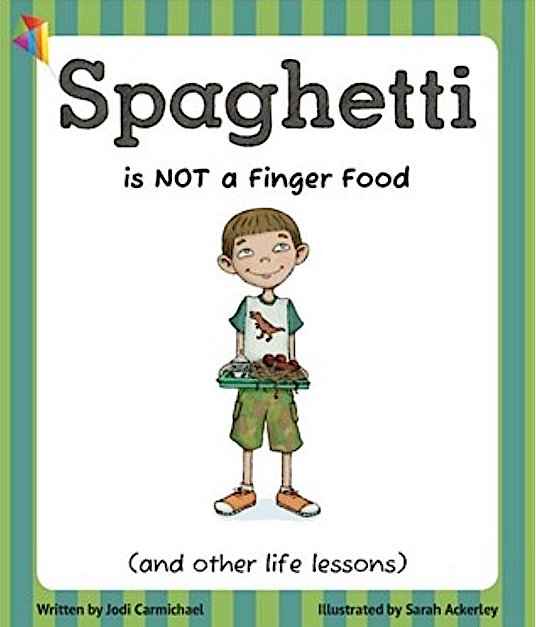
Spaghetti is NOT a Finger Food (and other life lessons)

Written by Jodi Carmichael 
Illustrated by Sarah Ackerley
Little Pickle Press/Sourcebooks Jabberwocky
978-1-939775-03-0
152 pp.
Ages 7-10
2013

Though the number of books with characters with ASD is ever increasing (see my abbreviated book list from 2013 here, revised this week), few books are written from the perspective of protagonists on the spectrum, and very few from a preteen's point of view.  Spaghetti is NOT a Finger Food (and other life lessons) fits that niche and provides an enlightening approach to the thoughts and behaviour of a child with Asperger's Syndrome that will both teach and astound.

Spaghetti is NOT a Finger Food (and other life lessons) is a story told in 14 lessons (chapters) experienced in one school day by third grader Connor Campbell, a little boy on the spectrum.  Amidst his passion for routines and strict adherence to the rules–except when they go against other rules or his thinking leads him astray–Connor is a boy with much knowledge, insight and perspective, though some students may label him as "weird."  He loves counting and he prefers the blue vinyl chair, not the red one, in the office–sadly he is sent there regularly–and smooth things rather than those with rough or squiggly edges and he adores dogs and dinosaurs and seeing others happy.  Of course, as a child and one with Asperger's, his choices don't always make sense to others, and while he can be rather entertaining, he can be frustrating and frustrated when misunderstood.  Fortunately, Connor gets a chance to show off his knowledge and make things right when a dog gets loose in the school, demonstrating that he has valuable and hidden strengths (even if he does do some silly things like dump spaghetti on his head).
From Spaghetti is NOT a Finger Food (and other life lessons) 
by Jodi Carmichael 
illus. by Sarah Ackerley
Jodi Carmichael, whose YA book Forever Julia (Great Plains Teen Fiction, 2015) took on the heavy issues of anxiety, grief and abusive relationships, switches flawlessly to the voice of a young child with Asperger's (though I guess the switch is actually the other way since Spaghetti is NOT a Finger Food (and other life lessons) was published in 2013).  Connor's voice is clearly defined, in his head at least, and after a few chapters or lessons, the reader will begin to understand his thought processes and choices.  What Connor's peers and teachers and principal and custodian cannot see or hear is what Jodi Carmichael imparts in his story and it all makes sense.  We might not agree with what he says or does but his lovely resource teacher Mrs. Rosetti helps him and the reader see his day from a different perspective and the path it took and how it could be different the next time.  Connor may be learning that spaghetti is not a finger food but we all learn why he might think it is under certain circumstances and appreciate his unique take on everything from geckos, to library stools and face wrinkles.  Like all of us, Connor is special in his own way and Jodi Carmichael has provided an accessible story about a child with Asperger's Syndrome that will ensure tolerance and compassion in ways that no classroom lesson ever could.

April 20, 2016

Everyday Hero


by Kathleen Cherry
Orca Book Publishers
9781459809826
168 pp.
Ages 8-11
March 15, 2016
Reviewed from advance reading copy


Everyday Hero is the story of thirteen-year-old narrator Alice who moves to Kitimat with Dad while Mom stays in Vancouver temporarily to assist her elderly parents.  Alice is very clear in her own mind about who she is, what she likes and dislikes, and what she can do and can’t and doesn’t want to do. But Dad refuses to tell the middle school of Alice’s Asperger’s, convinced she’ll have a chance to be a normal kid without the label.

This omission results in a series of detentions where Alice meets Megan, a goth-inspired teen who seems to attract negative attention but is also the only one who recognizes and helps Alice with her vulnerabilities in social situations, with distractions from routine, and with confusing verbal expressions.  While Alice is wondering whether she can be normal, “average in type, appearance, achievement, function and development” (pg. 54), Megan gives her opportunities to be so. But when Megan decides to get away from her mom’s abusive boyfriend and meet up with an online friend in Vancouver, Alice does what any normal friend would do: she tries to keep her friend safe.

Kathleen Cherry balances Alice’s story on our vague but overwhelmingly-supported ideas of normalcy by demonstrating that anyone can be normal, just as anyone can be a hero, in the right circumstances.  Don’t assume Alice’s thoughts, powerfully reflected in the seemingly erratic and tangential text, are evidence of anything but something normal, though they are manifestations of the syndrome with which she  is labelled. Kathleen Cherry, as a school counselor, get Alice’s voice just right.

Everyday Hero is heavily character-driven though it focuses on the issues of trust and responsibility.  But the message about the perils of labelling and trying to make everyone fit into one definition of normal is clear, and Everyday Hero helps the reader see into a very different but just as real one.


(A version of this review, in conjunction with one about Don't Tell, Don't Tell, Don't Tell by Liane Shaw, was originally written for and published in Quill & Quire, as noted in the citation below.)


Kubiw, H. (2016, May). [Review of the book Everyday Hero by Kathleen Cherry]. Quill & Quire, 82 (4): 37.

April 19, 2016

Don't Tell, Don't Tell, Don't Tell

by Liane Shaw
Second Story Press
978-1-927583-95-1
272 pp.
Ages 12-16
April 2016

Frederick, 16, in Don’t Tell, Don’t Tell, Don’t Tell, would loathe to be lumped into a group of individuals with Asperger’s syndrome or labelled with his “disorder”.
Giving me a label groups me together with many others who share a cerain number of common characteristics that would then define me as a syndrome or a disorder rather than a person with a mind of my own.  I don’t want to be a syndrome, and I am far too orderly to be a disorder.
     I just want to be me.
(pg. 50)
Though Frederick is different from many of his peers in his love of numbers and math, of routines, and of the dictionary and in the difficulties he has interpreting idioms and slang with which he is unfamilia, he is relatively comfortable in his own skin, having developed some stellar coping strategies for dealing with verbal abuse,  and ensuring that he is able to meet his needs for quiet and routines.  But, when he is befriended by another awkward teen, his routine becomes far more  tenuous and Frederick is taken outside his comfort zone.

Don’t Tell, Don’t Tell, Don’t Tell begins with Frederick being questioned by the police about the disappearance of the teen who’d befriended him, Angel Martinez.  Though their friendship had been discreet and primarily involved Angel using Frederick as a sounding board, Frederick gets lassoed into keeping a secret for her.  Questioning by the police, however, has Frederick carefully choosing his words, always reminding himself “Don’t tell, don’t tell, don’t tell.” When it seems that Angel’s secret plan isn’t as perfect as anticipated, Frederick begins to rethink that promise and find a way to stay true to himself and bring order to a very disordered situation.

The mature situations that have Angel scrambling for a way out makes Don’t Tell, Don’t Tell, Don’t Tell more appropriate for a young adult audience but the issue of labelling and keeping secrets are far more universal.  Liane Shaw, whose previous books Fostergirls (Second Story Press, 2011) and The Color of Silence (Second Story Press, 2013) capably dealt with difficult issues of foster care and guilt, continues to demonstrate the empathy needed to understand and help teens with the emotional, behavioural and physical problems.  Don’t Tell, Don’t Tell, Don’t Tell takes us into the world of a boy with Asperger’s and a girl whose efforts to make friends take a bad turn and demonstrates that we all are looking to find a way to fit into the world, whether it’s a world we make for ourselves or one into which we try to insinuate ourselves.


(A version of this review, in conjunction with one about Everyday Hero by Kathleen Cherry, was originally written for and published in Quill & Quire, as noted in the citation below.)


Kubiw, H. (2016, May). [Review of the book Don't Tell, Don't Tell, Don't Tell by Liane Shaw]. Quill & Quire, 82 (4): 37.

March 30, 2013

World Autism Awareness Day, April 2: Book List

 
(updated June 2017)

According to Autism Society Canada, Autism Spectrum Disorder (ASD) is a neurological disorder that affects the way the brain processes information, resulting in developmental disability.  Communication, social interactions and behaviours are affected to different degrees in individuals with ASD.

To encourage education and awareness of ASDs, April 2nd has been designated as World Autism Awareness Day. To support that mandate, I'd like to present this short list of youngCanLit book titles that includes fiction with characters that display ASDs or that aim to educate readers about Autism Spectrum Disorder. Share this reading with others and help extend those who have a better understanding of this neurological disorder.

PICTURE BOOKS

Dinosaur Diego: The World's Smartest Dude: Asperger's Syndrome (Autism)
by Jill Bobula and Katherine Bobula
Illustrated by Rob Hall
Wildberry Productions
36 pp.
Ages 5-9
2008
Diego may know everything about dinosaurs but his daily life isn't as clear cut as he tells readers about his Asperger's.


FICTION


Burn
by Alma Fullerton
Dancing Cats Books/Cormorant
255 pp.
Ages 10-13
2010
After her mom takes off, Casey must deal with her autistic sister Ginny, taunts from friends and bullies, and her mom's partner's despair and despondency.  


Don't Tell, Don't Tell, Don't Tell
by Liane Shaw
Second Story Press
272 pp.
Ages 12-16
2016
Teen Frederick is taken outside his comfort zone of routines when he helps a friend.
Reviewed here


The Encyclopedia of Me
by Karen Rivers
Arthur A. Levine Books/Scholastic Canada
251 pp.
Ages 10-13
2012
In the encyclopedia of her life that she writes while grounded, Tink deals with all events and issues, including living with her autistic older brother Seb.


Everyday Hero
by Kathleen Cherry
Orca Book Publishers
168 pp.
Ages 8-11
2016
Thirteen-year-old Alice may be initially helped by goth-inspired Megan but it's Alice who ends up being the hero to her new friend.
Reviewed here


Fragile Bones: Harrison and Anna  
by Lorna Schultz Nicholson 
Clockwise, Press 
217 pp.
Ages 13+ 
2015
Hugh-functioning autistic teen Harrison teams up with Anna in the Best Buddies program at their high school.
Reviewed here


Gemini Summer 
by Iain Lawrence 
Delacorte Press / Random House Canada
261 pp.
Ages 10-13
2006
It's 1965 and the summer of the Apollo Gemini mission. In Canada, the tragic death of Beau River, the younger brother of the protagonist Danny, is initially blamed on Dopey, a boy who ostensibly has a developmental disorder such as ASD.


Looking for X
by Deborah Ellis
Groundwood Books
132 pp.
Ages 11-13
1999
Eleven-year-old Khyber who lives with her mom and autistic twin brothers in Toronto's Regent Park befriends a homeless woman, X.


Seeing Red

by Ann Louise MacDonald
Kids Can Press
220 pp.
Ages 9-13
2009
Frankie, who has disturbing dreams with unclear messages, volunteers at a therapeutic horse ranch where he works with a young autistic boy.


Shimmerdogs
by Dianne Linden
Thistledown Press
134 pp.
Ages 9-13
2008
When his mother joins a peacekeeping mission in Bosnia, Mike becomes fixated on death, finding solace with unusual companions both real and otherwise. 


Shooter 
by Caroline Pignat 
Razorbill
320 pp.
Ages 12+
2016
Five teens barricaded in a school washroom during lockdown include a girl and her older autistic brother.
Reviewed here


The Space Between
by Don Aker
HarperCollins Canada
245 pp.
Ages 14+
2007
Eighteen-year-old Jace deals with middle-child syndrome, between his wildly successful older brother Stephan, now dead, and Lucas, his younger brother whose autism garners him much needed special attention.


Spaghetti is NOT a Finger Food (And other life lessons)
by Jodi Carmichael 
Illus. by Sarah Ackerley
Little Pickle Press/Sourcebooks Jabberwocky
152 pp.
Ages 7-10
2013
Gr. 3 student Connor shares life lessons from a single day at school in which his ASD helps define his routines, likes and dislikes and interactions with others.


Waiting For No One
by Beverley Brenna 
Red Deer Press
187 pp.
Ages 13+
2010
Taylor (from Wild Orchid, 2005) is becoming more independent after her summer of change. She is taking a university course, working at a bookstore and learning how to keep herself out of the "red zone" where she speaks and acts inappropriately.


Wild Orchid
by Beverley Brenna
Red Deer Press
156 pp.
Ages 12+
2005
Eighteen-year-old Taylor, who has Asperger's, graduates from high school and pursues her goals to get a job, make a couple of friends and find a boyfriend.


You Can't Take Micky!
by Sonia Craddock
Scholastic Canada
137 pp.
Ages 9-11
1986
Siblings Claire (13) and Adam (11) run away with their four-year-old autistic cousin Micky when they fear he will be placed in an institution.