Showing posts with label Asperger's. Show all posts

June 21, 2017

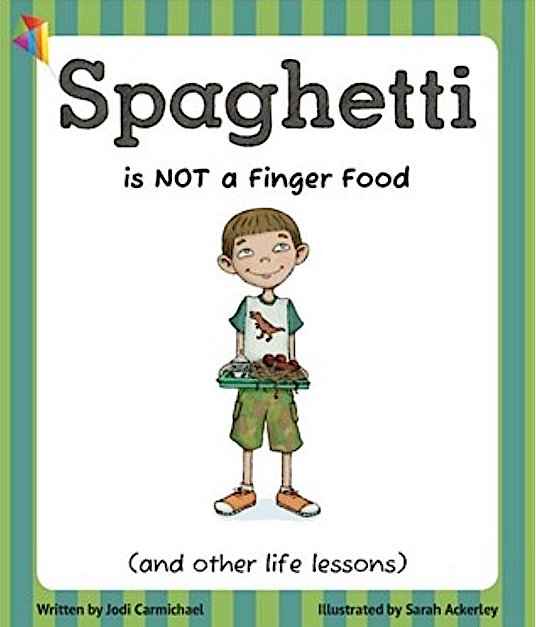
Spaghetti is NOT a Finger Food (and other life lessons)

Written by Jodi Carmichael 
Illustrated by Sarah Ackerley
Little Pickle Press/Sourcebooks Jabberwocky
978-1-939775-03-0
152 pp.
Ages 7-10
2013

Though the number of books with characters with ASD is ever increasing (see my abbreviated book list from 2013 here, revised this week), few books are written from the perspective of protagonists on the spectrum, and very few from a preteen's point of view.  Spaghetti is NOT a Finger Food (and other life lessons) fits that niche and provides an enlightening approach to the thoughts and behaviour of a child with Asperger's Syndrome that will both teach and astound.

Spaghetti is NOT a Finger Food (and other life lessons) is a story told in 14 lessons (chapters) experienced in one school day by third grader Connor Campbell, a little boy on the spectrum.  Amidst his passion for routines and strict adherence to the rules–except when they go against other rules or his thinking leads him astray–Connor is a boy with much knowledge, insight and perspective, though some students may label him as "weird."  He loves counting and he prefers the blue vinyl chair, not the red one, in the office–sadly he is sent there regularly–and smooth things rather than those with rough or squiggly edges and he adores dogs and dinosaurs and seeing others happy.  Of course, as a child and one with Asperger's, his choices don't always make sense to others, and while he can be rather entertaining, he can be frustrating and frustrated when misunderstood.  Fortunately, Connor gets a chance to show off his knowledge and make things right when a dog gets loose in the school, demonstrating that he has valuable and hidden strengths (even if he does do some silly things like dump spaghetti on his head).
From Spaghetti is NOT a Finger Food (and other life lessons) 
by Jodi Carmichael 
illus. by Sarah Ackerley
Jodi Carmichael, whose YA book Forever Julia (Great Plains Teen Fiction, 2015) took on the heavy issues of anxiety, grief and abusive relationships, switches flawlessly to the voice of a young child with Asperger's (though I guess the switch is actually the other way since Spaghetti is NOT a Finger Food (and other life lessons) was published in 2013).  Connor's voice is clearly defined, in his head at least, and after a few chapters or lessons, the reader will begin to understand his thought processes and choices.  What Connor's peers and teachers and principal and custodian cannot see or hear is what Jodi Carmichael imparts in his story and it all makes sense.  We might not agree with what he says or does but his lovely resource teacher Mrs. Rosetti helps him and the reader see his day from a different perspective and the path it took and how it could be different the next time.  Connor may be learning that spaghetti is not a finger food but we all learn why he might think it is under certain circumstances and appreciate his unique take on everything from geckos, to library stools and face wrinkles.  Like all of us, Connor is special in his own way and Jodi Carmichael has provided an accessible story about a child with Asperger's Syndrome that will ensure tolerance and compassion in ways that no classroom lesson ever could.

April 20, 2016

Everyday Hero


by Kathleen Cherry
Orca Book Publishers
9781459809826
168 pp.
Ages 8-11
March 15, 2016
Reviewed from advance reading copy


Everyday Hero is the story of thirteen-year-old narrator Alice who moves to Kitimat with Dad while Mom stays in Vancouver temporarily to assist her elderly parents.  Alice is very clear in her own mind about who she is, what she likes and dislikes, and what she can do and can’t and doesn’t want to do. But Dad refuses to tell the middle school of Alice’s Asperger’s, convinced she’ll have a chance to be a normal kid without the label.

This omission results in a series of detentions where Alice meets Megan, a goth-inspired teen who seems to attract negative attention but is also the only one who recognizes and helps Alice with her vulnerabilities in social situations, with distractions from routine, and with confusing verbal expressions.  While Alice is wondering whether she can be normal, “average in type, appearance, achievement, function and development” (pg. 54), Megan gives her opportunities to be so. But when Megan decides to get away from her mom’s abusive boyfriend and meet up with an online friend in Vancouver, Alice does what any normal friend would do: she tries to keep her friend safe.

Kathleen Cherry balances Alice’s story on our vague but overwhelmingly-supported ideas of normalcy by demonstrating that anyone can be normal, just as anyone can be a hero, in the right circumstances.  Don’t assume Alice’s thoughts, powerfully reflected in the seemingly erratic and tangential text, are evidence of anything but something normal, though they are manifestations of the syndrome with which she  is labelled. Kathleen Cherry, as a school counselor, get Alice’s voice just right.

Everyday Hero is heavily character-driven though it focuses on the issues of trust and responsibility.  But the message about the perils of labelling and trying to make everyone fit into one definition of normal is clear, and Everyday Hero helps the reader see into a very different but just as real one.


(A version of this review, in conjunction with one about Don't Tell, Don't Tell, Don't Tell by Liane Shaw, was originally written for and published in Quill & Quire, as noted in the citation below.)


Kubiw, H. (2016, May). [Review of the book Everyday Hero by Kathleen Cherry]. Quill & Quire, 82 (4): 37.

April 19, 2016

Don't Tell, Don't Tell, Don't Tell

by Liane Shaw
Second Story Press
978-1-927583-95-1
272 pp.
Ages 12-16
April 2016

Frederick, 16, in Don’t Tell, Don’t Tell, Don’t Tell, would loathe to be lumped into a group of individuals with Asperger’s syndrome or labelled with his “disorder”.
Giving me a label groups me together with many others who share a cerain number of common characteristics that would then define me as a syndrome or a disorder rather than a person with a mind of my own.  I don’t want to be a syndrome, and I am far too orderly to be a disorder.
     I just want to be me.
(pg. 50)
Though Frederick is different from many of his peers in his love of numbers and math, of routines, and of the dictionary and in the difficulties he has interpreting idioms and slang with which he is unfamilia, he is relatively comfortable in his own skin, having developed some stellar coping strategies for dealing with verbal abuse,  and ensuring that he is able to meet his needs for quiet and routines.  But, when he is befriended by another awkward teen, his routine becomes far more  tenuous and Frederick is taken outside his comfort zone.

Don’t Tell, Don’t Tell, Don’t Tell begins with Frederick being questioned by the police about the disappearance of the teen who’d befriended him, Angel Martinez.  Though their friendship had been discreet and primarily involved Angel using Frederick as a sounding board, Frederick gets lassoed into keeping a secret for her.  Questioning by the police, however, has Frederick carefully choosing his words, always reminding himself “Don’t tell, don’t tell, don’t tell.” When it seems that Angel’s secret plan isn’t as perfect as anticipated, Frederick begins to rethink that promise and find a way to stay true to himself and bring order to a very disordered situation.

The mature situations that have Angel scrambling for a way out makes Don’t Tell, Don’t Tell, Don’t Tell more appropriate for a young adult audience but the issue of labelling and keeping secrets are far more universal.  Liane Shaw, whose previous books Fostergirls (Second Story Press, 2011) and The Color of Silence (Second Story Press, 2013) capably dealt with difficult issues of foster care and guilt, continues to demonstrate the empathy needed to understand and help teens with the emotional, behavioural and physical problems.  Don’t Tell, Don’t Tell, Don’t Tell takes us into the world of a boy with Asperger’s and a girl whose efforts to make friends take a bad turn and demonstrates that we all are looking to find a way to fit into the world, whether it’s a world we make for ourselves or one into which we try to insinuate ourselves.


(A version of this review, in conjunction with one about Everyday Hero by Kathleen Cherry, was originally written for and published in Quill & Quire, as noted in the citation below.)


Kubiw, H. (2016, May). [Review of the book Don't Tell, Don't Tell, Don't Tell by Liane Shaw]. Quill & Quire, 82 (4): 37.

March 30, 2013

World Autism Awareness Day, April 2: Book List

 
(updated June 2017)

According to Autism Society Canada, Autism Spectrum Disorder (ASD) is a neurological disorder that affects the way the brain processes information, resulting in developmental disability.  Communication, social interactions and behaviours are affected to different degrees in individuals with ASD.

To encourage education and awareness of ASDs, April 2nd has been designated as World Autism Awareness Day. To support that mandate, I'd like to present this short list of youngCanLit book titles that includes fiction with characters that display ASDs or that aim to educate readers about Autism Spectrum Disorder. Share this reading with others and help extend those who have a better understanding of this neurological disorder.

PICTURE BOOKS

Dinosaur Diego: The World's Smartest Dude: Asperger's Syndrome (Autism)
by Jill Bobula and Katherine Bobula
Illustrated by Rob Hall
Wildberry Productions
36 pp.
Ages 5-9
2008
Diego may know everything about dinosaurs but his daily life isn't as clear cut as he tells readers about his Asperger's.


FICTION


Burn
by Alma Fullerton
Dancing Cats Books/Cormorant
255 pp.
Ages 10-13
2010
After her mom takes off, Casey must deal with her autistic sister Ginny, taunts from friends and bullies, and her mom's partner's despair and despondency.  


Don't Tell, Don't Tell, Don't Tell
by Liane Shaw
Second Story Press
272 pp.
Ages 12-16
2016
Teen Frederick is taken outside his comfort zone of routines when he helps a friend.
Reviewed here


The Encyclopedia of Me
by Karen Rivers
Arthur A. Levine Books/Scholastic Canada
251 pp.
Ages 10-13
2012
In the encyclopedia of her life that she writes while grounded, Tink deals with all events and issues, including living with her autistic older brother Seb.


Everyday Hero
by Kathleen Cherry
Orca Book Publishers
168 pp.
Ages 8-11
2016
Thirteen-year-old Alice may be initially helped by goth-inspired Megan but it's Alice who ends up being the hero to her new friend.
Reviewed here


Fragile Bones: Harrison and Anna  
by Lorna Schultz Nicholson 
Clockwise, Press 
217 pp.
Ages 13+ 
2015
Hugh-functioning autistic teen Harrison teams up with Anna in the Best Buddies program at their high school.
Reviewed here


Gemini Summer 
by Iain Lawrence 
Delacorte Press / Random House Canada
261 pp.
Ages 10-13
2006
It's 1965 and the summer of the Apollo Gemini mission. In Canada, the tragic death of Beau River, the younger brother of the protagonist Danny, is initially blamed on Dopey, a boy who ostensibly has a developmental disorder such as ASD.


Looking for X
by Deborah Ellis
Groundwood Books
132 pp.
Ages 11-13
1999
Eleven-year-old Khyber who lives with her mom and autistic twin brothers in Toronto's Regent Park befriends a homeless woman, X.


Seeing Red

by Ann Louise MacDonald
Kids Can Press
220 pp.
Ages 9-13
2009
Frankie, who has disturbing dreams with unclear messages, volunteers at a therapeutic horse ranch where he works with a young autistic boy.


Shimmerdogs
by Dianne Linden
Thistledown Press
134 pp.
Ages 9-13
2008
When his mother joins a peacekeeping mission in Bosnia, Mike becomes fixated on death, finding solace with unusual companions both real and otherwise. 


Shooter 
by Caroline Pignat 
Razorbill
320 pp.
Ages 12+
2016
Five teens barricaded in a school washroom during lockdown include a girl and her older autistic brother.
Reviewed here


The Space Between
by Don Aker
HarperCollins Canada
245 pp.
Ages 14+
2007
Eighteen-year-old Jace deals with middle-child syndrome, between his wildly successful older brother Stephan, now dead, and Lucas, his younger brother whose autism garners him much needed special attention.


Spaghetti is NOT a Finger Food (And other life lessons)
by Jodi Carmichael 
Illus. by Sarah Ackerley
Little Pickle Press/Sourcebooks Jabberwocky
152 pp.
Ages 7-10
2013
Gr. 3 student Connor shares life lessons from a single day at school in which his ASD helps define his routines, likes and dislikes and interactions with others.


Waiting For No One
by Beverley Brenna 
Red Deer Press
187 pp.
Ages 13+
2010
Taylor (from Wild Orchid, 2005) is becoming more independent after her summer of change. She is taking a university course, working at a bookstore and learning how to keep herself out of the "red zone" where she speaks and acts inappropriately.


Wild Orchid
by Beverley Brenna
Red Deer Press
156 pp.
Ages 12+
2005
Eighteen-year-old Taylor, who has Asperger's, graduates from high school and pursues her goals to get a job, make a couple of friends and find a boyfriend.


You Can't Take Micky!
by Sonia Craddock
Scholastic Canada
137 pp.
Ages 9-11
1986
Siblings Claire (13) and Adam (11) run away with their four-year-old autistic cousin Micky when they fear he will be placed in an institution.