Showing posts with label fathers. Show all posts

March 05, 2025

Happenstance

Written by Debra Loughead
BWL Publishing
978-0-228632696
284 pp.
Ages 12+
January 2025 
 
What would bring a teen from a wealthy family with both parents and a younger brother and, until recently, a nanny/housekeeper together with a girl who lives with her struggling mom who left her abusive husband, can't hold down a job and now dates incessantly looking for a new man? A ring, a moonstone ring. One loses it, one finds it. It's all happenstance.
 
Happenstance is told in the alternating voices of Sophie and Tara. Sophie has a dad who is a bank VP and is always travelling while her mom spends tons of money, often on new age stuff. Her mom has been hospitalized previously for depression and her brother Jonah deals with anxiety. Now that Dhanu, their nanny/housekeeper, has returned to Sri Lanka, their household seems unsettled. It feels even worse when the moonstone ring Dhanu had given Sophie's mom goes missing when Sophie borrows it.
 
That very ring is found by Tara, a Grade 10 student who loves acting and is in the school's production of "Our Town" though only as an understudy to the lead role. At home, her mom had tried repeatedly to leave Tara's disreputable dad but finally made it permanent in the past year. Still Mom can't keep a job and is always going on dates with guys she meets on dating apps, hopeful of meeting the right one. Though Tara's friend Priya tells her to look for the owner of the ring, Tara is reluctant to give up something so mesmerizing, especially after her mother wins $75,000 and Tara feels like the ring had something to do with their change of luck.
 
As Tara contemplates returning the ring or not, and Sophie wonders whether to look for it or not–both girls are grappling with family dynamics that leave them resentful and confused–their lives are taking odd turns, particularly with their best friends and with a new guy, Silas. He's the lead in Tara's school play and he's Sophie's new neighbour. But who will catch his eye?
 
Debra Loughead, who has previously published multiple books as Deb Loughead including The Secrets We Keep, Bright Shining Moment and The Snowball Effect, looks at two girls and how different they may be and yet how similar too. No one would ever see the similarities, but the moonstone ring allows their lives to become parallel and flipped to some degree. The superstitions tied to that ring may or may not be legit. The coincidences that occur may be just that: accidental and unrelated. But it offers an opportunity to see that lives are not all unfortunate or all lucky. It's a question of perspective. When Sophie and Tara ultimately meet, and connect with Silas, the teens see what they have in common even among the distinctions of their lives. Their new journeys with their families, their friends, and each other may have been prompted by a moonstone, a gem that signifies new beginnings, but how those new beginnings manifest is all up to those kids. Debra Loughead gives them the character to determine the nature of those new beginnings.
 
I don't know if that moonstone ring had any impact on these teens. After all, their lives are constantly in flux with friends, family, school, career choices, and more. But Debra Loughead makes us believe that things can happen sometimes by chance and sometimes by design and it's up to us to work with what we're given and make choices that are right for more than just ourselves.

September 17, 2021

Valley of the Rats

Written by Mahtab Narsimhan
DCB
978-1-77086-628-7
232 pp.
Ages 9-12
September 2021

Twelve-year-old Krish Roy has taken himself out of his comfort zone of the indoors, books and cleanliness when he suggests (or perhaps agrees) to an outdoor camping trip with his nature photographer father. Always cognizant of what a disappointment he is to his father who holds Krish's cousin Anjali as an example of how he wishes Krish would be i.e., optimistic, adventurous, outdoorsy, Krish is determined to bond with his dad, even if he has to arm himself with plenty of hand-sanitizer and candies to calm him.

But from the onset, everything seems to go wrong. In the bamboo forests of the Ladakh Range (India), their GPS gets busted and they get lost, they can't get a cell signal, Krish loses his pocket hand sanitizer, a thunderstorm hits and there are rats. Oh, there are rats, and plenty of them. Hopeful that the rats will lead them to people, Krish and his Dad follow them to a village of huts. There they are given shelter by the villagers of Imdur but warned not to leave their guest house or wander the village. In fact, they are adamant that Dad cannot take photos as they do not want people knowing of them.

However, Krish learns soon enough that this camping trip is actually an assignment Kabir Roy has undertaken, hopeful of a blockbuster photo story about a rumoured village of rat worshippers. But all Krish wants to do is fix their radio and get out of Imdur, a community rife with rats and unhygienic conditions. As Krish and his father both try to meet their own needs, the villagers of Imdur, lead by the shaman Imma and her daughter Tashi, try to maintain their secretive community. With a clash of cultures, between father and son, and the reclusive Imdur and those beyond its borders, there may be no happy ending here.

Each time Mahtab Narsimhan takes us into India as she did in several of her earlier middle-grade novels, including her Silver Birch award-winning The Third Eye (2007), The Tiffin (2011) and Mission Mumbai (2016), she drops us into cultures resplendent in myths, food, celebrations, and even superstitions. In Valley of the Rats, she again takes us into a world that is different and even surreal (there is an element of the fantastic in Imdur) and makes it credible. Because Mahtab Narsimhan's fictional village of Imdur was founded after the ecological event called Mautam, there is plausibility to communities like it finding unusual means of survival. Whether or not there really is an Imdur, perhaps by a different name, Mahtab Narsimhan has taken us there, to live with these people who wear rat-skin coats and feed what we consider vermin as if they are their pets or deities. As such, readers should know that they will truly be entering the valley of the rats, and there are no shortage of the creatures.

Still, Valley of the Rats is about survival. It's about the villages of Imdur seeking to survive in a world that gave them famine and rats and no government help. And it's about Krish enduring incredible anxiety to make his father accept him as he is–imagine a germaphobe in a community of rats–and the two of them surviving their encounter with a community that has secreted itself away from the world. Survival by its very nature is precarious; if it was easy, it wouldn't be so uncertain. Who survives and how in Mahtab Narsimhan's story is yet another secret–the plot is rife with them–that will only be revealed in the climatic last few pages but it's worth the wild adventure that is Valley of the Rats.

August 28, 2021

The Forest of Stolen Girls

Written by June Hur
Feiwel and Friends
978-1-250-22958-8
384 pp.
Ages 13-18
April 2021
 
Driven to find the connection between the Forest Incident, in which his two daughters were found near where a young woman was killed, and the disappearance of 13 girls since then, Detective Min Jewoo pursued an investigation onto the island of Jeju in early 1400s Joseon (Korea). But the detective goes missing, and now his daughter Min Hwani, 18, returns to the island of her birth to find her father and perhaps reconnect with her younger sister, Min Maewol, now 15, who was left on the island to apprentice with Shaman Nokyung five years ago. Still, how can Hwani investigate on an island rife with superstition, with villagers petrified of losing their daughters to an unknown menace in the Gotjawal Forest or being selected as tribute women for Ming China, and stay safe herself while trying to work with her angry sister, resentful of her abandonment and mistreatment by her family? Having learned much from her detective father, Hwani becomes the investigator, probing the disappearance of the missing young women, and the Forest Incident, as well as his disappearance. Who she can trust or doesn't differs greatly from that of Maewol but the two sisters find a way to come together and delve into the mystery of the missing and the suspicious man in the white mask.

I do not want to reveal too much about The Forest of Stolen Girls as it is a mystery at its foundation, albeit a historical one in a unique time period. Just as she did in her debut novel The Silence of Bones (2020), June Hur enthrals with her setting as well as her story. With both her books set in the time of the Joseon Dynasty and by also scattering in words unfamiliar to most (e.g., jukjangdo, shin-byung, jeomjip, hanji), June Hur has created a new character of place of which readers will want to learn more. I was constantly looking up more about this historical period, and devoured June Hur's historical note appended to her story, trying to understand the people, their ways of life, their relationship with geographical neighbours (including becoming a vassal state) and the practice of offering tribute women. But within that amazing context, June Hur has woven a story of mystery, of family lost and found. There are countless characters who may or may not know something valuable and some who present facades of compassion and justice while evil lurks in the forest and the villages of Jeju. Who is responsible for taking the girls is but one mystery that needs to be solved, as is the location of Detective Min, and who can be trusted is unknown. Because people are often weakened by their fears and their ineptitude, evil can show its horrific face any time. But evil can be subtle or it can be the stuff of nightmares. Making things right, though, that's what Hwani and others learn is the key.
Doing what is right, it is so utterly terrifying. And yet so freeing. (pg. 307)

April 19, 2018

The Big Bed

Written by Bunmi Laditan
Illustrated by Tom Knight
Farrrar Straus Giroux
978-0-374-30123-1
32 pp.
Ages 4-6
February 2018 

This child is going to be arguing cases before the Supreme Court; that is, before she ends up presiding over it and being appointed Chief Justice.  She is confident, articulate and, though very young, she knows what she's after and why she should get it. In this case, it's sleeping with Mom in The Big Bed.
From The Big Bed by Bunmi Laditan, illus. by Tom Knight
With eloquent arguments that she purports to be "reasonable" and filled with positive reinforcement about her father's skills as a wrestler and piggyback-ride giver, the little girl opines about what happens at night.  Seems the big bed isn't big enough for herself and her parents, and it's clear who will be leaving.  As she's afraid of the dark, and her father still has his own mommy–hence no need to share hers–she recommends a solution that she is sure he will "find not only satisfactory, but also quite generous."
From The Big Bed by Bunmi Laditan, illus. by Tom Knight
Bunmi Laditan, the blogger behind the very funny "The Honest Toddler" (at http://www.thehonesttoddler.com/), brings her trademark humour to this child's story.  Because it is all told from the child's perspective, from sitting her father down, arguing her case, presenting her plan to her mother (who laughs hysterically) and a culminating claim that "Mommy and I just want you to be happy", I feel like this is based on something Mommy Bunmi Laditan has experienced.  Everyone knows kids say the darnedest things and this little one does more than just say, she reasons and orates.  Supporting that perspective are British artist Tom Knight's illustrations.  His artwork, particularly that of the graphics the child herself creates, bolsters the cuteness of a child's perspective and makes The Big Bed as convincing as she is.

I truly hope her father can get some sleep on his new cot.
From The Big Bed by Bunmi Laditan, illus. by Tom Knight

December 18, 2017

The Nameless City

Written and illustrated by Faith Erin Hicks
Color by Jordie Bellaire
First Second (Roaring Brook Press)
978-1-62672-157-9
232 pp.
Ages 8-13
2016

It's time for me to join the growing fan base of Faith Erin Hicks's The Nameless City graphic novel series before the final book, The Divided Earth, comes out in September 2018.  There is lots to applaud in this first book of the middle grade trilogy (and even more in Book 2, The Stone Heart, which I will review next), not least of which are its diverse cultural landscape and strong characters.  Oh, and did I mention Faith Erin Hicks's vivid artwork inked and coloured by award-winning artist Jordie Bellaire

The Nameless City, the place, is probably the most important character in The Nameless City, the book.  It is an incredible metropolis, albeit one akin to that of 13th c. China, that has many names but all those given by outsiders, hence its moniker by those in the know as the Nameless City. Because of a tunnel, created mysteriously by the long-gone Northern People, through the mountain to the ocean, the city has been conquered time and time again. For the past 30 years, the city has been dominated by the Dao whose warrior leader, the General of All Blades, rules over the city.  Kaidu, a thirteen-year-old boy from the Dao homelands, has just arrived at the city's palace to train as a Dao warrior along with other boys under the tutelage of Erzi, son of the General of All Blades, and Erzi's bodyguard, the strange Myra.
From The Nameless City
by Faith Erin Hicks
When Kaidu gets lost outside the palace, he meets Rat, a spry runner and roof-jumper who, in exchange for food, teaches him to race and climb. Rat, who lives at the monastery at the Stone Heart, harbours much anger towards the city's invaders but she warms to Kai and he to her as they attempt to find a way to bring peace to the city and its people.  Of course, there are plots emerging both to bring the city together and to tear it apart, including an assassination attempt on the General and his son, but Kai and Rat are at the heart of trying to make things right for all the inhabitants of the Nameless City.
From The Nameless City 
by Faith Erin Hicks
Faith Erin Hicks may have used ancient China as an informal blueprint for the setting of The Nameless City, but the book is its own story, both in plot and characters, though some scenarios are all too familiar.  The Nameless City may be rich in cultural diversity but, with the numerous groups within the city and outside vying for place, whether to dominate or to live amicably with others, there comes much intolerance and discrimination, mostly between the invaders and the conquered.
From The Nameless City 
by Faith Erin Hicks
Fortunately, Faith Erin Hicks has created a world of possibilities for peace and tolerance, and she's done it with flair and detail, illustrating a passion against bad and for good.  The Nameless City, nominated for a 2017 Silver Birch Fiction award, could promote itself as historical fiction with the credibility of place and time but, for young readers, it's the composite of story and graphics that have made it a hit which inevitably will sustain it through Books 2 and 3.

➣➣➣➣➣➣➣

Check back for my review of Book 2 in The Nameless City trilogy, The Stone Heart (First Second, 2017).

March 11, 2016

Going for a Sea Bath

by Andrée Poulin
Illustrated by Anne-Claire Delisle
Pajama Press
978-1-927485-92-7
32 pp.
Ages 5-8
March, 2016

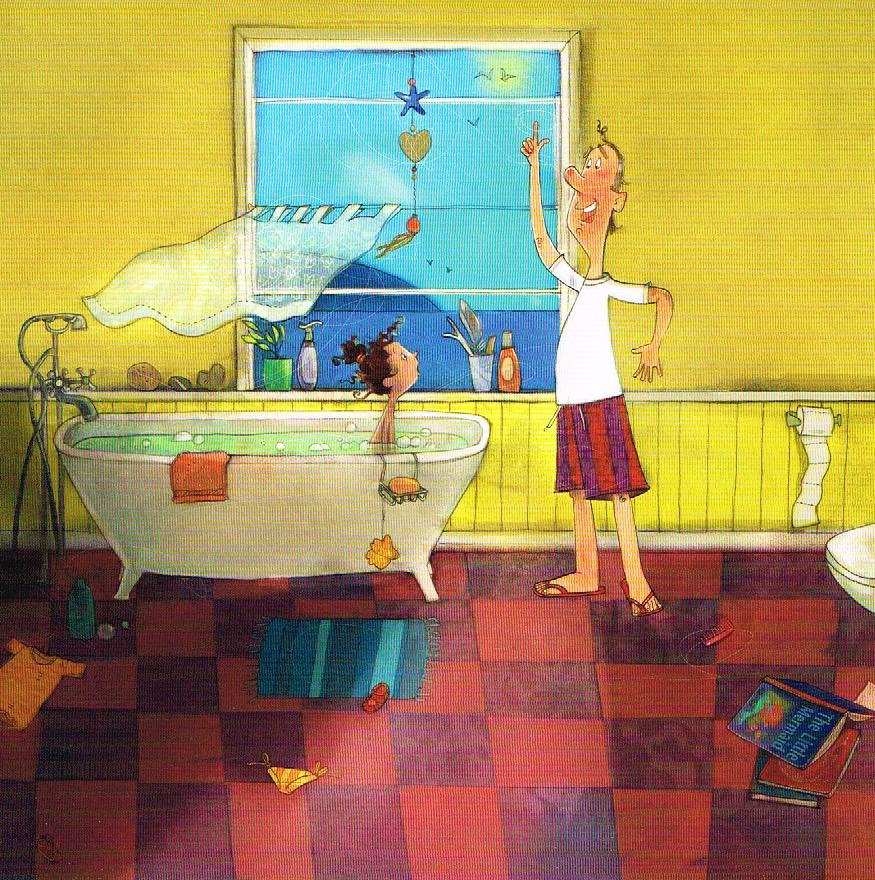
What is it with so many kids and baths?  For Leanne, “It’s so boring! It’s annoying! It’s a pain!”  But her father has an idea (or more than several) how to make it more fun and it has him running back and forth to bring the sea in to her bathtub.

There’s one turtle, then two eels, three clown fish, and four seahorses.  At the four seahorses, Leanne is exclaiming, “Taking a bath is exciting! It’s the best!”  But her father, delighted in  making his daughter happy, continues to feed her requests for more or different with five shrimps, six hermit crabs, seven sea urchins, eight anemones, nine starfish and ten octopi.  Needless to say, that bathtub becomes a little crowded and they must find a solution to a new problem.

Taking a bath has never been so much fun!  The repartee between father and daughter is priceless. There is such warmth and affection that it’s easy to see why Leanne’s father would take such delight in his daughter’s joy.  He’s a little goofy, with his paunch, flat feet and receding hairline, but he’s all about being a good dad.  And little Leanne, with her head full of curls and splattering of freckles, is the quintessential inquisitive child with eyes and heart wide open.

Though Andrée Poulin’s text is based on counting, and would be a fun way for parents or teacher to help young children with numbers,  Going for a Sea Bath is so much more than that.  It’s a fun romp at bath time, with a tub full of different sea creatures, while looking at their behaviour and physical characteristics (though I didn’t know octopi knew how to use a toilet or that the hermit crab would enjoy playing with toilet paper!) Andrée Poulin, whose award-winning The Biggest Poutine in the World I recently reviewed here on CanLit for LittleCanadians, is staggerinly effective in her story-telling, whether for the very young or middle-grade.

From Going for a Sea Bath by Andrée Poulin, illus. by Anne-Claire Delisle
But the precious factor for Going for a Sea Bath goes beyond priceless because of Anne-Claire Delisle’s illustrations. The details in all the animals and in the scenes she composes of Leanne and her father amongst the backdrop of the bathroom are so full that I continue to look back on the book and find more and more features that delight.  From the shrimp draped in Leanne’s hair and the reclining turtle to the octopus squeezing shampoo from a bottle, Anne-Claire Delisle’s artwork is charming.

And, if there isn’t enough to love about this book, teachers will love talking synonyms with the adjectives, like magnificent, phenomenal and super-stupendous, that Leanne’s father uses to describe each new idea.  Going for a Sea Bath is  some kind of wonderful!

December 27, 2015

The Biggest Poutine in the World


by Andrée Poulin
Translated by Brigitte Waisberg
Annick Press
978-1-55451-825-8
160 pp.
Ages 9-12
March, 2016
Reviewed from advance reading copy 

Using food to fill the void of loneliness and to quench the anguish of abandonment would not be unusual but using a 650-kilogram poutine to smother the emptiness of a cold, distant father and an absentee mother is definitely unique.  But that’s what twelve-year-old Thomas Gagné of Sainte-Alphonsine believes might offer his pathetic life some hope.
A glimmer of hope lights up in my mind.  A tiny, fragile, trembling glimmer.  I try not to pay too much attention to it. I’ve tasted disappointment before, and it doesn’t taste good. (pg. 11)
Though it has been seven long years since he’s seen his mother–and yet he does receive  very brief notes with cash from her at his birthday–Thomas has fond memories of her making poutine for him: peeling whole bags of potatoes, buying cheese curds together, making the gravy and cooking the fries.  Taking a cue from his favourite website, the Guinness World Records, Thomas concocts the idea of making a giant poutine and feeding hundreds of people so that he might earn a world record and become worthy of the attention of his parents.  So begins the Phenomenal Poutine Project, PPP, for which Thomas enlists the help of his best friend, Sam Bernier; Sam’s godfather and French fry truck owner Fat Frank; and Irene Ladouceur, who runs the local cheese shop and insists Thomas include her daughter Elie in the project.  But things run amok when the mayor, Thérèse Tartatcheff, refuses to rent the arena to Thomas for the event.

Thomas is not deterred, however, and cooks up a plan to kidnap the mayor’s Senegal parrot and then recover the bird, all to sway Tartatcheff into relenting to his PPP.  But, as with so many good plans, things go awry.  His friendships with Sam and Elie, his missing mother, his aloof father, an allergic reaction, a wayward parrot, and a candy-pink note all get heaped on top of each other and smothered in emotions.  Fortunately, all culminates in a satisfying fusion of humour and coming-of-age drama, with a side order of dysfunctional family.

The Biggest Poutine in the World is the English translation, by Annick Press’s Brigitte Waisberg, of Andrée Poulin’s La plus grosse poutine du monde (Bayard Canada, 2013) which won the 2014 Prix TD de littérature canadienne pour l’enfance et la jeunesse and the 2015 Le Prix Tamarac of the Ontario Library Association’s Forest of Reading.  The story is a visually-appealing mixture of graphics, including fun text messages between Thomas and Sam, drawings of emails between Thomas and Elie, an album of types of poutine (who knew there were so many!), and black-and-white sketches, with text set in large font and broken into small chapters with massive titles.  Young readers will undoubtedly appreciate the organizational format of the book but it’s the story line with which they will empathize.  Thomas is a boy with much resentment, anger and jealousy and yet he can still see the potential for hopefulness.  He even has a willingness and positivity to accept a challenge to captivate that hope although obstacles and self-doubt test him.

With The Biggest Poutine in the World, Andrée Poulin demonstrates an understanding of the complexities of a child’s mind when faced with familial conflict.  Being an accomplished author of over 30 French-language picture books and children’s novels, Andrée Poulin effortlessly translates that strife with compassion and humour into an uplifting tale of friendship and determination and emotional growth.  It does pull a bit at the heart, but no more than the occasional high-cholesterol poutine might.


(A version of this review was originally written for and published in Quill & Quire, as noted in the citation below.)

Kubiw, H. (2016, January/February). [Review of the book The Biggest Poutine in the World, by Andrée Poulin]. Quill & Quire, 82 (1): 44.

June 02, 2015

Bad Pirate

by Kari-Lynn Winters
Illustrated by Dean Griffiths
Pajama Press
978-1-927485-71-2
32 pp.
Ages 5-8
May, 2015

Of course Augusta Garrick wants to be a good pirate.  Her father is Captain Barnacle Garrick and he was all the things a good pirate should be: saucy, bold and selfish.  In other words, he was bad.  He has no problems tying up traitorous crew and making them walk the plank (though Augusta rescues them in her rowboat below).  Or fighting off a giant octopus. Or yelling at the crew for helping an older member.

So one night she decides to do something saucy, bold and selfish: she tosses out the wooden peg leg of Scully, the one-eyed pit bull who never lets Augusta get away with any kindnesses.  But the next morning a brewing storm demands Scully's attention to the main sail, and he can't climb!  Will someone be "feedin' the fishes" for that snafu?  Will it be Scully, Augusta or the whole crew when the ship sinks?

You know Kari-Lynn Winters will spin a great yarn, which she has, and it’s a rollicking good one of life on the high seas, living with barnacle-hardened sea dogs (literally) and a father-daughter relationship like no other.  There’s learning about being oneself and accepting others' strengths as important, even if different. The text is salted with the voice of pirates–though nicely scrubbed for young ears and eyes–and the fluency of a sea shanty.  And Dean Griffiths makes sure that his bold illustrations transport the reader to the swaying decks of that pirate ship, embellished with detailed rigging, portholes, ratlines and masts.  And the crew of spaniels, chihuahuas, bulldogs and sheepdogs (this list is limited only by my own limited dog knowledge) is resplendent in their kerchief do-rags, breeches, buckle boots and gold earrings, the captain especially dapper in his frock coat and feathered musketeer hat.  And Augusta fits right in, truly looking like a pirate, even if Kari-Lynn Winters has to help her, and everyone else on the ship, see that when she was good, she really was a very Bad Pirate. Lucky for them.

July 06, 2014

Depth of Field: A Pippa Greene Novel

by Chantel Guertin
ECW Press
978-1-77041-183-8
208 pp.
Ages 13+
For release August, 2014
Reviewed from Advance Reading Copy

Sixteen-year-old Pippa Greene, introduced in Chantel Guertin's The Rule of Thirds (ECW Press, 2013), is off to New York City to attend the two-week Tisch photography camp, along with Ben Baxter, the guy at school whose deplorable actions almost cost her that opportunity.  And, though she's upset to be leaving her new boyfriend, Dylan, and agreeing to refrain from communicating with him by text, email or phone (apparently to make their reunion all the sweeter), Pippa is determined to take all she can from this learning experience.

Pippa becomes fast friends with her roommate, Ramona Haverland, which is helpful for assignment work since Pippa is very unfamiliar with NYC.  Unfortunately, she and Ramona find that working with Ben Baxter, whom Pippa has relegated to "Dead to Me" status, occasionally is helpful. And as awkward as their occasional encounters are, Pippa is beginning to understand his motivation for what he did to her, and even suggest ways to help him resolve his own father issues.

Pippa's own father issue stems from the amazing bond she had with her dad when he was alive and now following in his photographic footsteps.  Fortunately she has the opportunity to work with  famous photographer David Westerly, who was also her father's best friend in college.  With David as a mentor and a valuable source of information, Pippa decides the theme for her first week's assignment will be her father: what he liked to do in New York City; where he liked to go; how her dad and mom met; etc.  Surprisingly, Pippa's mom is less than enthusiastic about Pippa working with David, as is her Aunt Emmy who lives in Pippa's dad's old apartment.

While David can be a self-absorbed jerk, he does present Pippa with a host of opportunities to develop her photographic skills and creativity, as well as learn more about her dad and ultimately herself.

Chantel Guertin throws a number of twists into Depth of Field that readers couldn't possible predict, which is as it should be.  If everything was obvious and laid out in front for the reader, it would surely be a dull read.  Just like Pippa who seems to be observant enough to be a good photographer, the reader must look a little deeper, question a little more and not take everything as it is presented.  It's amazing what you can see when you look a little deeper.  The big revelations may not be climactic–after all, they've been there all along–but their effects may well be.  And yet Chantel Guertin still manages to keep the text light-hearted and hopeful, never wallowing in family issues.

I had no idea that Pippa Greene would be coming back for another adventure after The Rule of Thirds, but I am delighted by Depth of Field in its furthering of Pippa's story and look forward to Book 3.  Here is my plea to Chantel Guertin: "There must be a next book!  How else will we know how Pippa's latest choices play out?  And you know which specific one I'm talking about, right?"  Happily, readers, you'll need to find out for yourselves.