Showing posts with label future. Show all posts

April 20, 2026

When You Dream Big!

Written and illustrated by Peter H. Reynolds
Orchard Books
978-1-339-00035-0
40 pp.
Ages 4–8
March 2026 
 
All of us will remember being asked what we'd like to be when we grow up. It's a rite of passage to be asked, to answer with something practical or unlikely, and then to change our minds. Knowing what you want to be when you grow older is a challenge. Ah, but dreaming big may be the start of a grand future. 
From When You Dream Big! written and illustrated by Peter H. Reynolds
When their teacher, Miss Rayna, plans a Dream Big Week, during which her students would share their dream jobs by writing them on colourful wings, Charley is stumped. Her classmates are enthusiastic about their ideas of going to mars, becoming an actor, or building a bridge across the ocean. They want to be engineers, astronauts, and artists. But Charley has no idea.  
From When You Dream Big! written and illustrated by Peter H. Reynolds
As she ponders and stresses about dreaming big, Charley becomes immobilized with anxiety. It's only when she focuses on her feet—"Ten toes — all pointing in the right direction" (pg. 20)—that she feels grounded enough to go on. The next morning, she awakens inspired by her dreams. She may not know what she wants to do when she grows up, but she know who she wants to be.
 
When You Dream Big! is less about doing than it is about being. Having dreams about your future job is normal, whether you're seven or twenty-seven. The dream can guide you in your education and your interests, and it can propel you to work hard. But dreaming about the future can be as much about who you will be as a person as what job you will have. Will you be adventurous? Will you be more assertive? Will you be responsible and caring? Peter H. Reynolds gives us a character who feels anxiety about the big dreams she's supposed to have and shows us that she's always had the right stuff to dream big, even if it is different than the dreams of her classmates. Even better, Peter H. Reynolds's Charley helps her classmates to dream big about who they can be, not just what they will do. 
From When You Dream Big! written and illustrated by Peter H. Reynolds
When I read Peter H. Reynolds's books, I always feel like someone has taken my hand. It's the hand of understanding, of compassion, and of guidance. He does this with his uplifting words and his heartfelt art. His text resonates with the voice of children who worry about their abilities or ideas, who compare themselves to others, and who feel joy when supported. Those same feelings come through in Peter H. Reynolds's pen and watercolour illustrations. Beyond the classroom posters of positive messages, he uses colour tellingly. His golds and purples are as reassuring as his words, and he spreads joy and reveals distraction and worry with colour and an effective use of line. His characters are fabulously diverse, and convincing in themselves. (Colby, a boy in a "Be You" shirt wants to make people smile more, while Josh wants to sleep a lot.) 
 
There is no one way to dream big, and Charley and her classmates and Miss Rayna all learn that this is true. With this epiphany comes relief, encouragement, and even creativity. So, when you dream big, good stuff can happen, even if it's not the dream coming true. (But maybe it will.)

September 05, 2025

The Sustainable School: A Journey Through Time and Energy

Written by Erica Fyvie
Illustrated by Scot Ritchie
Kids Can Press
978-1-5253-0668-6
56 pp.
Ages 8–12
September 2025 
 
As the Grade 6 Eco Club presents their project to conduct an energy audit at the school, a buried time capsule outside the school mutters away, waiting to be discovered and realizing it hasn't had many opportunities to learn. As the kids discuss the upcoming improvements to make the school more energy efficient including a rainwater collection system, a green roof, and solar panels, construction workers outside discover the time capsule—which seems to have its own thoughts as seen by its distinct speech bubbles—left by Class 6 from 1900. In the time capsule is a note from the teacher, Miss  Edna Sorman, who speaks of the impressive engineering of Birch Elementary Public School. So, with that note and the artifacts within, the kids of Class 6 of 2025 begin to see how things have changed over more than a century. 
From The Sustainable School: A Journey Through Time and Energy, written by Erica Fyvie, illustrated by Scot Ritchie
With their teacher dividing the class into 4 teams to tackle the issues of electricity, plumbing, building, and transportation, the Energy League is born. Through discussions and perusal of the time capsule's contents, the students think about the past, what their lives are like now, and then aim to apply what they've learned to predicting what things could be like in 2125, sparking plans for a Future Fair.
From The Sustainable School: A Journey Through Time and Energy, written by Erica Fyvie, illustrated by Scot Ritchie
Within the context of the discovery and the class's activities, young readers will learn about energy, kinetic energy, wastewater measures, retrofitting, and more. We get glimpses into the past when a hand-cranked ice-cream freezer was a luxury at $1.26, when innovations like electric light bulbs  and indoor plumbing were often seen as dangerous, and when the horse and buggy were the norm.  In addition to revealing much about where things were at around the turn of the century (the 20th century), author Erica Fyvie provides snippets about other time capsules, some accidental, some not, like the global seed vault, the Terracotta Warriors, the wreck of the Titanic, Voyager Golden Records, and Scott's hut in Antarctica, as well as reports about recycled building materials, food waste as a source of energy, and zero-fuel transportation.
I
From The Sustainable School: A Journey Through Time and Energy, written by Erica Fyvie, illustrated by Scot Ritchie
The Sustainable School covers a lot of information, but it does so in an engaging format. The use of a graphic-novel style to embed history, inquiry-based learning and STEM concepts will interest middle-grade readers and their teachers and parents. It is a story that does not need to be read in one sitting—though it could be—and can be used as a fabulous launching off for a myriad of science lessons on environmentalism and energy but also studies of history, particularly how things have changed. With those query lessons (see above for part of one based on the question, "Can we build a new building with only recycled materials?"; p. 40), Erica Fyvie offers educators a different way of looking at inquiry. She encourages focusing on the past as a step in the evolution of our infrastructure systems and to project how things might just change in the future. And with the illustrations by Scot Ritchie, whose artwork has enhanced the text of many picture books and non-fiction books (e.g., All Our Love, Frederica, and If You Can Dream It, You Can Do It), The Sustainable School becomes a welcome information book for middle graders and their classrooms. I always remark on the lightness of Scot Ritchie's artwork, probably because of his rendering it in pencil and then ink before colouring in Photoshop but it lends itself well to keeping information text manageable and hardly imposing or dull. In fact, Scot Ritchie's characters, who show the wonderful diversity of many classes today, and the graphic-novel format create a milieu for engagement.
From The Sustainable School: A Journey Through Time and Energy, written by Erica Fyvie, illustrated by Scot Ritchie
I really hope that Erica Fyvie and Scot Ritchie can extend this style of non-fiction to other topics, perhaps One Health or education. It is very reminiscent of Linda Bailey and Bill Slavin's The Good Times Travel Agency in the blending of graphics with time perspective and information, and I believe Erica Fyvie and Scot Ritchie honour those who've first accomplished much in presenting non-fiction books in captivating and informative ways. After all, looking back isn't languishing there; it's informing the future.

April 11, 2022

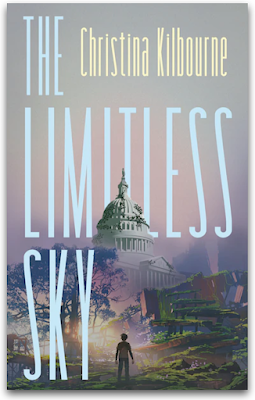
The Limitless Sky

Written by Christina Kilbourne
Dundurn
978-1-45974-887-3
384 pp.
Ages 12+
May 2022

They may be living in the same world, but Rook and Gage don't know it. 
 
Rook lives with her family in ArHK whose descendants, the Chosen Ones, had left the Outside hundreds of OT (Outside Time) years ago. In ArHK where she lives with her father and mother and young sister Sparrow in their pod on the Knowledge Level, one of four levels in ArHK, Rook is destined to be a Keeper, running the Archives and monitoring the Great Hall of Human Records, as is her family's heritage. 

Fifteen-year-old Gage lives with his parents, younger sister Brindle and dog Scruff in a yurt at a scouts' base camp. Organized by the Scholars, scouts have been going out for generations to find the Ship of Knowledge purportedly in the ancient city of Washington. When Chief Coil's map readers believe they are at the gateway to that city, Gage volunteers to join the scouting expedition as a Reader to assist his father and others in looking for artefacts and old structures that might reveal the ancients' knowledge of curing diseases, harnessing power and communication over vast distances.

During her regular assignments and exploratory days at the Archives, Rook delves into restricted files and starts piecing ArHK's history, much of which was buried by the Governors and for which her Grandmam had been exiled to the Growing Sector. Meanwhile, just as Rook is coming to some startling revelations, Gage is making his own discovery and one that will bring their two worlds together, even if at a distance.

Christina Kilbourne has not just created one new world; she has created two. Both are borne out of poisonous air, fires, floods and winds, with one world escaping into a newly-manufactured one and the other surviving in what is left behind. Though readers will be hopeful that the two worlds, those of Rook and Gage, will ultimately come together so that they might become whole again, Christina Kilbourne does not guarantee anything. She shows us alternatives of what our world might be like after climatic change has altered our landscapes and societies and offers an opportunity to see how power can corrupt, how progress can be a setback, and how inspiration may come from our youth. How limited our world is comes down to us.

Dystopian novels have always offered us a mix of angst and aspiration, and The Limitless Sky does just this. In a gritty read that will work for middle-grade readers as well as teens, The Limitless Sky begins a new story for a future that may or may not be. And, as this is first book in the potential trilogy, it's a future I'm looking forward to reading about.

February 17, 2016

Movers

Written by Meaghan McIsaac
Tundra Books
978-1-7049-818-1
288 pp.
Ages 12+
February 2016
Reviewed from Advance Reader's Copy

Forget today's world.  Meaghan McIsaac will take you into the new world of 2083 when people live in tiny apartments, use droidlets as keepers of all information, where schools are 64 floors high, water is scarce, powerful winds called Eventualies bombard everyone and everything, and there are Movers, people with the special ability to move others called their Shadows from the future of war, famine and disease to their own time.  And, because there are Movers, there is the Bureau of Movement Activity Control (BMAC) and the anti-Mover group, We Are Now, and Movers' Prison and Shelving–whereby Movers convicted of moving their Shadows are Shelved i.e., put into "An endless sleep. A living kind of deadness" (pg. 2).  It's a totally different world and it's the world of fourteen-year-old Patrick Mermick whose father Michael was Shelved after Moving his Shadow, Oscar Joji, from the future, killing him in the process and causing considerable damage.  Problem is that Michael Mermick was a Phase 2 Mover and incapable of Moving his Shadow.

Now Pat and little sister Maggie, both Phase 1 Movers, and Mom Izzy, a Non-Mover, must live in a world of monthly Mover renewal forms and much discrimination.  Not surprising Mom is known as a Mover symathizer, protesting Shelving, and helping Movers falsity their FIILES–digital accounts of their lives–to keep them from being treated as criminals.

Then everything goes from bad to worse.  Mom gets called into Maggie’s school, because of Mags' new behaviours suggesting the need for a Phase upgrade, and they are both being taken to BMAC headquarters when Mom tells Maggie to make a run for it.  Maggie heads to Pat’s school where a Movement creates destruction and chaos while bringing over the Shadow of Gabby, a classmate of Pat’s and a favourite target of the bullies. Together, Pat and Gabby and Maggie become fugitives and must delve into the underworld of Mover society in order to survive and avoid Shelving.

Movers is an earth-shattering, action-packed futuristic adventure of the heightest proportions.  Set in a future that appears to be of our own making–depletion of most resources, scarcity of others, continued discrimination for those who are different–with new technology and supernatural elements of time-travel, Movers is incessant in its fast pacing and rife with villains of all natures–bureaucratic, school bullies and future warlords–keeping the action steady and plot unravelling.
Another blast sends tremors rippling through the building.  The cement begins to give way under my right foot and there’s nothing I can do.  My body is in freefall and I cry out.  My brain shuts down, and there’s only one thought–I’m so dead–but my hand still has a grip on the metal bar.
I dangle there, scream-crying with Gabby while the rough rusty bar cuts into my palm.  My vocal cords feel ready to snap while the rest of me is consumed by fear.  No Gabby, no Movement, just – falling.
My temples start buzzing, like the lightning has shot right through them, and I can feel him, my Shadow, suddenly aware of me.  He’s angry, overwhelmed by the emotion flooding out of my body and suddenly I’m furious too.
(pg. 50-51)
It’s like Die Hard meets The Time Traveler’s Wife for teen readers except the threat is from within and a romance doesn’t drive the story.  But the threat is real and the time travel is real and the horrors of discrimination are real.  And, to cause even more discomfort for readers, the story of Movers isn’t over because Meaghan McIsaac leaves readers on the edge of time and place, literally, with an ending that can’t even begin to be resolved until Book 2 of this new series is announced.  Hang on.

June 22, 2014

Raging Star (Dust Lands, Book 3)

Written by Moira Young
Doubleday Canada
978-0385679244
448 pp.
Ages 12+
May, 2014

Proclaimed as "Better than The Hunger Games" (MTV's Hollywood Crush), Moira Young's trilogy Dust Lands embeds the reader in a dystopian world that has the characters struggling first with brutality then survival and finally retribution in this final book, Raging Star.  Set in motion with the abduction of Saba's twin Lugh in Blood Red Road (Doubleday, 2011; reviewed here), Saba has endured life as the cage-fighter known as the Angel of Death, met Jack and the Free Hawks who help her free Lugh, and then part ways as she and Jack attempt to rebuild connections with others, all within the threat of the Pathfinder's establishment of New Eden (Rebel Heart, Doubleday, 2012; reviewed here).

Saba has become the unofficial leader of a motley resistance group that includes Lugh, her younger sister Emmi, the deaf boy Tommo, the raider Creed, Free Hawk Ash, Ike's beautiful Molly and travelling medicine man Slim.  In secret collaboration with Jack who has infiltrated the Tonton, Saba works to sabotage the Pathfinder's (DeMalo's) plans for a new world he has envisioned.  While young teens are paired as Stewards to settle on plots of land in New Eden, babies and children are raised at Eden House to become Stewards, and slaves are used to construct roads and bridges, Saba is unsure of the efficacy of destroying the Pathfinder's work by violent means.  It doesn't help that she is conflicted by her feelings for Jack, who seems less loving to her, and DeMalo, who convincingly suggests that all her friends and family would be safe if she would agree to be his.

Still, encouraged by the very images DeMalo uses to impress others of his vision of a new world, Saba suggests the idea of using non-violence to ensure a New Eden that accepts all, gaining power through bringing families and loved ones together again.  As shrewd as that plan may sound, not everyone believes it to be so.  But Saba has grown as a sister, a leader, and a friend, and she knows to draw on all her skills and experiences to keep those she loves safe while offering hope for a better future. Sadly, as determined as she is, trust is an issue that she still hasn't resolved.

While dystopian literature is hot everywhere, only Moira Young takes readers into a society so unfamiliar in its way of speaking, vocabulary, and way of doing things that it becomes a true representation of life in a post-Wrecker world. We are the Wreckers, those who developed the technology and advances of planes and cars and structures that only exist as ruins or remnants. The Wreckers who dragged the world through global warming, leaving the land a dust bowl of sand storms and infertile soil. And with a crumbling society, education and schooling would have crumbled as well, leaving few characters speaking the English of our Wrecker world. Deciphering their literal and oral vocabulary, from shooters and firesticks to long-lookers and trackways, and spellings such as fer, yer, and git, make it clear that their world has been built on the vestiges of another time and culture. 

With Raging Star, Moira Young has ensured Dust Lands a critical spot on any top ten list of dystopian literature.  Don't be fooled by its lack of film adaptation, not yet any way.  Dust Lands will surpass all other dystopian literature by virtue of its chaotic world, fallible characters, including their relationships, and honest representation of the world we're bringing about through our actions, greed and arrogance.  We can only hope Dust Lands remains a world of literature, not our future.

December 17, 2013

Tomorrow

by C. K. Kelly Martin
CreateSpace Independent Publishing Platform
978-1492250876
248 pp.
Ages 13+
2013
Reviewed from Smashwords Edition


It seems like only yesterday that I reviewed Yesterday, the prequel to Tomorrow, but it has been just over a year (November 26, 2012 review).  Luckily, C. K. Kelly Martin's writing does not exclude readers who missed Yesterday if they choose to go directly into Tomorrow. Without just presenting a dystopian world of our future, C. K. Kelly Martin has created a cautionary tale of the course by which our disastrous tomorrow will arise, and how by looking back at yesterday, we may be able to prevent tomorrow from being ultimately fatalistic.

In Yesterday, teens Freya and Garren discovered that they had been sent, as were many others, from 2063 United North America (UNA) to save them, in the hopes of finding a way out of the impending environmental, political and health disasters of the future.  In order to keep their knowledge of the future from being shared, or destabilizing 1980s society with knowledge of a time chute, these time refugees have had their memories wiped and covered with new ones. But Freya's memory wipe was not "successful" and she was able to recognize Garren when she sees him in 1985 Toronto.  Now they're on the run from the UNA who consider them a threat.

Tomorrow begins just over a year after Yesterday ends. Currently living together in 1986 Vancouver as Holly and Robbie, seventeen-year-old Freya waits tables at a restaurant and nineteen-year-old Garren tends bar but they live with the anxiety that they could be discovered and lose everything, most especially each other.  And when they notice that key events in 1986 don't fit with the known history, Freya and Garren recognize that the UNA is at work.  After Garren finds Freya missing from their now-ransacked apartment, he is convinced that they may do more than just wipe your memory.

Garren's reminiscences from 2063 when he found himself seeking out the hard-core fringe faction of the grounded movement (contrary to the ideas of the UNA) are key as he throws himself into finding Freya. While Garren recognizes that Freya has always been the force behind their survival and the one who could tell when someone was lying or when something was going to happen, he is the one now who must take up the gauntlet and do what he can do to make things right.  Garren doubts his capabilities and constantly worries about who to trust, but he manages.  With his singular motivation of saving Freya, Garren's determination is boundless.

Freya's ultimate fate is wrapped up tight in the disaster that is 2063 UNA and the efforts of the radical faction of the grounded movement.  Without naming names and sharing secret alliances and conflicts, I can tell the reader that Garren's journey to Freya is not a direct one, and that conspiracy plays a significant role. Sadly, it's hard to tell the conspirators from the allies.  But that's what makes Tomorrow a true thriller.

Never does C. K. Kelly Martin convince the reader that the outcome is predictable.  Never.  I could never tell the bad guys from the good guys and Garren feels the same way.  And that's what keeps the story moving forward, albeit leaving you on the edge of your seat.  Be prepared.  You may know what you want in a happy ending, but C. K. Kelly Martin makes sure that you never see how she's going to get there, or even if.  Every book of hers that I have read (My Beating Teenage Heart, Random House, 2011; Yesterday, Random House, 2012) has kept me engrossed in her unique and passionate characters and their struggles whose outcomes are never obvious.  Tomorrow is a worthy and complementary addition to C. K. Kelly Martin's literary collection, and I look forward to future volumes.

~ ~ ~ ~ ~ ~ ~ ~ ~ ~ ~ ~

Months ago, I added the book trailer for Tomorrow to CanLitforLittleCanadians Book Trailers' site.  But it's never too late to enjoy it, especially before you purchase your own copy of the book. http://canlitforlittlecanadianstrailers.blogspot.ca/2013/07/tomorrow-yesterday-book-2.html

November 26, 2012

Yesterday

by C. K. Kelly Martin
Doubleday Canada
978-0-385-66845-3
355 pp.
Ages 13+
2012


Sixteen-year-old Freya just wants "living to feel the way it should." (pg. 78) Not like her sister Olivia (10) isn't really her sister. Not like Freya has all the details about her life but can't recall what she likes or feels or can do well. Not like she can only remember the facts of the memories but not the memories themselves. What she does know is that it is 1985 and that she, her mom and Olivia have recently come to Canada after the death of Freya's father, a diplomat, in an explosion in New Zealand.  And she gets lots of headaches and can almost tell what's going to happen before it does.

While at the museum with her class, Freya sees a handsome, green-eyed boy on the street and she is convinced that she knows him.  Following the young man, she learns where he lives, and returns another day to confront him.  Through questioning the boy, Freya learns that Garren's dad was also a diplomat who was killed in an accident in Switzerland but Garren does not recognize Freya at all.  In fact, he is infuriated with her insistence that he should know her.  It isn't until Freya returns with family photos and newspaper clippings that the two realize they share the same grandfather, Henry Newland, and both were seen by Dr. Byrne when they were stricken with the flu when they arrived in Canada.  But confronting their grandfather just sets them on the run when Freya "sees" him contacting men in dark suits with guns to come after her and Garren.

To avoid putting their families at risk, Freya and Garren hide out while they try to find some answers.  In fact, Freya convinces Garren to let her visit a hypnotherapist to help clarify her memories.  What Freya learns is that her memories are actually 78 years into the future, in the year 2063, and that Garren was a part of her life then.  Unfortunately, Garren's trust in Freya's memories is waning, realizing that he is giving up everything to follow her and help her while he himself has no memories of a life in the future.

So Freya's Yesterday is actually taking place in the future, or has taken place in the future, or will take place in the future.  I'm not really sure what verb tense is appropriate here.  But, while I may be confused with the timeline of Freya's life, those shortcomings are my own; C. K. Kelly Martin has no difficulty conveying those details to the reader.  Freya's anxiety about feeling out of place, actually out of time, is expertly handled by C.K. Kelly Martin whose book My Beating Teenage Heart (Random House, 2011), reviewed here, similarly takes the reader back and forth between times and experiences.  As a teacher-librarian, I know that this play between the past (future?) and the present can be a difficult concept for younger readers to follow and appreciate for its complexity and the richness it lends to storytelling; young adult readers of Yesterday should have no difficulties grasping and relishing this approach. 


I've just learned that C.K. Kelly Martin has her own YouTube channel at http://www.youtube.com/user/ckwriter where you can see a book trailer and teaser for Yesterday, as well as trailers for several of her other books.  For those readers who enjoy video overtures for books, I'd recommend checking the author's channel out. I will include her book trailer for Yesterday here, though.

Yesterday Book Trailer

Published on June 24, 2012 by ckwriter to YouTube.


January 03, 2012

All Good Children

by Catherine Austen
Orca Book Publishers
978-1-55469-824-0
300 pp.
Ages 14+
2011

Here's a way to start out 2012: read about a future that is so terrifyingly probable that you wonder how we're ever going to stop it from happening.  Catherine Austen's All Good Children may be science fiction but it certainly alludes to the direction we may be heading.  How many readers have heard a teacher, librarian, parent or any adult who works with young people declare repeatedly about young troublemakers taking all of their time and efforts?  If you have, then All Good Children could be our future, sadly.

Max Connors and his best friend, Dallas Richmond, would both consider themselves fifteen-year-old troublemakers and smile at that label.  In their gated community of New Middleton, owned by Chemrose International, they pull a lot of pranks, don't hold back their opinions of others, live for their RIGs (Realtime Integrated Gateways) and religiously follow Freakshow, an "entertaining" reality show in which deformed adults (as a result of chemical contamination) compete against each other.  The boys and their families are actually very fortunate: first, by living in a region devoid of environmental disasters such the drowning of New York City or desiccation of Phoenix; second, by living in homes in New Middleton, rather than the tents or shanties of the forests outside the gates; and, third, by attending academic schools because of their genetic status (Dallas is an ultimate, and Max a best-of-three) and not being the throwaway kids of the trade schools. 

In fact, Max's little sister, Ally, a six-year-old, has been very fortunate having missed the first week of school when the family (Mom, Max and herself) attended a funeral in Atlanta.  Upon their return, Ally notes that all the Grade 1 and 2 students are acting kind of slow and fuzzy, emoting very little, repeatedly using phrases about being lucky to be in school and that all their teachers deserve respect.  Consequently Ally is cited as not fitting in at her academic school and transferred to a trade school.  With a bit of investigating at the middle school, Max, his brilliant but quirky neighbour, Xavier, and Dallas learn of a new motivational leadership program called NEST (New Education Support Treatment) being delivered to all students, youngest first, via vaccination.  Max's mother, a nurse at a geriatric facility where patients are subjected to a similar treatment,  is determined not to allow her children to be vaccinated and initiates plans to evade the mandatory program.

While the plot keeps the reader on edge, anticipating exposure of Max and Dallas' deception and the family's plan for evasion, the moral dilemma of identifying children as "good" or not and consequent programs to improve their status was far more compelling to me.  Skillfully, Catherine Austen ensures that Max is seen as a smart aleck kid who has moments of brilliance and compassion, helping the readers clarify their own perspectives on this new world and its way of doing things.  Does Max need to be turned into a "good" child or is he already such a child, just an individual?  Who is able to judge a child's "goodness": a parent/guardian, a principal, a teacher, the child?  Think about the number of mothers of criminals who will claim that their children have good hearts or would never have done anything like that.  Really?  Should I trust their assessment or look to the evidence?  Having seen enough students similar to Max in my classes, I would never classify him as a "good child" but I would surely support his right to be an individual.

Moreover, while mass vaccination of a population is not unusual (e.g., against polio and small pox), their use to ensure compliance and the lack of opportunity to decline treatment is more akin to forced psychiatric drugging than "motivational leadership".  A rose by any other name?  Be the child or the parent/guardian and the perspectives may be very different, whether it is called nesting or psychiatric treatment.  Dallas' father certainly has a different perspective than his son and Max's mom.

As in her first book, Walking Backward (Orca, 2009), which was shortlisted for the Canadian Library Association's 2010 Book of the Year for Children Award, in which a family comes to terms with the mother's death, Catherine Austen poignantly reveals the psychological workings of a family under duress with parent and children all searching for clarity and understanding and always hope.  Charmingly, hope is offered in a country called Canada.

December 27, 2011

Blood Red Road

by Moira Young
Doubleday Canada
978-0-385-67183-5
459 pp.
Ages 14+
2011

Moira Young's debut novel, Blood Red Road, begins as a dust storm: sudden, painful, devastating and gritty.  In their post-Wreckers world at Silverlake, eighteen-year-old Saba and her family endure the lack of rain and resources, looking to the stars for guidance and the landfill for materials. After a violent dust storm, accompanied by lightning, which turns everything red, life just shifts from bad to worse.  Men on horseback murder her Pa and abduct her twin, Lugh.  Leaving her shanty existence for the first time, Saba pursues her brother's trail, accompanied by her pet crow Nero and her nine-year-old sister, Emmi.  Learning more about her parents' early lives and their stay in Hopetown, Saba heads for the brutal town where the violent Tonton, who took Lugh, control the people and slaves with the use of a drug, chaal.  Unfortunately, it's Saba's anger and tenacity that make her attractive to Rooster Pinch and Miz Pinch, who press her into the brutality of cage-fighting (as the "Angel of Death") by threatening Emmi.  Sadly, only if they escape Hopetown do Saba and Emmi have any chance of finding Lugh. 

Their isolation at Silverlake has not prepared Saba for the multitude of characters that she encounters in her quest for Lugh, making it difficult for her to assess accurately their true natures, sometimes not until it is too late.  Her most difficult relationships seem to be with Emmi and with Jack, a young male cage-fighter.  Saba continues to vacillate between trust and resentment, often overlooking the insights of others or almost squandering opportunities for assistance.  As strong as she is physically and emotionally, Saba's misunderstanding and naiveté weaken her, threatening to jeopardize her self-imposed mission.

The grittiness of the story is matched by the text, told from Saba's perspective and in her words, just as she speaks them.  She trusts the red hot in her stummick that tells of her raging anger and she knows about talkin an fightin but not about books or history or the technology of the Wreckers such as their bolt shooters or long lookers. The text can be disconcerting to read, with its lack of quotation marks for dialogue and its perfunctory spelling, but it emphasizes the reinvention of a society to its most fundamental - survival.  Literacy and progress have been eschewed as the values of a Wreckers' society whose failure is evident in their abandoned settlements littering the landscape.

Justifiably, Blood Red Road has been compared to Suzanne Collins' Hunger Games trilogy with its theme of survival in a dystopian world led by a despot and his cohorts who rule over the suffering masses.  Luckily, another commonality lies in the book's inclusion in a trilogy.  To my great relief, Blood Red Road is just Book 1 in the Dust Lands trilogy so readers (particularly those reading it in the White Pine reading program) can look forward to a sequel in 2012.  My own heavy heart at the end of my reading of Blood Red Road has been assuaged, knowing that soon enough I will learn more about Jack's pre-Saba life, the mystery of DeMalo and the nature of Saba, Lugh and Emmi's new life at the Big Water.

November 09, 2011

End of Days


by Eric Walters
Doubleday Canada
978-0-385-67006-7
316 pp.
Ages 10-15
2011

Science fiction is a genre that most readers either love completely or dislike vehemently.  I am generally in the latter group, reading the odd sci-fi novel or short story as required, never by choice.  So when presented with a tome in which the end of the world is forecast due to an asteroid speeding towards Earth, I was reluctant to even begin my read.  Fortunately, the author is Eric Walters who is well-known for spinning a great tale, whether its theme is Perry's journey to the pole (The Pole, Penguin, 2008); school uniforms (Branded, Orca, 2010); post-traumatic stress experienced by soldiers during various conflicts (Shattered, Penguin, 2006; Wounded, Penguin, 2009); the 9/11 terrorist attacks (We All Fall Down, Doubleday, 2006; United We Stand, Doubleday, 2009); or the healing power of art for street youth (Sketches, Penguin, 2007).  His versatility in crafting a complex, action-packed plot from any germ of an idea is epic.  Science fiction writing for Walters would undoubtedly be riveting.  It is.

Daniel Sheppard and other scientists have their deaths faked by the International Aerospace Research Institute in Switzerland so that they may work discretely on finding a solution to an impending global disaster: a massive asteroid (over 200 km in diameter) expected to impact Earth in 24 years.

Seven years later, their mission is revealed by brilliant and extremely wealthy innovator, Joshua Fitchett, whose alleged death the next day is attributed to the Judgement Day group who believe that scientists are working against God's will to purify the world. Apparently ridding the world of scientists and their research facilities is also God's will.  Meanwhile, panic ensues and society crumbles with shortages (food, water, fuel), violence and desperation.

Fitchett, who staged his own death, is finding his own solution to the looming disaster, recruiting hundreds of bright children, with 16-year-old Billy the Kid (gang leader known for his kindness and compassion) as their leader.  In the last year before the asteroid is expected to hit, while Sheppard and his staff at the Institute undertake their plans to destroy the asteroid, Fitchett, in their underground facility in Idaho, reveals full details of his work to Billy, and ultimately to Sheppard.

Walters' plot and subplots are so well constructed that the reader is emotionally engaged throughout, anticipating a disaster, despairing over a world headed for anarchy, and finally gratified with an ending sure to satisfy.

October 29, 2011

Ashes, Ashes

by Jo Treggiari
Scholastic Press
978-0-545-25563-9
341 pp.
Ages 12+
2011

We've all heard the dire predictions about where our world is headed.  With all the changes we've made to our planet, it's inevitable that the weather will become more unpredictable, disasters more frequent and colossal, landscapes immeasurably altered.  Such is the fate of New York City but twisted more so with a plague that has decimated the population.  Not surprising that Lucy Holloway, 16, survives alone in a camp she has created for herself in the former Central Park, trapping and hunting and eluding the hazard squads of Sweepers, the S'ans (scarred survivors of the plague) and other scavengers.

But, when Lucy is saved from the Sweepers' dogs by Aidan, whose community lives in The Hell Gate, and then a tsunami forces her to flee, Lucy joins the co-operative group of scavengers, hunters, and farmers that includes Aidan, Del, Joe, Grammalie Rose, Henry and several S'ans.  While trying to find her place in the community, Lucy realizes that she is being pursued as a love-interest, targeted as a rival, perceived as an anomaly, and even tracked for some reason.

Lucy Holloway is rich character whose layers of personality reflect her past but also her strong survival instincts.  Her naiveté regarding trust issues may lead to confusion for her, but her reactions are authentic.  On the other hand, Aidan remains a vague character, whose motivations and behaviour are not fully substantiated (perhaps just not yet), especially with regards to his affection for Lucy.  

As dismal as this dystopian new world is, with its conflicts and disease, hardships and pain, there is much promise for hope. The adventure and characters' drive for survival will keep the reader turning the pages, but it's this hope that will keep the reader waiting for Treggiari's sequel to Ashes, Ashes