Showing posts with label sisters. Show all posts

June 27, 2023

Tegan and Sara: Junior High

Written by Tegan Quin and Sara Quin
Illustrated by Tillie Walden
Farrar, Straus and Giroux
978-0-374-31301-2
304 pp.
Ages 10-14
May 2023

The names Tegan and Sara are well known to many as the Canadian Indie-pop duo but also producers of the TV series High School, based on their own secondary school experiences. Their Wikipedia page is loaded with accomplishments, collaborations, awards, and activism. But, for Tegan Quin and Sara Quin to become who they are today, they had to navigate the ups-and-downs of the middle grade years and puberty, all while trying to maintain their most important relationship, that of identical twins. This is the story of those Junior High highs and lows.
From Tegan and Sara: Junior High, written by Tegan Quin and Sara Quin, illus. by Tillie Walden
It's the beginning of their Grade 7 year and everything is new for the twins. First, their mom Sonia and stepdad Bruce have moved houses to be closer to the girls' dad, Steve. That means leaving their old friend Faiza and making new friends. But the girls will now be in separate classes so there is an added element of anxiety that their lives are more separate than they're used to. And Tegan and Sara are very close. Still, though they may be identical in their appearance, they do differ in their personalities. (Illustrator Tillie Walden tries to keep the two different in the artwork, when she can, by drawing Sara in red and Tegan in blue, though most of the illustrations are in violet.) So, when they meet Noa, Chloe, Vincent, and Avery, it's Tegan who becomes fast friends with Noa, much to the annoyance of obnoxious Avery who claims Noa as her own best friend and to the disappointment of Sara who is less concerned with becoming popular and more with remaining friends with Faiza.
From Tegan and Sara: Junior High, written by Tegan Quin and Sara Quin, illus. by Tillie Walden
But then Sara meets Kaito from her science class and his friend Roshini and things take another turn. While the twins navigate puberty–and all the surprising changes that come with it–and friends and family, two significant developments arise. First, the girls discover a guitar and start delving into song writing and performing. Second, they both develop crushes, Tegan on Kaito and Sara, much to her surprise, on Roshini. While doing things differently is normal, the twins rely on each other for support, and when things start to go awry, whether it's one getting her period and not telling the other or one exposing secrets that should not have been shared, Tegan and Sara find themselves in conflict. Can they be there for each other to get through the bad times and celebrate the good or will people and other things come between them?
From Tegan and Sara: Junior High, written by Tegan Quin and Sara Quin, illus. by Tillie Walden
Junior high and middle school is always tough. There are so many changes happening for young people, both inside and outside of their bodies, and figuring them out is even tougher when they don't always know whom to trust for support. Tegan Quin and Sara Quin certainly represent what middle graders might be going through as they confront new circumstances at home, at school, with friends and with their own bodies. But what Tegan and Sara understand best is how it feels to be and live with an identical twin. It's that relationship that is key to them becoming the successful musical duo they have and getting through those middle grade years undefeated. Yet their story highlights the fact that Tegan and Sara are their own people with their unique likes, dislikes, insecurities, worries, skills, and more, and, in the context of middle grade angst, they show grit.

Tegan and Sara: Junior High will be a welcome graphic novel for middle grade readers who may or may not know the twins as the singer-songwriters they are, but they will know the uncertainty of figuring out themselves with the coming of age. Tegan Quin and Sara Quin may be telling their story, but it's a story that goes beyond the autobiography and becomes more about encouragement and illustration for getting through.

October 05, 2022

Pebbles to the Sea

Written by Marie-Andrée Arsenault
Illustrated by Dominique Leroux
Translated by Shelley Tanaka
Groundwood Books
978-1-77306-824-4
40 pp.
Ages 3-6
October 2022
 
Les Îles de la Madeleine, a Quebec archipelago, is a truly unique maritime community in the Gulf of St. Lawrence. And La Grave, a heritage site on les Îles de la Madeleine, is the center of life for sisters Flo and Fée. It is quiet and lively, a solitude and a community, and it is home. 
From Pebbles to the Sea by Marie-Andrée Arsenault, illus. by Dominique Leroux
On a gray day, the two girls are told to stay put as their parents, separated in marriage and residence, head to work: Papa to the marina, and Maman to her workshop. Along the shore, Flo and Fée collect pebbles and decorate them with bits of colour. But, when a dot flies across the sky, they know it's Henri using his giant trebuchet and venture away to investigate, leaving their coloured pebbles to mark their path. They pass the marina, and then the café where Jean-Marc plays the piano that makes them dance. While they eat a large piece of three-layer cake, Jean-Marc heads out with a pot of paint.
From Pebbles to the Sea by Marie-Andrée Arsenault, illus. by Dominique Leroux
Another dot across the sky and Flo and Fée continue on their journey, stopping to visit with artist Francine at her shop, and admire her art that reflects their community, including Maman's house and Papa's, and share in her ice cream. Francine too takes off with a pot of paint and a brush as the two girls leave another pebble and move on. At Henri's giant trebuchet, the girls look out over the water and islands and learn of the ice bridge that once connected their own island–Havre-Aubert–with l'île de'Entrée.

The bridge between the two islands can never be broken, the same way you two will always link your mother and father.

When the two finally are returned home by their parents, there is a surprise for them that could only come from the many who united as one for them. 
 
Though artist Dominique Leroux gives Pebbles to the Sea a cool and damp feel, appropriate for a maritime landscape in which lined rubber books, thick woolen tights and hats are needed for outdoor play, the story is one of warmth and community. Marie-Andrée Arsenault's words, translated with honesty and heart by Shelley Tanaka, gives the story that spirit, even as the girls recognize the separation that is part of their family now. Still, they are reminded by everyone that they are part of something bigger. They are part of a community that will teach them, feed them, entertain them and watch over them. And they will do it with colour and affection.  The illustrations, multi-media created with paint and collage of photos, torn paper and lace, may mirror the same, seeming to be pervasively cool, as the girls might feel their circumstances may be, but brightened with colour and textures that cheer.

Des Couleurs sur la Grave (2019), the original French-language edition of Pebbles to the Sea, won the 2020 Le Prix Harry Black de l'album jeunesse for the best French-language Canadian picture book for children. Pebbles to the Sea will now introduce La Grave, les Îles de la Madeleine and creators Marie-Andrée Arsenault and Dominique Leroux to English-language young readers and perhaps reassure them that parental separation is not necessarily familial separation, and that family can go beyond the nuclear family.  Like Jean-Marc says of La Grave, Pebbles to the Sea is "the perfect playground for a happy life."
From Pebbles to the Sea by Marie-Andrée Arsenault, illus. by Dominique Leroux

October 22, 2021

The Midnight Club

Written by Shane Goth
Illustrated by Yong Ling Kang
Owlkids Books
978-1-77147-394-1
40 pp.
Ages 3-7
October 2021
 
The darkness of the night doesn't stand a chance when two sisters, and a cat, head out on a secret adventure, unbeknownst to their sleeping parents. With a secret hand sign and a quiet step, the Midnight Club is in session.
From The Midnight Club by Shane Goth, illus. by Yong Ling Kang
After Milly wakes up her older sister Becca and they give the secret sign of the Midnight Club–one finger on one hand and two on the other–the two girls sneak out of their bedroom and guardedly past their parents' room. In a game, following the club's rule of not touching the shadows, the pair cautiously make their way down the creaky stairs to the uncharted land of their night-time main floor. They enjoy their dad's forbidden chair and jelly beans, including the use of his back-scratcher, try on their mother's clothes and play with the shadows made by the streetlights.
From The Midnight Club by Shane Goth, illus. by Yong Ling Kang
Always listening for a creak or a scratch, they let in Oliver the cat a.k.a. the President of the Midnight Club, before playing a feline version of Follow the Leader. And even though they are reluctant to admit sleepiness, the two sisters yawn and stretch and return to bed as carefully as they vacated it, determined to keep the secret of the Midnight Club.
From The Midnight Club by Shane Goth, illus. by Yong Ling Kang
Though this is Shane Goth's first picture book, this Vancouver writer has the lightness of touch to charm us with a story of the sisters' night time exploration of their house. It's not just sneaking out of their room at night; it's an opportunity to bond and let their imaginations play while both safe in the familiar and vulnerable with the novelty. There is play and some impulsivity though also caution. Most of all, there is togetherness as Becca and Milly delve into the unknown nature of their home.
From The Midnight Club by Shane Goth, illus. by Yong Ling Kang
Yong Ling Kang's artwork has graced several picture books previously reviewed here (Tanna's Owl and This House is Home) so I know that she has a fluid style that fits the story. As such, her pencil and watercolour art in The Midnight Club gives the story the low-light softness of a late night caper. The blues, greens and purples of the dark house are never scary, only mysterious, compared to the brightness of the occasional light inside or outside the house, illuminating the children with warmth and an etherealness. Yong Ling Kang's delicate touch evokes the fleeting nature of the children's antics, ephemeral in fact, only for that meeting of the Midnight Club.
 
By bringing play into the scariness of the dark, Shane Goth and Yong Ling Kang's The Midnight Club will charm many a young child to new perspectives on their own homes and spur on imaginative play, whether in the night or the day.

February 19, 2021

The Project

Written by Courtney Summers
Wednesday Books (St. Martin's Press)
978-1-250-10573-8
352 pp.
Ages 12+
February 2021
 
In 2011, when Lo is just 13 years of age, she is critically injured in a car crash that kills her parents. Her 19-year-old sister Bea is called to the hospital and, in the chapel, begs for a miracle and Lev Warren appears. The miracle happens for Lo but Bea disappears from her life, leaving Lo in the care of their great aunt Patty.

Six years later, Lo knows Bea has joined Lev Warren's The Unity Project, an organization whose mission is to do good works to atone for all sins and bring salvation. After an earlier exposé investigating The Project as a cult, Lev has tried to keep The Project out of the media, focusing on their community work and annual public sermon. But, now working for SOV magazine, Lo is drawn to look into the organization again. While she has tried numerous times to reconnect with Bea, she is always kept away by Casey Byers, The Project's spokesperson and Lev's right hand. But Lo's interest is piqued by the death of a young man, Jeremy Lewis, whose father Arthur had been trying to save his son from The Unity Project. When Lo sees Bea in the photos Arthur's private investigator took of Jeremy, coupled with numerous voiceless calls she receives, Lo is determined to find Bea and learn more about The Project.

Alternating between the past and the present, primarily over seven years, Lo and Bea's stories unfold with Bea looking to prove herself worthy of a miracle she believes Lev performed and Lo looking for her sister. Their stories are eerily parallel, especially under the charismatic Lev who has become father, friend, therapist and even saviour to members of The Project. Both sisters are bereft because of their losses of family but each feels compelled to action because of The Project. But, it would seem, The Project has other things in mind.

Everyone should be prepared for an unnerving read in The Project. By balancing family and everyday living with the extremes of manipulation and doctrine, it's Courtney Summers at her best. Like her award-winning Sadie (2018), The Project is chilling in its possibilities because this could be someone's reality. A tragic accident, absolute faith in an irresistible leader, family estrangement, a compelling mission and the need for connection could all be elements of any of our lives and with her storytelling Courtney Summers will disquiet readers with the possibilities.

While her plotting is always sophisticated and involved, never leading the reader to a predictable ending, it's Courtney Summers's atmospheric writing that is most captivating. There's a perennial sense of foreboding, even with the most mundane of circumstances, like grabbing a cab or working in an office. Courtney Summers never lets the reader relax and maybe we shouldn't because bad things happen, even if dressed up as good.
 
Lo, the writer, tells Lev that...
If you tell a story–something real, something true–you get to be alive in other people. (pg. 251)

Thankfully Courtney Summers is alive and well by virtue of The Project and all her other stories. She tells the truth, even if it's unsettling.

September 17, 2020

Jo: An Adaptation of Little Women (Sort of)

Written and illustrated by Kathleen Gros
Quill Tree Books (HarperCollins)
978-0-06-287596-9
272 pp.
Ages 8-13
September 2020
 
Everyone knows Louisa May Alcott’s story of Little Women, her classic novel about the March sisters set in the 1800s. There's the girls, Meg, Jo, Beth and Amy, and their mother whom they call Marmee, and their father who is away in the military. There is also their neighbour Mr. Laurence and his grandson Laurie, as well as a number of family and acquaintances who visit or become part of the March girls' world. As the author and illustrator Kathleen Gros tells us in her subtitle, this is an adaptation of Little Women, sort of, but it is more.
 
From Jo: An Adaptation of Little Women (Sort of) by Kathleen Gros
 
The story begins with thirteen-year-old Jo writing her blog about life with her family. Meg is the oldest and starting high school and tutoring a couple of younger children. The shy Beth is eleven years of age, musically-inclined, and has leukemia. The youngest is the self-centered Amy who loves to draw. Jo really wants to become a writer and, though she thinks she prefers creative writing, she joins the Newspaper Club where she meets Freddie Bhaer (another familiar name from the original Alcott story) who is the student editor. It is this relationship with Freddie that helps Jo identify as gay and come out to her family. 
 
From Jo: An Adaptation of Little Women (Sort of) by Kathleen Gros

As Jo develops her writing, continuing to entertain her family with her stories while finding her journalistic voice, the other March sisters face their own challenges. Beth, of course, has her medical issue which requires medication, tests and hospital visits but she also is struggling to learn to play the flute. Meg who is crushing on a boy and wondering if he likes her is also dealing with her tutees who are always on their devices. Young Amy is frustrated with her art teacher who wants to teach the class skills like perspective when Amy would just prefer to draw. With the help of Marmee, who works as a nurse at a children's hospital, and their father with whom they have occasional video chats, as well as a host of characters, the March girls come of age in a contemporary setting.

From Jo: An Adaptation of Little Women (Sort of) by Kathleen Gros

By modernizing the story of Little Women to include technology, LGBTQ+ characters, the all-important school milieu and more, Kathleen Gros has honoured the original but made it relevant to today's readers. Beth's scarlet fever would be easily treated by antibiotics today so leukemia, a cancer that has some forms more common to children, replaces it. Jo's original ink and paper writing is now done on computer and gets published online via blogging and in a school newspaper. Even how the Newspaper Club members introduce themselves and share what pronouns they would prefer used is exemplary of how the story is inclusive. This is Little Women but it is more real, relatable and germane for a 2020 audience. Moreover, by creating her story as a graphic novel, Kathleen Gros firmly lands Jo into the present-day, giving us colour and movement, encouraging readers to learn about the March sisters' stories in a version, sort of, that is accessible and visual. 

Much more than an adaptation of Little Women, Kathleen Gros's Jo is a modern and realistic coming-of-age story that broadens the original story and invites all readers to see themselves in it, and learn lessons about being kind and brave and being part of a family.

September 23, 2019

The Proudest Blue: A Story of Hijab and Family

Written by Ibtihaj Muhammad with S. K. Ali
Illustrated by Hatem Aly
Little Brown Books for Young Readers
978-0-31651-900-7
40 pp.
Ages 4-8
September 2019

Rites of passage are important in many cultures though the nature of those rites can differ significantly or share commonalities. Many rites include those as a young person enters puberty and adulthood. For Faizah's older sister Asiya, it's the first day she will wear the hijab regularly, including to school. At home, Mama and Faizah are so excited as twelve-year-old Asiya chooses the  brightest blue, "The color of the ocean, if you squint your eyes and pretend there's no line between the water and the sky." But how will their schoolmates react to the princess Faizah sees in Asiya?
From The Proudest Blue, written by Ibtihaj Muhammad with S. K. Ali, illus. by Hatem Aly
When Faizah's classmate asks, she explains that it's a scarf, recognizing that it's like "the sky on a sunny day. The sky isn't a whisper. It's always there, special and regular." But, though Asiya is excited, Faizah is worried for her, especially when some boys laugh at her sister.
From The Proudest Blue, written by Ibtihaj Muhammad with S. K. Ali, illus. by Hatem Aly
Faizah is perplexed. The blue hijab is sky and water, strong and important, and these children do not understand. While Asiya and her friends ignore the taunts of the boys, Faizah remembers all the advice her mother had given them.
Don't carry around the hurtful words that others say. Drop them. They are not yours to keep.
From The Proudest Blue, written by Ibtihaj Muhammad with S. K. Ali, illus. by Hatem Aly
Muslim American Olympic fencer and social justice activist Ibtihaj Muhammad tells a personal story of starting to wear the hijab to school and the bullying that she endured because of the way she chose to express her faith. More importantly, she gives voice to a common experience of being ridiculed for being different or perhaps just not understood. Asiya and Faizah's mother–as did Ibtihaj Muhammad's mother as indicated by her author's note–prepared her daughters well for this rite of passage. Though she cannot control what others think or say, she does strengthen their pride in the wearing of the hijab and understanding for those who might attack from ignorance. With Canadian author S. K. Ali as her co-author, Ibtihaj Muhammad tells her story with charity and honesty and eloquence.

Illustrator Hatem Aly, Egyptian-born and New Brunswick-residing, has a repertoire that ranges from pen-and-ink editorial illustrations to comics but here his digitally-rendered art, textured with ink washes and pencil on watercolour paper, adds a brightness to a child's story. The bullies are depicted as shadows, their faces never seen, appropriate for senseless oppressors. And for Faizah and her family and compassionate classmates? The colours, like that of Asiya's blue hijab, are radiant, filled with warmth and encouragement.
From The Proudest Blue, written by Ibtihaj Muhammad with S. K. Ali, illus. by Hatem Aly
The Proudest Blue, like the hijab of Ibtihaj Muhammad, S. K. Ali and Hatem Aly's story, has depth and consciousness of what it means to be Muslim, what it means to wear the hijab and what it means to be proud of faith and self-expression.

December 28, 2018

Sadie

Written by Courtney Summers
Wednesday Books
978-1-250-10571-4
308 pp.
Ages 14+
September 2018

If you notice that the book cover is larger than I usually post, it's because Sadie, the book and the girl, should not be relegated to the back or to a corner to be forgotten. In her life, Sadie was neglected and abused and she may have felt insignificant, but she is courageous and responsible, and she deserves to be noticed–and not because of her stuttering–and her extraordinary efforts appreciated.

Sadie begins with the murder of Sadie's thirteen-year-old sister, Mattie Southern, after she'd left their home in Cold Creek, Colorado, ostensibly to search out their mother Claire, who'd left 3 years earlier. Mattie had never given up hope on her mother, an addict who'd showered her meagre love and limited attention on her youngest daughter and essentially ignored or was hostile to her eldest.
I can't even put into words what it's like to swallow down a moment like that, but I can tell you exactly how bitter it tastes. (pg. 55-6)
Sadie had given all of herself to her baby sister and mothered Mattie even more, when at 16, it was just the two of them, abandoned and living in a trailer park run by their surrogate grandmother, May Beth Foster.  When Sadie disappears eight months after her sister's murder and her car found abandoned the next month, May Beth contacts WNRK New York to get some media attention and help. So begins a serialized podcast, The Girls, by producer West McCray, who pursues Sadie's story and consequently Mattie's as well.
The Girls explores what happens when a devastating crime reveals a deeply unsettling mystery. It's a story about family, about sisters, and the untold lives lived in small-town America. It's about the lengths we go to protect the ones we love. . . and the high price we pay when we can't. (pg. 1)
Sadie alternates between The Girls podcast and Sadie's telling of her pursuit of justice for her sister. West's podcast includes narration and interviews with persons of interest as he tries to locate Sadie, all the while unravelling her story. There's May Beth Foster who acts as his home base for information and clarification, and then the people Sadie meets along her journey. The chapters based on Sadie's pursuit of Mattie's murderer begin at an out-of-town diner where Sadie suggests she's looking for her father, always showing a photo of her family with Claire's ex, Keith. From that starting point, she gets one lead after another, desperate to locate the man she is convinced is responsible for Mattie's death. Mixed with reminiscences, many unsettling, as triggered by those she meets, Sadie must uncover Keith's story, told from the points of view of those who considered him a good guy and those who won't reveal much from the cloak of shame and trauma. Regardless, she pursues and inevitably helps in ways she might never know.

Courtney Summers always tells bold stories, whether based on zombies (This is Not a Test, 2012; Please Remain Calm, 2014), on sexual assault and shame (All the Rage, 2015), on bullying (Some Girls Are, 2010) or self-destruction (Cracked Up to Be, 2008). They immerse the reader in tense situations of agonizing brutality, emotional and physical, that rarely have happy endings. But that's reality. Life is not neat and it's not fair. It's raw and real and not for the faint of heart. Courtney Summers sugarcoats nothing. Nothing at all. Even as West McCray speaks to witnesses or persons of interest, they spin Sadie's story with an effort to make themselves look better. It's not honest but it's real. Take Claire, for instance. This woman cared more for the child who looked like her than the one who didn't (and blames that on her youth, her mother's death and May Beth); neglected her children in favour of her addiction; sends an abuser packing only when she suspects he might have attacked her favourite; abandons her children for years; and blames West McCray when he can't find Sadie. Yikes. Sadie's story is gut-wrenching in itself: bullied for her stuttering, neglected by her mother, abused by her mother's boyfriend, abandoned, becoming a surrogate parent to a resentful child, and grief-stricken for her beloved sister. Her story is almost too much to take.

Don't look for a happy ending in Sadie, and it's not because Courtney Summers ends Sadie with another tragedy. It's just hard to tell what kind of an ending Courtney Summers has given readers. While there is justice, Courtney Summers also leaves a gaping hole in Sadie's story that readers will need to fill, either with hope for a new story for Sadie or with another tragedy to complete her original one. Read Sadie and let me know what you think happened to this fierce young woman because her story is far too important to let her be forgotten.

June 11, 2018

The Promise

Written by Pnina Bat Zvi and Margie Wolfe
Illustrated by Isabelle Cardinal
Second Story Press
978-1-77260-058-2
32 pp.
Ages 7-10
April 2018

The cover of The Promise is all encompassing. Within that single graphic, the reader knows the darkness and sobriety of a story told in a concentration camp during World War II, an impenetrable bond, and a smidgen of hopeful blue sky. This is The Promise.

When Rachel and Toby's parents are taken away by the Nazis, the two sisters are given three gold coins, hidden in a shoe paste tin, to help save their lives and asked to promise to always stay together. 
"...above all, stay together.  This is how you will both survive." (pg. 5)
From The Promise by Pnina Bat Zvi and Margie Wolfe, illus. by Isabelle Cardinal
When the two girls are taken to Auschwitz, slaving away at mindless work and starved with meagre food rations, they show courage in small acts of heroism and defiance.  But when Rachel falls ill, all is put at risk. Though Toby begs to work double for her sister, she returns to find Rachel gone from their barrack.  Knowing this could mean the worst, Toby uses the gold coins to bribe an inmate acting as guard at the barrack of the sick to allow her access and an opportunity to sneak Rachel out.  However, the next day Rachel's unauthorized return is noted by their Nazi guard who punishes Toby for her actions though, in a miraculous turn, allows Rachel to remain with her sister.
From The Promise by Pnina Bat Zvi and Margie Wolfe, illus. by Isabelle Cardinal
Against all odds, Rachel and Toby, the mothers of authors Pnina Bat Zvi and Margie Wolfe respectively, honoured their parents by staying together.  Though it was Toby who held onto those coins for years until the time came to use them, both young women showed extraordinary fortitude in everyday acts of courage and endurance such that they were able to survive a camp from which over a million never returned.  Likewise, Pnina Bat Zvi and Margie Wolfe honour their parents with the retelling of this story, told with admiration and candour. 
From The Promise by Pnina Bat Zvi and Margie Wolfe, illus. by Isabelle Cardinal
To add to the story's power, artist Isabelle Cardinal uses digital collage to blend reality with illustrations.  The horrors she needed to convey–hunger, illness, fear, cold and more–are evoked in the photos of faces but tempered with the sombre drawings of stark colours and textures. The art, like the story, is commanding and yet subtle. 

Based on a true story, The Promise reveals just one significant but uncelebrated act of heroism during a time and place of brutality. It's a story that needs to be recognized and its characters acclaimed for their survival.

August 02, 2017

Road Signs That Say West

Written by Sylvia Gunnery
Pajama Press
978-1-77278-023-9
216 pp.
Ages 12+
May 2017

Three sisters. One road trip.  No regrets?

When their parents go off on their European holiday, 19-year-old Hanna convinces her sisters Megan, 17, and Claire, 15, to head west on a summer road trip from Nova Scotia to Vancouver.  But the Three Sisters' Road Trip, with multiple stops at roadside attractions, camping and hostelling and the meeting of new friends, becomes more of an unloading of secret baggage and a clash of personalities than a sisterly bonding experience.

From their photo at the statue of Glooscap, to Montreal where their clubbing leads to Megan's hospital visit and her wrist in a sling, Hanna directs, Claire worries and Megan remonstrates her sisters.  Meeting a group travelling from PEI, Hanna accepts an invitation to a wedding they're attending in North Bay.  Onto Marathon and the Terry Fox memorial, the girls pick up the hitchhiking teen named Bear with his beagle Jake and end up driving them all the way to Pinawa, Manitoba to the home of his aunt and uncle where he intends to help out since his cousin Lenny joined the armed forces.  Bear and Megan make a connection but around that swirls unrest with a man sexually harassing Hanna and the fears Bear's uncle has about his son's safety.

Manitoba leads to Saskatchewan and Alberta where they meet a flutist-busker named Charley who encourages Hanna in her song-writing as healing for Claire's grief before the three head to BC where their road trip takes a sudden turn from which the three sisters may or may not find their way back.

It's evident from the onset that Hanna and Claire have back stories that affect their current interactions with others and between the sisters, though there's a lot more story to how the three became who they are than is ever told.  Hanna had gone to university but had left mid-term to take on an au pair position in Italy from which her parents had to involve lawyers to extricate her safely.  Though involved in scandalous circumstances beyond her control, Hanna parcels out little bits about it to her sisters, and still manages to keep mum about that of which she is most ashamed or embarrassed.  Claire is dealing with the recent suicide of her boyfriend Matt's best friend and still coming to terms with what Caleb had done.  Worried about leaving Matt behind and trying to resolve Caleb's death in her own mind leads Claire to contemplate depression and her own grief.  Megan is given no back story, except for having given up a summer job and anticipating starting university and continuing with her swimming.  Sadly, she is continuously vilified by her bossy and self-centred older sister and complacent younger sister for her cautious, more rational approach.  And, even though Sylvia Gunnery has written Road Signs That Say West from third-person omniscient point of view, critical commentary about Megan, the "grouchy complainer" (pg. 128) skews the narration for me.

The road trip scenario is an irresistible plot line, forcing the three sisters to interact (haven't we all been trapped in cars with those we may or may not like?) while they experience life and meet new people of all backgrounds and take in the diversity of places that make up Canada.  Roads Signs That Say West could be a travel commentary of places east to west (I found myself looking up information about Glooscap, Weyburn, and more) but it's really a story of family, a real family, of siblings with secrets, weaknesses, strengths and ambitions that they may or may not share.  The baggage that the girls take with them is far greater than their back stories and drives them to behave in complex and justifiable ways.  Though I would have preferred if Megan had been developed more as a character and not delivered as a scapegoat, especially since middle children are more often cooperative team players than embittered sulkers, young adult readers will appreciate the three different personalities Sylvia Gunnery has created as well as her story which takes the three to new places in their relationships within a colourful national landscape.

May 04, 2017

The Valiant

Written by Lesley Livingston
HarperCollins
978-1-44344-628-0
372 pp.
Ages 13+
February 2017

It should have been an auspicious day for Fallon, youngest daughter of the Celtic king Virico, chief of the Cantii tribe of Prydain.  She was turning seventeen and becoming old enough to become a member of her father’s royal war band. Moreover, Maelgwyn Ironhand, her fighting partner and best friend, had pledged his love to her.  But some backroom dealings and a murder send Fallon in pursuit of vengeance and sadly captured by slave traders and on her way to Rome, the city of their enemy and the killers of her much-revered older sister Sorcha.

The slave master Charon takes a surprising interest in Fallon and, after the ship they take across the Mare Nostrum is beset by pirates and Fallon fights alongside the legionnaires sent to escort the cargo, she also becomes the interest of Decurion Caius Varro.  This is especially so after Fallon and Elka, a girl of the Vaini tribe of the north, are sold as a pair to the Ludus Achillea, an academy for female gladiators, lead by the Lady Achillea.  There she is advised to “Kill your past and bury it deep in the earth of your heart” (pg. 135).  But the past keeps rearing its ugly head, bringing those she thought long gone into her present, and demanding her attention if she is to surmount them and become valiant in the future.

From a heart-pounding chariot manoeuvre to the murder of her beloved Mael to the arenas of the Rome and the appalling trafficking of humans as  chattel, The Valiant plunges readers into other worlds in time and space and mood.  The Valiant, like life for Fallon and her compatriots, is not for the faint of heart.  There is a brutality and ruthlessness necessary for their survival that must be balanced against the hedonism of those in power.  But Lesley Livingston focuses on the women as strong  and shrewd, with most finding a way to accept their fates and make them work for them.  There’s Elka who acknowledges to Fallon that with war and with life
There is only forward. Only tomorrow. No yesterday, no going back.  And nothing of value is left behind, so nothing is truly lost.” (pg. 73)
And there’s Kassandra, a fellow slave girl, who gives Fallon her sandals when an accident permits potential escape.
This was a girl who would choose to stay chained if it meant that her odds of survival were even so much as a hairsbreadth better.  And there was strength in that choice–the sheer, bloody-minded will to survive no matter how dreadful the circumstance.  Maybe honor wasn’t always something won by a blade, I thought.  And maybe it couldn’t be so easily stripped away, even in servitude.” (pg. 67)
Like all Lesley Livingston’s YA fantasy including her Wondrous Strange and Once Every Never series, The Valiant is an epic read of another world–here historically-based–offering a story of a gladiatrix that might or might not have been possible.  In fact, Lesley Livingston’s afterword discusses the known history of gladiatrices (plural of gladiatrix) and her own creation of “the realm of “what-if” where fantasy meets history.” (pg. 375)  With The ValiantLesley Livingston, in her impressively-evocative writing, gives readers a front seat in the arena, glory and guts and even a love story included in the price of admission.

April 18, 2017

NemeSIS

Written by Susan Marshall
Blue Moon Publishers
978-1-988279-32-3
204 pp.
Ages 13+
April 2017

I know that sisters can be as close as best friends (I have a wonderful younger sister who is just this for me).  Sisters can be there to support you through familial strife and guide you through the uncertainties of growing up.  As the middle of three sisters, I know what can be but I also know what is.  Susan Marshall’s debut YA novel, as the name suggests, is about that tenuous relationship between sisters, a mixed bag of bullying and bond.

With her parents going through a marital separation, fifteen-year-old Nadine could certainly use the support of her older sister, Rachel.  But seventeen-year-old Rachel is too egocentric to see anything, including her parents’ separation, in any terms other than those related to her. Between her parents' separation, and Mom establishing a new life as a realtor, and Rachel vacillating (can you say moody?) between kind and cruel, Nadine needs someone in her corner.
Like Voldemort, Rachel was a monster of the dark arts.” (pg. 41)
While trying to avoid Rachel’s wrath, like the dumping of ice water on Nadine while she sleeps and plugging her nose with a clothespin (painful!), Nadine begins to adopt a plan of steps, similar to the AA twelve-step program, to help “dig herself out of the hole she was in.” (pg.  18) Undertaking to become part of the school and make a friend, she meets Anne Lavery,  new to Elgin High School, and younger sister of wildly popular senior Matt Lavery and his twin Cameron.  With that one step, Nadine’s life expands to include a lunch buddy, a love interest,
Cameron was the sun, and I was this speck of intergalactic dust being pulled toward him, close enough to bask in the warmth of his rays but not so close as to get burned” (pg. 35)
and a place on the field hockey team where she meets a new friend Mei.  But while Nadine’s relationship with Anne brings many positives into her life, it also draws Rachel’s attention.  Not surprising that the manipulative Rachel uses her sister’s friendship with Anne to get close to Matt but Rachel can’t decide whether to cultivate her relationship with Nadine to her own end or threaten the girl about keeping mum about her bullying of Nadine.  And what Nadine learns is that bullying is bullying, whether it is by a sister, a team mate or an opponent, and avoidance is not an effective option.

As a reader, I often wonder whether all writers have first hand knowledge of that which they write.  I’m pretty sure Susan Marshall knows something about sibling bullying, though she tempers the viciousness that can be had at the hands of an older sister.  Still, the psychological torment of bullying and trauma inflicted by Rachel, and other bullies in the story, are very real and impactful, and Susan Marshall makes it clear that dealing with bullies does not have one solution.  The confusion of dealing with a bully who could turn kind or cruel in a split second may be rationalized by mental health issues but the care with which they select when, where and how to inflict that cruelty suggests a psychopathy beyond moodiness.  I think Nadine is far more generous with her sister than other bullies and more than Rachel deserves but it’s amazing what you can forgive family.  Susan Marshall conveys all that mixed up turmoil of shame, anger, resolve,  and expectancy convincingly and still provides a guarantee that things can and do get better.  It may not be fast enough or easily enough for many victims of  bullying, sibling or otherwise, but when you have a NemeSIS, it’s a long-standing relationship that can come to an end with a shocking bang like it does for Mei and her bully, or a soft closing of a door, perhaps as it will be with Nadine and Rachel.  Go with the door.  It hurts less.

March 27, 2017

Breaking Faith

Written by E. Graziani
Second Story Press
978-1-77260-024-7
328 pp.
Ages 13+
March 2017
Reviewed from advance reading copy

For most people, turning points help define them in terms of before and after.  They are sparks of tragedy or ecstasy that depress or elevate, twisting the trajectories of lives onto paths unpredicted.  For Faith Emily Hansen, her turning points began with those of her mother, Lacey, but when her own begin to accumulate, they lead her down paths that are both random and dangerous, and sadly all her own.

Life for Faith’s family has never been easy.  Her mother had been devastated when her husband Simon had died, leaving her with a two-year-old daughter Constance.  She tried to get on with her life, moving back in with her criticizing and argumentative mother Dot, and even getting involved with two different men and having Faith a year later and Destiny two years after that.  Still Lacey’s life is tenuous at best, and out of control at worst.  Although her love for her children is evident–including coming to Faith's rescue when the four-year-old becomes an innocent victim in a horrific act of violence–she leaves them when Faith is just seven, moving to Toronto and making promises she'll never keep.

When Constance moves in with her other grandmother, the affluent Josephine, Faith is left to mother her younger sister and navigate her own Darkness, ever difficult as she is overwhelmed with sadness and anger, hurt and loneliness.  And she is just a child.  As they all deal with Lacey’s spiral into drug use, Faith yearns for normal but is unable to make choices that support that.  Even some counselling and making friends with Norma and Ishaan in middle school can't keep Faith from eventually breaking and heading to a life on the streets of Toronto and into using heroin, eventually hitting rock bottom.
"And my soul was broken–I'd lost Faith.  Lost hope. Lost my belief in my own destiny." (pg. 264)
The story that E. Graziani tells with heart-breaking power and poignancy is devastating in its sadness and bleakness.  Though Faith's reactions are her own, the circumstances of her life were thrust upon her by a mother with her own addiction and mental health issues, by a random act of violence and by familial circumstances which burden her and for which she, as a child, was unprepared emotionally and physically.  Even happiness was a burden.
"And the feeling of constantly being on edge, walking on eggshells, and feeling guilty (though outlandish as that may seem) if I felt a positive emotion." (pg. 17)
But, though Faith sees little positive in her life, she is the poster child for the Bob Marley quote she repeats throughout: "You never know how strong you are until being strong is your only choice."
The reader may be hopeful that, since it is a nineteen-year-old Faith who is writing about the events and conditions that led her to a point where she needs to be rescued, Breaking Faith must have a happy ending i.e., she survives to write her story.  But I don't think there are any happy endings here.  As the Afterword by psychiatrist Dr. Vimala Chinnasamy states, Faith's story is not an uncommon one, one in which mental illness and addiction are perceived as emotional weaknesses and for which inadequate support, both within the family and outside, is provided, thus contributing to the tragedy.  And Breaking Faith is a tragedy of Shakespearean proportions.  The only saving grace is that Faith survives these chapters of her life and that E. Graziani provides a deep look into a life we need to witness so that we might walk with the Faiths of this world before we need to pull them up and rescue them or worse.

~~~~~~~~~~~~~~~~~~~~~

Check out the next post for details of the book launch for Breaking Faith this Sunday at A Different Drummer Books in Burlington, ON


February 23, 2017

A Month of Mondays

by Joëlle Anthony
Second Story Press
978-1-77260-026-1
340 pp.
Ages 9-13
March 2017

I was reminded of the Boomtown Rats song "I Don't Like Mondays" when I read the title of Joëlle Anthony's middle grade book and I couldn't even imagine a month full of those oppressive days.  It's just too overwhelming.  Not unlike Suze Tamaki's life.

Suze Tamaki is twelve years old and a Grade 7 student at Maywood Junior High in Victoria, BC.  She lives with her father and her slovenly sister, seventeen-year-old Tracie, in a cramped apartment.  Her Aunt Jenny a.k.a. AJ and Uncle Bill essentially round out her family.  That is, until her mother Caroline who’d abandoned them when Suze was 3 returns to town and wants to reconnect with her daughters.  Everyone has an opinion about that happening, especially Tracie who vehemently refuses to have anything to do with Caroline or allow Suze to do so.

At school, things aren’t any more settled. Suze, who regularly spends time in the office of the principal, Mr. Farbinger, and seems to be quite content to coast through her coursework, is moved into Honours English to work with best friend and super achiever Amanda on a speech presentation.  With the aim of presenting to the school board, the two decide to take up the cause of the custodians who are set to lose their jobs to more cost-efficient contractors.  But even that becomes a fiasco when Suze finds some unorthodox ways to research the custodians’ impact on schools.

Meanwhile, Suze is trying to navigate a potential relationship with a mother who seems to be out of touch with her children, though she has plenty of money to try and make an impact.  The question for Suze is whether any of her hurdles–her schooling, her mother, the rest of her family–are worth the effort necessary to overcome them and lead to some positive resolution.  Unfortunately or not, it’s up to her how she proceeds.  And when life feels like a month of Mondays, it’s hard to get up for any of it.

It’s nice to see a kid who neither has it all together or sits at the bottom of the heap trying to crawl out of the despair of a horrific life. Suze is probably more like most kids, at neither extreme but somewhere in the middle, just trying to make sense of the people and circumstances of her life.  She may not always choose well–her recurrent trips to the principal’s office attest to that–and may get distracted and discouraged but she keeps on plugging away.  Without creating a superhero for the middle grade set, Joëlle Anthony has created a very realistic young teen who’s just trying to find her way.  She may drag a few people along for the ride, and it’s sometimes a bumpy one, but she keeps heading somewhere and in her own time. I guess that’s as real as it gets, isn’t it?  And Joëlle Anthony ensures the reader comes away with a lesson in stick-with-it-ness, demonstrating that things always resolve themselves somehow, sometimes more and sometimes less positively than you might imagine.

October 17, 2015

An Inheritance of Ashes

by Leah Bobet
Houghton Mifflin Harcourt Books for Young Readers
978-0544281110
388 pp.
Ages 12+
October 2015
Reviewed from advance reading copy

An Inheritance of Ashes is a dark tale.  A dark, dark tale. And, though it has supernatural elements, An Inheritance of Ashes is a familiar tale of fears and love and heroes and isolation and pride, and family.  And it has a force within.  A force that good may come from evil.
The emptiness grew, and split, and ate the whole world in its wake.  It was never going to be all right again. (pg. 126)
Hallie, 16, and her sister, Marthe, 26, both inherited Roadstead Farm from their abusive father, and now run it–raising barley, goats, poultry, etc.–with Marthe’s husband, Thom Clarlund, or they did until Thom went to war against the Wicked God and his general and prophet Asphodel Jones and army of irregulars, and their creatures, nay monsters, everyone calls Twisted Things.  Though the two young women are cautiously hopeful of Thom’s return, now that a man named John Balsam who “by magic, skill or cunning killed the Wicked God” (pg. 23), Hallie and Marthe take on a vet named Heron for whom “No one’s waiting for me to turn life normal again” (pg. 13) to help with the harvest and running the farm.  

But things are far from normal at the farm. Twisted Things begin to appear, one here, another there, killing the air, burning whatever they touch, contaminating the remnants of their lives.  And Hallie worries that the Great Army, desperately searching for John Balsam, will quarantine the farm, if not take it away from them.  Though Hallie is reluctant to ask for help, Heron and their neighbours, the Blakeley’s, come to their assistance.  Moreover, even though Hallie recognizes that, because of the abuse of their father, “We were ruined for loving people.  We were ruined for being loved” (pg. 244), Tyler Blakely who has his own war ghosts begins to court her and, with his sister Nat and Heron, help her recognize that she doesn’t have to take on the evil alone, or hide or run from that which seems too much. “We made each other less alone.” (pg. 272)

There are things not of our world in An Inheritance of Ashes, and there are things that were never of their world either, including a Wicked God that is more storm than substance and bird- and lizard-like creatures that burn and kill that which they touch, and a violent purple and green world that is evident only through a hole in the air.  But fighting evil and finding strength with others and holding onto that which is everything–a home, family, friends–are our world, and Leah Bobet easily supplants readers from their comforts into the darkness of Hallie’s world.  Rife with atmosphere and Hallie’s longing for rightness, An Inheritance of Ashes demonstrates that what we get from family is not always what is expected.  If might be an inheritance of a family farm, or of fear, or isolation, but it can be the fortitude to continue on, when all expect failure to reverberate.  And, with powerfully evocative text, Leah Bobet allows Hallie and others in An Inheritance of Ashes to sift through the cinders and residue after a horror and find something worth keeping.

April 09, 2015

The Truth Commission

by Susan Juby
Razorbill Canada
978-067-006759-6
272 pp.
Ages 14+
For release April 2015

The truth really doesn't need any embellishments, does it?  It is as it should be. Nothing more, nothing less.  But sixteen-year-old Normandy Pale, the narrator and writer behind The Truth Commission, a piece of creative non-fiction for her Spring Special Project at Green Pastures Academy of Art and Applied Design in Nanaimo, does recognize that,
"When you tell a story, you shape the truth." (pg. 293)
And she and her best friends, Dusk (actually Dawn) Weintraub-Lee and Neil Sutton attempt to bring some much needed truth into a world overflowing with lies.  From Aimee Danes, whose new nose and chest scream to share her new truths with the world, and the snarly office secretary Mrs. Dekker to fellow students Tyler Jones, Zinnia McFarland, and Brian Forbes, the unofficial Truth Commission trio attempt to learn the truths about everything from motivations, love interests, heritage and substance abuse. But attempts to shed light on the truth are not always easy and rarely straightforward, often with unforeseen consequences.

But Normandy is having her own crisis of truths, dealing with the return home of her astoundingly successful older sister, Keira, from the California Institute of Art and Design. While still at Green Pastures, Keira had created a massively popular graphic novel series called the Diana Chronicles, about a girl who lives with her painfully average family on Earth and travels to an alternate universe, Vermeer, where she is queenExcept for Diana, the family resembles Normandy's family in the worst possible way, exaggerating their attributes to humiliating proportions. But something is amiss with Keira and Normandy is looking to help by getting at the truth, though the family's head-in-the-sand attitude is problematic.

The truth may be out there but it may not always be ideal to seek it out.  Susan Juby's characters, both main and secondary, demonstrate the precarious nature of the truth, though some recognize that truth sooner than later.  But their interactions with regards to the truth are what makes the story so lively, particularly with Normandy bridging the extreme differences between her friends and family when seeking the truth. What to do?
 
To be honest, Susan Juby's writing is like a Disney bandage on your heart.  It has delightful colour and humour that can hide something as simple as a paper cut (still very painful!) or a deep, festering wound.  It's not until you look under the bandage that the true depth of the story is evident.  The reader is glad for the amusing cover-up because it helps manage the pain beneath.  Even though removing the bandage can be agonizing, it must be done. Not unlike the truth.  And, in my opinion, Susan Juby's truth is the quality she attributes to some authors:
"There are the truths...when some writer puts exactly the right words together and it's like their pen turned sword and pierced you right through the heart." (pg. 10)
Susan Juby's pen is both honest and piercing in The Truth Commission, and I relished it wholeheartedly.

***********************************


Two Truths and a Lie (from yesterday's post)

If you haven't guessed yet, #3 is the lie.  Norm is short for Normandy and is all girl.  Ask Neil.

April 08, 2015

The Truth Commission: coming!

To celebrate the release this month of  
Susan Juby's newest young adult novel, 

The Truth Commission

Razorbill Canada
978-067-006759-6
272 pp.
Ages 14+

let's play a little game.

Two Truths and a Lie.  Want to play?

This is the story about easy truths, hard truths, and those things best left unsaid. (pg. 11)


I'll make 3 statements, 
two of which are true and one of which is a lie.  
Can you guess which is the lie?
  1. The Truth Commission includes a character called Dusk, though her name is actually Dawn.
  2. Neil, in The Truth Commission, dresses in the seedy costumes of gritty 1960s and 1970s movies.
  3. Norm, the main character in The Truth Commission, is a boy who dresses and acts like a girl.
Which do you think is the lie? 

Check back tomorrow when I post my review of The Truth Commission and reveal which statement is the lie.

February 23, 2015

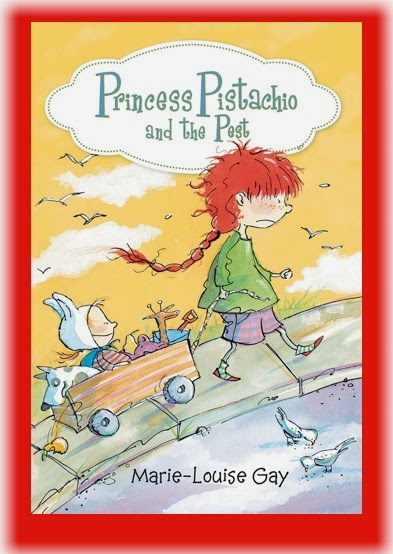
Princess Pistachio and the Pest

by Marie-Louise Gay
Translated by Jacob Homel
Pajama Press
978-1-927485-73-6
48 pp.
Ages 5-8
For release March, 2015

Pistachio Shoelace may have been disappointed when she learned the true nature of her royal status, or lack thereof, in Princess Pistachio (Pajama Press, 2014) but the little red-haired wonder of Marie-Louise Gay's newest series has unforeseen challenges to address in her second adventure, Princess Pistachio and the Pest.  And we're so delighted to share in it with her.

Waking up from a horrible school dream in which she is humiliated when she can't answer a simple addition problem, Pistachio is thrilled to realize it's the first day of summer vacation.  She's ready for adventures with her friends Madeline and Chichi exploring a local cavern. But "Pistachio's heart falls to her belly button" (pg. 12) when her mother instructs her to take her baby sister Penny to the park.

Dragging a wagon loaded with Penny, a tower of toys and the hidden dog, Pistachio continues to daydream about exploring the cavern and what she might find.  Meanwhile, Penny dressed in her rabbit-ear hat and Superman cape, proclaims herself to be Super-Rabbit and repeatedly demonstrates that her super-powers are of the unorthodox kind: pilfering fruit from Mr. Pomodoro's grocery stand; climbing up on a wall and falling into Mrs. Oldtooth's garden; and scavenging treasure from the park's fountain.  Unfortunately, Pistachio is taken as responsible for Penny's misdeeds.

Courtesy of her baby sister, Pistachio is never bored and, upon returning home, realizes that there are worse ways to spend a day than babysitting Penny.  But, it's Pistachio herself, with her imaginative daydreams to compensate for missed adventures and with her reactive diatribes to unexpected turns of events, who makes the day eventful.  Her fiery temper may share each disappointment but it's her exuberance for life that mitigates any annoyances the readers may have about her exasperation.  After all, it was the first day of summer holidays and Pistachio's mother knew to use her "maple syrup tone" (pg. 12) to attempt to sway her daughter.  I suspect the girls' mother, with her own fiery red
hair and foxy twinkle, knows well enough what Pistachio feels.  And luckily, Pistachio may feel many things–embarrassment, disappointment, irritation, fear, inspiration–but never boredom.  

Again, Marie-Louise Gay takes our Pippi-Longstocking-esque young character and places her in classic childhood scenarios to which Pistachio must adapt.  Babysitting younger brothers and sisters during summer vacation is not uncommon for children.  But by taking Pistachio into a neighbourhood of colourful people, diverse friends, and lively interactions, young readers may find the means to endure, even enjoy, surprises that arise during the crazy, lazy days of summer when anything can happen, as it does in Princess Pistachio and the Pest.