Showing posts with label Quill Tree Books. Show all posts

July 17, 2024

The Space Between Here and Now

Written by Sarah Suk
Quill Tree Books
978-0063255135
320 pp.
Ages 13-17
October 2023

I know I'm a little late to review Sarah Suk's second young adult book (she wrote Made in Korea in 2021) but I just recently heard of this novel from the Red Maple panel of the Forest Kid Committee who recommended it for their summer reading list. (Each year that I help out with this committee, I learn of new Canadian titles for young readers. These young people are amazing readers!) After checking out their recommendation, I was intrigued by the blurb about The Space Between Here and Now and was not disappointed.
 
Aimee Roh is a typical 17-year-old Korean Canadian living in Vancouver, BC with Appa, her father. She's thinking about university, she hangs with her friends, she has a passion for photography, and she and her father have a close but respectful relationship. She's typical in every way except that she has a rare condition called Sensory Time Warp Syndrome a.k.a. STWS. Those with STWS have different triggers for memories that can transport them back to the time of the memory. When triggered by smells, Aimee disappears, travels back to a memory usually for just few minutes. Some people grow out of the condition, but Aimee is finding that she's experiencing more frequent episodes and wonders if it is because of the stresses of being a senior and anticipating the next phase of her life. What doesn't help is that it is impossible to talk to her father about it or get the supports she needs to help her cope.
 
After a particularly lengthy disappearance in which she is taken to a long-forgotten memory of a family outing to Kitsilano Beach, before her mother abandoned the family when Aimee was 6, Aimee is confused. Her memory doesn't match what she remembers and she begins to wonder whether her mother perhaps had STWS. Taking matters in hand, and with the encouragement and help of best friend Nikita, Aimee embarks on a spring break trip to Korea, hopeful of finding out some answers about her mother and family that her father doesn't seem to want to share with her.
 
With Nikita researching online for clues, and Aimee reconnecting with her Aunt Gomo and childhood friend Junho, the search for Aimee's mom begins. With some new insights into her STWS and into her relationship with her father, Aimee finds herself gaining clarity and even confidence where there was once only confusion.

Teen angst is not unusual but the angst that comes from a chronic condition that unexpectedly disappears you from your life, even if temporarily, is beyond typical. It has left Aimee in a precarious position, in a space between then and now, unclear as to her memories of her past and her understanding of her present. Sarah Suk, a Vancouver author, gives Aimee a story that might appear tenuous, never knowing when she might disappear or where she will end up or even if there is a possibility of ending up in a time loop. But Aimee's story is not anxiety-driven; it is driven by a need to know. Young adults will appreciate that push to become self-actualized, to understand oneself. Aimee's life is many layered, between her issues of abandonment by her mother, being disaffected with her father, and struggling not to stand out because of her STWS. While today's teens may not have a memory-driven time-travel condition, they have their own issues that challenge them in their drive for understanding and satisfaction. They can learn from Aimee who faces peer pressures and family pressures and uncertainty and is still able to resolve things well enough for herself. She may not get the answers she was specifically looking for, but she gets what she needs and learns things that will help her, as well as others. 

Though the fantastical nature of Aimee's STWS elevates The Space Between Here and Now from the drama of teen angst to the realm of science fiction,  Sarah Suk gives a story that is both enlightening about one Korean-Canadian family as well as familiar. For that reason, I urge young people to read The Space Between Here and Now for some insight into their own lives and relationships with others, particularly parents, to see how reconciliation may be reached with patience, effort and, most definitely, compassion.

December 07, 2022

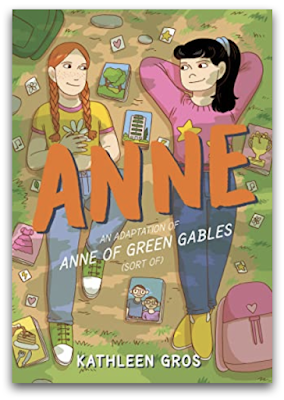
Anne: An Adaptation of Anne of Green Gables (Sort Of): Guest review

This review was written by Grade 8 student Hasini K.
 

Written and illustrated by Kathleen Gros
Quill Tree Books (HarperCollins)
978-0-06-305766-1
304 pp.
Ages 8-13
October 2022
 
From the classic story of Anne of Green Gables comes this incredible adaptation. This is a story that takes place in our modern world with the inclusion of LGBTQ+ characters and plot lines that improve the story and allows it to reach a wider audience in the present era.
From Anne: An Adaptation of Anne of Green Gables (Sort Of) by Kathleen Gros
Anne Shirley is a teenager in the foster system, and she’s sick of it. She’s already moved from one house to another, from one foster placement to the next. Anne is tired of starting over every time she has to move. So, when Alexandra, Anne's social worker, tells the girl the exciting news that she's about to move to another place, Anne has mixed feelings. She’s so grateful that someone wants her and really hopes it will work out but a part of her wonders if she'll just end up back in the system afterwards.
From Anne: An Adaptation of Anne of Green Gables (Sort Of) by Kathleen Gros
However, things don’t start off as she hopes. When she first meets Matthew Cuthbert, her new foster guardian, he seems confused. When they arrive at the Avon-lea, the apartment building where the Cuthberts live, we learn that Matthew and his sister Marilla had been expecting a younger kid. Anne is devastated and is sure that she'll be sent back, especially when Marilla calls Alexandra. Explaining about a glitch in the system, Alexandra asks them to keep Anne until they can arrange something else. Anne is determined to try her best to make sure the Cuthberts keep her.

But, Anne quickly finds herself in trouble, from physically hurting a classmate to accidentally dyeing her hair green. The Cuthberts may be cool, but Anne worries that she may be too much for them. Still, she has other worries, including developing feelings for her closest friend Diana. Anne wants to ask Diana to the winter dance but what if Diana doesn't feel the same way? You'll need to read Kathleen Gros's book to find out if Anne finally ends up finding her forever home.
From Anne: An Adaptation of Anne of Green Gables (Sort Of) by Kathleen Gros
Anne: An Adaptation of Anne of Green Gables (Sort Of) is not the kind of book I usually read, but I absolutely enjoyed reading it and would recommend it to readers in Grade 6 and up. In the book, Anne struggles a lot with embracing her appearance, and I love how she gained confidence throughout the story. Kathleen Gros turned the story into something which everyone could relate to, from being the new kid to trying to find friends and fitting in. Although I haven't read the original Anne of Green Gables–I'm very tempted to do so after finishing this book–I think Kathleen Gros's graphic novel version will appeal more to this generation of readers, especially with its diversity and gorgeous artwork and very appealing colours. But most important is Kathleen Gros's message that families come in different forms, and they are all worthy of love, no matter how crazy they may be.
 
~ Written by Hasini K., Age 13

October 25, 2022

Anne: An Adaptation of Anne of Green Gables (Sort Of): Q & A with author-illustrator Kathleen Gros

Today is the release of Kathleen Gros's new graphic novel Anne: An Adaptation of Anne of Green Gables (Sort Of).  Yesterday I reviewed this new book and today I am pleased to present this interview with author-illustrator Kathleen Gros.

Anne: An Adaptation of Anne of Green Gables (Sort Of)
Written and illustrated by Kathleen Gros
Quill Tree Books (HarperCollins)
978-0-06-305766-1
304 pp.
Ages 8-13
Released October 25, 2022

 
Helen Kubiw:  As Anne: An Adaptation of Anne of Green Gables (Sort Of) is a modernized graphic novel of a Canadian classic, you would have had to make many decisions about which elements to keep and modernize (e. g., Gilbert pulling on Anne's braid) and which to eliminate? How did you make those decisions?
 
Kathleen Gros:  Choosing what to keep and what to cut is the hardest part of making a graphic novel adaptation. Comics is a very different medium than prose. One page of a prose novel can turn into upwards of 5 pages of comics, depending on how the cartoonist handles it. So, of course, when looking at adapting a novel there’s a lot that has to be cut out.
 
The way I approach making a modernized adaptation is to start by making a lot of lists. I make lists of what I think the overarching themes for the story are, the themes of the relationships between characters, as well as the key scenes that stick in my memory after I close the book. Having a strong idea of what I feel the themes of the original narrative are helps guide me as I muddle my way through deciding which scenes to keep and transform, and which scenes to omit.
 
One of the big themes in the original work is the idea of a somewhat insular community. In the novel, that’s the rural town of Avonlea. I wanted to reflect on what community means to me in the 21st century. I’ve lived all of my adult life in apartments, which are their own unique kind of community, so it felt natural to turn the town of Avonlea into an apartment building! While some readers might wonder about this decision, I tried to give a few nods to L. M. Montgomery by using imagery from my own childhood in Toronto to inspire the setting of Anne. The original book is set in Prince Edward Island, but Montgomery actually spent a significant amount of her life in Ontario and Toronto!
 
One of my favourite parts of the original novel is when Anne starts a story club with her peers. I feel like this part of her story doesn’t get enough love! In my adaptation, I expanded this part of the narrative and gave it a bit of an update. My love of comics and creative writing was, in part, fostered by a teacher I had in high school who ran our school’s zine club (thank you Ms. Kim). Around the time that the original novel was written, people were really into the art of collage. Montgomery, herself, even kept collaged scrap books! Having Anne join a zine club felt like a way to give a wink to that history, while also incorporating my own connection to the original work. Anne’s storyteller side and creativity was something that really resonated with me as a kid.


HK:  Though you've included all the key characters from the original Anne of Green Gables–Anne, Diana, Marilla, Matthew, Gilbert, Josie, Ruby, Mrs. Lynde–they are similar and yet different. For example, though Marilla was initially reluctant to take on Anne, unlike Matthew, she actually comes around far more quickly to supporting the girl in your book than originally. Why did you do this?
 
Kathleen Gros:  This kind of comes down to the economy of storytelling necessary for a graphic novel. The original book spans years of Anne’s life, while my adaptation is translated into just a few months. My favourite parts of Marilla and Anne’s relationship come once Marilla has softened a bit. So I chose to kind of expedite the whole process in this new version.


HK:  Some fans of the original story may not appreciate a retelling, sort of, in a contemporary setting and with similarly-named characters with different characterizations. How would you address their need to leave the original unaltered?
 
Kathleen Gros:  I don’t think I’m ever going to manage to persuade a fan like that! And that’s okay. My feelings about adaptations is that they’re a way to continue a conversation about a work. To me, an adaptation is a way to examine the work, the cultural values around the work, the themes of the work, and find ways to respond to and reflect on those things. If that’s not how someone enjoys engaging with media, that’s okay. The original work still exists, and they can reread it forever. But I would say: I think you’ll have fun with my adaptation if you decide to give it a try.


HK:  What was the toughest decision you had to make about your adaptation?
 
Kathleen Gros:  The toughest decisions were all the stuff I had to cut out! I wish I had about 100 more pages to be able to fit in a chapter about Marilla’s amethyst brooch and the Raspberry Cordial Incident—but there just wasn’t space. I hope readers will forgive me for those omissions and enjoy the other elements I expanded on.


HK:  You've changed a key relationship from friendship to a romantic one. Was this a key premise upon which you based your adaptation or is it something that evolved as you wrote the story?
 
Kathleen Gros:  A big commonality shared by many of my friends who are queer women is that when they first read about Anne and Diana’s friendship, they felt their childhood crushes reflected back at them. Rereading the book as an adult, it’s so easy to see that connection. Anne and Diana profess their love for each other over and over again. They exchange locks of their hair. Anne is inconsolable when she accidentally imagines Diana marrying a man. I really wanted to honour the experiences of my friends with this adaptation. I think a couple of them would have been livid if I hadn’t approached the work through a queer lens. I’m joking, but I do want to acknowledge that it’s a huge privilege to get to queer classic works the way I have been able to. In classic literature, queer people mostly exist in subtext. There are people today (in both Canada and the US) who wish that they wouldn’t enter the text at all. It’s a very special thing to be entrusted with bringing that queerness into the actual text.


HK:  Anne: An Adaptation of Anne of Green Gables (Sort Of) is your second retelling, having previously written Jo: An Adaptation of Little Women (Sort Of). Do you have any plans for reimagining other classic tales as contemporary graphic novels? (Please, please, please do Pride & Prejudice!)
 
Kathleen Gros:  Ha ha I’m open to doing another contemporary retelling! Little Women and Anne of Green Gables are two books I absolutely adored growing up—and I want to make sure that if I do another retelling that it’s coming from a similar place of admiration and celebration. It would be nice to round out the (Sort Of) adaptations with a third book, don’t you think? Three books is always a satisfying number.
 
• • • • • • •
 
Many thanks to Kathleen Gros
for answering my probing questions
 
and to Shayla Leung, Publicist
at HarperCollins Canada, for facilitating this interview.

• • • • • • •

September 17, 2020

Jo: An Adaptation of Little Women (Sort of)

Written and illustrated by Kathleen Gros
Quill Tree Books (HarperCollins)
978-0-06-287596-9
272 pp.
Ages 8-13
September 2020
 
Everyone knows Louisa May Alcott’s story of Little Women, her classic novel about the March sisters set in the 1800s. There's the girls, Meg, Jo, Beth and Amy, and their mother whom they call Marmee, and their father who is away in the military. There is also their neighbour Mr. Laurence and his grandson Laurie, as well as a number of family and acquaintances who visit or become part of the March girls' world. As the author and illustrator Kathleen Gros tells us in her subtitle, this is an adaptation of Little Women, sort of, but it is more.
 
From Jo: An Adaptation of Little Women (Sort of) by Kathleen Gros
 
The story begins with thirteen-year-old Jo writing her blog about life with her family. Meg is the oldest and starting high school and tutoring a couple of younger children. The shy Beth is eleven years of age, musically-inclined, and has leukemia. The youngest is the self-centered Amy who loves to draw. Jo really wants to become a writer and, though she thinks she prefers creative writing, she joins the Newspaper Club where she meets Freddie Bhaer (another familiar name from the original Alcott story) who is the student editor. It is this relationship with Freddie that helps Jo identify as gay and come out to her family. 
 
From Jo: An Adaptation of Little Women (Sort of) by Kathleen Gros

As Jo develops her writing, continuing to entertain her family with her stories while finding her journalistic voice, the other March sisters face their own challenges. Beth, of course, has her medical issue which requires medication, tests and hospital visits but she also is struggling to learn to play the flute. Meg who is crushing on a boy and wondering if he likes her is also dealing with her tutees who are always on their devices. Young Amy is frustrated with her art teacher who wants to teach the class skills like perspective when Amy would just prefer to draw. With the help of Marmee, who works as a nurse at a children's hospital, and their father with whom they have occasional video chats, as well as a host of characters, the March girls come of age in a contemporary setting.

From Jo: An Adaptation of Little Women (Sort of) by Kathleen Gros

By modernizing the story of Little Women to include technology, LGBTQ+ characters, the all-important school milieu and more, Kathleen Gros has honoured the original but made it relevant to today's readers. Beth's scarlet fever would be easily treated by antibiotics today so leukemia, a cancer that has some forms more common to children, replaces it. Jo's original ink and paper writing is now done on computer and gets published online via blogging and in a school newspaper. Even how the Newspaper Club members introduce themselves and share what pronouns they would prefer used is exemplary of how the story is inclusive. This is Little Women but it is more real, relatable and germane for a 2020 audience. Moreover, by creating her story as a graphic novel, Kathleen Gros firmly lands Jo into the present-day, giving us colour and movement, encouraging readers to learn about the March sisters' stories in a version, sort of, that is accessible and visual. 

Much more than an adaptation of Little Women, Kathleen Gros's Jo is a modern and realistic coming-of-age story that broadens the original story and invites all readers to see themselves in it, and learn lessons about being kind and brave and being part of a family.