Showing posts with label heroes. Show all posts

June 19, 2019

Innocent Heroes: Stories of Animals in the First World War: Guest blog post

Today's review has been submitted by Grade 5 student Bronte L.

Written by Sigmund Brouwer
Tundra
 978-1-101-91846-3
208 pp.
Ages 9-12
2017

Innocent Heroes by Sigmund Brouwer follows fictional Canadian animal war heroes to see how they contributed in World War I. Every short story is followed by the historical record behind it, and how that animal helped in the war.

There are many animal heroes in Innocent Heroes including Little Abigail, the pigeon, who was trained to carry messages to headquarters. She travelled long distances while the war continued on around her. Tomato the Airedale Terrier was also trained to deliver messages between trenches. When a surprise gas attack comes from the enemy, it's up to Tomato to try to warn the soldiers. Mercy dogs relayed messages in their own way. Biscotte, for example, was one of the many French mercy dogs who went out into enemy trenches to find injured soldiers. If a soldier was found alive, the dog would rip a piece of their uniform, deliver it back to his fellow soldiers and a rescue planned.

Some animals helped eased the hardships endured by the soldiers. Cats like Boomer made the Canadian trenches less horrible places for the soldiers by hunting rats. Living in the trenches was dirty, tiring, and not at all like home. The rats made it even worse, biting soldiers while they were trying to get some sleep before the busy day ahead. This is where Boomer the cat was helpful. Boomer would come out at night to hunt for rats, bringing them to Boomer’s owner and the lucky soldiers who would roast and eat them.  Mascots also played an important role. There were hundreds of trenches so the mascots helped to identify them. One such mascot, Leo the lion cub helped comfort soldiers and occasionally even make them laugh.

Other animals were used as work animals. Coal Dust was a horse and the trusty partner of Lance who lead other men on horses on scouting missions into areas full of dangerous craters made by shells. But when the shelling started up again and all the other horses and men scattered, it was up to Coal Dust to come to Lance's rescue. Mules know when danger is coming and think before they act, so mules were very useful in the war. Such was the work of Charlie the mule who sensed danger while walking with soldiers.  Louise the horse was one of the hundreds of horses that carried shells over to cannons to be fired at the enemy. Horses would haul load after load, four shells each, much too heavy for a soldier to carry.

I enjoyed this book because normally when we think of war, we think of human soldiers fighting for peace with guns and cannons. We think of the peace they brought us. But we generally forget the animal heroes that helped win victory. So now, after reading this book when I think of war I remember more than the human soldiers. I also will remember the carrier pigeons and the mercy dogs and the many animals. Without them, I don’t know if we would have been able to win the war.

I would recommend this book to ages 10  and up. Also I'd recommend it to readers interested in history, the war, animal lovers, and everyone else. The fictional but imaginative story line gives you an idea of what each animal would do.  Because it is enjoyable to read, and a great balance of fiction and nonfiction, I would give this book a 10 out of 10. I encourage everyone to read Innocent Heroes!

Written by Bronte L., 11

October 29, 2018

Go Show the World: A Celebration of Indigenous Heroes

Written by Wab Kinew
Illustrated by Joe Morse
Tundra Books
9780735262928
40 pp.
Ages 5-9
September 2018

Although there are far too many Indigenous heroes to include in an illustrated collective biography and book of inspiration, Wab Kinew manages to honour thirteen figures from history including athletes, physicians, authors, military and leaders who marked history with their efforts.  These are their stories, told in emotional free verse by Wab Kinew and illustrated by Joe Morse with power and strength. But beyond these stories, Wab Kinew urges all readers to be inspired to learn and be more.
From Go Show the World by Wab Kinew, illus. by Joe Morse
Wab Kinew begins with a verse about the beginnings.
There's a power in these lands,
one that's been here many years,
strong enough to make you stand
and forget all of your fears.
It started in the past with a blast of light and thunder;
ancient ones looked up and beheld the sky with wonder.
From Tecumseh, Sacagawea and Net-No-Kwa to contemporary heroes such as Carey Price, Beatrice Culleton Mosionier and Dr. Evan Adams, Wab Kinew recognizes the achievements of those who showed the world that they were and are persons who matter. They led explorers, they faced discrimination, and they achieved beyond the limitations put on them. Knowing their stories, upon which Wab Kinew elaborates in a "Biographies" appendix, is but the first step of recognition which heralds appreciation, emulation and achievement.
We are people who matter.
Yes, it's true.
Now let's show the world what people who matter can do. 
From Go Show the World by Wab Kinew, illus. by Joe Morse
Joe Morse may be more familiar as an artist to his commercial clients but his striking illustrations, which I first noticed in his Visions in Poetry edition of Casey at the Bat, bombard the reader with powerful images. While I'm captured by his backgrounds of forest, sky and water, it is the hero of the double-spread who is always showcased. They are detailed in dress and expression and on a landscape reflective of their story. Most remarkable and unmistakable is the countenance of their expressions. It says that they do matter and are determined to Go Show the World, elevating Wab Kinew's message while illuminating it.
From Go Show the World by Wab Kinew, illus. by Joe Morse
•••••••••••••••••••

For teachers, a discussion guide is available at the publisher's website at https://tundrabooks.files.wordpress.com/2018/09/go-show-the-world_discussion-guide.pdf

May 11, 2018

Nick the Sidekick

Written and illustrated by Dave Whamond
Kids Can Press
978-1-77138-355-4
48 pp.
Ages 6-9
April 2018

Celebrated cartoonist of the syndicated Reality Check and author-illustrator of the three Oddrey books (Oddrey, Oddrey and the New Kid, and Oddrey Joins the Team; Owlkids, 2012, 2013 and 2014) and My Think-a-Ma-Jink (Owlkids, 2009), Dave Whamond brilliantly applies his cartooning skills to a new genre, the graphic novel, and superbly masters it with the flair of a superhero and the diligence of a loyal sidekick.

Nick is a superhero assistant with incredible hearing courtesy of his incredibly-large ears.  Though his classmates may ridicule him, his best friend Tess always has his back.  That comes in handy when you're the superhero assistant to the egotistic Super Fantastic Guy who wants to use Nick's super hearing without giving him the credit for his cleverness or contributions.  Super Fantastic Guy can't even remember Nick's name, always calling him Rick, and even getting all his details wrong on his membership to the National Superhero Society. And Nick does not appreciate the lack of respect and his designation as a (sigh!) sidekick, especially considering he does all the crime-solving! But it's Nick who learns that he is the true superhero when he uses his super talent to save Super Fantastic Guy and let Tess help bring the egomaniac down a bit from the superhero pedestal he's always taken advantage to enjoy.
From Nick the Sidekick by Dave Whamond
As much as Nick is a superhero (he does have the card to prove it), he's really the anti-hero in that he accomplishes much good without the public recognition and even his partner's appreciation.  Nick is probably the antithesis of the highly-acclaimed superhero in that he doesn't parade himself in front of the public and demand accolades, though he would appreciate a little respect and for everyone to stop calling him a sidekick. 
From Nick the Sidekick by Dave Whamond
Dave Whamond's artwork is made for graphic novels. Okay, I know it's also great for his cartoons and his picture books but, by applying it to storytelling in the graphic novel format, he can tell more story by creating action-packed plot lines that move with the force of his illustrations.  There's movement and energy and kapow!  Nick the Sidekick delivers a punch in character and story and has just launched Dave Whamond's career into a different layer of the stratosphere, though we knew it was inevitable. As much as Nick can't fly and hates all the clichés related to superheroics, from the Spandex onesies and to the criminals' responses when caught, he's going to be joining Dave Whamond on that trajectory. Happy travels to our newest superheroes!
From Nick the Sidekick by Dave Whamond

March 29, 2018

Sparks!

Written by Ian Boothby
Art by Nina Matsumoto
Color by David Debrick
Scholastic (Graphix)
978-1-338-02946-8
200 pp.
Ages 7-10
February 2018

Knowing the universal acceptance of dogs as heroes, a cat named August invents a robotic dog suit in which he and feline friend Charlie undertake daring rescues like saving babies from wells, children from tornadoes, and families from fires. The suit also helps keep August from touching the grass (a major phobia since an escape outdoors as a kitten led him to nasty testing at an animal lab) and keeps the cats anonymous from prying reporters and those who might disturb their comfortable lifestyle. However, unbeknownst to them, an evil genius in the guise of a baby named Princess is setting up accidents that require the rescue dog dubbed Sparks to leap into action.  It seems Princess believes that Sparks might be the dog that other animals, under the baby's control, would follow, allowing the heinous alien-infant to conquer the world.
From Sparks! by Ian Boothby, art by Nina Matsumoto
Ian Boothby and Nina Matsumoto, best known as veteran creators of The Simpsons comics, will delight middle graders with this hilarious graphic novel of cats banding together to achieve heroic deeds and fighting an evil baby.  Readers will be tickled by all the characters: clever inventor August, who plays the stock market and buys a house; Charlie, who lives life with enthusiasm and has a fondness for frolicking and attention;  Steve-O, the hyper-chattering squirrel; and the storytelling robotic litter box.  Even Princess who transmits pain via agony pants worn by her pseudo-parent minions is priceless as the koala hat-wearing brain who still needs diaper changes and naps.  Princess is as controlling and scary as any human baby, albeit with creepier toys, and it's so satisfying when (spoiler!) her errant ways are chastized by her real parents.
From Sparks! by Ian Boothby, art by Nina Matsumoto
Sparks! is a fun read that fights stereotypes of cats being self-absorbed, dogs being the heroes, and babies being innocent and safe. Moreover, it provides a sad commentary on the media that creates stories, not just reports them, and the ease with which they manipulate the stories.  In fact, Sparks! is really a story that turns the concept of control on its head.  Of course, young readers might not pick up on all those messages from author Ian Boothby but they'll love the story and Nina Matsumoto's bold graphics that blend the real with the fantastic.  It's obvious Nina Matsumoto knows cats well (a photo of the real August and Charlie in the dedication attests to this).  She gets the joy of rolling in the grass or the pose of the classic butt-lick perfect but then gives an imaginative angle to the technological wizardry and provides vigorous splashes of action and disaster.  The compulsory Zzzzzap! and Ka-Pow with an occasional Ssshhlorp!, Fa-dunk and Sproing add that touch of comic book flavour that kids will enjoy.
From Sparks! by Ian Boothby, art by Nina Matsumoto
I'm pleased that Ian Boothby and Nina Matsumoto (who will be attending this year's Toronto Comic Arts Festival in May) have left the cat flap open for a sequel to Sparks! as I'm sure the amazing duo of August and Charlie have more acts of heroism on which to embark, whether as themselves or in the costume of their canine superhero.

October 31, 2016

Bera the One-Headed Troll

by Eric Orchard
First Second / Roaring Brook Press
978-1-626721067
128 pp.
Ages 7-14 
August 2016


With today being Halloween and Bera the One-Headed Troll being filled with pumpkins and trolls and witches, it seems only fitting to review this graphic novel today.  Written and illustrated by Eric Orchard, the illustrator of the recently reviewed If I Were a Zombie (Kate Inglis, Nimbus, 2016) –am I sensing a monstrous theme here?–Bera the One-Headed Troll is atmospherically perfect for a fun but teensy bit scary read.

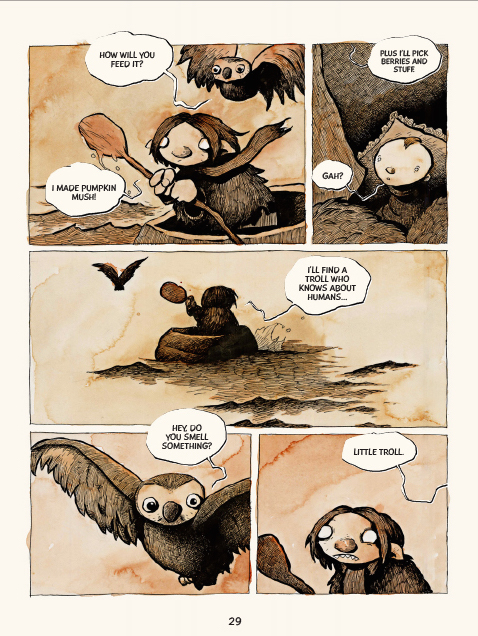
Bera, who lives on an isolated island with her owl companion Winslowe, is the official pumpkin gardener of the Troll King. (There’s the pumpkin connection for Halloween,  and, except for the cover and an occasional candle burning yellow, it’s the colour scheme of all the book’s graphics.)  When Bera rescues a human baby from three evil mermaids (they are not of the lean and lovely variety), she takes upon herself the task of returning the baby to its humans.  But that is contrary to the wishes of the malevolent Cloote, former  head witch of the Troll King, who wishes to use the baby to return to the good graces of the Troll King.
From Bera the One-Headed Troll 
by Eric Orchard
Bera who feels unprepared for dealing with the baby decides to seek a hero from her books, specifically choosing Wulf the Dragon Masher.  On their journey, Bera and the baby, with Winslowe scouting from above, encounter the mermaids again, as well as the Guardian, a sea monster as big as an island, and a bunch of hedgehog wizards.  Thankfully this last group whose mandate it is to protect the creatures of the wood already know firsthand of Cloote’s destruction and offer to steer Bera to Wulf’s tower.  Wulf, a troll of epic proportions and light-spirit (“Hey, is that a baby?”, “Well, look at that” and “Imagine that!”; pg. 52), has not been on an adventure in a very long time and, though willing of spirit, he succumbs to his epic sleepiness.

So Bera goes in search of another hero, finding both Duke Otig, the two-headed troll hero of the troll-giant war, and then the three-headed Nanna the Great.  But the reader will soon realize that heroes are not just those who undertake adventures and engage in battles.  Heroes are also those who make extraordinary sacrifices to do ordinary things, making their own quests in the spirit of goodwill, not glory.
From Bera the One-Headed Troll 
by Eric Orchard
Bera the One-Headed Troll is a offbeat graphic novel filled with trolls (one-, two- and three-headed varieties), goblins, witches, and rats (Vince is particularly helpful) and positive messages about offering assistance to those in need.  With only her want to do the right thing, Bera takes herself out of her comfortable pumpkin patch island and discovers new strengths and instincts, while making some new friends and good karma in the process.  I thought Bera the One-Headed Troll was going to be a dark, dark tale for a Halloween night, and its graphics would’ve supported that notion.  Eric Orchard’s trolls and witches and other creatures could be seen as darkly unnerving, as are the settings of straggly trees and murky swamps and stone edifices.  But Bera the One-Headed Troll is neither dark nor frightening.  It is a positive message wrapped in a dark cloak festooned with pumpkins.  Read it for Halloween but take its guidance beyond the day.

October 17, 2015

An Inheritance of Ashes

by Leah Bobet
Houghton Mifflin Harcourt Books for Young Readers
978-0544281110
388 pp.
Ages 12+
October 2015
Reviewed from advance reading copy

An Inheritance of Ashes is a dark tale.  A dark, dark tale. And, though it has supernatural elements, An Inheritance of Ashes is a familiar tale of fears and love and heroes and isolation and pride, and family.  And it has a force within.  A force that good may come from evil.
The emptiness grew, and split, and ate the whole world in its wake.  It was never going to be all right again. (pg. 126)
Hallie, 16, and her sister, Marthe, 26, both inherited Roadstead Farm from their abusive father, and now run it–raising barley, goats, poultry, etc.–with Marthe’s husband, Thom Clarlund, or they did until Thom went to war against the Wicked God and his general and prophet Asphodel Jones and army of irregulars, and their creatures, nay monsters, everyone calls Twisted Things.  Though the two young women are cautiously hopeful of Thom’s return, now that a man named John Balsam who “by magic, skill or cunning killed the Wicked God” (pg. 23), Hallie and Marthe take on a vet named Heron for whom “No one’s waiting for me to turn life normal again” (pg. 13) to help with the harvest and running the farm.  

But things are far from normal at the farm. Twisted Things begin to appear, one here, another there, killing the air, burning whatever they touch, contaminating the remnants of their lives.  And Hallie worries that the Great Army, desperately searching for John Balsam, will quarantine the farm, if not take it away from them.  Though Hallie is reluctant to ask for help, Heron and their neighbours, the Blakeley’s, come to their assistance.  Moreover, even though Hallie recognizes that, because of the abuse of their father, “We were ruined for loving people.  We were ruined for being loved” (pg. 244), Tyler Blakely who has his own war ghosts begins to court her and, with his sister Nat and Heron, help her recognize that she doesn’t have to take on the evil alone, or hide or run from that which seems too much. “We made each other less alone.” (pg. 272)

There are things not of our world in An Inheritance of Ashes, and there are things that were never of their world either, including a Wicked God that is more storm than substance and bird- and lizard-like creatures that burn and kill that which they touch, and a violent purple and green world that is evident only through a hole in the air.  But fighting evil and finding strength with others and holding onto that which is everything–a home, family, friends–are our world, and Leah Bobet easily supplants readers from their comforts into the darkness of Hallie’s world.  Rife with atmosphere and Hallie’s longing for rightness, An Inheritance of Ashes demonstrates that what we get from family is not always what is expected.  If might be an inheritance of a family farm, or of fear, or isolation, but it can be the fortitude to continue on, when all expect failure to reverberate.  And, with powerfully evocative text, Leah Bobet allows Hallie and others in An Inheritance of Ashes to sift through the cinders and residue after a horror and find something worth keeping.