Showing posts with label conflict. Show all posts

May 09, 2025

The Most Magnificent Team

Written and illustrated by Ashley Spires
Kids Can Press
978-1-5253-1295-3
40 pp.
Ages 4-8
May 2025 
 
The most magnificent little girl and her dog from The Most Magnificent Thing, The Most Magnificent Idea, and The Most Magnificent Maker's A to Z return and they're still making and building but with colleagues now.
From The Most Magnificent Team, written and illustrated by Ashley Spires
It's another day of doing for our young maker. She and her pug may do lots of things from helping others, snacking and dreaming but coming up with ideas for new builds is at which the child excels. Gathering her materials for her latest idea she heads down to her working space on the street and encounters another child already there. There's another little girl, this one with fabulous hair buns, a green headband, glasses and a grey cat out on the sidewalk with a collection of materials and the start of a house. Impressed with what she sees, our first little girl invites her neighbour to work with her on her new idea.
From The Most Magnificent Team, written and illustrated by Ashley Spires
Although our little girl starts off wanting to take the neighbour's ideas into consideration, the two have very different styles of working. While the girl gets right to work, the neighbour child is all about measuring and calculating and considering and making suggestions for making the idea better but never starting to build her part of the project.
 
Even when the girl just does it all her way, the neighbour girl has criticisms.
 
The neighbor insists her idea will be better.
But that's impossible since the girl's idea is already the BEST.
And you can't make the best BETTER – it's already
THE BEST!
 
From The Most Magnificent Team, written and illustrated by Ashley Spires
Not only does the neighbour criticize, but she also undoes the work of the girl. At this point, they huff off and decide to work on their own projects. But they both feel their projects to be mediocre, more "HMMM" than "WOW" so decide to amalgamate. They combine their efforts and help the other and while they still run into disagreements, they find that taking a breath, consulting their canine and feline assistants and rejigging their concept can lead to something even more magnificent than they imagined.
 
They might do things differently, and
they'll probably disagree sometimes, but they
know that whatever they make together is
sure to be MAGNIFICENT.
 
Working with someone can be challenging the first time. You have to take into consideration their ideas and their way of doing things and it might require some compromise and even relinquishing some control. But what happens when your styles of making are drastically different? The little girl in Ashley Spires's The Most Magnificent Team finds out soon enough that it's not just a question of adding a person to the mix. It doesn't mean your workload will be lessened immediately or that it'll be more fun. It sometimes means more work upfront to get to know them, how they work, how they can contribute and how to deal together when the partnership is challenged. Fortunately, Ashley Spires shows how a partnership or team can develop from individuals through disagreement and into compromise and finally lead to success and achievement. While young children will certainly benefit from reading a story about how a team comes together, whether they are working in a makerspace, on a sports team or in a group on a class project, I believe their teachers and parents would also be helped to understand that kids don't always hit it off immediately and that with time they can find solutions for themselves that work. It might not always be the solution we would have chosen, but if it's a solution that works for all, we have to let them try.
From The Most Magnificent Team, written and illustrated by Ashley Spires
I love Ashley Spires's stories whether it be her Binky the Space Cat or Burt the Beetle series or her standalone books like Larf and Small Saul. Though her approach is playful, and her illustrations whimsical and bright, she handles tough issues of fitting in and trying your best. In The Most Magnificent Team, Ashley Spires gives us two very different children and helps them find a way to work together, a big goal for everyone. Still, Ashley Spires always keeps it good-natured and lighthearted rather than confrontational or competitive. The kids want to work together; they just haven't figured out how to do it yet. But they do and their collaboration becomes a masterpiece for all, assistants included.
 
Being a magnificent creator can be a solitary activity, whether it be building or writing or something else altogether. But it can be the work of a team and, when a team works together, it can be truly magnificent.

December 21, 2022

Queen Among the Dead

Written by Lesley Livingston
Zando Young Readers
978-1-63893-018-1
416 pp.
Ages 14+
January 2023

Hold onto the reins of your horse or your chariot because Lesley Livingston is going to take you on an epic ride through Celtic mythology. There will be conflict and battles, romance and magic, questionable birthrights, and imminent death, and oh so many characters. Like I said, epic.
 
Young Neve lives with her older sister Úna and their father who is the Dagda, leader of the Tuatha Dé, the descendants of the Scathach Queen, and rulers of Eire. Neve wishes she could become a warrior and that her sister could become the next Dagda, but neither is possible for the two crown princesses. Still Neve likes to sneak away from the palace and head into more dangerous areas like Blackwater Town of the oppressed Fir Bolg villagers. As a child, Neve had met a rogue Druid apprentice and thief named Ronan on one of these jaunts and he'd helped her fight a demon using a banned spell stone. Seven years later the two restless spirits become reacquainted when Neve saves Ronan from the óglach who are sent out with their harrow hounds to hunt down illicit magic users and spell traders. But more than this reintroduction is the recognition that there is some magic between them, and not just of the romantic kind.

As Gofannon, the Dagda's chief Druid advisor and monument builder, begins to assert control while the Dagda obsesses over the erection of his formidable mortuary temple, it becomes evident that there is much manipulation of persons and magic in a struggle for power. Who will survive and who will rule is all up to Lesley Livingston.

This is another world, something Lesley Livingston creates with finesse. It's Eire, long ruled by the Tuatha Dé people, led by the Dagda after defeat of the shape-shifting Fomori and their elite female warriors, the Faoladh. It's the oppression of peasants and the Druids usurping the power of magic. It's a high fantasy built upon Celtic mythology with mythical creatures, potent magic and struggles for control. But it's also the story of a boy and a girl from different backgrounds who are drawn together to make the world right for themselves and others. 
The two of them would never truly be able to understand each other. Or each other's worlds. They both carried hidden fire, but they were not the same. Unleashed, Ronan's would be snuffed out by harrow hounds.
     Neve's, he feared, might just burn until the whole realm was on fire. (pg. 125)
This is Zando Young Readers inaugural young adult novel, and I can't think of a more dramatic entry to the YA booksphere than with Lesley Livingston and her Queen Among the Dead. Both have the drama of superb storytelling. As she has done in her earlier series like Wondrous Strange, Starling and The Valiant, Lesley Livingston drops us into worlds that are real and yet not. That's because she bases these stories in legitimate mythologies and immerses readers in the cultures of those legends. The stories were real to those cultures, and they become real to readers of Lesley Livingston's books. Even though she embeds magic and creates the fantastic characters who can make the impossible happen, she will have you convinced to look up the Fir Domnann and the Fé Fíada in Wikipedia. I won't give it away though I will warn you to keep crib notes as Queen Among the Dead is packed with characters, creatures, places, and cultures of wildly unique names. At over four hundred pages, this novel packs a lot of story and it's a story that will draw you and hold you there and take you for a wild ride. And all I can hope is that there is more story to come because I need more of Neve, a young woman who learned she was a warrior in more ways than she'd known.

November 16, 2022

Boney: Guest review

This review was written by Grade 8 student Hasini K.

Written by Cary Fagan
Illustrated by Dasha Tolstikova
Groundwood Books
978-1-77306-548-9
32 pp.
Ages 3-6
October 2022
 
While Annabelle and her dad are taking a walk in the woods with their dog, Scoot, Annabelle discovers an animal bone. Annabelle asks her dad if they can take the bone home, and her dad agrees. 
 
Annabelle decides to make the bone her new playmate, and names him Boney. Annabelle feels that Boney is a great playmate – and she is completely in love with her new friend! They hang out at the park and Annabelle even makes Boney a bed complete with a blanket and pillow in his own room. 

From Boney by Cary Fagan, illus. by Dasha Tolstikova
However, when creatures run wild in Annabelle's dreams, she wonders for the first time where Boney truly belongs. What becomes of Annabelle’s and Boney’s friendship? You'll need to read the book to find out.

Boney is written by Cary Fagan and illustrated by Dasha Tolstikova. It is a short but sweet story with very vivid and beautiful illustrations which are very thought-provoking. Kids may wonder where Boney, the bone, was actually from. The story does mention how the bone could've been any animal, but we can't help but wonder. I would recommend this book to readers from Grade 1-4 since it is pretty relatable in many ways. At some point in our lives, we all have to deal with the fact that something we might be doing is not right, even if we want to do it. Making tough choices is also very hard to do, no matter your age. Personally, I liked how the story had a really meaningful message. It teaches us that, sometimes, we have to do things that aren't easy to make the situation right. It captures the innocence and uncertainty of kids when they’re dealing with conflict within themselves. Little kids would especially take losing a friend or a toy or item they have gotten attached to, as Annabelle must do with Boney, very hard. I would certainly grab a copy of this creatively written book to enjoy!

~ Written by Hasini K., Age 13

September 28, 2022

The Line in the Sand

Written and illustrated by Thao Lam
Owlkids Books
978-1-77147-570-9
48 pp.
Ages 5-8
September 2022
 
When a monster drags a stick behind them and creates a line in the sand, they are unaware of the conflict that results. But how that conflict is resolved is up to those who perceive it.
From The Line in the Sand by Thao Lam
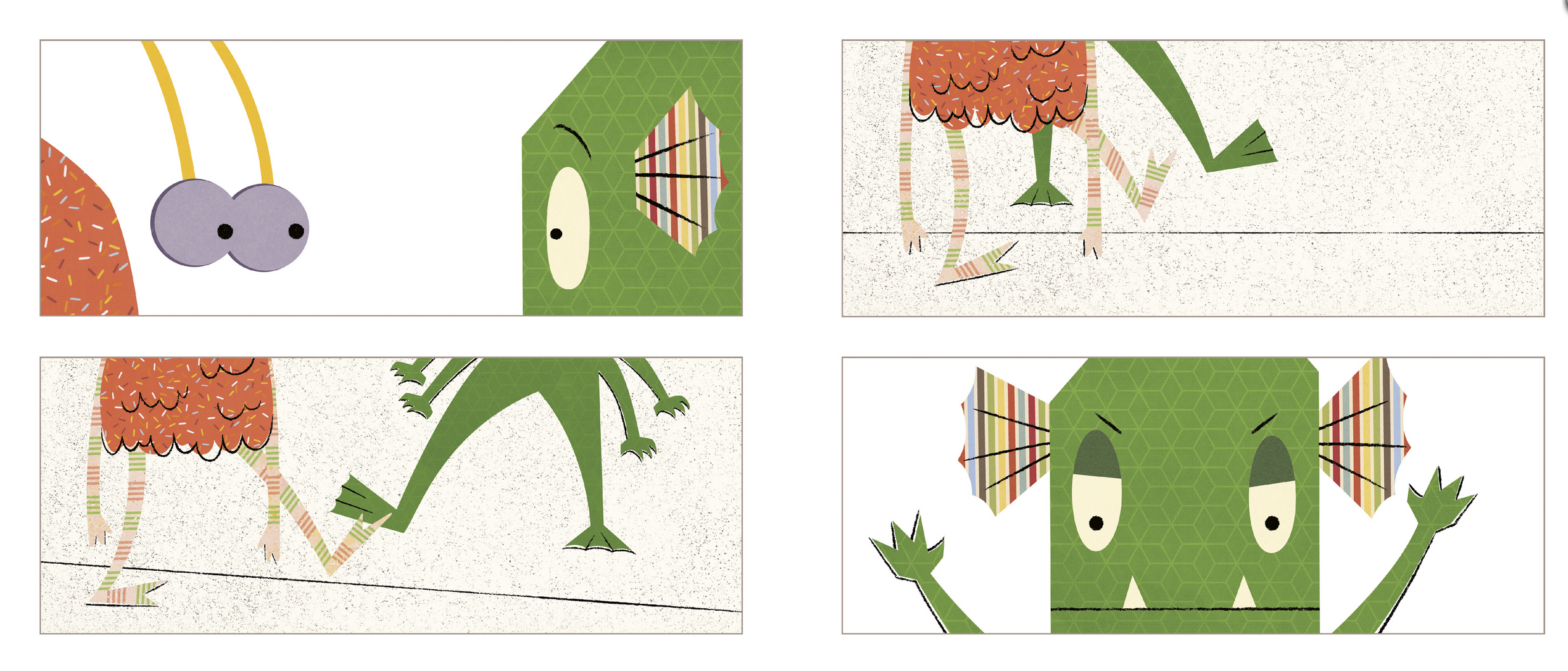
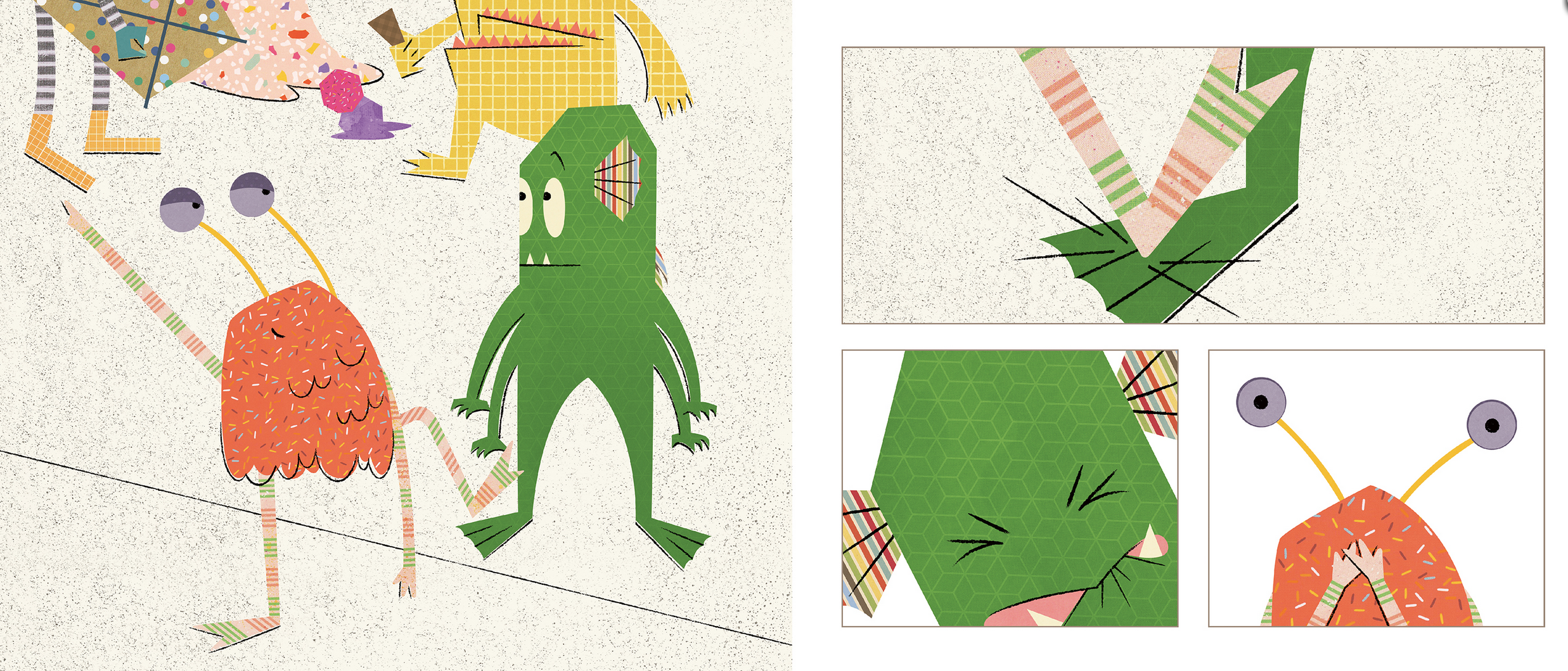
A varied assortment of monsters are playing at the beach: collecting shells, playing games, flying kites and building sand structures. One seven-eyed and four-limbed creature amuses itself by dragging a stick behind itself. (Haven't we all dragged sticks through sand and dirt to create shapes?) But several of the other monsters notice this line. It divides them. And when one tries to step over the line, another gets distressed and directs it back.
From The Line in the Sand by Thao Lam
This does not please the purple-eyes-on-antennae creature who promptly lifts its foot across the line and stomps on the green webbed foot of the other. Though it is deliberate, the purple-eyed monster does not realize the impact it would have, causing the green one to stumble and fall across the line and into its assailant, blurring the line in the sand.
From The Line in the Sand by Thao Lam
Then a bee flies into the mix.  Both monsters are thrown into a tizzy trying to evade the insect and in the process kick up the sand, obliterating the line. Looking up to see the roughened sand, the two creatures realize that beyond their interaction are numerous more lines, all drawn by the same stick-dragging monster. But, no one is reacting to those lines at all. They walk across them, they ignore them, or they are oblivious. The lines are present but of no concern.  Soon enough, our two rivals recognize the emptiness of their conflict, especially as they'd already joined forces to try to defeat a bee.

Conflict is often borne of words so it's meaningful that Thao Lam wrote a picture book about conflict as a wordless story. That just tells you how much words can get in the way. (They can also work wonders when used well.) In The Line in the Sand, no words are needed to convey distress, discord, territoriality, shock or even rage. These creatures, though their morphologies suggest otherwise, are as human as Thao Lam's readers.  (Don't we all differ to some degree in our shapes, colour, limbs and more?) Like all of us, they can be protective and defensive if they perceive a slight, intentional or not. And intention is key here because the creature with the stick intended nothing except play. Sadly, that line in the sand was the basis for some inadvertent conflict. Only when the two come together in a common goal–ridding themselves of a bee–do they see their squabble as insignificant.
From The Line in the Sand by Thao Lam
From her very quirky characters, that vary in colour from green to orange, yellow, pink and blue, with or without stripes or dots or other patterns, and with various limbs, eyes and more, Thao Lam includes everyone and spotlights no one. In their peculiarities, they are us. And we are them, drawing lines accidentally, taking offence indiscriminately, and coming together only when we see our similarities, not our differences. 

The Line in the Sand reminds us that conflict can be borne of misunderstanding or disregard but with communication, even without words, and awareness, resolution is possible.

February 04, 2022

Valley of the Rats: Interview with author Mahtab Narsimhan

Valley of the Rats
Written by Mahtab Narsimhan
DCB
978-1-77086-628-7
232 pp.
Ages 9-12
September 2021 
Reviewed here
 
This week I had the privilege of interviewing 
author Mahtab Narsimhan about her 
most recent middle-grade novel, Valley of the Rats
for the Ontario Library Association's Superconference. 
Because that interview could only be attended 
by conference delegates, I am posting that essential Q & A here.  
Enjoy!

Author Mahtab Narsimhan
 

Helen Kubiw:   The setting of Valley of the Rats is both a little creepy and a whole lot of fascinating. Is the actual valley a myth, a reality or a figment of your imagination?

Mahtab Narsimhan:  The valley and village of Imdur is pure imagination but the roots of it lie in fact, as is often the case with storytellers. I saw a National Geographic documentary on YouTube about the Karni Mata temple in Rajasthan which houses 20,000 rats. They’re revered instead of reviled and that fascinated and horrified me.

I’ve lived in the city for most of my life and recently moved to a rural community. There’s a lot here that scares me. Grass snakes, geckos, frogs and mice…basically anything that creeps, crawls, or flies. The best stories are where you’ve channeled your fear into words and so was born…Valley of the Rats.


HK:  I think one of the strengths of your books is that you showcase cultures and places with which all young readers might not be familiar. You definitely do this in Valley of the Rats both with Krish’s family and the village of Imdur. What do you think the benefits are of exposing children to different cultures?

Mahtab Narsimhan:  Thank you, Helen, I try. It’s important for children to be exposed, at an early age, to literature which serves not only as a mirror but as a window or a sliding door. It creates empathy and acceptance of the Other. I can only hope that in the future this word (Other) is extinct and that no one notices differences between people and cultures, only similarities.   


HK:    Have you ever had to deal with rats, individually as a pet or on a larger scale, like an infestation. If so, when and where, and how did you cope?

Mahtab Narsimhan:  True Story: While I was editing Valley of the Rats, a tiny mouse found its way indoors. I discovered it, shivering with fright on the steps leading down to my office, at 5.30am which is when I write. I screamed for my husband to put it back outdoors. I wish I’d taken a picture to share with the students! My imagination is much larger (and braver!) than reality. I could never have lived through some of the stuff that I put my main character, Krish, through.

While growing up in Mumbai, I lived in an old neighbourhood which had rats the size of kittens. And during the monsoon season, they’d be out and about. If you recall, they even made an appearance in Mission Mumbai.


HK:   At its heart, Valley of the Rats is about survival: survival of a people abandoned by their government, and a young boy enduring challenging circumstances. What strategies of survival do you think kids could apply to their own lives to ease them through difficulties?

Mahtab Narsimhan:  Great question, Helen. I truly believe that each of us has the strength to deal with whatever comes our way. We need to believe in ourselves, dig deep for courage, and most important, ask for help when we need it. 

Krish is a germophobe but he’s trying to change and bond with his father, which is the reason he asked to go on this camping trip. Krish has always relied on his father to be the leader but when things go wrong, he knows it’s up to him to get them both out of this dangerous situation. By seeing the Other, more clearly, he learns to control his fear and take help from an unexpected source. (I’m being a bit vague here so as not to give spoilers for those who have yet to read the book).

What I hope readers will take away from this story is that no situation is hopeless. There is always a way out if you try hard enough and are willing to try something new. Don’t be afraid to ask for help. It’s not a sign of weakness but a sign of courage. You only fail if you stop trying.


HK:    Another theme of Valley of the Rats is conflict and all the kinds that kids learn about in school are present here: man vs. self, man vs. man, man vs. the environment, and even man vs. society. Which do you think drives the story most?

Mahtab Narsimhan:  Conflict is the engine that drives a story and one of the exercises I do when plotting is to list all the ways I can include conflict. I believe many types of conflict add depth and breadth to a story. They will work as long as they are well paced, and the reader has pockets of respite between the drama and the high-stakes action.


HK:   In addition to an action-filled plot, Valley of the Rats is very much a character study. First and foremost is Krish whose anxiety is almost crippling though he has found ways to cope, like using hand sanitizer constantly and chewing candies to calm. Why choose to have him deal with anxiety?

Mahtab Narsimhan:  These days, almost all of us have anxieties. Most of us have learned to cope with them and carry on. I’m a bit of a germophobe myself and always worry about bathroom doorknobs and grocery cart handles, among other things I have to touch in public spaces. When I’m anxious, I chew gum to calm down. So, there’s a little bit of me in Krish.
 
Most readers invest time in reading a story because they care about a character and by the end of the story a character must change, must grow and/or learn something new. If the character is the same at the beginning and at the end, it leaves the reader dissatisfied and feeling as if they’ve wasted their time.   
 
I wanted to show character change and how better to show it in a story than to have a character hate something in the beginning and then accept it in the end. Or a person deathly afraid of something and then accepting of it at the end.
 
This change is part of my plotting process using the seven-point story structure. My method is to plot backward and write forward. With Krish, I knew the change I wanted in him by the end of the story, and so, he had to be the exact opposite, in the beginning. Once I have the beginning and the end, I plot the incidents in the middle which lead to that change. 


HK:   Because of Krish’s anxiety and his relationship with his father, the boy’s self-confidence is sadly lacking. In fact, he is always comparing himself to his cousin Anjali–as does his father–whom he sees as brave, outgoing and optimistic. What would you say to kids who feel bad about themselves when they compare themselves to others?

Mahtab Narsimhan:  I would say don’t. It’s easier said than done because even as adults we suffer from “comparinitis.” Unfortunately, this also starts with adults who constantly compare their kids to others (family or neighbours or school friends), instead of focusing on what their kids are good at and nurturing those qualities. 
 
To kids who feel bad about this comparison, I would say:
  • Find the things you’re really good at and appreciate those qualities.
  • Write down a list of goals you’d like to achieve. This could be for a day, a week, a month or a year.
  • At the end of that period see how far along you’ve come. If you’ve achieved those goals, celebrate. If not, see what else you could have done to make them happen.
  • Above all, try. You only fail if you stop trying. (As you can tell, this is my own mantra).
It truly is a matter of mindset! I love this quote by Thomas Edison, one of the most successful innovators in American history. “I have not failed 10,000 times—I’ve successfully found 10,000 ways that will not work.”


HK:   Early in the book, Krish recalls a bit of wisdom from his dad: “Argue for your limitations and they’re yours.” How would you explain this to kids?

Mahtab Narsimhan:  If you constantly tell people why you cannot do something, or why you’re bad at it, you start believing it yourself and you will continue to be bad at that activity. It’s a self-fulfilling prophecy. You believe it and therefore you don’t try hard enough and hence you fail at it. 
 
Instead, if you tell yourself that you’ll get better at something with practice, that’s what you will do. You’re no longer making excuses for why you’re bad at something, you’re trying hard to get better at it. And practice always makes you better. 
 
Great example: I hate math and for the longest time I’ve told anyone who’ll listen that I get an allergy when I do math, I’m so bad at it, etc. Since I had a ready made excuse, I didn’t try to do well and I continued to do badly. 
 
Fast forward to the present when I have to run my own business and now I have to be good at numbers to make sure I’m doing it right. I stopped making excuses, learned what I had to, and asked for help when I needed it. I no longer say I’m bad at math or numbers. I just tell myself I’m getting better at it each day.


HK:    If there is one character whom I liked the least, it would have to be Krish’s dad. He’s willing to lie and be deceitful just to get what he needs and wants. Then he tells Krish he expects him to keep his word and doesn’t do so himself. Not only does he deceive his son, he is especially disrespectful of the people of Imdur who had rescued them. Worse yet, he acts like Krish is a disappointment to him. Though this is really his dad’s issue, Krish has to find a way to deal with a less than honourable dad whom he struggles to please. What advice do you have for kids on dealing with parents who are less than we expect of them? 

Mahtab Narsimhan:  In Indian culture we’re taught to always respect our elders. That they’re always right. In this particular instance, Krish’s Dad was a perfect character to showcase that sometimes adults make the wrong decisions too. That is the time to follow your own instincts and do what is right. If you believe it’s the right path, others will follow. When Krish finally took charge of the situation and told his Dad how the plan would go, his Dad not only followed but was proud of him. Krish managed to do all this without being disrespectful and standing his ground. This is what I hope readers can do too. Kids have very little agency in life, but they have their beliefs and a sense of right and wrong. If they hold on to it, others will have no choice but to follow. 


HK:    Though I don’t want to give too much away, there is a supernatural element to the story. Why did you add this? Also, do you believe in the supernatural?

Mahtab Narsimhan:  I love the fantasy genre. Adding a supernatural element was fun and it added another layer to the story.

I, personally, don’t believe in the supernatural though ghost stories, the occult, etc have always fascinated me and they’re great reads. In fact, I’ll be releasing a trilogy this spring which can best be described as Goosebumps meets Asian Mythology and the third novel in the series is called POSSESSED: The Ouija Board.


HK:    You’ve written picture books, early readers, middle-grade and young adult novels. I think your middle-grade novels, whether for younger readers (ages 8-12) or older ones (10-14), are especially well-received, as was The Third Eye which won the Silver Birch Award of the Forest of Reading. Do enjoy writing middle-grade fiction?

Mahtab Narsimhan:  It’s my absolute favourite age-group to write for. I'm currently working on another middle-grade trilogy set on Mars. Wish me luck because it’s one setting I will need to research online rather than visiting.

🐀🐀🐀

It was a wonderful interview 
and lovely to chat with Mahtab Narsimhan.
 
Many thanks to Mahtab Narsimhan 
for the pleasure of this interview 
 
and to Chantelle Cho, Sales & Marketing Assistant 
at Cormorant Books/DCB, for facilitating this event.

🐀🐀🐀

The video of this interview is now available at Mahtab Narsimhan's channel at https://youtu.be/Y_rIDTmiXDE.

December 18, 2019

The Three Spartans

Written by James McCann
Crwth Press
978-1-7753515-4-2
160 pp.
Ages 8-12
October 2019
"This is our war!" I yelled, pumping my fish in the air. "It's our turn to take back our freedom! No more are we the weak children alone in the water park, fearing the Immortals. Today, we are warriors. Today, we are Spartans!" (pg. 64)

The Spartans may have fought the Athenians and the Persians in ancient Greece but their legacy is valiantly upheld by Art and Lea as they come together in Birch Bay to challenge rich kid and bully Zeke for the freedom to enjoy the local water park and private beach.

Summers for Art and his parents have meant visiting the family cabin at Birch Bay and, for Art, enjoying the friendship of local and year-rounder Lea. The kids have their routines of exchanging books at the bookshop, eating at the Fish Shack and playing video games. This summer, they're playing Zero A.D., a game which Art's dad helped develop about ancient Greece. The two kids, lovers of ancient history, are all into the game and Lea even shares with other kids how to get onto the game's server. After Art is humiliated at the local water park when a video of him throwing up at another water slide is revealed and Zeke makes sure to share it with everyone, Art finds solace in playing Zero A.D. That is until Zeke too gets onto the game, building an army of Persians, and threatening Art and Lea's dominance. 

When they challenge Zeke to a game of environmentally-friendly paintball with the local tree house as the target for Art and Lea to defend against Zeke, the kids hope to win back access to the water park and a private beach without Zeke impeding who is allowed in. Wearing colourful helmets adorned with crests of feathers, just like the Spartans, Art and Lea are joined by another local, George, and other kids tired of being bullied by Zeke. Unfortunately Zeke has likewise added to his army mostly with kids who want to stay on his good side. With so many players, many of whom are unknown to Art and Lea, it's hard to tell who to trust and how to stay safe.

The Three Spartans is about taking on a challenge to defeat an enemy but, by basing the story on the ancient history of the Spartans and blending it with a video game and paintball, BC author James McCann has translated it into a contemporary conflict with which middle-graders will be familiar. They know bullies and being embarrassed and being afraid of colossal water slides and gossip and viral videos and gaming. They get jealous when friends spend time with other friends and when some kids think they can do whatever they want. They know how to do things under the radar of their parents but also know when to enlist the help of an adult. And they know about making mistakes. Told in their voices, The Three Spartans will speak to them about being kids and managing bullies and life's challenges, sometimes with a trashcan lid as a shield and a feathered paintball helmet.

•••••••••••••••••••••

A book trailer for The Three Spartans was posted by publisher Crwth Press at https://youtu.be/6UcyTzuMGfY

Uploaded by Crwth Press to YouTube on October 17, 2019.

October 12, 2017

Sit

Written by Deborah Ellis
Groundwood Books
978-1-77306-086-6
144 pp.
Ages 10-13
October 2017

The premise for Sit is simple.  There are eleven short stories based on chairs and other places upon which the young protagonists sit, rest, work, deliberate, speculate.  Each begins with a name, descriptor of the seat and usually the place.
Jafar was sitting on a work bench in the furniture factory. (pg. 11) 
Miyuki was sitting on a tatami in the evacuation centre. (pg. 72) 
Mike is sitting on his heels on the floor of his cell. (pg. 91)
Except for two scenarios to which the protagonists return in somewhat different settings, each story is unique.  Still all are touching and deeply personal and insightful about the human condition and humanity, all told based on where we sit and why.

The first story, The Singing Chair, is the story of Jafar, a young boy who works in a furniture factory in Jakarta in order to pay off his family's debt.  But his life is more than this because after work he attends a school for working children and he is learning to read and write.  Jafar returns in the final story called The Hope Chair which focuses on the school and the overwhelming hope it gives him to write himself a bigger and better story.

More stories of a contemporary setting but which transport young readers to global locations include an escape from Taliban rule in Afghanistan to an equally reprehensible "safety" (The Hiding Chair) and Miyuki's story of entering the danger zone after the earthquake, tsunami and Fukushima nuclear power plant disaster in order to rescue her mother's donkey (The Glowing Chair).  Still a little different is the story titled The Question Chair in which a Berliner named Gretchen is thrown into intense contemplation about the experiences of the Jewish people and the Germans during World War II after sitting on a toilet at a concentration camp museum outside of Krakow.

Some stories read as more local but of worlds perhaps unknown to many readers and sadly familiar to others. There is the Mennonite community in the aftermath of a horrible tragedy (The Plain Chair) and a prison in which a young man in solitary confinement finds hope from an anonymous source (The Freedom Chair).  Even The Day-off Chair has a little girl on a street bench trying to find calm in her angry world, one in which harm is expected. The Time-Out Chair, represented by the pink chair with dinosaur on the cover, is the chair to which seven-year-old Macie is relegated for her multitude of "sins" but where she finds solace in her imagining of a forest house. The only other stories in which the protagonists are revisited are The Knowing Chair and The War Chair which focus on children in a family in transition.  From a food court table and chairs to a swing outside the neutral location for the family custody switch, Barry and his little sister Sue are pulled along in their parents' conflict. Regrettably this story may be all too familiar to some children.

As very different as the stories are in situation, each is a story with a young person struggling either with others or with themselves in order to survive emotionally and/or physically the trials of their lives.  What they learn of others and themselves in the process of sitting is extraordinary.  For Deborah Ellis's young people, sitting is but a starting point for new life stories.  Given the choice of remaining seated, condemned to a suspended existence, or getting up and moving forward, Deborah Ellis's young people choose life in whatever form is available.
Maybe she would live.  Maybe she would ride a great train of suffering for a long, long time, but there might be one day when that train would stop, and she could have a belly full of food and a face full of sun. (pg. 117)

October 14, 2016

Icarus Down

by James Bow
Scholastic Canada
978-1-4431-3913-7
374 pp.
Ages 12+
September 2016


Icarus Down may be science fiction but it is truly a cautionary tale of environmental destruction, colonization, genocide and cultural discrimination.  Their world, or rather planet, may be foreign to our 2016 one, but it’s what happened on Old Mother Earth that resulted in this new world.

After the Extinction Wars which took place following the Great Warming, the Icarus, a colonizing spacecraft, travelled 25,000 light years into the darkness, spending 72 years looking for a new planet to inhabit.  They called the planet upon which they crashed and settled Icarus Down, a web-like world of thirteen cities tethered by cables to anchors in cliffs far above the fog forest and the ticktock monsters below.

Simon Daub, who begins the telling of Icarus Down, is on his maiden flight as an ornithopter pilot with his older brother Isaac, a senior pilot and all-around golden boy.  Shortly after Isaac reveals to Simon that he believes their mother was murdered, not as a result of jumping to her death, something goes awry with the battery and Isaac, attempting to repair it, is burned to death by the powerful sun.  Simon manages to parachute out but he is badly burned and scarred.  Nathaniel Tal, chief of security for their city of Iapyx and older brother of Mayor Matthew Tal, questions Simon about the “accident” and Grounders, those supporting the move of the colonies into the foggy land below.  His questions make Simon begin to wonder whether Isaac and perhaps his mother had been Grounders themselves.

When lights start flickering, and steam-pipes burst, and message canisters travelling by pneumatic tubes are misdirected, the troubles are attributed to  Grounders terrorism.  Simon, having met with Grounders via Isaac’s betrothed Rachel, suspects the sabotage is being used to discredit their movement and he begins to investigate.  Suspecting Nathaniel Tal of the sabotage, Simon gets in a little too deep and, after witnessing the actions that would result in the inevitable destruction of their city, Simon and Rachel jump into the oblivion beyond Iapyx, hopeful of safety, fearful of death.

Our second narrator in Icarus Down is a human girl known as Small, Fierce-Hearted One to her people, which sounded like Ek-Taak-Tock-Taak in their language.  When she goes in pursuit of revenge on the invaders who destroyed her people and now reside in the air, she is witness to the literal fall of Iapyx, and discovers Simon, injured but alive.
I did not know what I had expected after travelling nine dozen sleeps to one of the invaders’ giant metal hives, but surely not to have it fall and almost crush me.  one of my dreams of revenge were so large. (pg. 163)
Simon, or Silly Strange Boy as she thinks of him, and Ek-Taak-Tock-Taak whom Simon eventually calls Eliza, must find a way to communicate and trust each other in order to survive and attain that which each seeks: justice or revenge.

This is but a slice of James Bow’s complicated story of conflict and colonization and conspiracy.  Though an unfathomable world of tethered cities and planetary travel and lizard-like creatures, the worlds of Icarus Down are reflective of the atrocities perpetrated here on earth in the name of exploration and colonization with the usurping of land and culture for our own purposes.  The truth is out there in Icarus Down but, like with all conspiracies, it is hidden away from those who might demand change.
If I didn’t do something, this would stay a lie.” (pg. 272)
Icarus Down is about the clash of cultures, invader and indigen, so seemingly different in dress, manner and language at first encounter but who find a way to work together and appreciate their commonalities.  By creating a cosmological allegory of settlement and occupation, with a thrilling adventure of intrigue and treachery, carried out by good guys and bad guys and a few playing both sides, James Bow has made Icarus Down a turbulent bit of travel into an unsettled future, perhaps a little too much like some historical disgraces from which we’ve yet to learn.

July 13, 2015

Nomad

Written by R. J. Anderson
Orchard Books
978-1408326480
352 pp.
Ages 12+
2014

Reviewed from audiobook
Oakhill Publishing Ltd.
 978-1784331016
Narrated by Lucy Scott
2014

When R. J. Anderson ended Swift (Orchard Books, 2012), Ivy had helped save her piskey family and friends of the Delve from the evil faery Gillian, but had been banished by her aunt Betony, the Joan, as a traitor.  Since then she has been looking for a place where the piskeys might live in safety away from the poison infiltrating th Delve –their below-ground tunnels home–and colluding with her brother Mica’s hunting partner, Mattock, who obviously has feelings for her and with her best friend Jenny to convince the piskeys that they are unsafe.

Meanwhile, Ivy is dreaming of a spriggan boy who is the son of a chief and a faery and Martin (formerly known as Richard), the faery-raised spriggan with whom she has been traveling, believes that Ivy must be having visions of memories of what actually happened, and perhaps these will help them find other spriggans.

But poor Ivy and Martin are trying so hard to do the right thing, for themselves and each other and the people from which they come, and there are so many others working against them.  Sadly, so much is tied up in prejudices between the different supernatural folk.  Although Ivy and Martin are both part faery, they have been raised to distrust each other, just as spriggans, faeries and piskeys have as long as they can remember.  And now, Ivy and Martin find themselves helping each other more than just as repayment for previous help and are experiencing growing affection for each other.  How to balance all their needs and feelings and be true to themselves?

R. J. Anderson is a a masterful storyteller of faery fantasy, easily convincing the reader that her characters are more than just human, even better than human.  And that’s saying something.  R. J. Anderson can create empathy for characters who can change into bird form, wield magic, and transfer memories, while creating realistic story-lines about finding or making home under unusual, if not dire, circumstances.  While R. J. Anderson continues to weave amazing stories–she has a new one called A Pocket Full of Murder coming out in September–she has announced on the FAQ page on her website that there are no current plans for a sequel to Nomad. As disappointing as that is not to revisit the characters in whom we've invested our hearts, readers can be assured that R. J. Anderson has cobbled an ending that will appease and successfully bring all her characters home where they belong.

December 03, 2014

Gathering Darkness: Falling Kingdoms, Book 3

by Morgan Rhodes
Razorbill
978-1-59514-705-9
432 pp.
Ages 12+
For release December 9, 2014

(1) Map of Mytica
I am so glad that Falling Kingdoms is not a trilogy, for three books would not be sufficient to house the complexity of the relationships within and between the three kingdoms of Mytica–Auranos, Limeros and Paelsia– and their people, given the richness and depth that Morgan Rhodes has woven into the plot.

When Falling Kingdoms, Book 1 (Razorbill, 2012) ended, King Gaius of Limeros had violently and successfully seized the castle and throne of Auranos, with some magical help from his daughter Lucia who is a powerful, albeit novice, sorceress.  Princess Cleiona, the only remaining Auranian royal, is determined to regain her family's rightful place, perhaps with the help of Jonas Agallon, the rebel who wants to take down the King of Blood.

But, in the second book of the series, Rebel Spring, (Razorbill, 2013), the rebels and Cleo have accomplished seemingly little to halt King Gaius’s plans.  Gaius is having a road constructed to link the three kingdoms of Mytica, through the Wildlands and Forbidden Mountains, destroying much of Paelsia while enslaving its people.  He has also arranged for the marriage of his son, Magnus, to Cleiona, which takes place regardless of an attack arranged by Cleo and Jonas to prevent it.

Now Gathering Darkness returns the story to Auranos where King Gaius continues to rule with fear, hopeful of securing the Kindred, the four crystals that hold the elemental magic: amber for fire, moonstone for air, aquamarine for water, and obsidian for earth.  But the Kindred is a very desirable commodity, and not everyone understands its significance or danger.

In addition to Magnus and Cleo, who have returned from their wedding tour, more perplexed about their feelings for each other, there are others who have appeared in Auranos whose motives are probably linked to securing the Kindred for themselves.  Alexius, the immortal Watcher from Sanctuary who had discovered Lucia’s power as a sorceress, has been banished to the mortal realm, ostensibly to be with Lucia, but claiming the Kindred must be returned to Sanctuary to help save the world from destruction.  And Prince Ashur and his sister Princess Amara from the far-off kingdom of Kraeshia have maneuvered themselves into honoured guests of King Gaius, easily manipulating everyone to their wishes, inevitably to garner the Kindred for their father, Emperor Cortas.

It is essentially a race to find the Kindred.  Many are willing to have others find the crystals and then steal them, but Cleo is more proactive, becoming a cherished friend to Lucia, who is frightened by her erratic powers and helping her, with Alexius’ guidance, to focus her magic, hopefully to locate and claim the Kindred.  And, through a secret messenger within the castle, Cleo is able to share this information with Jonas.

Meanwhile, Jonas has been joined by another rebel, the charismatic Felix, and is determined to save Lysandra and the other rebels who are being held in the King's dungeons and awaiting execution.  But what are Felix’s motivations?  Even Jonas’ motives are less transparent, especially as he is confused by his feelings for Cleo and Lysandra.

As in the earlier books in the series, Gathering Darkness is both plot- and character-driven, relentless in its ability to startle, to gratify, and to crush, engulfing the reader in more emotions than the heart can normally endure within a scant 432 pages.  The elemental disasters–fire, tornado, earthquake–are nothing compared to the cataclysmic breaches in the essential relationships within Gathering Darkness: between Magnus and Cleo, Cleo and Jonas, Jonas and Lysandra, Nick and Ashur, Amara and Ashur, Felix and Jonas, Lucia and Alexius, and everyone in between.

Morgan Rhodes wastes neither words nor characters, definitively giving everything and everyone substance.  The words she gives her characters are prophetic and powerful.  For example, Felix tells Jonas that,
“There are no guarantees in this life, only strong possibilities.” (pg.16) 
whereas Cleo reassures Lucia to
“believe in things other people think are impossible, and it makes you strong enough to face whatever comes next.” (pg. 76)
Forgive me for not sharing the gut-wrenching words of spellbound lovers or cutting comments by the wicked. Those are all there too. But, after the intense read that is Gathering Darkness (and that darkness is certainly gathering), I need to hold onto the crystals of tenderness that Morgan Rhodes embeds, helping us to see that it’s not all darkness. In fact, I must thank her for seven simple words on page 397 that carried me through the wickedness revealed in the last chapter and forward to await the next Falling Kingdoms book.  Thank you, Morgan Rhodes, for that gift and for taking Gathering Darkness into new realms of wickedly magical splendour.


(1) Map of Mytica: Retrieved from http://www.fallingkingdoms.com/extras.html on January 16, 2014.

August 30, 2014

The Cat at the Wall

Written by Deborah Ellis
Groundwood Books
978-1-55498-491-6
154 pp.
Ages 8-12
For release September, 2014

Many people believe that we are each put on this earth for a specific purpose: to love, to suffer, to teach, to battle, to learn humility, to help others find their voices.  But, if one is placed here to learn a lesson that doesn't get learned, the consequence might be reincarnation to try again. I suspect that's why thirteen year old Clare from Bethlehem, Pennsylvania has returned as a scrawny cat in Bethlehem on the West Bank. And judging by her attitude, she still has a lot to learn.

Clare the cat becomes immersed in a situation in the West Bank that has her reflecting on the circumstances that led to her death and her return as a feline struggling for food and shelter and avoiding skirmishes with other cats, including the king tom and his bunch.  Her past human life and current feline existence are told in parallel lines, allowing comparisons between her role in her own demise and in helping to resolve a conflict in which she is essentially an observer.

After being chased from the wall at a checkpoint from the West Bank to Israel, the cat sneaks into a small house when two Israeli soldiers break in, planning on setting up a surveillance on another residence.  Happy for the safety, shelter and opportunities for food and the occasional scratch, the cat makes herself quite at home, even creating some of the same mischief she enjoyed in her previous life.

When she exposes a young boy hidden under a toy city constructed of boxes and cans and other garbage, the two soldiers first restrain him as a potential threat before coming to his aid with an inhaler for his asthma and food. Sadly, the two Israelis do not understand the child as he chants and rocks himself back and forth.  However, Clare the cat has the distinct ability to understand all languages spoken by humans and animals and recognizes the boy's repetitious murmurings as the famous poem Desiderata by Max Ehrmann (1927), words that she despises because of their negative association with a teacher, Ms. Sealand, whom Clare blames for her death.  Aaron, the more seasoned soldier, a commander from Tel Aviv, is more intuitive about the boy than Simcha, the gun-happy young American private who came looking for a chance to fight and who is suspicious of everything including the scared little boy.  Even while they wonder about the young boy's family, Aaron is able to empathize with the youngster, seeming him as vulnerable and as scared as any of them.

Meanwhile, the cat watches and judges all those around her: Aaron, Simcha, the boy, and others who later become players in the situation, all the while recalling events involving her younger sister Polly, her parents, Ms. Sealand (rudely called Ms. Zero)–everyone.  Her own refrain seems to be "Not my fault.  Not my problem." (pg. 24), acknowledging that "Being kind doesn't lead to anything good." (pg. 63) 

But even the cat (who understands all linguistically) could never have imagined that the life lessons shared with her before she'd died as a thirteen-year-old girl would be others' salvation.  Not that Deborah Ellis ever writes anything that contrived or convenient.  Clare the cat doesn't just, bang, recognize how she can help resolve conflicts; Clare the girl never did.  The cat is still essentially the brash female who absolves herself of any responsibility for the consequences her actions bring about.  It's almost impossible for her to look beyond herself, to see the big picture, the context in which she experiences life.  That is, until she realizes she must do something quite extraordinary.

The concept of karma is well-illustrated in The Cat at the Wall, as is the idea of a purposeful life. But Deborah Ellis does not belabour these themes to teach responsibility or gratitude.  She simply tells an extraordinary story of conflicts that can spiral out of control and be resolved by adherence to some simple truths. The Cat at the Wall is a touching allegory that should remind us all to live a life of goodness and honesty.  It will be well worth it in the end.

<><>><><><><><><><><><<><><><>
Here, for context, is Max Erhmann's famous poem:
Go placidly amid the noise and haste, and 
remember what peace there may be in 
silence. As far as possible without surrender 
be on good terms with all persons. 
Speak your truth quietly and clearly; and listen
to others, even the dull and the ignorant; they too 
have their story. 
Avoid loud and aggressive persons, they are 
vexations to the spirit. If you compare yourself
with others, you may become vain and bitter;
for always there will be greater and lesser 
persons than yourself. 
Enjoy your achievements as well as your 
plans. Keep interested in your own career, 
however humble; it is a real possession in the
changing fortunes of time. 
Exercise caution in your business affairs; for 
the world is full of trickery. But let this not blind
you to what virtue there is; many persons
strive for high ideals; and everywhere life is
full of heroism. 
Be yourself. Especially, do not feign affection. 
Neither be cynical about love; for in the face of
all aridity and disenchantment it is as perennial as
the grass. 
Take kindly the counsel of the years,
gracefully surrendering the things of youth. 
Nurture strength of spirit to shield you in
sudden misfortune. But do not distress
yourself with dark imaginings. Many fears are
born of fatigue and loneliness. 
Beyond a wholesome discipline, be gentle with
yourself. You are a child of the universe, no
less than the trees and the stars; you have a
right to be here. And whether or not it is clear
to you, no doubt the universe is unfolding as it
should. 
Therefore be at peace with God, whatever
you conceive Him to be, and whatever your
labors and aspirations, in the noisy confusion
of life keep peace with your soul. With all its
sham, drudgery, and broken dreams, it is still
a beautiful world. Be cheerful. Strive to be happy.
 © Max Ehrmann 1927

July 07, 2014

The Night is Found: Blog Tour begins tomorrow

Starting tomorrow
right here on CanLit for LittleCanadians

Fierce Ink Press

presents

Take a Walk on the Wilds Side 

blog tour

for 

the final instalment in

The Magdeburg Trilogy
by Kat Kruger


 The Night is Found 


Here's what we'll have:
  • a giveaway of digital copies of ALL three books in The Magdeburg Trilogy (and all you have to do is add a comment to the blog post);
  • my review of The Night is Found; and 
  • a special blog post by author Kat Kruger about finishing her trilogy.

Please check in tomorrow and the next day for the blog tour's stop here at CanLit for LittleCanadians.

† † † † † † † † †


Many thanks to Fierce Ink Press for the opportunity to share in this wonderful event

July 03, 2014

The White Oneida: Guest Review 1

by Jean Rae Baxter 
978-1-55380-332-4
Ronsdale Press
280 pp.
Ages 10-14
For release September 2014


The White Oneida, by Jean Rae Baxter, was an amazing book! Set during the 1700’s, the protagonist’s name is Broken Trail. Broken Trail was born white, but when he was 10, he was kidnapped by the Oneida tribe. He grew up appreciating their culture and ways of life, and wouldn’t want to live any other way. Then, he meets a powerful man named Joseph Brant, who wants to unite all of the tribes and help them learn together. He sends Broken Trail to school because he thinks that will help him with his mission.

Broken Trail meets an aboriginal girl named Margaret, who wants to help him unite the tribes. His first move is to combine the tribes in the school lacrosse games, which makes a big difference within the school. Broken Trail is a huge influence on many students, including Christians. During his stay at the school, he busts a teacher, saves a professor and a student from dying, and befriends many people. The story continues, but you must read the book to find out what happens next…

From this book, I learned many things about history, a subject I can’t wait to study in grade seven. There were many conflicts between white and Aboriginal peoples, though some respected most people. Many First Nations were being given a horrible reputation by scholars, and Broken Trail had to sit through this torture.

Whether you’re reading this book on the way to a soccer game, as I was, or curling up with it before bed, I can guarantee that you will love and thoroughly enjoy this book, and be begging for more. Even though I hadn’t read the first book, everything was clearly and beautifully explained, and I didn’t get lost once! Enjoy your reading! :)

Grace D., Age 12

July 02, 2014

The White Oneida

by Jean Rae Baxter 
978-1-55380-332-4
Ronsdale Press
280 pp.
Ages 10-14
For release September 2014 


Born white but captured and adopted by the Oneida when a boy, seventeen-year-old Broken Trail is often referred to as the White Oneida. For this dual identity and his role in halting war with the Mississaugas, Broken Trail has been selected by a group of chiefs led by Mohawk chief Thayendanegea (a.k.a. Joseph Brant) for an important diplomatic role. So, in 1785, Broken Trail is sent to the Sedgewick School in Vermont as a first step in Thayendanegea’s plan to unite the tribes into a powerful federation.

Sedgewick School emphasizes the important skills of reading, writing and numeracy but expects most boys to become missionaries. Though not akin to later residential schools of abuse, the school’s mandates conflict with the tribal ways of Broken Trail and his Oneida, Mohawk, Mohican and Shawnee cabin mates. From names (Broken Trail becomes Moses Cobman), to clothing (“one less noble and less free”; pg. 21), rituals and even text being dictated, the message is that native people are savage and in need of being civilized. Fortunately, Broken Trail benefits from insight, careful observation, determination and sensitivity, attempting to amend the boys’ hostile lacrosse games and supportive when dealing with prejudice and physical harm.

Still focused on his mission to gain support for one federation of tribes, Broken Trail travels to Brant’s Ford and then onto the Ohio River, learning more about Brant’s plans and failings, about the hazy definition of good and bad in both native and white communities, and about the young Shawnee warrior Tecumseh, who has his own strategies for dealing with white men.

Historical fiction author Jean Rae Baxter, who first introduced Broken Trail in Broken Trail (Ronsdale, 2011), has become an astute storyteller of the past, avoiding the pitfall of focusing on history and expecting it to carry the story. That only works for textbooks. The White Oneida could have been the narrative of Thayendanegea and Tecumseh and their approaches to dealing with European settlers. Instead, it is the captivating story of Broken Trail’s education in the ways of both his peoples and ultimately in self-acceptance as he truly is, not as others see him or want him to be. The richness of the history, albeit a problematic one, only enhances Broken Trail’s story of self-discovery, never overtaking it.


A version of this review was originally written for and published in Quill & Quire, as noted in the citation below.

Kubiw, H. (2014, July/August). [Review of the book The White Oneida, by Jean Rae Baxter]. Quill & Quire, 80 (6): 44-45.