Illustrated by Claudia Dávila
Kids Can Press
978-1-5253-0496-5
128 pp.
Ages 9-12
May 2023
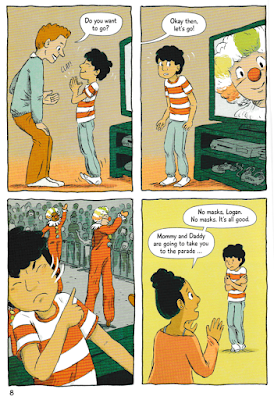
Going to the Santa Claus parade is a tradition that many families enjoy, even if they might worry about safety in the huge crowds. For Logan's family, those fears are far greater because Logan is nonverbal. So when Logan dashes away to see something and gets separated from his family, it is a scary situation for all. Thankfully ThunderBoom is around to help.
 |
| From ThunderBoom by Jack Briglio, illus. by Claudia Dávila |
As the family prepares for their trip into the city for the parade, it becomes evident that Logan communicates with his parents and older sister Izzy in his own way. He uses hand and body actions, and occasionally speaks the first letter of the words he wants to say, and they get him. He loves playing with his tablet and he loves trains. And he's Mister Social speaking to everyone on the train. But he also is unaware of the dangers that might befall him when he's excited. Logan might understand that he's being told to listen more carefully but that doesn't stop him from bolting from his family when he wants a closer look at the parade.
He soon realizes he's in an uncomfortable situation, faced with a group of clowns. But when faced with a stressful situation, Logan's imagination kicks in to protect him. (Illustrator Claudia Dávila demonstrates this with a white haze that appears and displays Logan's thoughts in yellow boxes.) So Logan envisions himself as ThunderBoom, a superhero who can stomp his way into protection. Still, after getting away from the monstrous clowns, he finds a new dilemma to solve: the little girl he'd met on the train has lost her teddy bear and her parents. ThunderBoom springs into action once again.
 |
From ThunderBoom by Jack Briglio, illus. by Claudia Dávila
|
After several more heroic adventures, Logan is finally reunited with his family, though he does have some moments of insight that his issues with discerning who is friend or foe, and hence his consequent reactions, may be him misunderstanding situations, just like others misunderstand him.
This may not be Jack Briglio's first book, but I suspect it's his most personal, as his "Author's Note" confirms. But that also means that his character Logan is more real, and Logan's alter ego of ThunderBoom evenmore genuine. Logan, modelled after Jack Briglio's son who has Angelman syndrome, has a great many fears and finds solace in his imagined superhero ThunderBoom for protection. He has found ways to communicate with his family but his ability to connect with others is limited, especially when he's anxious about those interactions. Thankfully his cheerful disposition seems to help him make friends, and also allies, who will help him become more independent and successful when he encounters challenges, whether it's a yappy dog or getting separated from his family.
 |
| From ThunderBoom by Jack Briglio, illus. by Claudia Dávila |
The message from Jack Briglio is more about Logan's ability to successfully meet those challenges in his own way, whether it's using an imagined superhero or asking for help from others. Everyone is faced with challenges, but we all need to find strategies to confront and overcome those obstacles or hardships. Logan's strategy works for him –I do wonder what really happened to those clowns and baton twirlers he fights off–though he has undoubtedly learned other skills from his family to approach his difficulties with patience and confidence. He's just a kid who is learning, and Claudia Dávila's digital illustrations–appropriately using superhero colours of yellow and red, though subdued, like Logan himself–make him as real as Jack Briglio's characterization and story.
ThunderBoom tackles a lot of important issues, not the least of which is coping with challenges. Giving Logan a voice, both in ThunderBoom the superhero and ThunderBoom the book, Jack Briglio may help other children find their own voices. Moreover, with ThunderBoom providing us with insight into individuals with Angelman syndrome and the families that love and support them, the story is an act of courage itself, much like that shown by the superhero depicted within.


