Showing posts with label paranormal. Show all posts

December 24, 2018

When Life Gives You Demons

Written by Jennifer Honeybourn
Swoon Reads
978-1-250-15823-9
262 pp.
Ages 13-18
July 2018

When life gives you lemons, you make lemonade. When Life Gives You Demons, the kind that possess people and make them levitate and revolve their heads, you get an exorcist.  But if you're sixteen-year-old Shelby Black, who is training to become an exorcist with her Uncle Roy, a priest, sometimes you're just not the exorcist who's up for the job.
Uncle Roy doesn't like family members to be present during an exorcism. They have a tendency to freak out when they see steam coming out of their loved one's ears. (pg. 6)
There is so much for Shelby to learn about exorcising demons. She's learning how to detect them and she always carries her silver crucifix, handcuffs, and bejeweled spray bottle of holy water. She's almost got the Latin incantations right and is diligent about writing reports about the exorcisms they conduct. Shelby really wants to help out, especially as Uncle Roy is seventy and exorcisms seem to being taking more out of him now. But she's still a novice, only studying how to conduct exorcisms for the past five months, ever since her mother Robin left suddenly to train at some secret exorcism school in Italy. Unfortunately Shelby fears her mother's departure had more to do with the hurtful things she said to Robin in an argument the night before.

While Shelby seems to keep bumping into possessed beings–and even a few suspected possessions that aren't–she's crushing on her peer tutor, Spencer Callaghan. But there's some weird stuff going on with him too. Spencer's brother Mike has a tattoo of the sign of the beast i.e., 666, and a dog called Cerberus. But Spencer gives her a black onyx protection rune necklace. Does he know something? How is she going to tell him what she is, especially after she learns from her uncle that her mother had become possessed while doing an exorcism and now may be a portal to the underworld?

When Life Gives You Demons is not horror, though it could have been. There are creepy demons.
The man's face contorts, and he's spitting and foaming at the mouth. And then–oh Lord–the head starts to revolve on his neck, bones cracking and popping, until it twists all the way around and his face is on the wrong side of his body.
      I wince. I really hate it when they do that. (pg. 160)
But Jennifer Honeybourn gives Shelby a humourous sarcasm about her unconventional vocation, seemingly unimpressed by the possessed she encounters. I suppose it could get a little weird seeing demons but, to Shelby, it's more annoyance, especially when she's on a first date with Spencer.
Unfortunately, my plan to ignore the demon across from me is about to backfire, because he seems to have come out of his trance.  His face has turned a dark shade of red, and he's beginning to snort. Also, his butt is hovering a few inches off the seat, so that's just great; now he's levitating. (pg. 158)
I am not a horror fan and suspected that Jennifer Honeybourn's story might be a bit too much for me but I was wrong.  It's the right mix of teen angst–though perhaps a little different than that for most teens–with Shelby crushing on Spencer while trying to find and save her mother.  There's suspense, a little romance, some family conflict, and those demons, making When Life Gives You Demons a great YA rom-com for readers who like a little paranormal with their flirtations.

November 07, 2017

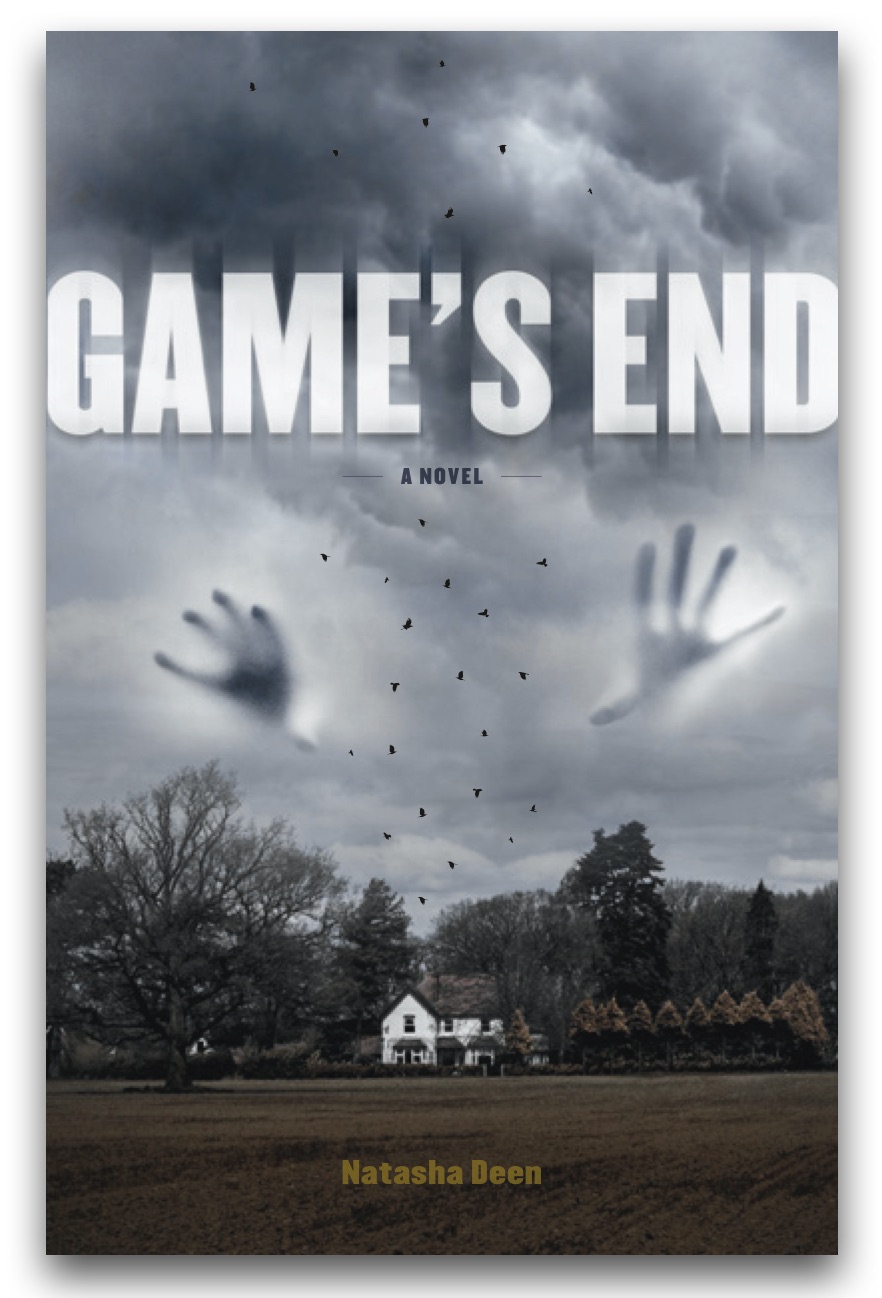
Game's End: Q & A with author Natasha Deen


Game's End
Written by Natasha Deen
Yellow Dog (formerly Great Plains Teen Fiction)
978-1-927855 -85-0
240 pp.
Ages 13+
November 2017


Yesterday I reviewed Game's End, the third book in Natasha Deen's series that began with Guardian and Gatekeeper. Today I have the thrill of interviewing author Natasha Deen about her newest young adult paranormal mystery.


•••••••••••••••••


HK: In my review of Gatekeeper, I called you the “princess of YA paranormal murder mysteries” and I stand behind that moniker, though I know you can write other genres as well.  But, though there are wild supernatural elements to Game’s End, at its heart the story is a whodunit, a murder mystery to be solved.  Are you a fan of mystery books and if so, who are a few of your favourite authors?

ND:  First of all, thank you for those kinds words! That thrills me. ☺

I am a huge fan of mysteries. There’s just something—thrilling, fascinating, intriguing—about hunting and gathering puzzle pieces, and delving beneath the personalities to find the truth. (I think it’s a bit like real life, where you listen and talk to people, and search for the subtext of their actions and words, and puzzle out who they are versus who they (1) want you to think they are (2) who they are trying to be).

I come by my love of mystery via family genetics.  Some of my favourite memories are the weekend afternoons when everyone was taking a nap, except my mother and I, who drank tea, ate cookies, and watched PBS Masterpiece Theatre,  as well my family coming together during the weeknights to watch TV and guess the murderer in Murder She Wrote, Columbo, and Matlock.

When it comes to my favourite authors, there are too many to name, but my first mystery-author love has to be Agatha Christie. Murder on the Orient Express, And Then There Were None, and any of the Miss Marple mysteries are tops in my books (no pun intended).


HK: Your subplots do double-duty, adding depth to the mystery as well as being the source of red herrings to trick the reader into guessing the identity of the murderer and more.  How hard is it to craft subplots that have to lure readers into thinking the story is going one way and then take them completely off course?  

ND:  It definitely takes some doing, but it’s so much fun to play with readers, and I really enjoy it. It’s like hiding Easter eggs and I love trying to find the balance of hiding clues deep enough to trick readers, but still making it apparent, so when they go back, they can see the clues.

As a reader, I love that feeling of racing to guess the bad guy before the main character/detective reveals them. It’s so exciting when you have that “Aha! I knew I was right!” moment, but I also love the “Ahh! They got me, I didn’t see it coming!” But when I go back, I can see how they were setting up the clues.

Stories that drive me crazy are when the author has some off the page clue that only the detective is privy to, or some sudden plot twist that’s not actually a twist, it’s just a sharp turn/plot device—that’s cheating. Put the clues on the page and let’s see how it turns out.


HK: From Guardian to Gatekeeper and now Game’s End, you have kept Maggie honest, humble and very real, though she has supernatural powers.  How did you ensure that she stay this real when she obvious isn’t?

ND:  I think from Maggie’s perspective, she’s not special.  Everyone has powers and talents, hers just happens to be seeing the dead. It doesn’t make her any better than anyone else, and with a dad like Hank, I just couldn’t see her being raised any way but the way she shows up on the page.

Also, I come from a culture (Guyanese) that embraces the idea of the supernatural, so why would you freak out or act weird? That would be like acting strange when you see the sun, but the sun is always there.

It’s not that Maggie doesn’t understand her power is unusual, but since it’s part of her, it just is…one of my favourite shows is West Wing, and one of the things that struck me was that the characters are never over the top or shrill. Then I realized that what was unusual for me (i.e., another country threatening to launch weapons or impose sanctions) is an everyday event for them. If they were over-reactive to it, they’d exhaust themselves by the end of the day. So, I think it’s the same with Maggie. It’s her everyday. She’s always seeing ghosts, transitioning them, learning about the terrible, beautiful aspects of their life. I’d like to think that it gives her depth and an appreciation for all the ways life is special and unique.


HK: While you’d made Maggie a sympathetic character, there are many others who are totally reprehensible and yet very real in the abuse they inflict on others.  Did you find it emotionally draining to write about domestic abuse and self-righteousness and violence against those who are vulnerable?

ND:  The short answer is yes. There’s a lot of personal experiences that inform those narratives, both mine and people I care about, and it’s a hard place to go, a hard place to live in, BUT, as storytellers, it’s important for authors to take the pain of those moments to make sure the story we tell is true to life, and the characters are as real as they can be.

One of the things that I feel is my saving grace and helps me not to get mired in the pain/darkness is my characters rise above those circumstances, so the bad things in life aren’t there to weigh them down, but to lift them up. I hope it’s something my readers can trust about my work—that there’ll be intense moments and difficult scenes, but in the end there is some kind of positive resolution.

There are a lot of studies on the effects of reading on the brain, on the physiological changes that happen when we imagine, so it’s important for me that even if there isn’t always a Hollywood happy ending in a book, it ends on some kind of hopeful note.

If I can expand out the answer, then it’s worth noting in my personal philosophy, I believe we’re all storytellers, and that’s why sharing stories (with friends, in writing, with groups) is an important thing. The world is made better and stronger when we connect through our shared stories and experiences.


HK: While there is much fear associated with death and dying, the concept of an afterlife offers some prospect for good to come out of that fear.  Do you believe in a particular version of an afterlife?  If so, does this belief come from a spiritual background, personal experiences with a psychic medium, or something else entirely?

ND:  Asking a Guyanese person if they believe in ghosts is akin to asking them if they believe in the sky. ☺ The sky exists, it’s there whether you believe it or not. According to Guyanese philosophy, ghosts and the supernatural is just another level of existence. Your ancestors will visit you in your dreams, they can change the reality around you, so you must always be aware of unusual occurrences in the everyday (a butterfly showing up in a location butterflies aren’t known to appear, for example). It’s why you should always behave—no one wants a lecture from long-dead Auntie who shows up in your dreams.

As a kid of two nations, Canada and Guyana, it’s one of the things I had to reconcile. North American culture doesn’t embrace the supernatural in the same way as Guyanese. But I’m so proud of my heritage and the subtext of this belief, that love can be so strong, your family members so connected to you that even death can’t break that bond, and I love the lesson to pay attention to the world around you, to pay attention to the unusual things because something beautiful might be coming your way.


HK: Although I’ve never heard of them, the supernatural creatures called serengti seem familiar to me yet I can find no reference to them in the literature.  Are these creatures from any particular mythology or are they your own fantastical creation? 

ND:  I sketched out the series back in 2010, and I remember coming across a reference to an ancient creature that was female and…that’s all I remember. When I tried to find my notes, they were missing. I *feel* like I came up with the serengti term, but that it’s based off of mermaids, sirens, and my wondering about what the after-life of Hans Christian Anderson’s Little Mermaid may have been like.


HK: I so enjoy your humour.  Even in a book that deals with death and the supernatural, I found myself laughing aloud at the banter between Maggie and Serge and Nell’s pluck.  How can you remain light and jovial in your writing when immersed in a story about murder and violence and dangerous situations?

ND:  I have to thank my family and my family history for that. When you grow up as a POC, your life is just different from the non-POC kids (I still remember being 9 years-old and telling a Caucasian girl in my class that I was creeped out by white pillows, and her not having a clue about why, and when I said, “Well, because of the KKK and the Aryan Nations,” she still looked confused. That was one of the many moments I realized my growing up and how I navigated the world wasn’t going to be like my classmates, and what the world offered me versus what it offered them was never going to be the same).

My family history is one of struggle and overcoming, of standing strong while terrible things happened, and letting the bad things pass. Part of the standing strong involved love, forgiveness, a lot of humour. There’s an unspoken code of conduct in my family. In a bad situation, find a way to laugh. If you can do that, you can find a way to overcome, you can find the light, and a way out of whatever darkness is encroaching on you.

From a story/character perspective, I wanted to give Maggie, Serge, Nell, and Craig a similar philosophy. Certainly from Maggie and Craig’s perspectives, they’ll have seen things they can’t unsee. Serge is now heading down that path, and for Nell, she doesn’t have the same abilities (or any supernatural powers) as her friends, so how does she navigate the stories she hears from them, and how does she step in to support? Humour seems like the perfect weapon.


HK: The ending of Game’s End leaves it open for the possibility of more books in the series.  Are you planning on continuing Maggie’s story?  Readers will definitely want to learn about the return of a key character. (I won’t spoil the ending for readers, though they should be prepared that, as you say, “Maybe there are no happy endings.  Maybe there are just endings, and it is up to us to make them happy.”; pg. 240)

ND:  I’m giggling because for writers, our stories are forever continued, and we’re always living with our characters. The Guardian trilogy wrapped some of the big issues facing Maggie—bullying, domestic violence, abuse, forgiveness, resilience—in a series of horror/mystery/suspense novels, and I feel as though I’ve told that portion of her story. Having said that, I’m definitely open to more of Maggie’s adventures.


•••••••••••••••••

Many thanks to Natasha Deen for answering my somewhat lengthy questions 
and 
Marketing Director Mel Marginet at Great Plains for facilitating this interview.

• • • • • • • • • • • • • • • • •

If you haven't read the whole series, time to get your own copies of Guardian, Gatekeeper and Game's End!


November 06, 2017

Game's End

Written by Natasha Deen
Yellow Dog, an imprint of Great Plains Publications
978-1-927855-85-0
240 pp.
Ages 13+
November 2017


     “He’s not my real brother, we’re soul-bonded.”
     “If he’s not your brother, why do you call him that?” asked Zeke.
     “Because.” Serge wriggled into the spot between us. “It sounds better than ‘hi, meet Serge. We used to go to school together and he bullied me until I wanted to die. Luckily, he was the one who stopped breathing.  I helped him figure out that his so-called suicide was a murder, and then we discovered in this life we were both scripted to become guardians.  We watch over the dead and living, transition souls from this plane to the next, and make sure the bad spirits from hell stay there.’”
     “Yeah,” Zeke nodded. “I can see how that’s a mouthful.”
(pg. 25)

That's essentially the creation story of Maggie Johnson and Serge Popov though there is so much more to their story.  There's Maggie's supernatural boyfriend Craig who is a ferrier of the dead, and her extremely plucky (her word, not mine) and loyal best friend Nell, and her dad Hank and his girlfriend Nancy who is the sheriff.  They all "live"–some more than others–in Dead Falls, Alberta where Maggie has been involved, with some supernatural help, in exposing those responsible for the deaths of several people, sadly raising the ire of some local citizens who consider the teen "a death magnet" (pg. 159) who has ruined the reputations of the town and some people like Serge's father, Reverend Popov.  The vibe in the town is definitely off but there's something worse coming as foretold by The Voice–the disembodied voice that comes through radios and whom Maggie suspects is her mother–and it's coming for Maggie.  Craig believes it's as a power-seeking soul-eater, which appears and swallows up lost and wandering dead just as Maggie is trying to help the newly dead Zeke cross over with his little brother Homer.  If the soul-eater is the only threat is yet to be seen.

As Craig and Serge attempt to get more info from the other side about her mother, Maggie is being pulled into her own investigations.  She tries to learn more about her mother from Hank who reveals that she too had powers that were tearing her apart.  On top of that, Maggie is experiencing unusual out-of-body experiences that take her to different times and places to witness the rescue of children's souls by a serengti, a supernatural called Serena, who compassionately tries to spare them the trauma of their deaths.

Then a murder shatters Maggie's world, and she's on the trail, both of our world and a supernatural one, to find the killer and keep those she loves safe.

Game's End is the conclusion of Natasha Deen's Guardian trilogy that began with Guardian (Great Plains Teen Fiction, 2014) and led to Gatekeeper (Great Plains Teen Fiction, 2016), all stories that embed the reader in the worlds of the dead.  For the dead in Game's End those worlds includes both the good and the bad, those who attempt to ease the dead to the other side and those, both living and supernatural, who seek to harm for the sake of power.  The evil that kills and aims to destroy is palpable in Game's End and, except for those who attempt to harm the children Serena wishes to rescue, not always easily identifiable.  Like evil everywhere, it is masked with lies and smiles and facades of rational behaviour.  The only reassurance is that, whether they are the self-righteous or domestic abusers or murderers, justice, in this world and the next, will be levelled against them.  That's the reassuring message of Natasha Deen's paranormal mystery: revenge is not necessary because there's karma.

Even so, Natasha Deen makes Game's End a story about a typical teen who is trying to find her niche in the world.  What she has on her plate is a little different than most teens, balancing being a friend and daughter with battling evil on both sides of the death divide.  But it all reads so naturally because of Natasha Deen's characters and a healthy infusion of comic relief.  While Maggie may be playing "demonic whack-a-mole" (pg. 29) with some unfriendly entities, she's rolling her eyes at Serge's wisecracks and Nell's off-hand comments that always alleviate the tension.

“Oh, he’s cute,” said Nell.
“Calm down,” I said. “He’s dead.”
“I could make him feel alive again.”
(pg. 21)

I know it's bizarre to match Natasha Deen's intense plotting with her tongue-in-cheek humour but the two work so artfully together, one escalating the drama and the other cushioning it, that Game's End would be a very different entity without this curious pairing.

Game's End may be Book 3 in this series but it's far from game over for Natasha Deen.  And if you're a new reader to the Guardian series, you've got three books of robust plotting, clever characters and bright banter ahead of you. Enjoy!


•••••••••••••••••

Look for my in-depth interview with author Natasha Deen tomorrow.  She graciously answered some tough questions about her writing, her beliefs and plotting for Game's End and her whole Guardian series. 

•••••••••••••••••

June 09, 2016

Gatekeeper

by Natasha Deen
Great Plains Teen Fiction
978-1-927855-39-3
232 pp.
Ages 13+
May 2016

Someone was pounding at the front door at 10:30 p.m., and common sense said not to answer.  Then again, I see the dead, live with a ghost, and was dating a supernatural being who transported souls.  Common sense may have been in my neighbourhood, but it wasn’t on any street I lived. (pg. 7)
Natasha Deen grabs readers and thrusts them into Gatekeeper with this opening, not unlike her opener to its prequel Guardian (Great Plains Teen Fiction, 2014),  in which 17-year-old Maggie reveals her knack for seeing the dead and helps solve the murder of Serge Popov with whom she now has become a guardian to help the dead transition into the next world.  Along with supernatural boyfriend Craig, a ferrier of the dead, and her best friend Nell, as well as her caring father Hank and his girlfriend, Sheriff Nancy, who all know of her gift, Maggie has found herself at the centre of more than one mystery in their small town of Dead Falls.  And Gatekeeper places her in the role of sleuth and ghost-communicator once again.

That knocking at the door is the wealthy Mrs. Pierson, frantic over the disappearance of her and Dr. Paul Pierson’s six-year-old daughter, Rori, and looking for Sheriff Nancy.  Maggie, Serge and Craig with Rori’s babysistter Nell go to help in the search and help locate the little girl on the brink of death.  But after Serge uses his energy to get her heart beating, he and Maggie meet the newly-dead ghost of Kent Meagher, former all-around amazing Dead Falls student and current med student at the University of Alberta who is oblivious and confused about his death.  And this is the murder mystery at the heart of Gatekeeper.

But Gatekeeper is more than a whodunit because no one knows Kent is dead, not the least of which are his separated parents whose antagonistic relationship destroyed the family and left them financially ruined.  Kent’s concern for his mother is overwhelming and brings back a lot of memories for Serge about his own family dynamics, his mother and his death, but demonstrates the newly-developed empathy that makes Serge such a key and now likeable character.  By way of some careful research and snooping, Serge and Maggie discover that a lot of people are keeping secrets, including Kent, and that Kent’s determination to be a doctor may be at the heart of a series of mysteries, including his own death and rampant vandalism in Dead Falls.  And, of course, there’s the dead people that add a suprisingly humourous and horrifying combination of subplots to Natasha Deen’s story.  (Be prepared for a nasty legion of souls called The Family who cannot find peace and is looking for additional souls to ingest.)

Gatekeeper, like its predecessor, is completely an edge-of-your-seat read, though I found that I looked forward to the witty dialogue as much as the paranormal elements which Natasha Deen flawlessly embeds in her plot.  I’ve always thought Norah McClintock was the queen of YA crime fiction but I think Natasha Deen has developed into a princess of YA paranormal murder mysteries.  With her multifaceted plotlines and great, great characters who are neither perfect nor surreal (though they may be otherworldly), Natasha Deen has become one of my go-to YACanLit authors for spooky whodunits with a smidgen of romance.  Consider them the young adult equivalent of Scooby-Doo: fun sleuthing with the ever-helpful Maggie and Serge and the gang. Gatekeeper is one more mystery solved, and I look forward to more.

November 02, 2014

Guardian


by Natasha Deen
Great Plains Teen Fiction
978-1-927855-09-6
192 pp.
Ages 13+
October, 2014

Guardian is buried in death, haunted by ghosts and plagued by bullies, youthful and not.  But Natasha Deen guards against wallowing her readers in the sobriety of these elements and instead pens an intricate plot that lacks any predictability, even that which we expect with death.  

Seventeen-year-old Maggie Johnson lives with her father, the local undertaker, in Dead Falls, and she sees dead people.  Actually she sees those confused dead who need her help to let go of life.  Her dad knows about her "gift" and her best friend Nell knows about Maggie's "woo-woo" feelings, but the teen has enough strife with bully Serge Popov that she's definitely not going to let this little secret out.  Unfortunately, when a creepy radio poltergeist sends Maggie to a deserted old mill to find Serge's murdered body, she can't help but become involved, especially when she finds his ghost inexplicably tied to her, 
"...the one person he hated most in the world, and it struck me as funny. Hilarious. Karma was a bitch, but she has a dark sense of humour and I was laughing at the punchline." (pg. 51)
But, it's not until Maggie visits Serge's girlfriend, Amber, and learns the girl is thrilled with Serge's death, and that his parents, the Reverend and Mrs. Popov, plan to have his body cremated without a service, as though he'd never existed, that Maggie actually reveals to Serge that she can see and hear him.  Though relieved that he still has a voice with someone, even Deadhead as he calls her, Serge needs to know what happened if he is ever to move to the next world, wherever that may be.

Luckily Dead Falls is a small enough community that Maggie's innocent (?) sleuthing generally looks like nosiness and gossip. She learns much through her friends including her crush Craig MacGregor, the captain of the water polo team on which Serge played, as well as from her father's love interest, the sheriff Nancy Machio. But it's Serge's reactions and commentary with her visits to those who knew him best (like Amber, his parents, etc.) that elicit the most revealing of secrets, some which Serge is not ready to have exposed. And I did mention the threatening poltergeist that continues to send creepy messages to Maggie, right?
"Help Serge or be killed by the poltergeist. Help Serge and possibly be killed by his psychotic father. What a set of options." (pg. 196)
Guardian is at its heart a murder mystery, albeit a paranormal one, and a superb one at that. But it defines itself with its characters whose thoughts and actions are unpredictable, as are most of ours, and with their development as they learn new things about themselves and others.  Even for Serge, a truly nasty bully, there is hope. And Natasha Deen's writing is a blend of smart dialogue and brisk action that effortlessly takes the reader looking for the "who" who did it. She has a real knack for creating the right atmosphere for friendly discussions and creepy scenarios, as well as thoughtful moments and teen angst.  And Natasha Deen has a wit that seems to infuse her words (or rather those of her characters) taking the edge off frightening elements. Everything is believable (even the poltergeist and Serge).

I don't know what Natasha Deen has in store for Maggie after Guardian but there is a perfect set up here for a sequel, not to complete the story but to examine how Maggie's psychic nature and her relationship with Craig both develop, and I look forward to reading about both.

~  ~  ~  ~  ~  ~  ~  ~  ~  

Consider watching the book trailer for Guardian that Natasha Deen posted in August (I've included it here) and taking a look at her website www.natashadeen.com for more about the author and her writing.

July 08, 2014

The Night is Found: Blog Tour begins


Let the Blog Tour begin!


by Kat Kruger
Fierce Ink Press
978-1-927746-57-8
978-1-927746-59-2 (epub)
978-1-927746-60-8 (Kindle)
301 pp.
Ages 14+
For release July 22, 2014
Reviewed from eARC

Being lost can be so much more than not knowing your location.  It can be the confusion that comes with new knowledge or revelations, and Connor Lewis' learning that he is a werewolf would be reason enough to feel lost and out of touch. For a kid, almost eighteen, going from geeky gamer to werewolf and now to pack leader and target of the Luparii (werewolf hunters), Connor needs a lot of finding to happen.

When Rodolfus de Aquila a.k.a. Roul, pack leader and owner of Fenrir Pharmaceuticals, chose to take a bullet meant for Connor, he gave the young man the task of bringing together the packs of Europe.  With the Luparii in possession of Wolf's Bane, a bio-weapon cure against lycanthropy produced by Henri Boguet, and with the Hounds of God led by magistrate Breber aiming to kill off werewolves, Connor needs to determine how best to organize the packs quickly. To that end, Connor and Amara travel to New York City to learn from the werewolves who'd left the Old World in the 1600's to avoid persecution and were rumoured to have become unified.  Meanwhile, Arden is tasked with visiting other packs and warning them of the Luparii and inviting them to Paris to witness their damaging effects.

Connor and Amara are received by a NYPD captain, Marrock, and the bored rich girl Esrin, who represent the Founders, short for the Wolf Conservation Foundation.  They manage their own pack as well as seven territories (wildlife sanctuaries) of the Wilds, werewolves who are ignorant of the outside world.  When the Luparii make their presence known using a device made by Phenix Industries, the arms technology business that funds the Founders, Connor recognizes that,
"I have a sense that what we bury here today is any hope of understanding of how to make things right overseas." (pg. 168)
Things overseas aren't necessarily faring any better.  Madison, Connor's love interest, has been under wraps at Fenrir Pharmaceuticals in Frankfurt since he accidentally bit her and changed her into a full-fledged werewolf.  Trajan, the biochemist, has been using her as a test subject for an antivenin for Wolf's Bane but Madison wants to play a part in helping Connor. Unfortunately, because of her relationship to Connor, Madison has become a commodity that has the Luparii, the Hounds of God and even ex-boyfriend Josh trying to get to her.

The complexity of The Night is Found is wild. Based on critical information from the first and second books in the series, The Night Has Teeth (Fierce Ink Press, 2012) and The Night Has Claws (Fierce Ink Press, 2013) respectively, The Night is Found twists the key characters of Connor, Madison, Arden and Amara into new personas as they accept their new attributes (bitten, cured, healed, safe, human, wolf, werewolf–whatever) and try to make things right while working with and against others.  Kat Kruger's characters are so real that I'd consider looking up some of the companies and locations mentioned in the book to see if they truly exist.  Yeah, I know werewolves aren't real (I do have to keep reminding myself of that) but Kat Kruger has developed all her characters so fully that it's sometimes hard to believe they're not.

If I hadn't enjoyed the first two books, keeping the storylines straight would've been difficult.  But I did, and I could, and appreciated Kat Kruger's complex storytelling all the more.  She's able to juggle the multiple subplots of teen angst and romance as well as biotechnology and belief systems easily with the paranormal and create a riveting tale that's imbued with sarcasm, sweetness and savagery. And still Kat Kruger convincingly allows Connor, Arden, Amara and Madison to un-lose themselves and amicably position themselves in their paranormal reality now that The Night is Found.

 ≈ ≈ ≈ ≈ ≈ ≈ ≈ 


Here's your CHANCE TO WIN a free digital copy of the entire Magdeburg Trilogy:
Just leave an appropriate comment below about why you'd like to read the whole Magdeburg Trilogy, and I'll choose a winner for Wednesday.

Easy peasy.

October 08, 2013

How to Curse in Hieroglyphics

by Lesley Livingston and Jonathan Llyr
Illustrations by Stephen Burley
Puffin Canada
978-0143184249
248 pp.
Ages 8-12 
October, 2013
Reviewed from galley copy

The title is fun, the fluorescent cover is dazzling and How to Curse in Hieroglyphics is entertaining as a rollicking adventure teeming with mystery, B-movies, graphics, humour and action!

Twelve-year-old cousins and B-movie fans Tweed Pendleton and Cheryl Shumacher live with their grandfather, Jefferson "Popcorn" Pendleton a.k.a. Pops, in Wiggins where he owns and runs the Starlight Paradise Drive-In.  Though the girls are responsible and diligent, they may have a reputation for too much imagination because of their regular game of "Action!" that has them playing movie scenes and chasing monsters.  That and the story they told about "The Incident" that left them as five-years-old sitting on a rock, the survivors and only evidence of a family plane trip in which their parents and siblings, and pilot and plane, all disappeared.  Luckily, even though the babysitting jobs seem to be infrequent, Pops has asked them to try their hand at programming for the drive-in, while he works at reopening the adjacent mini-golf course.

But the girls recognize the competition they'll have when Dudley's Traveling Curiosity Show comes to town and sets up across the road, especially with its posters claiming to have the sarcophagus of an Egyptian princess, Zahara-Safiya.  With the help of their 14-year-old friend, Pilot Armbruster (whose father had piloted the awol plane seven years earlier), the girls undertake a mission to scope out the carnival, along with their eleven-year-old annoyance, Artie Bartleby. 
Everything goes awry when Artie tosses "B. Ruth's ball" (Bob Ruth, not Babe Ruth) and cracks the green stone in a decorative scarab beetle embedded in the sarcophagus.  Some purple smoke and a whirlwind later, Artie is missing, the girls are babysitting 15 cats for the school librarian and Colonel Dudley, the proprietor of the carnival, is freaking out because the sarcophagus is empty.  Tweed and Cheryl's game of Action! becomes a real scenario in which they must herd four toddlers turned minions, deal with a transformed, lisping, scaly and tailed Artie, and thwart a curse to bring about a satisfying "The End" for all.
Readers in the middle-grades (Grades 4 to 6) will chuckle with the sparring dialogue between the kids and their verbose claims when trying to impress adults.  They call Arnie "Shrimpcake" and describe him "as annoying as a mosquito in a dark room" (pg. 122) while reassuring Miss Parks that she could "leave the precious shnookumses" in their capable hands (pg. 62).  Their commando gear consists of  
"two sets of hockey shoulder-pads rescued from outside Wiggins' only skating rink, a welding mask (Cheryl), a pair of cardboard 3D glasses with one blue lens and one red lens (Tweed), and a gear bag full of 6 cans of Day-Glo Silly String, a homemade crossbow and quiver stocked with two dozen spongy suction-cup Nerf arrows, a couple of coiled lengths of bubblegum-pink skipping rope, a dodge ball, a whiffle bat, collapsible poles with green nylon fishing nets attached to the ends, and a bag of Double Stuf Oreos with the word "BRIBES" written on it in black magic marker." (pg. 132)
It's so nice to meet pre-teens who still seem like kids.  Tweed and Cheryl are what all tweenies should be: creative, friendly, and fun-loving.  They're not concerned with looking older than their years or being the most popular or attracting boyfriends.  Even Pilot at 14 isn't playing at impressing anyone.  Maybe that will happen at 15 or maybe never.  In the meantime, all readers will enjoy the kids' exploits as literary entertainment, with some graphic storyboarding and scripting worthy of a favourite family movie.

Actor and author Lesley Livingston has always created books that are well-seasoned with wit and clever repartée (see these reviews of her Wondrous Strange series, Starling, Descendant, Once Every Never, and Every Never After) and it would seem that she has found a writing partner in actor and space geek Jonathan Llyr, who apparently wore a rubber turtle shell on his head on SPACE (Kevin A. Boyd, 2010).  How could middle-grade readers with a taste for geek, history, paranormal or adventure all rolled up in laughs not love this story?  I suspect they'll all be waiting (as we all do with Lesley Livingston's books) for the sequel to How to Curse in Hieroglyphics, hoping to learn the details about "The Incident".  Fortunately, How to Curse in Hieroglyphics has been identified as The Wiggins Weird, Book 1 so we know there's more to come.  Yeah!

~  ~  ~  ~  ~  ~  ~  ~  ~

Remember: the book launch for How to Curse in Hieroglyphics is on October 19, 2013.

September 14, 2013

The Night Has Claws (The Magdeburg Trilogy, Book Two)

by Kat Kruger
Fierce Ink Press
978-0-9917937-5-4 (pb)
978-1-927746-02-8 (ebook)
269 pp.
Ages 14+
Release September 24, 2013
Reviewed from advance release ebook

When Kat Kruger ended her award-winning first book in The Madgeburg Trilogy, The Night Has Teeth (reviewed here on January 13, 2013), it was bloody mayhem.  Really.  Seventeen-year-old Connor Lewis had learned that he is a pure werewolf whose "nature" was only revealed after born-werewolf Amara had accidentally bitten him.  His special nature had drawn the attention of Henri Boguet, one of the bitten "monsters", whose biotech company has developed an antivenin for werewolf bites as well as a cure he calls Wolf Bane.  And Connor's school friends, Madison and Josh, had revealed that Josh had bitten Madison, condemning her to a life as a monster too. Even though Josh is still in love with Madison and desperate to make things up to her, Madison and Connor have an affinity for each other. With the nature of one's werewolfness determining the allegiances one has, Connor is confused understandably about whom to trust.

The Night Has Claws begins with three different story lines which will ultimately converge.  First, with Boguet being captured, he is remanded to custody to stand trial before the High Court of Madgeburg, the werewolf court.  Secondly, Madison who has shot Boadicea, Boguet's associate, believing she was going to harm Connor, focuses on what she has done, what is on the USB stick Boadicea tried to give Connor, and how she feels about Connor and Josh.  Lastly, born-werewolf Arden, Amara's mate, who'd appeared to die by Boguet's hand (teeth, actually), had been buried along with Boadicea by the Hounds of God (a society of the bitten).  But Arden had not died, though he desperately wished he had, becoming human instead, getting Boguet's cure through his venom. 

So we've got Connor sticking close to Arden and helping him survive as a human while learning from Arden how to live as a werewolf.  But through it all, Connor must decide to whom he will ally himself:  Roul (Rodolfus de Aquila), leader of Arden's former pack, or the Hounds of God to which Josh and Madison belong. 

In Quedlinburg, Germany, where the High Court of Madgeburg officiates, all gather for the prosecution of Boguet by Heaven's Hand, the organization that governs werewolves.  In addition to Connor, Roul, Arden, Amara, Madison, and Josh and their related groups, the Luparii (marked by white armbands) who act as an intergovernmental European task force to limit and maintain control of the werewolf populations show a strong presence.  On the surface, the court and Heaven's Hand profess to protect all life with the singular law of condemning to death any who bites a human but, as with many organizations in which individuals carry their own emotional baggage and opinions, hypocrisy creates exceptions and thus friction.  While Boguet may be the official defendant, Connor and Arden become targets for the judge, Breber. While Madison may come to their aid with surprisingly revelations about Boguet, instead of quelling both judicial and physical attacks, her news launches a new barrage hitherto unknown.

Hold onto your book or device because The Night Has Claws may start with the emotional and physical clean-up of story-lines from The Night Has Teeth but it ends on an even messier closing. I don't mean messier as in confused but rather in terms of catastrophic ruin.  It breaks apart with secrets revealed, relationships and alliances exposed and shattered, and upcoming hostilities and combat forecast. The reader may still be hopeful for reconciliation between Connor and Madison and Arden and Amara but surprisingly Kat Kruger has you cheering for the motley band of protagonists and even laughing along at times. (Honestly, how often can a writer use the admonishment "Bite me" as a double entendre?) And there's even more action, surprises and affairs of the heart coming because we know that where The Night Has Claws leaves off, Book Three will launch and continue to thrill.

August 29, 2013

The Hypnotists

Written by Gordon Korman
Scholastic
978-0-545-50322-8 (hardcover)
978-0-545-60272-3 (audiobook)
240 pp.
Ages 8-14
August 2013
Reviewed from audiobook

Just like his earlier series—Macdonald Hall, On the Run, Everest, Island, Dive, Kidnapped and most recently Swindle—Gordon Korman will easily snag young readers with The Hypnotists if they're looking for his characteristic droll humour, kids vs. adult conflict, suspenseful thrills and unique plotting. 

Jackson Opus, 12, has always known that his eyes change extraordinarily from violet to blue then green, but it takes a few perplexing interactions with a bus driver, a basketball rival, his ophthamologist, a psychiatrist and a hypnotist at a vaudeville show for Jax to have his hypnotic ability identified.  (Come on, that's not really a spoiler.  What did you think The Hypnotists was going to be about?)

Selected to attend the Sentia institution of Dr. Elias Mako who,
"has devoted his life to New York City education and is an inspiration to every single one of us" (pg. 34)
Jax is taught how to control his ability to mind-bend (i.e., hypnotize) and challenged to mesmerize volunteers.  As an Opus, a family line well-known for its mind-bending talent, Jax is taken under Dr. Mako's personal tutelage, attempting greater challenges than ever imagined, including attempting post-hypnotic suggestion (i.e., producing a specific action after waking from hypnosis) via video.  But after making the acquaintance of the elderly, hippie-esque Axel Braintree, the head of the Sandman's Guild, a guild of "reformed" mind-benders, Jax learns more about his heritage and the extent of his own ability, as well as about Dr. Mako's true reputation.

It can't be surprising to readers of Gordon Korman's middle grade books that The Hypnotists has a couple of boy in their tweens trying to make sense of bizarre circumstances and erroneously interpreting others' actions, embedding laughs and dynamic surprises with each new development.  Imagine making a passing comment to a bus driver that "You have to get us to Ninety-Sixth Street as soon as possible" (pg. 3) and transforming the transit man into an Indy driver who refuses to stop for passengers, lights and traffic!  Or mesmerizing the lunch lady to provide more gravy for his friend Tommy's Salisbury steak ("Make sure you give him as much as you can" pg. 68) resulting in enough gravy to create a hazard on the floor and Tommy being stalked by the lunch lady.

With the pen (word processor?) in Gordon Korman's control, the main plot of The Hypnotists–Jax attempting to thwart an evil mastermind–is embedded with the boy's introspection of his conscience and motives while others are drawn in, demonstrating their own views on hypnotism and its uses, good or evil. Always enhancing the action with a peppering of pre-teen humour
"Aw, I don't want to see inside my mother's brain.  All those private thoughts and lady stuff.  I get skeeved out just looking at her eyelash curler" (pg. 186)
Gordon Korman will have readers anticipating Book 2 in this series, undeniably set up with Jax's final thought and the last eleven words of The Hypnotists.

= = = = = = = = = = = = = = = = = = = = = = = = = = = = = = = = =

Author Gordon Korman will be attending the International Festival of Authors (IFOA) on Saturday October 26, 2013 at 11:00 a.m. at Toronto's Harbourfront.  Don't miss this opportunity to see one of Canada's legendary youngCanLit authors.

July 22, 2013

Not Your Ordinary Wolf Girl

by Emily Pohl-Weary
Razorbill
978-0-67006-640-7
304 pp.
Ages 13+
September, 2013

Forget about any kind of ordinariness for Sam Lee.  At eighteen years old, she's one third of the popular band, The Cream Puffs, and their primary songwriter too. Along with their bad-girl lead singer, Jules, and sexy, bookish drummer Malika, The Cream Puffs are the hip band in New York City.  But Sam's life is not one that fans envision for a rock musician, especially one that performs with so much power on stage.  She eschews the parties and the fans, rides her bike at night, and lives on the top floor of a converted pickle factory that she owns.  And, except for crushing on Harris Walls, who is animating a video for the band and who has a gorgeous girlfriend, Sam is considered the loner tomboy (although there was a large guy who kept staring at her during a concert and tried to talk to her afterwards who obviously didn't think so).

But, after taking a nasty fall while careening through Central Park on her way home from the concert, Sam is jumped by a large dog, and then rescued from it by another dog that takes a gash out of her forearm.  Except for a voracious appetite, unquenchable thirst and a slight fever, Sam experiences no frightening symptoms but she goes to Emerg to get checked out.  But, with evidence of the bite gone and her status as a rock musician known, Sam gets out of there promptly when the medical staff start talking about testing for drugs and a psych assessment. 

Things go from bad to worse, or weird to bizarre, at their photo and video shoot, when Sam cannot eat enough roast beef and turkey sandwiches and gets aggressive with Jules, definitely odd for the introverted vegetarian.  She's sweating through her custom-made shirt, annoying their director and she can detect Harris' scent! Insisting that she is sick, Sam takes off. On her ride, she is followed by Marlon, an art school friend of Harris', who offers her beef jerky and a mega-water bottle and claims that he just wants to make sure she's okay, knowing what she's going through.  Finally, freakish dreams, messages from her nasty neighbours about her big dog (?), attacks by girl-gangs dressed as dogs, and a fan photo of her devouring a whole BBQ chicken help Marlon persuade Sam that she needs his help.

The title may give away what has happened to Sam, but it cannot even allude to the multitude of subplots involving Marlon's brother Owen, mutated werewolves, other supernaturals, and Sam's worries about revealing herself to her friends and the public.  And, of course, the love triangle of Sam, Marlon and Harris.

Emily Pohl-Weary's writing is evocative, ensuring the reader truly understands the depth of Sam's physical and emotional transformation, and her characterizations are explicit and fully revealing, reading like exposés from any teen magazine.  Emily Pohl-Weary (website here) takes Sam from a talented young woman who works in the social realm of music performance but prefers to live in a private world, to a wolf girl who finally finds the freedom to be herself.  While not an easy transformation, particularly if there's some confusion whether it is real or imagined, Sam's metamorphosis takes her through the full gamut of emotional responses: horrified, dazed, hysterical, logical, numb, secretive, embarrassed, angry, and appreciative.  Surprisingly, with people like Marlon and Malika volunteering to support her in her changeover to wolf girl,  Sam's Not Your Ordinary Wolf Girl storyline becomes all the more credible (if you can say that about werewolves) and definitely less horrific.

July 21, 2013

Compliance (The Dust Chronicles, Book Two)

Written by Maureen McGowan
Skyscape
978-1-1477816530
378 pp.
Ages 12+
June, 2013

In Deviants (reviewed here on January 6), Glory Solis had made the escape from their enclosed community of Haven with the help of the enigmatic but alluring Burn.  Having found safety for her Deviant brother Drake at the Settlement where her father, long thought dead, lives, Glory has returned from the Outside to Haven as an undercover agent for the Freedom Army to rescue other Deviants from inside. 

Her return has been accepted on the premise that she had been kidnapped by a Deviant and cannot remember her painful experiences at his hands.  In fact, Mr. Belando, the Junior VP of Compliance, has had Glory placed in Compliance Officer Training (COT), believing her kidnapping may give her insight into Deviants, particularly those conspiring against Management and launching terrorist attacks prior to the President's Birthday. 

So, by day, she participates in Comp training, along with her HR department-sanctioned dating partner, Cal, for whom she has conflicting feelings after being with Burn, and enduring the harassment of their Recruiting Captain, Larsson, and fellow classmates.  At night, she searches out Deviants to hand off for transport to the Settlement.  But everything changes when she learns from Burn that her regular contact for transport, Clayton, was killed along with a young Deviant, and that he blames her.  Determined to make things as right as she can, Glory searches for an elusive Deviant named Adele Parry.

Meanwhile, with Cal continuing to cover for her and protect her regularly against any harassment, Glory confides in him about her work for Mr. Belando and a suspected mole in COT.  Everything becomes even more complicated when Cal's brother Scout is seriously injured and video shows Burn loosening the bolts on their scaffolding!  With Scout "going to the Hospital" which many believe is a euphemism for execution, Cal and Scout's dating partner, Jayma, are distraught, unlike Glory who has been reassured by Mrs. Kalin, the VP of Health and Safety, who has taken a special maternal interest in Glory, that the Hospital is perfectly safe.

Whereas Deviants emphasized the false premises upon which Haven has been established and the journey from Haven to the Settlement, Compliance underscores the role of trust in moving the plot forward.  Nobody seems to trust Deviants. Deviants have valid reasons not to trust others, knowing their inevitable fate is being expunged to the Outside and attacked by Shredders.  Glory is confused by the trust she has for Cal, though he is a Comp Recruit, and for Burn, whose tenderness has been replaced by nastiness.  Who to trust now?  And what of Mrs. Kalin with whom Glory feels safest?  Or Jayma who has always been her best friend but may not accept Glory's Deviance?  But as Glory tells a young Deviant she is rescuing,
"I figured out that it's one thing to be cautious and another to never trust anyone." (pg. 7)
Maureen McGowan has topped the uneasiness of Deviants' dystopian story with Compliance's psychological tension, as neither Glory nor the reader ever has any indication whom to trust.  Moreover, trust is an ephemeral concept, appropriate in one situation and not in another.  Glory's strength in continuing to be fair and non-threatening i.e., harnessing her own Deviance just exacerbates the reader's heart-stopping trepidation each time she interacts with someone, friend or foe, Deviant or not.  While Maureen McGowan does relieve some of the reader's tension at Compliance's ending, it's not quite resolved for Glory, whose confusion is now compounded with the convergence of her two worlds, previously separated by space and time.  It's inevitable that Book Three of The Dust Chronicles will extend Compliance's gripping adventure but it's a relief to know that there will be some respite from the tension by way of the unavoidable amorous interludes Glory will share, hopeful of alleviating some confusion.

January 13, 2013

The Night Has Teeth (The Magdeburg Trilogy Book One)

Written by Kat Kruger
Fierce Ink Press
978-0-988-10671-0
294 pp.
Ages14+
2012


The Night Has Teeth, and it has sharp edges and secrets and anger and judgement.  As the City of Light, Paris harbours enlightenment but sometimes in dark corners and in underlying worlds that extend beyond its catacombs.  Surprisingly, seventeen-year-old American Connor Lewis has chosen to spend his senior year here at the Victor Hugo International School.  Perhaps he might reinvent himself, becoming someone other than the boy who lost control of himself and bit a kid in kindergarten. 

Connor's host family is only one young woman, Amara Liang, a tattoo artist with a large dog named Lou.  Their paths rarely cross until Connor makes the acquaintance of two other students, Josh and Madison, and suddenly Amara and her boyfriend Arden seem to be everywhere.  Although Madison reveals that she and Josh no longer date after an incident at a campground in which Madison was almost killed, Josh is obviously still attracted to the cherry-redheaded girl and jealous of the attention that she gives Connor.  But the three friends continue to spend time together, going for sushi, playing Truth or Dare and clubbing, often encountering Amara and Arden.

After Arden defends them from a wolf attack, and Connor, Amara and Arden return to the apartment, Connor sees Amara in bed with Lou who is bandaged just as Arden had been.  Seems Lou (actually Loup i.e., French for wolf) is Arden in wolf-form and both he and Amara are werewolves, determined to protect Connor from a beautiful young woman, Boadicea Faelen, who is showing an interest in him.  Connor can't comprehend Boadicea's interest in a geeky gamer until Amara explains that they all sense something "different" about Connor related to lycanthropy.  Boadicea wants Connor for her dangerous boss, Henri Boguet, who 400 years ago led the people in attacks against the wolves before being bitten by Arden.  Now Boguet, one of the damned as neither werewolf or human, heads a biotech company intent on eradicating the werewolf genome and saving humanity from their disease and terror.

What follows is a dance of secrets and manipulation as Connor is pulled towards and away from three groups who all have some interest in him:  Madison and Josh; Amara, Arden and pack leader Roul; and Boadicea, Boguet and his men Trajan and Attila.  As he tries to sort through the information, often selective, that each shares with him, never knowing whom to trust, Connor replays the kindergarten biting incident and his reaction to it, wondering about his own nature and link to lycanthropy.

Although The Night Has Teeth has all the elements of other paranormal young adult books, it is unmatched to any I have read to date.  While the protagonists are teens dealing with issues of independence and self-recognition, there is none of the lightness of tone that is more typical of YA novels.  Yes, there is the awkwardness of teen romance, making new friends, making good decisions and relating to parents, guardians and other adults.  But there is a greater sense of gravitas, not seriousness really, but rather a sense of substance, that the story could be true.  Okay, I know that werewolves don't really exist (don't I?) but Kat Kruger has you believing that The Night Has Teeth provides an accurate account of Connor's experiences, even if somewhat surreal.  All I know is that when I finished The Night Has Teeth, (on two final sentences that will go down in my journal of best endings), I knew I would have to wait until Connor and Arden and the others resolve some issues before Kat Kruger could commit them to paper again. 
I'm wholly prepared for what lies ahead in this journey, because the wolf in the night has teeth.  It has claws, and it's me. (pg. 290)

    ∆      ∆      ∆      ∆      ∆      ∆    

As an aside, the texture and colours of the cover make for a spectacular book jacket, particularly with the torn (clawed?) openings revealing the startling red with succinctly ominous text. Kudos to Fierce Ink Press' jacket designer for nailing this.  I would love to see Quill & Quire feature the development of The Night Has Teeth's cover on its Cover to Cover feature page.  Don't you agree?

August 05, 2012

Alyxandra Harvey's The Drake Chronicles

Having recently met Canadian YA author Alyxandra Harvey at the Festival of Trees in Toronto, as her novel Haunting Violet (Walker & Co., 2011) was selected as the Honour Book for the 2012 Red Maple Award, I learned that she pens a very successful and popular supernatural series called The Drake Chronicles.  So, having enjoyed Haunting Violet, I thought I'd look into The Drake Chronicles and have just finished reading the first three books.  How could I have been so remiss in not recognizing this series when it first came out?  With five books in total already published and the sixth scheduled for release in January, 2013 (see list below), I've got a lot of catching up to do. 
  1. Hearts at Stake (alternate title: My Love Lies Bleeding)
  2. Blood Feud
  3. Out for Blood
  4. Bleeding Hearts
  5. Blood Moon
  6. Blood Prophecy (for release in January 2013)
For now, I'll limit myself to reviewing only the first books in the series here.  After all, you can get too much of a good thing, just like chocolate. And the Drake Chronicles are a very good thing.

Hearts at Stake
Written by Alyxandra Harvey
Walker & Company
(Distributed by Penguin Canada)
978-0-8027-2074-0
248 pp.
Ages 14-17
2010


Blood Feud 
Written by Alyxandra Harvey
Walker & Company
(Distributed by Penguin Canada)
978-0-8027-2096-2
258 pp.
Ages 14-17
2010


Out for Blood 
Written by Alyxandra Harvey
Walker & Company
(Distributed by Penguin Canada)
978-0-8027-2168-6
292 pp.
Ages 14-17
2010


The Drake Chronicles are called such after the Drake family, an ancient family of vampires, upon whom each story is founded.  The nucleus of the contemporary Drake family consists of mother Helena, father Liam, seven brothers (Nicholas, Logan, Quinn, Connor, Sebastian, Marcus, Duncan) and the youngest and only daughter, Solange.  Also living with the family at the beginning of the series are Aunt Hyacinth, Helena's aunt, and Uncle Geoffrey, Liam's brother.  Lucy, Solange's human best friend, is also an integral member of the Drake family, essentially an honorary sister, daughter and soon girlfriend.

In the first book, Hearts at Stake, Solange is worrying about her impending sixteenth birthday, the time for her blood change from human to vampire.  Knowing the physical and emotional trauma that all her older brothers endured with the change, Solange is already apprehensive.  But, as the only female vampire-born offspring, a prophecy declares that she will be the ruling Queen, destined to supplant Lady Natasha.  And now a menagerie of vampires, including the power-hungry Montmartre, are sending courting gifts, hopeful of a liaison with an upcoming queen.  Luckily, her best friend Lucy, a human, is sticking around to help her still enjoy life, even if Lucy and Solange's brother Nicholas keep butting heads as they have since childhood (though that power struggle now includes surprising kisses!)  So, not only does Solange have to worry about the change (and how good her best-friend Lucy will smell), and the endless (and sometimes gross) gifts of her suitors, everyone is out to protect her, practically suffocating her, especially once they learn of a bounty on the Drakes.  But, Solange is determined to have a life, even if that means getting closer to Kieran Black, the Helios-Ra vampire hunter who is convinced the Drakes killed his father. 

Blood Feud has the Drake family preparing for Helena’s coronation as the new Queen, with special guests and emissaries beginning to arrive.  The representative of the Hounds, Isabeau St. Croix, an eighteen-year-old woman whose aristocratic parents were murdered during the French Revolution, had been turned into a vampire by Greyhaven and buried for centuries before being rescued by the powerful Hounds.  Now Isabeau represents her queen or shamanka, Kala, and the Hounds who have allied themselves with the Drakes, particularly against Montmartre and his Hel-Blar army.  Not surprising that Logan Drake, wearer of waistcoats, frock coats and pirate shirts, finds himself drawn to Isabeau, as they work together to thwart the attacks of Montmartre, the Hel-Blars and even Greyhaven.

Drake brother Quinn and Helios-Ra student Hunter Wild are the voices of Out for Blood, the third book in The Drake Chronicles.  Hunter, an outstanding student at the Helios-Ra Academy, has been chosen by Helios-Ra leader Hart to accompany him and nephew Kieran Black to Helena Drake's coronation, as the Helios-Ra are allying themselves with the Drakes.  Through Kieran, who is still dating Solange, Hunter encounters Quinn to whom she is wildly attracted.  Quinn, of course, is similarly attracted, though with his charm and startling handsome features (like all Drake men), he is known as quite a ladies' man.  Having a vampire as a close acquaintance is problematic for the young Helio-Ra, especially with her bigoted grandfather, but she needs to uncover the truth about some goings-on at the Academy, and Quinn is eager to help and protect her.

If you check out  Alyxandra Harvey's website, you'll see how popular her books are throughout the world by fans of YA vampire books. While it can be difficult to pinpoint the exact features of the books that the fans love, I suspect that it has much to do with the great and varied characters, sweet romances, strong female leads, expressive teen attitudes, and the interweaving of vampires, Helios-Ra, Hounds, Hel-Blar and other assorted groups.  While the paranormal aspects of the books create fantastic context for the stories, the interrelationships between individuals and groups are easily recognizable for YA readers:  best friends, enemies, siblings, crushes, guardians and children, teachers and students, mixed with love, hate, like, disgust, respect, fear, confusion, loyalty, and concern.  The familiarity blended with the fantasy and the resolution of the good-evil conflict is an irresistible combination.

Alyxandra Harvey's books are regular contenders in the best of the paranormal romances that include series like Twilight, the House of Night, the Mortal Instruments, the Infernal Devices and the Darkest Powers.  I couldn't count the number of readers who proclaimed with exclamation their preference for The Drake Chronicles over the Twilight series.  That's high praise for a series by a Canadian author whose books have not had the exposure and promotion that the other has enjoyed.  And as long as Alyxandra Harvey continues to tell stories about the Drake family and those in their circle in her winning style, readers, including myself, will continue to escape into the tempting shadows of The Drake Chronicles.

†      †      †      †      †      †      †      †      †      †      †      †      †

As already mentioned, Alyxandra Harvey has a fabulous website with details about the books, trailers, mailing list, bio and other such goodies.  But, if you only want to see a few of the official videos for these books, they are available on the CanLit for LittleCanadians: Book Trailers site here.

June 25, 2012

Hunted

by Cheryl Rainfield
Fitzhenry & Whiteside
978-1-55455-226-9
316 pp.
Ages 13+
2012

Whoa.  Catch your breath after reading Hunted by Cheryl Rainfield because you'll have been holding it through the entire read.  Surprisingly and sadly, that which horrifies is analogous to our own reality, for some more than others.

It's not unusual for civilizations (and I use the word loosely here) to organize groups within their society into factions, castes, or classes that can be based on all manner of distinction, usually related to something one group has and another has not, such as wealth, a particular race or religion.  In Caitlyn's world, the distinction is based on paranormal activity, where being a Para is a derogatory term for those unlike the Normals.  Paranormals are considered dangerous and abnormal, and all of society and government revolves around debilitating Paras, if not enslaving them to do the government's bidding.  There are ParaTroopers, Para-hunters, ParaWatch groups, Government Paras (a.k.a. Para-slaves) manipulated by their handlers using ParaControllers, Para-sympathizers, Para-lovers, Para-haters and now there is a ParaReaper torturing and murdering Paras.

At 15, Caitlyn has already endured the murder of her father by Normals during the riots; the kidnapping of her older brother, Daniel, when he was just 8 years old; her mother having deadened all her paranormal gifts so Caitlyn can no longer mind-talk with her; and years of running from those determined to hunt down every Para.  It's not surprising that Caitlyn has learned to protect herself, generally by pretending to be a Normal.  She also listens with her mind to the thoughts of others and to locate the energy frequencies of other Paras.  She visualizes shields of energy around herself and her mom.   And she swims, which deadens the voices and allows her to relax.  She also blogs as Teen Para, in an effort to educate others about Paras and debunk the propaganda levelled against them.

But, now in yet another new location, a town highly vigilant about capturing Paras, Caitlyn is not expecting to have to protect herself from friendship, love and her brother.  Because they so rarely stay in one place very long, Caitlyn's Mom has always advised her to remain detached.  But, when she first hears Alex's laugh, she is enthralled by the peace and goodness that emanates from him, and Alex is just as attracted to her.  Their budding romance and her friendship with Rachel, a Para-supporter whose Para dad is confined by the government, are making Caitlyn feel almost Normal and even hopeful.  But, the reappearance of her brother impels her to want to help Daniel's group fight the oppression of Paras by honing her telepathy to influence Normals.  But, Daniel has grown into a hardened Government Para, having endured much torture, and his idea of fighting for equality is actually a revolution to oppress the Normals.  And he is willing to do anything to get his powerful sister on his side. 

The nature of all Caitlyn's relationships - with her mother, her brother, Alex, Rachel, the motel owner, her telekinetic classmate Paul, the school librarian Mrs. Vespa, her teachers, everyone - provides a solid basis for the plot of Hunted, courtesy of Cheryl Rainfield's gift of voice for all her characters. Even with the book's cover quoting Caitlyn who considers, You don't feel much like living when you can't be yourself, Cheryl Rainfield always provides her with a consistent and honest persona, though Caitlyn might not always see that in herself.  Caitlyn is never anything but a believable teen.  Even as she plays at being Normal, she is still herself, just the part of her that isn't her paranormality, and this is what we see in her friendships and her romance.  Caitlyn sees the goodness and peace in Alex but she has the same within her.  She draws support and affection because she extends the same, whether it be to a Para stopped by a ParaTrooper, the motel owner grieving her loss, or enabling Paul to mind-talk with his mother and grandpa.  These interrelationships are often spontaneous and honest and provide the softness needed to complement the brutality of Caitlyn's world. 

Cheryl Rainfield's terrifying story of a world persecuting those who are different (by virtue of their paranormal gifts) will not only engage the reader emotionally, it will demand attention be paid. The implausible concept of Hunted is hardly that of fantasy in our world of conflict. The book merely depicts a world gone wrong in a singularly grotesque manner, and Cheryl Rainfield chose well to have Caitlyn Ellis be the hero of Hunted;  Caitlyn is the Para to make everyone come together.  She of Hunted parallels Rodney King's indomitable plea during the 1992 Los Angeles riots, "Can we all get along?"


n.b. I've posted two related videos on my Book Trailers blog here.