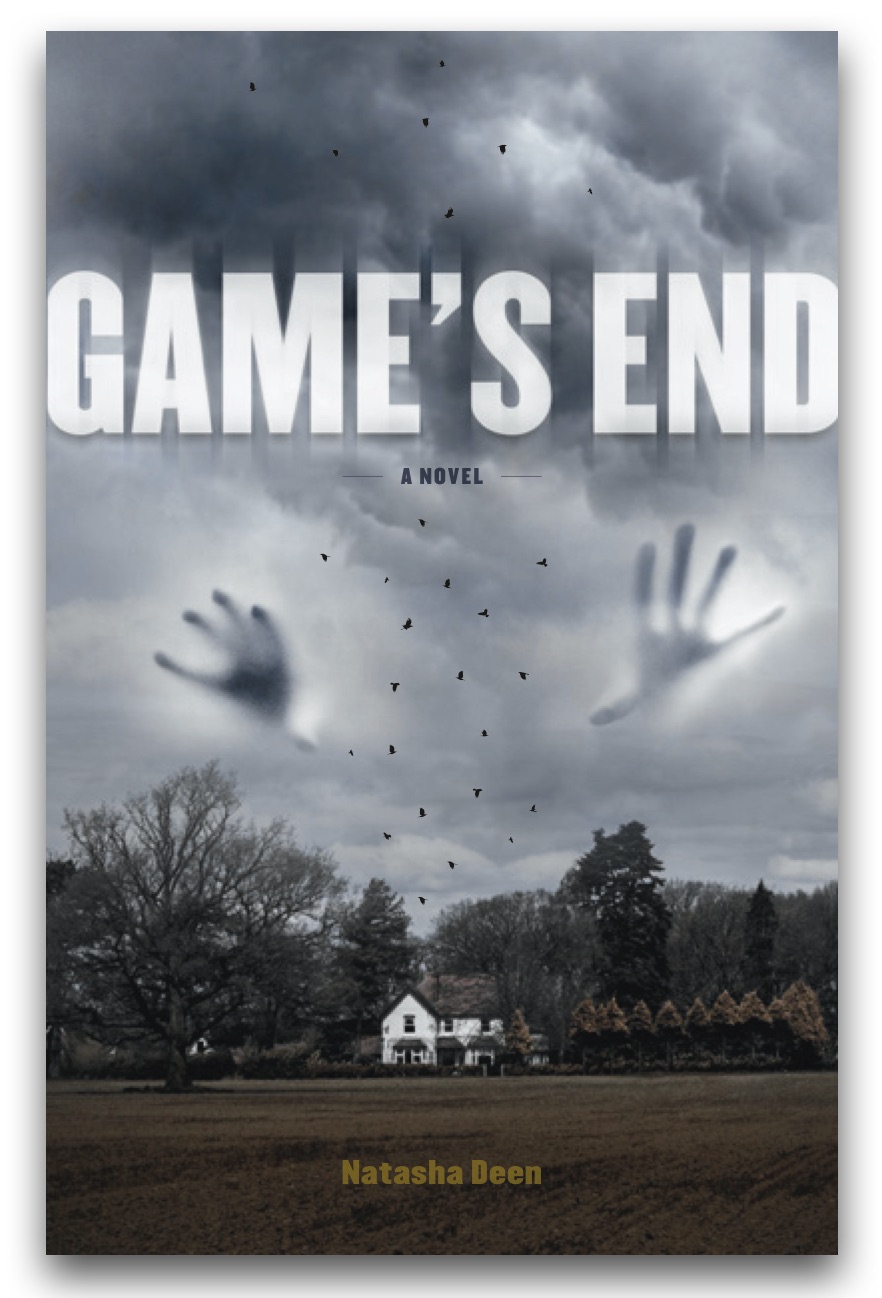
Game's End
Written by Natasha Deen
Yellow Dog (formerly Great Plains Teen Fiction)
978-1-927855 -85-0
240 pp.
Ages 13+
November 2017
Yesterday I reviewed Game's End, the third book in Natasha Deen's series that began with Guardian and Gatekeeper. Today I have the thrill of interviewing author Natasha Deen about her newest young adult paranormal mystery.
•••••••••••••••••

HK: In my review of Gatekeeper, I called you the “princess of YA paranormal murder mysteries” and I stand behind that moniker, though I know you can write other genres as well. But, though there are wild supernatural elements to Game’s End, at its heart the story is a whodunit, a murder mystery to be solved. Are you a fan of mystery books and if so, who are a few of your favourite authors?
ND: First of all, thank you for those kinds words! That thrills me. ☺
I am a huge fan of mysteries. There’s just something—thrilling, fascinating, intriguing—about hunting and gathering puzzle pieces, and delving beneath the personalities to find the truth. (I think it’s a bit like real life, where you listen and talk to people, and search for the subtext of their actions and words, and puzzle out who they are versus who they (1) want you to think they are (2) who they are trying to be).
I come by my love of mystery via family genetics. Some of my favourite memories are the weekend afternoons when everyone was taking a nap, except my mother and I, who drank tea, ate cookies, and watched PBS Masterpiece Theatre, as well my family coming together during the weeknights to watch TV and guess the murderer in Murder She Wrote, Columbo, and Matlock.
When it comes to my favourite authors, there are too many to name, but my first mystery-author love has to be Agatha Christie. Murder on the Orient Express, And Then There Were None, and any of the Miss Marple mysteries are tops in my books (no pun intended).
HK: Your subplots do double-duty, adding depth to the mystery as well as being the source of red herrings to trick the reader into guessing the identity of the murderer and more. How hard is it to craft subplots that have to lure readers into thinking the story is going one way and then take them completely off course?
ND: It definitely takes some doing, but it’s so much fun to play with readers, and I really enjoy it. It’s like hiding Easter eggs and I love trying to find the balance of hiding clues deep enough to trick readers, but still making it apparent, so when they go back, they can see the clues.
As a reader, I love that feeling of racing to guess the bad guy before the main character/detective reveals them. It’s so exciting when you have that “Aha! I knew I was right!” moment, but I also love the “Ahh! They got me, I didn’t see it coming!” But when I go back, I can see how they were setting up the clues.
Stories that drive me crazy are when the author has some off the page clue that only the detective is privy to, or some sudden plot twist that’s not actually a twist, it’s just a sharp turn/plot device—that’s cheating. Put the clues on the page and let’s see how it turns out.
HK: From Guardian to Gatekeeper and now Game’s End, you have kept Maggie honest, humble and very real, though she has supernatural powers. How did you ensure that she stay this real when she obvious isn’t?
ND: I think from Maggie’s perspective, she’s not special. Everyone has powers and talents, hers just happens to be seeing the dead. It doesn’t make her any better than anyone else, and with a dad like Hank, I just couldn’t see her being raised any way but the way she shows up on the page.
Also, I come from a culture (Guyanese) that embraces the idea of the supernatural, so why would you freak out or act weird? That would be like acting strange when you see the sun, but the sun is always there.
It’s not that Maggie doesn’t understand her power is unusual, but since it’s part of her, it just is…one of my favourite shows is West Wing, and one of the things that struck me was that the characters are never over the top or shrill. Then I realized that what was unusual for me (i.e., another country threatening to launch weapons or impose sanctions) is an everyday event for them. If they were over-reactive to it, they’d exhaust themselves by the end of the day. So, I think it’s the same with Maggie. It’s her everyday. She’s always seeing ghosts, transitioning them, learning about the terrible, beautiful aspects of their life. I’d like to think that it gives her depth and an appreciation for all the ways life is special and unique.
HK: While you’d made Maggie a sympathetic character, there are many others who are totally reprehensible and yet very real in the abuse they inflict on others. Did you find it emotionally draining to write about domestic abuse and self-righteousness and violence against those who are vulnerable?
ND: The short answer is yes. There’s a lot of personal experiences that inform those narratives, both mine and people I care about, and it’s a hard place to go, a hard place to live in, BUT, as storytellers, it’s important for authors to take the pain of those moments to make sure the story we tell is true to life, and the characters are as real as they can be.
One of the things that I feel is my saving grace and helps me not to get mired in the pain/darkness is my characters rise above those circumstances, so the bad things in life aren’t there to weigh them down, but to lift them up. I hope it’s something my readers can trust about my work—that there’ll be intense moments and difficult scenes, but in the end there is some kind of positive resolution.
There are a lot of studies on the effects of reading on the brain, on the physiological changes that happen when we imagine, so it’s important for me that even if there isn’t always a Hollywood happy ending in a book, it ends on some kind of hopeful note.
If I can expand out the answer, then it’s worth noting in my personal philosophy, I believe we’re all storytellers, and that’s why sharing stories (with friends, in writing, with groups) is an important thing. The world is made better and stronger when we connect through our shared stories and experiences.
HK: While there is much fear associated with death and dying, the concept of an afterlife offers some prospect for good to come out of that fear. Do you believe in a particular version of an afterlife? If so, does this belief come from a spiritual background, personal experiences with a psychic medium, or something else entirely?
ND: Asking a Guyanese person if they believe in ghosts is akin to asking them if they believe in the sky. ☺ The sky exists, it’s there whether you believe it or not. According to Guyanese philosophy, ghosts and the supernatural is just another level of existence. Your ancestors will visit you in your dreams, they can change the reality around you, so you must always be aware of unusual occurrences in the everyday (a butterfly showing up in a location butterflies aren’t known to appear, for example). It’s why you should always behave—no one wants a lecture from long-dead Auntie who shows up in your dreams.
As a kid of two nations, Canada and Guyana, it’s one of the things I had to reconcile. North American culture doesn’t embrace the supernatural in the same way as Guyanese. But I’m so proud of my heritage and the subtext of this belief, that love can be so strong, your family members so connected to you that even death can’t break that bond, and I love the lesson to pay attention to the world around you, to pay attention to the unusual things because something beautiful might be coming your way.
HK: Although I’ve never heard of them, the supernatural creatures called serengti seem familiar to me yet I can find no reference to them in the literature. Are these creatures from any particular mythology or are they your own fantastical creation?
ND: I sketched out the series back in 2010, and I remember coming across a reference to an ancient creature that was female and…that’s all I remember. When I tried to find my notes, they were missing. I *feel* like I came up with the serengti term, but that it’s based off of mermaids, sirens, and my wondering about what the after-life of Hans Christian Anderson’s Little Mermaid may have been like.
HK: I so enjoy your humour. Even in a book that deals with death and the supernatural, I found myself laughing aloud at the banter between Maggie and Serge and Nell’s pluck. How can you remain light and jovial in your writing when immersed in a story about murder and violence and dangerous situations?
ND: I have to thank my family and my family history for that. When you grow up as a POC, your life is just different from the non-POC kids (I still remember being 9 years-old and telling a Caucasian girl in my class that I was creeped out by white pillows, and her not having a clue about why, and when I said, “Well, because of the KKK and the Aryan Nations,” she still looked confused. That was one of the many moments I realized my growing up and how I navigated the world wasn’t going to be like my classmates, and what the world offered me versus what it offered them was never going to be the same).
My family history is one of struggle and overcoming, of standing strong while terrible things happened, and letting the bad things pass. Part of the standing strong involved love, forgiveness, a lot of humour. There’s an unspoken code of conduct in my family. In a bad situation, find a way to laugh. If you can do that, you can find a way to overcome, you can find the light, and a way out of whatever darkness is encroaching on you.
From a story/character perspective, I wanted to give Maggie, Serge, Nell, and Craig a similar philosophy. Certainly from Maggie and Craig’s perspectives, they’ll have seen things they can’t unsee. Serge is now heading down that path, and for Nell, she doesn’t have the same abilities (or any supernatural powers) as her friends, so how does she navigate the stories she hears from them, and how does she step in to support? Humour seems like the perfect weapon.
HK: The ending of Game’s End leaves it open for the possibility of more books in the series. Are you planning on continuing Maggie’s story? Readers will definitely want to learn about the return of a key character. (I won’t spoil the ending for readers, though they should be prepared that, as you say, “Maybe there are no happy endings. Maybe there are just endings, and it is up to us to make them happy.”; pg. 240)
ND: I’m giggling because for writers, our stories are forever continued, and we’re always living with our characters. The Guardian trilogy wrapped some of the big issues facing Maggie—bullying, domestic violence, abuse, forgiveness, resilience—in a series of horror/mystery/suspense novels, and I feel as though I’ve told that portion of her story. Having said that, I’m definitely open to more of Maggie’s adventures.
•••••••••••••••••
Many thanks to Natasha Deen for answering my somewhat lengthy questions
and
Marketing Director Mel Marginet at Great Plains for facilitating this interview.
• • • • • • • • • • • • • • • • •
Many thanks to Natasha Deen for answering my somewhat lengthy questions
and
Marketing Director Mel Marginet at Great Plains for facilitating this interview.
• • • • • • • • • • • • • • • • •


