Showing posts with label American Sign Language. Show all posts

March 22, 2024

Butterfly on the Wind

Written by Adam Pottle
Illustrated by Ziyue Chen
Roaring Brook Press
978-1-250-821-97-3
40 pp.
Ages 3-6
March 2024 
 
The anticipation of presenting the fairy tale she'd written is making Aurora quite nervous. But for a Deaf child who will use ASL to tell her story, trembling hands will make for a challenging storytelling. When she sees a beautiful butterfly in the garden, she recalls her father telling her that a butterfly's wings could create a wind that could carry around the world. With that, she is inspired her to generate one with her hands and send it off into the world.
 
From Butterfly on the Wind, written by Adam Pottle, illustrated by Ziyue Chen
Her butterfly travels to a farm where a little boy Milos, who also speaks with his hands, watches it sway the raspberry bushes. He creates his own beautiful blue butterfly that joins Aurora's to travel to a cabin in the mountains where Abbey and her grandmother spot them.
From Butterfly on the Wind, written by Adam Pottle, illustrated by Ziyue Chen
Knowing the cold would be hard on the butterflies, grandmother and granddaughter make their own butterflies to create an even stronger wind that blows all four butterflies off to warmer climes and above an ocean.
From Butterfly on the Wind, written by Adam Pottle, illustrated by Ziyue Chen
With each step (or rather flutter) of their journey, the butterflies meet a new Deaf child who with their supportive friends and family sends the butterflies off with new ones until "a tornado of butterflies, a churning circle of color and beauty" travels back to Aurora. Emboldened by her small butterfly wind becoming a magnificent storm, she can step forward into the school for her presentation.
From Butterfly on the Wind, written by Adam Pottle, illustrated by Ziyue Chen
Saskatchewan writer Adam Pottle was born Deaf and raised in a hearing family, so his story Butterfly on the Wind has an authentic voice, and a voice that does not objectify Aurora or Miles's disability, or that of all the other Deaf children. They are not there to inspire us with overcoming their deafness. They are there to demonstrate that, like everyone, they will have struggles and must find a way to cope. Aurora's strategy of sending out a beautiful butterfly ultimately garners strength from others in the Deaf community and gives her the courage to step forward for a public performance. There is magic in her butterfly and in all the butterflies that follow, but that magic comes from within–even if she doesn't know it at the time–and has the power to unite and invigorate and sustain. 

The magic that Adam Pottle creates for Aurora and the other Deaf children is something special, and the art that Singaporean Deaf illustrator Ziyue Chen uses to carry that magic is sweet and yet powerful. She uses colour that is both soft and vibrant, ranging from pinks and purples to blues and yellows. Whether it's the butterflies or the landscapes, there is a vibe of life and happiness. 

Adam Pottle appends his story with an enlightening Author's Note– also a visual depiction of the ASL alphabet–that tells readers of the symbolic nature of the butterfly in Deaf culture, and the basis of his story. His motive to reach others–"May it travel around the world as swiftly and beautifully as Aurora's butterfly"–is a testament to his good intentions and the same spirit of strength and grace shown by butterflies.

 🦋 🦋 🦋 🦋 🦋
 
There will be a very special in-person (Saskatoon) and streamed (YouTube) book launch for Adam Pottle's new picture book Butterfly on the Wind

on

Saturday, April 6, 2024

at

2 PM

at

the Travel Alcove of McNally Robinson Booksellers
3130-8th Street East
Saskatoon, SK

and

streamed
via
McNally Robinson Saskatoon Events channel on YouTube

There will be live ASL interpretation and 
CNS transcription provided by Saskatchewan Deaf & Hard of Hearing Services


November 24, 2023

Next Door

Written by Deborah Kerbel
Illustrated by Isaac Liang
Kids Can Press
978-1-5253-0658-7
32 pp.
Ages 3-7
October 2023
 
Wordless picture books have a general hush about them. In wordless books, i.e., ones in which the stories are told through illustrations alone, no one is speaking and there is no text to distract. It's all rather subdued. In fact, it's a perfect reflection of what the main character, a young boy with hearing aids, must experience much of the time. But don't be fooled into thinking that there is no story to be told or personal connection to be made.
From Next Door, written by Deborah Kerbel, illustrated by Isaac Liang
A boy and his mother head out from their home just as a moving van arrives and begins unloading boxes. It's evident these are not their goods as the boy is familiar with the places and people he encounters on their walk. Though he may have limited hearing, as evidenced by his hearing aids, he notices everything, from the musician busking, the construction workers at work, and even baby birds in a high nest. It's unfortunate when a cyclist races past the boy, startling him into dropping his teddy bear. But, after confirming he is okay, communicating via American Sign Language, his mother settles the boy.
From Next Door, written by Deborah Kerbel, illustrated by Isaac Liang
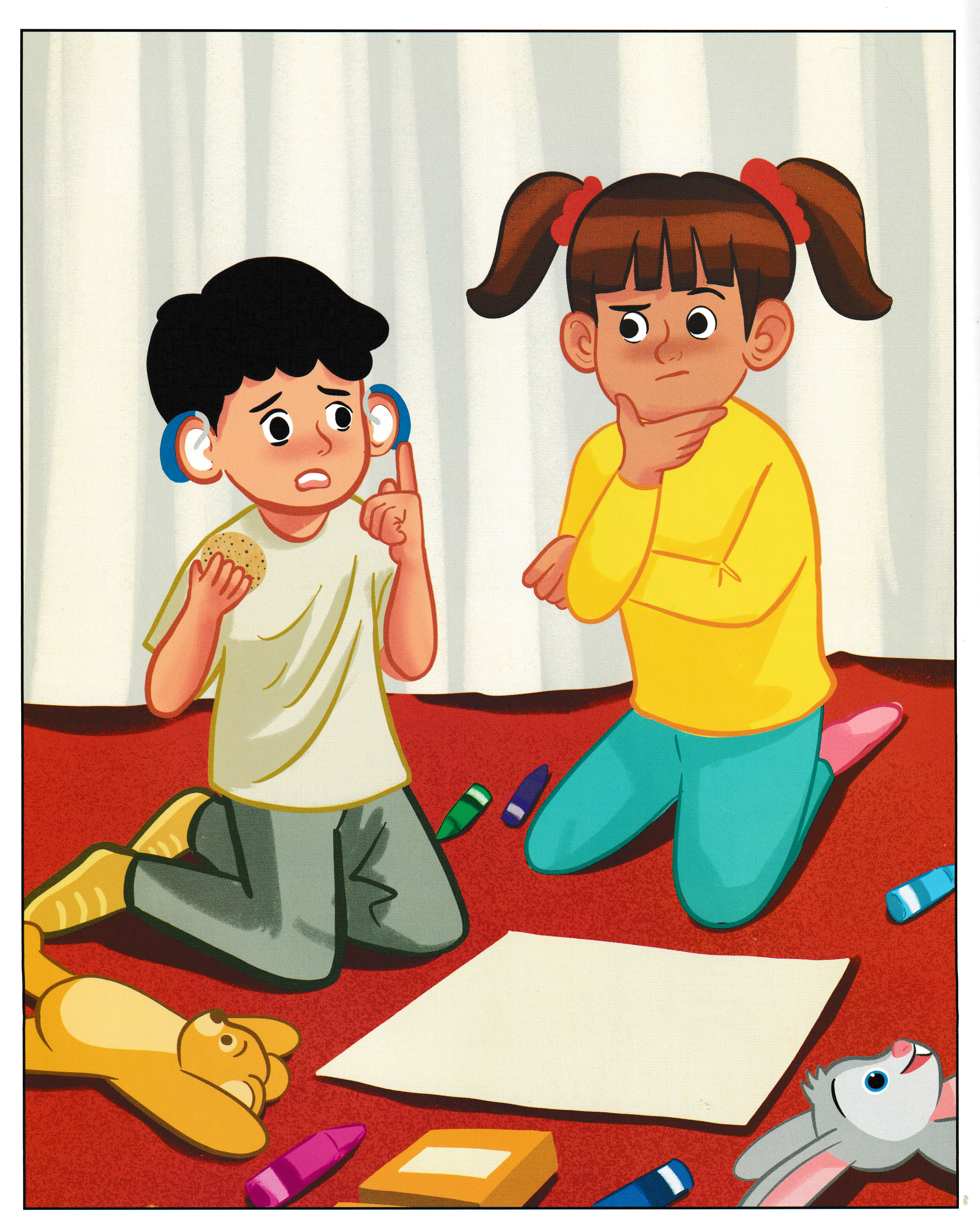
Returning to their building, they visit their new neighbours in the apartment next door. Using her own way of communicating, with hand movements and an Arabic/English dictionary, the woman welcomes them. But the boy spies a little girl hiding from them. When he approaches her, it is evident that neither can understand the other. But through the sharing of food and art, the two children find their own way to communicate.
 
This story is deeply personal for Toronto author Deborah Kerbel whose own sister had been born profoundly deaf. Deborah Kerbel's Author's Note speaks of her sister's abilities to connect, and Next Door's story reflects that ability for children who find different ways to communicate because of hearing and language differences. Undoubtedly a child who has a hearing impairment and one whose language is different than those around them may both feel at a disadvantage when trying to communicate. But, as the boy demonstrates, his disability is not a hindrance to living a good life, one in which he communicates with others, just in his own way. He successfully uses American Sign Language and his hearing aids to enable connection with others. But, when he meets the new little girl next door, he's on an equal playing field as she struggles to get him to understand her. But, with some effort and the common ground of art, along with a tasty cookie, a connection is made.
From Next Door, written by Deborah Kerbel, illustrated by Isaac Liang
Deborah Kerbel opens up about her sister's story to help convey the possibility that communication does not cease with hearing or a different language. We find new ways to communicate when the customary route is not available. By juxtaposing the boy's circumstances with that of his new young neighbour, Deborah Kerbel has found a way for any child for whom communication is challenging, because of, for example, cultural differences, emotional barriers, or physical barriers, to accept that different can still be effective. 
 
Isaac Liang is a deaf illustrator from Singapore who imbues the art of Next Door with knowledge and sensitivity. Because of his personal experiences with hearing impairment, Isaac Liang has found a way to bring the quiet and the connection for the children through his digital art. Because comprehension through the sense of hearing is compromised, his emboldens the story with colour and shape. Perhaps words are unnecessary but meaning still comes through with every building, person, and detail. 

Next Door is a great picture book for helping children develop their visual literacy skills and their empathy and acceptance for those who communicate differently. Hopefully it will help them to recognize that we do not all hear or see or understand the same way–the cyclist who almost collides with the child assumed the boy could hear him coming–and to find new ways of communicating that might work better for others. And, when it all comes down to it, kindness always works.