Showing posts with label Josée Bisaillon. Show all posts

March 15, 2023

Sometimes I Feel Like a River


Written by Danielle Daniel
Illustrated by Josée Bisaillon
Groundwood Books
978-1-77306-695-0
32 pp.
Ages 3-6
March 2023
 
In 2015, Danielle Daniel brought us Sometimes I Feel Like a Fox to help her own child identify with his First Nations roots and allow other children to see themselves in the strengths and behaviours of animals. Now, Danielle Daniel has teamed up with illustrator Josée Bisaillon to take children on another sensory experience, one in which her poems reflect feelings as landscape elements from rivers to oceans and even the moon.

From Sometimes I Feel Like a River by Danielle Daniel, illus. by Josée Bisaillon
In four-line free verses, Danielle Daniel compares children's moods to how they experiences different environmental attributes. When a child feels like the sun, there is brightness and joy inside of them. If one feels like a river, it's because there is bending and maneuvering around obstacles. Another feels strong like a mountain, another peaceful like the sky, and others feels like rain or rainbows. All moods are reflected and recognized.
From Sometimes I Feel Like a River by Danielle Daniel, illus. by Josée Bisaillon
Just as there are different moods, there are different children, ensuring that all young readers might see themselves within and know that they and their feelings are validated.
From Sometimes I Feel Like a River by Danielle Daniel, illus. by Josée Bisaillon
Sometimes I Feel Like a River is a lovely meditative reflection in sensory metaphors. Both in Danielle Daniel's verse and in Josée Bisaillon's art, the emotions that are reflected are true, emulating both the range of experiences within and as a part of our natural world. Danielle Daniel's words take us into the smile of a rainbow, the "boom, roar, bang" of thunder or the depths of an ocean. We feel through her words what the child feels. But the feelings are not just internal. They are also connecting with the outside world and that's what Danielle Daniel wants us to do. She completes her book with a text called "A Mindful Walk or Roll" to help children take an excursion into nature to see and feel, to hear and smell. She wants children to know that they reflect the world as the world is part of them.
 
Because Josée Bisaillon uses a variety of media, including soft and wax pastels, cut paper, coloured pencils, gouache, charcoal, and even digital art, she can depict a full range of emotions and textures of place and people. Whether a child is reaching mountain peaks into the clouds or swimming in the colourful underwater world of an ocean, Josée Bisaillon delivers us into the experience.

Even after feeling the full range of emotions portrayed through Danielle Daniel's words and Josée Bisaillon's illustrations, I was left subdued and in a contemplative mood, pondering my own natural world of snow and trees and sun. Sometimes I Feel Like a River made me feel part of something, something bigger and more important. It's a good feeling.

April 21, 2022

Martin and the River

Written by Jon-Erik Lappano
Illustrated by Josée Bisaillon
Groundwood Books
978-1-77306-444-4
36 pp.
Ages 3-6
March 2022
 
As Earth Day nears, we need to consider that the experiences of young people with the natural world will be quite different depending on where they live. But, if Martin and the River shows us anything, it's that it doesn't have to be that way.
From Martin and the River by Jon-Erik Lappano, illus. by Josée Bisaillon
Martin lives in a rural community where the river and its environs are more than just the landscape of his life: they are his companions. He watches the frogs, great blue herons and crayfish. He knows the behaviour of the otters and osprey. Countless hours are spent at the river that runs through the fields behind his house. Then a new job moves the family to the city.
From Martin and the River by Jon-Erik Lappano, illus. by Josée Bisaillon
As Martin prepares to leave the river and its life force, he seeks a plan to help. But it's not until his parents take him for a visit to the city, with its subway, museum, and its own natural area that Martin finds a way to bring the river to the city with him.
From Martin and the River by Jon-Erik Lappano, illus. by Josée Bisaillon
Story from Jon-Erik Lappano? Art by Josée Bisaillon? I was already sold on Martin and the River. I knew it would be impactful and it is because it touches on big ideas of adapting to change and of our relationships with nature. Every child will experience some change in their lives, especially the leaving behind of the familiar and going to the unknown, whether it be home, family or school. How they deal with that change is important in determining how disquieting the transition will or will not be. Martin may be a resilient child but change is still change and leaving behind his beloved river was going to be hard. Thankfully he and his parents knew enough to help make that transition smoother by finding another river for him to embrace.

Beyond the concept of change, Martin and the River is a big story because of the child's relationship with the river and its elements, hence my choice to review this book for our upcoming Earth Day. For Martin, Earth Day is everyday. It's appreciating the natural world and its plants and animals and water. It's acknowledging how nature sustains us, especially spiritually. He was fortunate to be able to spend time communing with the river and experiencing the life within. But these experiences helped him to bridge a difficult transition because he was able to appreciate that another natural environment had much to offer as well, just different. 

And don't Josée Bisaillon's illustrations, blends of coloured pencil, pastels, gouache and digital art, just burst with the life of that river and the scenes of the city? From the lush greenery, golden fields and busy indoor and outdoor city scapes, Josée Bisaillon has taken us into Martin's busy brain, imagining, appreciating and feeling. Everything is big and bold and wild.

Not every child is fortunate to have a river as a friend, but I hope that every child finds their own natural element, as Martin did with his rivers, to underscore their lives and guide them with reflection, resilience and imagination.

July 23, 2021

Poem in My Pocket

Written by Chris Tougas
Illustrated by Josée Bisaillon
Kids Can Press
978-1-5253-0145-2
24 pp.
Ages 4-7
June 2021
 
Gone are the days when poetry was the amusement only of romantics and the learned. With poet laureates and spoken word artists becoming part of the vernacular, everyone should feel comfortable to carry poems in their pocket and be inspired to share them. But what if a poem escapes before you're ready?
From Poem in My Pocket by Chris Tougas, illus. by Josée Bisaillon
Before Chris Tougas's story really begins, readers will see a child composing text, their earlier efforts discarded on crumpled papers littered around them. As they walk away, the finished poem, folded in a back pocket, begins to edge its way out of the ripped bottom. Witnessed by their companion, a white chicken, the child soon realizes that the words and thoughts, emotions and rhymes have flung themselves out into the world, scattering across
landscapes of colourful homes and businesses, into the sky and across a wild setting of cacti and yucca. 
From Poem in My Pocket by Chris Tougas, illus. by Josée Bisaillon
With language as colourful as their surroundings, the child tries to retrieve the letters, some mixed up into nonsense words, others forming playful puns and most elusive to their efforts to retrieve them.
Scribbled thoughts were scattered–
there were letters here and there.
Mixed-up words were whipped about
and mingled in midair.

From Poem in My Pocket by Chris Tougas, illus. by Josée Bisaillon
When the child does finally gather some words up, they try to recreate the verse but are unable to do so before the words are sowed into the soil with rain to germinate into something even grander.
From Poem in My Pocket by Chris Tougas, illus. by Josée Bisaillon
The letters and words of this child's creative imaginings may have escaped into the world but Chris Tougas shows us that how fortunate that accident truly was. The child may be bereft initially at having lost the structure of their poem, but the search to retrieve the bits and pieces carries them to many locations where the words play and inform and enrich. With their exodus, they have fostered the beginnings of new poetry in the form of a poetree. 
 
Though illustrator Josée Bisaillon has given us a South American flavour to the story, as hinted with the llamas, vegetation and food, this could be the story of an aspiring poet anywhere. The vibrancy of her digitally-rendered artwork carries the reader through communities of busyness into the quiet of the wild, manifesting the very nature of poetry. It can be solemn or angry, bright or clouded. It can speak to and about people, animals, plants or intangibles like emotions. The words may be the basis for the poetry but the creator's originality to mix and manipulate, sculpt and express gives it its unique form. 
 
When National Poetry Month comes around next April, get your own poem into your pocket and share it with the world. It doesn't have to be your own, though that would be cool. It's the act of sharing that inspires.

July 16, 2019

Dancing with Daisy

Written by Jan L. Coates
Illustrated by Josée Bisaillon
Running the Goat, Books & Broadsides
978-1-927917206
44 pp.
Ages 4-8
June 2019

Dancing with Daisy is a grandfather's story told to a grandchild intrigued by an album of old photos and memories. It's also a a fisherman's story so you know it might be a bit of a tall tale.
From Dancing with Daisy, text by Jan L. Coates, art by Josée Bisaillon
"Back in '62 it was, a frosty fall day." So begins this fisherman's tale of the onslaught of Hurricane Daisy as she "came roaring up the coast. She whirled and spun and whipped the waves into such a frenzy, they started leaping straight up onto the deck."
From Dancing with Daisy, text by Jan L. Coates, art by Josée Bisaillon
In true tall tale fashion, the grandfather exaggerates Daisy's impact as she  throws him onto an island and tugs and grabs at him to draw him into a dance. His wrinkles are the result of Daisy trying to bribe him with dollars that sliced into his skin and created scars. His arthritic hands came from clutching the branches of the tree and his blue veins resulted from her freezing cold breath. His raspy voice came from barking communications with a seal washed up on shore and he lost his hair when Daisy grabbed at his hair, playing "He loves me, he loves me not."
From Dancing with Daisy, text by Jan L. Coates, art by Josée Bisaillon
He returned to shore first on a handcrafted raft and then upon his own home's red roof, walking seven back-breaking miles before losing his teeth that ended up as icebergs. Daisy only abandoned her quest to dance with the man after "Nana went out and gave her a good talking to."
From Dancing with Daisy, text by Jan L. Coates, art by Josée Bisaillon
The grandfather undoubtedly remembers every detail of his harrowing assault on his fishing boat while besieged by Hurricane Daisy which tracked through the Maritimes in early October of 1962. It took six lives in Canada and smashed fishing boats, piers, and buildings with its rainfall and high winds. But the grandfather of Jan L. Coates's story protects his grandchild from the devastating truths of Daisy's impact and instead makes it into a tall tale that explains his aging, its own overwhelming trial, even ending with a good laugh.

Josée Bisaillon's art is a wonderful accompaniment to Jan L. Coates's story, taking readers to the Atlantic coast of colourful buildings, cold grey waters and tumultuous weather through her illustrations of watercolours, pastels, pencil and cut paper. Presenting the wind is a formidable task but Josée Bisaillon conveys movement and power in the water and the sky without restraint. It may be scary and mighty but it's still playful in its dance, and with the affectionate closeness of grandparent and child, Dancing with Daisy becomes more intergenerational tale, even if a little tall, than recall of a disaster.

🌊🌊🌊🌊🌊🌊

Running the Goat Books & Broadsides shares a video of Jan L. Coates discussing her story and background for Dancing with Daisy on YouTube.

Uploaded to YouTube by Running the Goat on June 27, 2019.

May 03, 2018

Ten Cents a Pound

Written by Nhung N. Tran-Davies
Illustrated by Josée Bisaillon
Second Story Press
978-1-77260-056-8
24 pp.
Ages 5-9
April 2018

I defy anyone to read Nhung N. Tran-Davies' text in Ten Cents a Pound and not be moved to tears by a mother's willingness to work at gathering coffee beans so that her child could have a better life. All the more poignant is the response from the child who recognizes her mother's struggles and does not want to leave her in order to pursue an education elsewhere. Their dialogue, told with love and admiration and respect, is the story of Ten Cents a Pound
From Ten Cents a Pound by Nhung N. Tran-Davies, illus. by Josée Bisaillon
Mama, I see your hands,
Coarsened and scratched,
By the twigs and bark of the trees, row on row,
By the leaves and berries, picked one by one.
I will stay with you.

So begins Ten Cents a Pound, with a daughter seeing the toil of hard work on her mother's hands and her declaration that she will stay with her.  Ah, but her mother will have none of that.  Calling her "silly child" or "faithful child" or similar, the mother asserts that she is working so that she might put books in her daughter's hands and set her on a life beyond their mountain and villages. Still the girl cannot see past her mother's pain and hardship and repeats that she cannot leave her.  Always with great affection and fortitude, her mother vows that the girl will be set free with an education and must go beyond the confines of their village. Finally, the girl accepts the wisdom of her mother's wish for her future but contends that she will return.
From Ten Cents a Pound by Nhung N. Tran-Davies, illus. by Josée Bisaillon
Though I cry readily, not all books move me to tears. Ten Cents a Pound did so. Many parents sacrifice much for their children, though those trials are not always acknowledged, but here a child recognizes that suffering and doesn't feel like she can accept the cost of her mother's unselfishness. I don't know if physician and author Nhung N. Tran-Davies, who came to Canada from Vietnam, ever witnessed this self-sacrificing love but Ten Cents a Pound is a testament to the determination a parent can have for wanting a better future for their child.  This mother is willing to suffer the back pains, the harm to feet and hands, and declining eyesight and more just to ensure her child has an education and a better life.

Award-winning illustrator Josée Bisaillon blends the realism of the mother-daughter relationship with a lightness that belies the gravity of their circumstances. The outdoor scenes of fields and trees are grounded in the earth but give rise to the green of dreams and expectation. Even the fluttering butterflies and the child in flight suggest a journey of hope and ascendancy.
From Ten Cents a Pound by Nhung N. Tran-Davies, illus. by Josée Bisaillon
Ten Cents a Pound may be a tome that supports the idea of education as the means for freedom and advancement or a social justice story embedded in the coffee fields of Vietnam.  But, at its heart, it is a dedication to mothers and daughters who are willing to offer anything to ensure a good life for the other.

September 26, 2017

Leap!

Written by JonArno Lawson
Illustrated by Josée Bisaillon
Kids Can Press
978-1-77138-678-4
32 pp.
Ages 3-7
September 2017

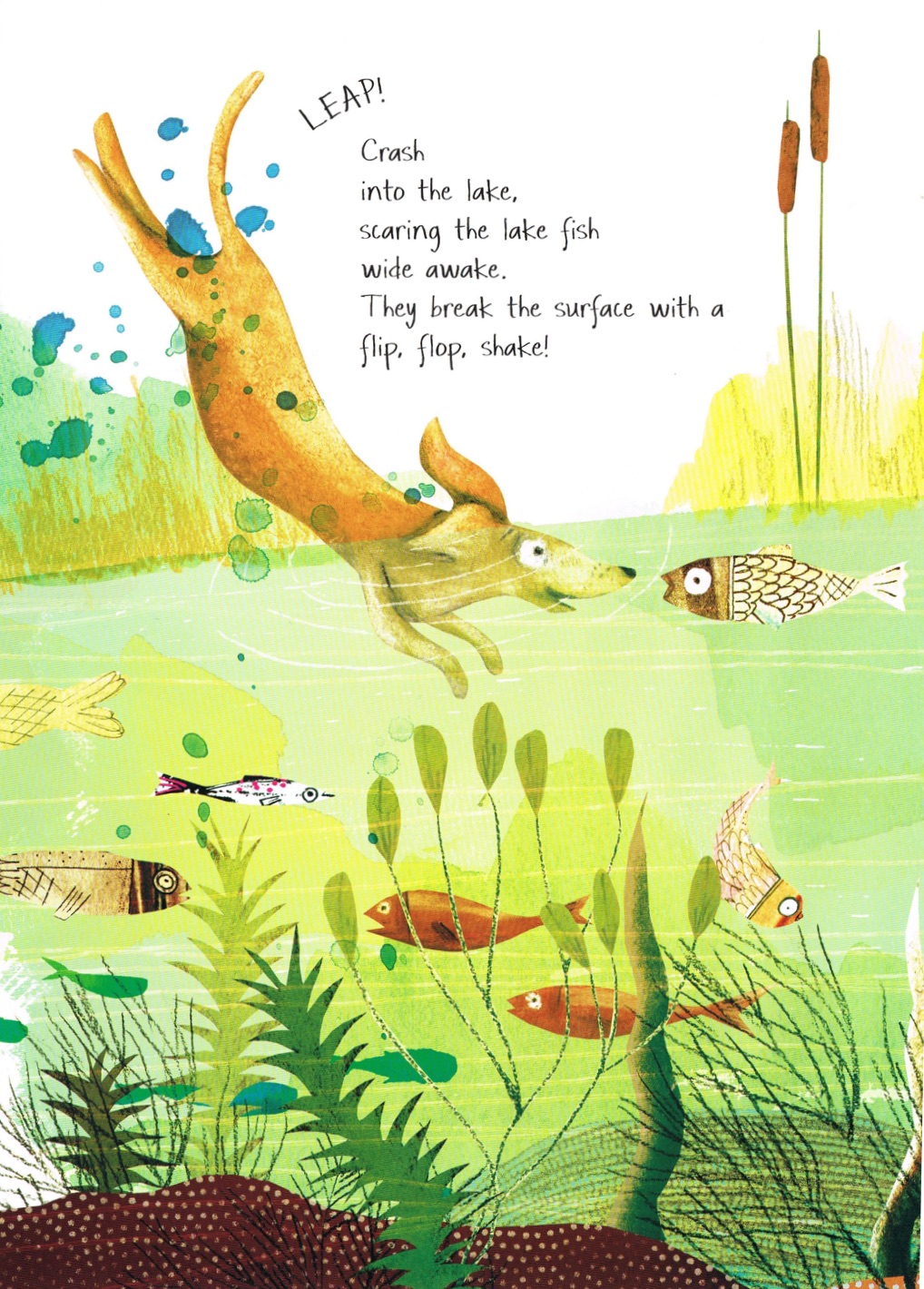
In a chain of events that begins with a flea, a series of animals that also includes a grasshopper, a rabbit, a dog, fish, a bullfrog and a horse cause leaping into, onto, and more in response.  But JonArno Lawson, whose stories Sidewalk Flowers (Groundwood, 2015) and Uncle Holland (Groundwood, 2017) have been reviewed here on CanLit for LittleCanadians, goes beyond this faunal domino effect and creates a living organism of movement in sophisticated poetry.
From Leap! 
by JonArno Lawson 
illus. by Josée Bisaillon
With each new LEAP!, JonArno Lawson plunges the young reader into a new environment with active vocabulary and emotional responses. 
LEAP!
Land!
Twist and spin!
The bunny bounds out
as the clouds roll in.
A dog gets a whiff
and barks at the wind –
bouncing, bouncing, springing
  and lunging!
Down the bank that dog goes
  plunging.
Gambol, lurch to 
LEAP!
In her signature collage style of cut-outs, watercolours, pencils and more, Josée Bisaillon produces multiple land and aquatic landscapes for JonArno Lawson's jumping, splashing, bounding creatures.  There are microcosms beneath bright flowers in cheery meadows and lakes filled with dozens of species of plant and fish, and a fenced farmyard with trees. From one to another to the next and back, Josée Bisaillon takes the reader down and over, under and above, seeing this natural world from all perspectives.
From Leap!
by JonArno Lawson 
illus. by Josée Bisaillon
For teachers who love a circular story that ends where it begins, Leap! is a treat, especially for the exquisite language and elaborate illustrations.  But I believe parents will find Leap! to be the perfect bedtime read for young ones who've been doing their own leaping all day.  In true poetic style, JonArno Lawson finds the word that rhymes with "leap" and brings closure to a day of activity.
From Leap! 
by JonArno Lawson 
illus. by Josée Bisaillon

November 16, 2016

The Snow Knows

by Jennifer McGrath
Illustrated by Josée Bisaillon
Nimbus Publishing
978-1-77108-441-3
32 pp.
Ages 4-8
September 2016

I know Jennifer McGrath as the award-winning author Jennifer Kent McGrath of novels Chocolate River Rescue (Nimbus, 2007) and White Cave Escape (Nimbus, 2009) which transported middle-grade readers to perilous situations on the Petitcodiac River and gypsum mines of New Brunswick.  But she’s also delved into children’s picture books, first with Gadzooks the Christmas Goose (Nimbus, 2011) and now with The Snow Knows.  The plotting may be very different between her children’s novels and illustrated books, but the quality of voice and literary momentum are always there.

The text of The Snow Knows is fairly simple, almost repetitive, prose based on what the snow knows about the various animals, both wild and domestic, as they live with, seek food in and move throughout the winter wonderland of a snowy landscape.  There’s a rabbit, an owl, a pheasant, deer, porcupine, weasel, mice, squirrel, fox, partridge, otter, lynx and coyotes who pepper the whiteness outside.  Jennifer McGrath’s words propel the reader through this winter wilderness, as if witness to a quiet and secretive world outside, one in which all is not said, but much is known.

The snow knows..
Where the rabbit goes.
It knows the hush-shush of the owl’s wing.

Josée Bisaillon’s artwork, which I’ve so admired in Eat, Leo! Eat! (Caroline Adderson, Kids Can Press, 2015) and Winter’s Coming (Jane Thornhill, Owlkids, 2014), is a combination of drawings and digital art, collages of richly treed landscapes and snow-covered fields peppered with stylized but easily recognizable animals and the ever present falling snow.  Moreover, Josée Bisaillon cleverly links the animals’ stories by providing an early peek of the each upcoming animal.  For example, on the double-spread of the deer, a porcupine hides in the tree and a small weasel glances out from behind a log, while the lynx slinks away from the hiding partridge and the sliding otter pages. The story comes full circle from the winter outside a red-tiled house, to the forest and fields, and back to the home from which two creatures exit to share in the snow too.

From The Snow Knows 
by Jennifer McGrath,
 illus. by Josée Bisaillon
We may not have snow now but we will soon enough, and all these creatures will be finding a way to survive and perhaps enjoy its abundance.  Take a slow, lyrical walk through it with The Snow Knows’ Canadian menagerie to appreciate its complex interrelationships and to enjoy Jennifer McGrath and Josée Bisaillon’s delightful frolic through the snow.

From The Snow Know
 by Jennifer McGrath,
 illus. by Josée Bisaillon

April 06, 2016

Mom, Dad, Our Books, and Me

Written by Danielle Marcotte
Illustrated by Josée Bisaillon
Owlkids Books
978-1-77147-201-2
32 pp.
Ages 3-7
April 2016

Instil a love of reading with award-winning author Danielle Marcotte’s Mom, Dad, Our Books, and Me, whimsically illustrated with Josée Bisaillon’s collage art.

The story may be called Mom, Dad, Our Books, and Me but it is more a young boy’s compendium of reading.  It includes everyone who partakes in the pleasure and value of reading, and the reading of everything from novels to sheet music and cookbooks, as well as the sky, the future, signage and body language.  The young boy, who starts with listing who reads in his family–his parents, grandparents, uncle and auntie–also makes note of who can’t read, like his little brother Buddy, Toto the fish and Gracie the cat.  Then he ventures further afield to those who must read the weather, thermometers, tarot cards and more as part of their vocations.  Finally, he speaks to the emotions that books can evoke, from laughter to tears recognizing that,
Thanks to books,
I find balance,
I climb high,
I follow new roads,
and I move forward.

From Mom, Dad, Our Books, and Me
by Danielle Marcotte, illus. by Josée Bisaillon
This is a dream book for every parent and teacher and librarian who would like to delight a young reader into the appeal and importance of reading while permeating that lesson with an appreciation for the many versions of literacy out there.  Danielle Marcotte imparts an important message in an inviting story, all the better communicated with Josée Bisaillon’s collage artwork.  The textures are both intense and subtle, as the illustration necessitates, and colour combinations evocative of busyness or calm, as appropriate.  Text and art come together strikingly in Mom, Dad, Our Books, and Me to become a book that all literacy advocates i.e., everyone, should be sharing with the very young, those who can read and those who can’t, yet. 
From Mom, Dad, Our Books, and Me
by Danielle Marcotte, illus. by Josée Bisaillon

July 24, 2015

YoungCanLit Who's Who: Illustrators A-G, List II


Here is the first of three new posts of youngCanLit illustrators whom I'd like to celebrate and promote.


Andrea Torrey Balsara


Kate Beaton


Josée Bisaillon


Mike Boldt


Claudia Dávila


Geneviève Després


Julie Flett


Alma Fullerton


Celia Godkin


Elise Gravel


Gabrielle Grimard


Per-Henrik Gürth
____________________________________________

Look for the following lists in the next couple of days:

YoungCanLit Who's Who: Illustrators H-Q, List II
  • Kellen Hatanka
  • Jacqueline Hudon-Verrelli
  • Matt James
  • Brooke Kerrigan
  • Dayal Kaur Khalsa
  • Jon Klassen
  • Julie Kraulis
  • Eliska Liska
  • Mike Lowery
  • J. Lum
  • Elly Mackay
  • Patsy MacKinnon
  • Isabelle Malenfant
  • Cyndi Marko
  • Luc Melanson
  • Nicholas Oldland
  • Paola Opal
  • Pierre Pratt
YoungCanLit Who's Who: Illustrators R-Z, List II
  • Erica Salcedo
  • Roslyn Schwartz
  • Sampar
  • Alan Silverberg
  • Sleepless Kao
  • Lisa Smith
  • Sydney Smith
  • Caroline Stellings
  • Todd Stewart
  • Jillian Tamaki
  • Christine Tripp
  • Anne Villeneuve
  • Frank Viva
  • Ange Zhang
  • Amei Zhao

January 16, 2015

Winter's Coming: A Story of Seasonal Change

by Jan Thornhill
Illustrated by Josée Bisaillon
Owlkids
978-1-77147-002-5
32 pp.
Ages 5-8
October, 2014

Sure, reviewing a book called Winter's Coming before winter would have been more logical–hence Owlkids' October release for the book–but isn't it just as great to read a book about the changes that come with winter while in the throes of that season's cold and snow?  (Apparently I thought so.)

Lily, a young snowshoe hare, is surprised by the changes she sees in her surroundings, which she'd always enjoyed as green.  Now there are colour changes in the trees and massive flocks of birds heading south because Winter's coming.  If they have to escape, she wonders whether she should be evading this danger as well.  Luckily the squirrel who is preparing a cache of food tells her she won't need to do the same, and Lily is relieved to know that, "Whatever Winter was, at least it wasn't interested in her food." (pg. 9) Also inquiring of the chickadee, mosquito, tree frog, caterpillar, snapping turtle and black bear, Lily still finds Winter a mysterious entity.  
Would it be as tall as the trees and have humongous, smelly feet?  Or would it be stretched out like a weasel, with a hundred pointed teeth?  Would it have a bald head like a turkey vulture?  Or would it have hair so long that it swished along the ground?  Would it make noise like thunder? Or would it fly on silent wings like an owl?  Lily had no idea, but she was convinced that Winter would be big and powerful. (pg. 20)
It's not until she watches Winter arrive and the black bear points out Lily's own change for winter that Lily understands what all the animals have being sharing with her.

Winter's Coming is as charming a book as it is educational, explaining animal adaptations to the coming of our coldest season as seen by a young snowshoe hare who doesn't know what to expect having never experienced winter.  Lily is inquisitive, but never precocious (thank you, Jan Thornhill!), always taking in what she sees and hears and tries to make connections with what she knows already.  She's on guard for potential threats, as a wise hare will be, but insightful and thinking beyond Winter as a predator.  Her thinking is probably similar to that of a child for whom a new concept, whether it be math or behavioural or whatever, is just out of reach of understanding.

Complemented by Josée Bisaillon's collage illustrations that emulate the bits and pieces of the natural world as it changes in response to the coming season, Jan Thornhill's newest nature book (she has an astounding repertoire of award-winning non-fiction) will be enjoyed just as easily as a story as much as an information book.  Winter's Coming will be an worthy addition to any library, personal, school or public.