Showing posts with label dance. Show all posts

November 27, 2023

Death & Sparkles and the Sacred Golden Cupcake

Written and illustrated by Rob Justus
Chronicle Books
978-1-7972-0638-7
316 pp.
Ages 10–4
November 2023
 
When Death first met Sparkles, the last unicorn and media sweetheart, in Death & Sparkles (2021), it was a difficult relationship. Death had never had a friend–how could he when whomever he touched would die?–and Sparkles was all about his celebrity. But they found a way to work together and give support as needed. But in their newest adventure, their friendship will be challenged by a quartet of moles who may know a little more about unicorns–or 'corns as they call them–and are accordingly less than impressed by Sparkles and his ancestors.
From Death & Sparkles and the Sacred Golden Cupcake, written and illustrated by Rob Justus
Rob Justus, who apparently rendered the illustrations "in magical cupcakes with a sprinkle of digital art" develops his story along two parallel subplots. In the first, four moles, identified by their colours of Purple, Brown, Pink, and Blue, are obligated to tend the unicorns' sacred garden resplendent in golden colossal statues. When the  moles turn sixteen, they are sure that they will be invited to the ceremonial coming-of-age party held for uni-colts becoming unicorns. Instead, they are unceremoniously excluded by the unicorns. To exact their revenge, the moles intend to steal the sacred golden cupcake. Instead, they are discovered and banished to the darkness of the underground.
From Death & Sparkles and the Sacred Golden Cupcake, written and illustrated by Rob Justus
The second subplot revolves around our two titular protagonists. Sparkles is not feeling quite right. His horn is glowing and his body is tingling. When Death suggests a growth spurt, Sparkles opens a suitcase left to him by his late parents and discovers a letter about the journey he must go on as well as a golden cupcake on a chain that compels him to dance. Regardless of what Death wants, Sparkles drags his friend to club after club, looking for the right one. When they are transported to an underground cavern and a golden-gated garden, and they must make choices as to where they should go, there is a clash of personalities, as the egocentric Sparkles plows on ahead, ignoring Death and following his "super-mega important unicorn family quest." (p. 134) Separated, Death meets the moles and, feeling welcomed and appreciated, befriends them, unknowingly becoming part of their scheme to get the scared golden cupcake.
From Death & Sparkles and the Sacred Golden Cupcake, written and illustrated by Rob Justus
There may be a lot of pink and purple and bling in Rob Justus's second b
ook starring Death and Sparkles but within all the sugary sweetness and sparkling flashiness there are important messages about being different, empathizing with others, true friendship, and humility (something Sparkles lacks). By juxtaposing the subdued and cautious Death with the look-at-me, self-absorbed Sparkles, Rob Justus lets us see that both extremes can be tiresome. However, a bit of risky taking with some judicious caution makes for a great partnership. And, though the mistreatment of the moles by the unicorns shows Sparkles that his heritage is not as noble as he'd imagined, it does inspire him to do better. (Now, if he just wasn't so over-confident and pushy. Sigh.)
From Death & Sparkles and the Sacred Golden Cupcake, written and illustrated by Rob Justus
Although Death & Sparkles and the Sacred Golden Cupcake only releases tomorrow, I'm already looking forward to Book 3 in this series. (Please let there be more books coming.) Judging by Rob Justus's Acknowledgments, he has lots of ideas. Maybe the ghost pirates didn't show up here, but I think Death and Sparkles have lots more adventures, and calamity, to experience, and more revelations to make about themselves.
 
• • • • • • •
 
Death & Sparkles and the Sacred Golden Cupcake (2023)

August 19, 2022

Ballewiena

Written and illustrated by Rebecca Bender
Pajama Press
978-1-77278-137-3
32 pp.
Ages 4-7
June 2022

Let's get some joy in our lives. Dance, dogs, and fulfillment will do just the trick with Rebecca Bender's Ballewiena.
From Ballewiena by Rebecca Bender
Dotty dreamed of being a ballet dancer. She knew how to plié, assemblé and pirouette. She could chassé, glissé and do a pas de chat (even though she was a dog). But Ms. Austere did not appreciate Dotty's moves and, while she trained Dotty's poodle sibs Jazzebelle and Miffy for the upcoming Golden Bow Talent Show, she took the dachshund to the Canine School of Obedience. 
From Ballewiena by Rebecca Bender
But obedience school was not for Dotty who "tried, she really did, but something inside her made her spring up into an elegant entrechat." Despondent, Dotty runs into the park after class and meets Louis-Pierre, a squirrel and an acrobat. Louis-Pierre invites Dotty, whom he calls Pitou, to work out with him and teaches her, by some unusual pedagogical means, the value of practice in gaining skills.  
From Ballewiena by Rebecca Bender
Still, when the Golden Bow Talent Show comes around, Dotty is expected only to watch from the audience. But, Louis-Pierre has other ideas and liberates Dotty to show off her skills and reveal her true ballerina self.

Young readers will know Rebecca Bender's storytelling from her award-winning Giraffe and Bird series (e.g., Giraffe Meets Bird; Giraffe and Bird Together Again; Don't Laugh at Giraffe) but she does as well by dogs as she does with giraffes, birds, hedgehogs and ducklings (e.g., How Do You Feel?) and more. She makes us care about her characters who are all expressive and one-of-a-kind, whether they are pets or wild. That's because her stories are those lived by children. Dotty may be a dog but she could be any child who feels her dream is being stifled and who wants to express herself through dance. I suspect that Rebecca Bender is a herself ballet parent, one who has learned much from attending classes with little ones. In fact, I myself learned much about ballet through the text of Ballewiena but also in her incredible endpapers that depict a variety of ballet movements and their phonetic pronunciations. Yes, Ballewiena is about ballet, and would make a great gift for any child who enjoys dance classes, but it has important messages about following your aspirations and being true to yourself while ensuring that you put the work in so it becomes a goal and not a pipe-dream.  

Rebecca Bender's illustrations, created with gouache, watercolour, pen and ink, as well as digital media, carry those messages through worlds of colour, shape and attitude. Her assortment of canine and other characters conveys a depth of personality beyond the dance. (I was especially taken with Louis-Pierre who, with his sweatband and drawstring workout pants, has a je ne sais quoi quality that is adorable, even as he coaches Dotty through rigorous training.)

Whether you're a dancer, an appreciative fan or neither, Ballewiena reminds us to follow our passions and dance fully in our lives.

May 30, 2022

Hungry for the Arts: Poems to Chomp On

Written by Kari-Lynn Winters and Lori Sherritt-Fleming
Illustrated by Peggy Collins
Fitzhenry & Whiteside
978-1-55455-466-9
32 pp.
Ages 5-8
March 2022

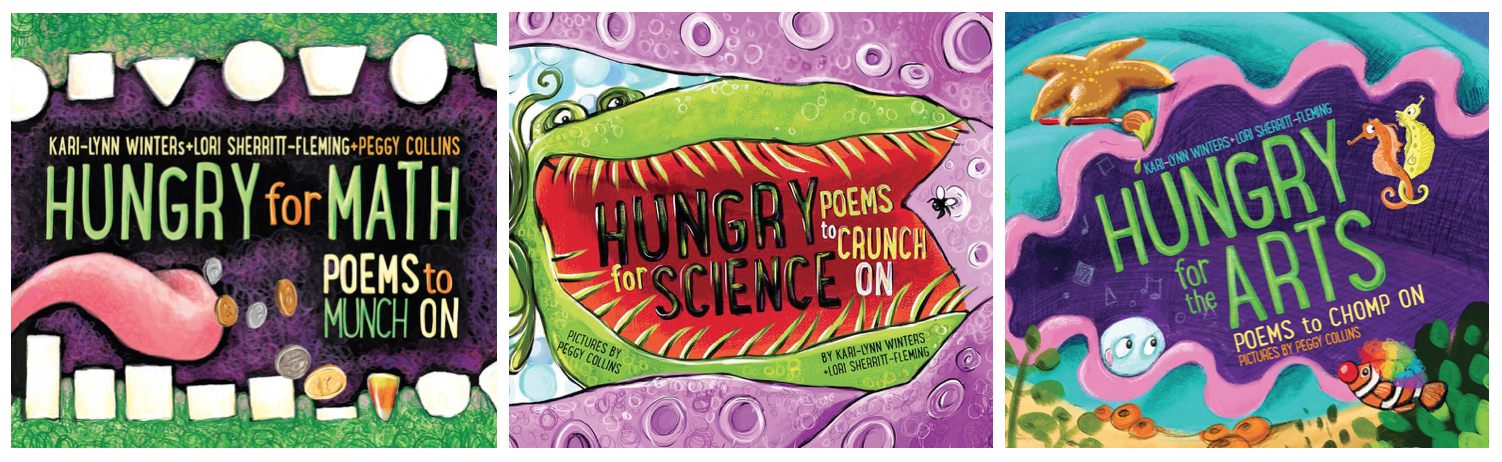
From the creative team that brought us Hungry for Math: Poems to Munch On and Hungry for Science: Poems to Crunch On comes a new book of lively poetry based in the arts of drama, music, dance and visual arts. 

From Hungry for the Arts: Poems to Chomp On by Kari-Lynn Winters and Lori Sherritt-Fleming, illus. by Peggy Collins
Colour-coded to organize the poetry which can span several pages–orange for dance, green for drama, turquoise for music and purple for visual arts–authors Kari-Lynn Winters and Lori-Sherritt-Fleming take young readers onto the stage and into the studio to find ways to express themselves. They are encouraged to...

Munch on motion
Chomp on play.
Chew on chants.
Eat ARTS all day!
And to...
Choose buffets or a-la-carte.
Music,
  dance,
    drama
      art!
From Hungry for the Arts: Poems to Chomp On by Kari-Lynn Winters and Lori Sherritt-Fleming, illus. by Peggy Collins

There's the poem called "Those Cats Can Play" which has a quartet of felines improvising with a variety of notes and "A Little More Forte" in which an elephant and a house mouse must learn about forte, piano, decrescendo and crescendo. In the dance poems, identified by the orange dot in the corner of the first page, some dinosaurs disco, tango and hip hop their way across the dance floor ("Dinosaur Dance Floor") while in "The Whammy-Roo" a child in a wheelchair introduces her friend to her new dance.
From Hungry for the Arts: Poems to Chomp On by Kari-Lynn Winters and Lori Sherritt-Fleming, illus. by Peggy Collins

In the drama poems that include  "When I'm" and "A Dramatic Ride" kids try out movements, improvise with costumes and perform, imaging themselves as anything from a roller coaster to a tiger and a pirate. And the poems based in the visual arts are just as colourful and entertaining, encouraging young readers to think about textures and shapes and create from found objects. In the thirteen poems in the book, Kari-Lynn Winters and Lori Sherritt-Fleming introduce children to new terms–a snappy glossary summarizes this new vocabulary–and encourage them to explore the different art forms with some playful poems that may or may not rhyme.

From Hungry for the Arts: Poems to Chomp On by Kari-Lynn Winters and Lori Sherritt-Fleming, illus. by Peggy Collins
Peggy Collins, whose book Harley the Hero recently won the Forest of Reading's Blue Spruce Award, brings the joy of making art to the page. Her own artwork bursts from the story in an explosion of life through her use of colour and shape and line. There are no wallflowers in Hungry for the Arts. Every poem is animated with animals and children, robots and activity. As the creators make art, through their singing, their dancing, their performance and their displays, readers will learn from the words and the play.

We've munched on poems, crunched on poems and now we get to chomp on them too. With the rhythm of the music, the step of a light foot, a stroke of a brush and a flourish on a stage, Kari-Lynn Winters, Lori Sherritt-Fleming and Peggy Collins take us into the places where children get creative and express themselves in whatever art form speaks to them, and we're there to applaud all their efforts.

May 12, 2022

Bharatanatyam in Ballet Shoes

Written by Mahak Jain
Illustrated by Anu Chouhan
Annick Press
978-1-77321-615-7
36 pp.
Ages 4-7
March 2022

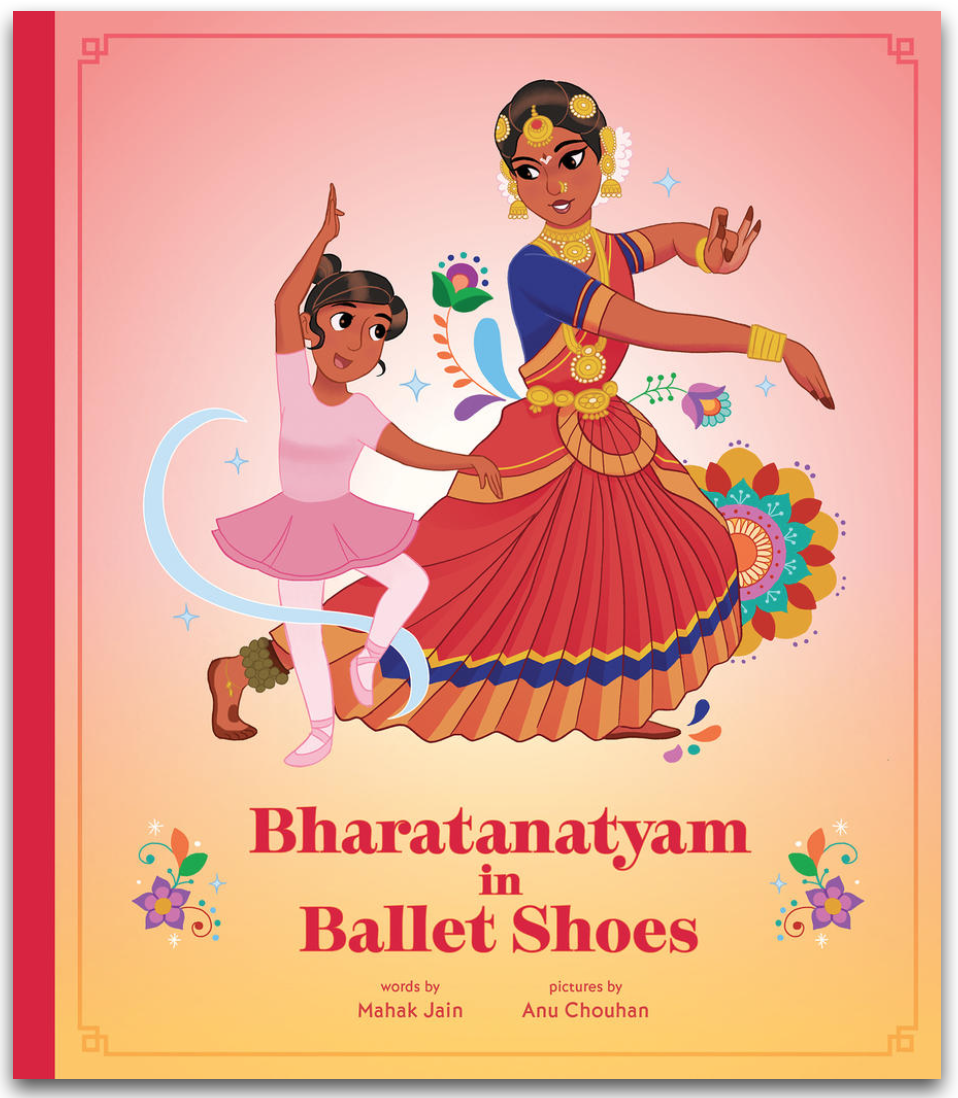
Palo loves doing Bharatanatyam, a classic Indian dance tradition, having learned from her mother whom she envisions as a queen of the dance. But when she heads to ballet class for the first time, she worries that she won't be able to dance and that her feet will fail her.
From Bharatanatyam in Ballet Shoes by Mahak Jain, illus. by Anu Chouhan
Though her toes seem eager to dance, Palo's apprehension grows as she meets young dancers Marco and Dana. They come from different backgrounds–Marco learned ballet as a baby and Dana learned to break dance from videos–and they are initially perplexed by Palo's unusual walk-dance. And when her Bharatanatyam moves get in the way of her ballet learning, Palo is not sure she'll be able to manage. Still Palo tells them about the Indian dance and about one of its most famous dancers, Rukmini Devi.

From Bharatanatyam in Ballet Shoes by Mahak Jain, illus. by Anu Chouhan

It's only when Palo can see, along with her new dance friends, that the glory is in the dance, whether Bharatanatyam or ballet or a blend of both, that she can accept that she really is a dancer.

While Bharatanatyam in Ballet Shoes will provide young readers with the inspiration to be themselves even if they worry that their differences will set them apart, I think that the picture book is more about the splendour of cultural diversity and inclusiveness of different art forms as both authentic and dynamic. How wonderful that a break dancer or a ballet dancer and a Bharatanatyam dancer can come together and learn, and even create something different. By doing so, Toronto's Mahak Jain, whose debut picture book Maya (Owlkids Books, 2016) gleaned her much positive attention, again brings her Indian culture to the forefront and introduces a classic dance tradition with its unique moves and costume (love the cross fan skirt). Moreover, she shows us that differences don't diminish who we are but rather enhance and that self-acceptance can mitigate any fears or worries about fitting in.

Anu Chouhan is a Punjabi-Canadian artist and game art director from BC whose artwork balances the boldness and brightness of Bharatanatyam with the soft and muted ballet. Whether it's the delicacy or the exotic, Anu Chouhan's artwork plays up that which defines them and unites them.
From Bharatanatyam in Ballet Shoes by Mahak Jain, illus. by Anu Chouhan
Palo may worry that Bharatanatyam and ballet are far too different to allow her to become a true dancer but Mahak Jain's afterword reveals a historical connection between two of the most famous dancers of each: Rukmini Devi and Anna Pavlova. If these two dancers could find a commonality that allowed them to blend elements of their dance with that of the other, then there's enough room for Bharatanatyam, and break dancing and ballroom and hip hop and more, to share any dance stage and studio around the world and bring dancing joy to those who move and those who watch.

June 03, 2020

Don't Stand So Close to Me: Q & A with author Eric Walters

Don't Stand So Close to Me
Written by Eric Walters
Orca Book Publishers
978-1-4598-2788-2 (pdf)
978-1-4598-2789-9 (epub)
116 pp.
Ages 9-14
June 2020

Yesterday author Eric Walter and publisher Orca Book Publishers launched an extraordinary middle grade novel and I was pleased to review Don't Stand So Close to Me here on CanLit for LittleCanadians.  Today I'm pleased to share with you some background into this unprecedented publication and launch via this Q & A with author Eric Walters.  Enjoy!

Eric Walters


HK:  If there was one thing that compelled you to write a story based on the ongoing COVID-19 pandemic, what was it?

EW:  Almost immediately I started receiving emails and twitter comments from students, teachers and teacher/librarians asking me if I was going to write a story about the pandemic.  At first, I simply told them it wasn’t something I was contemplating.  As those contacts reached over a hundred, I began to realize that there was both a desire and a need.  Young people needed to see something that reflected their present lives, to understand their situations, and teachers needed something to get their students engaged.


HK:  Though literature can be solely for entertainment and not harbour hidden messages to illuminate or educate, Don’t Stand So Close to Me cannot help but facilitate young readers’ understanding of the circumstances. If there was one message for them to take away from reading the book, what would you like it to be?

EW:  There were some very important pieces of information I wanted incorporated into the narrative including ‘flattening the curve’ and ‘exponential growth’.  I wanted these to be explained in a way that they could understand.  The overall message, however, is about changes, adapting, understanding what’s lost, acknowledging the anxiety of uncertainty, and perhaps more important, remembering what is still with us – family, friendship, human connection and hope.


HK:  Don’t Stand So Close to Me is more than “just” a book. It is an undertaking to involve young people in tackling the pandemic at their own level. It doesn’t require action but it certainly empowers them to look beyond the inconvenience and see the big picture of how they might help reduce the impact of this dangerous virus. If you could choose 3 actions that you would encourage them to take, what would they be?

EW:  It all stems from a basic understanding that, while we’re certainly not in the same boat, we are in the same ocean.  We have a deep connection, and need for that connection, with those around us.  Be kind.  Have faith.  Have hope.
a)    What can you do to show kindness to those in your family?
b)    How can you connect with others in your community to make their lives better?
c)    Change always starts with one person.  Be the person that helps to change your part of the world.


HK:  I applaud your characters who seem to follow the saying that when the going gets tough, the tough get going. But, we know that there are many for whom this pandemic is a struggle. As a former social worker and teacher, do you have any guidance for young people who might be struggling emotionally?

EW:  This pandemic has helped to expose the fault lines in our society.  We are not all blessed with the same support systems – either internally or externally.  Share a gentle word, encourage, make a phone call, a donation. Be kind to each other – and be kind to yourself.  Being kind to yourself may be the hardest.  Don’t judge – support.
    If you’re having problems, reach out to your parents, teachers and friends. It’s a sign of strength to know when you need help.  Be strong enough to reach out.


HK:  The book’s dedication is to your grandchildren whose names are coincidentally that of the three main young characters. But your grandchildren are far younger than Quinn, Isaac and Reese in Don’t Stand So Close to Me. Do the characters share any characters with your grandchildren or are they modelled after other young people you know or have known?

EW:  I love being a grandfather.  My grandchildren are all 2 or under.  Someday they’ll look at this story, see their names, and this will be part of my gift to them, to help bind them together.  You always invest bits of yourself or people you know in your stories.  I REALLY like these characters.  They are caring, capable, funny and thoughtful.  


HK:  Getting a book written and to press is usually a lengthy process. How were you able to complete this process so quickly, especially under the circumstances of everyone working remotely?

EW:  From the very beginning this was an act of trust and partnership.  With just a rough outline my publisher trusted me to craft and complete a novel on a tight schedule. While I was writing they were simultaneously editing, marketing, working on digital strategies, designing a cover and doing all the things necessary to publish a book.  We not only published in record time but created a marketing and promotion path that was more comprehensive than any plan previously attempted with any of my books – or any of their previous books!


HK:  Fingers crossed that this pandemic will be over, some time. Would you consider a sequel to reveal how Quinn, Isaac and Reese and their peers and families managed and look back at how this event has shaped them? Or would you perhaps write another book that addresses life in the aftermath of the pandemic? Or are you just as happy to let Don’t Stand So Close to Me be the end of this story?

EW:  Until you asked this question, I hadn’t thought about it at all!  Maybe I better call Orca before I answer. 
          This story ends with hope.  It’s the best possible place for any of us right now.  I’ve always believed in the power of hope.  At the same time, I strongly believe that you prepare for the worst and pray for the best. 
           I enjoyed those characters so much I would like to revisit them in another story.  I think what the story might be well be dictated by what’s going to transpire in the world.  I choose to believe it will be better. 
          You have to have hope.

•••••••••••••••

Many thanks to author Eric Walters for inviting me to be part of the process of getting Don't Stand So Close to Me to young readers during this challenging time.  

Thank you also to Leslie Bootle at Orca Book Publishers for allowing me to share in this amazing journey to launch.

June 02, 2020

Don't Stand So Close to Me

Written by Eric Walters
Orca Book Publishers
978-1-4598-2788-2 (pdf)
978-1-4598-2789-9 (epub)
116 pp.
Ages 9-16
June 2, 2020

978-1-4598-2787-5 (pb) 
Available September 22, 2020


In a novel for right now, Eric Walters has found a way to reassure, inform, educate and entertain about life during the COVID-19 pandemic, and all within the safety of a new digital book for middle grade readers.

Thirteen-year-old Quinn along with her neighbour and best friend Isaac and their classmates in Grade 8 are anticipating their spring break and planning their spring dance when the COVID-19 pandemic hits North America. The young teens show a variety of responses to the news that spring break will start a little early and last for three weeks: ambivalence, concern, joy and anxiety. Not unlike most young people, their responses are varied and often contingent about what they hear from family and on the news. Because Quinn’s dad is a doctor and Isaac’s mom is a police chief, these two friends get a very different perspective on staying out of school. 

As the kids begin to accept their new reality which includes online schooling and social distancing, all the COVID-19 related issues are touched upon in a meaningful and authentic way in Eric Walters's story. We read about Dad’s need for PPE and consequent skin reactions, his long working hours and the need to isolate from Mom and Quinn. The very social Isaac must deal with the loneliness of staying at home by himself and find safe ways to connect with others. Their friend Reese is unable to visit with her grandmother in a long-term care facility but the kids find a way to reach out after learning how to make masks. The young people learn of the positives of social distancing and strategies for keeping spirits up and bodies healthy. They are exposed to misinformation and those who disregard protocols and protesters who want to reopen businesses.

When the rest of the school year is cancelled except online, the kids decide to stage a spring dance on their street that abides by the rules of social distancing (chalk drawn boxes on road, with kids bringing their own phones, ear buds, water and snacks), and made possible with a little help from parent chaperones, police, and a neighbourhood that gets on board with making it special. With a highly appropriate playlist including the titular "Don't Stand So Close to Me," Isaac DJ’s the night away, saving one final dance with Quinn.

I loved this story. It covers everything middle graders might be experiencing right now, especially the confusion with different perspectives about the COVID-19 pandemic, from parents, peers, news, social media, etc. and their anxiety for their new routines. Their concerns are very real though they are so different from those of the adults in their lives. Still the kids find a way to do the right thing time and time again and I applaud these fictional characters for their responsibility and humanity. I wondered how the story would end, knowing that we don’t really know how this pandemic will ultimately play out. But Eric Walters's ending was more sweet than bitter and I even cried when Quinn’s dad tells her:
...Don’t underestimate what you did. It was much more than a dance. Tonight, wasn’t normal, but somehow you made it work, and for a few hours, you gave hundreds of people some happiness.  You gave them joy.  You helped them to forget for a little while. And, not just your classmates, but hundreds and hundreds of people on our street.  You gave them hope. You gave me hope.  (pg. 114)
Don't Stand So Close to Me is a positive story about a very negative event. It will take middle grade readers into the pandemic of their experiences, offering them reassurance and hope while educating them about helping everyone survive this pandemic. (The discussion about what flattening the curve means is especially brilliant.) I suggest parents and teachers help bring this novel to the young readers in their lives to offer them the hope and wisdom we all need to get through this.

 😊😊😊😊😊😊😊

Look for my interview with author Eric Walters next here on CanLit for LittleCanadians and learn more about Don't Stand So Close to Me and getting this relevant book written and to press with remarkable efficiency.

😊😊😊😊😊😊😊

Information for teachers and schools:
Orca Book Publishers is offering classroom and school licenses to accompany the ebooks. A teacher who wants to use this book in their Google Classroom platform or enable their whole class to access it from home can buy one copy of the book with a classroom license for $29.99. A school license (so multiple classes in one school would have access to the book) is available for $59.99.  See details at the publisher's website at https://www.orcabook.com

January 03, 2019

Totsapalooza Festival 2019 (Toronto, ON)

Small Print Toronto

is presenting its

annual kids' festival of books, bands and DIY crafts


It's

 TOTSAPALOOZA


A Day with Qin Leng & Friends

on 

Saturday, February 2, 2019

 1:00 -3:00 p.m.

at 

Revival
783 College St.  (at Shaw)
Toronto, ON


(always a good idea as they sell out quickly)
 
$15 for adults
$10 for kids
Free for non-walkers ages 0-2 (who will not be participating in crafts)


Activities include:

● author-illustrator Qin Leng unveiling her debut picture book as an author, I Am Small, and conducting a drawing demonstration;

● a sneak preview of Mine.Yours. by Marsha Diane Arnold, illustrated by Qin Leng, which will be published in April, 2019 by Kids Can Press, which is making early copies available for sale;

● drag performers JP (Fay Schlift) and Kaleb (Fluffy Soufflé) running their wildly popular, interactive reading program, Drag Queen Storytime;

● author Emil Sher sharing his picture book Away, illustrated by Qin Leng;

● drummer Dave Clark (Rheostatics, Dinner Is Ruined, Gord Downie) piloting The Woodshed Orchestra’s five-piece horn section, four-piece rhythm section and full-ensemble vocals, in a soulful mash up of classic dance styles from around the world;

● choreographer Ann-Marie Williams conducting her popular family dance sessions;

● dressing up and creating souvenirs of the day at PhaseOne Entertainment's Photo Booth.

Wanda’s Pie-in-the-Sky pop-up bakery selling healthy, handmade snacks.

● the sale of books for signing by authors and illustrator.


Be sure to get your tickets before they are sold out 
(and sold out they will be!) 
 

October 15, 2018

The Log Driver's Waltz

Words by Wade Hemsworth
Illustrated by Jennifer Phelan
Simon & Schuster Canada
978-1-5011-6195-1
40 pp.
All ages
September 2018

Whether you know the song "The Log Driver's Waltz" from the National Film Board short (John Weldon, 1979) or the version by the group Mountain City Four (with vocals by Kate and Anna McGarrigle) that accompanied the Canada Vignettes animated film, The Log Driver's Waltz is a piece of Canadiana which all will recognize. Written by folk singer-songwriter Wade Hemsworth of the agile log drivers he observed while he worked as a surveyor in remote areas of Canada, The Log Driver's Waltz is an iconic folk song of work and play and love in a northern landscape of trees and water.

Wade Hemsworth's lyrics may take readers and music listeners to a time when log driving, the work of moving cut trees from the forest to the mills downstream via river, was common and economically critical, but The Log Drive's Waltz is really a song about dancing, as a girl dreams to dancing with a lively and sure-footed log driver.
When the drive's nearly over
I like to go down
And watch all the lads
as they work on the river
I know that come evening
they'll be in the town
And we all like to waltz with a log driver. 
From The Log Driver's Waltz by Wade Hemsworth, illus. by Jennifer Phelan
Reading The Log Driver's Waltz has me singing aloud a song that should be sung at campfires and school concerts to celebrate a Canada of our past. But it's Toronto artist Jennifer Phelan's updated artwork that brings the song and its story to the present, without making it a contemporary tale, which it is not. Log driving is very rare anywhere in the world now but Jennifer Phelan's illustrations seem almost timeless. Though the log driver's appearance could be from the 1920s or the 2010s–a bearded fellow in a plaid shirt and toque–the dress of others reflects a variety of times.  There are the long dresses of the 1900s or the flapper girl dresses and the spats of the 1920s and even top hats. In fact, our T-shirt-wearing girl puts on a simple frock and pumps that could be from anytime between 1920 and 2018.

While she makes The Log Driver's Waltz about the log driver and a girl who yearns to dance with him above all others, Jennifer Phelan also makes the story a detailed homage to the task of the log drivers. She creates movement, integral to the work and the dancing, with line and shape that reflects the original animation of the film with astounding success. It's an organic take on the log driver's story.
From The Log Driver's Waltz by Wade Hemsworth, illus. by Jennifer Phelan
Moreover she honours those folk who brought history to life through music and art. In one image, the girl prepping for the dance is seen wearing a McGarrigle Sisters'1979 concert tour T-shirt. The flyer distributed to all announces the Weldon Waltz, recognizing the director of the NFB film. Even the endpapers show a darkened theatre with a small lit screen. And a stone statue outside the dance hall where the Weldon Waltz is held depicts the songwriter himself, Wade Hemsworth. Moreover, this is a Canadian story, though log driving was done throughout the world. Here we see pine trees reflective of Group of Seven styles, beavers, moose and the folk art traditions of our country.

The Log Driver's Waltz is a celebration of music and art, retelling a story from the past and giving it new life in the present. And we're delighted to be reminded of those who go "birling down and down white water..." and renew the earworm experience of that vintage song.

December 20, 2017

Totsapalooza 10 Festival (Toronto, ON)


presents 

Totsapalooza

the tenth anniversary of

its annual festival 

of

 picture books, indie rock bands and DIY crafts

 for kids aged 2-8  


on

Saturday, February 3, 2018

1 - 4pm 

at 

Revival Nightclub 
783 College St.


Tickets:

Limited number of Early Bird tickets:
 $12 Adults / $8 Kids 

After they are sold out:
 $18 Adults / $12 Kids


Authors in attendance include:

Dennis Lee
who will launch his new collection of poems for children, 
Good Night Good Night
and
lead a sing-a-long of his Alligator Pie 


Barbara Reid
who will read her latest book Picture The Sky 
and 
present Sing a Song of Mother Goose 
with musical support from indie-rockers


Nadia L. Hohn
who will launch Malaika's Winter Carnival,
the sequel to Malaika's Costume


Other in attendance will include:

Drag Performers JP (Fay Slift) and Kaleb (Fluffy Soufflé) who will read and lead an activity with children as part of Drag Queen Storytime;

Rock trio Communism;

The Woodshed Orchestra, a horn, rhythm and vocal ensemble, who will perform a mash up of classic dance styles from around the world;

Choreographer Ann-Marie Williams of Movement Lab who will get the kids dancing;

DJ Castlefrank (a.k.a. Matt Blackett of Spacing Magazine) who will keep the party going with kid-friendly beats;

and

Wanda’s Pie-in-the-Sky who will sell healthy, handmade snacks from their pop-up bakery.


Get your tickets online now 
and 
have something special to share at Christmas and then in February!

June 06, 2016

Spirit Level

by Sarah N. Harvey
Orca Book Publishers
978-1-4598-0816-4
233 pp.
Ages 12-16
February 2016

Spirit Level has nothing to do with spirits of the ethereal kind but it has everything to do with spirit of the attitude, strength and will variety. And with all the issues Spirit Level confronts–family, homelessness, donor conception and transgender youth–it is a young adult novel with a lot of guts.

Harriet a.k.a. Harry is seventeen, and the daughter of Della, a college sociologist, and honorary granddaughter of Verna, the widow who runs Verna’s Salon and took Della in and off the street when she was Harry’s age.   Now the three are essentially family and they continue to give back to their community.  Verna, with Della and Harry’s help, offers shampoos and hair styling for her “Sunday ladies”, an assortment of homeless and poor women who could not afford the treatment. Della is doing research on homeless girls, giving them voice about their circumstances. And Harry is working three summers jobs: dog walking, working at the salon, and transcribing her mom’s interviews with the girls who live on the street or couch surf.

There is no father in Harry’s life because her birth was by donor sperm.  After reading an article about a man who fathered 500 children, Harry decides she will finally check out the Donor Sibling Registry to learn about any siblings she might have. Within days she hears from and meets the exuberant Lucy, a fifteen-year-old dancer who also lives in Seattle and introduces Harry to two other half-sibs, Adam in Portland and Ben in Australia.  Lucy is ecstatic to make this connection, and even more so when another sister, Meredith, 18, who relocated to Seattle from Missoula with her best friend Alex, contacts them, hopeful of getting them on side to search for the donor himself.  Lucy, the consummate oversharer and all-in-girl is quite taken with Meredith, though Harry, the level-headed one, is reluctant to pursue this avenue and even more so to trust Meredith.  However, she does become involved with Meredith’s BFF Alex, displeasing Meredith.

As the siblings and friends and family meet and interact, the possibility of meeting the donor who helped conceive the three teens (and their far-away brothers) looms.  But, with the sensible Harry hesitant to agree to it and Alex pursuing Harry–though because he likes her or to get her on Meredith’s side is the question–Harry feels the need to do her Harriet the Spy routine and go in search of some answers, learning far more than she expected about Meredith, Alex and even herself.

There’s a lot going on in Spirit Level and I’ve barely touched on the homeless girls whose stories provide a different wallpaper from the family situations of Harry, Lucy and Meredith.  Their stories are integral to the book and to Harry specifically who begins to see her “problems” and family differently, taking wisdom from their challenges and attitudes, and ultimately she is able to make good for herself and at least one other homeless teen while continuing to evolve her own family circle.  

As I’ve mentioned, Sarah N. Harvey embeds a lot in Spirit Level, from homeless youth to mental health and donor conception and transgendering, but the message is still clear:  when life becomes uncertain and even chaotic, it is what it is and you begin as you mean to go on, go on as you began (two of Verna’s multitude of sayings).

May 30, 2016

Born With: Erika and Gianni

by Lorna Schultz Nicholson
Clockwise Press
978-0-9939351-7-6
231 pp.
Ages 13+
March 2016


Clockwise Press launched its young adult series One-2-One with Fragile Bones: Harrison and Anna (2015), also by Lorna Schultz Nicholson, focusing on the relationship between two teens in the Best Buddies program, a world-wide organization that aims to help individuals with intellectual and developmental disabilities integrate successfully  into their communities. Born With features two other teens, both with a love of musical theatre: Erika, a fourteen-year-old born with Down Syndrome and Gianni, a teen who’s struggling with his sexuality.  This is their story, a powerful one for their trueness of thought, action and self-appreciation.

Erika and Gianni both audition for the school’s musical Grease. While Erika is thrilled to get selected to sing and dance in the chorus for three songs, Gianni is disappointed to get slotted for the comedic role of Eugene, losing the coveted lead role of Danny Zuko to the more athletic but less talented Richard.  Also cast are Erika and Gianni’s friend Sonya, as Sandy, and a boy named Bilal to whom Gianni is secretly attracted.

Gianni is determined to be stellar in the role of Eugene and to help Erika rehearse her lines and steps, ensuring that both will be successful.  But the two teens have more on their plates than singing and dancing. Erika’s father has ALS and his condition is worsening, and, though she takes her responsibilities for him very seriously, all she wants is for him to see her dance.  On the other hand, Gianni is coming to terms with his sexuality and what he wants out of life, convinced he already doesn’t fit his father’s dream for him, and that he can’t be himself until he is able to graduate from high school and leave his big Italian family.  But secrets have a way of becoming revealed, especially when Erika has been tutored in not keeping secrets, even if they are someone else’s personal business.

Born With takes on the monumental task of showcasing characters living with aspects of their lives over which they have no control: a genetic disorder, and sexual orientation.  Erika has a great understanding and acceptance of the strengths and limitations of her genetic disorder, and works to meet her needs, advocating for herself while celebrating in her own successes.
Sometimes people don’t think I can be serious or that I can learn things, but I can–I can do lots of things after I’m serious and listen. And focus. Focus. (pg. 9)
Likewise, Gianni has compassionate insight into Erika but he has yet to accept himself, confused over his sexuality, still processing what he is feeling and with whom to share that secret.
Tonight Erika’s honesty was creating chaos in my life.  But, seriously, what difference did it make who I was in the school musical?  That was a relatively little issue in comparison to the rest of my life. (pg. 190)
Both Erika and Gianni must navigate how others feel about them and make them feel, while dealing with family, friends, peers, ignorant bullies, and others.  The high school years are tenuous enough but Erika and Gianni have struggles that many of us could not imagine, and yet they dare to be themselves and are able to thrive.  By wrapping their stories in the joyful musical that is Grease, another story about being true to oneself, Lorna Schultz Nicholson has written an inspirational and triumphant story of acceptance in Born With: Erika and Gianni.

April 04, 2016

Taking a Chance on Love

Written by Mary Razzell
Ronsdale Press
978-1-55380-455-0
156 pp.
Ages 14+
February 2016

Taking a Chance on Love was still to become a jazz standard, having only been released a few years earlier in 1940, but it perfectly exemplies the summer of 1944 for seventeen-year-old Meg when boys and affairs of the heart seem to abound for her and everyone.

Though Meg is still quite innocent and naïve about her feelings towards boys, her best friend, Amy Miller, is anything but.  Amy is well aware of them, easily flirting with the wealthy Robert Pryce whose extramarital activities involve several married women, including Amy’s own mother, and setting her sights on any man who could give her a good life.  Meg notices a lot and sometimes knows enough to be wary but can’t always put the big picture together, unfortunately accused by Amy of being jealous  when she attempts to share those feelings.  With her own mother deeply entrenched in the staunch ideas of what being a woman entails i.e., not continuing one’s education but marrying instead, and her father and older brother Sam away at war, Meg has to navigate these treacherous waters as best she can.

From Doug Thompson, a soldier pen pal, to seventeen-year-old Glen Pryce, wealthy half-brother of Robert Pryce, and 22-year-old Bruce Hanson, the emotionally- and physically-scarred Navy son of her employer at Hanson’s Guest House, Meg has no shortage of young men who can help her learn how to handle how she feels.  Sadly, as with coming-of-age for all of us, Meg endures many sweet and bitter moments as she tries to uncover this.
It made me curious, excited, with strong, unexpected yearnings.  But I also felt uneasy, not really ready to know any more about this new world. (pg. 94)
Taking a Chance on Love may be rich in the landscape of 1940s British Columbia, with the war, TB, medical practices, the expectations for women, and the music and clothes, but it could be any teen girl’s story as she delves into first relationships with boys and tries to find herself while opening herself up to the possibilities of finding someone to love.  With some marriages falling apart and others forged because of war, Taking a Chance on Love takes place in a tenous and strengthening time.  It’s a time that is both sweet and enlightening, temporarilty transporting readers to an era when love wasn’t dependent on social media and digital technology but more on self-discovery and resolve.

June 11, 2013

Summer Days, Starry Nights

by Vikki VanSickle
Scholastic Canada
978-1-4431-1991-7
219 pp.
Ages 10-14
June 2013

What a perfect time for Vikki VanSickle to launch her newest book, Summer Days, Starry Nights which takes middle grade readers to the lake, cabins and beach of Sandy Shores, the Starr family summer resort outside of Orillia, Ontario. The narrator of this 1962 coming-of-age story is the middle Starr child, Reenie, 13, who adores her home, the resort, but still doesn’t always feel like she belongs.  After all, her six-year-old sister, Scarlett, is so much like their mother, affectionately called Mimi, who likes pretty things and getting attention. Her brother Bo is 16 and, although he is obsessed with music and his band, the Wide Mouth Bass, he is still more likely to be asked to do work with his dad around the resort and will probably inherit it. But Reenie loves Sandy Shores. She can’t think of a better place to live or grow up.

So it’s perplexing to Reenie that Mimi becomes so melancholy about her past as a dancer and actress before she married and moved to the boondocks. And more surprising that Dad allows Mimi to implement a variety of ideas she has to bring a little class and hopefully more guests to the resort. In the summer of 1962, her idea is to bring in some entertainment and dancing, asking Gwendolyn, the daughter of her friend Grace Cates, to work for them. Gwen, almost 18, has grown up drastically from the lovely, ethereal girl attending ballet school who Reenie remembers; now she’s brash and more interested in singing than dance, especially not ballet, spending lots of time alone in her room when not teaching.

Reenie is determined to reacquaint herself with Gwen, hanging around her, taking dance lessons, talking about being a teenager. So it's not surprising that Reenie notices that, after Gwen gets letters from someone whose name begins with J or G, she is more grumpy and that there are times when it’s obvious she’s been crying. When Reenie is working in the office and answers a call from a rock and roller called Johnny Skins, looking to speak with Gwen, Reenie begins to hatch a plan that would bring some much-needed attention to Sandy Shores and lift her mother's mood; give her brother a chance to showcase his band and his music; and take away Gwen's blahs.  Reenie is convinced that she can pull together a special concert/dance and amaze everyone, especially Gwen, with a surprise appearance by Johnny Skins. But even plans laid upon the best of intentions will go awry when secrets are being kept by everyone.

The plot of Summer Days, Starry Nights draws attention to the sparkling promise of summer: new relationships, freedom, opportunities, spending time outdoors. But sometimes, like stars, that promise can be overwhelming, brighter than justified, blinding to the eyes. When the stars align, however, they paint a picture of a fragile family, held together by shimmering connections that waver, weakening and strengthening with different circumstances. With Gwen added to the big picture, all the Starrs begin to see themselves relative to her, moving within her pull, positive or negative, rather than as a stable system irrespective of her. But those pesky secrets shake the foundation of the Starrs forcing them to re-examine their ideas about themselves and each other so that they may rebuild those connections.

Characteristically, Vikki VanSickle pens a story that is like a classic rock-and-roll song: there is a familiarity to its melody, of a family working together, with harmonies and some dissonance (especially feared in the 1950s and 1960s music!) but together it is a pleasing sound that resonates with all.  Summer Days, Starry Nights is sure to be a summer hit on the youngCanLit charts.

May 23, 2013

Allegra

by Shelley Hrdlitschka
Orca Book Publishers
978-1-4598-0197-4
268 pp.
Ages 12+
2013

Allegra is told by Mr. Rocchelli, the teacher whose music theory class she is desperate to drop, that her name comes from allegro which means "lively, with a happy air." (pg. 4) But Allegra is more the serious dance student who has always felt less inclined to join in those lively groupings and fun activities that many children enjoy.

Seventeen-year-old Allegra Whitford, daughter of two very accomplished musicians (Mom is the Deer Lake Symphony Orchestra's harpist and Dad is the bass player of the Celtic-rock group, Loose Ends), is entering her first year at the Deer Lake School for the Fine and Performing Arts.  Already accomplished herself, in completing all levels in the National Music Academy, she is only interested in pursuing dance classes.  But the school, and Mr. Rocchelli, insist that she get a balanced arts curriculum, so she is stuck taking his music theory class. However, after she takes the final exam early and aces it, Mr. Rocchelli gives her a special project: to expand a simple melody into a conductor's score and written for every instrument in the orchestra.

Allegra is especially eager to delve into this project with her father who has just returned from another tour. But her parents' relationship seems rather awkward since he's come home.  Her mother seems more "prickly" and insists on continuing to get rides from another musician, Marcus, who drives a little red sports car.  Dad looks tired and is thinking of one last tour, realizing the impact his touring has had on the family.  Though they have a great time when Allegra invites new friends Spencer and Talia and a couple of others over for chili and to sit in on a Loose Ends rehearsal, Allegra begins to wonder about the steadfastness of everyone's relationships.

When Mom asks Dad to move out, Allegra is embarrassed to tell Spencer and Talia, and finds herself immersing herself in her music project and putting her dance on hold.  Spencer is showing interest, even kissing her but, after a fiasco of a sleepover at Talia's, he tells Allegra that, "You put up a wall and don't let anyone in." (pg. 130) Returning to dance while working even harder on her music composition, Allegra finds herself becoming more distracted by Mr. Rocchelli, especially after he begins to collaborate with her on the music, scheduling late night sessions and even asking her to call him Noel.  Though Mr. Rocchelli makes no advances towards her, Allegra is thrilled with the attention he gives her, convinced that they are in love.

Though I don't take any joy in Allegra's discomfort in social settings, it's refreshing for readers to recognize that not everyone aspires to popularity at all costs.  However, Allegra's awkwardness in social situations has kept her shielded from sharing herself with others and from gaining the support that friendships can provide.  Without the balance of others' views or input, Allegra's thoughts only feed themselves, both negatively and positively.  While convincing herself that Spencer and the others are only interested in her because of her father - definitely a negative perspective - she also convinces herself that Mr. Rocchelli feels the same excitement about her as she does when with him.  In the end, she does a disservice to everyone while never intending on doing anything but excelling at her craft.

Shelley Hrdlitschka could have made Mr. Rocchelli the "bad guy" by having him lead Allegra on but she charitably creates no good guys and bad guys, just characters who are human, trying to do the best they can.  Their way of doing things, including their reactions and interpretations, may be right or they may be wrong, but they don't seem to have any hidden agendas.  Allegra herself recognizes that she "should" be lively, or that she would at least benefit from being more extroverted, but it's not always possible to be what others want of us, no matter how beneficial.  But, like her parents, her friends, Mr. Rocchelli and others, Allegra takes what she's been given and works with it.  Sometimes it's flat but sometimes it's a superb orchestral piece with layers of harmonies and melodies that inspire and elevate.