Showing posts with label multiculturalism. Show all posts

March 16, 2026

Canada: We Are the Story

Written by Richard Wagamese
Illustrated by Mangeshig Pawis-Steckley
Swift Water Books (An imprint of Tundra Books)
978-1-77488-638-0
32 pp.
Ages 3–7
Releases March 17, 2026
 
The cover of Canada: We Are the Story announces this book as bold, beautiful, and powerful. From its flow of luminous colours and glowing shapes, this picture book, one of the first releases from Tundra's new Indigenous imprint, Swift Water Books, declares itself to be what it is: momentous.
From Canada: We Are the Story, written by Richard Wagamese, art by Mangeshig Pawis-Steckley
Based on a poem by Richard Wagamese, Canada: We Are the Story speaks to a child tasked with a school assignment, "What makes you proud to be Canadian?" Struggling, the child is guided to listen and feel so that they might sense their ancestors and what they could impart.
Close your eyes and tell me if you can hear your Ancestors in the Spirit World exhaling all at once. They are standing beside you even now. They are talking. Listen. (pg. 7)
From Canada: We Are the Story, written by Richard Wagamese, art by Mangeshig Pawis-Steckley
It doesn't matter whether the ancestors speak in Dene, Cree, Inuktitut, or German, Mandarin or English, because they are the Old Ones and their souls had "fallen head over heels in love with the spell of this country." (pg. 13) More importantly, the ancestors tell us that we are all in this together, no matter whether we're on the East Coast, on the prairies, or at the Arctic Circle. (Richard Wagamese mentions more than several place names like Belle Isle, Labrador; Wynyard, Saskatchewan; Revelstoke, BC; Okotoks, Alberta; the archipelago Haida Gwaii, and Pangnirtung on Baffin Island.) The message is that the ancestors come from throughout the country, and if we just listen, they'll tell us its story.

We are the story of our time here,
they have come to say.
 
It is all we bring with us
and all we leave behind. (pg. 24)
From Canada: We Are the Story, written by Richard Wagamese, art by Mangeshig Pawis-Steckley
Richard Wagamese's message is one of inclusivity and acknowledgement. His free verse poetry recognizes that everyone is part of the land and part of its story, whether Indigenous or immigrant. And this child, once they listen to the ancestors and hear their stories, can accept and cultivate themself as part of it. The voice of Richard Wagamese's narrator is profound and sweepingly affirming of all. They want this child to feel connected and embraced from their ancestors and from the people of the country to which they belong.
 
Mangeshig Pawis-Steckley, whose illustrations I first enjoyed in Mii maanda ezhi-gkendmaanh / This is How I Know (written by Brittany Luby, 2021) and Biindigen! Amik Says Welcome (written by Nancy Cooper, 2023), has acknowledged the message of Canada: We Are the Story with his simple but weighty dedication: "For all my relatives, Indinawemaaganidog." His Ojibwe (Anishinaabemowin) words invite all of his people to enjoy the art of this book, just as all readers will. Every page is a delight of colour and shapes. Mangeshig Pawis-Steckley draws his main character as a unique individual, wearing a personalized jacket with badges like a thunderbird, an NDN sweater, and a plaid skirt. They are unique and fit in because they belong. Mangeshig Pawis-Steckley has made this child any child, from an Indigenous community or one of a diverse background. They are Canadian by being part of the land. And with their meaningful background of ancestors, from all cultures and traditions, Mangeshig Pawis-Steckley urges us to see ourselves as part of the story.
From Canada: We Are the Story, written by Richard Wagamese, art by Mangeshig Pawis-Steckley
From words to art, Canada: We Are the Story is a stunning picture book, as valuable in its message for young children as it would be as a visual art book for the adults who might purchase it. It should give us all pause to think about how we belong, perhaps in our way, perhaps like others, to this country, and our stories will become part of it, now and forever.

May 12, 2022

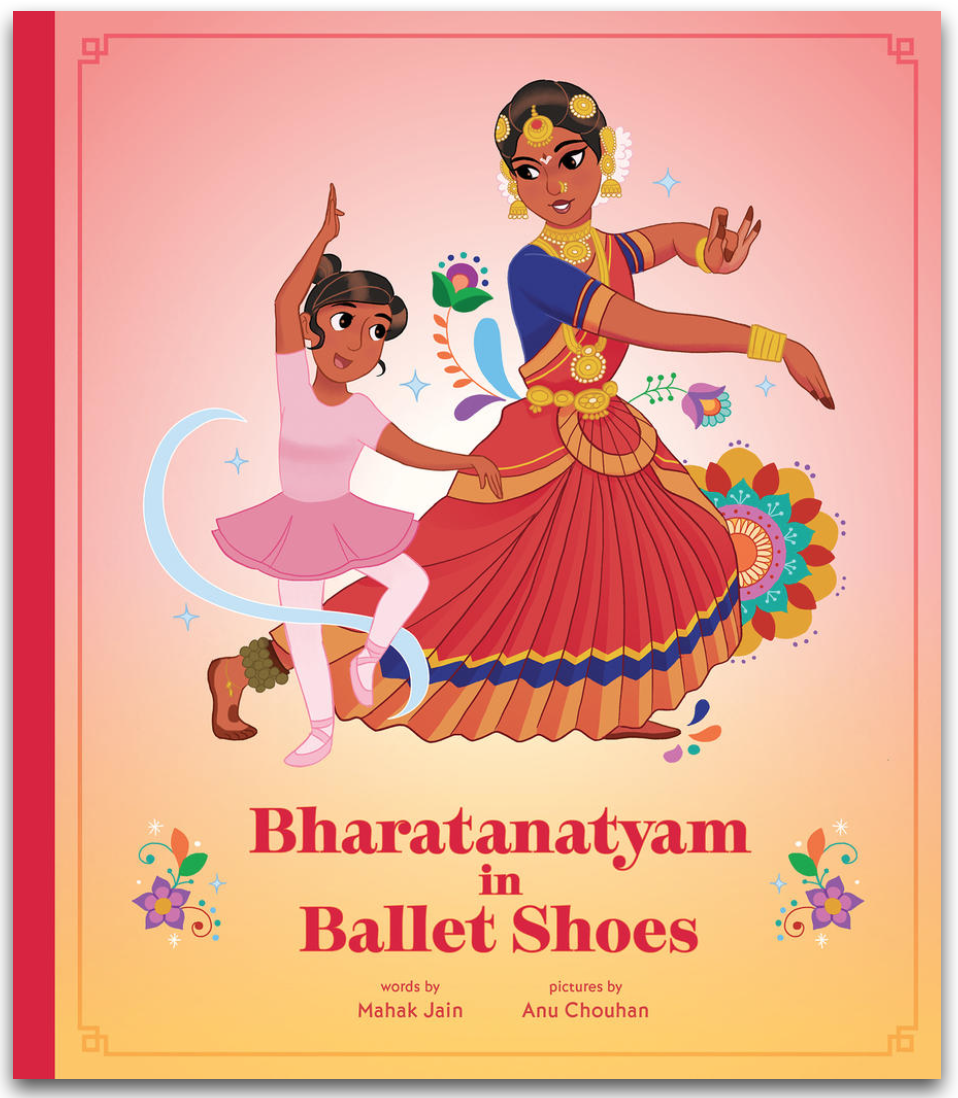
Bharatanatyam in Ballet Shoes

Written by Mahak Jain
Illustrated by Anu Chouhan
Annick Press
978-1-77321-615-7
36 pp.
Ages 4-7
March 2022

Palo loves doing Bharatanatyam, a classic Indian dance tradition, having learned from her mother whom she envisions as a queen of the dance. But when she heads to ballet class for the first time, she worries that she won't be able to dance and that her feet will fail her.
From Bharatanatyam in Ballet Shoes by Mahak Jain, illus. by Anu Chouhan
Though her toes seem eager to dance, Palo's apprehension grows as she meets young dancers Marco and Dana. They come from different backgrounds–Marco learned ballet as a baby and Dana learned to break dance from videos–and they are initially perplexed by Palo's unusual walk-dance. And when her Bharatanatyam moves get in the way of her ballet learning, Palo is not sure she'll be able to manage. Still Palo tells them about the Indian dance and about one of its most famous dancers, Rukmini Devi.

From Bharatanatyam in Ballet Shoes by Mahak Jain, illus. by Anu Chouhan

It's only when Palo can see, along with her new dance friends, that the glory is in the dance, whether Bharatanatyam or ballet or a blend of both, that she can accept that she really is a dancer.

While Bharatanatyam in Ballet Shoes will provide young readers with the inspiration to be themselves even if they worry that their differences will set them apart, I think that the picture book is more about the splendour of cultural diversity and inclusiveness of different art forms as both authentic and dynamic. How wonderful that a break dancer or a ballet dancer and a Bharatanatyam dancer can come together and learn, and even create something different. By doing so, Toronto's Mahak Jain, whose debut picture book Maya (Owlkids Books, 2016) gleaned her much positive attention, again brings her Indian culture to the forefront and introduces a classic dance tradition with its unique moves and costume (love the cross fan skirt). Moreover, she shows us that differences don't diminish who we are but rather enhance and that self-acceptance can mitigate any fears or worries about fitting in.

Anu Chouhan is a Punjabi-Canadian artist and game art director from BC whose artwork balances the boldness and brightness of Bharatanatyam with the soft and muted ballet. Whether it's the delicacy or the exotic, Anu Chouhan's artwork plays up that which defines them and unites them.
From Bharatanatyam in Ballet Shoes by Mahak Jain, illus. by Anu Chouhan
Palo may worry that Bharatanatyam and ballet are far too different to allow her to become a true dancer but Mahak Jain's afterword reveals a historical connection between two of the most famous dancers of each: Rukmini Devi and Anna Pavlova. If these two dancers could find a commonality that allowed them to blend elements of their dance with that of the other, then there's enough room for Bharatanatyam, and break dancing and ballroom and hip hop and more, to share any dance stage and studio around the world and bring dancing joy to those who move and those who watch.

May 08, 2020

Going Up!

Written by Sherry J. Lee
Illustrated by Charlene Chua
Kids Can Press
978-1-5253-0113-1
40 pp.
Ages 3-7
April 2020

In a jubilant story of inclusivity, diversity, and friendship.  Going Up! ticks all the buttons for a joyous read about making friends in an apartment building and accepting everyone as neighbours.
From Going Up! by Sherry J. Lee, illus. by Charlene Chua
Sophie and her dad are invited to Olive's birthday on the 10th floor of their apartment building. They bake cookies and take the elevator onward to the party. But getting to the party seems to be half the fun, because the elevator stops at every floor, taking on residents also invited to the party. There's the Santucci brothers–who look tough but are bedecked with cat and knitting trim–and Vicky and her partner Babs and dog Norman; Mr. and Mrs. Habib and grandchildren Yasmin and Jamal; Mr. Kwan; the Flores family; Vi Tweedle and her Chihuahua Minx; musicians Grace and Arnie; and finally Nori.
From Going Up! by Sherry J. Lee, illus. by Charlene Chua
As they take on new guests at almost every floor, the fit on the elevator gets a little more crowded but somehow there is always room to include everyone on the party elevator.
From Going Up! by Sherry J. Lee, illus. by Charlene Chua
When they finally arrive, the guests tumble out of the elevator in a glorious double-spread fold-out of colour and shape and spirit to wish poodle Olive, with her human mom, a happy birthday.

Going Up! will easily lift the moods of anyone who feels a little low. Whether on floors nearer the ground or the higher ones in this apartment building, there is much to elevate hearts and attitude. In fact, I suspect many people are currently relying on the same activities demonstrated as the apartments' residents–baking, gardening, knitting, pets, music, costumes and food–to help. We may not be able to all get together right now and celebrate birthdays in person, but Sherry J. Lee gives us the opportunity to see how we can revel in life with simple gifts of self. This is Toronto author Sherry J. Lee's debut picture book and its upbeat nature and depiction of inclusivity of all neighbours in an apartment building is a rousing kickoff.
From Going Up! by Sherry J. Lee, illus. by Charlene Chua
Charlene Chua, whose artwork I have enjoyed and reviewed numerous times (e.g., The Pencil, 2019; Akilak's Adventure, 2016; and Fishing with Grandma, 2016), brings that festivity to each one of her illustrations, which are rendered in watercolour, watercolour ink and coloured pencils before digitally completed with Photoshop.  She doesn't miss a detail, keeping Sophie and her dad's baking low-key and comforting in golds and greys, and amping up the colours and animation as the elevator travels up from floor to floor. Even the art that Charlene Chua uses on the copyright page reveals a little something of each apartment's inhabitants while the ubiquitous orange tabby cat enjoys some fish garbage.
From Going Up! by Sherry J. Lee, illus. by Charlene Chua
Going Up! cheers and rejuvenates, helping us all remember the joys of celebration with everyone, excluding no one, but also reminds us that there are ways to celebrate in which we might all partake alone. In tone and art, Going Up! raises all our spirits.

February 05, 2017

Becoming Culturally Competent with Diverse youngCanLit


Last week, I presented a talk on cultural competence at the Ontario Library Association's Superconference in Toronto.  The premise behind the talk was the need for schools, libraries and all institutions to go beyond tolerance and acceptance and become culturally competent.  To that end, I shared lists of some books (but only a fraction of a fraction of the books that could  be included!) of youngCanLit that could be used to support that endeavour, and thought that perhaps others might benefit from them as well.

If diversity is a window into other cultures, races, ethnicities, sexualities, families and individuals, then cultural competence is a mirror or a sliding glass door into those same identities. It is based on three main premises:

• recognizing the differences among students and families from different cultural groups;
• responding to those differences positively; and
• interacting effectively in a range of cultural environments.
(Lindsey, R.B., Robins, K.N. and Terrell, R.D. 2003. 
Cultural proficiency: A manual for school leaders
Thousand Oaks, CA: Corwin Press)

I based my presentation on seven foci that need to be understood and honoured in order to become more culturally competent.  There were:

• cultures
• languages
• races and ethnicities
• gender identities and sexualities
• capacities and abilities
• family life
• Aboriginal ways of knowing and being

Becoming culturally competent is a tall order but one which must be addressed in order to become a considerate and full-functioning member of society.  Everyone should be culturally competent, and awareness through youngCanLit is a great first step.

I hope these booklists, which I will present in a series of 7 posts, will help readers to come closer to achieving that end.

Let's begin with today's post focusing on...


Alego
by Ningeokuluk Teevee
Groundwood Books
24 pp.
Ages 3-7
2009
Inuit life

Chin Chiang and the Dragon’s Dance
by Ian Wallace
Groundwood Books
32 pp.
Ages 4-8
1994/1998
Chinese, dance, celebration

From Lands of the Night
by Tololwa Mollel
Illus. by Darrell McCalla
Red Deer Press
32 pp.
Ages 7+
2014
Tanzania, illness, ancestors, celebration
Reviewed here

Games of Survival: Traditional Inuit Games for Elementary Students
by Johnny Issaluk
Inhabit Media
60 pp.
Ages 7+
2012
Inuit, Arctic, games, skills, survival
Reviewed here

Greetings, Leroy 
by Itah Sadu
Illus. by Alix Delinois
Groundwood Books
32 pp.
Ages 4-7
2017
Immigration, Jamaica

Haiti My Country
Haitian schoolchildren
Illus. by Rogé
Fifth House Publishers
44 pp.
Ages 7-11
2014
Haiti, nature, poetry

Hand Over Hand
by Alma Fullerton
Illus. Renné Benoit
Second Story Press
24 pp.
Ages 5-8
2017
Philippines, fishing

The Hill
by Karen Bass
Pajama Press
256 pp.
Ages 12+
2016
Cree, survival, legends, supernatural beliefs, tolerance
Reviewed here

Lights for Gita
by Rachna Gilmore
Illus. by Alice Priestley
Second Story Press
24 pp.
1994
Hinduism, Diwali

Malaika’s Costume
by Nadia L. Hohn
Illus. by Irene Luxbacher
Groundwood Books
32 pp.
Ages 3-7
2016
Trinidad & Tobago, Carnival, absentee mother
Reviewed here

Mission Mumbai: A novel of sacred cows, snakes, and stolen toilets
by Mahtab Narsimhan
Scholastic Canada
272 pp.,
Ages 9-12
2016
India, Hinduism, Mumbai
Reviewed here

The Mummer’s Song
by Bud Davidge
Illus. by Ian Wallace
Groundwood Books
32 pp.
Ages
2009
Newfoundland, mummering, song

My Two Grandmothers
by Diane Carmel Léger
Illus. by Jean-Luc Trudel
Nimbus Publishing
32 pp.
Ages 4-8
2016
French Acadian, Scottish, grandmothers
Reviewed here

P’ésk’a and the First Salmon Ceremony
by Scott Ritchie
Groundwood Books
32 pp.
Ages 4-7
2015
Sts’ailes, salmon, ceremony

Sometimes I Feel Like a Fox
by Danielle Daniel
Groundwood Books
36 pp.
Ages 4-7
2015
Anishinaabe, totem animals
Reviewed here

The Tiffin
by Mahtab Narsimhan
Dancing Cat Books
190 pp.
Ages 8-13
2011
India, abandonment, working children
Reviewed here

Treasure for Lunch
by Shenaaz Nanji
Illus. by Yvonne Cathcart
Second Story Press
28 pp.
Ages 4-8
2000
Indian food,  shame, immigration

The Trouble with Dilly
by Rachna Gilmore
HarperCollins Canada
162 pp.
Ages 7-10
2009
Immigration, cultural conflict, hockey, India, Hungary

When the Rain Comes
by Alma Fullerton
Illus. by Kim La Fave
Pajama Press
32 pp.
Ages 4-8
2016
Sri Lanka, monsoons, rice-planting, oxen, floods
Reviewed here


Downloadable book list available here

August 01, 2016

Pandas on the Eastside

by Gabrielle Prendergast
Orca Book Publishers
978-1-4598-1143-0
192 pp
Ages 9-12
October, 2016
Reviewed from advance reading copy 

Never underestimate the power of goodness to overcome that which others consider weaknesses: youth, poverty, lack of education, dysfunctional families.  Ten-year-old Journey Song doesn’t.  She sees beyond the slummy side of the 1970s Eastside of Vancouver and sees a community of friends, that includes classmates, school staff, street people and local merchants.
Some people call the Eastside a slum.  That’s because they are describing buildings and roads instead of people.  To them, people on the Eastside probably look poor, sad, uneducated, sick and worthless.  But I don’t care what they think.  To me, the people around here are friends. (pg. 1)
And she’s going to need all of them in her mission to help the pandas housed in limbo at a local warehouse while the governments of China and the United States engage in a bureaucratic kerfuffle regarding action during the Vietnam War.

Though Pandas on the Eastside is narrated by the youthfully buoyant voice of Journey, each chapter brings another Eastside community member to the forefront, from homeless Kentucky Jack and mentally ill Contrary Gary, to teacher Miss Bickerstaff and her black boyfriend Ben Wallace, and Officer Pete Baker, and grocer Mr. Huang. Everyone adds to Journey’s story, not the least of which is her father whom she meets for the first time, finally answering some of her questions about her heritage.  But, just like everyone else on the Eastside, it doesn’t matter where you come from but who you are now. For Journey, her now involves helping the pandas and hopefully spreading some happiness in a world filled with war and sadness and conflict.

Gabrielle Prendergast, who made her literary mark with young adult novels in verse Audacious (Orca, 2013) and Capricious (Orca, 2014), demonstrates a formidable skill for writing an intricately-plotted, character-filled middle-grade novel that confronts prejudice without preachiness.  Yet it’s Gabrielle Prendergast's rich setting that truly drives the story, providing the impetus for action and consequently acceptance.  Pandas on the Eastside is an uplifting story from a time long-gone but a place ever-present in heart and geography.


(A version of this review was originally written for and published in Quill & Quire, as noted in the citation below.)

Kubiw, H. (2016, September). [Review of the book Pandas on the Eastside, by Gabrielle Prendergast]. Quill & Quire, 82 (7): 37.

December 10, 2015

A Big Dose of Lucky

by Marthe Jocelyn
Orca Book Publishers
978-1-4598-0668-9
249 pp.
Ages 12+
October 2015


"You may discover that going backward–discovering your past–will be the best route to the next chapter in your life." (pg. 31) 

This is what Malou, 16, is told as she and the other Seven girls in Orca’s Secrets books are released from the Benevolent Home for Necessitous Girls after a fire destroys it and they are given the barest of clues to their heritage.  Malou has never dreamed of having parents who might be monarchs or celebrities; she has only wanted an ordinary family that did things together.  The baby bracelet from St. Joseph's Hospital in Parry Sound with the name "Baby Fox" is her only clue to that family.  Though reluctant to leave, Malou heads by bus to Parry Sound, via Toronto, impressed by the diversity of people–her own skin colour had made her an anomaly in town where she was routinely identified as “the dark one or the little darkie or the colored girl” (pg.1)–and the newness of everything from pink popcorn to lemon meringue pie and grilled cheese.

In Parry Sound, Malou gets a bed at the local women's hostel and a job as a cleaner at the hospital, surprising considering her well-known untidiness at the Home, but "All it takes to be a cleaner? Don't be white." (pg. 70)  By way of a young orderly, Frankie, who shows an interest in her, Malou locates the stored records at the hospital and specifically the one for Sherry Fox who gave birth in 1948.  Along with an address, Malou finds a list of seven names which includes Sherry Fox's on the doctor's stationery and identified as A. B. cases.  Though her encounter with Sherry Fox, an Anishnaabe on the local reserve, reveals the bracelet was not Malou's but that belonging to, and taken from, Sherry's son Jimmy at birth, Malou makes an important connection with Jimmy and his classmate Pete and Pete's twin sister, Lucy, whose mother's name also appears on the list.

So begins a hunt by Malou and her new friends to locate the women whose names are on the list and find their connection.  A significant breakthrough comes from Pete's noting the physical similarity between Malou and a girl, Abby, who works summers at the marina.  And, with that, Malou and the other sixteen-year-olds are led to discover a program of artificial insemination at the hospital that involved an Jamaican intern named Andy Bannerman and probably others.  But this still does not reveal who Malou's mother may be.  Secrets long hidden may be being uncovered but it's only Sherry Fox's recollection of her own hospital visit that leads Malou to a mother she had long assumed dead.

The plotting by which Malou finds her mother is not as simple as that baby bracelet initially suggests, and for that I am thankful.  I should have given Marthe Jocelyn far greater credit, having read enough of her other books, including her young adult titles like How It Happened on Peach Hill (2007), Would You (2008), Folly (2010) and What We Hide (2014), to know the depth of her writing and the complexity of her storylines.  That plot is intense but secondary for me compared to Malou's experiences to become part of a world outside of the Benevolent Home for Necessitous Girls. Having  lived within the sheltered confines of the Home, Malou had little understanding, except via Joe the cook's small television, to glimpse the world of racial discrimination and the civil rights movement and multiculturalism, and her few experiences in town did little to expose her to all that world entailed.  Her discovery of the world and the freedoms that come with her departure from the Home are as much an eye-opener for the reader as they are for Malou.  She learns many things, none less than the price one must pay for freedom.
Freedom is harder than I expected.  Not the freedom part, but the making-decisions part.  Having a choice. (pg. 121)
All the girls in the Secrets series define themselves at the onset as orphans of the Benevolent Home for Necessitous Girls.  But ultimately, Malou learns “I’m not an orphan.  Not even half.” (pg. 249) and that she is very fortunate–there's A Big Dose of Lucky–having a family that is far more inclusive than ever imagined, except by Marthe Jocelyn.


SH...H...H...
Other books in the Secrets series are:

  • Innocent by Eric Walters 
  • My Life Before Me by Norah McClintock (Reviewed here)
  • Shattered Glass by Teresa Toten (Reviewed here)
  • Small Bones by Vicki Grant (Reviewed here)
  • Stones on a Grave by Kathy Kacer
  • The Unquiet Past by Kelley Armstrong