Showing posts with label Heather Tekavec. Show all posts

June 23, 2025

This is How a Ball Rolls: The Science of Wobbling, Bouncing, Spinning Balls

Written by Heather Tekavec
Illustrated by Suharu Ogawa
Kids Can Press
978-1-5253-0968-7
32 pp.
Ages 5-8
June 2025 
 
Tell most children you're going to be talking about physics, and you'll hear groans. Tell them that they're going to play with balls, and you'll hear the cheers. So, let them play with the balls and they'll learn about the physics painlessly.

This is no ordinary book of nonfiction. Heather Tekavec, who has written both playful picture books (e.g., Arnold the Super-ish Hero) and books of nonfiction (e.g., Same? Different?), always leads with playfulness, and This is How a Ball Rolls has that same whimsy of text, with art by Suharu Ogawa, to lighten the science basis of how different balls work.

From This is How a Ball Rolls, written by Heather Tekavec, illustrated by Suharu Ogawa
For each type of ball, and Heather Tekavec covers everything from a marble to a tennis ball, a bowling ball and a beach ball, she teases readers with a hint to the type of ball she'll be highlighting in the following double-spread. By doing so, she gets young readers interacting with the text, guessing what the ball will be. For example, before her focus on the marble (see illustration above), she writes,
There is a little ball–
A teeny ball–
A glossy, smooth and swirly ball...
The next pages include a five-line poem filled with appropriate verbs and adjectives for that ball–for the marble, words like "clinking,""plinking," and "trading" are used–and then an information box about the type of ball. Information included may deal with how the ball is used in play, the composition of the balls, and even the physics of wind resistance. (Heather Tekavec extends this information in a section called "The Science of (Wobbling, Bouncing, Spinning) Balls" with discussions about the sphere, elasticity, aerodynamics, gravity, trajectory, drag force and speed along with some fun trivia.
From This is How a Ball Rolls, written by Heather Tekavec, illustrated by Suharu Ogawa
This is How a Ball Rolls is anything but boring science. It's playful and colourful and yet informative. It's even more so because of Suharu Ogawa's digital artwork that is as colourful as the balls which she depicts. The brightness of her art is only secondary to the diversity of her characters and the fun that they have in their play. Because she has to represent each type of ball in the scenes in which it would be used, be it a yoga studio, a beach, or a bowling alley, Suharu Ogawa makes every illustration rich in quirky details to draw the young reader's smile and interest. (I'm especially curious about the animated knitted duck head (?) and ball of yarn.)
From This is How a Ball Rolls, written by Heather Tekavec, illustrated by Suharu Ogawa
I know the audience for This is How a Ball Rolls is listed as five to eight years of age so it would work well with Grade 3 students studying forces, but I'd also use it with older students too. They'll appreciate the fun and the interactive nature of the book, but they'll also take away a lot of science that they can apply to new situations.
Moreover, they'll never look at any ball again as just a play thing. It will be recognized as much more, and they'll have a ball sharing what they've learned. (Pun intended.)

January 10, 2022

Arnold the Super-ish Hero

Written by Heather Tekavec
Illustrated by Guillaume Perreault
Kids Can Press
978-1-5253-0309-8
32 pp.
Ages 4-7
2021

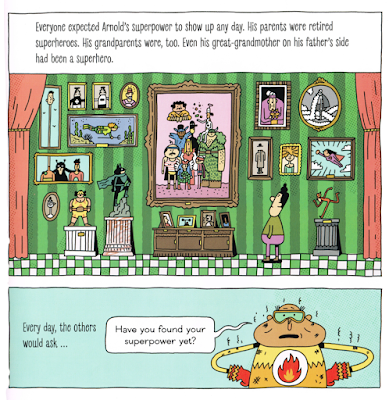
Arnold works in the family business, and that business is one of superheroes. They are superheroes like his super strong cousin and his super fast brother and his super bouncy uncle. But Arnold doesn't have a super power, yet, so, as they all wait for it to show up, Arnold is their phone guy.
From Arnold the Super-ish Hero by Heather Tekavec, illus. by Guillaume Perreault
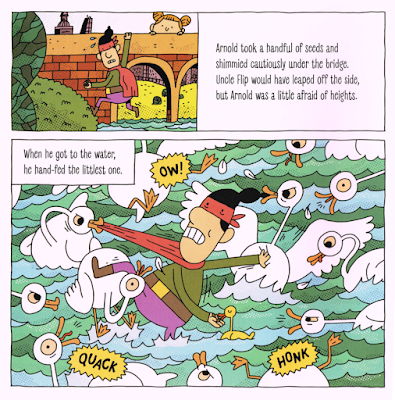
Then a call comes in for a superhero and no one responds when Arnold sounds the alarm. So, determined to follow the family motto of "Stop the bad guy from being a bad guy," Arnold dusts off his great-grandmother's mask and cape to find the crime. But just getting to the crime scene becomes problematic. As he speeds to the scene, as best he can after taking the bus, he comes across situations he misinterprets. A young man yelling at a woman in a wheelchair is actually a grandson trying to tell his grandmother who has lost her hearing aid to keep her hands off the tires so he can push her safely. Arnold's solution of giving the woman a stray kitten to hold works miracles for the grandson, grandmother and even the kitten. He sees a little girl throwing things in the water until she reveals she's trying to feed a baby duck before the more aggressive adults get the food. Arnold comes to the rescue again. 
From Arnold the Super-ish Hero by Heather Tekavec, illus. by Guillaume Perreault
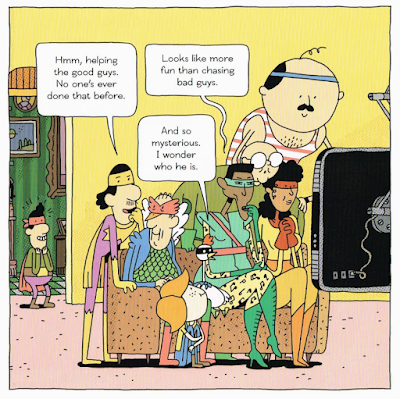
When Arnold finally gets to the called-in crime scene, he realizes that he can use his phone message-taking skills to good use to solve the problem and make two little girls very happy, with one declaring him a super-ish hero. After a few more good deeds, Arnold returns home to witness his efforts lauded on TV, with his family unaware that the Super Nice Guy superhero was their own family member. And that's a secret he's happy to keep to himself. (Oh, look, another superpower: keeping secrets!)

Kids love the idea of superheroes who can do beyond the norm, usually to fight crime and evil. But, if the past two years have shown us anything, it's that heroes come with all kinds of abilities, and goodness and kindness may be the greatest of all of these. As such, BC's Heather Tekavec has given us a humble character in Arnold, one who just wants to emulate his superhero family, but learns unintentionally that kindness is his strength. Even without trying for the spotlight, just stopping to offer assistance wherever help is needed, Arnold has become a hero. He's every guy and, with him, Heather Tekavec has shown us that anyone can be a hero.
From Arnold the Super-ish Hero by Heather Tekavec, illus. by Guillaume Perreault
Quebec illustrator Guillaume Perreault gives Arnold a banal look that works with the common person image. Except for a top-knot, there's not much to distinguish Arnold from anyone, including the reader. He doesn't stand out except when he does something kind. Guillaume Perreault may make Arnold's family members unique in their dress and skills but he makes Arnold stand out for his originality. In fact, Guillaume Perreault gives the whole book an understated feel with his choice of colours-no emphasis on bold primary colours–and blend of picture book illustrations with graphic novel boxes. Unlike most comic books about superheroes that bombard you with flash and action, Arnold the Super-ish Hero has the same restrained and easygoing appearance as does Arnold himself.

With a message that kindness is a superhero talent available to anyone, even Arnold, young readers will cheer for him and anyone who does good, knowing that the goodness comes in the doing, not from the recognition or the celebrity.

June 07, 2017

Different? Same?

Written by Heather Tekavec
Illustrated by Pippa Curnick
Kids Can Press
978-1-77138-565-7
32 pp.
Ages 2-6
May 2017

Maybe it's not really a book genre but I would call Different? Same? an interactive non-fiction book.  It's the kind of book that encourages young children to voice their observations in answer to the simple questions "How are these animals different?" and "How are these animals the same?"  And it's a lovely way of emphasizing the commonalities of animals while still appreciating the diversity of species that populate our world.
From Different? Same! 
by Heather Tekavec
 illus. by Pippa Curnick
For each double-spread, a series of animals are differentiated by their motility, habitat, textures, colours, sounds and other physical and behavioural attributes.  But a final statement at the bottom right corner instructs the reader to "But look closer now..." before sharing the similarity of note for that set of animals.

A final double spread illustration invites readers to seek other similarities, such as spots and webbed feet amongst the forty animals–insects, birds, amphibians, reptiles and mammals–depicted in the artwork.  It becomes a find and seek adventure for children, whether they read the book themselves or not. And, if they want to learn a little more, a note at the conclusion called "Why Animals Have the Characteristics They Do" clarifies the functionality of the characteristics noted, turning Different? Same? into a more serious science book for older readers.
From Different? Same! 
by Heather Tekavec 
illus. by Pippa Curnick
Heather Tekavec has published ten previous children's volumes including the popular Stop, Thief! (Kids Can Press, 2014) but this is her first non-fiction book. Still she retains her lively writing by turning Different? Same? away from pure information text and into a book of discovery.  UK illustrator Pippa Curnick furthers that intent with her amusing animals from all levels of the classification hierarchy.  All and all, Different? Same? shows us how distinct the animals in the world are while celebrating common ground, a lesson we should all accept and appreciate in our own world.