Showing posts with label quiet. Show all posts

June 03, 2022

When I Listen to Silence

Written by Jean E. Pendziwol
Illustrated by Carmen Mok
Groundwood Book
978-1-77306-254-9
32 pp.
Ages 3-6
April 2022
 
Listening to silence may seem like an oxymoron. After all, how can one hear the absence of sound? But Jean E. Pendziwol understands the distinction that is silence in our world and gives children a perspective on something which may often be lacking and underappreciated because it leads to greater voice and joy.

From When I Listen to Silence by Jean E. Pendziwol, illus. by Carmen Mok
As her mom struggles to work at the dining room table, a sight not uncommon to many during this pandemic, a child is asked to "Please, be quiet!" And so the child sits still and silent. But what happens when she's silent?
From When I Listen to Silence by Jean E. Pendziwol, illus. by Carmen Mok
First, she can hears that which would seem inaudible: the trees breathing. Not only do they breathe, they dance. And bears join them in the dance. But that awakens a dragon!
From When I Listen to Silence by Jean E. Pendziwol, illus. by Carmen Mok
The child is no longer just a listener; she is a participant. She is a musician, a passenger on a bird escaping the dragon's breath, and then on a steed with a knight flying to the moon. They cross an ocean of stars, end up on a pirate ship and have to be hushed by a pair of mermaids that look like her mother. Finally, the story comes full circle as it's time for the child to nap, with the whales, and she is compelled to ask her mother for quiet.

There is a profoundness and whimsy when you listen to the silence. It comes from heeding important messages about self and this child is able to take herself into her imagination with that silence. Jean E. Pendziwol shows young readers the wealth and breadth of play that can come from nothing but the imagination, when silence gives way to creativity and fantasy. Away from the noise of a TV, tablet or other riotous devices that take away the opportunity for self-directed play, this child grows and travels and experiences the fancies of being whatever she wants.
 
Carmen Mok's illustrations, rendered in gouache, India ink, dry pastel and colour pencil, take readers from the reality of an indoor room to the surreal of the forest of dancing trees and bears, across the sky and into space and onto the ocean, all from the perch of a child's imagination. The realism of a house with a mom on her computer with a cell phone at her ear, and a child playing with her toys on a window seat in her mom's view, is very honest and a foundation for the child's imaginative play. Her playthings become dancers, a mount and a pirate ship; stars, shells and plants in the decor become part of her landscape; and the toys like the drum and ukulele help her take part in her vision. Carmen Mok gives these imaginative scenes an ethereal feel, bright with the horn-playing moon, the shimmy of a river of stars, and the energy of a pirate ship resplendent in pinks and greens and yellows.  
 
Jean E. Pendziwol and Carmen Mok may show us that this child's play is all in her head but it's robust in colour, spirit and fancy. And it all comes from the power of silence.

March 30, 2022

Josie's Busy Calendar

Written by Jenn Wint
Illustrated by Allison Arndt
East 26th Publishing
978-1-955077323
42 pp.
Ages 3-7
October 2021
 
Like many children in Canada, Josie has had to endure the challenge of staying at home and away from school and friends and activities that have always added to her life. She has found many things to do, from creating art to running laps, watching TV to baking, but she misses her old life.
But, after weeks of playing on her own, Josie was officially lonely.
From Josie's Busy Calendar by Jenn Wint, illus. by Allison Arndt
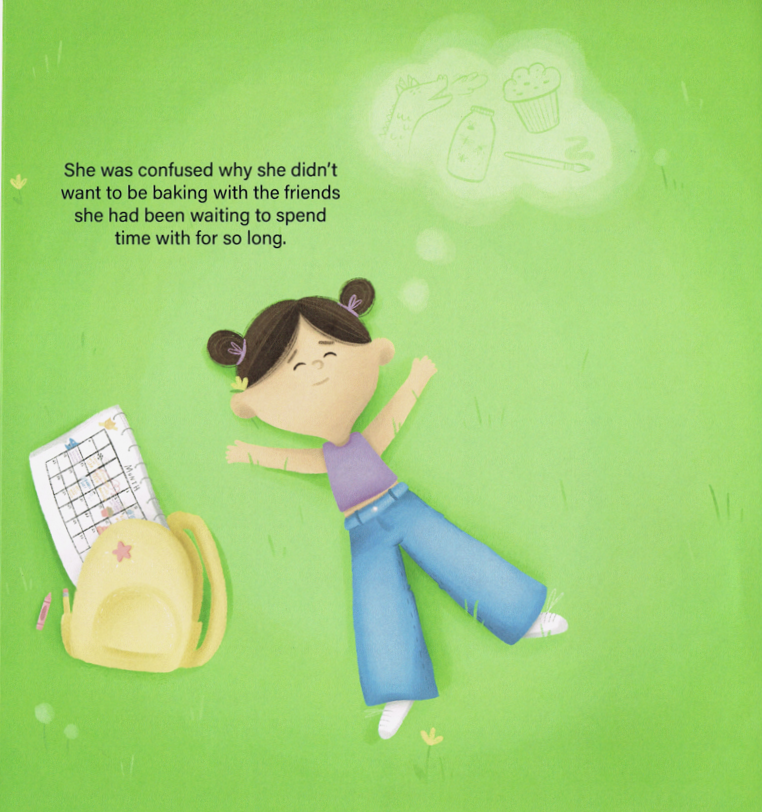
But, then things open up again and Josie is able to return to school. The little girl is thrilled. Once she reconnects with her friends, she is filling her calendar with play dates for soccer and baking, riding bikes and swimming. But, like anything, too much of a good thing can be just as onerous, and Josie finds that "her tummy was in knots" though she doesn't understand why.
From Josie's Busy Calendar by Jenn Wint, illus. by Allison Arndt
Realizing that she misses her alone time, Josie schedules herself into that calendar and finds that a balance of commitments to others and herself is what makes her feel calm enough to do it all.
From Josie's Busy Calendar by Jenn Wint, illus. by Allison Arndt
Vancouver's Jenn Wint knows that, like adults such as herself, children experience anxiety but probably don't understand it, and coming out of this pandemic–fingers crossed–there will be many children who have and will experience anxiety to some degree. After years of restricted social activities–a source of anxiety for some–many children will go overboard and want to do everything: sports, music, play, etc. But, if Josie’s Busy Calendar teaches us anything it’s that there is always a limit. Too little opportunity for interaction and activity is just as bad as too much. Down time is also important. In fact, for many, it’s the only means by which they can recharge to do those activities in the first place. 
From Josie's Busy Calendar by Jenn Wint, illus. by Allison Arndt
With Allison Arndt's whimsical illustrations, Josie comes across as a typical child whose life is filled with people and activities but who has learned to appreciate quiet time, whether it's for reflection, for the clean fun of bubble baths or creating art. So, for your children and your students, consider that busy calendar as a potential source of both fatigue and fun and schedule in some time for quiet, whether to look inward with self-reflection or to daydream about what could be.

August 30, 2016

Rhino Rumpus

Written by Victoria Allenby
Illustrated by Tara Anderson
Pajama Press
978-1-927-485-96-5
24 pp.
Ages 2-4
August 2016

Victoria Allenby and Tara Anderson, the author-illustrator duo who brought us Nat the Cat Can Sleep Like That (Pajama Press, 2013), have returned with another picture book for our littlest ones, this time focusing on the sibling antics of three rhinos as their mother attempts to bring them to some degree of harmony.
From Rhino Rumpus 
by Victoria Allenby, illus. by Tara Anderson
From page one, the three little rhinos are forever being unruly: rude, in a mood, tussling.  And Mama rhino has to interject and bring them in line.  Dinner time is not much different, and Mama sends them to get ready for bed.   Even bathtime (whose illustration is the “magic page” i.e., the cover art) involves a lot of pushing and boisterous escapades that Mama rhino rumbles to a stop with an emphatic “Quiet!”  Teeth brushing, a story and song, and a plea to “And when you wake, please get along!” signals the ultimate family hug and the blissful stillness that is sleep.

The text is perfect for toddlers who will delight in its simplicity and sounds, while those children who are just learning to read will be pleased to test themselves on the easy-to-read rhyming lines and repetition of numbers (e.g., One little rhino…, Two little rhinos…, Three little rhinos…).  I suspect that Victoria Allenby who dedicates the book to her nieces “who ALWAYS get along” has witnessed similar naughtiness but, by experiencing it with love and affection, she has given it a boisterous comic feel to it, something that will lighten the mood for any parent (or aunt!) who has to brave it and strive for calm.  Similarly, Tara Anderson, who dedicates the book to her own little one, animates the text with her coloured pencil illustrations that convey exuberance, joy, mischief and affection with each stroke.  Never is there anger or hostility between the siblings or directed at the little rhinos, and the message of patience in parenting is conveyed with fun and warmth and caring.
From Rhino Rumpus 
by Victoria Allenby, illus. by Tara Anderson
Rhino Rumpus will undoubtedly become the go-to book for families with young ones who get into squabbles, both for parents who need to recognize that children learn through play, even boisterous play, and for children who need to see that parental love is a gift that should not be overlooked, even if it does need a rest occasionally.
From Rhino Rumpus 
by Victoria Allenby, illus. by Tara Anderson