Showing posts with label Renné Benoit. Show all posts

May 25, 2020

The Haircut

Written by Theo Heras
Illustrated by Renné Benoit
Pajama Press
978-1-77279-095-6
24 pp.
Ages 1-3
May 2020

There's probably a lot of trepidation with respect to haircuts right now as many barbershops and salons are closed and people are taking on the task themselves. Fortunately, most of of have a history of haircuts and know what to expect, even if we ourselves don't know what to do. But imagine a toddler who has never had a haircut. That first haircut can generate much confusion and even distress for the unknown but Theo Heras and Renné Benoit's newest picture book, The Haircut, will comfort any child and probably a parent or two, as a young boy is taken to the barbershop for the first time.
From The Haircut by Theo Heras, illus. by Renné Benoit
This little boy may not know he needs a haircut but he does notice how it falls in his face when he plays. Even as he tries to keep it out of his eyes, it again falls. No wonder it's decided that it's time for a haircut.
From The Haircut by Theo Heras, illus. by Renné Benoit
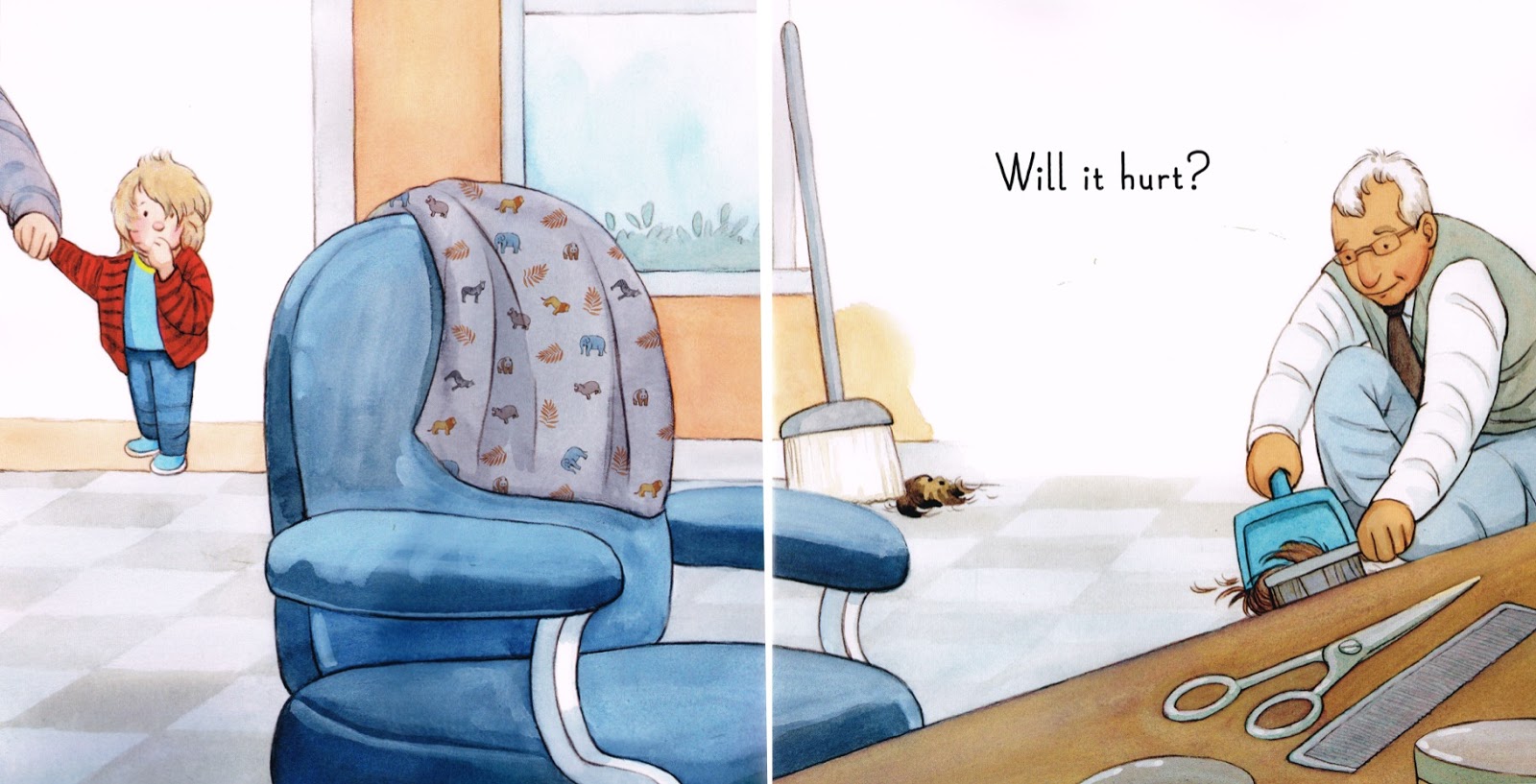
Off goes child and father hand in hand to the barbershop marked with its red, white and blue pole. Of course the boy wonders if it will hurt. There are after all dangerous scissors involved. But, with an animal print cape, a chair that goes up high and his dad holding his little hand, the child is reassured, especially when he gets a lollipop and no longer has long hair getting in his eyes.
From The Haircut by Theo Heras, illus. by Renné Benoit
What a wonderful book to read with toddlers (and then get them reading for themselves) who will be experiencing their first haircut. It speaks to them, not their parents who think their hair is too long or wants it styled or thinks it's time. It's time because the little boy's hair keeps falling in his eyes and gets in the way of his play. He knows it's not convenient so they know it too.

Theo Heras, along with illustrator Renné Benoit, has taken children through a number of common childhood experiences (e.g., Hat On, Hat Off; Baby Cakes; and Where's Bunny?) in these uniquely presented books. The padded cover with rounded edges and extra-heavy pages are far nicer than board books usually aimed at the youngest of readers and are a treat to handle and to read to young children. The Haircut is similarly comforting and informing. That book cover portrait that focuses on the child and his glorious tresses and doubtful face invites the reader in, and Renné Benoit's watercolour and digital illustrations are similarly engaging, both uncluttered and complete. Like Theo Heras's words, Renné Benoit has illustrated The Haircut for the young child, though everyone can appreciate the book.

Whether a parent wants to help a child to prepare for that first haircut or to reminisce about that first experience, The Haircut is there for an snuggly read.

March 12, 2018

Where's Bunny?

Written by Theo Heras
Illustrated by Renné Benoit
Pajama Press
978-1-77278-043-7
24 pp.
Ages 1-3
March 2018

Author Theo Heras and illustrator Renné Benoit's very young brother and sister from Hats On, Hats Off and Baby Cakes have returned in a story about getting ready for bed and the routines involved with that evening ritual.

The two never-named children (making it easy for any and every child to see themselves in the story and embrace the routines of healthy bedtime practices) know it is time for bed and begin to fulfil their rituals as listed in a "Bedtime Checklist" posted on the book's endpapers. First, they pick up their toys and put them away. Though the text includes the question "Where's Bunny?" young readers will be able to spot the rabbit nestled in a wagon. Next, it's bath time with play time in the warm water that "tickles toes" alongside a rubber ducky and a squirty sheep before washing hair, towelling off and ensuring Bunny is nearby. He is. Then bedecked in the softest of hooded plush robes, the two brush their teeth whilst Bunny watches on. (A second checklist on the back endpapers provides links to dental associations for proper techniques.)
From Where's Bunny? by Theo Heras, illus. by Renné Benoit
Then it's pajamas on, into bed, storytime and singing a song, all only with the big sister (who can't be more than 5) helping her little brother. A final hug and kiss and little brother is off to dreamland snuggling his own soft charge to his cheek.

Theo Heras makes her text simple and readable for those just learning to decipher books, and it is sweetly appropriate for a concept book about bedtime routines. Many concept books tend to be flat, emphasizing only the concept in the simplest of texts. Thankfully Theo Heras does more than just assert a concept. There is a story here, one of sibling affection and a young child's bond to his stuffed animal, that is elevated with Renné Benoit's artwork. The children are so beautiful and angelic with their bright faces and cowlicked hair, and their surroundings are as soft and inviting to the reader as to the children. From Bunny with his carrot-topped hat and the towels and robes and bedcovers, Renné Benoit draws readers into the warmth of the children's home and lives and asks them to stay for a bit.
From Where's Bunny? by Theo Heras, illus. by Renné Benoit
Another invitation that is extended to readers comes by way of Pajama Press's unique picture book format for the very young: a padded cover with rounded corners, and extra-heavy paper. It has been a winner since its first use. More embraceable than the board books typical for the very young, these softly padded books make for a sweet tactile experience to reading. If the affection so captivated in Renné Benoit's watercolour and digital artwork could extend beyond the siblings, it would be sure to include their books. Like the words and the art of Where's Bunny?, the book says, "Hug me" and the very young will be sure to oblige at least once before lights out.
From Where's Bunny? by Theo Heras, illus. by Renné Benoit

November 10, 2017

Baby Cakes

Written by Theo Heras
Illustrated by Renné Benoit
Pajama Press
978-1-77278-030-7
24 pp.
Ages 1-4
October 2017

If Baby Cakes don't sound yummy enough, wait until you see Renné Benoit's illustrations of the children and kitten at play baking.  They are sweet and delightful and wholly scrummy.

From Baby Cakes 
by Theo Heras
 illus. by Renné Benoit
An older sister and little brother, with tuxedo kitten in tow, don their aprons, gather their ingredients and baking utensils and set to work.  Of course there are a few mishaps–there always are in the kitchen–of spilled ingredients but the two little ones seem to know what they are doing.  Measure, sprinkle, cream, wash, wash again, pour, blend, mix, fill and wait.  Except for brief appearances of a parent's hands to help out with a spill and to put the cupcakes in the oven, this story is that of the labours of the children and the kitten.  As should be, there is a tasty treat to imbibe in at tea time.

From Baby Cakes 
by Theo Heras 
illus. by Renné Benoit
Theo Heras, whose first book with Pajama Press Hat On, Hat Off (2016) was also illustrated by the wonderful Renné Benoit, reintroduces the sister and brother, slightly older now and able to take on a baking project with a little help from a parent. But Baby Cakes is still written for the very young, with Pajama Press' trademark padded cover and sturdy pages, and large bold font and simple sentences of only a few words.  I suspect that Baby Cakes could be the first book young children will be able to read themselves as the repeated readings by an older child or adult will enable them to remember the words and learn to match the visual with the sounds.  Learning to bake and read in one charming book.

But like so many picture books, it is the artwork that will captivate children and adults.  Renné Benoit's illustrations capture the innocence and earnestness of the very young and their efforts to undertake what must seem a monumental task.  The seriousness of their efforts does not take away from their delight in the work and the surprises that happen.  With a much-loved kitten, the children are bonded to their task and to each other, cooperating in their efforts and sharing in the fruits of their labours.  It's a warm scene of family that I wish could be experienced in every household.  Hopefully, Baby Cakes will compel that to happen in more.  With the recipes for chocolate and vanilla cupcakes, as well as vanilla frosting, on the endpapers, everyone and anyone can assist young children in baking some yummy delights, with or without a kitten to help.
From Baby Cakes 
by Theo Heras
 illus. by Renné Benoit

March 16, 2017

Hand Over Hand

by Alma Fullerton
Illustrated by Renné Benoit
Second Story Press
978-1-77260-015-5
24 pp.
Ages 5-8
April 2017

Alma Fullerton is becoming well known for taking young readers to other parts of the world to appreciate different ways of life.  There was A Good Trade (Pajama Press, 2012) set in Uganda; Community Soup (Pajama Press, 2013) which is based  in a school garden in Kenya; and In a Cloud of Dust (Pajama Press, 2015) which emphasizes the long distances Tanzanian children travel to school.  Now Alma Fullerton, with Renné Benoit’s soft illustrations, transports young readers to the Philippines in Hand Over Hand and takes up the cause of a young girl determined to not let her gender limit the life she wants to have.

It’s evident that Nina is expected to stay on shore and tend to racks of drying fish because she is a girl.
From Hand Over Hand 
by Alma Fullerton 
illus. by Renné Benoit
When she proposes to her grandfather, Lolo, that he take her out fishing in the banca boat with him, he scoffs at first.  But Nina is determined and insists she will bait her own hook and remove the caught fish.  It is obviously a milestone for the young child but one her grandfather accepts and even defends to the other fishermen who discount Nina.  However, though Lolo instructs his granddaughter in the art of baiting and jigging, demonstrating the hand-over-hand technique for drawing his line in, Nina is catching no fish.  When she becomes dismayed, repeating the other fishermen’s refrain that a girl can’t fish, Lolo shares the wise words, “Posh! The fish can’t tell you’re a girl.” Just when she is checking that the bait is still intact, she gets a tremendous tug on her line.  Nina, fearful she might not be strong enough to bring in the fish, almost gives it up to Lolo but he instead encourages her to use the hand-over-hand technique and persevere.

From Hand Over Hand 
by Alma Fullerton 
illus. by Renné Benoit
Hand Over Hand is a story of empowerment and determination when faced with naysayers and traditions that keep opportunities at bay.  Alma Fullerton’s simple story is loaded with lessons in seeing beyond gender, of courage to take on new struggles, both emotional and physical, and of the amazing things that can be accomplished with a supportive hand.  Even the other fishermen are surprised when they see the big fish little Nina brings in. The messages are evident but the context of Hand Over Hand is just as powerful, revealing the fishing traditions of the Philippines, as well as the stereotyping of roles that are being broken all over the world.  With a charming but realistic relationship between grandfather and granddaughter, Alma Fullerton encourages cultural competence amongst all readers.

Illustrator Renné Benoit whose artwork has garnered numerous awards and nominations (e.g., Proud as a Peacock, Brave as a Lion by Jane Barclay, Tundra, 2009;  The Secret of the Village Fool by Rebecca Upjohn, Second Story Press, 2012; A Year of Borrowed Men by Michelle Barker, Pajama Press, 2015) was the perfect choice  for Hand Over Hand.  Her watercolour and coloured pencil with pastels lend an airiness to the outdoor setting of sky and water, and an innocence to Nina and her endeavours.

Hand Over Hand has a purity of text and image that promotes an appreciation for another culture but it extends beyond by furthering the idea of gender equality, helping a little girl and her grandfather both see a new way of doing things.
From Hand Over Hand 
by Alma Fullerton 
illus. by Renné Benoit

September 13, 2016

Hat On, Hat Off

by Theo Heras
Illustrated by Renné Benoit
Pajama Press
978-1-927485-34-7
24 pp.
Ages 1-3
September 2016

If you're Canadian with young children, you know about that compulsory basket of hats (and mittens and scarves) by the front door from which appropriate outdoor apparel can be plucked before heading out. As this little boy is getting ready and gotten ready to go with a help of a older but still young sister, a menagerie of hats go on and off with every step of the process. Thankfully, judging by the illustrations by Renné Benoit, it's not even the depths of winter so hats are the only on-off selection for this child!
From Hat On, Hat Off 
by Theo Heras, illus. by Renné Benoit
A red bear hat goes on, a sweater gets hidden.  The red bear hat goes off as sister does up his sneakers.  Jacket goes on with a new fleece blue-striped hat with frilly red pom pom which gets traded for a penguin hat after a detour for a sippy cap and pail and shovel. But wait! Time for a potty break (and, of course, you must remove your hat when you go to the toilet, right?) and a new green hat with eyes.  Then the absentee Bunny, with his own hat, must be located, and our little one is back in his red bear hat.  That is, until he isn't.

An autumn day with colourful leaves dotting the ground and ripe for picking is a perfect day for sporting a great hat, even one that is probably mandated by a mum or dad. Theo Heras’ text is not complex but that makes it easy to follow for those for whom Hat On, Hat Off is written, and the book is appropriately packaged for them: small size with padded hardcover, thick paper and rounded corners.  Young children will enjoy anticipating the next hat on and off and spot the common tactics toddlers use to prolong that getting-ready-to-go-outside activity.  But I know they’ll especially be hooked by Renné Benoit’s endearing illustrations of the children and their accounterments, particularly the assortment of head gear.  With knitted caps of varying colours and textures (very important in a hat) and design elements, Hat On, Hat Off a joyful experience of style and taste and childish amusement.
From Hat On, Hat Off
by Theo Heras, illus. by Renné Benoit 

••••••••••••••••••••••••••••••••••••••

If you're in the Toronto area this Sunday, get a signed copy of Hat On, Hat Off at the book launch with author Theo Heras and illustrator Renné Benoit at Another Story Bookshop on Roncesvalles Avenue at Grenadier.  Details are here.

September 07, 2016

Hat On, Hat Off: Book launch (Toronto)

Grab your hat 
and 
head on down to the book launch of

Hat On, Hat Off
by Theo Heras
Illustrated by Renné Benoit
Pajama Press
978-1-927485-34-7
24 pp.
Ages 1-3
September 2016

on

Sunday, September 18, 2016

4 - 6 p.m.

at

Another Story Bookshop
315 Roncesvalles Ave. (at Grenadier)
Toronto, ON


What a great chance to share 
this fun rhyming book 

with
author Theo Heras 

and

illustrator Renné Benoit


About the book:
It’s time for this little one to go out. But which hat will he choose? Red hat, blue hat, striped hat, penguin hat, teddy bear hat? Once that decision is made, that hat just doesn’t stay on, while shoes are tied and jacket is buttoned. One more visit to the potty. And once this child is in the stroller at last, will that hat be on his head?

Toddlers will delight in choosing their own hats after they see this charming story. A simple, rhythmic text that reflects the everyday challenge of getting a toddler ready to go out. 
(Retrieved from http://pajamapress.ca/book/hat_on_hat_off/ on September 4, 2016.)


Look for my review of this baby-toddler gem within the week here on CanLit for LittleCanadians!

January 28, 2016

Clean Sweep! Frank Zamboni’s Ice Machine (Great Ideas Series)

Written by Monica Kulling
Illustrated by Renné Benoit
Tundra Books
978-1-77049-795-5
32 pp.
Ages 5-8
January 2016

It’s always a great day when another of Monica Kulling’s Great Ideas Series books comes out.  These illustrated biographies, enhanced with artwork by an assortment of talented Canadian illustrators, highlight key individuals whose innovations we have come to rely upon but about whose stories we often know so little.  There’s been George Eastman’s photography, Elijah McCoy’s invention for oiling train engines, Elisha Otis’ elevator, Margaret Knight’s paper bags, Lillian Gilbreth’s efficient kitchen, Marconi’s wireless and now an invention dearly loved by hockey fans the world over, the Zamboni invented by Frank Zamboni.

Opening with a poem called Bone Blades that emphasizes “a way to fly around, when ice is on the ground”, Monica Kulling takes young readers to the early 1940s when Frank Zamboni and his brother and cousin opened their Iceland Skating Rink.  Resurfacing the ice, while skaters waited, was a time-consuming endeavour of a tractor levelling out the pits and grooves, a crew shovelling away the shavings, washing the surface and then spraying with fresh water, and all before a gleaming finish was added by hot water.

Having learned to tinker with trucks and tractors on their Idaho farm and working at his brother’s auto repair shop in California, as well as studying at an electrical school in Chicago, Frank was a busy man, working with his brother Lawrence doing electrical work, drilling wells, installing pumps and then making ice for home ice-boxes.  It wasn’t a big jump to making ice rinks with the smoothest surfaces ever.

But it wasn’t until after the war that Frank was able to buy military parts that became the foundation for his ice-resurfacing machine and a version of his famous Zamboni machine was created.

Oh, how I wish that the Zamboni had been a Canadian invention.  It seems so quintessentially Canadian.  But Monica Kulling still makes the reader applaud for the innovation and brilliance of Frank Zamboni to find a ground-breaking solution to a common problem.  By sweeping in details about his early years and training, as well as family and engineering development, in addition to some Zippity Zamboni! fun facts appended to the story, Monica Kulling again demonstrates how extraordinary developments can arise from very ordinary circumstances.

Having Renné Benoit, whose artwork has graced award-winning picture books such as Lily and the Paper Man (2007), Proud as a Peacock, Brave as a Lion (2009), and The Secret of the Village Fool (2012) as well as the recent A Year of Borrowed Men (2015), do the illustrations for Clean Sweep! seems intuitive, as she creates memorable work that feels like old photographs from a bygone era.  Her colours and lines are soft and sepia-like, both light and substantial, depicting people and places of a different time so naturally.

Clean Sweep! Frank Zamboni’s Ice Machine is a fresh take on a historic innovation told simply but with sparkle by Monica Kulling and perfected by Renné Benoit’s art.

********************************************
I encourage teachers to consider using this wonderful series for teaching biographies to young children.  Clean Sweep! and others in the series demonstrate an innovative way to share someone’s life story without the boring parts that are so often embedded in the teaching of biographical literature.

Here is a complete list of Great Ideas Series books, including upcoming releases:


  1. It’s a Snap! George Eastman’s First Photograph (Tundra, 2009)
  2. All Aboard! Elijah McCoy’s Steam Engine (Tundra, 2010)
  3. In the Bag! Margaret Knight Wraps It Up (Tundra, 2011)
  4. Going Up! Elisha Otis’s Trip to the Top (Tundra, 2012)
  5. Making Contact! Marconi Goes Wireless (Tundra, 2013)
  6. Spic-and-Span! Lillian Gilbreth’s Wonder Kitchen (Tundra, 2014)
  7. Clean Sweep! Frank Zamboni’s Ice Machine (Tundra, Jan/2016)
  8. To the Rescue! Garrett Morgan’s Underground (Tundra, Jan/2016)
  9. Zap! Nikola Tesla Takes Charge (Tundra, Aug/2016)

December 02, 2015

A Year of Borrowed Men

by Michelle Barker
Illustrated by Renné Benoit
Pajama Press
978-1-927485-83-5
40 pp.
Ages 6-9
November 2015

Of course young readers will always hear of the brutality of war.  It's in the news, in video games, in the movies.  But picture books can illustrate the kindnesses shown during war, the ones that keep people from truly becoming barbarians.  A Year of Borrowed Men is one such enlightening and enlightened read that will touch young readers and the adults fortunate to find this book and share it with them, whether it be in classrooms or home.

Based on Michelle Barker’s mother’s childhood memories of Germany in the final year of World War II, A Year of Borrowed Men recounts the time when three French prisoners of war–Gabriel, Fermaine and Albert–come to live and help on the family farm.  Seven-year-old Gerda sees them as “borrowed men”, on loan just until the ones the German government borrowed from their community to aid in the war effort, including her Papi, are returned.

The family which includes Gerda, her mother, one brother and three sisters knows that they are supposed to treat the men like prisoners, forcing them to sleep in the area off the animals’ barn.  But Gerda comes to see the men as “our French family: gentle Gabriel, prickly Fermaine, and cheerful Albert, who loved games” (pg. 9).  Though trouble arises when the local police are notified by a neighbour of a simple kindness the family shows the men, Gerda and her mother continue to  interact with them in a familial way, seeking ways  to make their lives a little more pleasant, a kindness which they extend back to the Schottke family.

The story in A Year of Borrowed Men ends with the liberation of the “borrowed men” and their departure for home but the message that generosity of spirit goes on forever is a meaningful one at this time of year.  Released on Remembrance Day, A Year of Borrowed Men will be a valuable and touching read for years to come in classrooms commemorating those whose lives were touched by war.  But on the cusp of Christmas–also a memorable event in the story–A Year of Borrowed Men will speak to inherent kind-heartedness and be a reminder to demonstrate our humanity even in the most challenging of circumstances.   The potential, unspoken, that the Schottke family’s adherence to the golden rule of “Do unto others as you would have them do unto you” might extend to their own family members away at war, is undeniable.  But their charity to strangers in a time of war, when others only demonstrate anger and suspicion, is a worthwhile lesson in empathy.  Michelle Barker gets the tone right for this message, telling her mother’s story simply and forthrightly, as a child might see the circumstances.  The fear and confusion is there but it is superseded by a fundamental goodness to do what is right.  Look at Renné Benoit’s unassuming illustrations of this child, this farm, the men and relive a simple though still harsh time, when war was horrific but there was a gentleness that could still be found. Thank goodness.

April 06, 2013

The Secret of the Village Fool

by Rebecca Upjohn
Illustrated by Renné Benoit
Second Story Press
978-1-926920-75-7
32 pp.
Ages 7-10
2012


Any intelligent fool can make things bigger and more complex... It takes a touch of genius - and a lot of courage to move in the opposite direction.
E. F. Schumacher

We are all fools at one point or another so the antiquated idea of a village fool is and should be reprehensible.  But, as E. F. Schumacher recognizes in the above quotation, courage and genius can transform, as it does in Rebecca Upjohn's The Secret of the Village FoolIn the capable pen of award-winning youngCanLit author Rebecca Upjohn (The Last Loon, Orca, 2010; Lily and the Paper Man, Second Story Press, 2007), the true events upon which this picture book is based demonstrate the ignorance of prejudice and the courage of those who can see beyond it.

A sensitive man who talks to animals and plants and never eats meat, Anton is ridiculed for his weird ideas. But he recognizes kindness in others, like Milek and Munio's mother who sends food and clothes over to Anton who is poor.  He also sees the ugliness of those who warn him against fraternizing with Jews.  In World War II Poland, the fear of Hitler has many shunning their Jewish neighbours.  But not Anton.  He considers how to help them should the Nazis arrive in their village.

When the Nazis do arrive and they begin arresting Jews, targeting the boys first, Anton arrives at Milek and Munio's house with disguises for the boys. Later when whole families are being taken away, Anton keeps six of them hidden in his attic until an underground hiding place is constructed for them leading by tunnel from Anton's root cellar and by a shaft from Anton's bedroom.  Along with a young girl Ziphora and a family friend, Eva, the family hides away for months, enduring lice, dampness, hunger and cramped quarters.  Mama always reminds them of the risks Anton was taking daily to ensure their safety.  But, as Anton had always known, "Life is precious--every life."

With photographs, Rebecca Upjohn extends the story of Anton Suchinski and the Zeiger family to 1992 with Anton's official recognition as "Righteous among Nations" at the Holocaust Memorial and Museum in JerusalemThis recognition may have finally transformed Anton from village fool to village hero but his heart and valour have always identified him as a champion, choosing to live his life true to his heart, even when ridiculed.  The Secret of the Village Fool shows Anton to be not a fool, but an angel, especially to those whose lives he saved and to their children, grandchildren and others they were able to touch.  And to those of us fortunate enough to read this story. 

Thank you, Rebecca Upjohn, for giving life to this story and presenting it exquisitely, wisely tempering the horrors of a wartime genocide and human ignorance with Anton's compassion and wisdom and the learning that happens, so necessary for ignorance to be overcome.