October 16, 2023

A Green Velvet Secret

Written by Vicki Grant
Tundra 
978-0-7352-7012-1
256 pp.
Ages 10–14
March 2023

Twelve-year-old Yardley has a rather original family, and she wouldn't have it any other way. Her grandmother and best friend Gidge, a retired fashion design teacher, lives her life to the fullest, dressed and accessorized to the nines. Yardley's parents, Pa and Mima, run The Hoof & Mouth Theatre, along with performing in its productions. They all offer Yardley opportunities to be creative and independent and inventive in her dress and activities, though they wish she'd make friends with kids her own age. And then Gidge drops the bombshell that she has terminal cancer and is thrilled that she has been "given the chance to go out in my own perfect way." (p. 6)

Yardley is angry at her grandmother's attitude but agrees to help Gidge "get her karma in order." (p. 8) Two important tasks Gidge undertakes are the writing of numerous cards and letters, some to be sent immediately, others after her death, and sorting her diverse wardrobe for donation and consignment. With that intent, they head to the Over Easy Vintage Emporium, the shop of a former student, Conrad Kim. In between running errands that include chemo, Gidge and Yardley help out at Over Easy, along with Con's twelve-year-old nephew, Harris, a sullen boy who spends his time working on puzzles.
 
Then "Gidge's big day" comes, as she has elected for medical assistance in her dying. Her death hits Yardley especially hard, and she works at honouring Gidge's directive to "make the most of each glorious moment." (p. 75) Yardley continues to help out at Over Easy, feeling a special closeness to Gidge there, through her clothes, including a long green velvet dress which Gidge had said did not bring out the best in her. When an older woman, Mrs. Margaret Johnson, comes to the store saying she'd won a prize, and she's given the green dress, everything goes awry. Mrs. Johnson says the dress was hers and she doesn't want it; Yardley is convinced Mrs. Johnson is Gidge reincarnated; and Harris gets caught in the middle, even more so when he tries to hide a small ballerina that had fallen from the dress.

For a book about a death from cancer, A Green Velvet Secret is surprisingly light-hearted but that's because it's about life and living life and make the most of life. Vicki Grant always, always, always finds a way to put a light touch to her stories, whether they are dealing with hoarding (Betsy Wickwire's Dirty Secret), scammers (Short for Chameleon) or unknown heritage (Small Bones), finding a way to show compassion and affection and even humour in challenging situations. Like Gidge who takes a graceful approach to her cancer diagnosis and the opportunity to orchestrate her own death and tie up any loose ends she has left, Vicki Grant takes an elegant way to telling Yardley and Gidge's story, and even that of Harris whose own secret causes him shame and a disconnect with his family. Vicki Grant finds the colour in the greyness of death and, though Gidge couldn't make it all right in her lifetime, Vicki Grant helps make it all right for her and Yardley and even Harris, without giving us a predictable ending and the happily-ever-after that rarely happens.

October 13, 2023

Do You Remember?

Written and illustrated by Sydney Smith
Groundwood Books
978-1-77306-986-9
40 pp.
Ages 3-6
October 2023
 
Remembering someone who is gone, whether through death, divorce, or moving, is a mix of grief and comfort. It's remembering the good times but never forgetting that loss. Do You Remember? is the sensory experience of a young boy and his mother remembering times when his father was still with them.
From Do You Remember?, written and illus. by Sydney Smith
Lying in bed in the dark, a mother asks her son whether he remembers a picnic in a field. She recalls the bugs and snakes the child looked for, but he remembers the sweet berries. They continue to trade remembrances, always asking, "Do you remember..." He recalls when his parents gave him his bicycle and he lost control, falling into a haypile. Then she recalls "the rainstorm" of the hard rain and leaking roof, thunder and lightning, and then the loss of power which led to the burning of Grandpa's old oil lamp.
From Do You Remember?, written and illus. by Sydney Smith
With each memory, there is that beginning idea, and then a multitude of vignettes involved in that memory. Perhaps most significant for them is when they left their home behind, and travelled further than they ever had, and got lost. That's the memory but the vignettes shows us the boy's dad handing him a teddy bear through the truck's open window, then waving to them, and the child holding the bear as they enter traffic and get lost. The memory is not just one of leaving: it is one of carrying boxes, a dad's face, a dad's wave, the many cars, watching from the back seat, holding his bear, and then seeing the source of all those memories stacked against the wall in their new place. The bear, the oil lamp, the bicycle, the picnic blanket–they're all there.

But do their memories have to remain in the past? Or are there new memories to be made?

A memory may be but a moment in time but it's a complex amalgamation of spoken words, foods tasted, textures touched, emotions felt, and images processed. It's seeing and feeling everything and incorporating them into a memory. It could be a sad memory or a joyous one, but it's all wrapped up and available to return the one remembering to another time and place. But, as Sydney Smith demonstrates, these memories are just part of the whole, of the past and future, of good times gone and future experiences still to be had. And loss and pain can play with those memories. In the case of this child and his mother, there has been a separation of his parents, and the consequent moving to a new home. Whatever rift has contributed to his parents' separation, his mother encourages him to remember times with his dad. She has not put her animosity, if she has any, ahead of the needs of her child. Instead, she encourages him to remember and to share in his remembrances too. There is tenderness in their exchange, understanding that there may be hurt below the surface and caution to not create more discomfort. They are tentative but honest, and that sincerity obviously comes from love.

Sydney Smith's illustrations, primarily watercolour and gouache, show a sensitivity for what the family is going through while demonstrating the strength of connection between mother and child even under these circumstances. They neither ignore nor rail at their heartache for their losses of father, husband, home, and established family. They look back but still forward. There is darkness–they are speaking at night in bed in their new apartment–but there are moments of lightness both in the past and in their future–as the child opens the window to the light–and Sydney Smith gives them that in his soft and thoughtful art.
From Do You Remember?, written and illus. by Sydney Smith
Sydney Smith dedicates this book to his mom, and his words and art honour parents who must move forward with a different family configuration. This mother, and undoubtedly many others, had to find ways to help their children accept new circumstances while not giving up on everything from the past. They remember and are loving enough to ensure their children do too.

October 10, 2023

Shizue's Path

Written by Mark Sakamoto
Illustrated by Rachel Wada
HarperCollins
978-1-44346-459-8 
48 pp.
Ages 5-8
September 2023
 
You need to know your darkness to know your light.

This is a story from history of history. It's a history too many lived and one which should not have happened and should never happen again. Still, it is a story of resilience and courage that arose from discrimination.
From Shizue's Path, written by Mark Sakamoto, illus. by Rachel Wada

Shizue, now an elderly woman, welcomes her granddaughter to hear her story. Though her memory may be less than reliable about some things, Shizue remembers vividly her father heading out to fish and worrying about his safe return. He always reassured her.

When I am on the water, I am the water. I am clear. I am flowing. I am finding a path forward. Someday you will, too.

But then everything changes with the onset of World War II.

A war from far across the ocean washed up on our new country’s shore. 
First came the anti-Asian leagues and their protests. Then Japanese Canadians had their homes and businesses taken away and Shizue's family was relocated to the prairies. It was years before Shizue was able to return to school, and longer, not until after the war, before the family was able to return home. Still, it was not the same.
From Shizue's Path, written by Mark Sakamoto, illus. by Rachel Wada
Again, Japanese Canadians were being threatened, this time with deportation to Japan. Shizue, now a young woman attending the University of Toronto, finally saw that there were those, particularly Rabbi Abraham Feinberg, who would speak against the unfair treatment of Japanese Canadians and promote messages of peace, not hate. She took from them lessons of compassion and courage that set on her own true path.
From Shizue's Path, written by Mark Sakamoto, illus. by Rachel Wada
Mark Sakamoto, author of Forgiveness: A Gift from My Grandparents, an adult fiction book that won the CBC Canada Reads in 2014, has taken a personal story–that of his aunt–and made it one of calm triumph over adversity. Shizue learned well from her father about seeing her path, to follow "Shikata ga nai" (trans. "It cannot be helped; you must carry on.") and from others like Rabbi Feinberg to create her own ripples of courage and compassion, wisdom and goodness. The stories of Japanese Canadian internment are plentiful, each providing a different perspective and context–see Mira and Baku, Naomi's Road, Torn Apart: The Internment Diary of Mary Kobayashi, Vancouver, British Columbia, 1941 and Stealing Home for just four examples–and Mark Sakamoto gives us yet another one, taking young readers along Shizue's Path from childhood to young woman and grandmother. And he gives us her story with a poetry of depth of emotion and wisdom. He makes her story beautiful, even in its darkness, just as artist Rachel Wada does.

Vancouver's Rachel Wada's first illustrated book, The Phone Booth in Mr. Hirota's Garden (written by Heather Smith), won the Elizabeth Mrazik-Cleaver Canadian Picture Book Award for 2020, and her success with showing the weightiness of the story with the beauty of people and place is again evident in Shizue's Path. The gravity of Shizue's family's situation because of the anti-Asian racism and the lightness that comes with reading, family, and evidence of kindness are all demonstrated in Rachel Wada's art. She uses line and colour effectively to take us on that journey of adversity and comfort, through darkness into light, triumphant with wisdom and compassion.

Just as Shizue learned from her father and others about how to be resilient and show compassion, so will young readers for whom internment may or may not be an unknown concept. Shizue's Path demonstrates that Shizue could move through hardships and take important lessons from those who had the courage to share.

October 06, 2023

Mira and Baku

Written by Sara Truuvert
Illustrated by Michelle Theodore
Annick Press
978-1-77321-756-7
44 pp.
Ages 4-7
September 2023

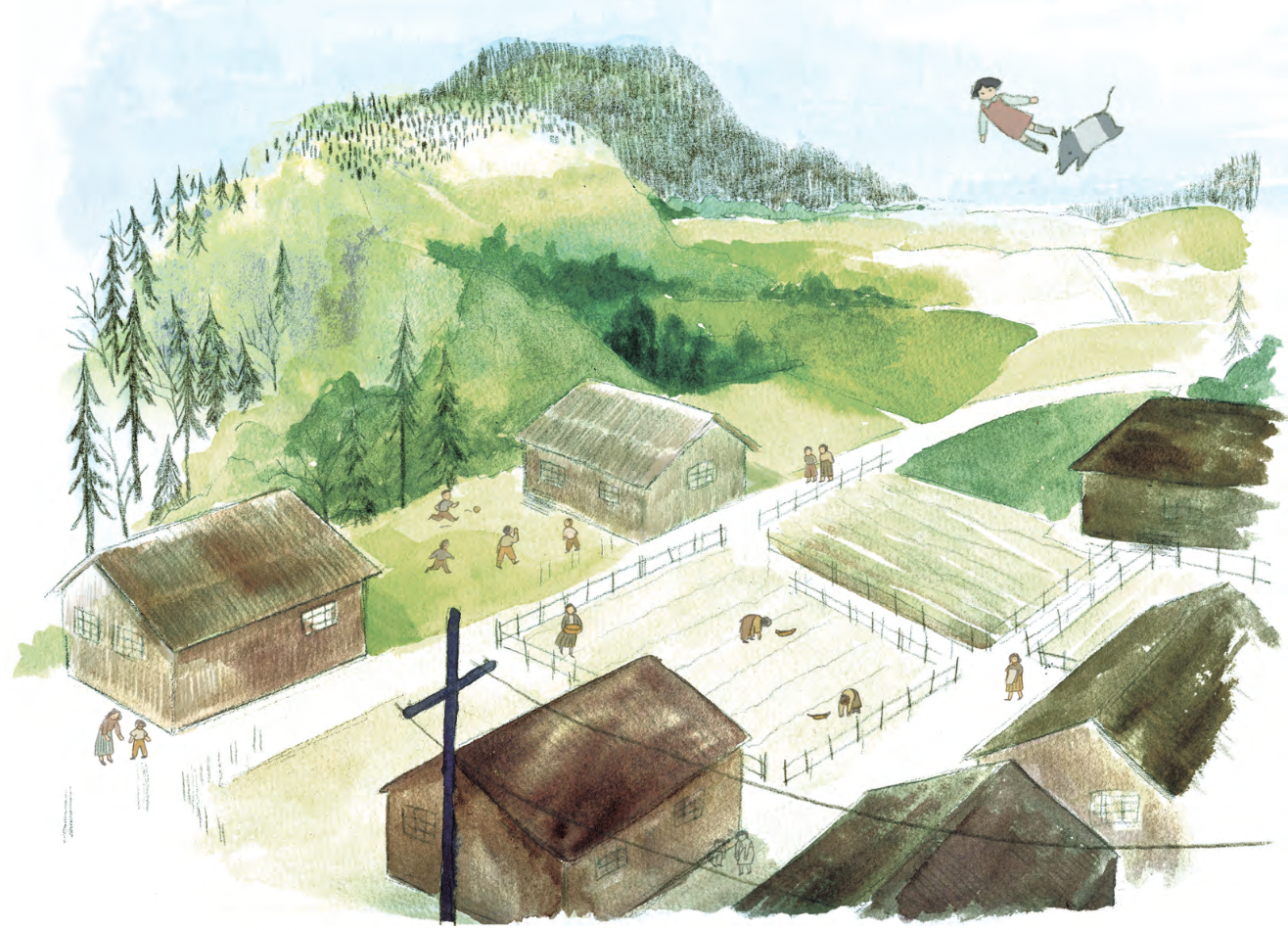
Mira can think of nothing other than her birthday is days away and her father is not with her and her mother. Will he miss her birthday for the first time ever? Perhaps with her imaginary friend Baku, a creature of Japanese mythology who is said to eat nightmares, Mira can find her father.
From Mira and Baku, written by Sara Truuvert, illus. by Michelle Theodore
But, as consequential as the issue of an absentee father is for a child, there is greater depth to Sara Truuvert's story because Mira and her mother are being detained at an internment camp. It's the 1940s when Japanese Canadians were forced to relocate, losing homes and businesses, and separating families. But Mira does not know all this. What she knows is that her father received a letter and then he was gone, and that Mira and her mother are now confined to an isolated community of internees, mostly women and children. 
From Mira and Baku, written by Sara Truuvert, illus. by Michelle Theodore
Still Mira holds on to the good things from before, especially the stones she and her father collected which she keeps in a sock. She remembers finding stones with him and the stories that came with them. There's the stone that turns green when wet that he'd melodramatically presented to Mira's mother. There's the glittery white one that came from a box of fresh salmon her dad was unpacking for his store.
From Mira and Baku, written by Sara Truuvert, illus. by Michelle Theodore
Worried her father has forgotten about her, Mira flies away with Baku to look for him. Together, she and Baku visit the family business, now deserted, and their old house. Disappointed in not finding her father, she begins to give up hope. And though she doesn't get exactly what she wants for her birthday, the day brings a surprise that reassures and reinforces the connection she has with her father.

Without making this a story of the Japanese internment, debut author Sara Truuvert has written a story that embodies the hardship and loss experienced by Japanese Canadians because of that unjust treatment. Sara Truuvert gives us the unique perspective of a child wishing to see her father on her birthday, as she always had, and coping with that anguish by creating an imaginary friend from a mythological creature. Baku, who is a hybrid creature of parts of an elephant, rhino, cow, bear, and tiger, allows Mira to speak her worries, feel her sadness, and imagine better. Baku gives her the opportunity to do something in a situation where she can do nothing. As such, Sara Truuvert's approach is sensitive and yet very complex, allowing Mira to be a child in a very grave situation and offer her hope through her imagination and memory.
From Mira and Baku, written by Sara Truuvert, illus. by Michelle Theodore
 That sensitivity is seen in the illustrations of Edmonton artist Michelle Theodore, who gives us the historical perspective of the internment, both of the camp where Mira and her mother live, as well as the work camp where her father has been incarcerated, and reminiscences of the family's life before internment. Memories from before are presented in pale yellows, appropriate considering how faint they might seem to Mira. The camps themselves are dreary and utilitarian, and Michelle Theodore keeps the best for the world outside the camps and for Mira's stones. The forests over which Mira and Baku fly are green and lush, and her stones are multicoloured. Within those elements, there is true spirit that will vitalize Mira, with a little help from her imaginary friend who is both soulful and calming.

Sara Truuvert provides an author's note that delves into the internment of Japanese Canadians as well as an appeal to reject fear of those who are different. With Mira and Baku, Sara Truuvert and Michelle Theodore give young readers an opportunity to see the misjudgments from our history and how children may be impacted. They also offer the promise that relief can come in an unexpected form, including imaginary.

October 04, 2023

We Belong Here: Interview with author Frieda Wishinky and illustrator Ruth Ohi

We Belong Here
Written by Frieda Wishinsky
Illustrated by Ruth Ohi
North Winds Press (Scholastic Canada)
978-1-4431-9403-7
32 pp.
Ages 6-8
October 3, 2023
 
 
Yesterday, I had the pleasure of reviewing an important picture book, We Belong Here, about intolerance and kindness. Today, I have the good fortune of sharing with readers a bit more about the book and the creative process through this Q & A with its author Frieda Wishinsky and illustrator Ruth Ohi.


Helen Kubiw:  Whether it be the 1950s, the setting for We Belong Here, or now, there are always those who distrust others who are different, whether in their appearance, their cultures, their faith, language, or something else. Why do you think this still hasn’t changed?

Frieda Wishinsky:  That’s an important question. I think some people are afraid or uncomfortable with anyone who is different because they haven’t had the experience of getting to know them. I grew up in New York City where there were always people around from different cultures and backgrounds. I felt comfortable and curious about that difference. I loved the diversity of food, customs and experiences but I think that some people who live in places which lack diversity, feel afraid of what and who they don’t know.
 
Ruth Ohi:  We have a long way to go, but I feel it has changed: I believe there’s been progress. I’d like to see the interest in making things better continue to grow the way I think it already has.


HK:  I suspect those children who demonstrate intolerance, including those in the book, are often doing so from observing their own families expressing that same bigotry. While We Belong Here demonstrates the value in getting to know those who are different, how do think it’s possible for those children to rise above their learning when they’re seeing the worst at home?
 
Frieda Wishinsky:  I hope this story and friendship of Eve and Mark will help kids and their families appreciate that although we are different, we are also alike. No one likes being called mean names. Everyone wants to feel appreciated. And being in touch with people from different cultures makes life richer and better. Being open to change and new people makes us less fearful and happier. 


HK:  The note at the end of the book suggests that the book came about through discussions that you had about your family histories. Once you decide that this was going to become a book, how did the collaborative process work?
 
Frieda Wishinsky:  Over two years ago Ruth and I had coffee and shared our family histories. We talked about how Jewish and Japanese people faced discrimination after the war. I said, "If I can figure out how to write that theme of connection and help as a picture book, would you illustrate it?”  Ruth said yes. Now all I had to do was write the story. Not so easy! The story couldn’t be about adults. It had to focus on kids.
     It took me over a year and a half to figure out how to create a story about two kids from different places and cultures who help each other in difficult times.
     When I finally felt pretty good about my text, I passed it on to Anne Shone at Scholastic. Anne had worked on many books with both Ruth and me. Anne liked what I’d written but made some suggestions. After more revision, the text was approved by everyone at Scholastic. Ruth could now begin to illustrate.
     I didn’t see the story with its art till it was almost a finished book. Ruth and I did have a few discussions about historical accuracy, tomato sauce vs. beets, and adding in a carved wooden sculpture but we worked separately.
     Seeing the finished book was a delightful surprise. I loved how Ruth added evocative and touching art to the story and theme. I think her art highlighted and elevated my words. 

Ruth Ohi:  Once Frieda’s manuscript was accepted by Scholastic Canada, she and I communicated through our editor, Anne Shone. I read the text many times so that the characters could move about in my imagination for a bit. I then created page breaks and tiny thumbnails to see how action and pacing could work. I researched the 1950s to immerse myself in the time and sent research elements and resulting rough layouts to Anne. Sketches were drawn and redrawn many times with feedback, until approvals were given to begin final art.
Rough sketch by Ruth Ohi from We Belong Here

 
HK:  I appreciate the fact that both of you were able to contribute familial background history to the story of We Belong Here. I like that, by bringing the two together through Eve and Mark, you were able to produce a story of discrimination defeated by kindness. But, in your own family stories, did kindness always conquer the unfairness of intolerance?
 
Frieda Wishinsky:  During the early days of World War Two, my mom met the wives of two Polish Generals when they were all jailed by the Russians as political prisoners. (My mom’s offense was a German sounding last name) These women, Yadviga and Zhosha, treated my mom as a sister, although they came from different religions and backgrounds. The three of them helped each other survive the harshness of a Russian prison for two years. Yadviga and Zhosha also promised my mom that if they were released, they would make sure she was released too. When the Russians changed their political alignment, the Polish women were released, and they got my mom out of jail the next day. Yadviga and Zhosha then opened a children's home in Russia for kids whose parents had been sent to Siberia. My mom worked there till the end of the war.  My mom was a natural storyteller and told me what happened to her in those terrible years. I never forgot the kindness and humanity of these two women.
 
Ruth Ohi:  My Dad was one of the first Japanese Canadians to be allowed to teach in Toronto. He was also a guidance counsellor. Leafing through photos, he’d tell me stories about his wonderful students and the staff that he worked with then and throughout his career.


HK:  How much of the story includes actual events that took place, like the shop, the rock, and the taunts, and how much is fictionalized but based on stories told within the family?
 
Frieda Wishinsky:  The core of the story, that a Jewish family helps a Japanese family, is true. The rest is fiction. We did incorporate elements from our lives in the book though. For example, I was an imaginative kid who loved climbing up on some rocks in a NYC park. My dad carved a beautiful crane out of wood. My dad was a baker and made rugelach.


HK:  For each of you, what was the hardest part of creating this story?
 
Frieda Wishinsky:  The hardest part for me was taking a true story and a general theme and creating a picture book that was universal and kid focused.
 
Ruth Ohi:  One of the hardest parts for me was also one of the most interesting as I had the chance to research the 1950s: fashion, cars, buildings, packaging, life in general. Anything I illustrated needed to actually exist. Everyone helped: Frieda sent family photos, my art director Andrea sent some men’s hairstyles, and Anne found a cake plate that inspired a spot illustration.


HK:  While many of your picture books, like Fox and Squirrel have important messages about compassion, empathy, emotional support, your books generally have a light-hearted innocence to them that veils those important lessons. How did you approach illustrating We Belong Here knowing that a story of children coping with discrimination could not be couched in sweet and colourful animal characters?
 
Ruth OhiI think Frieda’s story has a sweet innocence as well. My author/illustrated picture books have a lot in common with We Belong Here as they tend to focus on the role of empathy. When finding friends who look different from you, it doesn’t always matter from a young child’s perspective whether it’s an animal or not. I love that there are so many different ways of viewing the world for a child to choose from. My book Scribble is a celebration of what makes us different. Three very different looking shapes (Circle, Square & Triangle), with the help of a non-shape friend, discover how much you can accomplish using your differences. Fox and Squirrel is a celebration of what makes us alike. The series is based on two very physically different animals who discover that they have a lot in common i.e., they both need to eat and sleep and like to play.
     Looking back, I think my author/illustrated stories reflect my childhood – someone who looked very different from everyone else in their class (I also wore a metal back brace for over four years for my scoliosis) and was figuring out their place in the world. I never set out to teach a lesson when I write a story, but do enjoy hearing that they help kids and spark conversations about empathy.


HK:  I know that We Belong Here is not your first picture book of a fictional account of a historical event. Your own Kenta and the Big Wave (2013) deals with the 2011 earthquake and tsunami in Japan, and Joy Kogawa’s Naomi’s Tree (2008) deals with the internment of Japanese-Canadians during WW2. How do you approach illustrating a book of historical relevance and are there certain challenges you need to address?
 
Ruth Ohi:  Like Frieda’s story, research was required for both. The interiors and houses in Kenta and the Big Wave came from photos taken during my visits to Japan with my Dad and then later with my husband and my own kids. Kenta’s dog is the Ohi’s Shiba Inu that my daughters got to walk. It was an honour to illustrate for Joy and great to finally meet her at the launch, do a library session together and hear her say that she loved my illustrations. She is so gracious and kind. I feel very lucky in the authors I’ve been able to illustrate for.


HK:  I had thought it was unusual for an author and an illustrator to query a book together (unless the author is the illustrator). How did you get the publisher to accept a submission with both text and illustrations?
 
Frieda Wishinsky:  We were lucky that we’d both published a bunch of books with Scholastic and we’d both worked with Anne Shone. Scholastic knew our work and we were happy this story resonated for them. Plus it’s great that I’m Jewish and Ruth’s background is Japanese so we could bring each of our cultures into the story authentically.


HK:  Do you see a follow-up book or perhaps a companion book that takes the perspective of an older Eve and Mark as teens or as parents themselves, or perhaps a story of a different kind of discrimination experienced by others?
 
Frieda Wishinsky:  I hadn’t thought of a follow-up book, but I’d love to do another book with Ruth. Now all I have to do is think of a story that she might like illustrating!
 
Ruth Ohi:  I’d love to illustrate another Frieda story. Anyone who gets to illustrate one of her manuscripts is very lucky indeed.

• • • • • • •

Many thanks to 
author Frieda Wishinsky and illustrator Ruth Ohi 
for the privilege of asking them questions 
about their new book We Belong Here
As a story, it has great depth in its history and its lessons, 
and both Frieda and Ruth have brought insight and heart to it.
I hope this interview shares all that with you, my readers.

• • • • • • •

October 03, 2023

We Belong Here

Written by Frieda Wishinsky
Illustrated by Ruth Ohi
North Winds Press (Scholastic Canada)
978-1-4431-9403-7
32 pp.
Ages 6-8
October, 2023  
 
Eve Bloom hated being called a greenhorn especially since, although she'd been born in another country, she'd lived here since she'd been little. She often found solace, and the privacy to cry, at a special place on a high rock in the park.
From We Belong Here, written by Frieda Wishinsky, illustrated by Ruth Ohi
When a new boy, Mark Nakamura, comes to her school, he is ridiculed for being Japanese. Eve goes to his defense to stop the bullies and takes him to her special rock. In gratitude, he gives her a small turtle he'd carved. Together the two enjoy imaginative storytelling and talk about their families. They became fast friends, spending time at the back of Eve's parents' store, Bloom's Delicious Foods, and at Mark's apartment. 
From We Belong Here, written by Frieda Wishinsky, illustrated by Ruth Ohi
But then Mark's father, a craftsman with wood, loses his job at the factory because a customer didn't want a Japanese man to make his furniture. Moreover, Eve's parents are shaken when a faulty shelf almost injures a customer who threatens that no one will shop there with a new market opening nearby. By bringing their families together, both the Blooms and the Nakamuras get what they need: support, work, customers, and the welcome that says they are appreciated in their community.
From We Belong Here, written by Frieda Wishinsky, illustrated by Ruth Ohi
We Belong Here may seem like a simple story of children and families of two different cultures, Jewish and Japanese, helping each other to be accepted by their community. But, because of Frieda Wishinsky and Ruth Ohi's back stories, We Belong Here is a much bigger story and one of great historical and contemporary relevance. The need to belong and be accepted is universal. And to not be accepted because of arbitrary qualities like place of birth, religion, language, physical differences, and such is unacceptable. But, differences are what create us and bond us. They improve our lives by opening our minds and our hearts. And with that comes understanding, compassion, and harmony. When Frieda Wishinsky and Ruth Ohi brought Eve and Mark and their families together, they could confront the prejudice both head on and discreetly. Whether challenging those who mistreat a classmate or supporting someone by hiring them for a work project, these efforts remind everyone that strength and courage come with compassion, not force.

This is a story borne of deeply personal stories. As readers will learn tomorrow in my interview with Frieda Wishinsky and Ruth Ohi, their connections are very real and make the story even more personal. But the way they tell the story, readers will not be left with remembering the nastiness but instead smell the rugelach in Eve's family's store, feel the smoothness of Mark's carvings, and appreciate the coming together of people to shop, to work, to play. Through Frieda Wishinsky's sincere words, I hear friendship, and through Ruth Ohi's art, I see kindness in a different time. Together they are melded into one story, one lesson in compassion, and one to uplift and reassure that intolerance can be overcome.
 
• • • • • • •
 
For a little something extra about We Belong Here, check back tomorrow for my interview with author Frieda Wishinsky and illustrator Ruth Ohi.
• • • • • • •

September 29, 2023

Salma Writes a Book

Written by Danny Ramadan
Illustrated by Anna Bron
Annick Press
978-1-77321-803-8
120 pp.
Ages 6-9
 September 2023
 
Young Salma, whom we first met in Danny Ramadan and Anna Bron's first picture book Salma the Syrian Chef, is pretty excited to finally meet her uncle, Khalou Dawood, who'd left Syria before her own family to attend university in Toronto before moving to Vancouver. Now he's come to visit, and she is thrilled. But when Salma asks why he has never visited before, things get very tense, and Mama says they will not talk about it.
From Salma Writes a Book, written by Danny Ramadan, illus. by Anna Bron
Though he does not stay with them, her khalou takes her for outings and plays with her, and when her mother has a dizzy spell and Salma is worried, she calls Dawood who comes to help. He is a supportive younger brother, and Salma hopes she'll be a good sibling too when she learns her mother is expecting a baby.

Salma is determined to learn the right way to be a big sister and so she decides to do her research and write her own book titled, "Salma's Guide to Being The Best Older Sibling Ever." Not only does she need to learn how to write a book, but she must also find out from her classmates what is important about being a sibling. But Salma is confused when she sees her mother and her uncle interact. They seem to be close, but Salma wants to know why they have not visited before. Then Mama gets angry when Dawood brings his husband Michael to Salma's apartment for Eid al-Adha dinner. Michael choses to leave, as does Dawood, and Salma is perplexed. 

After a fiasco with her friend Riya's mother's shawl, which the girls cover up, Salma is convinced she doesn't know anything about being a sibling.
She has to learn how to make the right decisions, and how to teach her sibling the same. She has to learn how to guide her sibling, and how to be a role model. And worse of all, she still doesn't know when it is okay to be mad at your sibling, or how to fix things after a fight. (pg. 69)
It's only by understanding their mistakes, that Salma, and even her mother, can move forward and become the siblings they want to be.

While I don't know how many bits of writer Danny Ramadan's own story are the basis of Salma Writes a Book, I do know that there are lessons here that we all need to learn. From understanding "how confusion and fear can lead to mistakes" (pg. 81) and that sometimes it takes time to resolve them. It can mean reconciling confusion between what we've always been told and a new perspective. It could mean taking responsibility and fixing things. It could mean apologizing. Danny Ramadan makes us realize that mistakes can be little things or big things but fixing them is always worthwhile. And by helping Salma see the breadth of mistakes that can be made, from damaging someone else's property, to lying, or to being rude and intolerant, Danny Ramadan has given her opportunities to learn about correcting mistakes and hopefully help her become a more compassionate and supportive older sibling.

Though an early reader with fewer illustrations than Salma's first book, Salma Writes a Book still has more than two dozen black-and-white illustrations by Anna Bron that show us the extent of Salma's experiences, with meeting her khalou and his husband, interviewing her peers, struggling to write, and being part of her family. Young readers will appreciate seeing Salma in all her joys and frustrations, knowing how she might feel as she struggles trying to learn and understand through her own confusion and fears. Fortunately, with a fourth Salma book slated for 2024–Salma Joins the Team–we won't need to wait too long to learn the lessons Danny Ramadan has had Salma learn so that she might be a fabulous big sister to baby Nora.

• • • • • • •

Salma the Syrian Chef (2020)
Salma Makes a Home (2023)
Salma Writes a Book (2023)
Salma Joins the Team (coming in 2024)