February 02, 2023

The Grace of Wild Things

Written by Heather Fawcett
Balzer + Bray (HarperCollins)
978-0-06-314262-6
360 pp.
Ages 8-13
February, 2023

Grace Greene, who has been raised in the Rose & Ivy Home for Unwarded Children in Charlottetown since being abandoned by her parents, is determined to find a home with the witch who lives in the woods at Brook-By-the-Sea. The freckled twelve-year-old with a great imagination and love of words and reading is sure the witch will help her develop her own magical gifts. Grace just needs some guidance, especially as she is convinced she is the bad kind of witch because she can make people's see their worst memories. Though the witch, known to her neighbours as Miss Evelyn Puddlestone, is reluctant to have anything to do with Grace, she gives in when Grace shows some skills. She agrees to train Grace if the child can prove her gift is great, casting every spell in the witch's grimoire before the next blooming of an old cherry tree in spring. That leaves the child only nine to ten months to cast one hundred and a half spells or the witch would claim of all Grace's magic for her own.

With her poetry-loving crow Windweaver and the accidental help of a fairy she calls Rum, Grace begins to make herself at home at the witch's cottage. She is befriended by Sareena Khalil who lives at the farm next door with her parents and four-year-old sister invisible-pretending Daisy Bean. With the help of the children, her crow, and the fairy, Grace begins to make her way through the challenging grimoire. 

But, like a famous red-haired orphan of PEI to whom Heather Fawcett pays homage, Grace runs into trouble time and time again. She always intends to do good and behave but her temper sometimes gets the better of her, especially when she is criticized for her looks or behaviour. There's the snarky Mrs. Charity Crumley upon whom she spills ice cream that is now milked from their cow. There's the bully Poppy whom Grace goes after for making younger children cry. And there's the unfortunate brewing of a potion that spills on Sareena and leaves her drunk. 
 
Still, Grace is tenacious about making a home for herself at Brook-By-the-Sea. With her big heart and good intentions like helping heal the ill witch and deal with a woman claiming the witch as a squatter on her land, Grace has much work ahead of her.

For fans of Anne of Green Gables, the story of The Grace of Wild Things is rich with familiar elements of L. M. Montgomery's classic novel of the PEI orphan looking for a true home. She's freckled and imaginative, talkative, passionate, and sensitive. She has altercations with a local busybody, puts her friendship at risk by accident, and makes a friend of a former bully. But The Grace of Wild Things is much more than just an homage to Anne of Green Gables as those unfamiliar with the classic Canadian novel will instantly recognize. Heather Fawcett writes a fantastic story of magic, challenges, friendship, and home. The writing is superb, eloquent in its heart and richness of language.
Do you think one can have too much imagination? It seems to me it's rather like having too much lemon shortbread or too many flowers in your garden. After all, if you have too little imagination, you'd spend your life finding fault with everything, like Mrs. Spencer does, instead of noticing that there are beautiful things in the world alongside the horrible ones. (pg. 17)
Heather Fawcett, the acclaimed author of The Language of Ghosts and Ember and the Ice Dragons, blends fantasy with the mundane and creates a world in which an orphan seeks home and magical guidance. Forget the parallels with Anne of Green Gables and you still have an extraordinary story of courage and friendship, albeit swaddled in magic. With complex characters who are neither good nor bad and whose demeanours speak of human frailties and strengths, Heather Fawcett helps readers see themselves in those characters. Grace's story may be her own–unique from Anne herself–but, like the rest of us, she is looking for connection and purpose. With the help of the witch, her new friends and even an adversary or two, Grace becomes the witch she was always meant to be.

January 30, 2023

Fox and Bear

Written and illustrated by Miriam Körner
Red Deer Press
978-0-889956469
32 pp.
Ages 5-8
January 2023
 
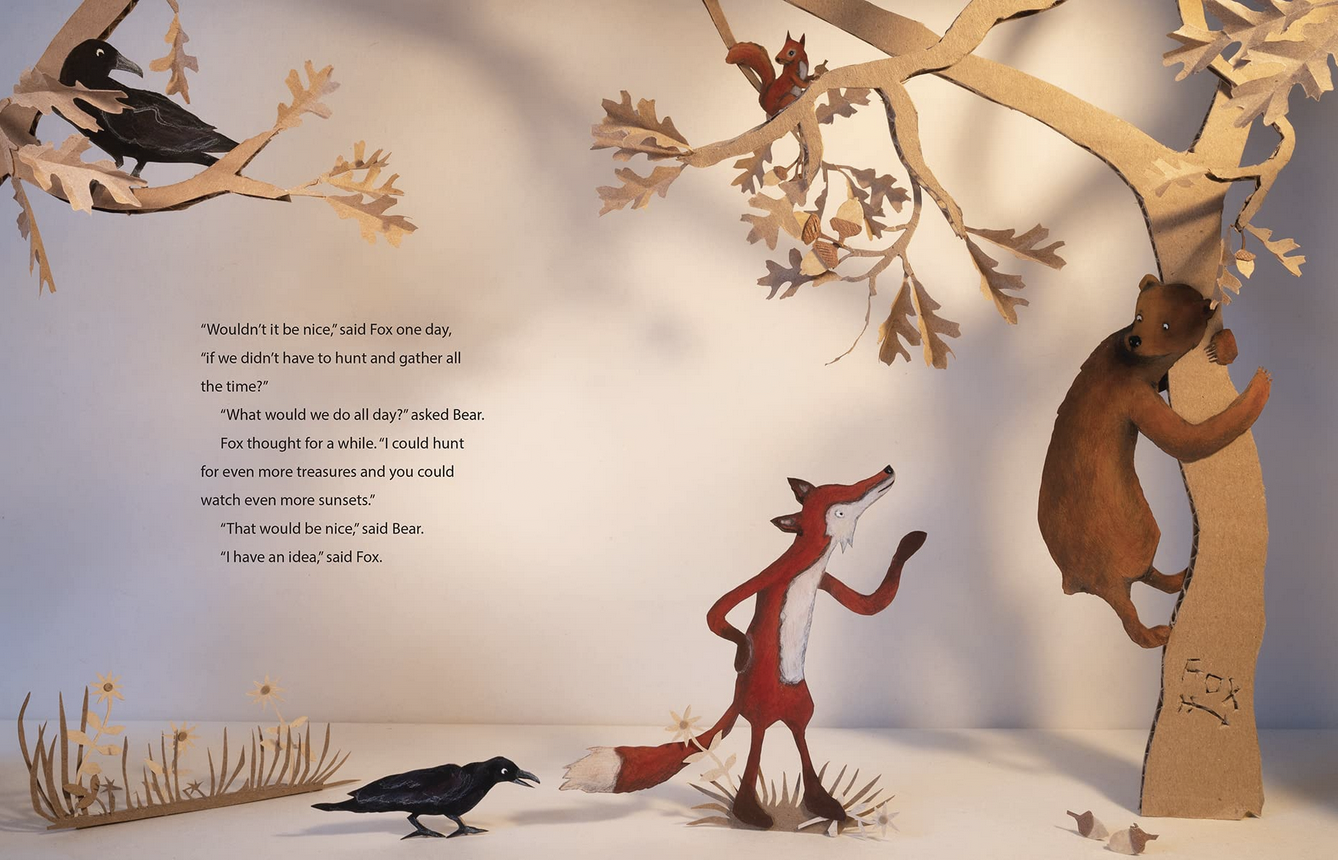
Though life for most animals revolves around the search for food and may seem mundane by human standards, Bear thinks life is pretty good. He loves picking berries while Fox hunts for eggs. And in between the search for food, Bear takes naps and enjoys the daily sunset while Fox searches for treasures and hides them. But then Fox has an idea. What if he could make their food forays more efficient?
From Fox and Bear by Miriam Körner
They start with cages to trap geese and keep them as egg-layers. They also gather more berries and seeds and plant them. Though their aim was to spend less time searching for food, all their chores require more effort, and Fox and Bear rarely have time for the pleasures of naps, treasure hunting and sunsets. So, Fox comes up with another idea.
 
This time, Fox draws up plans for a complex set of machines to gather eggs, feed the birds, water the plants, and pick the berries. Unfortunately, they have to dig up mountains and cut down trees for their contraption. And there were new jobs of gathering wood for the steam engines, filling the bird feeder and building more cages. As their work became more efficient, it became bigger and more involved and time-consuming. Eventually Bear realizes that their new efforts are greater than their past ones and their original daily tasks were the best of all.
From Fox and Bear by Miriam Körner
Fox and Bear could be an updated version of an Aesop's fable. Whether the message is about greed or ensuring that progress is actually an improvement, Fox and Bear remind us that bigger is not always best. A simple life of earnest food-searching and basic pleasures like napping and sunset-watching are not to be dismissed. Our world today is so focused on getting bigger and more that those who adhere to the principles of simple and meaningful are disregarded. It's reassuring to see that, although Bear goes along with Fox's plans, he eventually realizes what is best for him. What Fox decides is up to the reader as Miriam Körner leaves it open as to whether he too will return to his former life or stick with his new busy and overworked lifestyle. (This would be an interesting lesson for students to consider.)

Author-illustrator Miriam Körner lives in Northern Saskatchewan, and I suspect that the very landscape she sees outside her cabin's window is what has given her Fox and Bear's story. The destruction of forests for development must be seen in her northern community, whether for commercial farming, forestry, mining or settlements. Perhaps those behind all that economic planning should be reading Fox and Bear along with young readers.
From Fox and Bear by Miriam Körner
Behind her impactful story is Miriam Körner's artwork which is extraordinary. She has created dioramas from recycled paper and cardboard packaging painted with graphite pencils, soft pastels and acrylic paint. Through a limited palette of browns with red for fox and occasional hints of blue or black, Miriam Körner gives Fox and Bear an organic and very realistic feel to the natural world. Even when she introduces the machinery that Fox implements for efficiency, the cut of the paper and shape of her structures, though of the same colours, shouts of the manufactured and the synthetic. I'm a big fan of textures in picture book illustrations and, by photographing dioramas she has made of the paper and cardboard, Miriam Körner introduces even further textures with shadows and a three-dimensionality to the art. Miriam Körner's artwork presents a story of such quality that readers will be drawn in by the art but will stay for the fable that simple is sometimes actually best.

January 27, 2023

When Sally Met Harry


Written by Paulette Bourgeois
Illustrated by Brooke Kerrigan
North Winds Press (Scholastic Canada)
978-1-4431-7508-1
32 pp.
Ages 2-8
January 2023

Whether you're an adult, a child or a dog, change can be difficult. Even when the status quo is challenging, it's familiar. But when the norm is wonderful, filled with love and attention, adoration and praise, change can be especially effortful, as Sally a goldendoodle learns.
I was a bundle of absolute puppy adorableness.
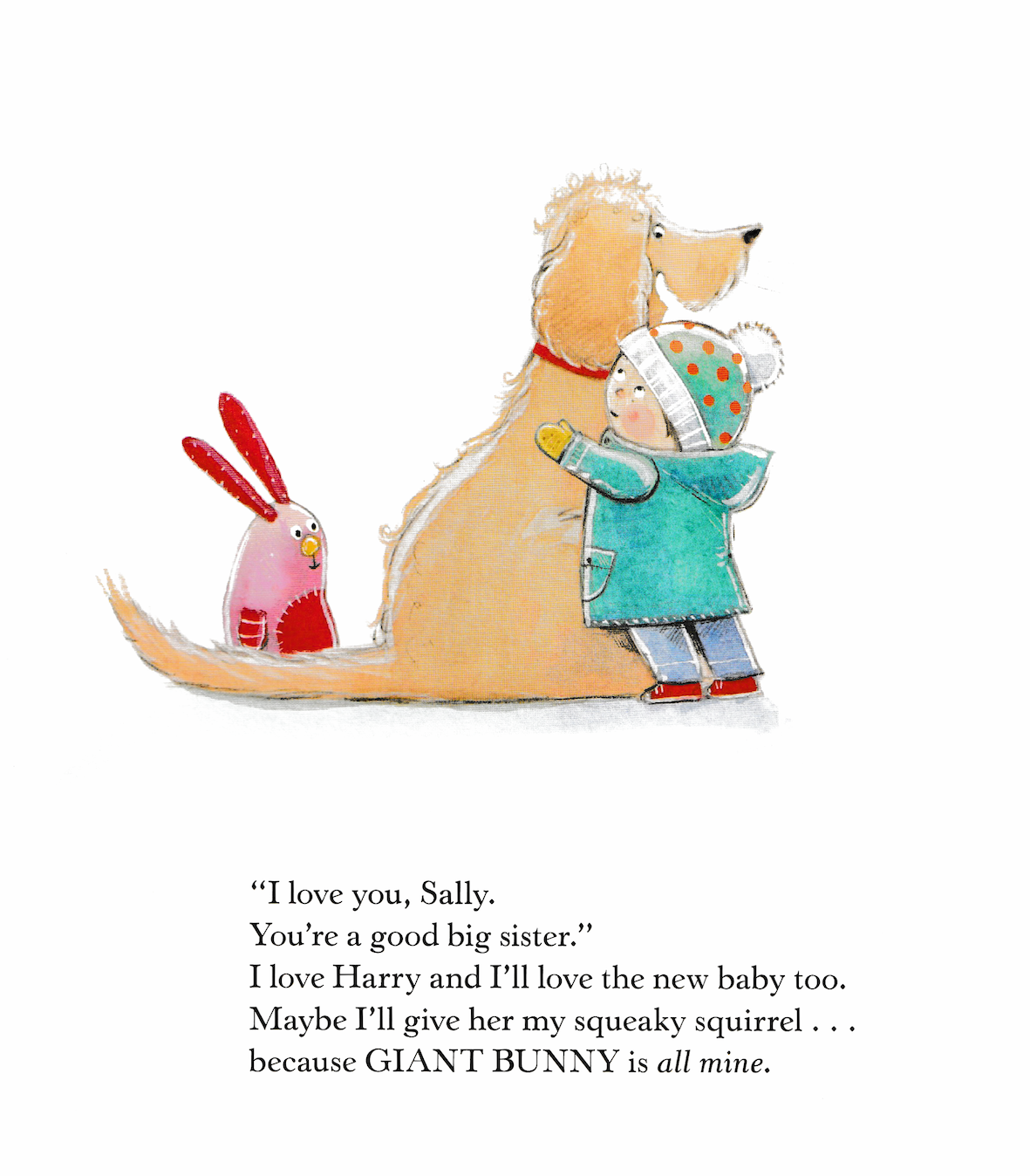
Sally can do no wrong. She sleeps on their bed, chases squirrels, plays and is cuddled. Even when she does do something inappropriate, like getting into their underwear, chewing it and getting sick, she is consoled with, "Poor baby." And then Sally learns that her people are having a baby. 
From When Sally Met Harry by Paulette Bourgeois, illus. by Brooke Kerrigan
Immediately after Harry arrives, Sally knows things are going to change. She lets herself out when her people are too engrossed with the noisy baby.  Sure, she gets a blanket and a new squeaky squirrel, but Harry gets a giant red bunny! And when Sally tries to show affection for Harry as she would her own pup, they yell at her to get away and she is told, "No." Now Sally has a dog walker, and she sleeps in a basket because Harry sleeps with them. 
From When Sally Met Harry by Paulette Bourgeois, illus. by Brooke Kerrigan
Though Sally tries to think of a way to make her people love her again, she really doesn't have to do anything special. Sally's specialness comes through with the simplest of acts and makes Harry realize that Sally is part of his loving family.
I look deep into Harry's eyes.
I let him know that I love him.
From When Sally Met Harry by Paulette Bourgeois, illus. by Brooke Kerrigan
Many will recognize the name of Paulette Bourgeois as the author of the Franklin the Turtle series but it's obvious she knows more than turtles. She knows babies and children and dogs. She knows the confusion of a new baby in a home with a pet who has been the only "child" and used to getting all the attention and love. But, Paulette Bourgeois, a grandmother herself, also probably knows about finding a way to make all feel appreciated and loved–which will be all the more important when Baby #2 comes along–while bringing seemingly unconnected family members to becoming part of the whole. Telling the story from Sally's perspective, feeling what she does, hearing from others, and seeing for herself, Paulette Bourgeois makes Sally the star of When Sally Met Harry and restores her place of importance when we all know that a helpless baby must become the center of his parents' attention, at least for a time. And then when that baby is a toddler and can be a little brother to big sister Sally, the family circle is complete again.

That sweetness of story and familial bonding comes through in Brooke Kerrigan's illustrations. Rendered in watercolour, pencil crayon and gouache on paper before digitally enhanced, the artwork screams cuteness. From the playful and loving Sally to the cherubic Harry–look at that round head!–and all the little details of toys, squirrels, cats, and other dogs, When Sally Met Harry depicts many a household in which a baby is introduced to a family pet. Still, with Paulette Bourgeois's words and Brooke Kerrigan's illustrations, When Sally Met Harry tells the story of a one-of-a-kind relationship that could earn a cinematic rendering of its own.

January 24, 2023

I Got You Babe: Guest interview with author Paul Coccia

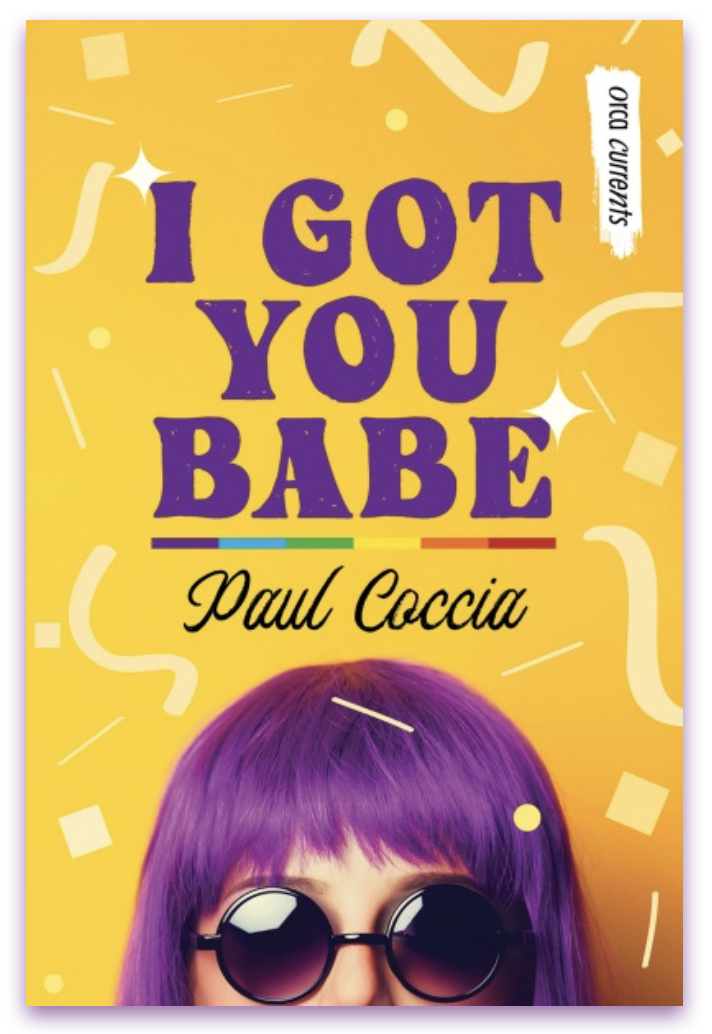
I Got You Babe
Written by Paul Coccia
Orca Book Publishers
978-1-459834705
120 pp.
Ages 9-13
Release February 14, 2023


Yesterday CanLit for LittleCanadians reviewed Paul Coccia's upcoming novel, I Got You Babe. Today I present an interview conducted by student Hasini K. with author Paul Coccia. 13-year-old Hasini read I Got You Babe and prepared questions for author Paul Coccia to delve a little deeper into his new book. Paul Coccia, ever gracious, agreed to answer her questions and even visited with Hasini virtually to chat about the book. 

Here is their Q & A.
 
Author Paul Coccia

 • • • • • • •
Hasini:  In the novel, Mac and Amy propose to change the annual Fun Fair into a Pride Carnival theme. Their idea is welcomed and the committee supports the change.  What would you say to your LGBTQ+ readers if they find themselves in a less than supportive environment?


Paul Coccia:  My first concern would always be whether a reader is in harm’s way. I wouldn’t want to see someone in physical or emotional trouble due to advocating for something they believe in nor would I want them in an environment that is damaging to their well-being. That aside, I would advise trying to open a dialogue. Be forthcoming about how you see the issue and try to understand why someone may object. The opposition may be something practical like budget constraints as in I Got You Babe. If the environment or people can’t or won’t be supportive, then I would suggest finding spaces and people that can. Too often, we give too much time and space to negative people or situations and, if possible, actively choosing positive things and giving them time in your life is a healthy move.


Hasini:  I really appreciated Mac’s desire for scheduling and organizing all the tasks needed for the Pride Carnival Fun Fair.  Would you say that this represents you or how might you be different?

 
Paul Coccia:  I do enjoy planning and organization and am impressed by someone who can pull off a big event and make it seem effortless. Where I differ from Mac is, as a writer, sometimes it’s a lot more satisfying to plan something in my mind than it is to actually do the work to get it going in reality. When I’m writing (or reading for that matter), there are more possibilities. In my mind, I throw these really elaborate parties with the best food and all my friends get to come. I plan them, but I might need an Amy in my life to push me to get it done.


Hasini:  When brainstorming for the Fun Fair, Mac had a lot of great ideas for the Pride Carnival theme.  Naturally, he was disappointed when the committee told him too many were unrealistic and they didn’t have the budget for all of it.  What would you say to kids who have to deal with disappointment?

 
Paul Coccia:  Disappointment, unfortunately, is something we all deal with. Authors and illustrators will tell you, we get these fantastic ideas, and sometimes they don’t end up turning into books. At least not easily. A lot of times, it is due to factors entirely out of our control. I started trying to get published at 17. It took me a couple of decades to get one of my great ideas turned into my first book. Being patient and waiting for a moment to arrive is incredibly frustrating and disheartening. Sharon Jennings’ Unravel is a great example of a book that took her over a decade to get published and it became a Governor General’s Award Finalist. So, don’t give up. Your best ideas will find their time and place if they’re important to you.


Hasini:  Mac and Amy have a very strong friendship.  How might this friendship inspire the readers of your book?  Also, do you have a friendship that inspired these characters?

 
Paul Coccia:  The backstory! Mac and Amy were inspired by my younger brother and his friend. They met before kindergarten and have remained close since. In eighth grade, they put on a Sonny and Cher routine for the school talent show where she was Sonny and he was Cher.

I hope one takeaway is that in a friendship, there can be room for two divas with lots of mutual respect. That can mean taking time to listen to someone and hear what they want and need not just try to pull them into orbit around you no matter how fabulous you are.


Hasini:  I noticed that pronouns weren’t used for Mac for the first 50 pages of the book.  Was there a specific reason you delayed using the pronoun ‘he’?

 
Paul Coccia:  I wish I had been clever enough to notice! I would have removed the rest of the masculine pronouns and left the decision on pronouns up to the reader. Readers are already active participants in books so I’d be happy to let them decide. Alas, I was not that smart. From a craft perspective, the story is told from the first-person point of view and Mac usually refers to himself as ‘I’ or ‘me’ while others call him by name or ‘you.


Hasini:  I love that the name Chandra was used in your book.  I am not used to seeing my culture represented in books.  Was there a reason for the name choices of your characters?  

 
Paul Coccia:  I, and so many authors and illustrators I know, intentionally try to be inclusive when we create stories. Part of that means finding ways and places for all sorts of characters to exist in the worlds we write. First and last names are an understated tool for any writer as they have the benefit of characterizing quickly and efficiently by hinting at cultural heritage. Amy’s and Mrs. Khatri’s surnames did this too. That aside, Chandra is a beautiful name. There is a goldmine of names that are not used enough that authors can look up. When I am trying to include a character that has a specific heritage or background, I look up the most popular baby names or surnames in the country the character’s family would have originated from for the year I imagine the character was born.


Hasini:  Mac is insistent on representing a strong woman in the Pride Carnival Talent Show.  Why did you choose for him to want this?  How might you have participated in the show if you were one of the characters?

 
Paul Coccia:  Personally, I was so lucky to grow up in a house with many strong women so I tend to bring that into my writing whenever I can. I also really, really love Cher. She is the Goddess of Pop!

The LGBTQ+ community, in particular gay men, has looked toward strong and often transgressive people, notably women, as icons. Often, these women are such strong allies to the Queer Community. When I think of Mac, he really does have a strong sense of who he is and that, like many icons, he’s ahead of his time. He would naturally identify with a larger-than-life celebrity like Cher who has remained relevant for decades throughout her career. 
 
As for a talent show routine, I lean more toward visual art or culinary arts. If I could bake on stage, I’d have a decent shot at winning something. I can’t sing or dance though, not that that stopped Mac.


Hasini:  It is mentioned briefly in the story that Mac deals with bullies in the school. What would you say to kids reading the book who are dealing with bullying?

 
Paul Coccia:  If you’re being bullied, seek help. This could mean finding an adult or authority figure to intervene or seeking professional help. This may be hard to do as I’ve found an element of shame and self-doubt accompanies being bullied. Finding a way to stop the bullying and healing from it is important.

If you are a bully, I would strongly suggest you reflect and consider if this is the person you want to be. Perhaps you didn’t intend what happened. Then you should apologize and make amends. If you did intend to hurt someone, I wonder if this is a moment to be proud of. We all make mistakes and our actions have the effect of bringing us closer to a version of ourselves we’re proud for the world to see or farther away.


Hasini:  In the book, Mac’s mom makes some creative meals like kimchi hot dogs.  I see on Twitter that you are quite the baker.  Did you have creative meals at home growing up that influenced you and your character, Mac?
 
Paul Coccia:  We are an adventurous family for eating and cooking. I think having parents and grandmothers from different backgrounds in the house helped, as well as growing up in an area of Toronto different from our backgrounds. My family loves trying different foods from around the globe, whether we cook it or it is takeout. Our most inventive and peculiar dishes always come out of repurposing leftovers.  Thanksgiving dinner does really well with a Tex-Mex influence. Spaghetti makes a non-traditional but surprisingly satisfying pad Thai. It’s fun and a challenge to see how we can switch up a dish and turn it into something new. Similarly, in my first novel, Cub, the main character is particularly interested in fusion when he cooks. Food culture is one more place to literally feed my curiosity.

 • • • • • • •
 
Many thanks to both Hasini K. and author Paul Coccia for this interview. Hasini asked wonderfully in-depth questions about the writing and story of I Got You Babe and Paul Coccia gave us great insight into his process and motivation.  I'm so pleased to share their interview with CanLit for LittleCanadians readers.

Graphic from Orca Book Publishers

January 23, 2023

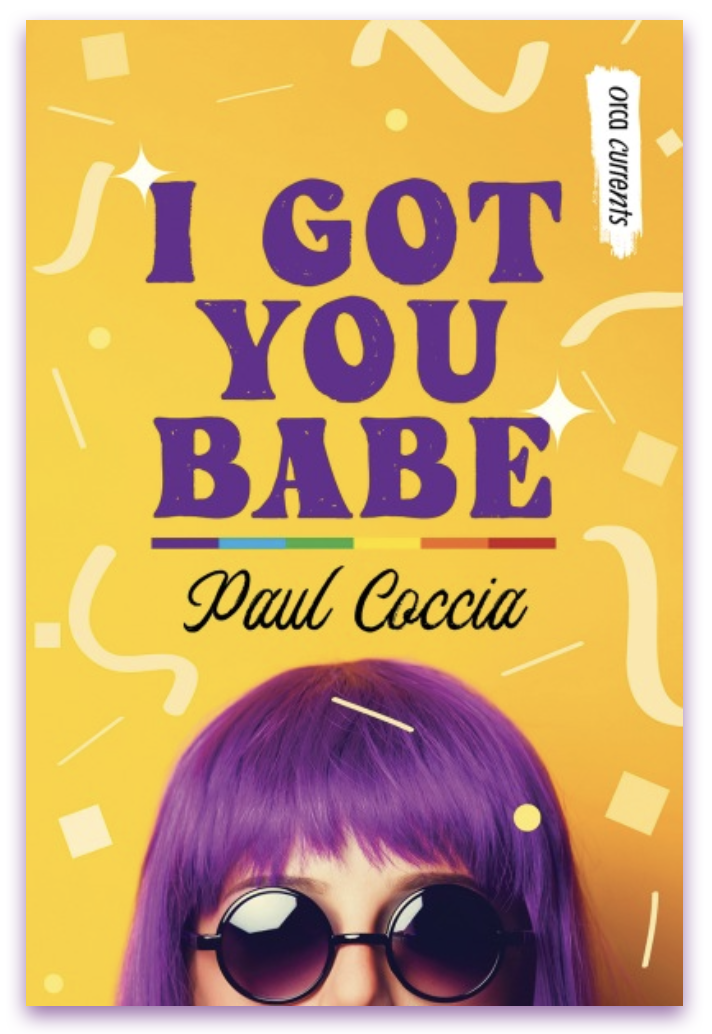
I Got You Babe (Orca Currents)

Written by Paul Coccia
Orca Book Publishers
978-1-459834705
120 pp.
Ages 9-13
RL 2.1
February 2023
 
Twelve-year-old Mac Riley has lots of ideas. He has lots of big ideas. His ideas are so big that they are almost overwhelming. In fact, his ideas may be just a little too big especially if he can't see that they may be jeopardizing some of his relationships.
 
When Charles Middle School's parent association, headed by Mac's dad, meet to discuss their annual fundraising Fun Fair, students which include Mac and best friend Amy are invited to attend. Mac, with Amy's tech assistance, suggests that they redo their boring Fun Fair with a Pride-themed event that is fresh and inclusive. Mac, who loves a bit of flash, from his clothing to his attitude, suggests everything from a rainbow-striped bouncy castle, a dunk tank and multicoloured cotton candy, to fireworks and a talent show with the winner crowned "Sparkling Crown of the Carnival." Though the committee recognizes that it might be too expensive to have it all and that there might be some pushback, they decide to go ahead. 

But Mac goes a little overboard with his plans, convinced he has something to prove.
"I wasn’t sure they were going to go for the carnival idea. Now that they have, it’s like I’ve got something to prove. It has to be great. It has to make money. People have got to like it. It needs to be epic.” (pg. 19)
Though Amy reminds him that the carnival isn't about him, Mac just steamrolls ahead with his plans, including planning on him and Amy winning the lip sync contest by depicting Cher and Sonny respectively. Amy tries to tell him that she's apprehensive of dressing like Sonny while Mac gets to dress in drag, but he just demands they rehearse daily and that she tries harder. 

Mac might be following the "go big or go home" precept but he doesn't realize that he's acting like the carnival is all about him. He may want to emulate the strong woman that Cher is but, instead of focusing on her iconic nature, he's acting like a diva. Will the Pride Carnival be the inclusive success Mac envisions or is he putting his relationships in jeopardy, and about to suffer the same fate as the famous duo, just to prove something?

If you don't know Sonny and Cher's song "I Got You Babe," take a listen to any version, video or audio, of Sonny Bono's song. It's catchy and heartening and will remind you that support doesn't require anything but being there. The song may be about a romantic relationship, but Paul Coccia's story goes beyond that singular type of relationship. I Got You Babe tells us that whether it's a friendship or a parent-child relationship or even self-love, support with understanding for strengths and flaws helps us through. Mac is imperfect–aren't we all?–but he learns from his mistakes and he does so  because there are those that support him, like his friend Amy and his father and his mother. With that kind of support, anything is possible: growth, love, and even winning a talent show.  And Paul Coccia makes us realize that it's all possible. This hi-lo (high interest, low vocabulary) story may be written at an easier reading level for middle-grade readers but its story is accessible to everyone. Paul Coccia writes a story about kids that are thinking outside the box and wanting to do interesting things. But what they get, in addition to a great school fundraising event, is learning that others have their back and that's something we all need to know.

• • • • • • •
 
Image from Orca Book Publishers
We're going to help get the hype going for this new novel that comes out February 14, 2023. Along with  this review, I'll be posting an interview with author Paul Coccia tomorrow with student Hasini. And here is the book trailer for I Got You Babe from Orca Book Publishers.
I GOT YOU BABE Trailer

Uploaded by Orca Book Publishers on January 23, 2023 to YouTube.

January 19, 2023

The Possible Lives of WH, Sailor

Written and illustrated by Bushra Junaid
Running the Goat, Books & Broadsides
978-1-927917855
60 pp.
Ages 9-12
2022

Who was the 19th c. sailor whose remains were discovered in Labrador in the 1980s? Where did he come from? How did he live? What was the story of his death?  Bushra Junaid examines these questions and tells us the sailor's possible stories in poetic rhyme of historical depth.

From The Possible Lives of WH, Sailor by Bushra Junaid
In verse, Bushra Junaid speaks of the bones found on the Strait of Belle Isle and exposed by erosion in 1987 near the village of L'Anse au Loup. The bones suggest a young man of short stature and missing a forearm, with kinky hair and strong teeth. Alongside the bones were some clothing, shoes, a knife and a pouch, several carved with the initials W-H. Though the story of WH is lost, Bushra Junaid insists on remembering this man, as a memorial for "all the Black fathers and brothers who plied these waters, For all the unnamed mothers and daughters bound to plantations" and for all they experienced before and after becoming seafarers.

She wonders at his origins and the memories he may have carried from his homeland whether perhaps West Africa, the Caribbean, the American south or even Nova Scotia. Was he taken by force or did he enlist to be a sailor? Did he fight battles, learn to read and write or acquire other skills? Was he treated fairly or discriminated against? And what of his family? With her questions, Bushra Junaid gives WH's life a legacy.
All these things we can't possibly know–
They have only made my curiosity grow
About all the possible lives you have lived.

I don't know from whence you came,
And I don't know your rightful name, but you
Remain.

Respect is due. It's time that you
Were laid to rest anew.
From The Possible Lives of WH, Sailor by Bushra Junaid
Born to Jamaican and Nigerian parents, Bushra Junaid accepts a responsibility to tell the story of WH, in essence claiming his bones as family. And with the telling of these possible stories, Bushra Junaid ensures that WH is honoured and will never be forgotten to history.
Some may say I've got no skin in the game,
Yet if it's really all the same,
This child of the diaspora would like to claim
You as kin.
Bushra Junaid is the respected illustrator of Adwoa Badoa's Nana's Cold Days (Groundwood, 2002) but The Possible Lives of WH, Sailor is her debut picture book as author and illustrator, and I think she successfully tells a story with great heart and lyricism. WH's true history may never be known but he will not be dismissed, and her words make us think about what that history may be and what the artifacts may tell us and what they don't. (Appended to the story are photographs of these artifacts housed at The Rooms in St. John's NFLD as well as extensive background and historical notes and references.)
 
Though WH's story may be a simple one of birth, life and death, that story's context is complex. As such, the simplicity of Bushra Junaid's art of lines and shapes created from pen and ink and watercolours complement her words. There is far too much that could be part of WH's story, so by focusing on simple vignettes of villages or ships at sea, Bushra Junaid grounds the man in the tangible.
From The Possible Lives of WH, Sailor by Bushra Junaid
I know that teachers will undoubtedly be using The Possible Lives of WH, Sailor for teaching purposes, especially for history–a list of discussion questions as part of an appended teachers' guide will be ever so useful–but this picture book should be seen as an exemplar for empathy and compassion for times and people gone and unknown. History, legacies and ancestry cannot always be corroborated but by giving them attention, even through speculation, we honour them.

January 17, 2023

Crescent Moon Friends

Written by Wadia Samadi and Mo Duffy Cobb
Illustrated by Lisa Lypowy
Acorn Press
978 -1-773660967
32 pp.
Ages 4-8
2022
 
Two girls. Two cultures. Two families. Two sets of traditions. One moon under which their differences are more similar than at first seen.
From Crescent Moon Friends by Wadia Samadi and Mo Duffy Cobb, illustrated by Lisa Lypowy
Aisha joins Amelia's class in Canada after leaving war-torn Afghanistan. When they become reading partners, they also become friends, sharing traditions of their cultures from games and food to celebrations and beliefs.

As they share, they also learn. Amelia's family follows Islamic traditions of peace and prayer while Amelia's teaches compassion and kindness. The two girls also have different dispositions, Aisha leaning to the maths and sciences and Amelia to the arts. One has the heart and mind of a scientist while the other one of a dreamer and a poet. And though they both love the moon, they see it differently.
From Crescent Moon Friends by Wadia Samadi and Mo Duffy Cobb, illustrated by Lisa Lypowy
It's relevant that the crescent moon, an important symbol of Islam, draws the attention of both girls. Still even in their different relationships with the celestial body, they appreciate how it is seen by the other. 

Afghanistan-born Wadia Samadi and P.E.I.'s Mo Duffy Cobb wanted to tell a story of two different girls who find commonalities in their differences. And young readers will learn how being different is okay but also will recognize that the differences aren't as contrary as some might expect. Amelia and Aisha are just to girls who have been brought up in different traditions and, with the sharing of those traditions, their friendship is strengthened.
From Crescent Moon Friends by Wadia Samadi and Mo Duffy Cobb, illustrated by Lisa Lypowy
Whether she's depicting Canada or Afghanistan in her illustrations, Edmonton's Lisa Lypowy uses watercolours to keep them bright and atmospheric. Even with her colours and shapes, Lisa Lypowy shows how similar the girls and their lives are while different in temperaments, landscapes and weather, clothing and customs. 

Wadia Samadi and Mo Duffy Cobb end their book with blurbs about Prince Edward Island and Kabul, Afghanistan. In one last manifestation, they compare and contrast the two locations and help young readers see, yet again, that separating ourselves along lines of differences hurts us but finding our connections makes us better.