September 05, 2022

Can You Believe It? How to Spot Fake News and Find the Facts

Written by Joyce Grant
Illustrated by Kathleen Marcotte
Kids Can Press
978-1-5253-0322-7
56 pp.
Ages 9-12
June 2022
 
With young people returning to schools soon here in Ontario, educators will be scrambling for great resources for teaching media literacy. Toronto's Joyce Grant has just that resource in Can You Believe It? How to Spot Fake News and Find the Facts.
From Can You Believe it? How to Spot Fake News and Find the Facts by Joyce Grant, illus. by Kathleen Marcotte
Using the best features of non-fiction texts, such as info boxes, labelled diagrams, a glossary, and important terms bolded, Joyce Grant covers everything from using critical thinking skills to search for clues of authenticity, looking for bias and understanding the importance of perspective, differentiating between facts, opinion, satire and ads, and clarifying new threats to credibility like clickbait, deepfakes and the proliferation of bots. First she introduces middle-graders to the concepts, giving them samples of news meant to sensationalize and draw in readers, before inviting them to practise their critical thinking skills. Can You Believe It? is a comprehensive examination of how to differentiate between the fake and the authentic, a tough endeavour with today's bombardment of news from all sources, including social media. To end, Joyce Grant offers lists of trustworthy sources, including websites and games, to help young people navigate the deluge of news offered on different platforms.
From Can You Believe it? How to Spot Fake News and Find the Facts by Joyce Grant, illus. by Kathleen Marcotte
The idea of fake news is a disheartening one as readers are manipulated or deceived for various purposes, especially for young people who have less experience with authenticating sources of information. (With the proliferation of fake news in recent years, we know how difficult it is for all adults to do the same.) But Joyce Grant adopts a positive take on this endeavour, encouraging young people that they can sieve through the detritus of fake news and highlight the real. She does it with a bit of humour–a few headlines like "Dog Lovers WAY Dumber than Cat Lovers: Study" or "Kids Are Better than Adults at Everything, New Study Shows" offer a chuckle or two–and thoroughness, and Kathleen Marcotte, an artist from Ohio, gives the text that added lift of colour, diversity, and scaffolding with her digital illustrations.
From Can You Believe it? How to Spot Fake News and Find the Facts by Joyce Grant, illus. by Kathleen Marcotte
Joyce Grant, co-founder of Teaching Kids News, has been talking to kids about the news for years, whether in the classroom or online. She offers links to legitimate sources and stories and proposes lessons to help build critical media literacy skills.  Can You Believe It? How to Spot Fake News and Find the Facts is just one more fine tool in her arsenal to help educators develop a foundation for teaching media literacy and for kids to be empowered to read the news with confidence.

September 01, 2022

Apartment 713

Written by Kevin Sylvester
HarperCollins
978-1-4434-6094-1
240 pp.
Ages 8-12
September 2022
 
That's what buildings do, Jake. They are like us, constrained by an arc. By time. They–and we–age and decay. They–and we–die. But how do we live while we live? That's the important question. (pg. 122) 
When Jake Simmons and his mom move into the Regency, it's because they've hit rock bottom. Mom has split from her partner Janice and lost her job as a legal secretary. To get back on their feet, the two move into the Regency, which Jake sees as a dump with its peeling paint, curling wallpaper, dust, grimy windows and worse. But, when he becomes acquainted with the original Regency, he recognizes that it is a true home.

Exploring the shambles that is the Regency, Jake makes the acquaintance of Danny, the superintendent, who knows all the residents and what they need. He introduces Jake to the elderly Lily in Apartment 405 whose cats are fed by Danny. Then there's the brilliant Professor who is so focused on her work that Danny cleans up her garbage and the elusive, baseball-loving Gus who won't leave his home. Danny is good about delivering and picking up Gus's mail as well as that of others like the piano-playing Theo in 501 and the enigmatic Delaney who lives somewhere on the seventh floor. These are just some of the odd assortment of residents of the Regency and Jake is happy to agree to be Danny's assistant and help with all his clients' needs. But then Danny gets a letter from a lawyer indicating that the long-term lease between the Regency and the city is set to expire and the residents will need to find another place to live. 
 
Soon after, the purportedly-broken call light for Apartment 713 goes off and Jake heads to the apartment he'd been told was off limits. Sure that someone inside is calling for help, Jake plunges into the apartment and into another world, one in which the Regency is in its infancy, hosting musicians, artists and other famous people while being a home to others. Believing that he was sent back to the 1920s to help save the Regency, Jake and his new-found friend, Beth, explore the mysteries that are hidden in the exclusive building, revealing more about its secrets, its history, and even its future.

Kevin Sylvester can illustrate (e.g., Super-Duper Monster Viewer), tell us sports stories (e.g., Hockey Super Six), entice us with food (e.g., Neil FlambĂ© series) and inform with non-fiction (e.g., Gold Medal for Weird and Follow Your Money with Michael Hlinka) so it's no wonder that he can also write speculative fiction with a time-slip element.  Still Kevin Sylvester includes all those elements in Apartment 713. His artwork peppers the story and there are elements of baseball, food, and history that build on the basic premise of a child dealing with upheaval and trying to find home where it would appear there is none. While there is a very cool time-slip element to Apartment 713, the story is really about looking a little deeper: into a new place, into new friends, and into one's self. It's finding the wonders within and recognizing them for what they are. It's being the solution rather than complaining about the problem. It's finding home by making a home.

While Kevin Sylvester will always give us a good story, well-written and illustrated, often with humour and a light touch, there will always be more. He gently manifests important issues like LGBTQ (e.g., The Fabulous Zed Watson co-authored with Basil Sylvester) and resource monopolization (e.g., Minrs) and, with Apartment 713, there's a message about superficiality.  Hopefully young readers will see beyond the obvious, that old buildings may look like dumps and eccentric people appear to be odd but both are built on histories that make them unique and enrich lives with their presence.

August 29, 2022

Forever Truffle

Three Stories by Fanny Britt
Illustrated by Isabelle Arsenault
Translated by Susan Ouriou
Groundwood Books
978-1-77306-070-5
114 pp.
Ages 7-10
August 2022
 
In three stories, Fanny Britt introduces young readers to Truffle, a young red-haired wonder who adores music, falls in love and learns about figures of speech, and contemplates life in a very big and beautiful way. He is Forever Truffle, and occasionally Truffleletto.
From Forever Truffle by Fanny Britt, illus. by Isabelle Arsenault
In the first story, Truffle The Rock Star, Truffle explores his love of music. From childhood and listening to everything from Verdi to Joan Jett, the Beatles and Led Zeppelin, it's obvious that Truffle is a lover of music, especially rock, and he's thrilled when he gets a biker jacket for a birthday gift. Determined to be a rocker, Truffle gets together with best friends Flo and Riad to conceptualize their own rock band.
From Forever Truffle by Fanny Britt, illus. by Isabelle Arsenault
In the second story, Truffle Loves Nina, Truffle has fallen for little Nina. However, ever since he's asked her to be his girlfriend, he can't speak to her. When his father suggests he let his heart do the talking, Truffle tries to understand that figure of speech and many others so that he might express his love to Nina. 
From Forever Truffle by Fanny Britt, illus. by Isabelle Arsenault
The final story, Truffle Tackles Existence, has Truffle asking big questions when attending the funeral of his great-grandma Sybile. The visit brings up Truffle's thoughts on his parents' divorce, including his hope for reconciliation; on his love of dogs and missing their pup Rocket; and about growing old and dying. He's thoughtful and observant, kind and forever Truffle. 

Montreal's Fanny Britt does not do frivolous or cute but she does do real and that's what and who Truffle is. He's a real child who dreams and wishes and imagines, as well as loves, hopes and reflects. And he's got lots to think about, from his divorced parents, to his older brother, his loves and his good friends, to his aspirations and his life. His naivetĂ© is authentic, not silly, and allows his inquisitive nature to learn lessons that all children will learn some time in their lives, some earlier, some later. 

Artist Isabelle Arsenault complements Fanny Britt's text, so expertly translated by Calgary's Susan Ouriou, with illustrations that emulate that sensibility of the story.  The artwork, rendered in pencil, ink and collage, are low key, tempered in doleful tones with splashes of yellow and orange and turquoise. After all, life is not all bright colours, bold in spirit and brash in tones. It's often just a plodding along of trying to understand and manage and find some brightness whenever and wherever possible. 
From Forever Truffle by Fanny Britt, illus. by Isabelle Arsenault
The collaboration between Fanny Britt and Isabelle Arsenault, as in Louis Undercover and Jane, the Fox and Me, has always been a powerful but subtle one of compelling stories of authenticity, told in words and pictures that depict children as they live. The complexity of their lives and their understandings are evident though not belaboured. Forever Truffle will forever be such a story.

August 24, 2022

It's My Body!

Written and illustrated by Elise Gravel
North Winds Press (Scholastic Canada)
978-1-4431-9650-5
32 pp.
Ages 3-8
September 2022

Elise Gravel has always used her quirky illustrative way to entertain while teaching STEM, from her Disgusting Critters series to The Mushroom Fan Club and even her early graphic novel series Arlo & Pips. But in recent years, Elise Gravel's picture books have shown a proclivity for encouraging young readers to be respectful of self and others by demonstrating that we are more alike than our differences might suggest. In It's My Body!, Elise Gravel reminds us that our bodies are our own, to love and appreciate, even as they are different in shape, colour, ability and how we feel about them.
From It's My Body! by Elise Gravel
If we're going to talk about our bodies, we first have to recognize all the different kinds there are. Brilliantly, Elise Gravel gives us dozens of bodies, all unrecognizable as people but all representative of the myriad of human body types. Some have two legs, some do not. Some have ears, and some do not. Some are tiny, some thin, some pear-shaped, and others stocky. Some move by wheels and some with canes. And they can all do stuff.
From It's My Body! by Elise Gravel

What we choose to do with our bodies is up to us but Elise Gravel recommends that we honour them by keeping them healthy and happy with good food, activity, cleanliness, fresh air and rest. And she reminds us that "Nobody should touch your body in ways that you don't like" and we should respect that for others as well.
From It's My Body! by Elise Gravel

Without belabouring any one issue like inappropriate touch or hygiene, illness or diversity, disability or body positivity, Elise Gravel gives it all to us. She reminds us to be kind to ourselves and others and to appreciate our differences as well as our similarities. With her one-of-a-kind monsters, Elise Gravel makes us feel worthy and included, no matter what we can do, feel or look like. That will help children with the ideation of self-esteem, while also shepherding them to good mental and physical health. After all, as Elise Gravel's green-and-yellow-spotted character reminds us:
Thank you, BODY. Without you, I would be a NO-BODY!

August 22, 2022

Room for More

Written by Michelle Kadarusman
Illustrated by Maggie Zeng
Pajama Press
978-1-77278-252-3
32 pp.
Ages 5-8
June 2022

With fire season upon us, Room for More reminds us of the fragility of habitats and the vulnerability of animals to destruction too often wrought by humans, whether by carelessness or climate change. Fortunately, animal species such as the Australian ones Michelle Kadarusman has highlighted here do better than we do at showing compassion, generosity, flexibility and reciprocity.

From Room for More by Michelle Kadarusman, illus. by Maggie Zeng
Two wombats, Dig and Scratch, know that when they smell the smoke of a bushfire that they will be safe in their deep burrows. But when they hear other animals scurrying for safety outside, Dig offers them shelter, though Scratch keeps reiterating that, "There is no room." Still, Dig tells a wallaby with a joey in her pouch who was already succumbing to the smoke that, "We have plenty of room."
From Room for More by Michelle Kadarusman, illus. by Maggie Zeng
When Dig spots a koala clinging to a tree, he again helps a stranded animal, against Scratch's grumblings of limited space. When a tiger snake is spotted, there is much trepidation about a venomous snake that might bite but Dig is convinced the snake will behave.
From Room for More by Michelle Kadarusman, illus. by Maggie Zeng
Though very snug in the wombats' burrow, the motley group of animals survive until a rain comes and puts out the bushfire. But, with that rain, comes a new worry for the wombats whose home is in danger of flooding. However, their new friends find a way to reciprocate the relief provided, showing a generosity of spirit all around.
 
Australian-born author Michelle Kadarusman's "Author's Note" reveals that Room for More is based on the science that animals other than wombats would find safety in their deep burrows during the horrific bushfires of 2019-2020. Perhaps there weren't discussions between wombats about helping out or animals uniting to engineer an embankment, but Michelle Kadarusman reminds us that all animals, even unlikely allies, can cooperate for greater good and without compulsion for mutual benefit, though in this case that is exactly what happens.  Though the consequences of bushfires are often devastating, Michelle Kadarusman has emphasized a gentler story, that of animals surviving and by unusual means. And that's the good story. But Michelle Kadarusman also gives us the science of Room for More, providing a glossary of the species involved in the story as well as explaining important issues like climate change, environmental disasters and Australian Indigenous land practices.
From Room for More by Michelle Kadarusman, illus. by Maggie Zeng
That gentle touch to what is a heartbreaking and devastating circumstance is emulated in artist Maggie Zeng's digital illustrations. While there is an orange hue of fires and a pall of grey haze to the landscape, Maggie Zeng does not overwhelm the art with angry flames or blackened scenes of destruction. Instead, she takes us to a dry and warm setting that is softened with the kindness of benevolence. In her colours and shapes, Maggie Zeng offers generosity and compassion.

I know teachers will love to share this story with their students whether for STEM lessons regarding habitat, characteristics of living things, different world biomes or climate change or for character education centered on empathy and goodwill but at its heart it is a sweet story that goes beyond teaching by captivating readers and transporting them to other worlds. It would seem there's always room for another fabulous picture book on the youngCanLit shelves.

August 19, 2022

Ballewiena

Written and illustrated by Rebecca Bender
Pajama Press
978-1-77278-137-3
32 pp.
Ages 4-7
June 2022

Let's get some joy in our lives. Dance, dogs, and fulfillment will do just the trick with Rebecca Bender's Ballewiena.
From Ballewiena by Rebecca Bender
Dotty dreamed of being a ballet dancer. She knew how to pliĂ©, assemblĂ© and pirouette. She could chassĂ©, glissĂ© and do a pas de chat (even though she was a dog). But Ms. Austere did not appreciate Dotty's moves and, while she trained Dotty's poodle sibs Jazzebelle and Miffy for the upcoming Golden Bow Talent Show, she took the dachshund to the Canine School of Obedience. 
From Ballewiena by Rebecca Bender
But obedience school was not for Dotty who "tried, she really did, but something inside her made her spring up into an elegant entrechat." Despondent, Dotty runs into the park after class and meets Louis-Pierre, a squirrel and an acrobat. Louis-Pierre invites Dotty, whom he calls Pitou, to work out with him and teaches her, by some unusual pedagogical means, the value of practice in gaining skills.  
From Ballewiena by Rebecca Bender
Still, when the Golden Bow Talent Show comes around, Dotty is expected only to watch from the audience. But, Louis-Pierre has other ideas and liberates Dotty to show off her skills and reveal her true ballerina self.

Young readers will know Rebecca Bender's storytelling from her award-winning Giraffe and Bird series (e.g., Giraffe Meets Bird; Giraffe and Bird Together Again; Don't Laugh at Giraffe) but she does as well by dogs as she does with giraffes, birds, hedgehogs and ducklings (e.g., How Do You Feel?) and more. She makes us care about her characters who are all expressive and one-of-a-kind, whether they are pets or wild. That's because her stories are those lived by children. Dotty may be a dog but she could be any child who feels her dream is being stifled and who wants to express herself through dance. I suspect that Rebecca Bender is a herself ballet parent, one who has learned much from attending classes with little ones. In fact, I myself learned much about ballet through the text of Ballewiena but also in her incredible endpapers that depict a variety of ballet movements and their phonetic pronunciations. Yes, Ballewiena is about ballet, and would make a great gift for any child who enjoys dance classes, but it has important messages about following your aspirations and being true to yourself while ensuring that you put the work in so it becomes a goal and not a pipe-dream.  

Rebecca Bender's illustrations, created with gouache, watercolour, pen and ink, as well as digital media, carry those messages through worlds of colour, shape and attitude. Her assortment of canine and other characters conveys a depth of personality beyond the dance. (I was especially taken with Louis-Pierre who, with his sweatband and drawstring workout pants, has a je ne sais quoi quality that is adorable, even as he coaches Dotty through rigorous training.)

Whether you're a dancer, an appreciative fan or neither, Ballewiena reminds us to follow our passions and dance fully in our lives.

August 16, 2022

Blanket

Written and illustrated by Ruth Ohi
Groundwood Books
978-1-77306-614-1
32 pp.
Ages 3-6
August 2022 
 
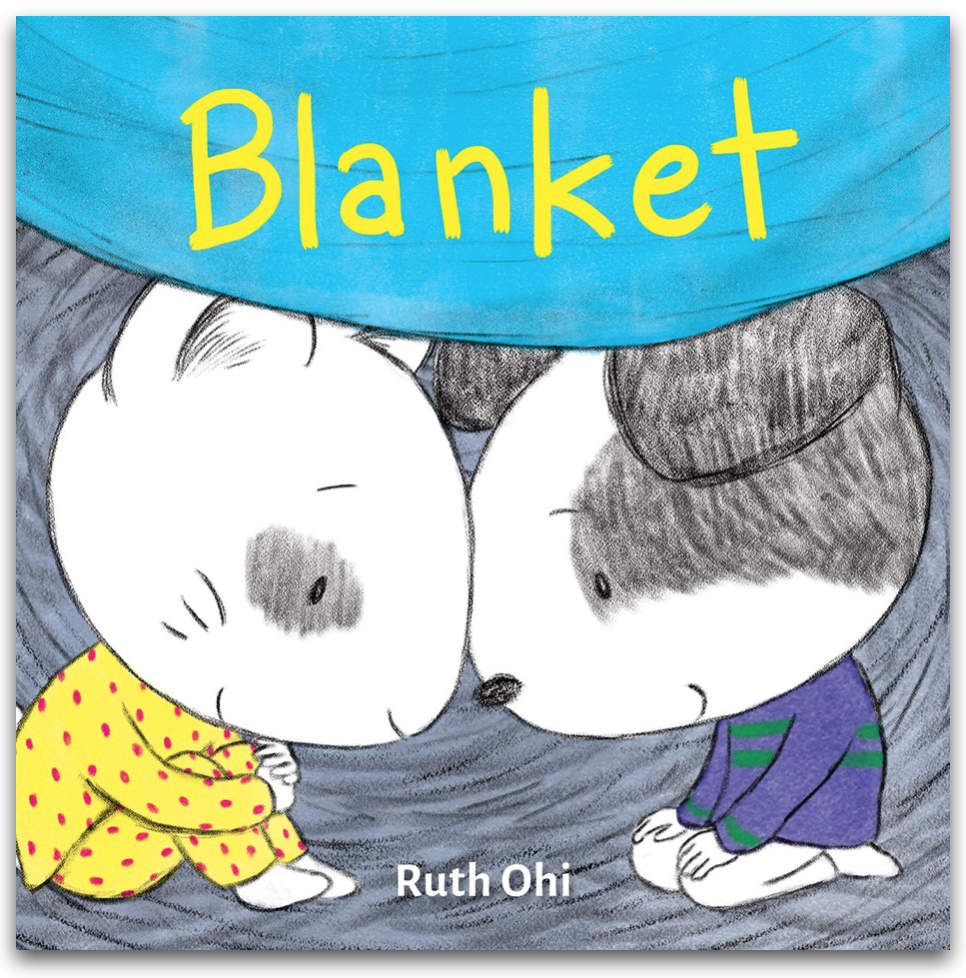
Readers and writers know the power of words. Words can evoke and reassure, anger and subdue, and enlighten and confuse. They can do it all, or it would seem. But sometimes words aren't needed for an impact to be made. Author and illustrator Ruth Ohi makes this subtle and powerful point with her first wordless picture book, Blanket.
From Blanket by Ruth Ohi
Sometimes it doesn't matter if it's sunny outside and the birds are chirping and the flowers are blooming. Inside, really deep inside, is where it can still be grey and that sunshine cannot reach. Yet.
From Blanket by Ruth Ohi
When Cat awakens to the grey inside, they take their turquoise blanket and burrow under it. When Dog shows up, they see the lump that is Cat beneath the blanket, but Dog does not demand anything of Cat. Dog sits down nearby and quietly reads. With time and still beneath the blanket, Cat snuggles over to Dog. Eventually, Cat lifts the blanket and allows Dog to enter and share their protected space.

It's obvious that, while the darkness beneath the blanket offers Cat security, it is also a place where fears can grow and take over. But Dog has a flashlight and the two play with the light before Dog suggests using the blanket to create a shelter over two chairs. It gives Cat the security they need but offers more light and something else. It's a first step to feeling safe enough to venture outside and transform the blanket from shield to shared comforter.
From Blanket by Ruth Ohi

While Ruth Ohi's charming animals are easily recognizable for their sweetness and emotional depth, Blanket is so different from her earlier picture books because of its wordless nature. I've always been delighted with Ruth Ohi's books (e.g., No Help Wanted; Fox and Squirrel, The Best Christmas Ever; Kenta and the Big Wave); still, Blanket is so impressive in its story and messaging that it will sit with me for a very long time. (Though I love sharing books with others, I'll be holding on to Blanket for myself.) Blanket reminds us that, if someone is dealing with sadness or depression, it is not up to others to decide how to help them. When an individual is dealing with an internal greyness, everyone wants to help but seldom–only in dire circumstances–should another decide what is needed. Dog knows this. With time and patience, a flashlight and some playfulness, Dog is able to offer Cat opportunities to come out from the shadows of the blanket. It's still up to Cat when they are ready to move from beneath the blanket into the light. And with few colours and strategic lines of smiles and eyes that are dim and then bright, Ruth Ohi tells us all this in her moving illustrations. Even in the darkness of Cat's sadness, Ruth Ohi has given us light through her art.

A blanket can be so much more than a coverlet for a bed. It can be shelter and armour, defense and offense, and love and fear. It can hide and reveal. This is Cat's blanket. It offers them the opportunity to hide from the world but also reveals Cat as they are to Dog. There is power in that blanket for good and I'm so glad that Cat used it as they needed and that Dog was there to take their cues from Cat.