April 17, 2023

I Am Not a Ghost: The Canadian Pacific Railway

Written by David Bouchard with Zhong-Yang Huang
Illustrated by Sean Huang
Plumleaf Press
 ‎978-1-778242816
40 pp.
Ages 7-12
May 2023
 
While the building of the Canadian Pacific Railway in the 1880s was considered an achievement in connecting eastern Canada with British Columbia, its history is clouded in infamy. From its treatment of Chinese workers to the expulsion of First Nations from their lands, the construction of that national railway is a bigger story and one made up of many. I Am Not a Ghost is one story.
From I Am Not a Ghost by David Bouchard with Zhong-Yang Huang, illus. by Sean Huang
Granddaughter, you and your children must know this story, and you must remember. (pg.9)
 
As a grandfather remembers, he recalls the hardship of finding work in China and leaving his family to find a better life. But what he found were tireless working conditions, hunger, cold and the bigotry that had the white men calling every Chinese man by the name Johnny. Still, he persisted, hopeful of a prosperous future, eventually saving enough money to send for his wife and son.
From I Am Not a Ghost by David Bouchard with Zhong-Yang Huang, illus. by Sean Huang
When he falls ill, laying in the snow as if already dead, and is ignored by the foreman, Lady Amelia Douglas, the visiting wife of the late Governor of BC, comes to his aid and demands he be taken to her home in Victoria. Although the men at the camp tell his family he has died, Mrs. Douglas gets him medical attention and, once she learns of his family days later, brings them to him. After several weeks, his family returns to Chinatown and he to the railway.
From I Am Not a Ghost by David Bouchard with Zhong-Yang Huang, illus. by Sean Huang
But, upon his return, his countrymen are aghast, convinced they are seeing a ghost. He has to persuade them with the words of the book's title that he is not a ghost and recounts the goodness and compassion of Mrs. Douglas, a Métis woman, who was their friend like other Indigenous people. 
 
Because of the kindness of Mrs. Douglas, he was able to survive the building of the railway, build a business and extend kindness to other Chinese immigrants, helping to grow a compassionate and vibrant community.
From I Am Not a Ghost by David Bouchard with Zhong-Yang Huang, illus. by Sean Huang
Non-fiction books that teach history, especially those used in schools, tend to be verbose and comprehensive, skimming over many topics, using dense text, and leaving no memorable impression. I Am Not a Ghost is not such a text. By focusing on the immigrant experience of one Chinese Canadian in the 1880s, Victoria's David Bouchard with Regina's Zhong-Yang Huang effectively place young readers into the treacherous life of working on the railway as a Chinese immigrant in the 1880s. The toil, the racism, and the unfairness of conditions and treatments all speak to oppression and perseverance in that oppression. The story of this man is heartbreaking and very real, as is the true story of the building of the railway and Mrs. Douglas with her  compassionate nature. ("Historical Notes" at the end of the book give further details about the context for the story of I Am Not a Ghost.)
 
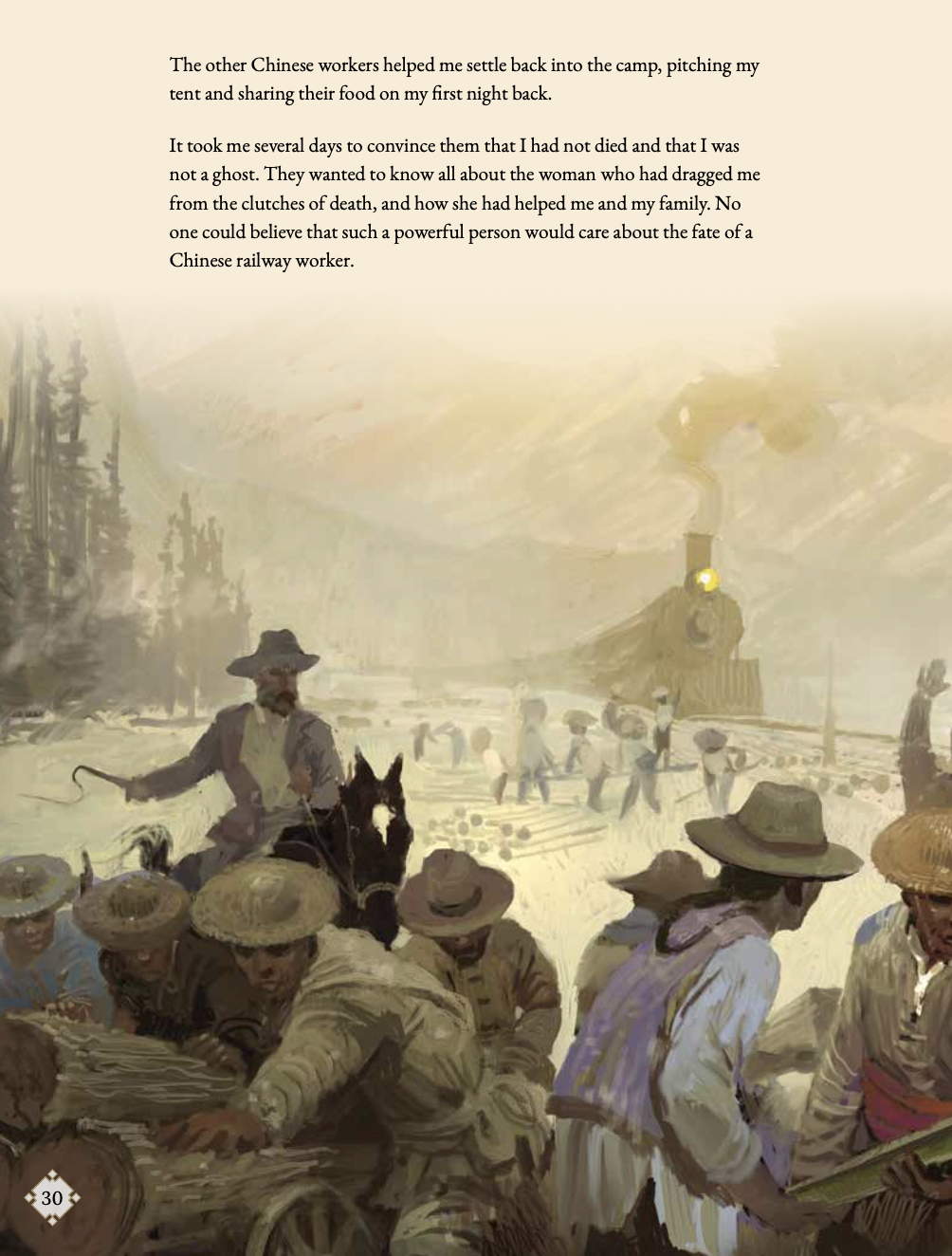
With the seriousness of the story and the realism of a historical narrative, the art of Sean Huang adds to the story, taking us from frozen landscapes of workers in canvas tents or collapsed in snowbanks, to the opulence of a fine lady's Victorian home, to the busyness of countless workers on the railway. Combining both a heaviness and lightness to his brushstrokes and the classic palette of old masters, Sean Huang takes us into the past of David Bouchard and Zhong-Yang Huang's story, and tells a history where a man is disregarded because of his heritage and taken for dead because he might not have mattered enough to be helped.

If you're a teacher of Canadian history for young people and want a fresh take on the building of the railway, I Am Not a Ghost provides a very personal story that goes beyond the placement of that last spike and reminds us that achievements are often on the backs of others who should be recognized and their stories told.

April 15, 2023

Garden Wonders: A Guidebook for Little Greeen Thumbs (Little Explorers Series)

Written and illustrated by Sarah Grindler
Nimbus Publishing
978-1-77471-143-9
32 pp.
Ages 4-8
March 2023
 
While many in the US were celebrating National Gardening Day yesterday (April 14), our own National Garden Day takes place on the Friday of the week of Father's Day so June 16, 2023. Still, I'd rather not wait another two months to share Sarah Grindler's picture book Garden Wonders with its sweet illustrations and lessons about how to garden, from what to grow and what is needed to help plants grow.
From Garden Wonders: A Guidebook for Little Green Thumbs by Sarah Grindler
Whether you're on the west coast, as is author-illustrator Sarah Grindler, on the prairies, on the east coast or in an urban setting, a rite of spring is preparing a garden. It might be a large vegetable plot, or flower cutting garden, or perhaps containers of herbs for culinary endeavours. Regardless, starting a garden and sustaining it is pretty much the same.
From Garden Wonders: A Guidebook for Little Green Thumbs by Sarah Grindler
After taking us through the garden gate of her garden, which including a lovely tabby cat, Sarah Grindler starts with explaining the need for soil and the components that help things grow. She discusses nematodes and moisture, aeration and ensuring sufficient nutrients and minerals. 

Next, she discusses the planting of seeds for successful germination, giving helpful tips about watering and a visual example of how to plant. Sarah Grindler also delves into perennials, biennials, and annuals; veggies that are root vegetables or leafy greens; and all the creatures, both beneficial and harmful, that might be found in a garden.
From Garden Wonders: A Guidebook for Little Green Thumbs by Sarah Grindler
Garden Wonders: A Guidebook for Little Green Thumbs has a very retro feel to it, both in its text and illustrations. There is a nostalgic feel to the picture book, reminiscent of Little Golden Books, which relied on traditional storytelling rather than cartoons, sauciness, or issues-driven tales. Sarah Grindler's picture book is to inform but she does it with colour, using watercolour and more, and gentleness with the reality of her art and the modesty of her words. 
There are so many types of amazing gardens.
Creative gardens are everywhere, and you don't
need a lot of space to plant your very own.

What would you like to grow?
She's encouraging while thoughtful, understanding the breadth of opportunities–some limited, some vast–that young explorers might have to growing a garden. And, with an offering of several gardening projects for kids to try,  Sarah Grindler takes us into the garden to learn and grow in a calm and unassuming way.

• • • • • • •
 
If your little explorers might like to venture out into the forest or the seaside as well as the garden, I might recommend the other books in this series from Sarah Grindler.

Seaside Treasures: A Guidebook for Little Beachcombers 
(Nimbus, 2019)
Forest Magic: A Guidebook for Little Woodland Explorers 
(Nimbus, 2021)
Garden Wonders: A Guidebook for Little Green Thumbs 
(Nimbus, 2023)

April 12, 2023

Otis & Peanut

Written by Naseem Hrab
Illustrated by Kelly Collier
Owlkids Books
978-1-77147-496-2
80 pp.
Ages 6-8
April 2023

Otis is a long-haired guinea pig. Peanut is a naked mole rat. And they are as different in their personalities as they are physically. Yet, they are the best of friends, being for the other what they are not easily themselves. Together, they will touch your heart and remind you that diversity gives the world a soul.
From Otis & Peanut by Naseem Hrab, illus. by Kelly Collier
Told in three graphic stories, author Naseem Hrab, recent finalist for the Governor General's Literary Award for Weekend Dad, introduces us to her unlikely friends Otis and Peanut. In the first story, The Haircut, the two set off for the barbershop to get Otis a much-needed haircut. Unfortunately, their fears about the process and what they might look like causes them much anxiety. As Peanut tries to help Otis embrace change, Peanut realizes that they too would enjoy change. While that could be a new hat, a new coat, and new shoes, it might include a new friend. Fortunately, with a haircut, Otis becomes that new friend!
From Otis & Peanut by Naseem Hrab, illus. by Kelly Collier
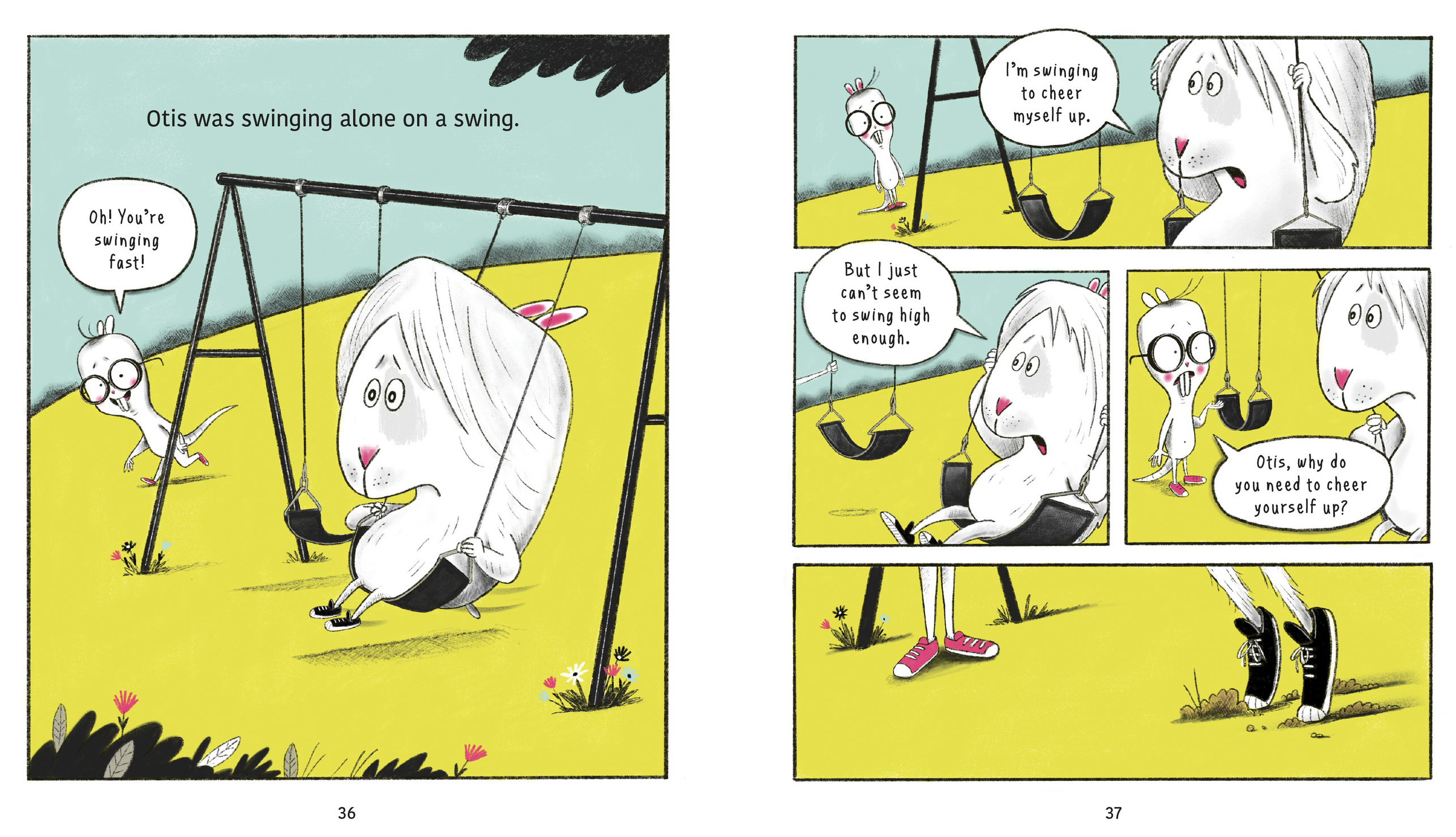
The Swing is the second story in the book and focuses on Otis missing their friend Pearl. As Otis tries to subdue the sadness that keeps him from enjoying a swing, Peanut recognizes that recalling the good memories of Pearl is important, as is accepting that grief and joy can coexist.
From Otis & Peanut by Naseem Hrab, illus. by Kelly Collier

In the final chapter titled The House, Otis is decorating their new house to make it a true home. 

"Well, I want to feel like my heart is here. So I'm painting it my favorite colors. And putting special things inside of it and outside of it."
From the front door to the lilac bush, Otis has reminders of friends that make the house truly his. But when there still feels like something is missing, Peanut becomes the solution.

There have been many comparisons of Otis and Peanut to the celebrated Frog and Toad as a duo of friends that learn from their interactions with each other and others. But I think Otis and Peanut are far more diverse both in their appearance and their demeanors. Naseem Hrab has made Peanut the confident and extroverted character, eager to take on change and challenges, while Otis is more sedate and thoughtful, more sensitive to their feelings and surroundings. But both are capable of expressing themselves beyond those personalities, with Peanut showing compassion and insight beyond what might be expected of an exuberant extrovert and Otis able to enjoy things beyond self and feeling. Through their self-expression and Nassem Hrab's storytelling, Otis and Peanut have loads to teach young readers about friendship, grief, change and self.

Those important lessons come by way of a lightness of text and art. Kelly Collier–whose Steve the Horse series was reviewed here–illustrated this early graphic novel digitally and yet it has the delicacy of ink and watercolour. Surprisingly, the economy of her palette brings a boldness to the illustrations. While Otis and Peanut are essentially black and white with only the barest hints of pink for ears and nose and such, Kelly Collier saves the chartreuse yellow, pale turquoise and bright pink for backgrounds and large swaths of coats and furniture and such. It is a limited palette but it's fabulous to highlight Otis and Peanut, the stars of the stories.

It's tough to write an early reader that doesn't talk down to kids while addressing big issues like grief and friendship and home. But Naseem Hrab has done so with her words and, with Kelly Collier's graphic novel illustrations, Otis & Peanut is sure to be a hit. And, since this is only Book #1, there will be more stories with which we can visit Otis and Peanut, and I look forward to all of them.

April 10, 2023

The Song That Called Them Home

Written by David A. Robertson
Illustrated by Maya McKibbin
Tundra Books
978-0-7352-6670-4
52 pp.
Ages 4-8
April 2023
 
A day out with their Moshom becomes a supernatural experience when a child must enter the world of the Memekwesewak to rescue her little brother.
From The Song That Called Them Home by David A. Robertson, illus. by Maya McKibbin
During a trip to the land with their grandfather, Lauren and her little brother James head out in their canoe to fish while Moshom takes a nap. But after stirring up the waters to attract the fish, the waters become violent, and the kids are tossed into the lake.
From The Song That Called Them Home by David A. Robertson, illus. by Maya McKibbin
When Lauren resurfaces, she sees the Memekwesewak, or Little People, dragging her brother beyond a waterfall. Following, Lauren discovers a portal to their world where the Memekwesewak dance with James around a fire and sing a song to keep him with them. Things worsen when Lauren tries to release him from their supernatural bindings, and she too is ensnared. Only when a song from their own world penetrates and beckons them home do the kids return to their Moshom.
Come back! You've been gone so long!
What places have you found to roam!
Come back! Hear my welcome song!
My beating drum will guide you home!
Governor General's Literary Award-winning author David A. Robertson tells his best stories when he reaches into the stories of his family and people, as he has done here with his father's story of an encounter with the mischievous Memekwesewak. Perhaps that is why the story of The Song That Called Them Home seems so believable. It is rooted in the ordinary, in an outing with a grandfather who takes a nap as the children fish. What happens when they fall in the water, though, is perhaps the stuff of legends and the supernatural. But, as David A. Robertson's "Author's Note About the Memekwesewak" tells us, perhaps this part of the story is just as real. Regardless, this story reminds us that when we're lost, whether to the surreal or the dangerous, there is hope that those who love us will call us home and we will hear them. The threatening voices of the Memekwesewak, or contemporary dangers of risky behaviours and unsafe friendships, may seem unyielding but there are those who would guide us back to safety, as does Moshom with his song and drum.
From The Song That Called Them Home by David A. Robertson, illus. by Maya McKibbin
That ordinary and extraordinary is conveyed in the art of Maya McKibbin, an Ojibwe, Yoeme, and Irish-settler artist who illustrated the Governor General nominated Swift Fox All Along. Maya McKibbin's digital art transitions from the calm and comfort of family and the land and water to that of the turmoil of the Memekwesewak's world. They plunge us into the danger and the fears associated with the Little People through their use of line and shape as well as colour, emphasizing the wildness and the uncertainly that comes with the rush of the Memekwesewak, pasty creatures with purplish ink and long pale hair. Still, if you're worried about little ones being frightened, don't be. Maya McKibbin does not play up the fearful elements; instead, they emphasize the bonds of family and connection in Lauren and her brother, and the strains of a drum beat that can "Thum Thump" to draw them home.
 
While a story based in an Indigenous legend of the Little People, The Song That Called Them Home speaks to everyone. I can only hope that everyone will always have a song to call them home and the heart to hear it.

April 08, 2023

The Weird Sisters: A Robin, a Ribbon, and a Lawn Mower

Written by Mark David Smith
Illustrated by Kari Rust
Owlkids Books
981-1-77147-459-7
93 pp.
Ages 7-10
April 2023

They're back! The Weird Sisters of Mark David Smith's early middle grade series are back in their second book, creating mayhem with their magic and their misinterpretations to solve their newest mystery: who vandalized the local tire swing?
From The Weird Sisters: A Robin, a Ribbon, and a Lawn Mower by Mark David Smith, illus. by Kari Rust
The three sisters, Hildegurp, Yuckmina and Glubbifer, who opened their pet emporium and detective agency in the first book in the series–The Weird Sisters: A Note, a Goat, and a Casserole (2022)–are lamenting their lack of business with their young neighbour Jessica who is missing going to school during the summer holidays. When the girl offers to teach them how to use the tire swing to cheer them up, they discover the rope frayed and the tire useless on the ground. They enlist the help of their friend Officer Nazeri who takes them to see Mayor Ronald Bombast who is desperate to attend another ribbon-cutting ceremony and deputizes the group to solve the crime. But there always seems to be another mystery in Covenly and the sisters and their friend are also drafted to help Chelsea Oh attract her local robin who'd been chased off by the Weird Sisters' cat, Graymalkin.

Following a promising lead involving their neighbour Cosmo Keene, creating a love potion for an unlikely pair, and enhancing the power of a souped-up lawn mower, the Weird Sisters and Jessica get to the bottom of the latest Covenly conundrums.
From The Weird Sisters: A Robin, a Ribbon, and a Lawn Mower by Mark David Smith, illus. by Kari Rust
Young readers who are transitioning from early readers to middle grade will appreciate the humour, the plotting and most definitely the characters in Mark David Smith's The Weird Sisters series. With a trio of wacky sisters who want to do good, a young girl who offers a bit of normalcy (though she does have a pet goat), and all manner of secondary characters who do everything from cook seed cakes for robins and are passionate about cutting ceremonial ribbons, there is much to tickle the funny bone. And, for me, the humour is paramount, especially when it revolves around idioms and the sisters' misinterpretations of them. Idioms are often tough for young children to appreciate so they will laugh at the Weird Sisters' confusion about giving someone a lift (we know superhuman strength is unnecessary), going undercover (blankets also needless) and being blue (which does not involve the colour or dye). Coupling the strong storytelling and amusing voice of Mark David Smith's text with a splattering of Kari Rust's quirky black-and-white illustrations, The Weird Sisters: A Robin, a Ribbon, and a Lawn Mower takes us for a wild and loony ride, with or without the swing or lawn mower for conveyance.

April 05, 2023

Standing on Neptune

Written by Valerie Sherrard
DCB
978-1-77086-687-4
160 pp.
Ages 13+
April 2023

Brooke Wells's story begins with an important line:

…this is about what happened (pg. 1)

But the seventeen-year-old explains that it’s only a moment in her story, not her whole story. It's less than a week, in fact, but a monumental one of a secret, hidden beneath the facade of being a daughter, a sister, a girlfriend, a friend and a classmate. It's a moment and one that may, or may not, change her life.
 
x + y = -5 is the equation Brooke envisions for her situation on the Monday of her story. What this means is she and her boyfriend Ryan had sex and now her period is five days late. Standing in Neptune is primarily her story, told in free verse, as she comes to terms with what it means, who to tell, and what to do. While she grapples with the shock and enormity of the possibility of a pregnancy, Brooke is almost frozen in place, telling only Ryan and only in the briefest of terms. She sees his panic, his anger, his fear, and even hope, and, instead of supporting each other, Brooke becomes more aloof and distant. 

Her bestie Emma knows something is up, but Brooke lies, worried that Emma may let her secret slip. Brooke's nine-year-old brother Kevin can also see that she is distracted, but she denies it and lies to him as well. Her thoughts are her only support, though she finds a convenient distraction in a science project on Neptune. As she learns about the frozen planet, she finds parallels to her own situation, like how it was detected mathematically and what is visible and not visible.
Our shared truth, I suspect, is that
it too has secrets, hidden beneath
what can be seen.      (pg.79)
Like Neptune, with so much more to it than the obvious, Brooke is more than her relationships with others. She is more than Ryan's girlfriend or Emma's friend. She is holding in a secret that might impact her whole life. Or will it? The frozen blue planet of Neptune with its orbiting moons is easily recognizable but, like Brooke, there is much beneath the surface that is unknown. And, until she knows the truth, i.e., is she pregnant or not, she is frozen with inaction, with hesitancy to share, and projecting a facade that all is normal.
Perhaps I am simply frozen in place, afraid of
facing things, of
getting it wrong.      (pg. 99)
Novels in free verse are one of my favourite genres, packing so much emotion and storytelling in few but well-chosen words, structured for meaning. Valerie Sherrard, whose earlier novel in verse Counting Back from Nine (2013) was nominated for a Governor General's Literature Award for children's text, knows how to use the genre to tell gripping stories. She takes us into the thoughts of teens as they contend with issues of teen pregnancy, shaky friendships, blended families, insecurities, and self-awareness. There's a lot going on in Brooke's head, more than she reveals to others, and Valerie Sherrard lets us hear Brooke's thoughts. Though Ryan's point of view is occasionally shared in excerpts of prose, it is Brooke we hear. It's her perspective that is paramount in Standing on Neptune. Whether she is pregnant or not, or right or wrong in her choices is irrelevant. They are hers. And as she studies Neptune and sees herself as a lone planet with moons that orbit her, perhaps someday being torn apart by her gravitational force, Brooke still knows she's part of something far greater.

April 03, 2023

Afikomen

Written by Tziporah Cohen
Illustrated by Yaara Eshet
Groundwood Books
978-1-77306-606-6
32 pp.
Ages 3-6
March 2023
 
Soon the Jewish community will be celebrating Passover (April 5-13 this year) and many non-Jews know little of the traditions or stories that accompany the holiday. With no words, Afikomen invites us to attend a Passover Seder and witness Tziporah Cohen's family's traditions, but it also transports readers to ancient Egypt via time slip to witness Moses' beginnings.
From Afikomen by Tziporah Cohen, illus. by Yaara Eshet
As the family gathers at the table to read the Haggadah, the guidebook to the Passover Seder, i.e., the Passover religious service and dinner, the three matzah breads rest in front of the host. He takes the middle one, breaks it in half, and places the larger piece in a special bag to become the afikomen. The afikomen will be the last food eaten at the seder meal but, depending on the traditions of the family, the afikomen will play a big role before that end. In this family, the children "steal" the afikomen, and will return it for small gifts. First, though, these three children and their dog, hide beneath the table skirt and are transported to ancient Egypt.
From Afikomen by Tziporah Cohen, illus. by Yaara Eshet


There they become part of the Jewish story of the Exodus from Egypt, the basis for Passover. As Pharaoh had decreed that all Jewish baby boys were to be killed, Moses' mother saved him by placing him in a wicker basket and sending him down the Nile. The contemporary children witness this, and like Moses' sister who watches over him as he travels down the river, they ensure that he is safe from calamity like getting stuck in the reeds, taken by playing Egyptian boys, or accosted by a crocodile, so that he might be found by the Pharaoh's daughter and saved. It is only at this point that the children return to their own time and deliver the afikomen–with an unexpected twist–to end the Seder.
From Afikomen by Tziporah Cohen, illus. by Yaara Eshet
I knew so little of the story of Passover and nothing of the afikomen, so I am grateful to Toronto's Tziporah Cohen for giving us a wordless story and an extensive Author's Note to help educate. While a time slip story is unusual for a picture book and especially one with a non-fiction element, Tziporah Cohen makes it work. Not only did I learn about the afikomen and the Passover Seder, but I also learned that Jews of different origins, e.g., Ashkenazic and Sephardic, may differ in their traditions regarding the afikomen. 
 
Moreover,  I learned that even a holy celebration with a sombre history can have joy, and even playfulness. That comes through in Yaara Eshet's watercolour and ink illustrations which show us family who come together. The table laden with wine, the Seder plates, and texts, and the extended family members of varying ages makes for a colourful and textured display. With the expressive kids and dog, registering both the fun of stealing the afikomen and their surprise once dropped in ancient Egypt, as well as the bright landscapes of flowing water, golden sand, and lush riparian vegetation, Yaara Eshet gives a richness to the wordless story. Tziporah Cohen may give us story without words, but Yaara Eshet gives the content colour and texture, and together they give us a visual narrative that teaches and captivates.