June 15, 2022

A Day for Sandcastles


Written by JonArno Lawson
Illustrated by Qin Leng
Candlewick Press
978-1-5362-0842-9
48 pp.
Ages 4-8
May 2022
 
JonArno Lawson has the words, as his picture books like The Playgrounds of Babel and  Leap! have demonstrated, but he doesn't need the words. As his award-winning Sidewalk Flowers and now A Day for Sandcastles show us, his storytelling can go beyond text and, with the skill of an amazing artist like Qin Leng, a story rich in characters, activity and feeling is told.

From A Day for Sandcastles by JonArno Lawson, illus. by Qin Leng

It's a day at the beach for this family of five. As they disembark from a bus, mum and dad coming up the rear, the three children race to through the grassy dunes, arms raised in cheer. There's a red-haired girl in a red-striped bathing suit, and older brother in navy patterned board shorts and a small child in green T-shirt and yellow shorts. Having found the remnants of a washed out sandcastle, they retrieve their pails and shovel and begin to work on their own.
 
But, as focused as they are on their creative endeavour, beach life teems around them. There are the swimmers and the sunbathers, the runners and the volleyball players. There are older women and toddlers, lovers walking hand-in-hand, and friends taking selfies. And there's also the splash of water and a wind-blown sun hat that damage their multi-castle structure with moat, compelling them to take a break and join their parents for lunch.
From A Day for Sandcastles by JonArno Lawson, illus. by Qin Leng
The children, though, are determined and look to rebuild their sandcastle. Together they fill buckets, mould turrets and dig out shapes. Even a toddler who sits herself down in the midst of their creation does not deter them from their work and adding flourishes of shells, twigs and other found objects.
From A Day for Sandcastles by JonArno Lawson, illus. by Qin Leng

But time and a tide wait for no one, and the children's numerous efforts must ultimately be left behind as they take their weary and sun-kissed bodies back to the bus for the trek back home.

For those who know the pleasure of a day at the beach, whether outside their own door or a bus ride away, A Day for Sandcastles is a day of possibilities. It's a day filled with play and family togetherness, cooperative fun and creative building. It's enjoying the positives and accepting the setbacks as natural and moving forward–or backward from the tide!–to dream of what sandcastles might be. JonArno Lawson gives us a full day at the beach with the companionship of siblings and the quiet but never-failing support of parents. He gives us the promise of a wide-open day as they step from the bus and the satisfying fatigue of a day well lived. We're there for the lapping cool water, the mild frustration of an errant sunhat, and the warmth of the sun on our backs. It's a day bursting with life and JonArno Lawson has given it to us without words.

Of course, without Qin Leng's watercolour and ink artwork, we couldn't envision this beach or these children on this day. Her media are perfection for a day at beach, giving us the fluidity of splashing water, the summer bustle of a diverse group of people and animals on a beach, and the heat of a sun warming sand and people. Qin Leng's skilled artistry transports us to this beach with this family and these strangers to share in a day of outdoor recreation.

There is far too much in A Day for Sandcastles to share in a single review. It will be up to you to visit that beach with your own children, students or family, and discover the minutiae of one day with these people at this one beach to build your own sandcastles, with sand or otherwise.

June 13, 2022

Shadow Grave

Written by Marina Cohen
Roaring Brook Press
978-1-250-78300-4
288 pp.
Ages 8-12
May 2022
 
The trip to a New Hampshire bed-and-breakfast for twelve-year-old Arlo and his eight-year-old sister Lola with their mother for Thanksgiving is supposed to be a treat. With their father remarried with a new child and Mom dealing with health issues and Arlo managing anxiety, the family needs a break. And with money being an issue–they're driving Mom's old clunker of a car–everything is being done on a budget. But when something jumps into the road and they end up hitting a tree and totalling the car, their family trip takes an unexpected turn. 

The trio have no option but to seek help, especially as Mom's ankle may be broken and their one working cell phone cannot get a signal. Following the road that eventually becomes little more than a footpath, they reach the town of Livermore, an isolated community that almost feels deserted. In fact, when they finally get someone to open their door, the woman tells them, "You've come to the wrong place." (pg. 37) But Lovicia, with the urging of her young niece Hannah, lets them in and summons Doc Brown to tend to Arlo and Lola's mom. Everything's a little bit old-fashioned from the plaster cast Mom is given to the pot over a fire in the hearth but it's the lack of automobiles or phones that poses the greatest concern. And then Arlo hears some one say, "Leave now. While you still can." (pg. 46) With one last call to his Dad before their phone dies, the family is put up at the Samuels' B &B, a large mansion of Mr. Woodbridge Samuels, his young daughter Alice, and housekeeper Mrs. Hawthorn. They also meet all the community who join them for a Thanksgiving meal but, even though they are polite enough, Arlo feels the townspeople are somewhat reserved, perhaps even unwelcoming.
It was as though their warm smiles and formal manners hid their true feelings, like sweet perfume masks the stench of sweat. (pg. 87)
What their superficial politeness and old-fashioned natures hide is far more creepy than even Arlo and his family could anticipate, and whether or not they can get out of Livermore safely is part of the mystery of Shadow Grave.

Author Marina Cohen has always given us a little bit of creepy blended with the realism of family relationships, mental health, and more. With Shadow Grave, she again delivers us to a surreal world, this one the town of Livermore with its eerie inhabitants, time-frozen settings and dark unknowns, while integrating it with the familiar as Mom battles a life-threatening illness, Arlo struggles with his anxiety and the whole family is challenged with rebuilding after divorce. So while Marina Cohen has given us another solid middle-grade horror novel (check out my favourites The Inn Between, The Doll's Eye and Chasing the White Witch),  Shadow Grave has infused a story with ghost-like entities, monsters, and unknown dangers with the reality of a family's challenges, thereby also drawing in readers with the fears of every day life. She reminds us that some times the terrors we feel are both familiar and alien. 

Enter Livermore with caution. There are monsters of different kinds but, if you face them as Arlo does, with positive thoughts, trust and family, you may just get out alive.


June 08, 2022

Me Three

Written by Susan Juby
Puffin Canada
978-0-735268722
224 pp.
Ages 10+
March 2022 
Reviewed from audiobook

Rodney's dad used to be famous as the author of the best-selling poker book Get Lucky and the host-poker player of Get Lucky TV who took celebrities to high-stakes poker games. Now it's because of accusations by Missy Stephenson of inappropriate behaviour. Eleven-year-old Rodney believes his dad when he says it's all a misunderstanding but his father is still at a facility, apparently to help him deal with how it feels to have his actions, like hugs, misconstrued. Meanwhile, Rodney, his older sister Kate and their mom, now using Mom's maiden name, have moved from the opulence of their life in Las Vegas to the small home of cousin Maria in Stony Butte, Arizona, four hours away.
From Me Three by Susan Juby
Rodney is desperate to connect with his best friend Larry, the son of Get Lucky TV's producer Isbell, but all his texts, etc. have gone unanswered. So Rodney writes unsent letters to Larry to tell him about life in Stony Butte and about trying to fit in and make friends. But Rodney has a lot to learn about navigating a new school that is very different from his private school Circle Square. He tries to follow Dad's "10 Rules for Living a Lucky Life" but it doesn't always work. That's especially so when Kate, who is furious with her father and believes her brother is in denial about their father, is losing weight and obsessed with her food consumption. And their mother has to take a job at an insurance company and teach Pilates in her off-hours so they can afford anything extra. And he really misses his old friend and has to keep his old life under wraps though he looks forward to when things will be back to normal.

Then things start to look up. He makes friends with Ben who comes from a family of stunt people and who gives Rodney his first taste of danger. Rodney also begins to hang out with a few other kids including Rigmor and Fisherman and Dave. But when popular Van Johnson, a wild man YouTuber, performs a song about J. Crederman and the allegations made against him, and a classmate discovers an online photo of him with Rodney, the family is devastated with being exposed and with the negative attention.
My emotions felt tired out. Like someone smeared all the colors together and now I just felt muddy.
In a time of #MeToo and social media, Susan Juby has given young readers a new perspective, taking us into the head and heart of a child whose father has been accused of sexual harassment and perhaps worse. (Details are suggested but never revealed.) Rodney's dad is a jerk, caring more about his brand, his reputation and the impact on his finances, though he is learning to say all the "right" things, but he's squirreled away in a treatment facility while his family is forced to live in diminished circumstances and under a cloud of shame and acrimony. Rodney, Kate and their mom are the heroes of their own lives, getting on with things, regardless of the "power shamer" J. Crederman. They're learning to balance the past with their present circumstances, even if Kate has become "a Death Star of bad mood." Wisely, their mom tells them that...

The best thing you will ever learn is to deal with what is versus what you wish was.

Sexual harassment and abuse are heavy topics for a middle grade novel but even more so when allegations are made involving a parent. Still Susan Juby keeps her story balanced with humour and candour. The honesty is in the plot and the humour comes through her characters. Both Rodney and Kate are cheeky and have a dry, almost dark, humour. He groans at her fashion sense–"Kate dresses like she wants to hurt people's eyes"–and she can laugh at their situation, claiming that "What doesn't kill you makes a better Instagram poet." But I would expect nothing less from Susan Juby who has won the Stephen Leacock Medal for Humour. She makes us laugh while she makes us think and feel. 

Though the full extent of the sexual abuse perpetrated by Rodney's father is unknown, it is the driving force behind the story of Rodney, Kate and their mother in Me Three. But by making Rodney the focus of the story and giving him the voice of a child who develops from one completely in support of his father to one who wants to know the truth and then hears his father's words as sound bites of rationalizations and mandatory apologies, Susan Juby gives us a different viewpoint. She lets us lace up a pair of Rodney's shoes and deal with the aftermath of his father's misconduct as he, Rodney, experiences it, with a loss of friendship, security and support in the shadow of shame and secrecy, and yet still able to come out with a solid support system of family and friends.

June 06, 2022

Una Huna?: Ukpik Learns to Sew

Written by Susan Aglukark
Illustrated by Amiel Sandland and Rebecca Brook
Inhabit Media
978-1-77227-433-2
36 pp.
Ages 5-7
June 2022
 
After Ukpik's father (ataata), uncle and cousin return from a hunting trip with five caribou, the child's mother enlists her help in preparing the furs for a special project. Though she doesn't know what the special project will be, Ukpik is delighted to be part of something that will include some beads (sunguajait) that her anaana had been saving.
From Una Huna?: Ukpik Learns to Sew by Susan Aglukark, illus. by Amiel Sandland and Rebecca Brook
First, Ukpik is told get the ulu her grandfather (ataatatsiaq) had made for her as she would help with the cleaning of the skins. She is instructed on how to remove incidental fat and how to be careful with the sharp tool. Later the skins are stretched out and pinned to the ground to dry.
From Una Huna?: Ukpik Learns to Sew by Susan Aglukark, illus. by Amiel Sandland and Rebecca Brook 
As they wait for the skins to dry, Anaana allows Ukpik to work with the beads forming a pattern. After the skins are dry, Anaana teaches Ukpik how to soften the skins by tromping on them and also using a sakuut

For practise, Anaana cuts pieces according to a pattern for Ukpik and her friend Qopak to learn to sew mittens. When it becomes evident that the girls are becoming fatigued, Ukpik's anaana reminds her that:
You must begin your lessons now so you know how to do the right stitches for each pattern. The size and shape of the stitches matter, Ukpik, and to get these right, you must practise. (pg. 25)
From Una Huna?: Ukpik Learns to Sew by Susan Aglukark, illus. by Amiel Sandland and Rebecca Brook
It takes days of patience and meticulous work to prepare the skins so that they might be fashioned into clothing, and it's a skill that connects Ukpik and Anaana and others with their ancestors. Anaana and Ataata recognize that the world for Ukpik and her peers is changing (the earlier book Una Huna?: What is This? relates the introduction of new tools to the community from the south) but that skills like sewing and skin preparation are lines of kinship that will link them with their heritage forever.  
 
Author Susan Aglukark is perhaps best known as an award-winning Inuk singer-songwriter but her Una Huna? picture books take us to a northern Indigenous community in a different way, perhaps to see what growing up there might have been like for her. Una Huna?: Ukpik Learns to Sew reminds us that learning is happening constantly for children and especially for this Inuk child who wants to know and to discover all that she can. Una Huna? translates to "What is this?" and reflects Ukpik's inquisitive nature and desire to understand the nature of her people's ways of living while still being a kid who likes to play with her friends and puppy on the tundra. And, for most readers, Una Huna?: Ukpik Learns to Sew will be an introduction to traditional skills of the Inuit in addition to their language (a glossary with Inuktitut pronunciation guide is provided), making this picture book another culturally relevant book from Inhabit Media.
 
The illustrations by Amiel Sandland and Rebecca Brook are both playful and informative, striking the right balance for young readers who will learn but be entertained by the artwork. Amiel Sandland has always been astute at keeping the art simple enough for children to get the essentials of the details without overloading them with insignificant fluff. As such, the illustrations give us the starkness of the tundra and the straightforwardness of living as Inuit on the land while emphasizing an ancestry of significance.
 
Una Huna?: Ukpik Learns to Sew is an endearing recollection of the learning of traditional skills from a parent who is both patient, wise and loving.  It's about being at the crossroads of past and future, connecting to one's heritage but seeing what that might mean for later. It's a big story told skilfully with the essence of the Inuit at its core.

June 03, 2022

When I Listen to Silence

Written by Jean E. Pendziwol
Illustrated by Carmen Mok
Groundwood Book
978-1-77306-254-9
32 pp.
Ages 3-6
April 2022
 
Listening to silence may seem like an oxymoron. After all, how can one hear the absence of sound? But Jean E. Pendziwol understands the distinction that is silence in our world and gives children a perspective on something which may often be lacking and underappreciated because it leads to greater voice and joy.

From When I Listen to Silence by Jean E. Pendziwol, illus. by Carmen Mok
As her mom struggles to work at the dining room table, a sight not uncommon to many during this pandemic, a child is asked to "Please, be quiet!" And so the child sits still and silent. But what happens when she's silent?
From When I Listen to Silence by Jean E. Pendziwol, illus. by Carmen Mok
First, she can hears that which would seem inaudible: the trees breathing. Not only do they breathe, they dance. And bears join them in the dance. But that awakens a dragon!
From When I Listen to Silence by Jean E. Pendziwol, illus. by Carmen Mok
The child is no longer just a listener; she is a participant. She is a musician, a passenger on a bird escaping the dragon's breath, and then on a steed with a knight flying to the moon. They cross an ocean of stars, end up on a pirate ship and have to be hushed by a pair of mermaids that look like her mother. Finally, the story comes full circle as it's time for the child to nap, with the whales, and she is compelled to ask her mother for quiet.

There is a profoundness and whimsy when you listen to the silence. It comes from heeding important messages about self and this child is able to take herself into her imagination with that silence. Jean E. Pendziwol shows young readers the wealth and breadth of play that can come from nothing but the imagination, when silence gives way to creativity and fantasy. Away from the noise of a TV, tablet or other riotous devices that take away the opportunity for self-directed play, this child grows and travels and experiences the fancies of being whatever she wants.
 
Carmen Mok's illustrations, rendered in gouache, India ink, dry pastel and colour pencil, take readers from the reality of an indoor room to the surreal of the forest of dancing trees and bears, across the sky and into space and onto the ocean, all from the perch of a child's imagination. The realism of a house with a mom on her computer with a cell phone at her ear, and a child playing with her toys on a window seat in her mom's view, is very honest and a foundation for the child's imaginative play. Her playthings become dancers, a mount and a pirate ship; stars, shells and plants in the decor become part of her landscape; and the toys like the drum and ukulele help her take part in her vision. Carmen Mok gives these imaginative scenes an ethereal feel, bright with the horn-playing moon, the shimmy of a river of stars, and the energy of a pirate ship resplendent in pinks and greens and yellows.  
 
Jean E. Pendziwol and Carmen Mok may show us that this child's play is all in her head but it's robust in colour, spirit and fancy. And it all comes from the power of silence.

June 01, 2022

Linty: A Pocketful of Adventure

Written and illustrated by Mike Shiell
Kids Can Press
978-1-5253-0494-1
64 pp.
Ages 6-9
May 2022

What kind of a life does a piece of lint have while tucked into the corner of a pocket, ignored by all, and oblivious to much? Well, author-illustrator Mike Shiell takes us deep into that pocket to find out.
From Linty: A Pocketful of Adventure by Mike Shiell
Day after day, a piece of link in the front pocket of a pair of jeans wakes up, does some cardio and some sightseeing and plays Solo Marco Polo. They are days of limited activities but it's all he knows. Then one day, the old jeans are passed on to a younger brother and everything changes for the amorphous lint.
From Linty: A Pocketful of Adventure by Mike Shiell
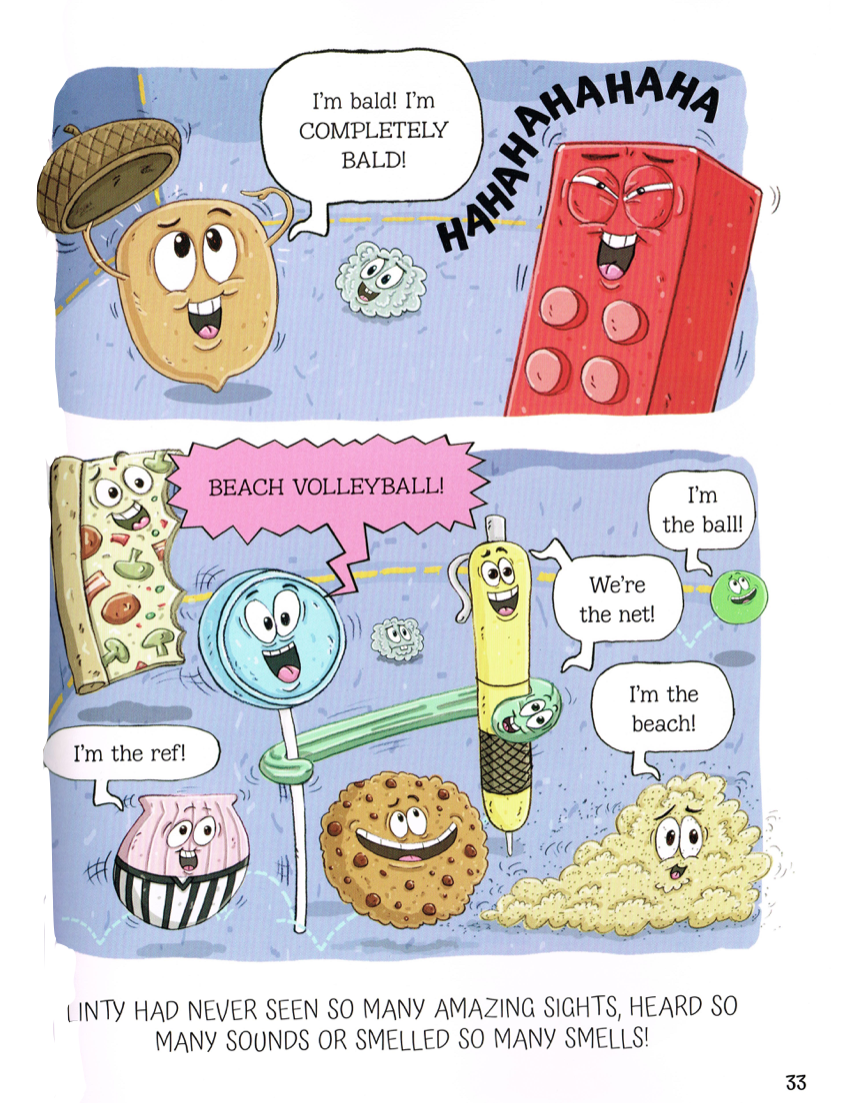
For the first time in forever, the piece of lint is joined by other entities. There's an acorn, a lollipop, a bottle cap, food and more. They give him the name Linty and want to know about him so he shows them what he does. In fact, they turn his game of Solo Marco Polo into a game for all and Linty declares it the best day of his life.
From Linty: A Pocketful of Adventure by Mike Shiell
Then Wash Day, something with which Linty is unfamiliar, arrives and everyone else is vacated from the pocket but Linty chooses to stay behind. After a tumultuous wash and dry–with a dangerous encounter with a lint trap–a fluffier Linty is missing his friends. Still he finds a way to get past his fear and look beyond his world in a new way to reconnect with them.
 
I've only known Mike Shiell from his illustrations in the non-fiction series Gross Science by Edward Kay and from his illustrations in Caroline Adderson' s Jasper John Dooley series so I'm so pleased that he's letting his own quirky and lighthearted writing shine along with his artwork in this early graphic novel. Mike Shiell blends a simple but cheeky story with playful artwork which will be enjoyed by early readers, ages 6-9, who are reading on their own but enjoy the illustrations that come with graphic novels. I'm sure they'll pick up on the pickle socks and cow underwear in the wash, the broken mustard packet joining Linty in the pocket, and the mess of a child's room. Most significantly, they'll have a different perspective on everything from what they put in their pockets, to the force of a washing machine and dryer, and even playing Marco Polo. In fact, I can just imagine wonderful lessons that could come with children delving into their own pockets. So, not only will young ones be entertained and laugh with Linty and his new friends, Linty: A Pocketful of Adventure will have them thinking about what's at the bottom of their own pockets and speculating about how that lint and other things spend their days there.

Marco?

May 30, 2022

Hungry for the Arts: Poems to Chomp On

Written by Kari-Lynn Winters and Lori Sherritt-Fleming
Illustrated by Peggy Collins
Fitzhenry & Whiteside
978-1-55455-466-9
32 pp.
Ages 5-8
March 2022

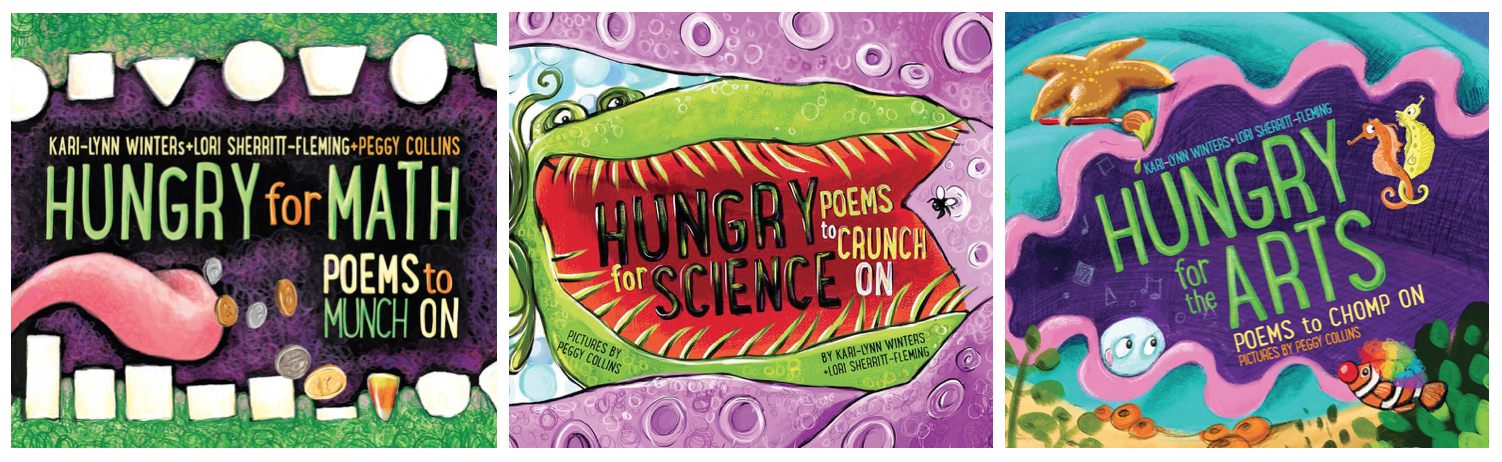
From the creative team that brought us Hungry for Math: Poems to Munch On and Hungry for Science: Poems to Crunch On comes a new book of lively poetry based in the arts of drama, music, dance and visual arts. 

From Hungry for the Arts: Poems to Chomp On by Kari-Lynn Winters and Lori Sherritt-Fleming, illus. by Peggy Collins
Colour-coded to organize the poetry which can span several pages–orange for dance, green for drama, turquoise for music and purple for visual arts–authors Kari-Lynn Winters and Lori-Sherritt-Fleming take young readers onto the stage and into the studio to find ways to express themselves. They are encouraged to...

Munch on motion
Chomp on play.
Chew on chants.
Eat ARTS all day!
And to...
Choose buffets or a-la-carte.
Music,
  dance,
    drama
      art!
From Hungry for the Arts: Poems to Chomp On by Kari-Lynn Winters and Lori Sherritt-Fleming, illus. by Peggy Collins

There's the poem called "Those Cats Can Play" which has a quartet of felines improvising with a variety of notes and "A Little More Forte" in which an elephant and a house mouse must learn about forte, piano, decrescendo and crescendo. In the dance poems, identified by the orange dot in the corner of the first page, some dinosaurs disco, tango and hip hop their way across the dance floor ("Dinosaur Dance Floor") while in "The Whammy-Roo" a child in a wheelchair introduces her friend to her new dance.
From Hungry for the Arts: Poems to Chomp On by Kari-Lynn Winters and Lori Sherritt-Fleming, illus. by Peggy Collins

In the drama poems that include  "When I'm" and "A Dramatic Ride" kids try out movements, improvise with costumes and perform, imaging themselves as anything from a roller coaster to a tiger and a pirate. And the poems based in the visual arts are just as colourful and entertaining, encouraging young readers to think about textures and shapes and create from found objects. In the thirteen poems in the book, Kari-Lynn Winters and Lori Sherritt-Fleming introduce children to new terms–a snappy glossary summarizes this new vocabulary–and encourage them to explore the different art forms with some playful poems that may or may not rhyme.

From Hungry for the Arts: Poems to Chomp On by Kari-Lynn Winters and Lori Sherritt-Fleming, illus. by Peggy Collins
Peggy Collins, whose book Harley the Hero recently won the Forest of Reading's Blue Spruce Award, brings the joy of making art to the page. Her own artwork bursts from the story in an explosion of life through her use of colour and shape and line. There are no wallflowers in Hungry for the Arts. Every poem is animated with animals and children, robots and activity. As the creators make art, through their singing, their dancing, their performance and their displays, readers will learn from the words and the play.

We've munched on poems, crunched on poems and now we get to chomp on them too. With the rhythm of the music, the step of a light foot, a stroke of a brush and a flourish on a stage, Kari-Lynn Winters, Lori Sherritt-Fleming and Peggy Collins take us into the places where children get creative and express themselves in whatever art form speaks to them, and we're there to applaud all their efforts.