April 11, 2022

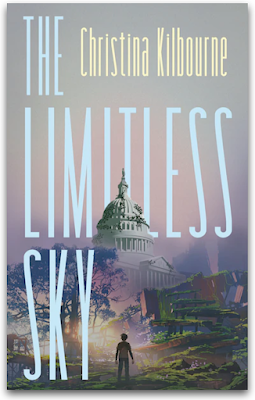
The Limitless Sky

Written by Christina Kilbourne
Dundurn
978-1-45974-887-3
384 pp.
Ages 12+
May 2022

They may be living in the same world, but Rook and Gage don't know it. 
 
Rook lives with her family in ArHK whose descendants, the Chosen Ones, had left the Outside hundreds of OT (Outside Time) years ago. In ArHK where she lives with her father and mother and young sister Sparrow in their pod on the Knowledge Level, one of four levels in ArHK, Rook is destined to be a Keeper, running the Archives and monitoring the Great Hall of Human Records, as is her family's heritage. 

Fifteen-year-old Gage lives with his parents, younger sister Brindle and dog Scruff in a yurt at a scouts' base camp. Organized by the Scholars, scouts have been going out for generations to find the Ship of Knowledge purportedly in the ancient city of Washington. When Chief Coil's map readers believe they are at the gateway to that city, Gage volunteers to join the scouting expedition as a Reader to assist his father and others in looking for artefacts and old structures that might reveal the ancients' knowledge of curing diseases, harnessing power and communication over vast distances.

During her regular assignments and exploratory days at the Archives, Rook delves into restricted files and starts piecing ArHK's history, much of which was buried by the Governors and for which her Grandmam had been exiled to the Growing Sector. Meanwhile, just as Rook is coming to some startling revelations, Gage is making his own discovery and one that will bring their two worlds together, even if at a distance.

Christina Kilbourne has not just created one new world; she has created two. Both are borne out of poisonous air, fires, floods and winds, with one world escaping into a newly-manufactured one and the other surviving in what is left behind. Though readers will be hopeful that the two worlds, those of Rook and Gage, will ultimately come together so that they might become whole again, Christina Kilbourne does not guarantee anything. She shows us alternatives of what our world might be like after climatic change has altered our landscapes and societies and offers an opportunity to see how power can corrupt, how progress can be a setback, and how inspiration may come from our youth. How limited our world is comes down to us.

Dystopian novels have always offered us a mix of angst and aspiration, and The Limitless Sky does just this. In a gritty read that will work for middle-grade readers as well as teens, The Limitless Sky begins a new story for a future that may or may not be. And, as this is first book in the potential trilogy, it's a future I'm looking forward to reading about.

April 08, 2022

West Coast Wild ABC

Written by Deborah Hodge
Illustrated by Karen Reczuch
Groundwood Books
978-1-773066219
26 pp.
Ages 0-3
May 2022
 
Concept books are valuable vehicles for teaching concepts like the alphabet. But most become dreary listings of themed objects, especially for the very young, that trudge through 26 letters without any heart or atmosphere.  Deborah Hodge and Karen Reczuch's West Coast Wild ABC does not belong with those humdrum tomes. This board book has substance in both the content of its words and art, being both relevant culturally, ecologically and geographically.

From West Coast Wild ABC by Deborah Hodge, illus. by Karen Reczuch

For children who live on the West Coast, West Coast Wild ABC will engage them with familiar words and images, taking them through natural landscapes of forests, shorelines and water. There are fish and eagles, sandpipers and whales. There are plants like huckleberries and kelp, weather of rain and sunshine, and geographical features like the Pacific Ocean and phenomena like tides.
From West Coast Wild ABC by Deborah Hodge, illus. by Karen Reczuch

And, with everything, there is activity. There is shimmering and clinging, roaring and stinging, swishing and drifting. Even with elements that are relatively static like plants, there is towering and ripening. Life is happening on the West Coast and Deborah Hodge has seen it and Karen Reczuch has illustrated it.
From West Coast Wild ABC by Deborah Hodge, illus. by Karen Reczuch
The collaboration between Deborah Hodge and Karen Reczuch has helped young readers across our country visit the Pacific coast in earlier books in the West Coast Wild series: West Coast Wild, West Coast Wild Babies, and West Coast Wild at Low Tide. As with the others, the landscape of the picture book is the West Coast but it goes beyond space and presents a strong STEM foundation in ecology. Living things and their relationships with their environment and each other are paramount, as is ensuring they remain healthy and flourishing, as evidenced by the life they display in West Coast Wild ABC. Deborah Hodge may use few words–only two or three for each letter except the concluding "z"–but she spotlights each letter appropriately for our youngest children. A noun and a verb is all it takes for each to represent the West Coast properly and teach the alphabet. Similarly, Karen Reczuch may have illustrated each alphabet letter's page with simplicity in mind of her audience but she gives us the detail and realism that takes us to those shores and into the water and forest. I didn't know what a velella velella was before West Coast Wild ABC but Karen Reczuch depicts the morphology of the sail jellyfish, as well as the quillback rockfish, cougar, xiphister and others, so well that it becomes recognizable, and, by giving each living thing context, from a nest or tidal, Karen Reczuch also gives teachers and parents the basis for STEM lessons.

If you live on the West Coast, then West Coast Wild ABC will be almost a guidebook for young children with a opportunity for learning the alphabet by making connections to home. And if you don't live on the Pacific side of our country, West Coast Wild ABC lets you visit vicariously and open discussions about new places and the similarities and differences that come with a rich diversity of environments.

April 05, 2022

The Red Palace

Written by June Hur
Feiwel and Friends
978-1-250-80055-8
336 pp.
Ages 13-18
January 2022
Revenge begets revenge; the anger is unquenchable. We become the monsters we are trying to punish. Justice, however, brings closure, and that is what I want. It can only be achieved by remaining sober-minded and rational. (pg. 173)
It is 1758, and eighteen-year-old Baek-hyeon is a nurse (uniyeo) at Changdeok Palace, a position for which she has worked tirelessly in her efforts to gain the attention of her biological father, Lord Shin, and appreciation of her mother, one of his oft-neglected concubines. But the palace is a place of spies, secrets, and worse, and Hyeon learns first-hand to keep her counsel when she and her friend Nurse Jieun and a royal physician are called to the Crown Prince's chambers to participate in a charade of caring for Prince Jangheon who is AWOL. But then the nurses are alerted to a massacre at the Hyeminseo, the public medical office where Hyeon had studied to become a nurse. Two student nurses, Head Nurse Heejin and Court Lady Ahnbi, who served Madam Mun, the King's concubine, have all been violently murdered and Hyeon's mentor, Nurse Jeongsu, is Commander Song's prime suspect.
 
Hyeon vows to prove Nurse Jeongsu's innocence, even as Commander Song endeavours to torture a confession from her. It seems someone else thinks the same, peppering the capital with handbills declaring the Crown Prince to be a murderer. Undertaking her own investigation, speaking with several nurses including Nurse Inyeong who'd reported the murders, with Royal Physician Khun who'd been seen arguing with Court Lady Ahnbi, and with Sulbi, a damo working for the police bureau, Hyeon forms an unlikely alliance with the young Police Inspector Seo whom she believes at first is only Eojin, a police servant. Together, the two young people work to uncover lies and truths, protect the innocent, thwart injustice and develop a relationship deemed socially improbable.

The Joseon dynasty which ruled Korea from the 1300s to the 1800s is not a familiar one for this reviewer or many readers. But June Hur skillfully takes us to this era and its society of classes ranging from royalty and the nobility to the cheonmin (vulgar commoners). It is a time when men kept concubines, sons were revered over daughters, and Confucian ideals were followed. From the clothing which marks the roles and status of many, like the nurse uniform of pale blue silk jacket and dark blue skirt and white apron with garima headpiece,  and meals of gukbap and sullungang, to naming protocols, June Hur makes us believe in this reality, with these people and these histories. Her "Author's Note" reveals the true history which she incorporated into her story but her characters and the mystery to be solved are all her own, intricate and vivid. As with her earlier books, The Silence of Bones (2020) and The Forest of Stolen Girls (2021), June Hur tells a story but readers do more than just absorb it. They become invested in it. Even as I learned of a different culture, I wanted justice for the honourable Hyeon, for the victims of violence, and for women who were limited by their birth. I wanted resolution. And, with tenderness, compassion and honesty to time and place, June Hur eloquently gives readers that.

March 30, 2022

Josie's Busy Calendar

Written by Jenn Wint
Illustrated by Allison Arndt
East 26th Publishing
978-1-955077323
42 pp.
Ages 3-7
October 2021
 
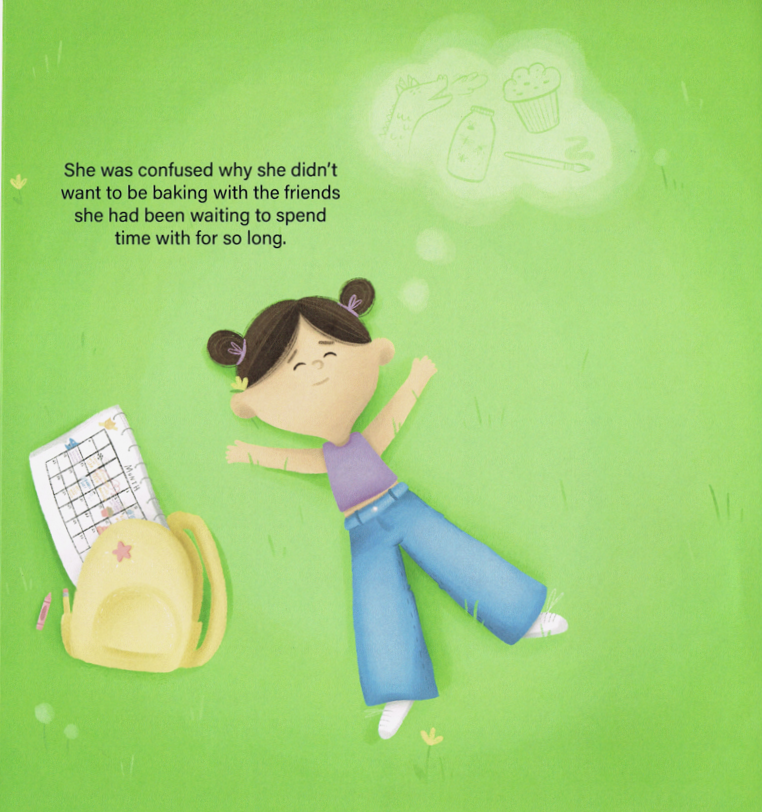
Like many children in Canada, Josie has had to endure the challenge of staying at home and away from school and friends and activities that have always added to her life. She has found many things to do, from creating art to running laps, watching TV to baking, but she misses her old life.
But, after weeks of playing on her own, Josie was officially lonely.
From Josie's Busy Calendar by Jenn Wint, illus. by Allison Arndt
But, then things open up again and Josie is able to return to school. The little girl is thrilled. Once she reconnects with her friends, she is filling her calendar with play dates for soccer and baking, riding bikes and swimming. But, like anything, too much of a good thing can be just as onerous, and Josie finds that "her tummy was in knots" though she doesn't understand why.
From Josie's Busy Calendar by Jenn Wint, illus. by Allison Arndt
Realizing that she misses her alone time, Josie schedules herself into that calendar and finds that a balance of commitments to others and herself is what makes her feel calm enough to do it all.
From Josie's Busy Calendar by Jenn Wint, illus. by Allison Arndt
Vancouver's Jenn Wint knows that, like adults such as herself, children experience anxiety but probably don't understand it, and coming out of this pandemic–fingers crossed–there will be many children who have and will experience anxiety to some degree. After years of restricted social activities–a source of anxiety for some–many children will go overboard and want to do everything: sports, music, play, etc. But, if Josie’s Busy Calendar teaches us anything it’s that there is always a limit. Too little opportunity for interaction and activity is just as bad as too much. Down time is also important. In fact, for many, it’s the only means by which they can recharge to do those activities in the first place. 
From Josie's Busy Calendar by Jenn Wint, illus. by Allison Arndt
With Allison Arndt's whimsical illustrations, Josie comes across as a typical child whose life is filled with people and activities but who has learned to appreciate quiet time, whether it's for reflection, for the clean fun of bubble baths or creating art. So, for your children and your students, consider that busy calendar as a potential source of both fatigue and fun and schedule in some time for quiet, whether to look inward with self-reflection or to daydream about what could be.

March 28, 2022

I'm Not Sydney!

Written and illustrated by Marie-Louise Gay
Groundwood Books
978-1-77306-597-7
40 pp.
Ages 3-6
March 2022
 
Why is Sydney not Sydney? It's because he's a sloth. And while his tree looks like a deciduous tree of Canada, the child imagines himself in the lushness of a tropical forest. As a sloth, he is happy to smile, sleep and daydream his days away, though his companion, Sami, scampering up the tree, sees herself as a spider monkey.
From I'm Not Sydney! by Marie-Louise Gay
As sloth and spider monkey enjoy their new personas, little Edward, ready for baseball, responds with the most charming of answers when they tell him of their exploits.
"Well, well," said Edward. "How about that?"
With that, he's down on all fours, his elephantine form disappearing into the tall grass of the savanna, feeling the sun, hearing the grasshoppers and smelling the grass and earth.
From I'm Not Sydney! by Marie-Louise Gay
Anamaria becomes an anteater and quiet Brigitte a bat and the quintet of friends play at make-believe animals until the elephant's trunk–or was that a water hose?–drenches them with water and laughter. They may return home when called for dinner by their parents but their imaginings carry them through their meals, bath time and sleep, with Brigitte even staying up, anticipating her flight into the night.
From I'm Not Sydney! by Marie-Louise Gay
Oh, to be a child with the freedom of play and imagination. For Sydney, Sami, Edward, Anamaria and Brigitte, a tree and meadow become the ground for creating a new world or two, and allows them the abandonment to visualize themselves as different in body and behaviour. They don't just pretend. They become. And Marie-Louise Gay lets us peek at them at their play, turning their realities into new worlds, as true as those in which they are called for dinner and given baths. Marie-Louise Gay, creator of the popular Stella and Sam and Princess Pistachio series, always, always, takes us to the heart of children's play of imagination, revealing both their innocence and sophistication in visualizing that which may not be there. In both words and art, she makes worlds resplendent in butterflies, caterpillars and birds among overgrown flora profuse with flowers with the children as stars in their own worlds, created or not. They are the gardeners of those daydreams, cultivating and nurturing life from whatever seeds are present. Whether those worlds last but a day or are ones they will revisit regularly is all up to them as well as the pen and watercolours of Marie-Louise Gay.
From I'm Not Sydney! by Marie-Louise Gay

March 26, 2022

A Soft Place to Fall

Written by Tanya Christenson
Red Deer Press
978-0-889956384
409 pp.
Ages 12+
January 2022
 

Out of suffering have emerged the strongest souls;
the most massive characters are seared with scars.
 
~ Kahlil Gibran 


Kahlil Gibran's words may end Tanya Christenson's debut novel, A Soft Place to Fall, but they work well as a preface to a story of struggles, challenges and loss from which triumphs emerge from the ordinary.

The story is told from the perspective of Creighton Fischer, a boy whose singing mom, Gracie Rae, left when he was just five, and whose father's work with the carnival has kept them moving for many years. When, after Creighton's Grade 7 year, Dad decides it's time for them to settle down, they move to Breton, Mom's old home town. Because of gaps in his learning and attendance, it is recommended that Creighton join an alternate school. There, under the compassionate and diverse teaching methods of Ms. Hayworth, Creighton becomes part of a unique cohort. The dozen or so students soon reveal themselves to be impacted by various traumas and disabilities but Ms. Hayworth's approach is to meet their needs and not slot them into the rigid curriculum. And by showing flexibility and empathy, she brings out the best in most of them. That is, except for Carlos a.k.a. Carcass. And for Creighton, he finds his first real friends in Carin, Ratchet and Schooner and the support system he and all of them need to brave the loss of loved ones, economic hardships, bullying, past traumas, criminal charges, and even love.

The twelve kids in Ms. Hayworth's class may attend L.O.S.E.R. (Lane Oslo School of Educational Reform) but they aren't losers. They may be flawed through trauma, mental health, disability or circumstances beyond their control but they are not losers. They are human. Their resilience may at times be shaky but it is undeniable and it thankfully allows them to persist.
 
BC's Tanya Christenson, a teacher and school counsellor, knows kids and she's written these kids as human as you and I. And she doesn't wrap up their struggles with happy endings, ribbons or balloons. Tanya Christenson makes their outcomes as real as the kids. They've suffered abandonment, abuse and upheaval, and they have endured. Sometimes they've triumphed over those struggles and  sometimes not, and like all of us, they have needed support and a soft place to fall. Because, after all, we will all fall some time, some way. I just hope that there will always be a soft place to fall, perhaps even land, for anyone challenged by life. And that's everyone.

March 22, 2022

The Gift of the Little People : A Six Seasons of the Asiniskaw Īthiniwak Story

Written by William Dumas
Illustrated by Rhian Brynjolson
HighWater Press
978-1-553799924
48 pp.
Ages 8-12
February 2022
 
While many of us are not fortunate enough to hear a storyteller like William Dumas share the tales of his oral storytelling tradition, illustrated books like The Gift of the Little People are an ideal method for getting those stories told and for providing the visuals that our own experiences might not be able to provide. With words and art together, The Gift of the Little People transports us to the northern Manitoba community of South Indian Lake to see how a legendary people gave the Rocky Cree the medicine they needed for healing.
From The Gift of the Little People by William Dumas, illus. by Rhian Brynjolson
The narrator recalls growing up in remote South Indian Lake and hearing the elders tell stories in the evening. These stories included those of the 3 kinds of little people who were no taller than our knees: those who were static-voiced (mīmīkwīsiwak); those who were troll-like; and those that looked like tiny human beings (apiscithinīwak).

One story he remembers his father telling was of a man named âhâsiw (the Crow) of the Rocky Cree who lived along the Misinippi river (now known as the Churchill River). When there were reports of new people coming into mistiwāsahak (Hudson's Bay) with many new tools and items for trade, a delegation was sent. Upon their return, after numerous favourable trades, a feast was held. But a few days later, several members of that delegation fell ill and then person after person within the band became sick and died. âhâsiw did all he could to heal them but he also prayed for help. And help comes one night in the form of a little man who tells him that the medicine was available but he could only reach it by going through a solid rock face across the lake.
From The Gift of the Little People by William Dumas, illus. by Rhian Brynjolson
Though the task that the little person had given âhâsiw and oskâpêwis (his helper) seemed impossible, it was the means by which the Rocky Cree are able to connect with the little people and help heal themselves.

From The Gift of the Little People by William Dumas, illus. by Rhian Brynjolson
The Gift of the Little People is a companion book to William Dumas's Six Seasons of the Asiniskaw Īthiniwak series which explores the language, culture, knowledge, territory, and history of the Rocky Cree (Asiniskaw Īthiniwak) people. The first book in the series Pīsim Finds Her Miskanaw (2020) will be joined by a second, Amō's Sapotawan, later this year. With The Gift of the Little People, author William Dumas shares much about the Rocky Cree from both a historical and spiritual perspective. From life in a remote location without electricity to the devastation of first contact with Europeans, The Gift of the Little People reveals life of the Rocky Cree and the traditions upon which they prevailed. But within that framework, William Dumas tells readers of the little people. Whether it is folklore based in legends or otherwise–there are countless claims of evidence that the little people exist–the folklore of how the little people came to the aid of the Rocky Cree people when illness resulted from first contact with Europeans is a story worth telling. It's about trusting unlikely allies and accepting challenges for good. And with the artwork of Manitoba visual artist and educator Rhian Brynjolson honouring the First Nations with both its realism and style, without misappropriation, The Gift of the Little People has more than one story to tell of the Rocky Cree and their history and culture.

Six Seasons of the Asiniskaw Īthiniwak series